Bioregulatory Medicine, The Marion Institute, and Cancer Recovery
Jul 24, 2023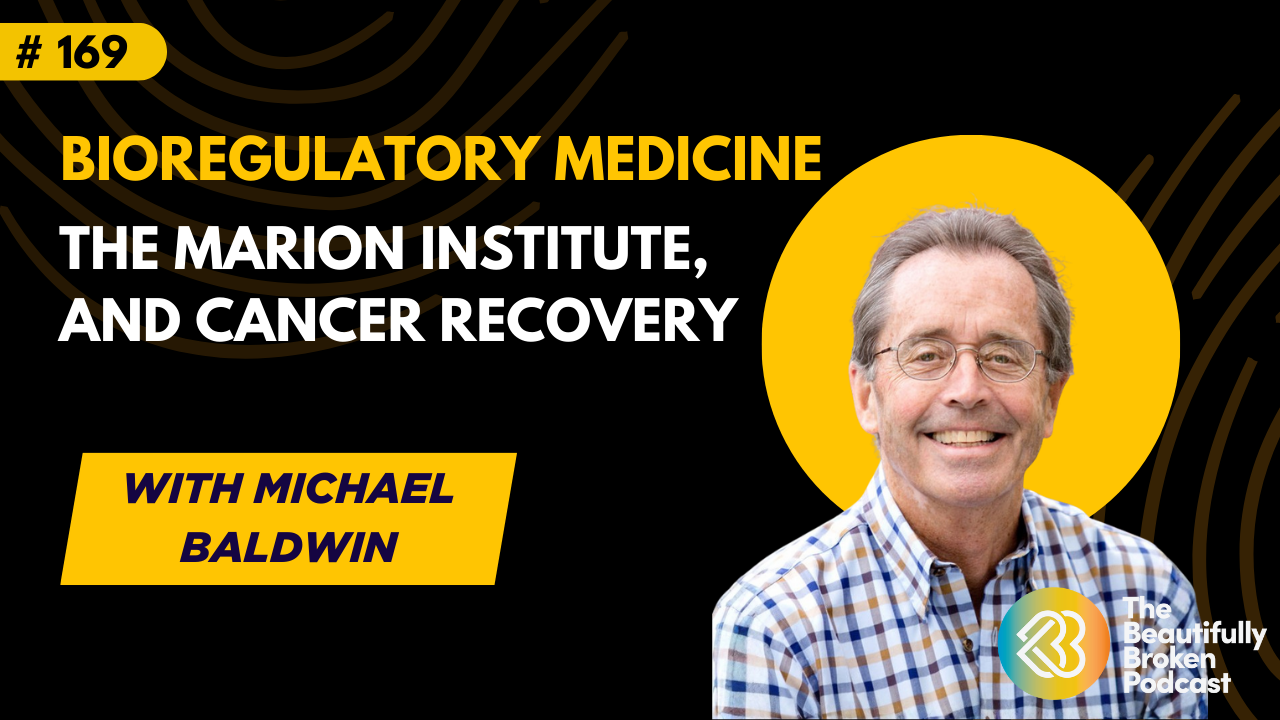
WELCOME TO EPISODE 169
A terminal illness is life-changing, to say the least. And it’s not just for the people who suffer from it—the loved ones that surround them are just as affected. When Michael Baldwin’s son was diagnosed with cancer, he led his non-profit to begin its foray into decades of action-oriented change in the name of health, sustainability, environmentalism, and spirituality.
Our guest today is Michael Baldwin, the founder and chairman of the Baldwin Brothers investment management firm, the visionary behind the Marion Institute, and co-founder of the BioMed Center New England. Through the Marion Institute, he has championed change on a global scale, with projects dedicated to accessible health and wellness, particularly in the field of Biological Medicine.
Throughout the episode, Michael shares his personal account of his son’s battle with cancer and the insights he gained from the transformative experience, offering a path forward with action when faced with life’s challenging circumstances. Tune in!


Episode Highlights
[00:00] Introduction
[03:35] The Story of Michael’s Son Contracting Leukemia and Biological Medicine
[13:40] Michael and Applying Biological Medicine in His Life
[18:15] The Marion Institute
[21:40] Why is Imparting the Knowledge of Biological Medicine Difficult?
[30:39] Scaling Biological Medicine to Public Recognition
[35:24] The Crisis of Emotional Toxicity
[37:13] Educating People on Biological Medicine
[43:18] On BioMed Centers and Clinics
[49:27] Personal Responsibility and Biological Medicine
[55:49] What Michael Would Tell the World if He Could
[57:10] Outro
UPGRADE YOUR WELLNESS
Silver Biotics Wound Healing Gel: https://bit.ly/3JnxyDD
Code: BEAUTIFULLYBROKEN
LightPathLED https://lightpathled.com/?afmc=BEAUTIFULLYBROKEN
Code: beautifullybroken
STEMREGEN: https://www.stemregen.co/products/stemregen/?afmc=beautifullybroken
Code: beautifullybroken
Flowpresso 3-in-1 technology: (https://calendly.com/freddiekimmel/flowpresso-one-on-one-discovery)
CONNECT WITH FREDDIE
Work with Me: https://www.beautifullybroken.world/biological-blueprint
Website and Store: (http://www.beautifullybroken.world)
Instagram: (https://www.instagram.com/beautifullybroken.world/)
YouTube: https://www.youtube.com/@freddiekimmel
FULL EPISODE INTERVIEW
EPISODE TRANSCRIPT
Freddie Kimmel (00:01.962)
Ladies and gentlemen, welcome to the beautifully broken podcast. I am here with a very special guest, Michael Baldwin. Welcome to the show.
Michael (00:11.091)
Thank you very much. Happy to be here.
Freddie Kimmel (00:13.586)
Now I'll read a little bit about you, Michael. I'm just going to say Michael is not just the founder and chairman of Baldwin Brothers, an investment management firm. He is also the founder of the Marion Institute, whose core mission is to drive and inspire change in the areas of health, healing, sustainability, education, and spirituality. You're also a Harvard grad. Congrats.
Michael (00:38.892)
Thank you.
Freddie Kimmel (00:39.522)
You're right.
Michael, we got connected through our good friend, Christine Isadionese, with our shared interest for health. And she was sharing with me that you have an incredible story around your relationship to not only the Marion Institute, but biological medicine.
Freddie Kimmel (01:02.114)
Take us there. What got you started and interested, inspired?
Michael (01:05.971)
OK, well, so I guess it means I'll talk about our son, who back in 93 came down with AML, a very, very serious form of leukemia. And he was on the cusp of 13 years of age. We picked him up at his camp in New Hampshire, raced him to Children's Hospital. Dana Farber went on a very special protocol,
complete waste. And happily, he was saved by a sister who was one of two people that were candidates for a six by six bone marrow transplant. Unfortunately, which is what can happen in leukemia, you can develop after the transplant confusion internally and you get these graft versus.
host diseases. And he developed something. I won't give you the name. It's too complicated. But he destroyed half his lungs in about seven weeks. And the children's in Dana Farber knew about this form of lung disease, but they couldn't do anything about it except to hit him with a ton of steroids just to arrest the decline.
And then they said to us, your son's going to have 50% of his lung capacity for the rest of his life. And I said, this is not acceptable. We've got to find something else. And I happened to read an interview with a Dr. Thomas Rau, who ran a clinic in Switzerland called Paracelsus. And I went over and sort of kicked the tires and was sort of startled that Dr. Rau, in his advice, didn't talk about minerals or
vitamins or sort of alternative health care. He just said, I would have thought you'd like to come here and then learn why your son got cancer, which I thought was rather stunning. Anyway, the point is Nathaniel went over there starting in 95 and two years later, he had 100% of his lung capacity. And so that set us on the road to really exposing as many people as we possibly could to biological medicine.
Freddie Kimmel (03:29.314)
Yeah.
Michael (03:29.851)
which is Rau's, not invention, but he tweaked it a lot and created a model that we're practicing now in our clinic in Providence.
Freddie Kimmel (03:40.99)
Yeah, it's, it's fascinating. That's an incredible story. And so your son is doing really good today. That's amazing. Now to, to delve into biological medicine, cause that's conversation, right? It's like, what is biological medicine? People are, most people are familiar with our typical allopathic model where we're treating usually the symptoms of disease. We're great at emergency medicine, a heart attack, a stroke. But if somebody falls in this, um,
Michael (03:45.955)
Yeah, he's fine. He's great. Absolutely great.
Michael (03:56.06)
Yep.
Freddie Kimmel (04:10.082)
homeostatic balance of being in a chronic condition or chronic loop in which there is no evolution of the disease, they really get stuck. And for me, that's where biological medicine really walks back. Preconception. So it's, it's if, if you couldn't take us, what has been your, your understanding, if you were to explain biological medicine to some
Michael (04:32.467)
Well, biological medicine, which you have to remind everybody, is science, scientific and logical. It's not woo-woo stuff. On the other hand, it does look at both the physical, the emotional, and the spiritual. But what it does is it gets to the root cause of an illness as opposed to what allopathic does so much of, which is what we call symptom suppression.
I've got a pain, I've got arthritis, I've got a heart condition. I take a pill, I take another pill. This, it gives me sort of instant gratification to suppress the manifestation of the problem, pain or otherwise, and that is the cure. Well, it's not a cure, it's just symptom suppression. So when you get into biological medicine, it is all oriented.
great deal behind the incredibly sophisticated diagnostics that go with it, all of which would be totally weird to anybody if I talk too much about it today, because it's so very different from allopathic. It's incredibly sophisticated. And the whole point of it is to show way in advance what's starting to weaken or go awry. So it's really oriented to preventative stuff.
And of course, it's also very oriented towards what the cells thrive on, which is oxygen and electrons. So there are just 15 to 20 therapies that we use at our clinic and also abroad, which are oriented pretty much towards introducing those two factors.
Freddie Kimmel (06:28.19)
Yeah, that's my language. I always, I always say healing is a story of electrons. That's what we're trying to, we're trying to add more energy with this idea that within the body, both the physical and the spiritual body, there is, there is a force directing this energy to heal. And when the almost, you can almost literally say when the light that the cell is emitting is dim, we don't have that extra electron spin. So it's fascinating that it does work like that. And there's brilliant cases.
Michael (06:30.62)
Yeah?
Freddie Kimmel (06:58.058)
I love my most simple case of this. I had a friend with a father who had a non-healing bed sore, a great big bed sore. What they had done, and they had worked at it for a year, all the creams, all the patches, all the bandaging, and they had taken a pulsed red light laser and they had just run it over and just given red light to the sore. It was like a week and it just closed up and healed. The body, it was quite a great example of the body really needed light.
Michael (07:27.491)
Yeah, yep. But the other thing is the whole silo approach and the whole one size fits all. So the silo approach is you never have anybody who's really coping with the whole body and whether the problem is heart or liver or kidney or arthritis or whatever it might be. So you go to the specialist. The specialist gives you a pill for your heart problem.
You go to the endocrinologist, you get another pill from the endocrinologist. Nobody is communicating. Nobody is sharing information and nobody is looking at the entire body to try to determine why these manifestations of dis-ease or imbalance is being generated. And, and of course Rao always used that wonderful metaphor of the disease barrel.
and we all have a disease barrel, it's constantly filling with toxicity and more so than ever today because of all the reasons we're aware of. And what you have to do is you've got to drain that barrel and you've got to build up your immune system. So for Nathaniel, he had 20 times the normal chemo, which is a poison as we all know. And even though it arrested and took care of his ANL,
We had to get rid of that poison and we had to build up his immune system, which was, of course, very much compromised by the chemo. So there are all these factors that come into play with respect to why does it work? And of course, it often, Freddy, takes, it's not instant gratification. And you also learn, you know,
Freddie Kimmel (09:12.319)
Yeah, it's.
Michael (09:21.555)
Did cancer start yesterday? Did arthritis start last week? No, it probably started 20, 30 years ago. So when you think, well, let's get rid of it within a week or two weeks, you gotta realize that it's gonna take sometimes a couple of years.
Freddie Kimmel (09:37.586)
Yeah. There's so many directions I could go here. Michael, I would love to hear when you went over and you took your son, cause you took your son overseas to peristalsis. Yes. Uh, how did, how, how was that experience for you when you were looking at all these things that were not what you were used to as far as, um, medicine.
Michael (09:48.815)
Right. Correct.
Freddie Kimmel (10:01.194)
Were you completely accepting of all the therapies and the different modalities? And what were some of the things that you did that you, that might sound outside of the box as somebody.
Michael (10:10.755)
Well, I think the biggest thing that happens in bio-med with cancer is Iscador, the mistletoe. Mistletoe is a huge anti-cancer biological medicine. So he had an enormous number of mistletoe shots up and down his back. But then he also did a great deal
with oxygen, with the generation of electrons. And there are all sorts of different ways in which these can be administered. And then, of course, IVs, particularly with ozone. And I mean, sure, it was all Greek to me, but what was I going to lose? I mean, people go, well, oh, gosh, are these things going to hurt me in some other way? Is there going to be some sort of fallout like
You know, if you take this pill, you're probably going to drop dead in the ads that you hear on TV. Everything you do in bio med is beneficial. It doesn't have poisonous side effects. So when you go in there with all this sort of choice of what you can do, whether it's a paracelsus or an R clinic, you just say, you almost don't care. Well, I think I'll do this and this and this today, and maybe.
Next month, I'll do that and that and that. And so the experience at Paracelsus was really fabulous people, fabulous Rao. I mean, he's an extraordinary man, Rao, because he has a sixth sense. And he really does, which is a very highly unusual thing, and not many doctors have it.
Freddie Kimmel (11:54.634)
Yeah.
Freddie Kimmel (12:01.714)
Yeah. How much biological medicine have you applied to your body and your life?
Michael (12:10.259)
100%. Now, I go to a GP because, you know, I'm 82 and, you know, things fall apart. You may have to rush to the hospital and you need to have a local GP. But from the point of view of maintenance of health and detoxing and building an immune system, I guess I go to the clinic in Providence every other week. So does my wife. Yeah. And then about every
Freddie Kimmel (12:35.142)
Okay. Wonderful.
Michael (12:39.095)
Once or twice a year, you do an upgrade as far as looking at the diagnostics again and seeing how things are going. I mean, it's a constant. You're not on this program for life. You're on this program to correct an imbalance that you've generated over the past years or whatever. And so you check in, all right, do I still need to take these supplements? Probably not. You may have something else you have to take.
Freddie Kimmel (13:08.446)
Yeah. And what are some of your favorite therapies that you're able to do at biomed center that you find are kind of fun and. Enjoyable.
Michael (13:15.675)
Well, there's something called a sound bed, which I lie on. It's a water bed, and it vibrates. And it's all the dials, the vibration for relaxation, the vibration for all sorts of different things, plus music. I then do a breathing of oxygen while I'm lying there. And then I have an electron coil that I lay on my chest.
Freddie Kimmel (13:20.619)
Mm-hmm.
Michael (13:45.499)
So I do three things at once and fall sound asleep. It's one of the best. Another one that's really unbelievable, which is incredibly important, is lymph drainage. And then, of course, in allopathic medicine, lymph drainage? What the hell's lymph drainage? But we have to realize how the toxins accumulate in the myriad of lymph nodes. And you've got to purge them.
Freddie Kimmel (13:50.329)
It's great.
Yeah.
Freddie Kimmel (13:58.487)
Mm-hmm.
Michael (14:13.991)
So there's a wonderful therapy called Flowpresso, which I do once a month at the center.
Freddie Kimmel (14:21.674)
Amazing. Yeah, very, very familiar.
Michael (14:22.915)
Yeah. And of course, you know, the other big thing, Freddie, which I'm sure you know and a lot of people know is the inclusion of the head, particularly the jaw, the teeth and an allopathic medicine. That's for dentistry. We don't deal with that with the GP. In allopathic, you've got to understand one of the beliefs they have is around the Chinese system of meridians.
and every tooth has a connection to something internally. And if you're not dealing with the tooth problem, and by the way, 70% of illness starts in the mouth. So you have to look at your amalgam fillings, you have to look at your root canals, you have to look at the jaw, I mean, it's highly sophisticated. And if there is...
they call a foci, in other words, influence, then you've got to deal with the tooth, which will then release the problem. And in paracelsus, one of the things they kept track of, very much so, was breast cancer, because it was so phenomenally successful in getting rid of the breast cancer. And in something like 94 or 5% of the breast cancer patients over a period of five years,
Freddie Kimmel (15:43.124)
Mm-hmm.
Michael (15:53.551)
tooth on the breast meridian was impacted.
And I mean, that just goes to show, biological medicine incorporates Chinese, Ayurvedic, Naturopathic, Herbal, Allopathic, Anthroposophical. I mean, it's the best of the best. They're all incorporated.
Freddie Kimmel (16:18.473)
Yeah.
Yeah, I found that fascinating. It's funny, I always tell people I had a, I started, they began a root canal on the side of my body where I had cancer. And it was just one of those things I've heard. So, and I ask people all the time, I'm like, have you ever had a root canal? What side of your body? If you look, there's this great poster that shows the circuitry.
The nerves that run up from the teeth up and around and attached to every single organ and it really is the teeth are almost like you could think of it like a circuit breaker in your house in which they're going to open up that energetic channel into that corresponding part of the body. It is the body. The body is wild. So Michael, given your experience with your son and your, um, the experience with Dr. Rao, what.
Michael (16:57.863)
Yeah.
Freddie Kimmel (17:10.166)
you came back to the United States and how did you get involved with Marian and what happened after that experience overseas?
Michael (17:18.327)
Well, the Marion Institute, which I created, I guess, sort of on a day, it was just sort of a quim. I mean, it wasn't even a quim. I'm sort of a voracious reader. I'm incurably curious. I read sometimes way too much. I get a New Yorker, I look at an article, I go, do I really need to read that article?
How is, you know, and I can't resist. The point is I shared a lot of information with an ever-growing audience. And then it started to become quite expensive. And I was hiring people to take care of it because I was running the investment advisory firm. And so then I thought, well, I better get a deduction. So I created the Marion Foundation in those days, now the Institute, hired a part-time executive director.
And anyway, a great deal of what we did in those days was learning about a whole host of different subjects, everything from paranormal to health to native traditions, business and transition. I mean, there was a whole host of interests. And we threw an enormous number of conferences and workshops. And it was a lot of sort of self-discovery work.
We did homotropic breath work, we did overtone chanting, we did past life regression work, I mean on and on and on. And when we got into Nathaniel and his illness, you know, I came back and I thought, listen, this navel gazing is great, and it is very helpful to people to understand more about themselves. But you've got to do something more than this.
And that triggered the first sort of outreach to educate and to expose as many people as possible to the merits of biological medicine. That's how it all sort of started. And we had many, many courses. And we had many, many practitioners come and learn from Rao and a couple of the other biomed doctors over the years.
Freddie Kimmel (19:30.184)
Mm-hmm.
Michael (19:46.756)
And it's a tough road. It's a tough road because it's such a 180. And now we're doing much more active stuff around health generally, but involves a great deal around food.
Freddie Kimmel (19:49.182)
Yeah, it is.
Freddie Kimmel (20:02.526)
Mm hmm. Yeah, it's it really is when you when you say it's a 180. It's a you got to let go of a lot of programming and a lot of ideas that you consider to be well, this is this is what it is. You know, you have the body, the body is injected with some type of bacteria and then disease forms. And this, it really is the education is a great is a great model for this because you really do need to be re educated on how the how the body
how the itself and then there's other and when we have these things like other like metals, what is the process of the body getting rid of mercury? It's fascinating and even with all I know, I'm just like eight hours into this intro to biological medicine and I've read Dr. Rowe's books back in the day when I went through Lyme disease and my cancer and I was always, I took it in but this course I started at Marion has a different level of, you get the backstory, you get the whys.
as opposed to not just do this because I've really, yeah, I've really, I've really enjoyed the process. What do you think, you know, what do you think if you had to say, what is, you said it's a tough road. What, what is the problem? Um, if we know, if you and I have this experience where we're like, when you look at the body as more wholism, we know it works. We know we can deliver better healing, more health. Um, why is it sometimes hard to get the message out there? Do you think?
Michael (21:31.055)
Well, I think it has a lot to do with habituation. I mean, we're so brainwashed about allopathic medicine as being the only way. And then it has a lot to do with fear. I mean, I see so many of our friends, particularly at our age, who come down with cancer and are going through the chemo process, which we don't.
So the scream at them or object, chemo, we've learned through our son, works. But then you just say, you do know it's a poison. You do know it's impacting your immune system. And we would suggest that you get down to the center, you detox because that poison sits around for a long time and is not being beneficial after its initial
use. And the other thing is, it's compromising your immune system. So build it up. And most of them say, well, I better get the permission from my doctor. And the doctor usually says, that's a bunch of crap. And we would suggest you don't try it. Even with something like the importance of vitamin C, which is huge, particularly in cancer.
Oh, no, no. It's probably too much. And it's going to hurt your gut. And I don't know. So I think it's just that people are fearful. They're brainwashed. And particularly when it's seriously serious, like cancer, of course they're scared. And you do hear great stories about the allopratic approach to cancer. So you think.
Freddie Kimmel (23:27.31)
course.
Michael (23:28.803)
I'm gonna go there and be my guest. I'm not gonna stop you. But I am gonna suggest that you wanna deal with the after effects.
Freddie Kimmel (23:40.702)
Yeah, I really like the both and conversation. I think most people can hear that in some way, but I understand what you're saying too. A lot of times when I'll speak to somebody and I get a lot of probably once or twice a week, I get up, Freddie, I know you went through cancer and all these surgeries, what do I do? Here's what I'm looking at. And I always say, I was like, well, listen, you're probably gonna do the standard of care if that resonates. And then look, there's all these other things that we can do to support the body.
That actually, like you said, I think the best point is that they do no harm. These aren't things that have adverse reactions. There are things that you know, you're going to feel it or you're not. So I'm, I'm such a huge proponent for understanding, but what's missing, what's missing in that scenario that I laid out. That person really needs a guide. And that's what I, I will often, I'm like, you gotta go talk to, you know, this person who is working there, the function area of their whole role.
Is to put all the pieces together because I can't tell you the pieces in a, in an Instagram message, it's actually, it's irresponsible of me to for say, Oh, go do this one therapy because it's, it's wholism. It's like everything involved. Um, yeah.
Michael (24:52.911)
So this is why, Freddie, one of the great problems for biomed also is, and there's a wonderful doctor in Boston who's picked up on Otto Warburg, whose understanding of cancer back in the 1920s is what now people are really gravitating towards. But when I talk to this doctor and say, I think you should take a look at biological medicine, well, he says.
I certainly will, but you've got to give me triple blind studies before I'm going to take any interest. And of course, you have to understand the worst thing you can say about biomed is one size fits all because in biomed, every single individual is unique. So you may have prostate cancer. I may have prostate cancer.
You are not going to get the same treatment that I'm going to get. There may be overlap, but you can't do double-blind, triple-blind studies, because everybody is going to be treated differently. And this is a really, really critical part of it. That's the whole examination of the individual from all these aspects of emotional and physical and spiritual, et cetera.
Freddie Kimmel (26:18.034)
Yeah, your constitutions, your temperaments, myasms. I had someone mention myasms to me like seven years ago, eight years ago. I was like, what is that crap? That's not real. And then you're like, oh, it does. There's actually like some even, there are some studies in PubMed about the initial myasms driving the science of homeopathy. It's really fascinating and it is helpful to understand, especially I found the constitution and the temperament. Like what my dietary temperament is gonna tell me about.
Michael (26:21.045)
Yeah.
Freddie Kimmel (26:46.73)
what foods cause cooling, what foods cause heat, and how that's going to affect any therapy that I would be engaging in. So why wouldn't you look at it?
Michael (26:55.771)
Yeah, and I mean, it's like all this new stuff that's going on with CTEs, childhood traumatic events. And this is a major, I mean, in fact, I wasn't too aware of it until this past weekend with Dr. Tom, who spent a whole morning on CTEs. And of course, it's not just the ones you remember your traumatic experiences or can be coaxed out of you, let's say, by a shrink.
Freddie Kimmel (27:03.511)
Yes.
Michael (27:23.899)
You've got to remember these traumatic events occur in utero, and they occur pre-utero. And so the other thing to remember is, you know, a divorce, you have twin children. A divorce for one of the twins may be traumatic. For the other twin, it's sort of a know who gives a hoot. So it's not so much the magnitude of the trauma from an external point of view, it's the way in which it's interpreted by the individuals who's impacted.
big. And I was unaware of all the science of the fallout from traumatic childhood events insofar as health is concerned. It's huge.
Freddie Kimmel (27:55.361)
Yeah.
Freddie Kimmel (28:06.738)
It's the, the figures on, uh, CTEs are incredible. If, if anybody's had a chance, there's a great podcast with Tim Ferris and Gabriela Mate in which he talks about his new book and I mean, he's, he's talked about this work for a long time, but the, the evidence of downstream chronic conditions, cancers, heart failures, it's it, the numbers it's, you know, again, it, they're there. It's impossible to deny. I want to go back to this.
the idea of this bio individuality that we all bring to the table. How does this, Michael, do you have a vision for how this could scale? Because you're imagining the system that we exist in now, which is so, we all know it's broken. I think most people would say, I have a general dissatisfaction with how I'm cared for. And if you've ever been through a chronic condition, then you really have that like, oh, this is broken. You're frustrated. But how does something like this scale?
Michael (29:08.935)
Well, I just watched the struggle we have with the Biomed Center in Providence, which is very definitely on a trajectory of interest and increased patience and increase and everything else. Greatly helped by, as you probably know, Christine.
Michael (29:34.543)
It's tough. I mean, if we get this center into sustainability, we will try to replicate it in different cities, is our intent. But I had no idea how difficult the challenge would be to get people to buy in. So it's not just that. It's the degree to which
the care absorbs time, particularly the whole diagnostic process. So if you go to the Biomed Center in Providence, you get three major sessions, an hour, 30 minutes, another hour or 30 minutes with a doctor. And that compared to what you get in allopathic, which is mostly with the nurse and then five minutes with the GP.
who's got to get you in and out in 15 minutes. This is a huge contrast. Now, you may pay a little more for our process, of course, because of the amount of time, but it also impedes the road to sustainability, so to speak. It's a big deal. And of course, the other thing, Freddie, which I think is so important, so often...
What you get in the way of patients coming into the center or going to Paris or wherever, desperate cases. The allopathic doctor has given up. We don't care what you want to do. Try anything you like. So in they come, fourth stage, whatever it might be. And it's tough. And what people have to, the biggest lesson is to try to make people understand how to avoid
Freddie Kimmel (31:03.402)
Yes.
Michael (31:25.235)
disease barrel spilling over into a chronic illness. So just because you feel great and your doctor GP is telling you, wow, like they do every time I have my annual physical, you're in fantastic shape. And I don't bother to say, little do you know, what's afoot within my body. But it's preventative is what you have to get into. And that's tough.
Freddie Kimmel (31:47.756)
Yeah.
Freddie Kimmel (31:53.376)
Yeah.
Michael (31:54.695)
Because people think, I feel great. Why do I need to do anything?
Freddie Kimmel (31:59.994)
Yeah, I do. As I'm, as I'm going through some of the educational modules, I'm, I'm imagining how powerful this would be as a. This, this, some of the information could be still down for a, for a course in public school. And so from a young age that kids would be learning about what the signals their bodies are giving them, because that was something I was never tapped into.
Michael (32:19.087)
Yeah.
Freddie Kimmel (32:29.146)
Intel, I had to be, you know, it was like you, you have diarrhea, you take an anti diarrhea medication to stop up your body. It's trying to let things out of your colon. You know, you, you have a headache, you suppress the inflammation with some type of a pain reliever where we're constantly numbing the voice and it's such a different way of thinking about it. And, and also like the, you know, the other example I really liked that Dr. Tom uses is the example of the tree and all four seasons.
that there's a time when it leaves, when there's a time when it will fruit, there's a time when it's barren. And so I look at the way we operate in the modern world and we're like always expected to fruit. You just got to put out, put out, put out, put out. You know, that's not honoring the laws of cyclical change in the world. And I, it's almost like we're looking to bypass disease. Well, of course you're sick.
Of course your hips are burning out, you know, whatever's coming. It's like we haven't honored the cycles of rest and restorative nature. And I think there's something there that people could hear if it was framed in the right way and get excited about.
Michael (33:37.199)
Yeah, I couldn't agree more. I couldn't agree more. And of course, he also uses that tree to show how everybody's focused on the trunk and the leaves and the branches and where you've got to go are into the root system. You've got to go subterranean. That gets you where everything is manifest. And it's a great metaphor or analogy. Yeah.
Freddie Kimmel (34:02.202)
Yeah, I do. I do think the other thing that I thought was so profound and that I am, I am a, I join with, I join with the Biomed Center and Dr. Tom and Marion Institute that, that emotional toxicity is one of the most voracious. And it's again, talk about a skillset you're just never, you're never given, right? Or, or it's, it's certainly not, it's, it's your
Michael (34:06.715)
Thank you.
Michael (34:16.487)
Alright.
Freddie Kimmel (34:27.442)
I just look at the way people chastise their kids in the grocery store when they're misbehaving. They're like, don't, no, stop, blah. You're like, wait, it's wild. It's wild, but we don't have any, there is no emotional intelligence, emotional vocabulary that we're taught in public school. I feel like that should be like year three for four. Learn all the words for feelings. Learn all the words for grief or sadness or elation or.
You know, we're just happy, angry, mad, sad, tired.
Michael (34:58.315)
Well, it's a real crisis. It's a real crisis as we're well aware, particularly amongst the teenagers and all with respect to suicide and depression and lost souls. It's very, very serious. And there's just so much garbage that we have to cope with, with the clickety-clickety-click and nobody talking and nobody dining together.
everybody off on their own little trajectory. And it's, it's also, I think, a crisis of narcissism. And we've lost, we've lost empathy. Because we're, we've become a world of narcissists. It's, it's, it's grim. It's grim. I mean, it's pretty grim.
Freddie Kimmel (35:45.406)
It's grim. It's grim. It's grim. But that's why we do podcasts like this, cause we're instilling hope and somebody's going to hear this episode and they're going to be interested enough to find their way down the path. They're going to look up Dr. Tom. They're going to look up Dr. Rao. They're going to look up the Marion Institute. They're going to look up the Biomed center in Providence, Rhode Island or Scottsdale, Arizona. And they're going to go, they're going to go poke around and they're going to go see, I'll tell you, I looked when I was really sick, it was like,
Michael (36:06.373)
Yeah.
Freddie Kimmel (36:14.73)
It was, I was like surgery number four, 2012. I looked up the biomed center in Arizona. And at the time I was balancing so many plates that financially I couldn't swing it and, and I, I would also say this. My hindsight, if I had to, I probably would have, you know, I was, I felt terrible and I was just like, man, nothing was working, wasn't getting any improvement. I was very much in the.
Michael (36:29.829)
Mm-hmm.
Freddie Kimmel (36:44.742)
I was, I had found functional medicine, which I often tell people is, is a, it's, it's a step up functional as a step up, but there's an assumption that with all the data's and numbers, you're going to get better information and somehow therein lie your lab results are going to be the answers between supplements and more drugs, which I mean, listen, I think there's value there, but if I'm really being honest with myself, the things that move the needle for me were the energetic tools. It was like,
the lights and the grounding and behavior and sleep, emotional intelligence, PEMF coils, amp coil was profound for me. All those things were really, and what I was doing without realizing it, I was just supporting all the way my system would naturally cover anyway.
Michael (37:32.143)
Well, that's great. I mean, we have this great challenge, because of course, there's no insurance. And that's my great next challenge. If I can get the center into sustainability, I've now got to go after the insurance companies to make them understand the obvious benefits of backing insurance for biomed, which is pretty
Freddie Kimmel (37:41.324)
Right?
Michael (38:01.075)
clear, but it's going to be an enormous hurdle. And that's why we have a scholarship fund at the center so that it doesn't have to be fairly affluent people who are the only candidates to come there. But then there is also a very sort of basic series of ingredients for what each of us can do, which is the kind of thing we're teaching.
planning to teach in all of the schools that we work with in New Bedford and Fall River, which are very poor communities. And they're the 10 things that Dr. Rao talks about that you might have read about. But none of them costs anything, really. So you do dry brushing for the lymph nodes. You raise the head of your bed three inches, which also helps to drain the lymph nodes.
Freddie Kimmel (38:47.947)
Yeah.
Michael (39:00.315)
You do much deeper breathing. You teach yourself to take bigger breaths, which if you keep doing it, you will breathe less shallowly. And the list goes on. I mean, of course, it includes you've got to go outside and bare feet and ground yourself because of the energy that comes up from the ground. You've got to meditate or have relaxation. I mean, and you've got another one is you got to have some fun.
every day. So that kind of what people would say, oh, that's so silly. I have no time for fun. I have no time to run out on my bare feet and think that something's happening to me from the earth. But then there are the practical things that, and there are 10 of them, and they don't cost a dime. So it's very important for us at the Marion Institute and also at the Center to make sure people become aware of that who really just can't afford to come.
Freddie Kimmel (39:57.566)
Yeah. I, and I think that is, um, that has the potential to make the most profound impact is finding that education at an early age, understanding the systems of the body, all the things that you do have. I don't want to say control, but you does have, you do have some influence over which makes a difference down the road, especially when you start adding up days, start adding up two years of those, the things you just mentioned, just lymphatics and
Michael (40:09.234)
Right.
Michael (40:19.876)
Well... Grrrr! Yeah, I mean...
Freddie Kimmel (40:25.782)
allowing the glymphatic system in the brain to drain. I mean, downstream decisions right there. It's like maybe we wouldn't do so many stupid things as teenagers. Maybe we probably would have, but.
Michael (40:36.015)
Yeah, well, I mean, it's generating beneficial habits. Boy, are they tough. It's learning to floss your GD teeth, which I find so boring. But new good habits. It's so akin to what we have to face in all these schools, these elementary schools. And
Freddie Kimmel (40:44.608)
Yes.
Michael (41:02.363)
New Bedford, of which there are 19, where the Marion Institute now has these gardens. And working with the children, working with the parents, working with the community. And they're all many different ethnicities and different sections, and understand about growing good organic food. These children don't even know what the beet is. What is this? I have no idea. Or a carrot.
And so it's basics that sometimes it's so stunning to figure out, oh my God, they don't have the knowledge. And that's why that kind of education, like you're suggesting, could be so important.
Freddie Kimmel (41:49.118)
Yeah. I think that's where it's at. I get that intuitive hit a lot. Um, and it is profound how those little shifts, you know, we assume we make the, I did this for a long time. I made the assumption that everybody was like this complicated case with like mold and Lyme disease and cancer. Like, like me, I was like, Oh, everybody, you know, cause I, that's who I was. That's the stories that I was listening to online. That's who I was surrounding myself with other people who couldn't get better.
And the reality is not everybody is to that stage or will be to that stage. So I think it's really important to pull back sometimes and look at, you know, wow, there are people who don't know about carrots. Like we can start thinking, you know, it's easy to be in your little echo chamber, especially in this level of high elite, like wellness, but like, oh, there's, because it's a great point, Michael. People don't know what a carrot is. That's a great spot to start whole foods, you know? Yeah.
Michael (42:43.675)
Yeah, yeah, totally, yeah.
Freddie Kimmel (42:49.546)
I love it. So the, my other question for you is, you know, when we look at, um, when we look at the, um, so we got biomed in Rhode Island, we got biomed in Scottsdale. Now you're associated with that center as well.
Michael (43:05.199)
Oh yeah, because Dr. Tom and Dr. Drobot are the two doctors out there. It's sort of interesting just to give you a quick sidebar on Dr. Tom. You know, he was the Dean of the school in Oregon. That's a naturopathic, very famous naturopathic college and a revered teacher, absolutely revered teacher. And his student, Dr. Drobot.
Freddie Kimmel (43:23.876)
Mm-hmm.
Michael (43:32.667)
persuaded him to come and join him in Scottsdale. And the reason Dr. Tom agreed is because he noticed with his student body, the goal was gradually morphing out of caregiving into greed. And he just decided, I'm not gonna do it. I don't want that kind of motivation.
to be what I'm rewarding with my education. And that's depressing.
Freddie Kimmel (44:05.462)
Yeah. Yeah, it is. And it's all it's wound in. It's all persuasive. It's wound into a lot of the stories that and I would say it in some layer of everybody's life, we're going to experience like these were truths, we're going to be able to unwind that from ourselves or we're not we're gonna get swept up in it. But it's really good. It's really good to be able to step back and like just see the field for a second.
Michael (44:11.963)
But sure is all pervasive.
Freddie Kimmel (44:35.21)
Now, how would you differ Rhode Island from Scottsdale, the two biomed centers?
Michael (44:41.595)
Well, and frankly, it differs from what's available overseas, too. I should quickly say the Paracelsus Clinic collapsed. Rao is not part of it, just for information purposes. Rao's created a new clinic, Sonnenberg Clinic. And then one of the other former doctors at Paracelsus, Ralph Ottmeyer, has his own clinic. Those are the two biggies in Switzerland.
Freddie Kimmel (44:47.043)
Mm-hmm.
Freddie Kimmel (44:56.83)
Right, people, if people go looking that up.
Freddie Kimmel (45:11.49)
Mm-hmm.
Michael (45:12.227)
Scottsdale is brilliant. It's smaller. And so we have a broader range of therapies. We have exactly the same diagnostics. And the other big element that we have is we have truly the state of the art dentistry with a brilliant, brilliant dentist. And it's like, you know, 22nd century. It's so advanced.
Freddie Kimmel (45:39.79)
Amazing.
Michael (45:40.091)
And you know, we have one of the two cone beams in Rhode Island where you get a vision, not just of the teeth, but the whole jaw. And that is a huge role. The jaw, the teeth, as we discussed. And that's truly the only difference. And Drobot comes every other month to our center and deals with his East Coast patients.
Freddie Kimmel (45:59.148)
Yeah.
Freddie Kimmel (46:11.038)
Yeah. So that's it.
Michael (46:11.999)
But that's it. That's it. And that's what's so sad. And, you know, I'll just say quickly, one of the things that was so depressing about all the education that we did with all of these practitioners, we constantly tried to get them to band together, to create a force, to create a committee or whatever that would bring more credibility to the movement, as it were. You couldn't do it.
Freddie Kimmel (46:40.022)
Yeah.
Michael (46:40.791)
Everybody said, oh, that was brilliant what Rao did or whomever did, but I really think I can do it better. So I'm going home to do my version. So there was no keenness to collaborate, to create a community of like-minded folks to promote something. And that was a major problem.
Freddie Kimmel (47:03.248)
Yeah. It wasn't ready. It wasn't ready for whatever reason to arise from the field yet. Yet.
Michael (47:03.501)
Anyway, tis what it is.
Michael (47:08.247)
I guess. Yeah. Well, that's a nice positive way to go. Yeah.
Freddie Kimmel (47:15.094)
Well, it's in that universal soup somewhere. I, I think it's fascinating. You know, when I would look back at, you know, going back to the, to the model of like, uh, sustainability or financial viability, I'm pretty sure. In Switzerland, if, if you were a citizen of Switzerland, wasn't, was, were those clinics, was that included in your being a entity of the country? Yeah. That's incredible.
Michael (47:39.419)
Well, in other words, being paid for. Yeah.
Freddie Kimmel (47:46.284)
That's awesome.
Michael (47:48.611)
Yeah. And as a patient, if you go over there, you're gonna blow it like 12 grand or more a week. I mean, it's expensive.
Freddie Kimmel (47:57.47)
Yeah. And you're not there for a week. You're there for.
Michael (48:01.423)
Well, you go for a week usually. That's what we always did. Sometimes with Nathaniel, we'd be there for two weeks. One little thing about Nathaniel. So he has a partial year abroad from his college, and it's India. He goes to India, and I say, look, Nathaniel, let's meet up at Paracelsus and have you have a checkup before you come home. So we meet up at Paracelsus. We start out on a Monday morning.
And you can see there's a little sort of a flutter by Rao and his assistant. Tuesday, it's more than a flutter. Wednesday, it's starting to look like panic. Thursday, it's my God, the leukemia is returning. And so, you know, okay, we ain't going home. We gotta stay around here. And they worked on them over the weekend and everything. And he reverted to health the following Monday, Tuesday, it showed.
things were working out. But Rao said to him, you cannot go back to India, Nathaniel. India is a place lacking groundedness, and that's you. And you're too much out of your body, and that place is gonna impact your health. So stay away from India. Never.
Freddie Kimmel (49:13.026)
Mmm.
Freddie Kimmel (49:23.618)
Did he go back? Oh my God.
Michael (49:30.133)
But it gives you this sort of, you know, some of the stuff that becomes a little woo-woo for people, but frankly, I think has a great deal of credibility.
Freddie Kimmel (49:36.904)
Yeah.
Freddie Kimmel (49:40.914)
Yeah, it's man, it's like, you know, these incredible tools, it's all in the, it's all about who, whose hands are wielding the information in the direction. I do like for the, for the most of, uh, for the most of my experience, especially with biological medicine, it really is like more of an empowerment and education, uh, learning about your body, you're making the decisions about what you're willing to do or not willing to do with a lot of these therapies.
Michael (49:50.172)
Yeah.
Freddie Kimmel (50:08.958)
A majority of it is lifestyle and, and the law it's on it's being on the road for it's a, it's like you said, it's not a weekend. It's like, this is, we're going to do this for life and in some aspect. Right.
Michael (50:19.687)
Yes, you have to take ownership. You have to take ownership of the healing process or the detoxing process. You can't just say, why didn't you call me and tell me to go do another IV with ozone? Wait a minute. Take it upon yourself to heal yourself with all these tools. Yeah?
Freddie Kimmel (50:34.622)
Yep. No. Yeah. So this, this is really interesting to me. I think this is, I think there's something here. So my doctor in Austin, um, has a great clinic in, in he would, he would say precision medicine, you know, there's elements of, of biologics and hyperbaric and
Freddie Kimmel (51:04.622)
great, great practice, um, Dasein health. And I've, I'm going to send you this podcast with this guy. He's a total game changer, rockstar naturopath, uh, nurse practitioner. He, uh, what I like is he structured his rent, like in his equipment by with a client, he figured out what clientele number that would be on a subscription model. So everybody pays every month, no matter what.
Michael (51:12.851)
Great, great.
Freddie Kimmel (51:33.118)
Right, you have a click like leasing a mid-range car. And then if you go in and get therapies, everything's super moderately priced. So I will tell you, it's the highest precision medicine I've ever done in my life at Design Health. And it's the most affordable. And I mean it. I pay a good chunk of change because I'm doing the elective stuff. I'm like, oh, I want to do a.
a ozone blood IV this week and I want to do a methylene blue and then I want to do a vitamin C. I want to do a Myers cocktail at the end of the month. I traveled a lot this month. Can I get three sessions in the hyperbaric chamber? I'm going to schedule for an ice bath and some red light therapy. But because a lot of those things that I mentioned, a lot of them are just included like the cold thermodynamic, the red light, the amp coils, compression therapy.
all those or like a hyperbaric chamber to atmosphere hard shell chambers. Like it's a $25 add-on, you know, because we're all paying. So there is like this, um, you know, there's like a community, a co-op.
Michael (52:46.235)
Yeah, yeah, well, you know, it's interesting, Freddie, because we discussed it yesterday in a meeting, just exactly what you're talking about. Christine brought it up.
Freddie Kimmel (52:53.942)
Yeah. And I think, I think, you know, especially with, obviously with better guidance and a better medical staff and a bigger staff and the dentistry and all those things, you can see at some point you're like, Oh, well, what is a reasonable amount to get everybody to pay provided you, you eliminate like colorectal cancer in your life and you eliminate your like last 20 years being debilitating arthritis. I'm like,
That's, I think that's where the mind shit shit. I get out of that. I probably won't. The mind shift comes from, right? Because you're like, all of a sudden you're seeing, you're seeing the long game and you're like, Oh, it's really not that expensive because what I'm getting on the other end is a quality of life that if I were ill, I'd be saying I'll pay anything for, I would do anything to have that health back.
Michael (53:46.547)
Well, you know, what Dick does, and when we, oh, it's so expensive, we can't afford it, we don't get any insurance. Dick says, now listen, gang, you have house insurance for emergencies. You don't get the roof redone. You don't get the pipes fixed. You don't get this. You don't get, you'd have to paint and pay for it. You have car insurance.
but it doesn't do the oil change. It doesn't give you new tires. It doesn't do blah, blah. What you do, what it does, it gets you emergency stuff. There's a fire that burns your house down. There's a car accident that destroys some of your car. And he says, you gotta look at this health creation maintenance model and realize that yes, you have health insurance, break the bone, you have...
a heart attack, whatever, but for the maintenance and restorative nature of biomed, pay for it for Christ's sakes. And it's a rather good analogy, it seems to me, because everybody does their house insurance, does the car insurance, and they have their health insurance. But if you go beyond the emergency stuff, wait a minute, wait a minute, I'm not getting reimbursed. Anyway.
Freddie Kimmel (55:11.294)
Yeah. It's the conversation to have. And again, we know, you know, we don't, the thing is, it's like the therapies and the modalities to add oxygen, electron, mental, emotional balance. We got a lot of good therapies out there. It's, it's really like the, how are you applying? How are you getting access? How are you educating around these? How do they come into the fold that
Michael (55:14.952)
Yeah.
Freddie Kimmel (55:37.77)
you know, whatever it is, it's just this community model. It's a co-op of medicine. But that is, you know, that's really the conversation. The other thing is like, you know, when you have a systemic infection, you do not need a band-aid. You gotta look at the whole picture. We gotta go back to the drawing board on a lot of this stuff. And I just think it, I haven't necessarily seen it happen, you know, but I do like the conversation. I am excited about it.
Michael (55:51.4)
Mm-hmm.
Freddie Kimmel (56:08.082)
I was just at the Upgrade Conference in Orlando with our friend Christine and our friend Desiree from Flowpresso. And everybody was like, how was it for you? What was the thing? And I was like, you know, it's all a bit much. Like I just feel, I feel overwhelmed. I'm like all the, and it's fun to be there, this great community, all the toys, all the gadgets. I'm like this whole event, and I mean this with the best amount of love, is so problematic.
Michael (56:10.824)
Mm-hmm.
Michael (56:25.968)
Yeah.
Freddie Kimmel (56:36.95)
Cause if you were to walk into this store, it's like a kid in a candy store and you're like, Oh my God, I need this. I want this. It needs, um, it needs a container in which people understand the when and the where and how, and that doesn't, I don't see that yet. I know people are selling systems like that. I haven't seen one for me. I think the languaging around biological medicine makes the most sense to be applied to these tools to date. Anyway.
Michael (56:40.226)
Yeah, yeah, yeah.
Freddie Kimmel (57:05.002)
That's my, that's my Ted talk. Michael, it's been a pleasure talking and speaking and connecting and getting to know you. I is, is there anything else? Is there anything else? Let me, let me do this. You get a magic wand. You're going to like tune all the televisions and all the smartphones to your channel. You get to speak to everybody on planet earth for a minute. What would you tell people?
Michael (57:07.411)
Okay, very good, excellent.
Michael (57:16.275)
Thank you. Me too.
Michael (57:35.844)
I would tell him to wake up.
Just briefly, two of my brothers and I are working on something called the great relearning, which is trying to make us all understand the degree of misinformation, lies, falsehoods that are permeating everywhere. And they've got to be challenged. And they've got to deal with the fear about stepping out and beyond.
so much of that crap. And this is just, you know, you can be disappointed with your allopathic approach for so many reasons. But do something about it. Inquire, study, search. And that's something that's really lacking today. People are not capable of exploring and learning anymore. They don't read. Anyway.
That's it.
Freddie Kimmel (58:40.814)
Stay curious, search, read, ask better questions if you want a better life. That's what I'm hearing.
Michael (58:42.551)
Yeah, yeah, right, right. Yep. Okay.
Freddie Kimmel (58:49.874)
I love it. Well, it's been a treat on my end and we're going to talk more.
Michael (58:52.643)
and for Maine.
Freddie Kimmel (58:57.699)
Yes, big love. Bye.