Craniosacral Fascial Therapy: The Missing Link in Chronic Pain & Chronic Illness
Dec 22, 2025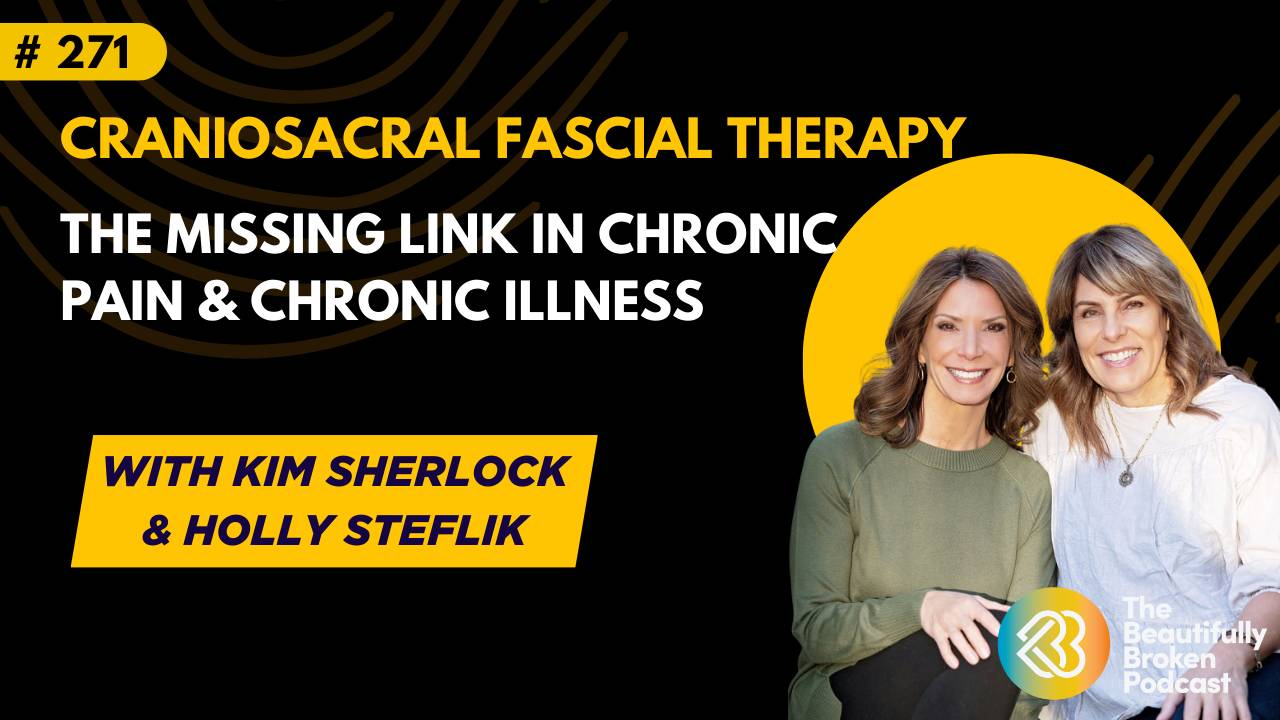
WELCOME TO EPISODE 271
Welcome back to Beautifully Broken, where healing meets high performance. Today’s conversation is with Kim and Holly from CFT Global, the leaders carrying forward Craniosacral Fascial Therapy, a modality that blends craniosacral therapy, myofascial release, and oral-structural work into one unified system.
We explore why fascia is not just connective tissue, but an intelligent communication network that holds tension, trauma, and adaptation patterns. From infants struggling after birth, to adults with migraines, brain fog, concussions, and chronic stress, CFT works by restoring movement—movement of the cranial bones, movement of cerebrospinal fluid, and movement of the nervous system back toward safety.
What struck me most is this: CFT doesn’t force the body to heal. It listens. By following the body’s innate wisdom, the nervous system shifts into parasympathetic regulation, allowing digestion, detoxification, emotional processing, and cognition to improve naturally. This episode is a deep dive into why healing is not about doing more, but about creating the conditions where the body can finally do what it already knows how to do.


Episode Highlights
[00:00] – Craniosynostosis, infant skulls, and why cranial plates must move for brain growth
[02:16] – What Craniosacral Fascial Therapy actually is (and how it’s different from CST)
[04:11] – Cognitive clarity, emotional shifts, and whole-body effects of fascial release
[06:34] – The origins of CFT: osteopathy, myofascial release, and oral structures
[08:29] – Why head pressure persists even when labs “look normal”
[10:12] – Tongue ties, airway dysfunction, and the overlooked craniodental system
[13:29] – Weston Price, epigenetics, and how modern environments reshape facial structure
[17:27] – Why releasing a tongue tie without bodywork can create new problems
[23:10] – Are cranial bones really fused? Debunking a long-held medical myth
[25:48] – Understanding the “brain cycle” and what zero brain motion means
[31:23] – Vagus nerve regulation and parasympathetic healing through CFT
[39:41] – Fascia as an organ system and what dissection reveals about the body
[41:36] – Adhesions, scars, and how gentle work restores visceral movement
[47:26] – Concussions, CTE, and why unresolved cranial strain matters long-term
[50:57] – Why CFT is still unknown—and why that’s starting to change
[01:01:36] – Emotional releases, stored trauma, and the body’s ability to unwind
[01:04:34] – What infants teach us about nervous system regulation (no placebo required)
Links & Resources
CFT Global Website & Trainings: https://craniosacralfascialtherapy.com
Kim and Holly’s Instagram: @cftgillespieapproach
Beam Minerals: http://beamminerals.com/beautifullybroken
— Code: BEAUTIFULLYBROKEN
Silver Biotics: bit.ly/3JnxyDD
— 30% off with Code: BEAUTIFULLYBROKEN
LightPathLED: https://lightpathled.pxf.io/c/3438432/2059835/25794
— Code: beautifullybroken
CathcBio https://www.catchbio.com/beautifullybroken
— Code: beautifullybroken
StemRegn: https://www.stemregen.co/products/release?_ef_transaction_id=&affid=52&oid=1
— Code: beautifullybroken
CONNECT WITH FREDDIE
Work with Me: https://www.beautifullybroken.world/biological-blueprint
Website and Store: (http://www.beautifullybroken.world)
Instagram: (https://www.instagram.com/beautifullybroken.world/)
YouTube: https://www.youtube.com/@freddiekimmel
FULL EPISODE INTERVIEW
EPISODE TRANSCRIPT
Freddie Kimmel (00:01.382)
Ladies and gentlemen, welcome to the beautifully broken podcast. We're back for another episode with Kim and Holly from CFT Global. Welcome to the show this morning, ladies.
Holly Steflik (00:13.368)
Thanks, Freddie.
Kim Sherlock (00:14.461)
Thanks, Freddie. It's great to be here with you.
Freddie Kimmel (00:17.572)
It is now I am, I'm nervous about this dynamic. Not only are we in three different locations around the, around the world, but I rarely have three people on the podcast. So I'm really excited. This is maybe like one other time I've tried to do it. Yeah. Yeah. So
Holly Steflik (00:32.59)
Wow. Well, we're a team, so we're pretty much always interviewing together.
Freddie Kimmel (00:39.838)
I love it. love it. Ken, if we bumped into each other in Whole Foods and you were telling me a little bit about your work, what would you say you do?
Kim Sherlock (00:52.925)
Well, that's the real quick version. So I would say I practice craniosacral fascial therapy and they would go, you would say, huh, what's that? And then I would explain it's a type of very gentle body work. So I'm working with the fascia in your body. I might ask you if you know what fascia is and the craniosacral system. So basically helping your body and your brain release any tension, any tightness.
so that your brain can work more optimally and your body can be freed from any tension.
Freddie Kimmel (01:27.9)
Yeah. Yeah, that's, that's been my experience. It's exactly what I would say after our time together in Austin, that for like four days, I felt like the smartest man alive. I just felt like everything was so clear. And in the, the, in the sessions that I've had with, with one of our, our, our co-friends, our shared friends, Corindy, that I called her afterwards and it was just literally working on zoom. She was prompting me to do things.
Kim Sherlock (01:39.729)
Yeah.
Holly Steflik (01:49.496)
Thank
Freddie Kimmel (01:57.758)
And I was like, I had the best day. It was no downtime. Didn't have that lull where your brain starts to really slow down midday. It was really, really incredible. Where is, because there is craniosacral and there's also practitioners who work with the fascia. How would you say this therapy or this modality or this parameter is unique?
Holly Steflik (02:22.904)
Yeah, well, it's two separate modalities put into one system. So we're always working within the craniosacral therapy, which is the brain, the cerebral spinal fluid, all the cranial nerves, and of course then the fascia that wraps around all of that. And then we were out in the fascial system and that's all the connective tissue in the body.
you know, that surrounds every organ, endocrine, body part, all the tendons and ligaments, all of its connective tissue. And we're asking where, you know, there's fascial strain. And that's kind of the difference between CFT and CST is that we are bringing in the fascial web and the fascial system. So what we find is that if there's a lot of fascial strain in the body, then it will override the craniosacral system. So just doing craniosacral therapy,
won't get the job done, we have to release the fascial strain that's pulling into that system.
Freddie Kimmel (03:24.294)
Yeah, I would, I would offer my experience in that I've had also these cognitive shifts and this, it could be jaw tension. could be elements of, I literally could feel happier when someone might work on the sacrum or the bottoms of the feet. Like there is a systemic impact and not just working on the head. What is the, what is the background? Like who put this together? When did it start?
Kim Sherlock (03:55.751)
So the founder of this work is Dr. Barry Gillespie. And in the 1970s, he was a periodontist up in the New England area, and he had a lot of his own health issues. So he was experiencing headaches and TMJ. As a kid, he was very sickly. He had asthma. He was on a lot of antibiotics, a lot of penicillin. So he started to look for his own health and went around to all the medical centers and nobody.
could really tell him what was wrong. They just chalked it up to stress, you're a young father, know, dental practice. But he went to some chiropractors and they told him something he had not heard before was that his cranial bones were restricted. And so they were doing cranial osteopathy with him and he was feeling great relief. So he started to study with the osteopaths. So that's really where it's rooted. And he took it back into his practice. He started to see great things happening for his patients.
And he decided that this was going to be his path. As a dentist, he really couldn't practice full body. He moved back into the Philadelphia area where his wife was from and he started to practice with John Barnes. I don't know if you know who he is, but he's kind of the godfather of myofascial release. And together, while he was working in his center, he started to see some of the similar type of unwinding that he was getting.
doing the cranial osteopathy. And he came across a study that stated that cerebrospina fluid was found out in the fascia. So that was his light bulb moment where he said, this isn't just about the central nervous system, brain, spine, sacrum. The fluid is going out into the fascia, therefore it's all one system, craniosacral fascial system. So he took what he learned from the osteopaths, what he learned in myofascial release, and then he also introduced all the oral structure.
work that we do because of his background in dentistry and being a periodontist. And so that's kind of the three-prong approach. There's so much found in the oral structures with the tongue, oral facial muscles that are also involved in a lot of these conditions that we see, and no one is looking at that.
Freddie Kimmel (06:09.958)
Yeah, truly. It ties a lot of things in together for me. And I'll just throw this out there earlier on in the show is that I've really, and I just have this intuitive hit that this community that struggles with biotoxin illness and Lyme and mold, this is a piece where we can be so close to a breakthrough moment where we may have a good
therapeutic for your burden of viral load, we may have a detoxification strategy like lymphatic drainage, but there is this piece to having the fascia and the cerebral spinal fluid start to alleviate the pressure in the head. And so we can have this moment of like, clarity. And for me giving somebody like, an evidentiary moment of like, my god, my body can do it.
Holly Steflik (07:02.424)
you
Freddie Kimmel (07:05.01)
You really create, you fan that fire of hope. Like for me, there was a couple times when I've done this, I'm like, how can this be this impactful? That is a big thing that I hear long after people say, my labs are normal, my viral load's going down, the permeability of my gut's getting better. I still have this terrible head pressure. Very, very common feedback. Do you wanna add?
Kim Sherlock (07:31.527)
Yeah, we often, well, we kept hearing from people over the years, you why don't we know about this? This is the missing piece. This has been the missing piece. And so it's kind of our tagline now, but it's what we truly believe is that by adding in CFT to all of the other great things that you're doing, it may just be that piece that helps you amplify your healing and open up the possibilities from there. So whatever it is that you're doing,
all of the therapies that you mentioned, you add in, you know, chiropractic, then, you know, we're, we're big in the OT world and the PT world. It just amplifies all of that work, right? Because now your system is open. Cerebrospinal fluid is flowing with the detox that you mentioned. That is, that is about detox. Our cerebral spinal fluid is what helps clear our brain at night when we're sleeping. So.
Freddie Kimmel (08:12.445)
Yeah.
Kim Sherlock (08:28.381)
You know, we need that open and flowing and it needs the room to move.
Freddie Kimmel (08:33.532)
Yeah, so tell me, why does that specifically like the base of the neck, the asapa, different areas on the temporal lobes, why do they get restricted? Why does that tightening over time that causes this, you know, lack of functionality?
Holly Steflik (08:51.544)
Well, I mean, we can go back to fetal life. So we're starting with fascial strain from fetal life or being in a small place for a long period of time. Then there's birth trauma that happens along the way. There's accidents, injuries, surgeries. And then of course, there's all of the conditions that go along with the cranial dental system. So as we start to stack up those things over time and become an adult, we've probably had
you know, teeth pulled, our wisdom teeth pulled, we might've had expansion, we might've had braces, cavities, root canals, veneers, all of those things are part of this craniodental system. And so the whole fascial web is part of that. And there's just so many conditions that are happening up here and nobody's looking at this. we, you know, in the last, I'd say five to eight years, we really beefed up that
that piece of it. It's the whole, you know, first morning, morning time of the third day where we're doing the oral structures, because we find that so many conditions that are end stage disease conditions come from the dysregulation of the nervous system and all the tightness in the cranial dental system, clenching and grinding, airway. So I'm sure that airway is a big thing in your world now and it's kind of
It's kind of like that what's out there. There's so many of those, you know, practitioners out there now, which 10 years ago when we used to, you know, ask, does anybody know what a tongue tie is? Nobody, you know, nobody in the room raised their hand. So it's just come a long way into kind of really seeing end stage disease through the lens of strain in the whole cranial dental system. And it just, it's just a cruise over time.
Freddie Kimmel (10:44.582)
Yeah. I want to talk about independently. I want to talk about the craniosacral side and the fascia side, but can you tell the audience what a tongue tie is?
Holly Steflik (10:55.47)
Well, we have fascia in our oral structures. We have kind of seven places that we can have these connections. So we can have it underneath the tongue. We all have a frenulum there. And then we all have a piece of fascia that connects here. Sometimes we have some on the side, some down here. So we have seven total frenulum. And if they're too short and too tight, and for the tongue, if it's too far forward,
Freddie Kimmel (11:06.685)
Mm-hmm.
Holly Steflik (11:23.266)
then we have restriction in how the tongue can work. And if the tongue, as we know, is supposed to be on the roof of the mouth, front, middle, and back, then we have, like from the very beginning, a good suck, swallow, breathe as an infant. And if we have restriction in that from the very beginning, then we learn to compensate with all of the other orophacial muscles in order to feed ourselves as infants. And then that just moves forward into all the dysfunction that happens, you know, with...
with going forward. So we see a lot of conditions that are tied back to a tongue tie. And we see it all the time in our trainings with these adults that have no idea. And they've been to the specialist for TMJ and the person for the chiropractor and migraines and anxiety and depression and high blood pressure. And we could see across the room, like the dysfunction here, and nobody's ever helped him with that.
So this is a lot of times the education and the missing piece that they find for starting to move forward and making corrections with all that.
Freddie Kimmel (12:28.318)
Can we take that one layer deeper and you know, this idea or a concept that like we were not nature didn't design us flawed, but we're seeing people come in to the world and having more and more chronic patterns, chronic dysfunction, chronic disease. And so what is shifting as far as this design of the palette and the mouth and the, the facial structures.
that it's becoming more of an issue over time. At least that's my interpretation.
Holly Steflik (13:02.818)
Well, I think part of that's true. I do think it's been there for the last hundred years, but I do think things are changing. As you know, Weston Price did all of that research. know who he is? He is a dentist back in the 30s and 40s who did all this research. And basically he found in the populations that he was photographing and studying that, you know, people had pretty wide palates. They didn't have dental decay, carry. They, you know, they had like very symmetrical faces.
Freddie Kimmel (13:13.138)
Yes.
Holly Steflik (13:29.41)
And it was because they were eating a local indigenous diet. then so over the years, our diet has changed. Of course, it's just become so compromised with all of the toxins. So epigenetically, I think that we are changing because of our environment and because of the toxic load that we have. You know, a lot of the things that exist now that we are battling to keep out of our systems we didn't have back then. So I think genetically,
they're being, our genes are being influenced by our epigenetics and like the nutrition is such crap, you know, even when you're trying so hard, you know, to, there's just like, there's nothing you can eat. You, find, you know, something like, this electrolyte and then, you know, two months later, they're like, no, that one's no good anymore. It's totally toxic. So it's just, it's hard, you know, like to find really clean sourced, you know, food.
Freddie Kimmel (14:24.294)
Yeah, it really is challenging. mean, I'll even use myself as an example. I should know, I should know all the things to do. And I'm pretty, I'm a very compliant person, but I have found times where I have like, followed my bias down a rabbit hole and I'm like, I'm basically nutrient deficient. Like I'll be taking too long of a window in the morning without food.
I'll be running on my adrenals have had a kickstart just from coffee. And then I'll have a very, maybe it's like, you you have lack of fiber or nutrient density or, and then you see it show up in your labs and you know, maybe, or, or it's something like your bile flow has been restricted from surgery. So you need that extra digestive support to break down the fats. It's like, sometimes it's an intake issue.
And then another time it's a terrain issue and where it's like, don't have the raw materials to process the food for the micronutrients. So I really do empathize with everybody right now. It's a real tough time to just understand like who to listen to, what's right, what is the science? You you have this like via vegan, via carnivore, you know, probably somewhere in the middle. I can, I always listening to people and like, that's interesting. You know, this piece of like, my autoimmunity is gone.
Kim Sherlock (15:35.559)
Yeah.
Freddie Kimmel (15:49.181)
I don't have IBS anymore just from eating meat. But on a longer timeline, it's like, I'm not always concerned about the symptoms of the body. It's like, well, if we have just as many microbes as we do human cells, and you're going to crush the diversity of that population because you're not feeding them anymore. And the microbes are what are making your B vitamins and your micronutrients. Tell me what happens in 20 years. So we just don't know with a lot of these theories right now, but it is tough to make sense of it all sometimes.
not to go down that, that dietary rabbit hole. I don't know if you want to add anything there, Kim, to that.
Holly Steflik (16:25.826)
Well, I just want to say one more thing. We're so disconnected from nature. So we're not out in biology. We're not mixing our microbiomes out with, you know, nature. And that's how we populate, you know, our microbiome is by all of that. And we're living in boxes.
Freddie Kimmel (16:41.852)
Yeah. Boxes with hand sanitizer.
Kim Sherlock (16:45.297)
yeah. The other piece to the tongue that we're talking about, in utero, know, our baby should, the baby starts swallowing maybe around 12 weeks. So we're already starting that motion of tongue, which should be hitting the roof of the mouth, hitting the roof of the mouth. So we swallow 1500 times a day and that force can help us create a wide palate.
So if baby isn't doing that in utero, we look at, why is that? And there's a theory that if mom is mouth breathing, she's not getting proper quality oxygen for baby. So the baby may not have enough activity where they're swallowing as much, hitting the roof of that mouth and forming that nice wide palate. So, you know, that's something else we have to be looking at. We work with a lot of moms pre-pregnancy, during pregnancy, and then we work with their infants.
Freddie Kimmel (17:29.211)
Hmm.
Kim Sherlock (17:41.574)
and explaining to them the importance of them getting the proper nasal breathing going, especially while they're pregnant. So, and I also just want to be clear that CFT does not release any type of ties. So if you have a true tie, then we're going to work with airway center dentists if you choose to have a release. But what CFT does is it goes in and it cleans up any tightness around that tie because there's tightness and there's restriction.
that just comes as a result of that. So we're helping kind of, it's almost like we're sculpting it away. We're helping that tongue lift so that we can see the frenulum. It's not the whole floor of the mouth coming up, all of that tightness. And then we're working with the team and infants. We're working with lactation, airway center dentists who are doing pediatric phrenectomies all day long. excuse me. And then at older people, we may bring in myofunctional therapy, speech, different types of
You know, so it's a piece of the puzzle, but we think it's a very important piece. When we see people who just go get a release without the bodywork, particularly CFT, it's not a great outcome. When they do everything right, it's a beautiful outcome. And I've been in those phrenectomies and I've seen them and they go extraordinarily well.
Freddie Kimmel (19:01.766)
Yeah. Yeah. I, I, I know people that have just went for the, the tongue tie cut and like all of sudden they had like drop foot and like a bad hip and all systemic issues going down the body. Yeah. It's pretty wild. I, from my music theater days, you know, there was, I think I told you the story in the training that there was one.
Kim Sherlock (19:09.265)
Don't do it. Don't do it. Yeah.
Kim Sherlock (19:14.097)
Mm-hmm. Mm-hmm. Mm-hmm.
Freddie Kimmel (19:30.142)
role that I did when I had a very strong affect, was Cagney the musical and I was playing standby for James Cagney and my jaw, like, I mean, it was like a knife stabbing at the end because I was sort of talking out of the side of my mouth and, and it wouldn't go away. And so I'd go to a PT and my PT would get in the rubber gloves and he would just grind in my mouth. And it was like so painful. However, I would have like four days.
Kim Sherlock (19:34.843)
Yeah.
Freddie Kimmel (20:00.409)
ish of really no pain, but my voice opened up. This is what the really I was like, cause I'm a pretty good tenor and I would have like bees and effortlessly nothing was holding it back. And I've always said that there's I've not really figured this out. I've had a couple of voice teachers who would be like, you know, they would do a clasp on the hyoid.
Holly Steflik (20:01.314)
Thank
Freddie Kimmel (20:28.124)
and we would do like a tilt and we would mobilize and grind and stretch this. And I would notice easier, there was less restriction in that range of my voice. I know there's something there for me because I will often find that when I'm singing a really challenging thing that kind of sits up in the upper register, it's not my voice that gets tired. It's the tongue and these muscles here start to pull down on the voice box.
You ladies would, I would love to see you do a vocal workshop with singers for a weekend.
Kim Sherlock (20:56.701)
Totally, yeah, totally.
Holly Steflik (21:01.24)
That would be so fun.
Kim Sherlock (21:01.443)
Absolutely. Yeah. And the thing is, it's, I just want to say, like, when you said somebody went in and was doing, you know, the intraoral work and it was so painful, we don't work that way. It's, it's so natural because what we're doing is we're, we're following the body where it wants to go. You know, where you want to release this tightness, how you want to release this tightness, but you just need, you need an observer. You need someone to help facilitate it. So it is a very natural flowing.
type of gentle body work that helps you get there. Yeah.
Freddie Kimmel (21:34.939)
Yeah. Yeah.
Holly Steflik (21:36.162)
And we can do this on our most fragile populations. That's why we can work on infants that are one day old, one hour old. We can work on, yeah, and we can work on people that can't lay down on a table. There's, you know, we can work in a chair. So it is very gentle work. And what Kim said, like, that's really all we're doing as a practitioner is we're being the observation where it's sort of like the blending of our innate wisdom with their innate wisdom.
Kim Sherlock (21:39.216)
Mm-hmm.
Yeah, in the neck view, I mean.
Holly Steflik (22:03.244)
and we're trying to just bring their body back to homeostasis by asking them, asking their innate wisdom, what do you need to return back to homeostasis? So we're just being a witness for that. We're always following. So it's a very easy modality to like learn and to incorporate into your practice. There's not a big protocol, you know, that I've got to memorize all these steps of where to, what to do. So once you kind of understand the concept of fascia hand,
Freddie Kimmel (22:27.464)
Yeah.
Holly Steflik (22:31.616)
addressing the fascia, cranial sacral hand, they work together and you're the whole thing is in you're feeling it in your hands and in your body and you're just following.
Freddie Kimmel (22:41.854)
Yeah. You know, we're at a really interesting time in humanity. There's a lot of legacy medical diagnosis that we are, especially, anyway, somebody who's been through chronic illness and cancer that I'm, I'm often, uh, find face to face in a, in in a treatment room with some somebody's telling me something and I know it from my experience, from my understanding of the literature of it, not to be true.
Holly Steflik (23:04.779)
Thank
Freddie Kimmel (23:10.77)
But a lot of times we have a medical practitioner that maybe went to school 20, 25 years ago. My example is, is that like when I had said to someone at one point, I was like, I'm going to a craniosacral therapist and they're mobilizing the plates in my head. And they were like, laughed at me. And they're like, the plates in the head are fused. There's no movement after this age. They're like, that's witchcraft. That's not real. Like, what are you doing? And I was, and they're like,
I was like, well, I feel, I feel relief. feel my nervous system feels different. I'm, I have these emotional releases during the therapy. They're like, well, you're not moving the plates in the head. So can we start with the cranial sacral side and this idea, or maybe we can start, what is the validity of that claim that the plates in the head are, it's settled science that it's just, they're, they're done moving.
Kim Sherlock (24:05.469)
Do you want, I'll take it.
Freddie Kimmel (24:06.398)
Hahaha
Holly Steflik (24:06.616)
Go ahead, Kimmy.
Kim Sherlock (24:10.407)
So they're not, I mean, they clearly have movement and you can see, if you look at the plates of the bones, you can see how they fit together. They're like a little puzzle piece, right? The suture lines, so that they give you this movement of expansion and contraction. That allows babies to be born so that the plates can kind of tighten up so that they can fit through the birth canal.
Holly Steflik (24:24.951)
Ahem.
Kim Sherlock (24:37.703)
I'll just give an example just so that we know this. We see babies that are diagnosed with craniosynostosis. This is a very serious condition where they claim that the bone, the bony plates are fused together. And that's not good because our brain grows, two thirds of our brain will grow before the age of two. So we need those plates to be expanding for the expansion of the brain, right? So how in the world could they be fused as the brain grows?
Holly Steflik (24:53.55)
.
Kim Sherlock (25:06.469)
With CFT over several sessions, we've seen these babies develop the soft depressions and the soft spots. So we know that we're making some kind of difference and moving this, you know, these, these tight plates. So I think that that's old news. It's fake news. I think that most, you know, most people have caught up to the fact that there is movement with the plates of the brain.
Holly Steflik (25:32.846)
And to follow that up, Kim, I think I just had a friend of mine text me yesterday and she said, I was talking to my dentist and they were, you know, I was telling them that she also has studied CFT about, know, CFT. And she said, the dentist told me that that midline suture does not move at all. And so that's still out there, you know, when you go to a dentist, like those, and especially the old school, you know, dentists and the people, the practitioners that have been trained 30, 40 years ago.
Kim Sherlock (25:53.734)
Yeah.
Holly Steflik (26:02.126)
That's what they learned.
Freddie Kimmel (26:03.324)
Mm-hmm. Yeah. Yeah.
Kim Sherlock (26:06.077)
But it's rooted in the cranial osteopathy. When you go back to, I think it was like in the early 1800s where they were doing tests on themselves to, I think it was like Andrew Still, he would compress his brain almost like into a corner and he would get the pressure and the headaches and everything because our brains aren't meant to be compressed and held still. There's an expansion and a contraction.
Holly Steflik (26:14.956)
Ahem.
Kim Sherlock (26:36.145)
We as CFT therapists can feel that. So when we hold someone's brain and we teach this in our trainings, we can feel the expansion and contraction and the movement of the brain. And it's a real thing. And so we're looking for very long, smooth expansions and contractions that's telling us that we freed up this fascia, we freed up the system and that there's more movement and more flow.
So it's a very cool tool that we have as CFT practitioners to kind of gauge. If someone comes to me, headaches, migraines, pressure in the head, dizziness, you whatever their story is with all of their issues. And I feel their brain cycle and they're at a zero brain cycle. I, as a practitioner have hope because I think if this is tied to this tightness in their system and I can help relieve that tightness, their issues are going to fall away. And that's exactly what happens. And when you explain everything in detail to
Freddie Kimmel (27:02.739)
Yeah.
Kim Sherlock (27:31.941)
to a client, it gives them hope because they're going to say, that makes so much sense. No one ever, no one ever talked to me in these terms, you know, and you go back and you look at all of their history and their, their, health history and their falls and their accidents, concussions, the tough birth that they had, and there it is. So, yeah.
Freddie Kimmel (27:50.737)
Mm-hmm. You said a term that I want to jump back to. You said they have zero brain cycle. Explain that to us. What are we talking about? We have zero. That sounds bad.
Kim Sherlock (27:58.888)
Right.
Yeah, so the brain has, it is bad, but there's hope. The brain has an inherent motion of expansion and contraction, okay? And that is what we're tuning into and we're feeling. So when we say there's a zero brain cycle, it means we may not feel any expansion or contraction. So what we do is we feel and we teach this to our students how to feel that, how to feel the quality of it.
Holly Steflik (28:08.688)
Ahem.
Kim Sherlock (28:29.947)
You know, is it smooth? Is it bouncy? Is it easy to hear? Is it like a whisper? And then we teach how to time it. So ultimately we want to have a longer cycle. This is telling us there's more expansion, more contraction versus even very tight in and out, in and out, in and out. That's a very tight cycle. So when we're zero, we don't feel any motion. There are symptoms associated with that. There's just, it's just, you know, no doubt. When we can open that up.
there's a high correlation between a better brain cycle and the person feeling better.
Freddie Kimmel (29:06.617)
Is there any tools to measure this in the realm of diagnostic? I mean...
Kim Sherlock (29:16.209)
Not yet, but if you know anyone, it's all through our hands. At this point, it's all through our hands. It's a felt sense. So there has not been anything developed. And we've had some people like, you know, in our trainings kind of say, wouldn't it be cool? Yeah, if we had, you know, some kind of a cap or some kind of electrodes or something that could actually measure this, it would be amazing. So, but for right now, it's our hands. Yeah.
Holly Steflik (29:16.504)
No.
Freddie Kimmel (29:24.006)
Yeah, yeah, yeah.
Holly Steflik (29:29.802)
engineer dads of like, could figure this out.
Freddie Kimmel (29:40.093)
Yeah. Guarantee that could be made. Guarantee that could be made. Yeah, I also think with a high enough resolution imaging camera and an algorithm that you could do this. There, just, that was at an event last year up in Jersey and someone had, they had a really high end camera and you would stand, you would do all these turns and then the computer would map your fascia.
Holly Steflik (29:44.522)
Yeah, I think it could be. Yeah.
Kim Sherlock (29:52.508)
Yes.
Freddie Kimmel (30:09.242)
It would kind of show you where you were like pulled to the side. It was really alignment. but I know I was doing some research yesterday before our episode. I was, I was asking, I was like, is there any visual imaging where we can start to see these, restrictions in the fashion? There's like some, some stuff, there's some type of, you know, some people are using MRIs or it was like a really high level ultrasound, but it was like very spot treatment. But I was wondering if there was something to map like the whole suit.
Holly Steflik (30:11.246)
Ahem.
Kim Sherlock (30:38.373)
It would be amazing. The only piece of imaging I can, well, actually there's two. One was a client that I had, it was actually an X-ray. It was a girl around 11 years old who had scoliosis and it was getting progressively worse. She was getting images taken every six months. She had some imaging done in March. I got her in August and I think we had maybe two, maybe three sessions. And by September her imaging was fine.
there was no scoliosis. And the doctor just said to the mom, well, she must've outgrown it. That was the answer. So, you know, in that case where we think the fascia could be pulling the spine out of alignment, we released the fascia and the spine now has a chance to realign. You know, I actually had some imaging to say, you know, maybe CFT helped in this case. Years ago, there was a doctor who was doing, is it Q-E-E-G?
Freddie Kimmel (31:09.341)
Hmm.
Freddie Kimmel (31:14.302)
Yeah, of course.
Freddie Kimmel (31:30.174)
Mm-hmm.
Kim Sherlock (31:36.86)
mapping of the brain. was doing some mapping of the, of the brain. And, Dr. Gillespie was working with him and I had them and somewhere in my files, I still have them, the before and after of this kid's brain. And it was quite remarkable to see, you know, all those, all those places that were on fire and very lit up had calmed down after the CFT session. So I do think that. Yes, we, you know, it'd be wonderful if we could get some more evidence along those lines.
Freddie Kimmel (31:38.77)
of the brain, Yep.
Freddie Kimmel (32:04.85)
Yeah. That's today's, today's podcast is with a guy, John Golden. And I don't think I showed either of you this device over the house, but it's a big headset with leads down the front. we get frontal, medial and the back. So it, and it's got all these electrodes on it and electrodes on the front of the headset. And it gives you a brain score. So it's mapping the percentages of, of how much is in Delta, Theta, Alpha, Beta, Gamma.
Kim Sherlock (32:16.338)
Mm-hmm.
Freddie Kimmel (32:31.846)
And so you get a performance score based off that time of the day. And so you can do little performance check-ins as you're using the headset to do like it is a live neurofeedback with two layers of music where, you know, when you're in coherence or based on if I want to sleep, if I want to be in focus, if I want to be relaxed, it grades me on that, but it's creating music to train the brain. And then the baseline drops out when I start to think about, you know, my socks in the dryer. It's really cool headset.
Kim Sherlock (32:59.26)
yeah, yeah. That's very cool.
Holly Steflik (33:00.611)
Mm-hmm.
Freddie Kimmel (33:02.226)
I mean, it's like a high-end neurofeedback system that you'd pay, you know, $14,000 to go get 40 sessions, but you can do it at home now. Really, really high-end. Yeah. Really, really unique.
Holly Steflik (33:03.853)
Ahem.
Kim Sherlock (33:10.385)
Yeah, that's beautiful.
Holly, was our dentist? We don't have to mention her name, but the dentist that we had that was doing CFT and when she was doing it, what was she measuring? She was measuring heart rate, blood pressure. Yeah, yeah.
Holly Steflik (33:25.302)
yeah, yeah, yeah. It was ratty. Yeah. So she was, she was doing CFT in her office and I think she was doing it while she was doing releases. So she would have, you know, what did she have him set up to set up? you know, maybe just pulse and something, something else. And she would, maybe, and as she was doing the release, she would, she would see things start to climb up and then she would do CFT and would come right back down like instantly.
Freddie Kimmel (33:42.738)
Maybe like HRV.
Holly Steflik (33:54.67)
So she was doing CFT with these, you know, a couple of things, with them plugged into a couple of things to kind of just watch it. It'd be super cool if you could do that with your friend, you know, and look at the different, you know, alpha, beta, theta, delta, and just play around with CFT in that. That'd be super cool.
Kim Sherlock (34:10.983)
Yeah.
Freddie Kimmel (34:11.368)
They're coming out with a dashboard for coaches. So when coaches want to work with a remote client and they want to see what the brain is doing, and you could use this as anything. So the person, imagine they have a headset as remote and you as the coach are kind of like, you have a monitor view of what's happening in the brain, both live and performance during a session. So you could do it after a therapy. You could check in. It's super, yeah, it's really, really cool.
Kim Sherlock (34:39.837)
No, totally. Because the other thing, I was just, yes, okay. We totally think the same.
Freddie Kimmel (34:40.828)
Really, really cool.
Holly Steflik (34:40.994)
Well, just to say, I was just going to say about the vagus nerve. Were you, okay, okay. Yeah. Yeah. I mean, that, that is such a huge reset, vagus nerve. And that's what we're doing with CFT is resetting the nervous system. So people that come in sometimes for, know, they just get sent by their partner, like they'll get CFT and they don't even know why they're there. You know, that's what we can always tell people. What, what they'll say, what should I expect?
Well, you we want your symptoms to improve, but you can always expect that your nervous system is gonna be reset. You're gonna be in parasympathetic mode, rest and relaxation, healing and growth. That's what we want for the body to repair itself.
Freddie Kimmel (35:20.222)
Yeah, that's, that's number. mean, if I had my pyramid of hierarchy, I know we need food and water and air. Um, but nervous system, it's just like, if you can not win the nervous system, what's the word that I want to use? If you can have, if you can be, if you can be in relationship with a nervous system in which you can have a conversation with it and deal deep and down the awareness of where your nervous system sits. just think there's so much potential in healing that we
that we wait for that. like an afterthought. It's like, where is your nervous system? It's dictating what you're digesting. If you're using protein to repair DNA damage, draining the glymphatic system, I could go on and on transit time of food, that motor migrating complex in the gut. There's so much on the table to have an improved tone within that nervous system. noticed I've heard that I heard a couple of times in our training, our live three day training.
people were commenting on the tone of the vagus nerve. Is that something you can feel with your hands or tap into?
Kim Sherlock (36:29.501)
So we have a technique for the vagus nerve. So what we're teaching is we're feeling for tightness around a particular area that we're working with. yeah, so if someone is working on the vagus nerve technique and they sense tightness, then we're going to go into some type of release at that point. So that may have been what you were hearing, that people were having releases around that vagus nerve technique and they were feeling tension and tightness.
Freddie Kimmel (36:51.719)
If
Kim Sherlock (36:58.843)
So, I mean, we know the vagus nerve is running, you know, throughout the body. It's a big nerve and it covers so many different areas of our function. So it's very important that we release any fascial strain that could be squeezing that nerve and, you know, keep it from working optimally.
Freddie Kimmel (37:18.846)
Yeah, can we talk about the fascia? Just again, like entering the conversation, if somebody doesn't know, like what is fascia? Is it just like a film around the body? As I kind of view it like an organ system, but how would you explain it to somebody? What is it really?
Holly Steflik (37:42.26)
It's all of the connective tissue in the body and it's just, it is really the whole body. If Kim and I got to do a six day dissection training with Gil Headley in Colorado a couple of years ago, and it was just to, from the perspective of going layer by layer by layer of the fascia web, and it was incredible. So it took us about six days to get all the way down. We started the layer of the skin, we take that off.
we go down to the next layer a whole day to remove all the superficial fascia, which is like this matrix of connective tissue that has the adipose tissue and the fat in it. So that covers, and it's really quite thick. Even for somebody that's lean, we had an older guy that was quite lean. And I mean, around the abdomen, you have superficial fascia that might be that thick. And then we'd go a layer deeper and there's this perifascia.
Freddie Kimmel (38:20.018)
Mm-hmm.
Freddie Kimmel (38:33.563)
Yeah.
Holly Steflik (38:37.538)
that connects the superficial to the deep fascia. And we take all of that away. And it was just, it's just, there are so many layers and it's so involved that, you you can go forever and ever. And we could have spent another six days with it, but we get down to the deep fascia and that's what's, you know, the peritoneum and what's wrapping around, holding all the organs in, around all the muscles.
It's just like, it's a fascinating system that I don't think people realize how involved it is and how we could remove the whole layer of superficial fascia from a cadaver and you could still see, there's Freddie. It's really holding us together.
Freddie Kimmel (39:19.216)
Yeah. Yeah. It's wild. And, you know, from my understanding, the fascia, it's these very strong collagen, some of the strongest tissue in the body. only know this because my fascia, I always reference adhesions. I had these abdominal adhesions, which are like, can hold 2000 pounds of pressure per square inch. They're like,
strong, strong scaffolding that upon injury, especially me, surgical, surgical like incisions, after that, the body in its hyper-intelligent state said, look, let's throw in some scaffolding. So we're going to go repair, you know, we're going to set up some scaffolding so we can get all these different elements in there to repair. in many people, the scaffolding will be reabsorbed into the body. The body will like go in, repair and the fascia
Holly Steflik (40:05.439)
Thank
Freddie Kimmel (40:16.478)
that adhesion goes away. And then there's another set of population where the adhesion stay. Like they grow and they become problematic. And so where do adhesions come into this conversation and fascia? Like how are they different? Did you get to see any of those in the fascia web?
Holly Steflik (40:34.006)
Well, you were, yes we did. You were our scar demo, Freddie. Okay, so tell us from your perspective what you've, yeah, what you felt, because you got to experience it firsthand.
Freddie Kimmel (40:39.004)
That's right. That's right.
Freddie Kimmel (40:47.868)
Yeah. I mean, I've done so much work on that, right? From both a visceral manipulation and, my goodness, like all the different, the Burrell Institute and clear passage down in Flora and myriad of different techniques. I've never done anything so gentle as CFT and had like such a great return on investment. So like I can immediately like,
Holly Steflik (40:52.48)
Yeah.
Freddie Kimmel (41:16.872)
feel the movement specifically, like I went home audience. had the best ball movement. It was like a complete evacuation. was like, my God, what happened? And we didn't push on anything. We didn't, there's no pulling. It's literally you had some, you had a hand, Holly had a hand on my sacrum and you had a hand on my belly and the slightest movements. It's very subtle.
Holly Steflik (41:24.014)
You
Freddie Kimmel (41:45.126)
And you've said this word a couple of times in the podcast I want to drill down on. You've said unwinding. And so, yeah, let's go in. What's happening there in this unwinding?
Holly Steflik (41:52.696)
Well, that, yeah.
Holly Steflik (41:58.658)
Well, that's funny that you asked that because when we did this six day dissection, Kim and I thought, we're going to see, we're going to actually understand like what we're doing when we have this hand out there in the fascia web and we feel the pulling into the cranial sacral system and they're talking to each other and we're following it. And then it gets quiet and that release happens. And we thought that we would see that. we did not, when we did the six day dissection, we really were like, I would say totally more confused about how CFT works.
So to answer that, we don't know. We don't know what this unwinding piece actually looks like. All we know is that we're following the least resistance, the path of most allowance for the body and allowing it to do its thing. And so we're really trusting that the body knows how to do that. And that's what we did with you. I think we were working at your diaphragm actually on like one side. I remember that.
Freddie Kimmel (42:57.0)
We did, yeah, upper left, yep.
Holly Steflik (42:57.962)
Yeah, and so it was like, you know, it wasn't right exactly where your scars were. It was over. So, you know, when we're looking at you asked if we saw adhesions in our cadaver, we did see adhesions. He had a gallbladder removal. He had plates in his head. So we saw like, you know, different things as shoulder like surgery. I don't know a lot a lot of yeah. yeah. yeah. So his lungs were completely adhered to his rib cage. And
Freddie Kimmel (43:03.134)
Mm-mm.
Kim Sherlock (43:18.179)
ribs, the ribs remember?
Holly Steflik (43:27.232)
we don't know whether that was from an accident or an injury or something, but you couldn't even go in there with your hand to separate it. You had to get a scalpel in there. things get hard and tight and we want to return that collagen that's become adhered or fixed into more ground substance, more elastin, and we want mobility back. So is CFT the only thing that could do that? No, but it's just like part of...
Freddie Kimmel (43:34.974)
Mmm.
Freddie Kimmel (43:50.386)
Hmm.
Holly Steflik (43:55.31)
part of the puzzle that somebody might experience with that.
Freddie Kimmel (43:59.967)
What are the ingredients or terrain elements that you would want someone to bring into the conversation to improve the quality of the fascia in a human being? Minerals, hydration, light, what is there anything that comes to mind?
Kim Sherlock (44:20.477)
I think all of those things for sure. Fascia likes water and hydration and fascia likes movement. So again, when we were in our dissection, one of the instructors took a ligament and we had a unfixed cadaver. So the body had been frozen. you over the six days, you can imagine, you know, how things started to become very pungent.
So probably around the fifth day, one of the ligaments from an ankle he took, and it was very brittle. And he says, watch this. And he puts it in a tray of water. And in 20 minutes, it was soft and pliable again. So, you know, that shows you right there, even on a cadaver, how much the hydration is important to these structures. So in our own human body, that's very important. And then movement. If we become stiff and stagnant, our fascia is going to build up.
and we're not going to have as much mobility. So we want to remain mobile. But I would say all of those things, you know, keeping our inflammation down, the good clean diet, keeping our nervous system in check are all going to help with our fascia. So it's, this is a, this is a piece as far as the body work, but I will say that you can do all those things right. And you still may need some assistance in releasing this tightness.
Freddie Kimmel (45:47.199)
Yeah. Yeah. Because if you think about a, um, well, if you think about like a lion, like an old lion, like they lose their ability to have the same strength in their jaw and the spring from their step and the speed, you know, life is, is almost, you know, the journey, the arc of life is to, that we start out with one level of functionality. We hit some type of a peak or a prime and then we're moving.
Kim Sherlock (46:04.989)
course.
Freddie Kimmel (46:16.03)
towards another part of life, is death. And so this, does change over time. I think for me, it's the conversation, it well, how can we maintain the quality of that, the movement, the integrity, our mobility, the ability to go, I wanna be able to grocery shop on my own when I'm older. I think that's a big goal for me is like, be able to drive when I'm older, have some sort of freedom, you know, when I'm older. So I think that's why.
It's not, you don't need to wait till you have some really horrible problem. Like the fascia is something that we should really have a training program for really and truly like, yeah. And this should be in our education. This should be, this should not be a course. This should be in, this should be in public education. This should be in, there should be a course on fascia.
Kim Sherlock (46:50.728)
no.
Kim Sherlock (47:09.881)
And I also wanted to say, as far as aging, when we look at our brain function and all the neurodegenerative diseases that people are facing with dementia and maybe Alzheimer's and then, who knows, maybe Parkinson's, CTE disease, if the brain is not detoxing effectively, we may be having these buildup of these plaques that are causing these diseases.
I would just hypothesize that by opening up the system, having that expansion contraction, cerebrospinal fluid moving, bathing the brain, detoxifying the brain, we may be able to prevent some of these diseases in older age as well. So, you know, when you get a concussion, I can guarantee you, you are at a zero brain cycle. I may not know what you were before, but you will be at a zero brain cycle. And then that's where you are. That's how you're going to adapt.
through your life and then go level another concussion and another concussion. And what have we seen particularly with these professional athletes is this horrific CTE disease because nothing's really ever been addressed in the realm of this concussion. So that's an area where we really feel that CFT can be very impactful.
Holly Steflik (48:06.592)
Thank
Freddie Kimmel (48:29.052)
Yeah. Yeah. There was two, two things. I'm a huge football fan, huge fan of my Buffalo Bills. And I'm always just watching the injury, you know, as, as I get older, as much as I love the game, I'm also taken back by its brutality. It's just so hard. You, I watched three people yesterday go off. Now there's an, there's definitely an awareness where they're changing helmets. People are taken off. right into the blue tent for a concussion evaluation. And then they're actually, they're like,
Kim Sherlock (48:34.759)
Yeah.
Freddie Kimmel (48:58.148)
not clearing them to come back next week. Like there's multiple people that are out there like three, four cycles out, you know, it's not a week. and so they're not cleared whatever diagnostic work they're doing. Yeah, it's really interesting. And then there was just a player who committed suicide in Dallas, two weeks ago, a 24 year old.
Kim Sherlock (49:02.503)
Good, yeah.
Kim Sherlock (49:06.577)
Mm-hmm.
Freddie Kimmel (49:19.942)
Lord knows why, right? But you're like, these guys are banging their heads. So you can only wonder, is that a piece in this, like, either chronic depression, suicidal ideation?
Kim Sherlock (49:31.311)
I absolutely think that it is. But I mean, I'm even seeing kids, you know, I'm seeing kids who playing soccer, volleyball, football, lacrosse all the time with the concussions. And then, you know, they're, they're not getting pulled. A lot of these kids, they want to get back there so bad, they get cleared and they're back out there. So, you know, I just think it's, it's something that, that needs to be out there more and known that this is an opportunity for healing from those things.
Freddie Kimmel (49:59.463)
Yeah, I really think so in a big way. And it's so niche. You really don't until I had met Karindi, Karen D. Karindi, I call her Karindi. I call her Karindi. Karindi! Until I had met her and seen what she's doing with, with children and the, all the structures inside the mouth and the face, head and neck for better improvement. There, she just has so many cool videos up of just
Holly Steflik (50:09.624)
Karen Day.
Kim Sherlock (50:10.673)
Karen D, yep.
Freddie Kimmel (50:28.296)
my goodness, behavior change, speech pattern, pain, resolving very, very, improving very, very quickly. I had never heard about this. And so what would you, do you know in the realm of like all these conversations around healing and wellness, like where is CFT? Is it, it to 1 % of the population?
Kim Sherlock (50:50.429)
think it's at 1%. I mean, I really do. Yeah. Yeah. We will tell you that over the last few years, it has really grown. mean, Holly and I, back in 2015, we would travel across the country to teach six students, you know, because we are just trying to get it out. And now, you know, our classes are about maybe 40 students. They sell out. There are wait lists.
Holly Steflik (50:52.002)
Yeah.
Freddie Kimmel (50:52.804)
I don't think it's at one. I think it's like 0.03.
Holly Steflik (50:58.08)
Yeah.
Holly Steflik (51:04.014)
you
Freddie Kimmel (51:11.346)
Yeah. Yeah.
Kim Sherlock (51:20.589)
And, know, we're teaching maybe eight to 10 trainings a year. We have our three day foundation, which will give you the skills to work children through adult. And then we have our infant training, which is for pre-crawling infants, where we bring in about 35 babies that we work on with the students hands on. You are ready to go after those three days. And so, you know, it is growing exponentially and it's getting out there, but there's so much more work to be done so that
It should be as known as a chiropractic. You know, I'm going for CFT. I'm going to the chiropractor. should just flow and people should just, you know, know it as a household term. So we're working on that.
Freddie Kimmel (52:00.797)
Well, any good chiropractor, and I have some, there are some great chiropractors and there have been just some total hacks that I've seen. Like with all things in life, right? Any good chiropractor is, they're used, a lot of times they're using technology. They're using things like shockwave and pulse electromagnetics and different tissue therapies, cold and hot contrast therapy.
Kim Sherlock (52:08.934)
Of course, yeah.
Sure.
Freddie Kimmel (52:29.832)
to address the texture and the tone of the fascia, as well as the nervous system. And for me, it makes absolutely no sense to go in. It's literally like, you you have an engine problem. They're like, well, I'm going to work on your, I'm going to work on the axle inside your car. We haven't looked at the engine. You know, there's, it's just a very incomplete.
I think a lot of medicine, both holistic and allopathic, really does need an overhaul. And this cranial sacral fascial therapy is a huge piece of the conversation. I think it just needs to be integrated. So it's a three-day workshop, and then there's three days for the babies. Obviously, you don't do this training once.
Holly Steflik (53:14.37)
Yeah, we should, yeah.
Freddie Kimmel (53:21.862)
Right? Do you have a lot of people that repeat and come back for mastery? Or how does that work?
Holly Steflik (53:22.317)
Hmm
Holly Steflik (53:28.29)
Well, we teach mostly professionals. we're like, I would say we have, you know, a lot of chiropractors, OTs, PTs, SLPs, a lot of dental professionals that come to the training, birth professionals. So midwives, doulas, IBCLCs, lactation. So that's kind of our, you know, demographic of people taking the training. And then there's always, you know, those parents that want to help their kids. They don't have a CFT practitioner near them.
They have a couple of kids, they have a kid with a brain injury and they want to be able to do, you know, help them more than just, you know, once every, you know, week or two weeks or three weeks. So they come and take the training as well. We, you know, if you're going to do CFT, you've definitely got to have a license if you're going to practice professionally. yeah.
Freddie Kimmel (54:14.654)
That's right. So what type of a license would people, it would need some type of a, ability to use hands on a body, like a touch therapy, right?
Holly Steflik (54:20.896)
Yeah, yeah, yeah, whatever your you know, we say a license to touch whatever your scope of practice is within whatever your model. We do not. Yeah, I like that a lot for it. License to touch. But so okay, now you know, I don't know what I'm talking about. yeah, we also we also teach
Freddie Kimmel (54:26.61)
License to touch. That's a great, do you have that t-shirt on your website? With like a double 07 spin off. It's like.
Kim Sherlock (54:29.743)
you
Kim Sherlock (54:35.197)
It's good, I like that.
Freddie Kimmel (54:36.306)
That's a coffee cup at the very least.
Kim Sherlock (54:38.365)
you
Freddie Kimmel (54:44.542)
type of therapy that you that you would need to, I was saying, yeah, what qualifies you?
Holly Steflik (54:49.322)
Yes. So, so a lot of times they are already like in the realm of bodywork. So yes, we do offer them to retake it. they can retake the training at half price and we have a couple of slots that we save in each training for that. So I think, yeah, it's, think it's a great, you know, way to kind of upgrade your skills. And, know, it's always different when you take it again the second time. but people, yeah, they go, they go out and they start practicing it. It's really,
Kim Sherlock (54:51.773)
Thanks
Holly Steflik (55:17.026)
you got to start right away, you know, working on people every single day and you start to get the feel for it and you start to have your own experiences of, you know, how it works and you just, you're incorporating that in, it's in, you really have to experience it somatically in your own body before you can take somebody else there because if you don't know what it feels like in your own body, you're not taking anybody else there.
Freddie Kimmel (55:20.028)
Mm-hmm. Yes.
Freddie Kimmel (55:36.19)
course.
Freddie Kimmel (55:39.75)
Yeah. And so we just a short list. So I would have, what would I have? could, a nurse could take this, a Cairo massage therapist, occupational therapist, a PT, lymphatic drainage, obviously. Yup.
Holly Steflik (55:48.131)
Mm-hmm.
Holly Steflik (55:52.844)
Dental professionals, dental professionals, birth professionals. Who else, Kim?
Freddie Kimmel (55:57.202)
Mm-hmm.
Kim Sherlock (56:02.238)
mean, we've had all, yes, all of those. And then you have, you know, people who just, maybe they're working with Reiki or somatic healing or their functional medicine or, know, there's something, homeopathy, you know, there's something that they're doing that they see the benefit of this. And then like Holly said, they need to make sure that if they're gonna incorporate that it falls under their scope of practice and within their state. So.
Holly Steflik (56:15.542)
athletic trainers.
Freddie Kimmel (56:30.578)
Mm-hmm.
Kim Sherlock (56:31.889)
you know, that's on them to figure out so that they have the proper license, the proper insurance. So we're teaching a skill, you know, it's a, massage therapists, it's a continuing education opportunity for them. And it's, you know, it goes across so many different modalities. And when we do our intros, it's just a whole training full of so many different backgrounds, which also adds
Holly Steflik (56:43.502)
modality.
Kim Sherlock (57:01.253)
a lot of interest to the class.
Freddie Kimmel (57:04.892)
Yeah, it's certainly something I just being there, I was like, I'd want to do this multiple times. do you have like a, so you run the training. Do you ever host like, like a master training or like some sort of like a summit? Have you ever done that?
Kim Sherlock (57:11.099)
Yeah, yeah.
Kim Sherlock (57:22.417)
We haven't done that yet. We've talked about it. What's up next for us is, we want to, we want to find more Kim and Holly's, you know, so that we can have more trainers out there training. So that's kind of in the works developing a teacher training program. I really liked the idea of some type of an advanced training or intensive, you know, something where people can come back and have us a little bit, you know, smaller class size.
Freddie Kimmel (57:32.701)
Mm-hmm.
Kim Sherlock (57:52.006)
and work on some things, because there's so much that we still have to share, but we can't cover it all in just a foundation training. Yeah.
Freddie Kimmel (58:00.647)
Yeah, yeah. I have so many ideas. We'll talk after the call. I'm like the, it's like the idea fairy, forget it, but that's like my super power. I just get like a really good download. Yeah, yeah, yeah. I just, I'm so, yeah, I was so impressed by the workshop. was just impressed by the way it was run. I really loved the supplemental education materials.
Kim Sherlock (58:04.603)
good. We love ideas. Absolutely. Yeah. Yeah.
Holly Steflik (58:11.992)
We'll take your superpower, Freddie.
Kim Sherlock (58:14.129)
Yeah.
Freddie Kimmel (58:28.51)
The workbook, was very simple and easy to follow, which you don't always find. know, sometimes you're like lost in the sauce. It's like, I just thought it was a really good, I was like, I'm going to keep this. This is a great guidebook.
Kim Sherlock (58:28.679)
Good. The manual? Yeah. Yeah.
Kim Sherlock (58:41.339)
I think one of the most challenging things for people who come in sometimes is to leave what they already know at the door. know, we'll often hear, my PT brain is thinking or I'm looking through my OT lens. And it's like, you're not serving yourself by doing that here. Leave it at the door, come in, learn pure CFT. And when you leave, you can pick it up and you can blend it in any way that you want. But...
Freddie Kimmel (58:47.834)
Yeah.
Kim Sherlock (59:05.169)
We keep it very experiential. It's very hands-on for those three days because we're trying to teach you how to feel the brain cycle, how to feel the fascia, and how to assist, facilitate, and feel the releases, the unwindings, and that's what's gonna make you a good practitioner. It's not always all of that technical physiology, anatomy, that can load you down. Yeah, that can load you down sometimes.
Freddie Kimmel (59:23.75)
Mm-hmm.
Holly Steflik (59:28.494)
assessment and yeah, yeah.
Freddie Kimmel (59:32.509)
Yeah. Yeah. And again, to go back to this term, this like idea of an unwinding, like I'll just for the audience, you feel, when you have your hands on someone and you're, and you're at the base of the spine and their hands are, you know, starting at this Twitch and the nervous system. And there'll be like a little shutter and you'll, you can see that. then when you're on the table and somebody's on you, can feel the releases happening. when I worked on my partner, Cynthia,
you guys met and is, has worked in the federal prison system for, you know, 13 years in a high, high trauma drop job as a physician's assistant. Like I got my, I'm like, my God, this is like piano wire. I was like, there's the tension index in her body was just so, and she, I was like, I don't know if she's into this or not. doing it. You know, I put on like nice music and I did the lights and I got her on the table and I'm doing all the things. And she got up off the table. She's like,
Kim Sherlock (01:00:15.569)
Yeah.
Freddie Kimmel (01:00:29.906)
I just had this phrase come into my head. goes, it was like, this is the, remembering the great remembering. She's like, there was something about this phrase that was like, there was an opening that she felt in her tissue and she goes, you know, I'm so relaxed. I feel so easy. She's a headache person. So I'm excited to keep going with her, but it was really interesting. I didn't know if I was having impact. I wasn't getting the same releases that I was in the workshop, but for her.
It was a great experience.
Kim Sherlock (01:01:01.105)
Yeah, that's beautiful. A lot of times people will get up from the table and it's like, they'll say, I can't quite put my finger on it, but I feel different. And they'll come back and life is still hitting you hard. There's still stress, but I'm managing it better. you know, I just, feel more in my body. You know, I was able to go out for a walk. I was able to go out and meet friends. I'm doing yoga again. It's like all of a sudden all those pieces can just start to come into play and they're all building bucks.
for health as well. So that's the nervous system coming in. And also we do believe that the fascia and the sort of spinal fluid and that whole craniosacral fascial system may be what holds processed, unprocessed emotions and experiences because we see people having emotional releases on the table all the time. So that is also a big component of
Freddie Kimmel (01:01:34.749)
Yeah.
Kim Sherlock (01:01:58.256)
experiencing some freedom in your body. So many times those traumas have come into play and they were so long ago that we've obviously forgotten about them. They weren't processed and now there's this space and now we have the, you know, a different perspective in life to bring goodness into that space instead of the trauma.
Holly Steflik (01:01:59.8)
you
Freddie Kimmel (01:02:01.416)
Yeah.
Freddie Kimmel (01:02:16.966)
Yeah. Yeah. Yeah. Amen. I, reminded me somewhat of, had, had years ago, I'd went through a Reiki and a Reiki master training. And obviously sometimes the hand is on the body, a lot of times, six inches away and tapping into the energetic field. And I would feel things and being worked on from an energetic standpoint and Reiki, I would feel, I would have crazy emotional releases.
I would have tension index change and I'd open my eyes and I'm like, the woman's in the freaking corner of the room. I was like, it feels like her hands are on me. it's really, really wild, but it reminded me of that, that, that, that, that body is actually doing the releasing. Do you know what I mean? Like you're there with your hands, almost like you're playing a piano and you're maybe have your finger on a key and it's the body that is making the music from that therapeutic intervention.
Kim Sherlock (01:02:55.773)
Yeah.
Holly Steflik (01:03:01.046)
Okay.
Holly Steflik (01:03:06.22)
Yeah.
Holly Steflik (01:03:13.964)
Yeah, for sure. The body is doing the healing. We're just the witness for it. Creating the space to make that observation. Yeah.
Kim Sherlock (01:03:15.013)
Absolutely, yes.
Kim Sherlock (01:03:20.091)
Yeah, there's no, yeah, no forcing, no manipulation, no agenda. That's how you're approaching this work.
Freddie Kimmel (01:03:20.103)
Yeah.
Freddie Kimmel (01:03:28.23)
Yeah. Yeah. It's, you know, I've always the, the, it's never made sense to me. I, I'm a huge, I go to the gym every day pretty much because I like the nervous system component of pushing weight. Like I feel, I get such a great, I'm like, I feel freaking great. Not, it's never made sense to me to go and destroy myself in a workout. Right. And so I'm,
beat up and then go do it the next day and then go do it the next day. It's always been like, what's the minimal hormetic stressor in which I have an improved functionality on the other side. And a lot of times in the world of like, you know, Instagram, we're looking at a body we think that we want. But if you're going to go put a bunch of muscle on a lever and you haven't dealt with patterns, you haven't addressed fascia for me, you're creating that chronic pain cycle.
Like you're creating, mean, look at like, you know, the big, you know, flex Wheeler or Ronnie Coleman, or these guys, these huge power, they're like cutting off their horror. They're in wheelchairs. They're cutting off legs. They're, they're not honoring the design of the system, although they're getting to this crazy peak state. Right. I guess they're a bad example. Cause it's kind of like, it's like somebody who
climbs Mount Everest, it's not healthy, but you do it to see where you can push the boundary. But I think for most people that want to feel well, they want to live well, they want to still be able to go skiing and stuff. That this CFT, working with the plates in the brain, the fascia for the nervous system benefit, is for a hierarchy for me, this is like on top. I would go there first.
Holly Steflik (01:05:18.744)
Yeah, that is what we tell people. That's what's going to happen. If nothing else happens, your nervous system is going to start to regulate. Parasympathetic nervous system is coming online.
Kim Sherlock (01:05:19.281)
Yeah, okay.
Freddie Kimmel (01:05:28.006)
Yeah. And so, yeah, go.
Kim Sherlock (01:05:28.921)
And I was just going to say one more thing to that. We know that this regulates nervous system because we see it in the infants. You know, we see a baby who is fussy and crying and miserable and not feeding and not sleeping and not pooping. And as soon as we help that baby release any tightness that they came into the world with, we see improvement in all of those things. But mostly we see a happy baby, like a really happy baby. And it's
There's no placebo effect in that for an infant, right? Yeah.
Freddie Kimmel (01:06:01.757)
Yeah. Yeah. Amen. Amen. The website for, for the, the training and your work is it's, it is a craniosacral, fascial therapy.com. Correct. And that's where people go to learn about the trainings. Where can we get trained? Where can we go do this? Is there any more we can say about that?
Holly Steflik (01:06:17.614)
Correct. That's us.
Holly Steflik (01:06:24.418)
Yeah. We have an Instagram CFT Gillespie approach. Yeah. And so we have a lot of other podcasts on our Linktree that may be very specific to, we did do a dental summit. that one was all about, you know, oral structures in the tongue. We've done some with different birth professionals with concussion, you know, people. there's, there's like, you know, niche ones on there. So if you go to our Linktree, you'll see that all of the other podcasts and
Kim Sherlock (01:06:24.668)
Yes.
Kim Sherlock (01:06:29.479)
Gillespie Bridge.
Holly Steflik (01:06:53.026)
Yeah, that's where all of our 2026 trainings are up on the website. Two of the beginning ones for next year are already open for registration, Florida and South Carolina. And then the rest will open January 5th. If you can register.
Freddie Kimmel (01:07:08.286)
Okay, January 5th. Yeah, I'm looking at some of these. I have my eye on Bozeman, Montana.
Kim Sherlock (01:07:16.541)
Great place. Yeah, yeah, yeah. We've been there, we're returning again, and that'll be a great class.
Holly Steflik (01:07:16.578)
That's a fun place. Yeah. That's a fun crew.
Freddie Kimmel (01:07:25.51)
Yeah, that or Boise. Yeah, I've got Melbourne, Florida, Greenville, South Carolina, Westfield, Indiana. got a bunch of great places on here. I'm excited. Yeah. I'm excited to keep going. Thank you for the work you're both doing in the world. It's really inspiring. I love it.
Kim Sherlock (01:07:42.775)
Freddie, was so great. Well, Holly had already known you, but it was so great to meet you. And I look forward to seeing you again. Yeah.
Holly Steflik (01:07:42.776)
Thanks, Freddie.
Holly Steflik (01:07:51.99)
Yeah, we do. We'll be back to Austin for sure. We have a really nice matrix there of people putting it together and the babies. So we'll be back probably in 27 for Austin.
Freddie Kimmel (01:07:52.008)
Yeah.
Freddie Kimmel (01:08:03.43)
Yeah. Amazing. Amazing. Well, let's close it down because we're at our hour. I'm sure we could, I'm sure we'll be on again and talk more about CFT. There's so much to go into everybody. Definitely go check out the website. Definitely check out and follow these ladies on their Instagram pages. And you know, a licensed practitioner or not, I do think this is a skill. I would tell all
parents to have or people who are enthusiastic about their health and improving their position in the world.
Kim Sherlock (01:08:36.071)
Yep, that's how we feel.
Freddie Kimmel (01:08:38.119)
I love it. I love it. Thank you for being guests on the beautifully broken podcast. Yes. Love it.
Holly Steflik (01:08:41.154)
Thanks, Freddie.
Kim Sherlock (01:08:42.13)
Thank you, Freddie. Have a great day. All right. Bye bye.