Doctor Inside Cook County Jail Breaks Down HIV Care, Stigma, and Healthcare Behind Bars
Dec 29, 2025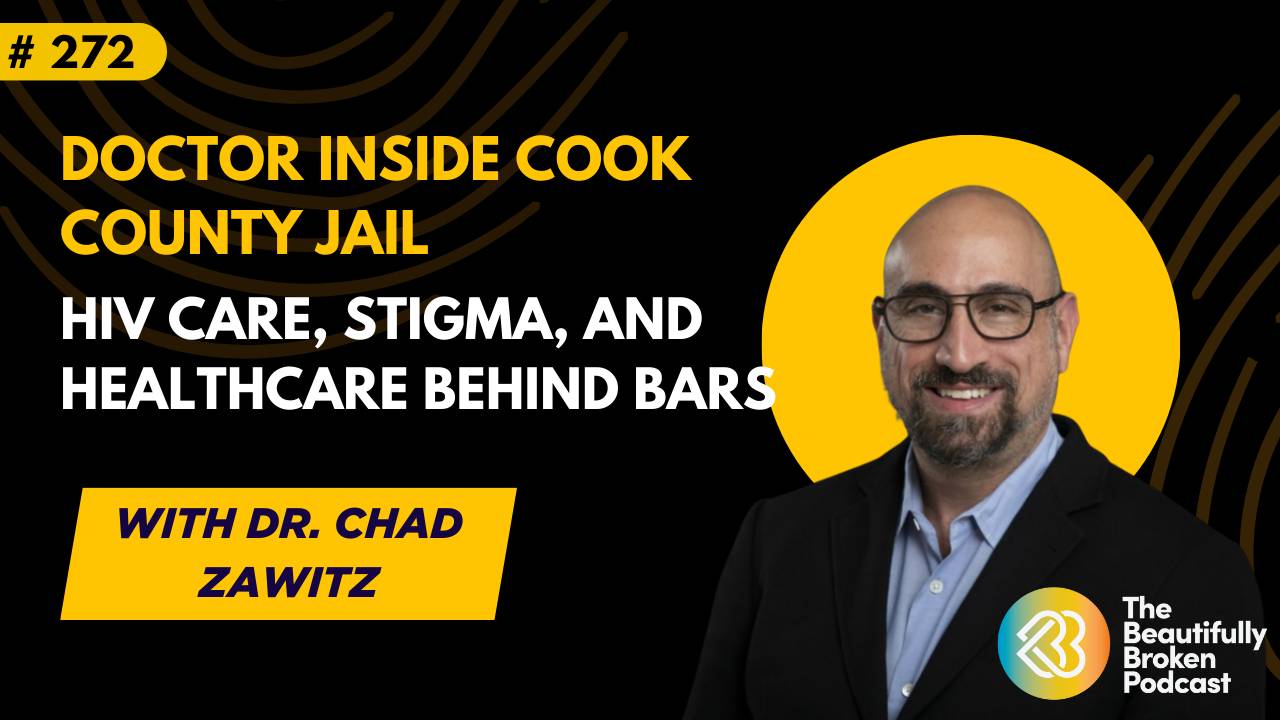
WELCOME TO EPISODE 272
In this powerful conversation, I’m joined by Dr. Chad Zawitz, a physician who spent over two decades delivering frontline medical care inside one of the largest urban jail systems in the country. Dr. Zawitz pulls back the curtain on carceral healthcare, explaining the critical differences between jail and prison, the constitutional right to medical care for incarcerated individuals, and why many patients actually experience better measurable health outcomes while locked up.
We spend significant time unpacking the evolution of HIV treatment, from the early days of fear and stigma to today’s extraordinary advances, including long-acting injectable antivirals and the game-changing reality that people with undetectable viral loads cannot transmit HIV. Dr. Zawitz explains why, with proper access and adherence, HIV could be effectively eliminated within a single generation, without a cure or vaccine.
This episode also explores stigma, language, trauma, addiction, and the power of treating people like human beings. From stories inside the jail to reflections on COVID, public health messaging, and medical ethics, this conversation is a reminder that healing doesn’t begin with protocols, it begins with compassion.


Episode Highlights
[00:00] – Why HIV could be eliminated in one generation with the tools we already have
[03:15] – Dr. Zawitz’s path into correctional healthcare and why it matters
[05:40] – Jail vs. prison: understanding the difference and why it impacts care
[10:30] – The constitutional right to healthcare for incarcerated individuals
[14:50] – How HIV care is delivered behind bars
[18:30] – The evolution of HIV treatment: from AZT to modern long-acting injectables
[22:55] – U = U explained: undetectable equals untransmittable
[26:30] – The role of stigma, language, and bias in healthcare outcomes
[35:55] – Treating patients as people: why simple kindness changes everything
[43:00] – Why health markers often improve during incarceration
[48:40] – COVID in jails: fear, access, vaccines, and media narratives
[55:35] – “Tales from the jail”: surprising clinical lessons from real life
[01:08:50] – Public health, vaccines, and the cost of polarization
[01:17:45] – Lessons from Dallas Buyers Club and early HIV innovation
Links & Resources
Silver Biotics: bit.ly/3JnxyDD
— 30% off with Code: BEAUTIFULLYBROKEN
LightPathLED: https://lightpathled.pxf.io/c/3438432/2059835/25794
— Code: beautifullybroken
CathcBio: https://www.catchbio.com/beautifullybroken
— Code: beautifullybroken
StemRegen: https://www.stemregen.co/products/release?_ef_transaction_id=&affid=52&oid=1
Beam Minerals: http://beamminerals.com/beautifullybroken
— Code: BEAUTIFULLYBROKEN
CONNECT WITH FREDDIE
Work with Me: https://www.beautifullybroken.world/biological-blueprint
Website and Store: (http://www.beautifullybroken.world)
Instagram: (https://www.instagram.com/beautifullybroken.world/)
YouTube: https://www.youtube.com/@freddiekimmel
FULL EPISODE INTERVIEW
EPISODE TRANSCRIPT
Freddie Kimmel (00:01.418)
Ladies and gentlemen, welcome to the beautifully broken podcast, another episode. And we are going to jump in today with Dr. Chad Zawitz. Welcome to the show.
Chad Zawitz (00:12.615)
Thank you, Freddie. Pleasure to be here.
Freddie Kimmel (00:14.732)
Yeah, so excited. This has been a year in the making that I've wanted you on the show. I just... I just dropped the ball.
Chad Zawitz (00:21.009)
Good things are worth the wait, my friend. At least I hope so.
Freddie Kimmel (00:24.526)
They are, they are. So you're a doctor, but you in your lifetime have, in my opportunity or my understanding, you've really had this like unique population to work with in the world of wellness and medicine. And what is that?
Chad Zawitz (00:45.265)
Well, I guess it probably could appear unique. I would say maybe more atypical or unusual rather than unique. And I'll get into why in a second. But I had worked for the majority of my medical career in a correctional facility in Chicago, a large urban jail. And correctional health care or carceral health care, depending on where you choose.
is not, I think most people going through their medical training in these fine universities are unlikely to be envisioning themselves behind bars delivering healthcare. They're picturing a nice office with a water cooler and a coffee machine and windows. So these are the fineries and accoutrements that are a little less common in a correctional setting. Of course, there's much more
that we'll talk about. that's what I've done up until April of this past year.
Freddie Kimmel (01:48.394)
Amazing. And so can I say that it was Cook County Jail?
Chad Zawitz (01:53.149)
I don't work for them anymore, so I think so. We just did.
Freddie Kimmel (01:55.82)
You know, the reason why I say it is as a, you know, a music theater nerd, Cook County is the, it's the backdrop for the Tony nominated musical, Chicago. And that's where it, that's where it's set in that storyline. It's really funny. I, I get to talk about this a lot with my partner, Cynthia, who you know very well, and you guys worked together in the past.
Chad Zawitz (02:10.749)
okay, well, there you go.
Freddie Kimmel (02:25.644)
You know, when we first met and I was talking about things like stem cells and hyperbaric chamber and nutrient IVs and all this like crazy like optimization stuff, she was really, it was a unique experience for her to hear that she's like, it's just not my world. She's like, this isn't the medicine that I got to work on. And it's like, you know, she'd start to,
let me hear some of these stories from work where like the reality of working in the prison system, providing healthcare and who you're providing for, like, what is it like being on the front lines of a prison?
Chad Zawitz (03:07.557)
Well, for the audience, think there's a little orientation with some, it's nuanced, but I think it's relevant to share because a lot of people don't know this. So there's carceral settings where people are removed from free society and put basically in custody. They're behind bars. There are jails, there are prisons, and in certain situations, they're hybridized, jail and prison systems are blended. But for the most part,
It's really important for people to understand the distinction between jail and prison. In general, jail is not short stay and prison is long stay, which is what I think many people perceive. It's not that it's wrong technically, but jail is mostly pre-trial detainees. Someone has been arrested and charged with a crime and in this country, supposedly, allegedly, innocence until proven guilty or innocent. And they stay in jail as a detainee.
Freddie Kimmel (03:56.182)
Mm, mhm.
Chad Zawitz (04:06.853)
until the court has adjudicated the case. Someone is convicted of a crime, then they are sentenced to prison where they will carry out their prison sentence, which is the actual punishment allegedly. So that's really the distinction. So I worked in a jail. We are sort of like a feeder system for the prisons because how do they get prisoners? How do they get inmates if you want to use those? Those are somewhat dated terms, but I think it's what people are familiar with.
Freddie Kimmel (04:19.309)
Yes.
Chad Zawitz (04:36.689)
They go to jail first, then go to court, then are convicted and sentenced, and then carry out their sentence. And the last little detail, and then we'll get into the healthcare part, is that sometimes they're in jail longer than they're in prison because it's a long, complicated case. They're evidence, they're waiting for witnesses, whatever. And they might be sentenced to, I'm making these numbers up, two years is their sentence, but they've already done 18 months in jail waiting to be convicted. They may only do six more months.
to fill out the two years, because that time will count towards their sentence in many cases. when last thing is, know, it's media, I think that does the disservice, but they'll say things like, I'm going to send you to jail for the rest of your life. And I laugh because, well, then what's wrong with the court system? Like, why can't they adjudicate this case and get you to prison for the rest of your life? You don't spend the rest of your life in jail. But that terminology is confusing to a lot of people. And I find it helps to clarify one, because I didn't work in the prison. I worked in the jail.
Freddie Kimmel (05:21.87)
Yeah
Chad Zawitz (05:36.165)
And two, the help bringing us to the healthcare part, jail is where people are, they're kind of raw, they're fresh off the street, they've been arrested, they maybe were living there, what I sometimes refer to as their life of chaos, their substance use may be active, their untreated mental or behavioral health issues are, you they're disorganized, whatever, they come in fresh and their time in the jail is
Freddie Kimmel (05:58.338)
Hmm.
Chad Zawitz (06:06.205)
One, to deal with the sort of acute detachment from that free world life they were living and connecting them to healthcare because as soon as they enter the facility, they are accessing healthcare. It's not an opportunity for healthcare. They are accessing healthcare. It's the first thing that happens after the carceral system gets their ID, fingerprints them and does whatever their criminal justice history taking they do.
Freddie Kimmel (06:13.219)
Mm-hmm.
Chad Zawitz (06:34.503)
The next step is they go to access the healthcare. They're seen by a medical screener, and I'm paraphrasing a more elaborate process, but do you have any health problems and what are they? Or do I, the screener, perceive you to have some sort of health problem or even be at risk, like for withdrawal or something? And if there is a yes, then they get a secondary medical assessment by a practitioner who then dives deeper into this to try to...
make sure they're receiving medications or get steered into a detox program or whatever. in jail, they come in, know, fresh and raw and it's a little, it's messier. It's in my opinion, a little more challenging because you're dealing with a sort of acute phase of all of this. But by the time they get sent off to prison, they've been, you know, tucked in, if you will, they're,
Freddie Kimmel (07:19.436)
Mm-hmm.
Chad Zawitz (07:24.059)
Stabilized in again and I'm paraphrasing because people who work in prisons will say are you kidding me? They're they're they've the parole violators. They go right to prison. They come in just like that. This is all true I'm speaking in very big generalization. So those people who know the system, please don't come after me for this. I'm speaking broadly So those are those are some of the nuances and the other thing that's really important on the tail end is in jails We never know when they're leaving. We only know when their next court date is we don't know what's gonna happen in court
So planning for the transition of care is a real steep challenge for every jail everywhere in this country. Everybody has the same challenge. Prisons on the other hand, a sentence is generally speaking very clear. You will be in this prison until this date and that is your release date. And so there's more structure to planning for the transition of care back to the community. And I'm not saying it makes it easier. I'm just saying there are those kinds of nuanced differences that do play into how
the delivery of care is a little bit different between the two systems.
Freddie Kimmel (08:27.904)
Yeah. Only because it was just out of ignorance and I didn't know, but I was, I was surprised that people came in and they had an intake in which, you know, chronic conditions or heart medications or all these, they're basically onboarded into the system. Right. And now thinking it out loud, it does make sense. It's like, they're not guilty at this point.
Right? So we want to be sure that they are Sherpett and cared for and whatever that outcome is. And then if they do go on to a longer term sentence, there is long-term care there. I'm sure you've seen the gamut of what people come in with, but what happens when people come in with that they're going through cancer or they're going through...
maybe they have like an unmanaged diagnosis of HIV, some of the meatier medical conditions that we're dealing with.
Chad Zawitz (09:26.685)
Well, these are fabulous questions. I think there's a lot of parallels with emergency medicine. mean, think about how a lot of people in this country utilize emergency rooms. I'm not saying the jails are the same thing, but a lot of folks who, for the complex reasons that their health conditions may be in flux or they've been disconnected from care when things get bad,
Where do they go when they're out in the community, especially if they don't have insurance or don't have like a more organized way to access health care. They go to the ER. Well, what does an ER do that? They're not there to manage their HIV or manage their cancer. They say, great, you're here now. here's what we can do for you here. You know, here's a bandaid. Here's again, sorry for the emergency health system for me, characterizing you as band-aids. It's not what you do. get it. The point is they're not there to, to
to manage everybody's health problems at the level that they need. They're there to steer them back into the system, if you will. So jails and prisons are similar in that we are differently resourced around the country. Bigger jails are gonna have probably more resources than say a local town jail that might have two cells and like a nurse or something. They're just simply not gonna be equipped the same.
It's not even equitable really. When I said like equal versus equitable, it's not even really that it's, it's, it's really strange how it works. But bottom line is answer your question long wind. when somebody enters a carceral system, they are legally entitled. They have actually a constitutional right to healthcare. You, Freddie and myself, and probably your listeners, none of us have a right to healthcare. It's one of these.
bigger picture issues that comes up, especially in election cycles. But we are, if we have insurance or we have other ways of paying for care, we are very privileged and we do what we do because we are privileged. But we do not have a right to healthcare. But when you're incarcerated, you actually have a right. You have a constitutional right, the eighth and 14th amendments. And a lot of people probably haven't really looked at the bill of rights or read the constitution. I get it. It's not.
Chad Zawitz (11:49.671)
common knowledge, but do ever ask yourself, what does no cruel and unusual punishment mean? Like, I think if you hear that at face value, you think don't like beat me and waterboard me or I don't know, I'm, you know, or sure, but, that was actually interpreted by the Supreme Court, I think in the seventies, in a major lawsuit to also mean like if someone is sick and they're locked up and they can't go and get healthcare for themselves because they're behind bars, they are
Freddie Kimmel (12:03.522)
Mm-hmm.
Chad Zawitz (12:19.515)
dependent on or reliant on the system to provide that for them. And it was actually interpreted as such under the eighth and 14th amendments. So they have a right. In other words, it's illegal for the carceral system to deprive somebody of access to, and this is another whole other podcast, the community standard of care. Well, what that is is a whole other podcast. Yeah. But the bottom line is they have a right to health care.
Freddie Kimmel (12:42.722)
What's that?
Chad Zawitz (12:47.685)
We, the carceral system, are required to deliver this. It's illegal to not. So if they came in and said, I have HIV, I, the carceral system, am legally responsible for ensuring this person engages in the community standard of care for whatever somebody who has HIV would receive. If that's medications, if that's blood work, if that's seeing a specialist. Same thing with cancer, same thing with, you know,
Freddie Kimmel (13:08.12)
Mm-hmm.
Chad Zawitz (13:14.621)
You name it. All of those things are legally required. And it brings up all sorts of challenges because again, different resources and different systems have challenges in delivering these things. Our jail is very large. We have a pharmacy on site. We have a big pharmacy. We have a team of pharmacists, 24 seven.
We have doctors and PAs and an army of nurses and we have mental health specialists and psychiatrists and blah, blah, blah. We have all of that. Well, not every jail or prison is going to have all of that like on site. For us, it's relatively easy. HIV, refer them to Dr. Zawitz. Then I see them and I take care of them. But in a smaller system, it's okay. The on-call medical provider is going to do the best they can and say, I don't treat cancer.
I don't treat heart failure or I'm not a specialist. I need to refer that person to someone who is. And the jail or prison is legally responsible to make sure that person gets seen by whomever provides that level of care. So that may mean like engaging in special contracts. Like you're, I'm going to say small town USA.
Freddie Kimmel (14:21.238)
Mm-hmm.
Chad Zawitz (14:31.665)
Well, where is the nearest community hospital where there is an HIV specialist or a cancer specialist? I'm gonna have to work something out with that system and the taxpayers of my jurisdiction will be responsible for the bill. That's how it works. That's a very long answer, but that's how it works.
Freddie Kimmel (14:47.726)
Yeah, it's just, fascinating to me. And you mentioned, asked, uh, we kind of went into my other question. I was like, well, what about mental health? I mean, I can only imagine where people's mental state is given the front loaded, you know, 30, 40 years to coming in. And then you're in this very acute situation. Um, yeah, that's wild. That's wild. And, and, and it makes complete sense because you're not dealing with a person who has been
given a sentence. They're not guilty at this point. They're in a jail.
Chad Zawitz (15:19.133)
But even if they are, even if they're sentenced and go to prison, they maintain the right to healthcare because they cannot go to their own doctor. unless I'm misspeaking here, I'm not aware of a jail or prison anywhere that allows a person in custody to call their own doctor and have their own doctor manage. Like I have Blue Cross, I want my doctor to manage my, he knows me, if he knows me, it doesn't work that way. They say, great.
Freddie Kimmel (15:44.791)
Yeah.
Chad Zawitz (15:47.857)
Have your doctor send your records to our doctor and we will take care of it. Like that's how it works.
Freddie Kimmel (15:53.647)
Yeah, yeah, it's, it's fat. It's fascinating. It's a fascinating world to examine. Um, I wanted to go in this direction of it. One thing I was looking through your resume and some of your work and it looks, you have a lot of work with HIV and AIDS, which is very, again, a topic we've not really gotten into on the podcast, but because of my history in music theater, you know, the generation and half before I got to New York City was it
decimated by half. How has, and I would like to just talk specifically about HIV and AIDS because you've been able to work in this patient population, how has treatment changed over the years and what were some of the big advancements as far as like managing long-term care?
Chad Zawitz (16:42.513)
Great question. All right, so I'll try to be succinct, you already know is not my strong suit. In the beginning...
Freddie Kimmel (16:49.272)
but that's why we do podcasts, because we can do long form. You can ramble on. We don't need to do a 25 second sound bite for ABC or NBC.
Chad Zawitz (16:52.816)
Okay.
Chad Zawitz (16:58.429)
This is, hey, all right, well, so the first cases, I should say, were identified by a specialist in Los Angeles in 1981. fast forward, it wasn't until 1987 before the very first antiretroviral medication was FDA approved. was monotherapy, meaning just one drug at one time given to treat.
And it was a drug called AZT, which for the HIV history buffs, they're going to know that one. That used to be an old drug used or tried to be used for cancer treatments, but it turned out that they found it had antiviral properties. Anyway, fast forward. It wasn't until 1995 when the first triple therapy regimen was FDA approved. Triple therapy, meaning they combined three antiviral medications together at the same time. And that
proved to be the of the magic number at the time of medicines necessary to both control the multiplication or replication of the virus and to prevent it from developing resistance. This virus mutates itself so quickly and when it multiplies, it replicates, it's error prone. It makes mistakes. And sometimes these mistakes give them an advantage. They accidentally make a mistake that is a resistance mistake to one medicine.
Well, there's still two more that are still working and it holds it in check. It's very hard for the virus to develop a sequence of mutations that will knock out three drugs. And so in 1995, this first triple regimen that was approved began widespread use and it literally changed the trajectory of the history of managing HIV. went from effectively a death sentence for most people who would acquire this virus to what I maybe
shouldn't call it this, but a life sentence. We don't have a cure, but it became a chronic, manageable medical condition, much like we talk about diabetes and high blood pressure. Nothing we do with Western medicine cures diabetes. Nothing cures high blood pressure. Nothing cures a lot of the chronic health problems we have, but we have effective ways to keep them manageable so that they mitigate the long-term.
Chad Zawitz (19:22.535)
health impacts of living with these diseases and HIV became one of those in 1995. Now fast forward, since then, the evolution has been a combination of less pills, less times per day, with less side effects, less drug interactions with other medicines people had to take, food requirements became less important. were these nuanced evolution until I believe it was,
Good God, if I get this wrong, but 2006 or so when the first single tablet all-in-one triple regimen became available, it was a revolution to go from quite literally dozens, handfuls of pills a day to just a single pill one time per day to keep this virus in check. And that was almost 20 years ago. So what could be better than that, Dr. Zawitz? Well,
While that was a single pill and it was very convenient, it still had a lot of side effects. had some risk for people who didn't take it correctly. Like every single day you have to take this pill on a schedule. If you miss sometimes as little as one dose, it was enough like of a drop drop of the level of medicine in the bloodstream for the virus to develop resistance. And then the medicine stops working. So better versions.
of these medicines evolved different classes or ways that the medicines fight the virus that were stronger, that were less fragile genetically so that if somebody were to occasionally miss a dose, it wouldn't be, oops, the medicine doesn't work anymore. So that evolution happened over the next 10 or so years. And we're now at the point where we're now looking at strong, strong, strong medicines. Now maybe we just need two instead of three.
and it will do the same work that three did. And probably the most breathtaking of the advances since the beginning is we're now looking at long acting antivirals, meaning things like injections where there are no pills at all, but you can receive a dose of your medication. There's one that's FDA approved that you can now receive a dose every two months and no pills. We're now looking at
Freddie Kimmel (21:44.642)
Mm.
Chad Zawitz (21:45.679)
every six months, even maybe once a year. And further down in the sort of crystal ball, if you will, there are visions of having certain medicines that may be implantable, like there are with birth control, those little wands of birth control medicine, they stick it under the skin and they just forget about it. We're now at a crossroads where the days of having to take a daily pill are gonna be a relic of history. We're not there yet, but it is the future.
And it's very exciting as a scientist and as a healthcare provider. Of course, these things are, what fuels you to, to, stay stimulated and excited about the field too. so the future is bright cure research is, has been ongoing. There's really interesting promising things in the pipeline. but it also brings up another podcast about what is the word cure mean? And we don't have to go into that now, but just to say that's how things have evolved. And while it isn't.
equal access to these amazing medications for everybody everywhere in the world. They do exist and for the fortunate folks who do have access to them, this is a new era where HIV went from again, a death sentence to a life sentence. And the last thing, especially for your listeners who don't know this, there is a medical equation that every human being should know and it's U, letter U, equals U, letter U. U equals U. This stands for
Freddie Kimmel (23:07.522)
Mm-hmm.
Chad Zawitz (23:12.505)
Undetectable equals untransmittable. And what this means for the lay folks is when someone who is living with HIV is successful with their treatment, the amount of virus in their bloodstream falls to a level which we call undetectable. It's still there, but it's there in such tiny numbers that two things happen. One, there isn't enough virus circulating to be causing harm to the patient.
They maintain their health because the virus present, but present in such small numbers that it can't hurt you. And two, when they reach that undetectable level, which again, it isn't there, it's just in such tiny numbers, undetectable means they cannot transmit the virus to someone else through condomless sex. So the impact of this is our modern treatments not only keep our patients healthy, they prevent
Freddie Kimmel (24:01.294)
Mm-hmm.
Chad Zawitz (24:09.029)
downstream transmission. And if we were able to get every person in the world who has HIV on treatment successfully, we could effectively extinguish this virus from the face of the earth in one generation. We don't need a vaccine. We don't need a cure. mean, awesome if we had those, but we don't. We have today, right now, everything we need to stop this from being a thing.
Freddie Kimmel (24:22.816)
in a generation.
Freddie Kimmel (24:35.53)
Yeah.
Chad Zawitz (24:38.161)
And I didn't even talk about PrEP.
Freddie Kimmel (24:40.034)
But you need compliance, you need buy-in. Yeah.
Chad Zawitz (24:42.811)
And you need access. Think about where most of the HIV is in the world. mean, have, sure, it's here in the United States, it's everywhere. But the developing world, and particularly impoverished sectors of the world, like sub-Saharan Africa, big swaths of Southeast Asia, a lot of Eastern Europe, even areas of the Middle East, for all sorts of different reasons, they simply do not have universal access to these amazing treatments. And because of that,
HIV is still doing what it does when it is untreated, which is kill people and spread.
Freddie Kimmel (25:18.254)
Hmm. Yeah. I, it's so funny. have such a trauma response for me with just even the convert, I can feel the tension index raise and you know, I, I graduated high school in 96. So, know, in 96. So, so at that time, you know, we were being showed like the Ryan White documentary where, where Ryan White had contracted HIV through blood transfusion and we would do these talks and bring everybody in the auditorium.
Chad Zawitz (25:32.999)
Okay.
Freddie Kimmel (25:48.327)
And this was also around the time when I'm in high school, so you're old enough to get blood. And, and I just remember this, they sat us all down there said, okay, so if anybody is HIV positive, we'll send a letter to your mailbox and let you know. I was, now I hadn't had sex yet. I was convinced I had AIDS. I was convinced. I was, I know, I know. was like, I've been masturbating that's sexual. I probably have it. Little, my little.
Chad Zawitz (26:07.065)
Freddy! my goodness, you're still standing!
Freddie Kimmel (26:18.134)
You know, my little wild mind just trying to meaning making machine. didn't know any better. it was really wild. And my mom was also, my mom, my mom was a nurse. So my mom would, would tell me, she's like, I want you guys to know I'm in the hospital today. There's some HIV patients and AIDS patients. And it freaked me out. It was just scared, you know, because that marketing, if you remember through that Reagan administration was just like, fear, fear, fear, fear.
It was not a lot of education empowerment around that piece. We didn't have the gentle touch that we can use today. Not that we use it today. Just really interesting time. Yeah.
Chad Zawitz (26:57.925)
You know, when you bring up the Reagan, I'm biased from my awareness of the history of what happened in the eighties with Reagan administration, but let us not forget the four H's and I'm sure I'm going to get them wrong, but they were, it was not just fear, but intentional demonization of subpopulations. was H for Haitian, H for heroin for, you know, injection drug users. There was H for homo for homosexuals.
Freddie Kimmel (27:24.216)
Mm-hmm.
Mm-hmm.
Chad Zawitz (27:27.545)
And gosh darn it all, why can't I remember the fourth H? And the HIV community don't strike me down. It'll come to me later and I'll be like, that was the fourth H. there was intentional publicity around if you are one of these populations, that's where all the HIV is and was and how it's being transmitted. And if you're not part of that, this doesn't necessarily apply to you.
this is sort of the birth of the stigmatization and the disparity of public interest in supporting
There was a different mindset and still to a large degree remains a different mindset about certain people and certain populations. mean, well, like just look at gay people. mean, while they're more accepted now per se in a general speaking sense than back in the 80s and 90s, still very stigmatized. Injection drug users. I mean, I still hear terminology like junkie and things like
I'm clean, I'm not using like there's language we just use that if you just pause and think about it implies that if you're using you're not clean, that means you're dirty. Like it changes a mindset about an entire group of people and we need to look at that differently. I mean, we can get back into the jail and prison part of this, but I can tell you that I've never met a person struggling with substance use.
Freddie Kimmel (28:56.47)
Mm-hmm.
Chad Zawitz (29:06.225)
who didn't want to stop using. And if it was easy, everybody would just stop, right? I mean, it's not that easy. And these are the people who need the most help, not to be shunned and stigmatized and finger pointed and name called and the language we use, it does matter. I spent a lot of my years with medical trainees and I would give them this similar messaging, like even what you write in a chart.
everybody downstream from you that reads that and sees the language you choose is immediately going to be prejudiced in some way. When even the word non-compliant, just think about that word, like non-compliant with their medication. Immediately you're like, I'm wasting my time with this person who doesn't even want to follow my doctorly instructions. What a waste. And the effort isn't even going to be the same when they're caring for this person in some situations. And instead of
Freddie Kimmel (29:48.802)
Mm.
Chad Zawitz (30:05.881)
asking why they're quote non-compliant. It's just they're non-compliant. They're not worthy of my brain power and all my training and skills. I want to go take care of the person who actually cares about their health. Well, my version of it is a little different, which is these are the people who are not as equipped as everybody else is to deal with whatever their problems are. They need even more of your knowledge and skills. They need even more help and support, not less.
You're unhoused. People are familiar with the term homeless, and I'm sure even unhoused may not be the right term anymore. I can't keep up with it. But just to say, we have to look at people who are suffering and people who are struggling through a humanistic, caring lens and realize that some people, quite frankly, I mean, we're all created equal, but we're not. Some people need more than others, and that can mean more help. We're supposed to be
Freddie Kimmel (31:02.296)
Thank
Chad Zawitz (31:03.985)
purveyors of humanity and of empathy and of sympathy, let alone the delivery of these amazing treatments that we have access. And yet our own sort of biases, our own built-in prejudices and stigmas, they spill through even in healthcare. Healthcare professionals of every creed, we're still human. We still...
Freddie Kimmel (31:26.51)
Oh yeah. I mean, I say it all the time. One of the things I like to phrase, I hang my hat on is most of our fears are born of fatigue. And if you think about that, when our energy gets low, right? When I feel my cup empty, I'm less empathetic and I'm less willing to extend myself. But I can tell you that we should lean in. We should love harder.
Chad Zawitz (31:35.847)
Hmm.
Freddie Kimmel (31:53.891)
You know, your four, by the way, your four H's were homosexuals, hemophiliacs, heroin users, and Haitians. Yep, hemophilia. Yep.
Chad Zawitz (31:59.239)
Gotcha. Hey, Ophelia, thank you.
And yes, we should totally demonize hemophiliacs. Let's go get them.
Freddie Kimmel (32:08.519)
I know, I know, you know, but at the end of the day, it's, we're, we're all people, but
The trend right now is to dehumanize, right? If you can dehumanize someone and put them outside of the story, it's something other, they're othering, right? And it does it for me, it's not, I'm very much a believer in the realm of quantum mechanics and quantum energy and particle theory and string. It really is all one. Do you know what I mean? It is like, but if you thought about us, each is our individual journey.
as the protagonist in our own ever unfolding story. It is like this pop-up expression of existence. And of course, we all, you need the different characters to create the dynamic story. is, you know, all the world really is a stage, the men and women merely players. This is what we're doing. But because life is so grand and...
It, need everybody at these different ranges and scope. And it really calls you for me anyway, it calls me to step up, you know, till that lean in and love harder, even when I, and I very much try to witness when I'm like, you know, God, I could tell you a million different stories of riding the subway. And there's a great meme that's, and I've literally seen the woman in New York where she has a, she is shaving the dry skin off her feet and it's like white snow coming down and then someone cuts it with a clip of.
like doing parmesan and like avocado toast and eggs. and that, you know, your first impulse is like how gross, how disgusting about, and not to say, man, I wonder, I wonder what it was like when she was a baby and somebody hopefully was holding her and be like, my God, this is the love of my life. And then you see this departure and this person is straight off of the path and they're in a really tough spot. You know, how do you bring love? How do you bring.
Chad Zawitz (33:45.917)
Bye.
Freddie Kimmel (34:11.17)
that kindness, that open heart, that humanity back into that moment.
Chad Zawitz (34:15.377)
Well, first of all, what a visual. I totally could picture that exact image you described. And to answer your question, I don't know if there's an answer, but I'll speak to like my jail population. So these are some of the most stigmatized, demonized, forgotten, outcasts.
Freddie Kimmel (34:22.349)
Mm-hmm.
Chad Zawitz (34:41.129)
The general gestalt of the public is, know, if you're in jail, you did something bad or wrong and you deserve to be there. Again, jail, not prison, innocent until proven guilty. Let's stop right there. But people don't. They just say, you're locked up. You did something and it's just guilty until proven guiltier. But that being said, for me, they were patients, not prisoners. They were there. My role was to deliver health care. My role...
was not to be part of the criminal justice system. There's courts and judges and lawyers and whatever to deliver justice, if you will, to deliver so-called justice, right? But my job was a patient in front of me with a health need who needs health care. And part of that word is care. I found some of the easiest ways to engage in the jail. And it's so silly to even say this out loud, but
almost everybody from the minute they enter the system talks to them and treats them like they're human garbage. And all I have to do is smile and say, good morning. You know, I'm Dr. Zawitz. You know, please have a seat. Let's talk. And just being polite, just simply greeting them like a person would greet a person. You could see, you could see lights go on. You could see them like, wait, you're talking to me, me?
Like a person? Yeah, I am. You're because you are a person. I'm not here for that. You know, take the cuffs off, officer. Because they come in handcuffed. know, that's a security like thing. And I would always say first thing, officer, please take the cuffs off. with few exceptions, the cuffs would come off. And again, sidebar about why wouldn't you take the cuffs off everybody? I have to trust our security folks who may know more about why they're in jail than I do in those situations. Doc, I think you want to leave the cuffs on this one is coded language for leave the cuffs on this one. OK.
But other than those exceptions, just simply greet them like people. But one of the things I loved about my job, and there were many of them, is that because we don't bill, because we're not part of any managed care system, there's no one to bill, right? The taxpayers are paying for all the health care. is no, you name the insurance organization, there's no Medicaid billing, there's no none of that. I was not held to the same sort of performance metrics.
Chad Zawitz (37:05.296)
that a lot of health systems put upon healthcare providers, there wasn't 12 minutes per encounter or whatever. The encounter was as long as it took until I felt like I was done. And sometimes they were 12 minutes and sometimes they were more than an hour. the reason I loved the job was because I could do what I think a lot of healthcare providers wish they had the time to do, which was get to know the person, not just the health condition that I'm there to treat.
I would ask them the why questions. We take a history and we say, do you use drugs, alcohol or cigarettes? Like lame, very not thorough, not helpful information. And that's what we're trained in medical school to ask like these not even very open-ended and very bad questions. And if someone said, yes, I use drugs.
Maybe you take it a step further and say, what kinds of drugs and when was the last time you used? But what's missing from those is, but why were you using the drugs? And there is no time because it's a rabbit hole. Once you go into that rabbit hole and you find out, because they'll tell you if you ask nicely and you are genuinely interested and I am, they're going to tell you. And the reasons why are very eye-opening, very humanizing. You realize
Like I said earlier, these are not necessarily people who are simply junkies who want to get high instead of having a job. These are people who are self-medicating, and that's a cliche, but there's some truth to that. I can't think of anyone that I've ever cared for that struggled with drug use who A, didn't want to stop, and B, themselves wasn't a victim of something earlier in their life. Their upbringing wasn't as privileged as ours.
financially, emotionally, you name the whatever, they didn't have the advantages a lot of us had along the way. you know, everyone can say, yeah, yeah, who didn't have a fucked up childhood? Who didn't have a messed up, you know, aunt or parent or what? Great. So, so you navigated it better than some other people did. But at the end of the day, and it isn't to say everybody who's using drugs is self-medicating their, their abuse away or something, but just to say there's almost always
Chad Zawitz (39:29.349)
a backstory of why. And when you probe that, makes, to me, it made it more human and less of a stigmatizing thing and more of a, that's another problem to try to solve. And if it was steering them to, you know, psychotherapy to try to address some, you know, unaddressed trauma, to steer them to a case manager because they're, you know, unstable living situation, unstable housing, they're still in an abusive...
relationship, especially the women who come in were, they were terrorized their entire lives. And so all that is to say the why is something we are not equipped for mostly because of time in real, real world healthcare. But in the jail, the appointment is when I call for you and the appointment is over when I'm done with you. And I know that sound, I know that sounded horrible like that, but you get my drift, right? So I took full advantage of this.
Freddie Kimmel (40:23.894)
Yeah.
Chad Zawitz (40:27.581)
But on the flip side, from the patient's perspective, I just know it. I know they felt that care. They felt the human interest in them as a person. And when that connection happens, I get emotional when I say this out loud and I'm hearing myself, but it's that connection that really drives helping to...
reinvigorate them and motivate them to want to do better for themselves. They feel hopeful. They feel like there actually is still some part of this system out there that cares about me and they're willing to give it another try. They may have tried a hundred times and failed for all these different reasons. And I'm not saying I was some sort of magic wand. mean, I have probably more failures than successes in fixing somebody's life, but that's
Freddie Kimmel (41:21.1)
Yeah.
Chad Zawitz (41:22.301)
a really, really valuable, important component that is unfortunately lost when managed care forces us to
I don't know, churn numbers rather than like be human and take care of the person in front of you who might need more.
Freddie Kimmel (41:41.165)
Yeah. It's a big speeding train, you know, and it's hard to turn around. It's hard to slow down the really, you know, the, again, that the very, the flip side of the coin is most of the time on this podcast, we get to talk about people that are not only want to level up, but want to go above and they're like, I want the most out of my body and the brain and my tendon and my fashion and my, you know, optimization.
as well as people that have struggled a long time on the chronic disease loop. I would be really interested to have your perception or your experience of the trend in the U.S. You know, for now, this is all the people out of the prison, all the people out of the jails. The trend in the U.S. is that we spend the most out of pocket on our health care, yet we are one of the most chronically ill countries
in the world, we're winning there. what do you, I would just be interested in your experience. What is the trend in the jail population?
Chad Zawitz (42:52.903)
Well, I guess like everything, you can find a statistic or a study that's gonna support whatever your viewpoint is for everything, everywhere, always, including carceral health. But I think the reality is for the systems that are best equipped for the delivery of healthcare, again, equitable and equal and all of that is, even that doesn't really work out. But bottom line is,
Freddie Kimmel (43:02.296)
Mm-hmm. Mm-hmm.
Chad Zawitz (43:21.511)
people actually do better health-wise, just from like measurables in healthcare, like A1Cs for diabetes, viral loads for HIV, frequency of asthma attacks. Like all of these things actually get better when people are locked up because they're sequestered from whatever it is in their real world life that has made it challenging for them to adhere to treatment or to stay off.
a substance that's harming their health, whatever. All of those things, they're separated from them when they're locked up. And so granted, locking people up who are sick to make them better is not a way to provide healthcare. But this is a little weird experiment or weird observation that is really happening. They do better when they're locked up. They don't have to worry about how am I gonna pay for this visit or for this pill. It's provided for them because we're required by law to do so. So of course they do better, right?
Freddie Kimmel (44:15.406)
Mm-hmm.
Chad Zawitz (44:20.155)
So why have we as a society chosen? Because this is a choice. We chose this system of mass incarceration and spending all of this money and resource to massively lock up all these people instead of channeling at least some of this into community resources if these folks had
access to the mental health services and if they had access to housing and if they had access to you name the whatever There's a large number of these folks in my opinion that would never have ended up having hate to say it But having to do what they did to end up in jail Again, you can you can black and white it and say stealing is wrong and it's against the law doctors a wits if you steal you go to jail and I say if you're starving
and you are gonna die if you don't have something to eat, you're gonna steal it rather than die and risk getting caught. I'm not kidding. I can tell you, I have people who are in jail because they were stealing food from the grocery store. Like they were starving. It's so sad that this is, so my point, going back to this, we have chosen where we are. And if we choose differently and say, let's build our community resources, let's build our society.
Freddie Kimmel (45:31.691)
Okay.
Chad Zawitz (45:46.525)
around caring for our fellow human beings and meet those basic needs, we would not see giant jails and giant prisons filled with people. There are people who commit real crimes. And I'm not here to like say we need to ban jails. I'm not one of those like black and white people about carceral systems either. I'm just saying, I think we're overusing this as a resource.
Freddie Kimmel (46:08.078)
Sure.
Chad Zawitz (46:13.691)
instead of having those same resources be where the people actually are. Maybe I didn't even answer the question and I went into another rabbit hole, sorry.
Freddie Kimmel (46:22.228)
No, it made sense and you got us there. There's a term in the, I don't even know what to call the container. There's a term called the worried well. it's just like this, it's not that people aren't sick, but they have so much idle space to, my working theory is always like, look, the hardest thing in the world is to do the work.
It's the thing right in front of you that you can vary. The ego is so great and evasive and it's never really going to reveal itself. So we can, it's people really do, and I'm sure as you've experienced this, they, develop maladies and mental health issues and anxiety. And it's like anything but address the thing that is the elephant in the room. Right. But my, working theory has always been when your priority and again, there's
We can't generalize who comes into a jail or a prison, right? But if you're in that spectrum, there's worried about food and survival and getting your next meal. would intuit very few of the percentage of that population has chronic fatigue syndrome that you don't do. know what I mean? It's like the, the meme with the, there's a little, there's a little African boy and he's just like, got his hand on his chin and, and, and he's like,
Tell me more about these food sensitivities. know, it's like, we, we, kind of create this stuff and the mind is so powerful in its ability to create a disease model or a symptom. Um, yeah, I just, I, I wonder like, how did, how did the jail population do with COVID? Like, what was that like compared to the general pod? Is there any stats that you've seen that are different or not really?
Chad Zawitz (48:19.099)
Well,
Chad Zawitz (48:23.717)
In the beginning, I think it was very similar to what the public at large was experiencing, which was the fear of the unknown. We don't know how easy this is to spread. We don't know if am I going to face the Grim Reaper if I catch this? The very beginning was terrifying, I think, for almost everybody. And yeah, when you're locked up and you're in a
Freddie Kimmel (48:48.856)
Hi everybody, nobody knew.
Chad Zawitz (48:53.853)
a big dormitory where you have 40 other people around you and poor ventilation and you don't have the ability to sequester. You know, when they saying on the news, separate yourself six feet, do all the things that they told everybody to do to be safe. And imagine that you're in a place where you're going, but I can't like I literally, I literally can't be six feet apart. mean, I'm so I'm in a cell.
with that's 10 feet by six feet with another dude. How am I supposed to be six feet apart at all times and whatever. So there was fear amplified and because they were dependent on the carceral system to provide them with protection, the best that jails and prisons could do was to try to make space, to try to spread people out, to try to give people access to like face coverings or masks.
and so on, maybe to try to improve ventilation if you could maybe more access to soap and hand sanitizer than might be norm, know, those kinds of things were, that was all you could do. So there was a lot of fear. other than that, I think it was really very much like everybody else experienced, but there was one other thing that did happen. This, this massive, massive push to decarcerate quickly, because that was one way to increase physical space and reduce exposures was.
have less people in jails and prisons. so they forced, yeah, the courts were forced to make a lot of decisions about who truly, truly needs to remain behind bars somewhere and who could we maybe relatively safely transition back to the community to try to mitigate some of the disease transmission. So that was a real phenomenon. really happened. And quite frankly, while it wasn't in and of itself,
Freddie Kimmel (50:23.128)
That's right.
Freddie Kimmel (50:34.914)
Mm-hmm.
Chad Zawitz (50:50.321)
The reason why we saw things get better in jails and prisons in terms of COVID, it was a big player. Since COVID though, the numbers have more or less rebounded back to pre-COVID numbers and the carceral system is packed again. But there's so many ways to answer that question, but I think the fear was there, the lack, the helplessness. What can I do? I can't do all the things I'm seeing on TV.
Freddie Kimmel (51:07.746)
Yeah.
Chad Zawitz (51:18.393)
One thing that I thought was interesting, I want to sidebar, there were some positives. Public health agencies like our local health department here in Chicago, the CDC and other major institutions, they recognized the impact and the importance of congregate settings, not just jails and prisons, but all sorts of congregate settings like barracks, dormitories and colleges and whatever, that these were going to be foci for amplifying disease transmission if we don't do something.
pay special attention. And our jail population at the Cook County jail had very early access to the vaccine. I don't know if people remember, but in the very beginning, you had to be a certain age or have a certain health condition, or you were not gonna get vaccinated in those first months. And a lot of people were like, gimme, gimme, gimme, and like, well, no, you're not over this age, whatever. In the jail, it was, well, you're here, it doesn't matter because it's high risk.
Freddie Kimmel (52:05.56)
Yeah.
Chad Zawitz (52:16.091)
for all the reasons I kind of covered it more, we actually got very early access for people who otherwise would have never gotten access to it in the community. So they actually had advantages and you would never think that. And the public never got to hear that story because we were, first of all, we were in it. And second of all, the Cook County Health System has a very rigid process for communications with the media.
We were not allowed to just talk about what was happening, good, bad, or otherwise. We were, we were told, do your job. We'll handle the PR and I'm not criticizing that. That's not my purview. I just did what I was told. I'm a good employee, but we didn't get to tell. We didn't control the narrative. Other people did. And so what a lot of people hear, I, you may remember from the news and others might, you can Google it later. Cook County jail in the very beginning of the pandemic, like it was March.
of 2020 when it really started to blow up. And we made like national, if not international headlines. The Cook County jail was like the epicenter for COVID for the entire state of Illinois. And what the F is going on at Cook County jail. Why are they screwing up so bad? And here's my version of it, which is, remember, just like the vaccines, you couldn't get tested that early on. There weren't testing tents and those tests.
were impossible. We were the first jail to get access and we're actually testing. So of course we looked like ground zero because we were the only place who was actually testing for it. Do you really think there wasn't COVID in every jail and prison everywhere and every school and every airport and every, every, every? Give me a break. The difference was
Freddie Kimmel (53:54.638)
you
Freddie Kimmel (54:08.086)
Yeah.
Chad Zawitz (54:09.857)
We acted fast and early. We knew how to access these tools through our connections with public health. We were early adopters. So of course we were finding it, but the media just hypes it up and blows it up into this whole, look at this screwed up, messed up, blah, blah, blah, Never did we get to tell that side of the story. It doesn't, you don't click on a good news story. You click on like picturing
caskets and body bags and zippered refrigerator trucks and whatever else outside of jail. That's what people want to tune into. They don't want to hear, wow, these people are actually getting it right. We never got to tell that story.
Freddie Kimmel (54:46.926)
Yeah.
Freddie Kimmel (54:50.976)
Yeah, that's, mean, that's the human psyche, right? We love it. We love to slow down for an accident. We love to see the, you know, the, some, some, something there must be some programming in that ancient, you know, lizard brain that, that wants to see and witness for whatever reason, whether it's like, my God, I don't want that to happen to me. or, or we're reminded of our mortality. Yeah. It's so, it's so wild.
It's so wild. Yeah, there's so many, so many different podcasts we could literally branch off on the topic that you just went into.
Chad Zawitz (55:27.769)
You know, funny you should say that I realize we're probably closing in on some time here. This is your show. You can probably broadcast as long as you want. I have a like library, both literally in my brain library and also like a book I never finished where I was collecting some of the most interesting stories that I personally witnessed in my time at 21 years in this jail. You know, Tales from the Jail, if you will.
We should explore that sometime, because I think you'd get a kick out of some of these stories.
Freddie Kimmel (56:00.663)
No! Give us a couple stories. Give us some tales from the jail.
Chad Zawitz (56:02.567)
god. god. Freddy, all right. Well, like, I need a like a rating like GPG PG-13.
Freddie Kimmel (56:13.742)
You you go you yeah use your use your barometer. I I we can go PG-13 and are
Chad Zawitz (56:21.629)
All right. Well, one of the more recent ones before I left that I thought was interesting, it's a little pharmacokinetic story. had a person I had never met before. There's a lot of folks in my 21 years, there's recidivism, they're back, I get to know them because they're back again and again and we try over and over. But this was a new name referral to me, was my HIV clinic. And I know this person. But of course, I read the notes from intake when they come in off the streets and this
Freddie Kimmel (56:29.782)
Yeah.
Chad Zawitz (56:49.277)
And my word choice is what it's going to be so sorry for the sensitive ears, but the notes describe literally this crazy behavior, just psychotic and acting out and just just bonkers. And I was like, Oh, God, oh, my God, I don't want to see this person. This is going to be so hard. Like, huh. So I shamefully intentionally scheduled the follow up with me for like, I don't know, a week later instead of like the next day because I'm like,
that behavioral health team like tuck him in and kind of calm down whatever behavioral thing is going on, like fix that first. So when I see this person, can, they'll be calm and I can actually do what I need to do. That was my plan. I'm shamefully admitting that now, but well, happens. So I looked for days and saw that day after day for like five days, this person was acting a fool, just.
Freddie Kimmel (57:33.87)
Mm-hmm.
Chad Zawitz (57:45.777)
just doing these bizarre bonkers things in the notes anyway, just like crap. And I had to like brace for impact. So finally I called this guy down and I don't know, again, I don't know the exact number of days, but it was at least a week after that intake and several days of these notes of this person behaving the way they were. And he comes in and he sits down and it was like talking to you and me. Like it was the most ordinary, just normal...
Casually, hi, hello, I'm patient so-and-so. I'm Dr. Zawis back and forth and doing the whole health thing. And I'm just dumbfounded going, but that, those notes and the person who's in front of me, there's some discordance. What the hell? So I said, listen, I'll ask you like a sidebar question, but like when you came in, the notes all said you were behaving this way. And it looks like that went on for several days, but here you are. And we're not having those, like it's totally different. Like, can you?
Tell me what was going on. And he says, yeah, sure, doc, I can tell you. I struggle with methamphetamine. I'm a meth user. And I said, yeah, that kind of explains when you came in. But dude, meth lasts a long time, but it doesn't last five days. Why did this keep? And he said, I can explain that. Let me tell you before I tell you what really happened here.
My first thought was you had some meth like on or in your body somewhere and you were able to get it into the jail and you were still using, that's what you're gonna tell me. I was ready for it. Because that does happen. I think there's a, what do they call them, a mule, whatever. There are people who, in this case, I was sure that was what the answer was gonna be. But sure enough, he goes, oh, well, no. See.
Freddie Kimmel (59:17.442)
Mm-hmm.
Chad Zawitz (59:38.399)
doc, I'm, I'm what's called a tinkle tweaker. And I, no expression, Freddie. I, I found that term something I had never heard and I've heard everything. And I was like, what? And he says, I'm a tinkle tweaker. And I said, well, please educate me. What is that? And says, and he was like, practically a pharmacist or a chemist or something. And he said, well, meth is one of a few drugs that is basically unmetabolized by your body and you excrete the excess drug in your urine.
Freddie Kimmel (59:46.446)
you
Chad Zawitz (01:00:06.477)
unchanged, it's still meth. So I was collecting my urine and I would drink it and I could continue to get somewhat intoxicated off my own meth for a period of days because I'm a tickle tweaker. And I'm sort of giggling to myself a little bit, one, because that's a cute funny name, and two, because I'm like, there's no way, no way, but I'm not going to let this go. So after he explains his methodology for how he's able to maintain his high for several days and his behavior,
Of course, I'm going to Google Tinkle Tweaker and to the listeners and to you, Freddie, Google it later. And, you know, maybe don't do it on a work computer if people are going to read your search history. But this is actually a real thing. He was correct. It's meth and a handful of other drugs that are excreted, I'm metabolizing the urine. And it turns out that you can actually distill enough drug if you collect enough urine to actually get intoxicated. And if you really look hard in the internet, you're going to find there are like
I don't know what the correct term would be, like houses and places of use where groups of people are using together, where they actually can collect enough meth from urine, like they'll have everybody pee in milk jugs, and they can distill commercially saleable amounts of meth by distilling it out of the urine. They can actually start reusing and it's commercially viable way to do it.
Tinkle tweaker is one of my more recent kind of fun stories and it also taught me some stuff. also know four other drugs that are excreted on metabolizing the air.
Freddie Kimmel (01:01:38.583)
Yeah. I mean, now, yes, it's like, it's a, it doesn't shock me at all. You're also talking to somebody who I was so sick with Lyme disease at one point. I, I did every therapy there is. I bee sting therapy where you would literally have a bee and like sting yourself. had the venom from the bee that I would rub on my skin, hoping to stimulate my nerve, my immune system.
I would drink, I drank my urine for at least a year, which there, there's now, this is very fringe, right? But you've got a subset of the population that says the morning, you know, stream is the most potent in which all night long your immune system, there are, there would be fragments or particles of the bacteria immune system had won the war against. And so it could be some type of an immunotherapy, you know, I know.
Now, people have said this is total hogwash. I got it. Now we know the brain is very powerful again. So you have, my theory was always like, you got the gumption to drink a shot of your morning urine. It's telling your body you really want to get better. So I felt better that I did this for at least a year.
Chad Zawitz (01:02:57.159)
So first of all, kudos for innovation and for while I was trained as an allopath and know, formal Western medicine, medical education, know, the standard, the standard fair in medical schools. And we have very little exposure in that training to complimentary or alternative or whatever term people might use for anything that's in so-called mainstream Western, you know.
Freddie Kimmel (01:03:22.285)
right.
Chad Zawitz (01:03:23.933)
A lot of other civilizations for centuries and millennia have other ways of delivering healthcare that are different that have been effective for thousands of years. So while I may not be well versed in it or an expert in it, I don't scoff at it. I'm more curious than anything. I like to learn. to your point, I'll just say with no evidence to back it up.
Freddie Kimmel (01:03:40.696)
Sure.
Chad Zawitz (01:03:49.329)
There may be some merit to something like that because if there are bacterial antigens, know, bacterial particles that are in your urine, you know, your gastrointestinal tract being that it's one of the membranes of your body that's exposed to the outside world is chock full of immune system cells that are there specifically to see germs or foreign things before they get into your body.
and produce a defense against them. So ingesting antigens in theory, it could be a way to expose the immune system to generate a response that could be helpful. I'm not saying that's true, false, but just to say, just at very basic science level, you are not far off, at least in terms of could I orally ingest something?
Freddie Kimmel (01:04:32.227)
Yeah.
Chad Zawitz (01:04:43.983)
and expose my immune system to it and have some sort of reaction to it. And the answer is, yeah, I mean, at least on some level, there is a little bit of merit to that. So I'm not going to say no, I haven't done a study. I'm not.
Freddie Kimmel (01:04:57.922)
Well, it's in the, there's not, it doesn't exist. Right. There's other things that I like absolutely have felt incredible benefit, you know, coffee enemas. I just got to give a very good friend of ours yesterday, her first coffee enema. And you know, I wonder who that could be. Well, we won't out her, but you know, from, from my, again, my, my, whether it was like a severe chronic
Chad Zawitz (01:05:12.209)
Hmm of hours. I wonder who that could be
Freddie Kimmel (01:05:25.656)
constipation from all the abdominal adhesions, but also the backup of, if I ran my blood, my viral titers for Epstein-Barr and cytomegla and my bacterial load from Lyme and Lyme co-infections was horrendous. When I would do a coffee enema and mold toxicity, right? I lived in a black mold home for a year. Who knows what I grew up with on the farm. I would have such an alleviation of head pressure and my energy would change. Now, if you look into.
the claims around coffee enema, it's always like, well, you the, lay on your left side, the caffeine and the polyphenols is stimulating the portal vein, which runs right up to the liver. And then the liver makes more glutathione. There's not really been deep, deep research on a coffee enema, but I can tell you my experience is that I had a huge boost in energy. had a change in tension index and my pain overall.
And to this day, you know, if I have jet lag and I'm like, I'm going to that coffee enema, I feel like a million bucks. So I continue to do it as a practice, but the science is nil to, it's just very thin. And it's one of those things that angers me. was like, God, everybody says this. Oh, you boost glutathione production 600%, 250%, 700%. It doesn't exist. But this is one thing that we say and we say and we say. So.
Is it this mechanical thing of doing a release that's giving me the benefit or is there some type of cascade, chemical cascade within the body's, you know, liver that's really causing me benefit? I can't find it, but my experience is real strong.
Chad Zawitz (01:07:07.389)
Well, to that one very specific example, one thing I can speak to is...
your, it's a little bit of an anatomy situation going on, but the membranes of your colon are porous and are there to absorb. So if you administer a chemical agent, whether it's caffeine or polyphenols or whatever else might be, we'll just say therapeutically put there, first of all, they're going to be absorbed. But the anatomy lesson is this, the way
Freddie Kimmel (01:07:38.678)
Right. Put there.
Chad Zawitz (01:07:44.689)
that the veins that drain from there and bring it back to your system, they bypass the liver on what's called first pass metabolism. So let me back up. When you eat something and you digest the veins in your small bowel, the first thing they do is they drain the nutrients, the things, including toxins as well, that you eat that are absorbed.
and they pass through the liver where there is first pass metabolism, the first pass of that blood, it's detoxified or absorbed or otherwise metabolized by the liver. There's an impact. The liver changes what you've absorbed, but that's from a very specific set of veins that drain from the intestinal system. Other membranes do not drain directly to the liver. So that's why tinctures that you put under your tongue, for example,
Freddie Kimmel (01:08:42.926)
Mm-hmm.
Chad Zawitz (01:08:43.803)
They're absorbed by that membrane, but those veins drain right directly into your mainstream blood supply, as would those from the back end, if you will. So they avoid the liver on the first pass. So whatever's in that substance gets one free round trip around your body before it hits the liver, meaning it'll be at the highest concentration, the fullest effect before the liver gets a chance to.
to do something to it that might make it less impactful. So caffeine would be an example of something that you would get a bigger boost simply because it missed your liver on the first pass. Polyphenols or whatever else is in there, and I'm not gonna pretend to know, I'm just gonna say. So anatomy explains a little bit of it, if nothing else.
Freddie Kimmel (01:09:14.285)
Mm-hmm.
Freddie Kimmel (01:09:20.973)
Right.
Freddie Kimmel (01:09:28.782)
100 %
Freddie Kimmel (01:09:33.687)
Yeah. Yeah. It's wild. want to go back around. I'm like hesitant to do this, Chad, but I'm just going to do it. You know, I was one thing that I was really hurt by in the pandemic, was how, how the, how, how the community was presented with the option to do, to do the vaccine. I, again, as someone who was just severe auto immunity and RA from
2001 and the lot, the dysregulation of the Lyme markers all over the world. I'd worked so hard to get my immune system back in balance. So I was so hesitant when the, you know, that conversation about the vaccine was presented. And I just, I was like, you know, this is something I'd really just personally for me, um, my personal decision. I don't want, I don't want it. And it was like, you know, you remember the
It was just such a he- still a kind of a heated conversation. There's just so many opinions and many of them are not based in, you know, science. still- most of my friends in longevity and wellness and the human optimization world that were like, absolutely not. But we're not- I think the inability of people, and this is what I always thought, the inability of people to separate the conversation of myself and then public health are very different.
Chad Zawitz (01:10:30.973)
Thank you.
Freddie Kimmel (01:10:57.516)
Right. And there was also this way in which the data was presented in this, like, you know, if you guys want to travel in two weeks, you'll do this and you'll be good. And we're doing, and that's, that was the way it was presented. We're not the real, the not the facts as we understand them today. And I just hold onto a lot of hurt. And it was like, as a, as a member of our, our, our community, our global community, I wish someone could have just said, you know what?
We screwed up. We didn't have, we gave you the wrong information. We didn't present it the right way. actually, we gave you a very black and white. And today we're, just, Freddie, we're sorry we presented it that way. And there was so this mist, you know, cause we have this very mistrust now of like our, it's just very, as we, as we become more and more polarized over time. For me, I'm like, God, if people could just go to the table and be like, Hey,
I'm sorry. We got this a little bit wrong. This is what we should have done. You know, and we don't do that as a society or leaders. Anyways, I just want to say that because it's like, and I've never said that on a podcast because I know I really try to keep things not about, you know, very little about like my opinions about public health and government, blah, blah, blah, blah. Because I want it to be about wellness.
I want people to be able to come to the conversation and be like, I actually, hate that guy. He's one of those people that thinks that way. So I try to say out of, but anyways, I just want to, cause we talked about that for a little, little bit. didn't say anything.
Chad Zawitz (01:12:35.217)
Well, well, didn't necessarily hear a question. guess I can comment on hearing that. Yeah, no, that's okay. And I, may I wax philosophical a little bit? I'm not in disagreement that the way things ultimately played out was chaotic. And I think undermined a lot of people's belief systems about public health messaging. There, there, there could and should have been things that
Freddie Kimmel (01:12:40.558)
I don't think I gave you one.
Let's wax, yeah.
Chad Zawitz (01:13:04.989)
that were done differently in the big scheme of things. However, and maybe it's not even a however, in addition to that, while the world has seen pandemics before, we've had, think about the 1918 Spanish flu, whatever, this is not the first time the world has dealt with a plague. But this is the first time the world has dealt with a plague in the era of all of the technologies
Freddie Kimmel (01:13:12.59)
Mmm.
Freddie Kimmel (01:13:21.634)
That's right.
Freddie Kimmel (01:13:25.976)
Yeah.
Chad Zawitz (01:13:34.861)
all of the universal communication systems that are out there. This is a whole new.
framework for how a world experiences something like a pandemic. And so I'm not defending or anything. I'm going to just say that there is no playbook, even though the world has been through a pandemic before. there were and will always be mistakes that in hindsight could have been done differently or better. I think that all of the folks
Freddie Kimmel (01:13:57.454)
Hmm. Yeah.
Chad Zawitz (01:14:10.161)
who were working tirelessly during the pandemic to try to find a way to protect human health were doing the best they could. I understand like the polarization and the polarizing viewpoints and misinformation and all of that. And so much of it was actually amplified by the very technology we're using right now. People have a platform to say anything and they have wide audiences to hear these messages, whether they're grounded in reality or partial reality.
Freddie Kimmel (01:14:37.218)
Mmm.
Chad Zawitz (01:14:38.521)
or false information or some mix of all of the above. The point is this entire experience was something the world has never dealt with this way before. There is no playbook. There was no playbook. There are pillars of infection control which remain grounded in reality. Things like the less you're exposed to a germ, the less likely you are to get sick from it. Very basic stuff.
hand washing and covering your cough and keeping away from other sick people. Like that's never going to not be good information. Like that's a whole six feet and all that. That's forget about that. Just talking in very broad sense. But there weren't mRNA vaccines in 1918. There weren't, you know, internet and broadcasting of information and whatever. There were so many things that are different to say.
we've done this before, why wasn't it like this the last time is because there was never anything like this the last time. So, and let's not even get into rabbit holes about bioengineering and whether this virus was even a natural phenomenon. that's a like again, no, no, no, no, no. saying.
Freddie Kimmel (01:15:54.029)
Yeah, well, mean, yeah, we can, again, we can make up stories. You know, there's a, I'm sure there's people who know what really happened, but does it, you know, does the world need another working theory on this? Probably not.
Chad Zawitz (01:16:06.705)
Yeah. So to your point about the vaccines, like I agree, the rollout happened the way it did because it all happened very fast. There had to be decisions made in the beginning. Of course, it's a limited resource. So decisions are made like, well, then we're going to have to, you and I hate the word rationing because it's, I think people misuse that term as well, by the way, rationing means there's a fixed supply of something and everyone
Freddie Kimmel (01:16:20.782)
Hmm.
Freddie Kimmel (01:16:31.256)
Yeah.
Chad Zawitz (01:16:35.515)
gets a little bit of it, that's rationing. What happened with the vaccine was prioritization. It was, we don't have enough for everybody, so let's try to make our best guess for who needs it first until we can ramp up the supply. there was tons of controversy, tons of it, and remains to be so. But that was part of it was, well, who gets it and why?
Freddie Kimmel (01:16:41.869)
Mm-hmm.
Chad Zawitz (01:17:04.753)
Like I said, our prisoners, our detainees, our individuals in custody, many of whom didn't meet the so-called priority categories, they met one, which was you're in a congregate setting, that is a priority category. But the sidebar about requiring people to be proof of vaccine, to go to a restaurant or proof of vaccine, to get on an airplane, like those are all things, there was no playbook, this has never happened before.
Freddie Kimmel (01:17:16.278)
Right. Yeah.
Chad Zawitz (01:17:33.541)
And so it's very easy Monday morning quarterback and look back and go, wow, that rollout was crappy and stupid. And I can't believe how inconvenienced we were at the time. I get it. I get it. And in fact, there were employees at the jail who were told you work for, you know, the County and all County employees must be vaccinated or you will not be able to come to work. And many people said,
Freddie Kimmel (01:17:45.975)
Yeah.
Freddie Kimmel (01:18:00.43)
Hmm.
Chad Zawitz (01:18:01.649)
I don't want the vaccine. It's experimental or I just don't do vaccine, whatever their reasoning. I'm not judging anybody's reason for why they did or needed. Just to say the rollout was what it was. Mistakes were made. Maybe if an apology would soften people's pain and hurt from what happened, maybe there could or should be an apology. I don't know PR and I don't know how that all works, but.
Freddie Kimmel (01:18:06.606)
Yep. Sure. Sure.
Freddie Kimmel (01:18:24.93)
Mmm. Yeah.
Chad Zawitz (01:18:27.227)
At the end of the day, I just want to give credit to the people who had very, very, very hard decisions to make. They made them some for better, some presumably for worse. And here we are next time this happens, if it's in this era, maybe it will be different next time and better for everybody. Total sidebar, because I violated your initial very early rule.
Freddie Kimmel (00:00.92)
great and we're right back in and we have power. I'll let the editors know this. You know what I really like on if you ever listen to Rogan. Rogan will just be like, man, I got a P and then they just keep that P break in and they come right back in it.
Chad Zawitz (00:15.273)
I want to say what an honor it was to be invited to share an hour or so with you, Freddie. And if this warrants a future conversation, I would love to do this again.
Freddie Kimmel (00:24.599)
great, we'll good. We'll close it up here.
Freddie Kimmel (00:40.012)
Totally. We should, we should. We'll deep dive on one thing. You know, one thing I want to get into before we go ahead. Did you see the movie Dallas Buyers Club?
Chad Zawitz (00:49.053)
Yes.
Freddie Kimmel (00:51.284)
Do you are you feel very familiar with that story like the real life history and unfolding of that character?
Chad Zawitz (00:57.123)
No, I'm not going to pretend I mean, I felt connected to the story when I watched it. But no, I don't know the real world story.
Freddie Kimmel (01:04.053)
It was just such a fascinating, you know, like little nuanced community that was doing more or less bioregulatory medicine and terrain medicine using whether it was high dose vitamin C or nutraceuticals or certain dietary to keep people afloat in that time back to the beginning of our conversation when AIDS was the complete death sentence. And they were finding mechanisms within the body
that did allow for some level of healing or some level of preservation. This is fascinating story.
Chad Zawitz (01:42.493)
Yep, I don't disagree. And I'll add that at the time, and even now, people were were quite frankly desperate to find anything that could help. And there was all sorts of theories and experimentation, and whatnot to try to find like anything that could slow this down. Or in some cases, there were, you know, snake oil remedies that people pushed. One of the most interesting things
that, in my opinion, that came out of this very early on, there was a type of blue-green algae called, and you might know this, Freddie, but chlorella. Do you know chlorella? And there was a theory that this blue-green algae had some antiviral properties to it. And it turns out that it actually did and does, but you would have to take such massive
Freddie Kimmel (02:23.436)
Mm-hmm. Yeah.
Chad Zawitz (02:39.751)
massive, massive amounts in sort of this, even like processed, you could buy these chlorella pills at a health food store. And you can now. But there simply wasn't a way to get a concentration from it that would be sufficient to have meaningful antiviral properties. But fast forward 20 something years, and they've actually found what is the antiviral agent in this algae. And I've actually turned it into an FDA approved.
Freddie Kimmel (02:46.87)
yeah.
Chad Zawitz (03:08.785)
antiviral medication now that is changing the landscape of the future of how we're going to treat and prevent HIV. It's a crazy story, but it came from those early days when people had these theories, especially outside mainstream medicine, but it panned out. So we can't just cast off anything that hasn't passed a rigorous FDA review process to say it doesn't work if it wasn't studied.
Freddie Kimmel (03:37.152)
Well, to, you know, again, to your point when there's an emergent situation and people are desperate and, know, I, this is the other one I, I had listened, I was shocked the first time I heard there was a recording, I believe it was like a Vanity Fair recording of the Reagan administration. The second the press conference went down, the tone, timbre, and the words that were used to address the community dying of AIDS and HIV. It was.
It was horrendous. Do you know, again, today, if this happened to be like, you know, it would be, you know, ground groundbreaking news. Like people would be, people would have lost their jobs, but it was just like, behind the line, that community was not, they were literally shoved into a closet. They were not, no one was seen. Right. And to your point, people needed to do what they needed to like, well, we got to find something.
Like I'm just, I'm very empathetic with that. You know, again, I'm someone who, when I started to seek out, infectious disease doctors and people treating chronic Lyme, two of the big specialists had had their license pulled because the CDC said there's, there is no chronic Lyme. That's not real. You know, and now we're today, you know, now you can get coverage for, for treatment for any of the things that I did 15 years ago, be it.
major auto hemotherapy with ozone infused into the blood or think they were just not valid. I just put a sub stack article on to, out in the world yesterday on ozone. You know, one of the things I had, I bought a machine that was, essentially to do either did direct inject and I was doing this to myself as a non-nurse, non-medical, or I was doing rectal ozone and there's
Well over 250,000 practitioners in the world using ozone as medicine. But again, for the last 15 years, mean, I had doctors laugh me out of the office, be like, you're crazy woo woo. There is no science to this whatsoever. And funny enough, there are actually, yeah, there's some good evidentiary proof and there's tons of clinics in the USA. The elite elite are doing.
Freddie Kimmel (05:56.172)
You know, ozone infusions and major auto hemotherapy and rectal ozone. So I was always seeking out a lot of this fringe information. So the reason I brought up Dallas buyers, cause I identify with that, narrative arc. was like, dude, that was me. was pleased. Someone listened to me, please. Someone helped me. Let's do something. And I did a lot of stupid stuff. I did a lot of stuff, you know, if we could swap stories on the next one, stuff that I totally could have died.
That I'm just lucky that I didn't kill myself. Right. But it was out of, I was, I was, I felt so bad. was willing to do anything. Yeah. Just wild. Wild.
Chad Zawitz (06:38.451)
My dentist uses ozone. I love it. It smells terrible, but they use it topically on my gums. can I tell you, my gums are healthier if they did or didn't receive it? I don't know, but I get good checkups and I trust in the system and I trust my dentist.
Freddie Kimmel (06:46.722)
That's right.
Freddie Kimmel (06:56.119)
Yeah.
Freddie Kimmel (06:59.758)
That's right. Yeah. Yeah. Yeah. But for years that was a, know, they pulled people's license. it just, it's a, yeah, I just, I empathize cause and I literally had this, another working show that I'm kind of like, man, it's, it's harder than ever to discern what's real to your point. can prove your bias anywhere now, anywhere. There's so much.
You know, we talk about where we can go back to the number of scientific articles being pulled because they were rushed to print. Right. How many of those happened last year?
Chad Zawitz (07:30.419)
Now that AI is making up data, we can't even know that it was a real study anymore. Well, you can continue the study that was done. What about the ones that are completely hallucinated by our technology now? So brave new world, brave new world.
Freddie Kimmel (07:46.936)
Brave new world. Yeah, yeah. Brave new world. Which is why I like to have people like yourself who are, say, in the trenches in clinical practice, because you see the human condition, you see patterns, you see what works, generally what doesn't work. You've been really lucky to be on some of the front lines of is the innovations, we've talked a lot about HIV and AIDS come through and you've seen the change.
that personal experience is like gold, right? I just think that's the most valuable thing. and I would tell this to anybody listening, if you feel overwhelmed, go talk to somebody who's either lived through it or been through it or is in the trenches. If you're wondering if something is real or not, and do check your bias, because that's something we have to be able to do for ourselves. I think that's one of the best ways to use AI. Tell me how I could be wrong here, and I'm going to go research those.
Yeah.
Chad Zawitz (08:48.745)
I'm gonna try that. I'm kinda scared, because I think I'm wrong all the time, and that's without a computer telling me I'm wrong. So I'm gonna try.
Freddie Kimmel (08:54.294)
Yeah, yeah, Yeah. So as we close it up, because you have another appointment, I just want to ask a couple more questions for you here. So, you know, the beautifully broken podcast, the times that we fall down using these moments as the impetus for change, what does it mean to you to be beautifully broken?
Chad Zawitz (09:20.841)
I mean, think I'm going to take that quite literally at face value. And I'm sure I'm going to misuse the Japanese term wabi-sabi, but there's beauty in imperfection. And while that may not be really exactly what beautifully broken means, I guess like a handmade anything, there's just that something about that little imperfection that came.
from the human touch that makes it more valuable and more interesting. Physical texture, visual, all of the senses are impacted by the imperfections. And that's what makes it perfect. So I know that's a very literal translation of beautifully broken. But speaking about myself, I'm flawed if you want to use that term. I'm not perfect.
I strive to be better. I want to be at my best. And it's a constant evolution. I'm learning. I'm changing. I go to therapy. I work on myself. I want to be a better person, all of those things. But I'm none of those things at the same time. I want to be, know, but I want to be. So part of that, part of that.
drive in life is to try to achieve my highest state of being, if you will. Maybe that almost gets metaphysical or philosophical in some way, but that's probably the most confusing and yet best answer I can give you.
Freddie Kimmel (11:01.1)
And where does the energy come to get out of bed and put one foot in front of the other when you don't want to do it? Is there something that fills your sail? there something you, you know, it's like almost like the ticker board that's going across in your head.
Chad Zawitz (11:19.539)
I don't know if there's any one thing that fuels me, but I feel like I have, at least most of the time, I have a bottomless well of energy and desire to make the world around me better in some way. And some of that is giving what I have to offer to someone who's there to receive it. There's a lot of receivers. I, receive from
people in my world, think it's a give and take situation. But quite frankly, I'm probably being given more than enough to have this wellspring. I it doesn't always come just from myself. I think it's coming from the world I have around me. I've been blessed to be surrounded for the most part by an incredible network of love and support and stimulation.
I have resources for which I am gifted with. That comes my background, the education. I was able to get a company that I work for now that has corporate level resources to help me deploy my knowledge and skills in a different way. There's just all these blessings. have a certain mutual friend of ours who introduced you to me. And now I have a broadcasted platform to talk about things that might influence somebody to
to want to do something different or better in their own life. So that's kind of what gets me out of bed every morning, that and my cat.
I love my guy. Yeah, he's over there getting in the sun right now. He's my best friend.
Freddie Kimmel (12:56.856)
Beautiful.
That's what they do. And I'll ask you this because it is, you know, again, per my perception, a world in which I feel like I can feel people pulling apart and disengaging. If you could tune everybody's iPhone or Android into your Dr. Chad channel, what would you say to people?
if you could have a message of hope or togetherness.
Chad Zawitz (13:35.593)
Wow, oof, on the spot.
Chad Zawitz (13:42.907)
Maybe it's do your best to be in the moment, focus on what you actually may have some control over and stop distributing your energy and your resources to things that are immovable objects because that's not going to change. You'll focus on what you can control and what you can change. And quite frankly, almost all of that is self.
We aren't gonna change somebody else. We're not gonna change their mindset or their decisions. Maybe we can influence them, but we can't make them change. We can look inside ourselves and find sort of the greatness within. It reminds me of one more jail story maybe that ties in with this and can wrap this up a little bit.
Freddie Kimmel (14:38.104)
Do it.
Chad Zawitz (14:39.111)
when I was, this will come as no surprise to anyone who knows me, Freddie, but surprise, when I was in high school, I was the so-called king of the nerd herd, right? I wasn't part of the social popular group and the jocks or the whoever. kind of longed to be more a part of that, but I wasn't. I was definitely surrounded by the nerds and the so-called smart kids and the library kids and whatever. And senior year, yearbook time, there was a...
someone that I kind of idolized from afar as a basketball player. And I didn't even think he knew who I was. But it was senior year, you're never going to see most of these people again, probably. And I was like, well, screw it, yearbooks, you how that is. So I went around getting people to write their little whatever's and I went up to this guy and I said, hey, you my yearbook. And he took it and he scribbled something in there and then closed it up and handed it back to me. And at of the day, I go home and I'm reading what people wrote in there. get to what he wrote and he wrote in there.
One simple thing he wrote, you don't even know your own greatness. And forever since that day, that was one of the most meaningful, powerful, impactful things I've ever read because here I was this super achiever academic, you know, excellence swim team, school records, student council, blah, blah, blah, right overachieving, trying to compensate for what I didn't have socially and otherwise. And I didn't think this guy even knew who I was, but
Here he was, who was actually observing all of this, who maybe never spoke to me, but had seen all of these great things that I was doing and that I didn't even appreciate my own greatness. And I remember how powerful that message was for me. And it changed my whole life trajectory, quite frankly, to appreciate what I am and what I have and what I have to offer. There was a young lady who came into the jail.
heroin addict, hep C, an AIDS diagnosis, was struggling with injection drug use and a lifetime of abuse and all the horrific stuff, And I was treating her and we had to establish some sort of a alcohol to therapeutic relationship. And then one day she came to the clinic and she had written a little letter. It was in an envelope and she said, here, this is for you. And she leaves. And I have this letter and I'm like, well, guess I'm gonna read it. I open it up. And first thing was that it was like,
Chad Zawitz (17:01.255)
the most beautiful handwriting, was like, again, stereotype. You picture this like scraggly, broken-toothed, skinny, sick, know, like, you know, that was horrible. But then there's this letter and you look at the handwriting and you would think this was like, it was practically calligraphy. It was beautiful just to look at. But as she's writing, it was basically a thank you letter and saying, you know, I basically had given up on life. I thought I was gonna die. I thought it was over, blah, blah. But you...
Freddie Kimmel (17:25.39)
Mmm.
Chad Zawitz (17:29.169)
You turned it all around for me. You inspired me. And she told me it was when I told her that story because I remember telling her. said, you know, her name was Patricia. And I know Patricia, I know that's not a violation of she has given me like universal lifelong permission to tell her story. We've published an article together. So if you want to Google it, you'll find it eventually. But Patricia had told me there was a day when she came down and I had said to her,
Freddie Kimmel (17:47.232)
Mm-hmm.
Chad Zawitz (17:57.661)
There was something about her. could just tell underneath all of the veneer of this awfulness that there was a really smart, really good person that was right there, but she didn't even know her own greatness. And I remember telling her this story and I said, Patricia, you don't even know your own greatness. And I was in the moment kind of just thinking this was, you know, just a little shit story to like whatever the patient in the room.
What I didn't realize at the time was just how deeply impactful that messaging was for her in that moment. And it literally changed her entire life, her entire life trajectory. Fast forward to now, she's been out of jail, she's never come back. She got healthy, she followed up in the community, she got her mental health and her substance stuff treated. She got housing and case management.
Then she went back to school in her 40s and got a degree. And she's doing incredible work in the substance use and counseling field. She speaks all over the country. A true inspiration and a true success story, she realized her own greatness. And it just took that what at taste value was this inconsequential moment in her life in the shittiest of all places, this jail, this decrepit environment.
totally turned her life around. So, I don't know, I kind of lost track of where this whole story came to answer your question, but I just remember that we all have it in us. We have that greatness in there somewhere, and it's just figuring out how to realize it. Having it be recognized by someone outside maybe what it took. She needed someone to see it in her and remind her that she had that greatness, and maybe that's what it...
what some other people need too, but it worked for me, it worked for her. And I do truly believe that each of us have the ability to do something great or be something great, maybe even greater than we ever imagined we could be. Just have to find it.
Freddie Kimmel (20:10.228)
Amazing. Amazing. I love that that basketball player had like two transition moments or two people throughout time. And we never know. We never know how the story weaves together. Chad, thank you for being a guest on the Beautifully Broken Podcast. Big love.
Chad Zawitz (20:28.637)
Thank you, Freddie, truly an honor. Look forward to hopefully more in the future. Have a beautiful rest of your weekend and happy Thanksgiving to everybody.
Freddie Kimmel (20:35.339)
You too. Talk to you soon. Bye.