Dr. Shayne Morris (Systemic Formulas) on Gut Health, Herbal Genomics & the Microbiome That Outweighs Every Animal on Earth
Aug 03, 2026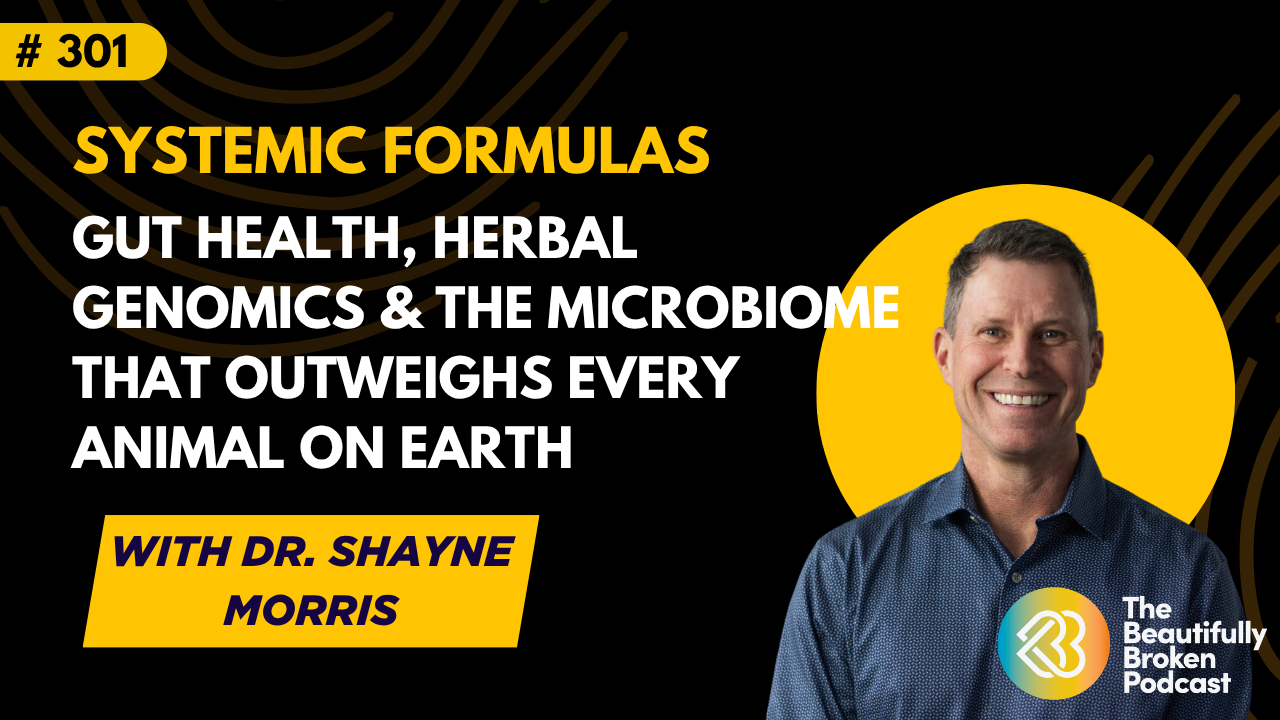
WELCOME TO EPISODE 301
Dr. Shayne Morris didn't stumble into the microbiome world — he inherited it. Now CEO of both Systemic Formulas and Alimentum Labs, Shayne's grandfather started the company back in 1984 as a healer studying Eastern, Polynesian, and South American medicine, and Shayne spent his career turning that legacy into hard science: how nature actually produces healing, and why the microbes living in and on us — which outweigh every other living thing on the planet combined — do more biochemical work than our own 23,000 genes ever could. In this episode, we get into herbal genomics (Shayne coined the term "herbalomics" back when he realized compounds like turmeric were directly switching genes on and off), why methylated vitamins were considered fringe in 2007 when Systemic started using them, and the surprisingly recent science connecting fungal overgrowth to childhood ADHD and eczema.
We also break down the Holobiome Roadmap — Systemic's five-stage system designed to make gut and cellular health personalized without handing a patient fourteen different bottles and no instructions — and why compliance, not complexity, is usually what determines whether a protocol actually works. Along the way: the real story behind why doctors started washing their hands between autopsies and deliveries, and details on Systemic's NextGen event in Ogden, Utah (September 18–20), where Freddie will be speaking on sales as a role of service.


Episode Highlights
00:00 - Introduction to Shane Morris and microbiome’s significance
02:20 - Microbes as the foundational layer of health
05:05 - The weight of the microbiome on planetary health
07:01 - How microbes have been misunderstood and underappreciated
09:00 - The impact of diet and environment on microbiome diversity
11:07 - The immune system’s development through microbial exposure
13:26 - The importance of personalized microbiome therapies
17:17 - From natural remedies to microbiome science and research
23:19 - Challenges in probiotic product selection and strain specificity
27:43 - Stool testing and genetic tools for microbiome insights
35:14 - Support strategies for aging microbiome health
43:41 - The Holobiome Roadmap: structure and application
50:09 - The influence of lifestyle and sleep on microbiome recovery
65:14 - Supporting neurological health through microbiome balance
70:45 - Upcoming event details and practitioner resources
73:39 - Practical advice for supplementing and maintaining microbiome health
Connect with Shayne and Systemic Formulas
https://systemicformulas.com/
Instagram: https://www.instagram.com/systemic_formulas/
Discount code: freddie10
Upgrade Your Wellness:
LightPathLED: https://lightpathled.pxf.io/c/3438432/2059835/25794
Code: beautifullybroken
Silver Biotics Wound Healing Gel: https://bit.ly/3JnxyDD
30% off with Code: BEAUTIFULLYBROKEN
MaxGen Labs: https://maxgenlabs.com/BEAUTIFULLYBROKEN
CONNECT WITH FREDDIE
Work with Me: https://www.beautifullybroken.world/biological-blueprint
Website and Store: (http://www.beautifullybroken.world)
Instagram: (https://www.instagram.com/freddie.kimmel
YouTube: https://www.youtube.com/@beautifullybrokenworld
FULL EPISODE INTERVIEW
EPISODE TRANSCRIPT
Freddie Kimmel (00:01.032)
All right, ladies and gentlemen, welcome back to the Beautifully Broken Podcast. We have Shane Morris with us this morning. Welcome to the show, Shane.
Shayne Morris (00:08.77)
Yeah, thanks. I'm grateful to be here. It's exciting.
Freddie Kimmel (00:12.019)
Yeah, if we bumped into each other at a grocery store, what would you tell me you do? How do you spend your time on planet Earth?
Shayne Morris (00:18.412)
Yeah, so I guess I'm an entrepreneur and a scientist. And I guess I've grown up my legacy, I mean, it's a family journey. My grandfather began this wellness journey, and you know, it's gone through two more generations. And I dug into the science side of it because the early days my grandfather was he was a kind of a scientist, but he was still very much a healer.
in in today's notion of you know how healing works. He he studied under Eastern as well as Polynesian and South American healing. And I wanted to know how it worked. So by the time I got involved, I wanted to know how nature provides healing, how medicines come from nature. And ultimately that led me to the microbiome, right? The biochemistry of our system and and how microbes, which are everywhere, you know, in every
nuke and cranny of this planet are microbes and they do the ma the vast majority of what happens on the planet. And of course the ones in our body became my passion. Yeah.
Freddie Kimmel (01:24.261)
Yeah. Yeah. I I think about that a lot, you know, I and and and where it comes up for me is like order of operations. When you meet somebody and they're struggling with something that icky yucky place and they're stuck and they don't feel good, you know, where does one go? And they're you know, you you jump on the to our point or our preamble that I wish everybody could have heard and we'll get into on the podcast is that, well, you know, this person tells me that my water's awful and it's toxic and I gotta fix my water and this person says
you know, this is the sleep regiment that I need to follow. And this person says, well, you know, you need to eat all if you'd go on a all meat diet, then this is gonna fix your autoimmunity and you start to kind of spin, right? I always think about the microbes, always pulled back to it, because I look at this the tube from mouth to anus's outside world and I say, you know, it kind of reminds me of like playing Oregon Trail in in high school. That was like the video game. That was like the video game we had in my high school
And you had to to play the game, you had to go get the floppy disc from your library professor and you had to go to put it into the commute computer and that information would upload in the interface and we could play. And I always think about the gut microbiome is like that interface. It's that outside world to inside world, mouth to anus, and the food that I take, all the things that I take into my body to make a new version of Freddy in however many years or however er every
every month, ever every tissue regenerates at a different rate. It's about the food, but without that interface, without that diverse microbial community, it doesn't I there's so much left on the table. There's so much opportunity left on the table and that's what gets me fired up every time we start to talk about the microbiome on the show.
Shayne Morris (03:02.178)
There is.
Shayne Morris (03:07.874)
Well I get so excited about it because you're absolutely right. And it's not just simply the mouth to anus, your skin is covered by an entire microbiome. Your lungs, your nasal, your eyes, anything that touches the outside world, and sometimes even more like the prostate, urogenital, these are all in in some way directly or indirectly impacted by the microbiome. But when you say food, you know, our food is created in part by a microbiome. Plants have their own microbiome. Animals have their own microbiome. I mean it it
They drive they're the drivers. If you were to take the mass of all the microbes and pile it up on the planet, it would outweigh every other living thing on the planet combined. All the trees, all the animals, all the mammals, etc. The microbiome weighs more on this planet, that biome, than every other living thing combined. So it is a enormous and a significant part of our world. And we've we've spent the last you know hundreds of years trying to destroy it. Right? Our our thought of microbes were.
If it's microbes, first it was invisible, we didn't know what it was, but once we figured it out, we've tried to destroy it, you know, not only directly, but sometimes indirectly, through our choices of how we grow our food, through our choices of using antibiotics when it's completely unnecessary, through chemical, all this chemical use across the planet and in our oceans, because it makes life simpler for you know creating things, but the microbes do it better. And if you look at
Where the vast majority of microbes and enzymes that we make from microbes are used. They're used industrially. They're not used in supplements. They're not used in food production. We use a ton of microbes to make things for us industrially, which is pretty amazing when you think about it. Now that's using microbes to your advantage, which I still prefer over using chemistry, for example. You know, chemistry can lead to some really crazy things. But yeah, the micro, I completely agree with you. It is the
Freddie Kimmel (04:53.964)
Yeah.
Shayne Morris (05:05.27)
It is that layer that everything has to go through. And there's a million genes that are inside of that layer. You have 23,000 genes that make up your body, but the microbes that you carry have upwards of a million genes, which means they can do over orders of magnitude more work than your body can do. And that's why we need them.
Freddie Kimmel (05:28.162)
Yeah. Yeah, it's that it's that we talk about the genetic blueprint of a human, right? I send my I send my saliva sample away to MaxGen Labs and we get a report on all the things. But it's a very small picture. So how those genes are expressed is not only what I eat and how I sleep and how I drink and how I supply my body with that information to create a new protein expression, but it's how are those microbes performing. You know, and when you start to think about it on that scale, from the skin to like
Is it a is it about is it just sun damage that's driving skin cancer? Or is there a component of that microbial layer that is impacting how the skin would regenerate the dermis? And so it becomes this much bigger picture, and to your point, like how food is made, how food is processed. And we are in a we're in a world, you know what it reminds me of that I I first was like had this moment, and there's a story about how there was an incredibly high mortality rate of of
women giving birth to children in the early nineteen hundreds. And it's because our physicians were working in one hospital and they were doing autopsies and surgeries and then going right over to delivery. And I believe the story goes something like a w a a woman had fallen outside and had her baby in the street and and the baby didn't die. And there was some connection like that not going into that environment. And I think it was like the first physician to realize that washing his hands while going between an autopsy and helping deliver a
baby changed the mortality rate dramatically.
Shayne Morris (07:01.676)
Yeah, in fact, that that piece of understanding our microbes, and when we talk about a microbiome, we also have to loop in the viruses, right? There are more viruses than our bacteria. And that that includes phages, you know, which are viruses that attack bacteria. We very rarely talk about the the mycobiome, which is the the global fungi world. You know, we see that we s we we worry about, let's say, black mold, you know, the aspergillus, the penicillin gives us, you know, penicillin.
Penicillium, excuse me, gives us penicillin. Th that world is also incredibly important. You know, the there's been some new research looking at kids that suffer from various, you know, ADHD, ADD, and things like ecot my goodness, dermatitis. These have a drivers that are now looking like partly fungal. So overgrowth of fungal because of something in their diet or something in their birth, you know, as they were being
The process, as well as lack of these keystone organisms that they're looking at saying, well, if mom didn't give these babies this organism, we're seeing from an epidemiological study that kids missing these certain organisms aren't producing compounds that protect their brain as they age in infancy. So not only is it a globally an important topic, but there are actual individual players.
Freddie Kimmel (08:22.033)
Yeah.
Shayne Morris (08:30.306)
That do phenomenal things. You know, if you think of a team, you know, you know, we just had the World Cup. If you think of a certain player on the team that contributes a very particular skill set, we can think of the microbiome as this general ecosystem that we need to keep healthy, but we can also recognize that we're learning more about the individual players that make a dramatic difference to the total ecosystem. And we call that a network. And the better players you have in that network, the more robust that network.
becomes.
Freddie Kimmel (09:01.073)
Yeah. Yeah, the the the reason I wanna say and this came to me after I stopped talking, is that the reason why I say that story about the human beings having experience where having some level of sterility save lives, like that is a powerful story to run with. And so I understand today we live in a in a world where we're like wash your hands, wash your vegetables
you know, hand sanitizer when you leave the grocery store. Obviously things have were amplified after the pandemic in fear of one microbe. But we live in a world where it's very decided it divided. And you said something like a network effect, the benefit of of of fungus and microbes and certain molds to complement that terrain. Whereas we've got this other view where we want to keep the bad guys away. And I know it's some I do know it's somewhere in the middle, but
But we're definitely one sided right now. If we look at if you just walk out into the world and you look at the ways to clean yourself and avoid dirt and and avoid all these things with do play into the network effect, like we've got some work to do as far as education.
Shayne Morris (10:08.972)
Yeah. And it's not to get off topic too much, but when you th when you go back in time looking at how we c how we've developed our immune system. And our immune system absolutely develops based on your microbiome and your exposures. So when you think of us as smaller groups living across the planet, you know, not, you know, let's say maybe a couple thousand people at a time in these little, you know, towns and you know, hunter-gatherer communities, depending on where you're at. And then in Europe where we start to
Create these larger cities. And when you just take the Black Plague, for example, you know, that that really did show you that when you get a lot of people together, you have no infrastructure for sanitization, right? So species and disease. And then you have you introduce a vector like rats. Yeah, we do need to be considerate of the potential when you reduce a lot of the other factors that help us, you know, being in the environment.
Freddie Kimmel (10:52.784)
Mm-hmm.
Shayne Morris (11:07.156)
Still living on a space of land that isn't just concrete and all the feces is in the middle of the road. And, you know, there's there's obvious choices that we made kind of leading us down this path. Now, interestingly, some of those things strengthen us too. You know, the people that survived the plague have particular genetics in their immune system that strengthen them, by the way. You know, the Europeans that if we now run their genetics here in in the West, we can see some of these genes that
Freddie Kimmel (11:14.032)
Yeah.
Shayne Morris (11:37.455)
really helped the survival of the plague. And so, you know, that, and that's why when we came over here, the Native Americans did not have that capacity. So when we came here, we introduced all these new bugs and it it decimated, you know, Native American tribes. So, yeah, there's this story of we we have to be more critical thinkers. We have to think about consequences. And I'm and we do, I think, in fact, a lot, thinking about what we're putting in our food, how we're getting our food.
Freddie Kimmel (11:40.377)
Yeah.
Freddie Kimmel (11:51.321)
Yeah.
Shayne Morris (12:05.644)
What we're putting in our body, you know, I just think now it's it's I think something you and I talked about before, and that is how do we differentiate between really good advice, really good truthful marketing versus this idea of we the marketing that we know can impact your psychology, but it isn't necessarily what you need or what you need to hear. Right.
Freddie Kimmel (12:28.162)
Yeah. Yeah, that's that is truly truly the challenge. We probably mention it every single week. You know, as as I'm working as in in the in the world of wellness today and and I get to luckily, like the gift of the podcast has has driven my curiosity. So I always wanna know where I'm when I talk to a clinic or a practice that's practicing medicine, I'm like, where do where does a story on this, you know, this supplement or
Shayne Morris (12:35.778)
Yeah.
Freddie Kimmel (12:56.715)
This thing that's supposed to express longevity, where does it fall apart? Who are the non-responders? What does that look like? Do you see commonality there? So I get to ask that, you know, all the time. And I think that it is, it's a really important time if you're working in a practice to check your bias on do I have a system that that demonstrates results and can I repeat that? That's the thing I always ask. I'm like, tell me about your repeatable results because it's
Very, very complicated. I I you know, after going through chronic illness and Lyme and rheumatoid arthritis and RA and cancer and all those things for a long time, I thought it was all complicated. I really did. I was like, it's so hard to get better. It's so complicated because I was living in a in a little pond of other people that couldn't get better. And the algorithms were driving me into groups where we talked about why can't we get better? So we just write we created that limbic looping and that's
It was really I'm, you know, blessed I got out of that loop. Yeah. It's wild. Yeah. Yeah. So how how does one how does one what are the tools that you really like to educate, inspire, empower people to look at to support this microbiome?
Shayne Morris (13:59.801)
Yeah. Yeah, broke that limbic limbic friction, right? Yeah, for sure.
Freddie Kimmel (14:20.489)
So that we may be a better protein expression, we may be a better functioning human being that can get back to society.
Shayne Morris (14:27.458)
Yeah, so the tools that now I mean speaking directly to, you know, we have our research on, but then the you know, our company is Systemic. I hope I can bring that up. Yeah? Yeah, great. So nice. Okay, so Systemic Formulas is our company that we we develop everything for. And we've been around since 1984. So we have quite a, you know, quite a legacy there of we got into through the, you know, natural medicines, which which really encompass
Freddie Kimmel (14:37.129)
Yeah, you can you yeah, your your podcast, systemic formulas.
Shayne Morris (14:56.502)
All the different medicines you think about around the world, Ayurvedic, you know, all the Asian medicines, local, Native American, just ancient medicine that's been handed down. And the vast majority of those tools are in the herbal world. You know, herbal, some fungi like mushrooms and things. And I was very passionate about that to begin with when I was a when I was younger, because these herbal products really had amazing therapeutic benefits. You could actually dig down into the compounds that drove certain
Freddie Kimmel (15:09.012)
Mm-hmm.
Shayne Morris (15:24.76)
Whether it turned on genes, whether it hit certain receptors, whether it influenced the, you know, my the excuse me, the microbiome or the the cellular uptake, et cetera. So herbs had a lot of power. I found that early on, and I thought, okay, this is amazing. I'm gonna pursue this scientifically. But as systemic, we offer a whole herbal line. And then what we've done in the last decade and a half is try to understand something you just mentioned. There's this idea that.
We have to personalize our approach to wellness, especially if you're going to be targeting a particular problem, whether it be a chronic or an acute issue, right? Whether it's a an acute or chronic disease, for example, or a syndrome, or whatever you want to diagnose it as, because we know diagnosis is kind of a weird thing as well. However, when I was transiting from just loving natural products, loving what vitamins do, right? No one really thought about what vitamins do in our
I dug deep into that. I'm like, wow, they are used by all of the mechanisms of the mitochondria. They are used in every biosynthetic pathway for our methylation, which of course is neurotransmitters, DNA turning on and off. So it's quite fascinating to really understand what a vitamin or a mineral does, right? We think of magnesium, take magnesium for sleep. That is a very little, that's a very small contribution of what magnesium does. Zinc, right? Zinc is what we call an essential mineral.
But what does it do? No one thought about it. So I dug into that. Now people thought about it. That's that's a funny statement, but I hadn't thought about it. And Systemic hadn't thought about it. So I really wanted to understand how these things work and why they're so beautiful and elegant when we use them and why sometimes they don't work. And in you know, throughout that journey, in comes the microbiome. And we're starting to see how important it is.
Course, there's data going back a hundred years where we identified where groups identified it and they just ignored it after that. They identified something and then kind of tabled it. And then we come back to, you know, the 2010 era where we got involved in it, where the my we used the term microbiome and no one was using that term. there were no microbiome-centric companies, but we were starting in on the research. We were looking at stool, we were looking at skin, we were trying to figure out what this was. You had the
Shayne Morris (17:47.487)
You did have groups, you know, we did have the Human Microbiome Project, the Asia, the European Microbiome Project, all bringing out this exciting news that microbes do so much more than we had ever imagined, and we need to stop killing them. So our journey goes from natural healing through vitamins and herbology to microbes, and which include probiotics and prebiotics. No one really speaks about that.
And now we hear this term postbiotics, and then we have another term called symbiotics. That just means add these things together, add probiotics with prebiotics, and you get what we call symbiotics. So we really dug in and leaned into this science. How can we make new probiotics with keystone organisms? How can we make unique prebiotics that feed these organisms? And our goal isn't just to follow the journey of dairy, you know.
The the dairy world where they use these these probiotics to create yogurt and cheese and kefirs, or the kombucha world where they use similar symbiotics to create kombucha or kefir or any of these, right? These are great products, don't get me wrong, but these are not human microbes. Human microbes needed a very human-centric experience. They're anaerobes. Fermented products are not anaerobic necessarily. They are, they require unique.
Types of prebiotics. You know, in our journey of going down this path of creating Keystone organisms. And I want to finish. I'm sorry I'm rambling on. Creating these unique organisms was a learning curve, a huge. It took us a decade to figure out how to grow these outside of the human. When they're in the human, they're happy, if you're feeding them. But outside of the human, we had to recreate.
Freddie Kimmel (19:33.87)
Yeah.
Shayne Morris (19:39.861)
inside human conditions, right? That's where the work is done. Is inside a chamber that that basically reproduces the human intestinal world, right? And we did. And we found these beautiful nutrients that we and that you and I would consume thinking it's good for us. Turns out it actually is good for the microbiome. And then you may get something from the microbiome that's beneficial in addition to right, a metabolite. So we created product around that. And
Freddie Kimmel (19:43.766)
Yeah.
Freddie Kimmel (19:50.978)
Yeah.
Shayne Morris (20:09.058)
We have a a line of probiotics and a line of prebiotics that are, although they're generally, I tell everybody to go through the series, we have named them for particular research that they've that have been done on them, like the immune, neurological, skin, hormonal, which are men and women, of course. we've named them in in these ways, you know, to help consumers and/or clinicians, well, patients and clinicians understand how to use them, but in general.
We need all of those because one thing that's turned out that you you may have alluded to earlier is we are severely lacking in our microbiome. So over the last, you know, thousand years, we've we've changed our lifestyle. We live in these big cities, we've changed the way we eat, change the way we sanitize, etc. Our microbiomes are much smaller, much less diverse than they were, or to are to groups still practicing.
More act, you know, more hunter-gatherer, or even early agricultural lifestyles. Even people that live on farms have a more robust microbiome than people live in cities. And that isn't the end-all-be-all, but it is a very, it, it is a, I guess what we'd say, a key feature that we want to change. That was our goal. We wanted to target particular systems that we now know. We know more about the gut brain axis, the gut lung axis, the gut skin axis. And that just means that.
Freddie Kimmel (21:10.699)
Yeah.
Shayne Morris (21:34.242)
the tie between our tissue and the microbiome is there and we need to fix it. We need to, we need to target it. And that became our R and D, our product development goal. That was a long answer. I'm sorry about
Freddie Kimmel (21:44.479)
Yeah. T no no no, you're good. It's your podcast, so you are allowed to ramble. and you're allowed to give a long, long answer. Seriously, just speak, you know, I give I give you the stage. I wanna say that if I go on Amazon right now and I I put in products and in in anything, you know, I'm searching for, the evolution over the past fifteen years is wild. Because there were and I should go find this, there were New York Times articles
There were scientific articles. There were is is the microbiome real? Are there value to probiotics? Like it was a big thing. People were like, it was a big deal, you know, ten, fifteen years ago it's like, you know, you know, half scientific truth coming through these channels. I found great benefit personally. I mean have s I've had some wild experiences with probiotics of of resolution of s of symptoms and I could go on and on. But if I go on Amazon right now
Shayne Morris (22:14.988)
Yeah, yeah. Right. It was a big deal.
Freddie Kimmel (22:38.15)
There are so many options and there's different strains and there's various claims and so where do you like to point people? I wanna I wanna I wanna start us there.
Shayne Morris (22:49.57)
You know, that's a great phen phenomenal question because that is probably one of my biggest challenges is, you know, you like you said, 15 years ago, when we started investing in microbiome research, what we didn't have is the massive machinery of venture capital. And so you see this idea that the microbiome is going to be the next big thing. And then you then you see tons of money going into that world.
Regardless of what we knew at the time, regardless that we were still trying to understand it, you know, and how to how to really leverage it for health, not just leverage it for marketing, but truly leverage it for health. You know, what is a good bug? What is a good strain? What does that even mean to people? All that was kind of pushed to the side, and you just saw this being inundated by probiotic here, probiotic there. and of course.
You know, we're struggling to get the the message out too, but we're small companies. So we just put our heads down and kept working on these keystone organisms. You know, what is it about these types of organisms that are in us that we find in healthy people and they're missing in unhealthy people for various conditions? We kept working on that while we could see that regular probiotics that have been around since I was a kid. I used to sell probiotics as systemic back in.
You know, the 80s. I mean, probiotics were not a new introduction to the world. They were just being re they were re-emerging as this new tool for the microbiome. And yet, you know, that wasn't always true. It turns out that, yeah, eating fermented food and taking regular dairy probiotics can be helpful for certain people under certain conditions. When you apply it incorrectly, those people either don't fill the well or and they lose trust, they lose faith in a probiotic.
Freddie Kimmel (24:19.324)
Yeah.
Shayne Morris (24:44.792)
Which started happening. I think that was one of the consequences of what you mentioned. This big thrust of probiotics are everywhere. Was this people became disenfranchised, disheartened by this fact that, yeah, yeah, yeah, these are amazing. I'm gonna take a bunch today. Okay, I don't feel better. You can't it that that became another concern of mine because they are like everything else. You have to know what you're doing. You have to know when to use a certain probiotic, when to use a prebiotic.
And why they are very specific to their conditions. Not all acromantia, that that became the first keystone that hit the market, as you recall. I mean, acromantia, mucinophilia. And there are various strains. I have two strains of acromantia mucinophilia. They do slightly different things, believe it or not. if you think of all probiotics like the like the dog, right, the canine family, there can be a
One organism that looks like a chihuahua and another organism that looks like a Doberman, but they're the same, they are the same genus and species. Think about that, right? They're both canine. They're both they can be very different genetically, even though we call them the same thing on a label. So we have to understand that, and then we have to try to give that message to practitioners and patients. That's part of our journey, is creating.
Freddie Kimmel (26:06.981)
Yeah.
Shayne Morris (26:09.782)
And and buying probiotics that are studied clinically in humans, not just in the lab, or they didn't come from dairy. Now, some that do are important. Some that come from dairy have been studied and are beautiful probiotics, but not everything is that way. And you have to differentiate. It's a lot of work. So we talk about trying to simplify. You're right, it's complicated. We have to make it less complicated, no doubt. But that that's where we've put our energy into these really unique organisms like phacobacterium.
Eubacterium, we have all these other organisms. And just recently, a seminal study comes out and looks at over 30 countries, I believe, globally, and is trying to delve into this idea of a core healthy microbiome. So they took diseased people, compared them to non-diseased people over many countries, thousands of stool tests, and they correlated and created these idea of a core microbiome.
First time it's really been done this well. And it it was phenomenal. I want to talk more about it some other time. But you know, we've already, we already have six of those core organisms in our library now that we offer in our products. And, you know, that's six out of thousands of organisms because we really dial in on the important features of human organism interactions.
Freddie Kimmel (27:27.993)
Yeah.
Freddie Kimmel (27:34.764)
Talk to me about the yardstick of truth, Shane. Talk to me about stool diagnostic and testing your poop. Are you a huge fan of having an understanding where we're starting a path?
Shayne Morris (27:43.838)
Yeah, yeah, yeah.
Shayne Morris (27:47.917)
I do. I have two things that I lean into. I'm slightly biased, but that's because I know how to understand the the usefulness of the tool. So my two biases are if you do a genetic test, a human genetic test, right, SNP test, there's value there if you do it right and if you interpret it properly. Secondly, there is value in microbiome testing like stool testing, if you do it correctly and you interpret it correctly.
Those are two key features that I want to point out because the tool itself is just another tool, right? It's a way to look at genetics of what's going on. And if you have the right people generating that data, qualifying that data, right? The QC of that data, and then reporting that data, then you can look at it and say, wow. So for example, you know, I've when I was younger, my dad had high cholesterol and
We thought, okay, let's change his diet, let's get him fixed. And we we learned once neutrogenetic testing came on. I ran him on our test and I ran myself. We both have genetics that drives up LDL. We also have one of the ApoE4 genes, right? So we have to be more cognizant of our diet, yeah. And we could bring it down, and we did bring it down using, you know, natural tools, but it wasn't that we were.
Eating bacon and and you know, all these things to drive up our cholesterol, we had a genetic predisposition that we didn't lean into, we we just didn't know. So there's ways to use it to to drive up health, you know, knowledge. You don't want to panic people. Sometimes that happens. But it is a tool. And microbiome stool testing, same way. You can look at that across and look at these key organisms that are dangerous. You know, many people, you know, in one of our studies we did here,
at systemic, we found someone that had they were carrying six different pathogens in their intestines. Now, working back on their medical history, we figured out where they got them, but they and they hadn't had a complete, you know, meltdown from the pathogens attacking them, but they were on the verge of it. So we put them on a program similar to the holobiome roadmap. And by the end of that 90 days, they only had one left.
Shayne Morris (30:09.524)
And so we just focused on that one after 90 days. And at the same time, of course, we were building up the positive or the beneficial organisms simultaneously.
Freddie Kimmel (30:18.195)
Yeah. Let me ask you, just I'm just following my intuition here. You know, I the audience like, yeah, Freddie, we know your story. I was I had a couple of resections. Like I had abdominal resections, so you know, some pretty pretty gnarly surgery. And so one thing that that changed was transit time for me. So like this is this other variable, like we got ad he and you don't need to be cut open to have an adhesion that impacts transit time.
Shayne Morris (30:26.606)
wow. Okay.
Shayne Morris (30:37.632)
Indeed. Yeah.
Freddie Kimmel (30:43.408)
And then there's things like nervous system dysregulation, which impacts transit time. So I found, again, part of the bigger picture, we always want to be asking these questions. Am I supporting the microenvironment? Yes. Am I supporting that motorized wave that is moving through my body to allow food to move on an appropriate time? And that's something that I've always struggled with. I I often found really good relief, albeit temporary.
From a antibiotic it was called xyfaxin. And it's purported to not pass from the gut into the body. You know, it does a good job at cleaning up SIBO, but I would always find, even though I'd find temporary relief two to three months, that eventually like stool quality would degrade and I would have to you know, I'd have to do another round. And I found my window became shorter and shorter of benefit and shorter and shorter.
What are your thoughts about you like short term interventions of antibiotics? Do you think that is a tool that we can use, or do you do you like people to look at the herbal alternatives to find a better solution?
Shayne Morris (31:49.081)
Yeah, that's that's actually something I've I've experienced. So there is, you know, I would grade them. You mentioned the yardstick, I would grade the the person in a very specific way. So for example, if if multiple things have been tried. So if you know, by the time we come to them and we we go through their medical history and their approach to whether it be herbal and or other interventions, and we have a and we have our data, we have our data from them.
And they've struggled, struggled, struggled. It's okay to the risk factor goes up. So let's say you run a stool test on that person and you see that they've got six pathogens. And they and they've experienced real symptomology of being ill and going through cycles or bouts of really poor faculties, diminished, you know, energy, et cetera. There is a time and a place for an antibiotic intervention. There that's absolutely true.
And you can choose your antibiotics that you just mentioned. You don't have to go after the atom bomb of antibiotics. You can go after ones that target certain types of microbes. We have this option. And everybody forgets that. Even even doctors that prescribe them forget: wait a second, I want one that targets what I'm dealing with and doesn't get into the bloodstream or doesn't wipe out the entire microbiome. It's a more targeted approach. These tools are available, right? It's it's just takes a minute.
to think about it and understand the mechanism. Moving backwards along that yardstick though, you know, if they haven't quite hit this crisis, then there are tools like, for example, the type of fiber you put them on. You know, we we created the blue poo pill just for people like you that we wanted to know the transit time. We wanted to understand what's happening during transit time because that can you can infer a lot of really useful data from that.
Microbiome data, as well as peristolysis, as well as, you know, how the stool looks, right? The Bristol score, et cetera. That was one of the tools we developed so that we could mu manage people that were having widely varying stool transit times, you know, from constipation all the way to diarrhea and back again. But if you work back, then I like to try things like certain probiotics, depending on whether they're diuretic diarrhea or constipation.
Shayne Morris (34:16.31)
stool type stool or and or the prebiotics. And if it's something like SIBO, we absolutely start them off with the non-fermentable fibers. Now this this has been shown to so if you start with non-fermentable fibers and you give them competitive probiotics, probiotics that are known to produce their own antibiotics in your gut, right? There's a lot of probiotics that will that will knock down other organisms in that ecosystem.
Those are brilliant because you want to move all of those microbes that have bloomed in the small intestine back to the large intestine. And you know, worry about any mechanical problems later, but get them moved. And that way, you know, with fermentable fibers, you can exacerbate it. Non-fermentables will start to starve them. And certain dietary restrictions, you know, if you have to go FODMAPs first, great, let's do FODMAPS for a while, but then slowly reintroduce.
Freddie Kimmel (34:59.138)
Yeah.
Freddie Kimmel (35:13.826)
Yeah.
Shayne Morris (35:14.188)
our microbial foods. And it's a process, of course. but then they're done that. We've we've done that a few times in our world and with success. And of course we're not the only ones, but we certainly are proud of our our success when it comes to that.
Freddie Kimmel (35:17.364)
It is a it is a process, yeah.
Freddie Kimmel (35:27.906)
Yeah, Bactillus subtilis was one was one of the ones that I had a wild die off reactions from. I was crazy. Crazy.
Shayne Morris (35:30.7)
Yeah.
Shayne Morris (35:34.382)
And we've now introduced new bacillus species, right? There's more than just when I was a kid it was coagulans, subtilis, you know, and and maybe one other, but now there's like I we have twelve, I believe. Bacillus. Yeah.
Freddie Kimmel (35:47.915)
Yeah, yeah. It's it's it's wild how it's it's evolved over time. Before we go into I do want to talk about the holobiome roadmap because that's that's something I'm actually on box number three. Whatever whatever box number three is. So I'm doing it. So I have some good good personal experience with it. and
Shayne Morris (35:52.718)
Yeah.
Shayne Morris (36:01.568)
yeah, you've made it nice.
Freddie Kimmel (36:11.336)
I I wanna just before we go there, I wanna talk a little bit about some of your research. You've mentioned collecting data, you've mentioned research, different strains. Can you talk about some of the s some of the in in very on your end, some of the data that's pointed you in a direction of we are doing really good stuff over here?
Shayne Morris (36:28.652)
Yeah, I appreciate that. We so as I mentioned, we started off as, you know, we've always been a practitioner-based, but we used to really lean into unique herbs, combination of herbs, adding in unique nutrients. you know, we brought in like methylated vitamins back in 2007. we were one of the very few people offering methylated vitamins back then. And so we've really leaned into what is working.
Cellularly, what helps us, you know, from a cellular level, and then of course, beyond that to the microbiome. And back in around 2009, we decided to try and better understand this concept of the the emerging microbiome, but how is this contributing to these chronic issues that seem to be on the rise? Right. We had really we'd moved from this acute idea, this idea that
You know, if you get E. coli, you're going to get sick. Yes. If you get Lyme, you're going to get sick. These are ac acute issues, or a parasite, or a, you know, lead toxicity, because you work in a battery plant, or these acute issues, yes. We seem to be able to wrap our mind around that. But what about these chronic things that have no real definable etiology? We really wanted to understand what's going on with our body. Is the microbiome at play here? Are the genetics at play here? And so we really lean into.
developing a lot of genetic tools, understanding genes as best as we could, what how nutrients impact genes. And so in the early days, I termed a I created a term that we called herbal genomics or herbalomics, because we knew that certain herb compounds, like turmeric, for example, the cuminoids, they actually turned genes on and off in our body. So herbs, the things we were eating in the herbal world were actually you being
they were mechanistically changing cellular behavior, which I thought was pretty incredible back in the day. I thought that is amazing to think that the herbs that we eat and other plants that we eat are turning on genes and turning off genes. Right? We had that, that was an intimate relationship that we had with our plant world. and there are some examples of that, you know, from the animal world, but way more from the plant world. So that became, we got to look into this.
Freddie Kimmel (38:39.678)
Yeah.
Shayne Morris (38:54.062)
Genomics world. So we started delving into the idea of neutrogenomics. We bought ourselves a sequencer in the RD world. By 2010, that quickly added to it the microbiome, because the microbiome was influencing what those herbs turned into. You mentioned earlier in this earlier today that it is this shield that is everywhere on us. Everything has to go through that, through the microbiome to get to us. Therefore,
It makes sense that all the herbs we eat have to go through that. And they do, in fact. And they get transformed, some into good things, some into bad things. So we have to be considerate. But so we've brought in, I brought in some scientists from the microbiome world, and I call him the bug whisper. He actually has a phenomenal relationship with bugs. I don't know how he does it. He can grow these things, nurture these things. You know, if you talk about like a gardener that develops a beautiful garden.
He does that with more microorganisms. He can develop the most beautiful microorganisms. So we did that. And that was our investment. We were studying these organisms. We were sequencing them. We were learning what they eat. We were using herbs and prebiotics. This is why our superfoods that are in the holobiome and and beyond have really unique ingredients. They're not just f inulin, fructooligosaccharide, galacto oligosaccharide, xylan. There are many more things because what we learned.
As these other types of compounds stimulate the growth of the good guys and have and are have a starvation effect on the bad guys. That was one of the things we learned. So we really leaned hard into the microbiome and how to how to turn it into a probiotic, prebiotic, symbiotic potential. And then we leaned into the metabolites of the microbiome when they take medicinal herbs.
What does it do with our vitamins? What does it do with minerals? What does it do with herbs? And we kind of joined that, and that actually is kind of a definition, but the definition of holobiome is the combination of all the microbes and your tissue and your cells living in concert, right? So living in a symbiotic. That's why we call a lot of what we do the holobiome world, and we have the holobiome roadmap, because you are more than just
Shayne Morris (41:20.12)
Freddie Kimmel or Shane Morris, we are we have an a t a whole new organ called the microbiome that works with us beautifully, elegantly. You know, perhaps
Freddie Kimmel (41:29.754)
Yeah. Yeah. So if if we if we if we if you guys in the lab, have you guys looked at do you do stool samples before you put somebody on a on a holobirum roadmap? Like what are some of the results you've seen?
Shayne Morris (41:42.115)
We do. it's right now, I'm trying to commercial get it out ready for the clinicians. So we're in beta testing. But yeah, we have but run a number of of tests. We just finished an in-house one on the metabolic products we have. And you essentially I mean, I don't want to get too graphic, but we we have a way to collect the stool. And then that gets sent to the lab. And they, of course, extract all the DNA, they sequence that DNA, and then they have to use fairly powerful.
Computer tools to align it to the microbiome data that exists in the world. So, of course, we have access to the Human Microbiome Project, the European, and you know, now is now there's an Asian. We want to see all these microbes that are possible. And then we align that to see what's in you. And it turns out that we have a lot of amazing ones. We have a lot of things we don't know what they do. We call that microbial dark matter. And we're learning more about the microbial dark matter, what it's doing there, that it has some benefits.
And then from that, we can we can then cater changes to not only their supplements, you know, where to start them, what to do with them, but also lifestyle changes as well. You know, what to avoid, and at least initially. And then because our goal is to get you to a place where you're eating 30 types of fibers, plant foods at, you know, a week. And that includes nuts, you know, seeds, that includes all of the the
The colorful rainbow of veggies. And and I'm I find myself being too busy to do it. So that was one of my motivations personally to get the superfoods made because I use a lot of variety of plants in those. And I know that every scoop of those, I'm at least getting five, 10, 15 different of my 30 a week. Cause I'm always on the go. And that helps me at least. And and my family, right? I've got personal motivations. But that drove up our that was our research. So we invested heavily in.
Understanding that. And as I mentioned earlier, the fruits of that have been both the microbes that we've identified and that now we know that a many of those are already on the core list of important microbes academically, you know, for the that was done with work, you know, globally, not my work, but it it it is consistent with our work, which is beautiful. I mean it's it's a good feeling. You know, my challenge has been getting the message out there because that the whole bio.
Freddie Kimmel (44:03.03)
Yeah.
Shayne Morris (44:09.954)
holobiome roadmap is an entry level for practitioners. It's where we want to start. It gives them an easy tool, gives the patient an easy tool. They don't have to travel around with 14 bottles. Which one do I take in the morning? Which one do I take at night? What do I take it with without food? You know, it's confusing if you're trying to cover this type of work that we're doing in the holobiome roadmap without derailing the clinician and the
patient simultaneously. And we did that in the early days. So it's, you know, it's five stages. The fifth stage is a more of a maintenance stage. But the first four are designed around what we know about people. We know certain deficiencies. We know certain, at least from European genetics primarily, we know certain weaknesses now. And then from the microbiome we know there's a deficiency if you live in an industrialized nation. So we begin there.
Freddie Kimmel (44:40.704)
Yeah.
Shayne Morris (45:08.034)
You know, for detox, we know, you know, there's a we don't have to, you know, we can tacitly say everybody's becoming more exposed to toxins, right? We don't have to be a pundit to know that. And we also know that we are more and more deficient in critical nutrients based on our, you know, general people are taking in still highly processed foods. Those two things, you don't have to be a a genius to know that's happening and has been happening.
So let's begin there. Let's begin by replacing a lot of these things in the whole biome roadmap with the intent that the practitioner then can take that to a new specialized level for the patient. We can introduce, like in phase three, I would introduce the DNA test. I would also introduce the microbiome test. I just don't have it quite ready yet. And from that, we would truly turn that corner to personalize it, because we have the ability now to do that.
Freddie Kimmel (45:49.961)
Yeah.
Freddie Kimmel (45:57.993)
Yeah.
Freddie Kimmel (46:04.349)
Yeah, thank you for saying that. It has to be, you know, in my experience it's just it's it's not valuable if we can't personalize it. And I think there'll be two you know, there'll be two roads you can take here. It's like we try to we try to make everything for everyone or we try to make the impact that we know we can make. And and that and and then from there someday you will figure out I think I think that's where all this supercomputing and AI will come in is that we will be able to scale
given the discrepancies within a practitioner's background because some of these numbers are eventually the the numbers are not gonna lie. Right. So what I'm hearing you say if you've done all this research and investment to get these certain strains, which you know to be impactful, which you know to be absent from most microbiomes, and then we're trying to create this roadmap to start people off. I'll I'll speak to you know I'll speak to the holobi. You know, I got it right before I went on a trip to Italy.
Shayne Morris (46:56.75)
That's right.
Freddie Kimmel (47:03.55)
I was like, man, I'm not not gonna stick this, stick with this, because you know, there's there's there's like you basically get four boxes and there's like a tear off section on each box. Some some steps have two a day, some steps have three a day, but what I loved is that ev the my morning packet is all the pills that I need. And then I got my my midday packet or I got my PM packet. And I traveled through Italy for two and a half weeks and just I just pulled my AM and PMs. So they were just in my medicine bag, took religiously
It was really easy to stay compliant. If you had shipped me the amount of there's a lot of different pills in the holo biome roadmap. If you had shipped me different bottles for all those pills and said, Freddie, you gotta take two from here, one from here, two from here, two from here, one from here, I guarantee your appliance would be your compliance would be less than one percent. So I like the way you guys have packaged it. I think that's brilliant. And from my experience, I've not met another company, entity or program that does that in this way.
Shayne Morris (47:39.916)
Yes. Yeah.
Shayne Morris (47:45.95)
Mm-hmm.
Right.
Freddie Kimmel (48:01.809)
Like it's very, very smart. It's practical. And you have to meet people where they're at. And that is there's a lot of friction and noise about opening a bunch of bottles and staying compliant. and the other thing is just I think the education was really good. Like I got a big fat booklet on why step one is step one, why we're taking these, you know, why I'm pairing the neurological superfood powder in this step, or why I'm doing the immune step one.
in this step. So it was very clear and what I've done is just those powders go in my morning smoothies. Because that's something I'm doing anyway as a f is a first morning meal. I will tell everybody on here one thing that I've I've really committed to lately is doing four hours before bed with no food and not skipping breakfast. And for me, that has been a wild change in
Consistent improvements, and I mean over six months, it just keeps going up my HRV and my sleep quality. It just gets better and better and better the more I give my my body a full three to four hours with no food, and then starting off with breakfast, which is, you know, for years off influence of the internet, is that I said, you know, I wasn't hungry when I woke up, probably because I was eating late and I had weird transit time issues.
But that was the narrative, you know, ten years ago. It was like, you don't need breakfast. You can just do black coffee with ghee and like, you know, MCT oil and you'll be fine. You're not hungry. So I would wait, you know, till two in the afternoon, o often feeling fried and burned out, but wiry and like you know, like a little manic a little manic, but I was like, is that energy? Like I didn't understand what energy was, but in my weird you know, my my
Shayne Morris (49:43.03)
It's true, it's true.
Freddie Kimmel (49:52.856)
My road, my road of figuring that out, I was like, Well everybody says this is what you do, right? From Mark Sisson like all the paleo people were like, Don't you don't eat breakfast. You can just eat in this little window. Probably some of the worst Yeah, yeah, yeah. Yeah Yeah. Yeah. Yeah.
Shayne Morris (50:03.552)
It's the intermittent fasting, right? If avoid that intermittent fasting. It's true. It's it's funny you say that because I was at a conference and one researcher was looking at our epigenetics, right? Looking at which genes are coming on. And she presented on this concept that so many carbohydrate-centric genes get turned on in the morning, which means it's the perfect time to eat carbohydrates.
In the morning, because you're going to utilize them very differently than if you eat them at night. And her research was was s pretty much dismissed. I still haven't had a chance to return to it, but I was blown away at the idea that, okay, she's looked more deeply at this, and she said, our body, circadian rhythm way, or the circadian rhythm kind of designates or at least triggers certain types of food, you know, cravings or food.
preferences throughout the day. And of course we know more about that now, but it was against the grain at the time. That was probably like five years ago. So her research was definitely against the intermittent fasting. So I don't think it went anywhere, but it was a curiosity for sure.
Freddie Kimmel (51:12.802)
Yeah. Yeah, I'm a huge fan of fasting. Do don't get me wrong. I'm a huge fan of not eating at all and just taking a total break. I mean, again, I've had some you know, I I don't think I I think I'd be hard pressed to say any neurocognitive treatment that I've done as far as like focus has ever touched a five day fast. In fact, I know it's not close because it's just you are so clear, right? But you gotta set that container up for
Shayne Morris (51:17.037)
Yeah, yeah.
Yeah.
Freddie Kimmel (51:42.4)
Hydration, ease, sleep. You don't want to be on this crazy you don't wanna have a project due, you know, you're thirty six, seventy two hours in. You're gonna you're gonna feel awful because you're asking so much of your system, which I would argue is outside of the normal naturalistic design of what we're supposed to be doing as humans. Again, the forty hour work week, like what a joke. I mean, sorry, what a joke. That talk about a we could do a whole podcast on that mess, but it's not real.
Shayne Morris (52:09.975)
Ha
Freddie Kimmel (52:11.943)
It's not real and and if somebody's asking that of you, that's okay. Just be sure you're aware of the cost, the bio bioenergetic costs on the other side. Any thoughts on that forty hour work week, Shane?
Shayne Morris (52:22.754)
You know, it it is I probably don't want to go down that rabbit hole because I have a tendency to keep going. But one thing I do want to to circle back to what you said is not only is the fast beneficial from so many, you know, cellular functions to GI, right? Getting the GI to to relax and have nothing to do for a little while. You know, it's a reset moment for that. It's a reset for your neurological system, et cetera. But when you break the fast, that's a very critical moment in time.
Freddie Kimmel (52:26.741)
Good.
Shayne Morris (52:53.132)
When that fast gets broken, what you do in those early times, you know, that early point of breaking the fast, what kind of food you eat, what kind of things you do is critical to not having reversed some of that fasting benefits. So if someone fasts and then breaks the fast with some terrible choices, you've lost all the benefit of that fast. You have to break the fast with the right choices, the right foods, the right intake. So that's a critical point.
Freddie Kimmel (53:11.465)
Yeah. Yeah.
Freddie Kimmel (53:21.215)
Talk to me, what are what are some of your favorite foods to break a fast with that you that you resonate with?
Shayne Morris (53:25.314)
So depending on when you break the fast, you know, you want to balance out it's gonna be you're going to wanna break it with a decent fiber, at least, you know, 30 grams of fiber that day. I mean, you're gonna wanna introduce multiple kinds. Again, you can use plants, you know, whether it be spices to regular vegetables, you're gonna want to introduce nuts and seeds. Of course, you know, people with allergies gotta, you know, maybe switch that up a little bit. Fruits, of course.
Even protein at that point in time, yes, you want to get good protein, but you don't need to go protein heavy. That will come, right? You don't need to go, my gosh, I've been on a fast for five days. I need to eat 200 grams of protein. That's not a good idea. Yeah. I also like to break it with, you know, I okay, I'm biased, so I do a probiotic and a prebiotic. otherwise, I will also add in a a fermented food. Even if I
Freddie Kimmel (54:05.649)
No. Yeah.
Shayne Morris (54:20.374)
Even if it's a small dose, you know, if I take a little bit of kefir or kombucha, instead of coffee, I just drink my, you know, fermented food. That way I'm setting my digestive system up for a lot of other things to come. And I'm not overwhelming it with excessive. So I certainly don't I would completely say avoid like everybody would, but any type of processed food, especially ultra-processed food. don't do that.
Cause that will try trigger some of the microbes that we have we've shrunken during that period of time. And by adding all those other things in, we're going to they should have starved, but they're not gone. They can reemerge if you don't continue that, you know, that journey pro properly. We've seen people you know get their knock down their counts, which is like part of phase two. I love to tell people do more fasting in phase two of the holobiome.
Freddie Kimmel (54:55.709)
Yeah. Yeah.
Freddie Kimmel (55:07.347)
Yeah.
Shayne Morris (55:17.676)
Because you're you're doing a double whammy. You're reducing that using natural microbial, you know, antimicrobials and you're fasting. But then when you get into phase three, diet and phase three are critical. Don't reintroduce foods that are gonna help feed the organisms that you've been trying to get rid of. Of course, simple sugars, refined foods, highly processed foods. yeah, I so I use a lot of fermented foods, a lot of
Freddie Kimmel (55:37.701)
Yeah.
Shayne Morris (55:47.555)
Veggies, it it it sounds vegetarian and there is it it's more vegetarian than it is carnivore, of course, but you can bring in proteins without a problem. That's not a problem. Fish, you know, chicken, just good quality food. nuts and seeds, you know, diverso diversify a little bit, berries. And then of course, as you introduce more fat, fat, be careful with fat at that point in time because you don't want to you don't want to shock the gallbladder, you don't want to shock the small intestine.
Because small intestine is gonna be empty for a while. And you don't want it secreting gobs of of bile into that into that world and, you know, triggering this flare up, so to speak. So introduce fat slowly, you know, good healthy fats, but on in moderation.
Freddie Kimmel (56:28.208)
Yeah.
Freddie Kimmel (56:32.355)
It's so funny, there's you know, on once you tune your I found once you'd really tune your body up, it is not it is not a weakness to be sensitive to like when you go out to dinner and you'll have like a disaster pants after a meal and you're like, Wait, I ordered vegetables and chicken and da da da da da. You know, there's this one restaurant in town that's like supposed to be organic and fresh, and I was like, every single time I go there and of course like I'm peering over the kitchen one time and they're just like
containers of oil and they're like you know, there's they're stir-frying the wok. And I just watch this guy pour like on a meal like six or seven rotations. I like, it must it must be a half a cup. You know, of course, of course I'm having digestive issues, you know, after this meal, but it's a really good signal. Like, well, what what was it about my choice that created the experience, you know, as opposed to
Shayne Morris (57:08.546)
Yeah, yeah.
Shayne Morris (57:14.254)
Yeah. Yeah. Yeah.
Freddie Kimmel (57:28.899)
You know, how can I do a workaround every time to go to that restaurant? And maybe not going to that restaurant. Shane, I want to ask you a couple of quick fires as we come to the come to the end of our hour here. you know, and I'll say this, you know, there's a there's a company on online, I think it's I sat in Vegas and watching this big like keynote two years ago at A4M company's pendulum. They're talking about like they're the only company on the market to have is a a an acromancia screens. Acromancia, so they're making this claim. I didn't think that was true.
Shayne Morris (57:53.912)
Come here, yeah. Yep. Yeah.
Freddie Kimmel (57:58.519)
Like wha what is what is the T on that? Like is that is it a proprietary strain? Is it different?
Shayne Morris (58:01.997)
Yeah. So
Yes, yes and no. So yes, we they were probably the first company to mass market or market to the public an acromancia, their pendulum acromancia. That I I would imagine that's probably true. They weren't the only ones that had it, but they were the ones that really I mean, they had huge venture capital to market the heck out of that thing, right? They went, they went down the venture capital route. I think they have over a hundred million dollars in funding. They went crazy.
Which is great. I mean, you know, it's good for them. And but we have we had two acromancies at the time. We just don't have that kind of marketing budget to get it out to the world. And we sell directly to clinicians. So there's that piece. But there's also been, I don't know, soon after that. So I don't know if if two years ago, probably it was already changing, where acromancy is now available commercially. So from people that grow probiotics, so we had to make our own.
Pendulum had to make their own, but now probiotic companies that actually grow probiotics commercially, and some of them are brilliant, they now have an acromancia. So there's probably somewhere in the neighborhood of four or five strains now available. We have our own too, but we can now purchase it as well. And so we've actually done that. We buy an acromantia, we have our own acromancias. And our bug whisper guy, Michael, who's brilliant, he's actually looking at them genetically to see how different they are.
Freddie Kimmel (59:17.324)
Mm-hmm.
Shayne Morris (59:34.303)
And one key feature is I love acromancy. I think it has some huge benefits for us, but it doesn't meet the criteria to become one of our core beneficial microorganisms, to be clear. That seminal study I mentioned. It's a very important organism, but it doesn't quite hit the top tier. one that you might recognize that does hit the top tier is Facobacterium. We have Dencanii, Presnoutsi. The that one does hit higher. So acromancy is.
Critically important for us in many ways, but it's not in the top tier based on some of the research that's coming out. So that's kind of fun. Yeah.
Freddie Kimmel (01:00:10.603)
Great. Yeah, good good to know. you know, the other thing that I would ask you is with with systemic formulas, do we need to take these strains forever? I think I met I met I met some of your team at a show. I'm trying to think where we were. S it was a mental health sho. No, it was it was in Southern California. It was it was all it was s it was a psychology mental health slant.
Shayne Morris (01:00:27.992)
Okay. Might have been A four
Freddie Kimmel (01:00:40.348)
event. This is like a year ago. And but we were talking and he and some of some of your team was mentioning that some of the products from systemic formulas that you can take a series or a circuit or a you know, a a cycle through thirty days, forty five days, and then you might not need to take that strain again. Like it had done its work. I had never heard that from a company before.
Shayne Morris (01:01:04.44)
Yeah, that's that is one of our goals. And you know, we gotta touch on the personal aspect of this. But yeah, the goal is so for example, you know, I've had many people on the Holobio Rabat or and and by the way, just for all your listeners, I wanna make sure that the Holobiorma Holobiome Roadmap sets you up. But we have a lot of other probiotics with keystone strains and superfoods that have to be continued, if that makes sense, right? You got it.
Freddie Kimmel (01:01:11.209)
Yes.
Shayne Morris (01:01:32.046)
We've got to get beyond that system and into more specialized in all cases. I'm gonna say that for gut for pure microbiome gut health. But that aside, yeah, we wanna get these things instilled. So you have to be very conscientious of taking and getting new bugs into your body that you're missing, and or you wanna change the ecosystem for sure. But you have to feed them. So once you go through, and this is where testing is quite important. If you test and you see that they're there.
Now all you have to do is feed them for the rest of your life. Now, if you come across, let's say, and what can change this? So if you come across a severe infection or some trauma in your life, you might need to do this again because your gut responds to psychological and or physiological damage, right? When you get when you get an E. coli or if you get something really stressful in your life, you're losing gut microbiome during that same traumatic experience, right? We know that now.
Freddie Kimmel (01:02:05.086)
Yeah.
Freddie Kimmel (01:02:20.385)
Amen. Yeah.
Shayne Morris (01:02:30.392)
You might have to s you know, go back and refresh some of your bugs back then. But otherwise, you feed them. You use the microbial, you know, superfoods and diet to keep those guys happy. If you don't keep them happy, they will leave. Yeah. Or die.
Freddie Kimmel (01:02:42.693)
Yeah. So important. I I the point you're making is is one I make often and I say, look, it's a body that's moving towards death, towards entropy. It's fine. You it's your choice on what you want to do, but understand the older that we get, the harder we're going to have to fight to maintain this level of functionality. So do you need to continue to go to the gym? Do you need to continue to brush your teeth? Do you need to continue to use your, you know, your full body red light? Absolutely not.
But as as these systems break down over time, it's always by my my thought some core pillars around foundational health and and understanding where this cutting edge technology comes in, you're gonna you're gonna fare better than everybody else. So with strategy, with personalized care, like build that what does that system look like for you to support your biology over time? And I th I just think it's so important.
That with that we do want to look at these things, what does that long term relationship with our gut microbiome look like and the foods that we're giving it to support that diversity?
Shayne Morris (01:03:45.067)
And I think that's a crucial point. And you're right, as you age, we we've we really take youth for granted, right? Your resilience. You know, if you when you're a when you're in your 20s and you go to a restaurant, you come home and you have a little bit of, you know, loose bowel, and then you're like, whatever, I'm gonna go, you know, hang out with my friend. It doesn't impact you. When you're when you're older and you have a loose bowel, you panic. Some you know, some people truly panic. my gosh, why do I have diarrhea? This is not good. What did I eat? You know, there's this.
Freddie Kimmel (01:03:51.898)
Ha.
Shayne Morris (01:04:13.378)
There's this not only physiological difference, but our mental difference, right? We're more concerned about every ache and creak and you know, dietary change. And I mean, we just it it's true. You're absolutely right about this journey from young, you know, youth to age. maybe we overthink it. There's a lot of factors there. It's a fun topic, actually. But that aside, things are changing. So as you age, you you do have to be more prudent. You have to be more perhaps.
Freddie Kimmel (01:04:34.359)
It is, it is, it is.
Shayne Morris (01:04:43.598)
Proactive than you were as a youth. You know, there's a lot more going on as a youth physiologically that you can overcome. As an older person, you really do have to take more steps towards your health. You know, I'm way more conscientious about what I eat. I always focus on keeping my microbiome healthy. You know, if someone offers me a choice of a food that I know can be disruptive, even though it's delicious, I have to say no to that. I may not have in my 20s. In my 20s, I'm like,
Whatever, I'll go to bed, you know, I'll wake up, be a good boy tomorrow. you know, it you have to be more conscientious and more deliberate on your choices. It's certainly true. And, you know, we're but the other thing is we're more conscious about our neurological health. You know, it's very, very rare, you know, as a teenager, you think, Did I forget that? Did I walk into the room and go, Why did I come in this room? No, you don't care about that stuff. You're, you know, you're
But when you're in your 50s, you're like, why am I in this room? I walked in here on purpose. What was I doing here? And then you turn around and leave. But so we do have all these, you know, nuances, right? These types of nuances we want to deal with. So yes, health is absolutely central. I always want to keep my microbiome healthy. you always want to maintain neurology, neurological flexibility, dynamics by not only the choices we make, but the types of brain exercises we do. You know, challenge your brain.
Freddie Kimmel (01:05:52.323)
That's right.
Freddie Kimmel (01:06:11.154)
yeah.
Shayne Morris (01:06:11.47)
You know, learn a new language. read science that you otherwise wouldn't do. Read, you know, challenge it with opposing opinions. It's very stimulating for your neurons. And then of course, you know, physical activity. Don't ever lose that. And that drives up microbiome health, by the way. So if you're if you're being good with your microbiome, you know, for me it's probiotics, prebiotics, and diet, fermented foods, but then getting physically active, those two things combine synergistically and
And you really benefit from that. Yeah. Yeah.
Freddie Kimmel (01:06:43.305)
I got another one. I got one more question for you. Another product on the market, Z Biotic is one that I played around with. Have you heard of Z Biotic?
Shayne Morris (01:06:54.21)
That doesn't ring a bell unless you have some more specific
Freddie Kimmel (01:06:57.031)
It is Z-biotic is a genetically altered strain. I will tell you what it is, that purportedly helps to break down alcohol. and and they send it out in a little shot. I was like, whatever. This I don't drink. I'm not a I'm not a big drinker, right? I'm I'm just not anymore. Obviously, we don't need to we just had a whole show on choices. But, but, but I love a good
Shayne Morris (01:07:08.137)
I have heard about that. Yeah.
Okay.
Freddie Kimmel (01:07:26.002)
mescal tequila once in a while. I love a good let me see, hold on. Here's here's it actually says what it is here. It actually says, bear with me audience. What are we? I think it's it's a b some type of a bacillus, but it's modified to to break down alcohol.
Shayne Morris (01:07:39.554)
We probably
Shayne Morris (01:07:46.095)
So it's probably modified to genetically produce a ton of, let's say, alcohol dehydrogenase, which is an enzyme. Yeah. Yeah. Yeah. you know, I love the, I love the creativity, right? I I try to be creative all the time. I agree. And there might be some, you know, it's it's it's likened to the idea that if you drink a bunch of alcohol and then take a bunch of like our binder, you know, a bunch of carbon, it will bind up some of the alcohol.
Freddie Kimmel (01:07:51.156)
That's I think that's right. Al Yep. Yep.
Freddie Kimmel (01:07:59.942)
Yeah.
Freddie Kimmel (01:08:14.421)
Uh-huh.
Shayne Morris (01:08:14.562)
Which reduces the amount getting into bloodstream. But you are very effective of of taking up alcohol. So, you know, it's this, it's this game you could play. and the idea is if you're not, again, if you're not going too hard with the alcohol, alcohol is part of our culture. It's part of our there isn't a a a culture or a society on the planet that hasn't had some component of alcohol, right? Whether and even kombucha.
Right. That that has a low level of alcohol. All fermented foods do. So just be respectful of it and you can enjoy it in a healthy way, not abuse it. You know, a lot of the studies are saying no more than two drinks a week. that's, you know, one of the most recent stuff. Maybe one to two a week is beneficial. But then you see wine studies that show red wine has some benefits. That's going to be an ongoing debate. genetically modified organisms, we don't know a lot about them yet.
Freddie Kimmel (01:09:13.212)
Yeah.
Shayne Morris (01:09:13.986)
You know, if they get into the environment, bacillus is a soil-based organism. So if it finds its way into the soil, I don't know. I mean, I'm a little nervous about GMO organisms because, you know, that there's so many beautiful organisms on the planet. They could have spent a lot more money looking for another organisms that metabolizes alcohol, which I know exist. I've used them. The question is, is are are they useful in a human? Don't know, but I do know that you can use organisms to do that. I've
Freddie Kimmel (01:09:25.128)
Sure.
Freddie Kimmel (01:09:42.94)
Yeah.
Shayne Morris (01:09:43.094)
I've used them in the laboratory. You don't need to GMO them. nature has solutions. We don't have to do that right now. Yeah.
Freddie Kimmel (01:09:45.948)
Yeah, yeah, it's it's interesting. I'll I'll
Yeah, that's a good that's a good one. That would be that's very interesting to me. Only because I was like I've tried it a few times and I've noticed while my sleep scores, no matter what, they take a hit. HRV takes a hit. I've found nothing to change, even one drink. It's always so I have to weigh that cost. Is it worth it? Is it was one more than one dr no, one drink? It's just not worth it to me because the day is really valuable and we only have a few drink.
Shayne Morris (01:10:09.438)
Yeah. Yeah.
Freddie Kimmel (01:10:17.905)
few numbered days, right? And I don't know how many I'm gonna have. So for me, I make a personal agreement what I'm willing to do and what I'm not willing to do. But that being said, I will say I've taken this a few times and I don't feel any hangover. Even though like recovery scores are clearly sh I don't I do not feel it. Is that placebo? you know, I've tested it enough times with and without to say there's something here. So I'd love to explore maybe when I'm out at your guys' big event.
Shayne Morris (01:10:19.48)
Right. Right.
Shayne Morris (01:10:33.55)
Interesting. Yeah.
Shayne Morris (01:10:45.25)
Yeah. Yeah. Yeah. The I mean it's yes, next gen coming up. Yep, coming up in September. It is. It's coming up. We've got to get as many people to come and have a great time with us. I mean, we know you'll have a great time if you come. And so yeah, we wanna we wanna get you to come. It's in Utah, it's in Ogden. We are
Freddie Kimmel (01:10:46.992)
What what that what that looks like. Shane, we gotta mention the event you're doing.
Next gen. It's coming up.
Shayne Morris (01:11:12.128)
It it is gonna be fun. We're always exciting. We're always fun people. it's September 18th through 20th. Great speakers, great education. And you know, you really would love. We're kind of a we're a mountain outdoors community, but we're not as crowded as the big cities. So it's it's it's a nice place to be. It's a nice place to see. The mountains are much closer than like if you're used to going to Denver or, you know, other places, they're literally 10 minutes away.
You know, if you're someone that likes to hike, bike, ski in the winter, etc. yes, the speakers are brilliant. We've got, we'll talk about microbiome for sure, holobiome roadmap. They're we're always available. So you'll be you'll be networking and mingling, and you know, we'll be having crazy nerdy conversations, clinical conversations, TMI all the time. You know, we'll just be having so much fun. And every time we've done this, we
we leave smarter than when we started. So we are putting on the event, but I can tell you that our team here ends up learning more about the, you know, the community of clinicians, the challenges and the future of it all. So we learn as much as we give in that sense. Yeah. It's amazing. Sign up on the website, September eighteenth through twentieth. yeah.
Freddie Kimmel (01:12:30.125)
That's great. So you can sign up on the website to go to the event.
Shayne Morris (01:12:37.656)
Please come. It's it's gonna be amazing. You're gonna meet amazing speakers and amazing people.
Freddie Kimmel (01:12:42.473)
And I'm gonna tell everybody, if you're listening to the podcast and you wanna meet and you're on that side of the country, I will be there. I'll be speaking. I'm actually gonna be speaking on we're gonna do soful sales. We're gonna do doing sales as a role of service. And it's a talk I've done a bunch of times. This will be brand new for this audience at this event. And we're gonna talk a little bit about the process of how I help people from where they're stuck moving to where they wanna be, and whatever the tool is, it doesn't matter.
Shayne Morris (01:12:52.014)
Nice. Yeah.
Freddie Kimmel (01:13:10.243)
But it's really asking those deep questions. How do you want to do it? What do you want your player experience to be like? Because this is your N equals ones. We're going to empower you and inspire you to do something. And we're going to try to help you establish what that yardstick of truth looks like for your journey. And that that's pretty much the formula. But I'll be there, I'll be there with some cutting-edge tech. I'm going to be bringing f definitely bringing flow presso, which is full body lymphatic drainage. So if you're there, you're going to be able to get in the flow presso system.
Shayne Morris (01:13:39.544)
I don't know.
Freddie Kimmel (01:13:40.18)
It's gonna be fun. It's gonna be a great event. And just check out the website. You can visit I we definitely have a code. I have a code for this, so I will put that in the show notes so you can get some type of a discount. And this is a live event. Great. Great. Great. Last question, Shane. When people are looking at systemic formulas, is this something that they can go buy for themselves or do they need their practitioner on board?
Shayne Morris (01:13:49.644)
Yeah. Okay. Yeah. Systemic formulas dot com is the website. I should have said that earlier. Systemicformulas.com. Yeah.
Shayne Morris (01:14:08.162)
Yeah, so we have practitioner is our focus. There is a patient portal. So practitioners can send patients over. And if people themselves go and sign up as a patient, we can then assign them to a practitioner post sign up so they can get what they need. And then we will funnel that to a practitioner if they don't use one up front.
Freddie Kimmel (01:14:29.079)
That's great. That's great. And really important. I love that you guys are doing that. I I truly believe that this is a pillar of hyper personalized medicine. And you don't want to figure it out on the internet. You know, you really do want some guidance, you want some sage like advice here. And this is what you guys have done for like over like forty plus years, right? Yeah. Amazing. Amazing. Well it was my treat this morning. I loved having you on.
Shayne Morris (01:14:49.41)
Yeah, yeah. True.
Shayne Morris (01:14:54.53)
Yeah, my pleasure too.
Freddie Kimmel (01:14:56.085)
We'll definitely we'll we'll r we should I'll bring my stuff 'cause we'll record something live because I'm sure there's gonna be some new things that are gonna come up at the event. And I will see you I will see you in like a month and a half.
Shayne Morris (01:15:07.832)
Fantastic. Thank you so much.
Freddie Kimmel (01:15:09.652)
All right, big love.
Shayne Morris (01:15:11.417)
Take care.
Freddie Kimmel (01:15:13.469)
Awesome. You still there, Shane?