Jen Heller on Infrared Sauna, Heavy Metal Detox, Stroke Recovery, and Creating a Home That Heals
Mar 24, 2026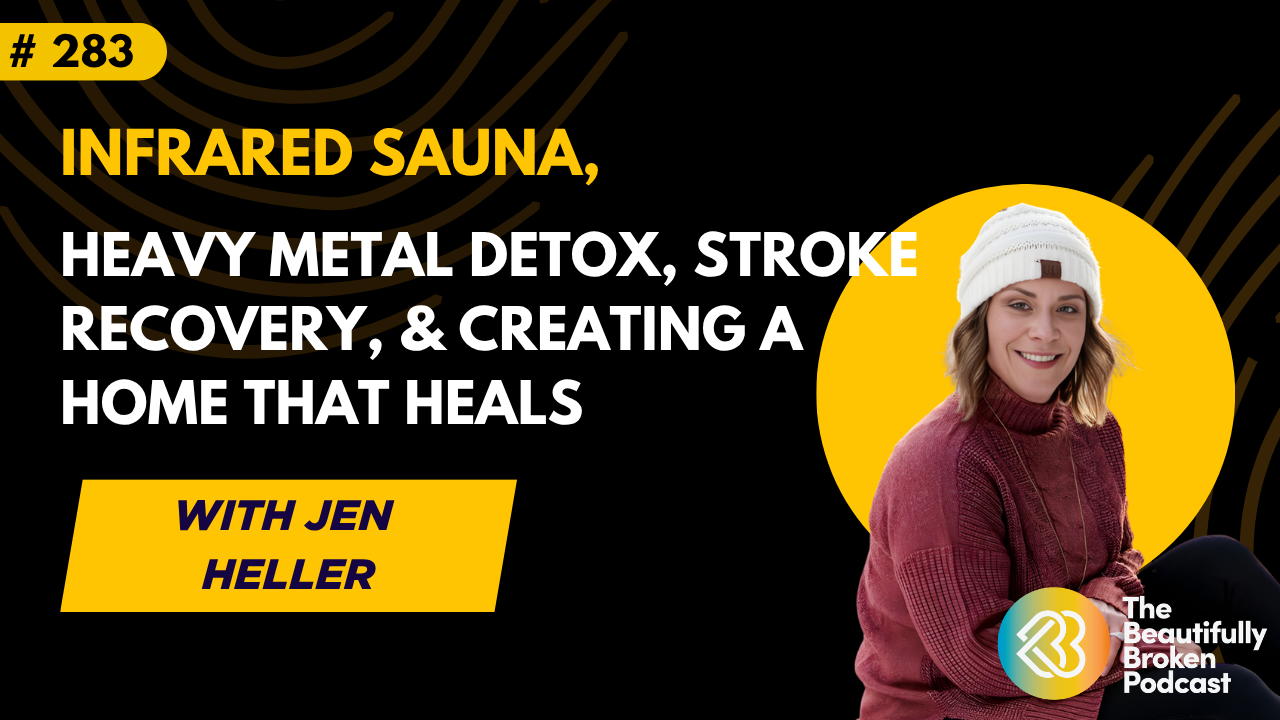
WELCOME TO EPISODE 283
Jen Heller is a functional wellness consultant and infrared sauna expert who has spent nearly two decades helping people understand how to use healing tools — especially infrared saunas — safely and effectively. In this episode, she opens up about the health crisis that started it all: crushing fatigue, brain fog, and 100 pounds of unexplained weight gain in her mid-twenties that conventional medicine wanted to address with surgery. A chance introduction to Nutrition Response Testing revealed off-the-charts heavy metal toxicity — and an infrared sauna as her path forward. That single recommendation changed the trajectory of her life and eventually led to her platform, her podcast Homes That Heal, and her consulting practice.
Freddie and Jen also get real about the mental health challenges facing so many people today — and why creating intentional, healing-centered spaces and communities matters more than ever. From Jen's "Heller Haven" retreat home to Freddie's backyard sauna gatherings, this conversation is a reminder that healing doesn't have to be clinical or solitary. Whether you're navigating a serious health protocol or simply trying to feel better in your own body, Jen's message is clear: no time like the present, and your health is your greatest wealth.


EPISODE HIGHLIGHTS
[00:00] – Introducing Jen’s story: stroke recovery, heavy metals, and rebuilding health
[02:20] – Processing grief, mental health, and the importance of real conversations
[07:52] – Early warning signs: fatigue, brain fog, weight gain in her 20s
[11:20] – Discovering heavy metal toxicity through holistic testing
[14:20] – The role of infrared sauna in detox and healing
[18:30] – Detoxing the body, and realizing what else in life needed to change
[19:38] – The stroke: paralysis, nervous system overload, and a perfect storm
[21:06] – Why conventional medicine couldn’t fully diagnose her condition
[22:20] – Turning to Chinese medicine and acupuncture for real progress
[24:04] – Living with paralysis, and slowly rebuilding function
[25:50] – The recovery stack: oxygen therapy, PEMF, red light, stem cells
[26:39] – Infrared vs traditional sauna: what actually makes them different
[29:04] – Why infrared sauna became a daily ritual and emotional reset
[34:22] – How to choose a safe sauna: EMFs, materials, and red flags
[39:55] – What to look for in construction, wood, and long-term durability
[46:34] – Why sauna is a lifetime investment, not a luxury
[50:19] – Building a wellness home: light, temperature, oxygen, and lymph
[55:00] – Why there is no universal protocol, only personalization
[57:00] – Final takeaway: if it matters, bring it into your home and your life
Links & Resources
Jen Heller's website: https://jenhellerlifestyle.com/
The Biological Blueprint Program: https://www.beautifullybroken.world/
Try CatchBio: https://www.catchbio.com/beautifullybroken
— Code: BEAUTIFULLYBROKEN
LightPathLED: https://lightpathled.pxf.io/c/3438432/2059835/25794
— Code: beautifullybroken
Get Silver Biotics: bit.ly/3JnxyDD
— 30% off with Code: BEAUTIFULLYBROKEN
CONNECT WITH FREDDIE
Work with Me: https://www.beautifullybroken.world/biological-blueprint
Website and Store: (http://www.beautifullybroken.world)
Instagram: (https://www.instagram.com/freddie.kimmel
YouTube: https://www.youtube.com/@beautifullybrokenworld
FULL EPISODE INTERVIEW
EPISODE TRANSCRIPT
Freddie Kimmel (00:01.514)
All right, ladies and gentlemen, welcome back to the beautifully broken podcast. You're in for a treat today because we are joined by Jen Heller. Jen, welcome to the show.
Jen Heller (00:10.517)
Freddie, thank you so much for having me. This is going to be a treat for all involved today.
Freddie Kimmel (00:15.298)
Well, I will tell you, I really, I want to say thank you for stepping in. As you know, life happens and Dr. Nasha, Dr. Nasha Winters, was going to be on and there was a fire in Mexico where she's at and her house is okay, everything's fine, but she had to evacuate for the smoke. So her internet signal was not going to happen. And I have a list of about six people that are kind of like in my head, I'm like, we could just do an amazing show.
at the drop of a hat anytime. And I've been wanting to have you on ever since you had me on your show.
Jen Heller (00:50.182)
Well, thank you. Yeah, we had a great time. We have a lot to talk about and I appreciate the ask, of course, but grateful to hear she's okay.
Freddie Kimmel (00:58.488)
She is okay. There's a lot going on in the world. In fact, I'll tell you, in a real transparency moment, like 40 minutes before this podcast, I just got a ping on social media. And you know how we have events at our house and we have dinners and we host an event called Open Spaces. I learned that one of the people that attended the dinner had committed suicide or he passed away. I don't have the full details, but it was just...
Stop me in my tracks. Yeah, stop me in my tracks and you know, I'm real time processing that and that is part of life and it's like, I know how bad people are struggling right now and I know the home, the container is not supportive to dealing with icky yucky things at this time because we're isolated.
Jen Heller (01:28.568)
my gosh, Freddie. Jeez.
Freddie Kimmel (01:56.226)
There is too much mirror, literal mirroring happening in a screen which is not good for our mental health. And I just was like, you know, one of the most important things I think we can do is just be real, raw, and honest, and transparent, and have deep conversations. you know, yeah, so I wanna, yeah, thank you for being here, and it just, it really hit me. It really hit me to be on the other side of my story and feel.
not have those thoughts because believe me there were I never wanted to end my life but there were times when I said to myself I won't do this I won't do this for a lifetime
Do you know what mean? It was more of a threat. I was almost like threatening the creator. I was like, we're gonna change this, because I'm not gonna put up with it. That's how I have been in that level of suffering. And I just, my heart really goes out to everybody. Everybody impacted in that way how that person's life was tethered to theirs, because I know there's a massive ripple effect through the field.
Jen Heller (02:36.837)
Yeah.
Jen Heller (03:01.743)
Yeah, I did not know that. So first of all, my heart goes out to you and your friends and your community for that. There's so much I want to say about this. I actually, as I shared with you when we chatted and when you're on my show, I shared with you the story of my niece who we brought in last year to live with us. And she, 18 years old, struggling with suicide. I mean, attempted multiple times. In fact, I just interviewed her on my show, which is going to air here this month in March.
She shared some more stories with me about trying to take her life, literally walking out onto thin ice on a frozen lake, hoping she'd fall through. And she didn't, you know, standing above a bridge or standing on a bridge above rushing waters and was about to jump. And then basically having a similar conversation that you were saying, like, I don't want to do this any, I don't want to do this, but I don't want to live this anymore. And she heard a divine voice say, step off the bridge. And she walked a couple of blocks instead and walked into a police department and asked for help.
Thank God she did. You know a lot about my journey, my story, paralyzing stroke, living with my husband's alcoholism, like really, really deep suffering and heavy metal toxicity, brain fog, just literally struggling to get out of bed some days. And I can honestly say, I don't think that I've ever, I mean, I know that I never really thought about taking my own life.
but I'm with you in the camp of where I was like, I can't do this. Like, this is too much. You're gonna need to show me a different path. I learned throughout the journey that things happen for us, not to us, but that still doesn't make it easy to process. It just asks more questions. Like, what am I supposed to do with this information? Why am I suffering? What am I supposed to do? And so I had a lot of dark moments too where...
I laid in bed because I couldn't move or just analysis paralysis, just paralyzed in my own thoughts and just too emotionally and physically and mentally drained to actually get out of bed. And now, mean, this was years ago, my journey started almost 20 years ago, but man, the world we're living in right now is noisy and there's a lot more coming at us as humans for sure.
Freddie Kimmel (05:29.046)
It was very different to experience what you did and I did 20 years ago. It was very different. I would almost, would, I again, hindsight's 20-20, I would almost say it was definitively easier.
Jen Heller (05:32.997)
Yeah. Yeah.
Jen Heller (05:42.736)
I would say so too. Yeah, it was easier because when you had the internet and you could look up things and you had access, but social media, mean, Facebook, all these, you know, Instagram wasn't even a thing. There wasn't as much noise and there wasn't as much chaos and there wasn't as much confusion. There were outlets, like resources that you could go to or look at, but it wasn't what it is now. It's very noisy.
Freddie Kimmel (06:10.574)
Yeah, it's really funny to me. it was at the time I was updating people on I did have Facebook. You know what? I think it was actually MySpace because it was like 2006. I think it was
Jen Heller (06:22.075)
I didn't do MySpace. I skipped that.
Freddie Kimmel (06:27.564)
I think it was MySpace, but I go back and I have some of those posts saved. I used no grammar. I didn't capitalize I's. I was like, this looks like you didn't finish high school. And I liked to write, but there wasn't AI to fix all your copy.
Jen Heller (06:43.299)
No, no. And I think it was cool if it wasn't correct, right? Like you just didn't care maybe. I don't know. Again, I didn't do Myspace. did, I think Facebook.
Freddie Kimmel (06:50.03)
It was a little bit like I'm wearing ripped jeans and a shitty old white t-shirt and I'm showing you that writing style on my MySpace page.
Jen Heller (06:55.117)
Yeah. Yeah.
Jen Heller (07:00.259)
I've got a carefree vibe of how I write things and say things.
Freddie Kimmel (07:05.08)
living on the edge. Jen, we don't know your story. And if you had to kick us off in a time where I like to say, when did you notice things were not flowing for you as far as your health?
Jen Heller (07:24.699)
That's a great question because there are a couple of very specific, what I would call like waypoints or milestones where you never forget those turning points. I would say my first one, I I struggled with weight. I would say most of my life, I was always kind of short and stout throughout high school. I wasn't the skinny girl. I had a lot of friends, but I struggled with weight a little bit.
But then when I got into my twenties, I got married young, I got engaged at 19, I got married at 21. My ex-husband and I, built a house, we started all the white picket fencing. While all my friends were going to college and just kind of getting into adulthood, I had already made the decision to, I was in business school, I had a full-time job with Coca-Cola, I was married, I was building a home, living, kind of living the life, right? Like really, really young. And on paper,
And to a lot of people that looked fantastic and like, la dee da, like that was great at the time. But I would say it was about my mid twenties, 25, 26. And I remember, you know, living in a nice home in the country. I was really overweight and I was really struggling with memory and like, again, getting out of bed, brain fog, fatigue. And I also realized that I wasn't happy. I started questioning what happiness.
meant. Because again, on paper, my friends and family in my inner circle was like, you have it all. And I was like, yeah, maybe if you looked at my front door, you know, I have it all. my marriage isn't great. My relationship wasn't great. I wasn't feeling comfortable in my own skin. I liked my job. You know, I worked in HR and administration for Coca-Cola, but it wasn't fulfilling. Like it was just monotonous.
And I really struggled. wanted to do something more creative and I just felt like I was in this box. And so when I talked about earlier being in like analysis paralysis, like I felt paralyzed in the morning, like just kind of laying there like, I don't want to get up and do any of this. If that makes sense.
Freddie Kimmel (09:38.39)
It does. How young were you when you started to experience the brain fog, the fatigue, the lack of motivation?
Jen Heller (09:47.644)
It was in my 20s. It was like mid-20s. And now if I go back, it was probably even earlier, could have been close to late teenage, but I didn't start noticing it. It started showing up in my job. I couldn't remember things. And I remember feeling very tired at my desk, just very lethargic. I would say I was about 25, 26, is when things, like I said, I started noticing it in a way of like, somebody my age shouldn't be having these types of issues.
But I also started asking some of my girlfriends and just talking a little bit about it, like, gosh, I'm really struggling. And again, I kept going back to the weight thing because, well, I mean, honestly, I was like 100 pounds overweight. So that's significant amount of weight. That's not just like, I got the 15, 20 pounds lose. It was like a whole human that extra that I was carrying around. And so I just kept kind of blaming it on that. Fast forward a bit of time and I started really digging down the path of like
how could I lose this weight? I'm doing all the things, I'm walking and I'm eating salads, like all the things that you're supposed to do supposedly. Nothing was budging and I was getting frustrated. So then that's when I was talking to one of my girlfriends and she introduced me to NRT, Nutrition Response Testing. She's the one that suggested I go potentially do some muscle testing on the body with a more holistic practitioner.
instead of baseline blood work, which I'd gone to get. And the baseline blood work came back like, hyperthyroidism, maybe we should take your thyroid out, your cholesterol is a little high, and yeah, you're 100 pounds overweight. Here's what we think you should do, surgery, burn, cut, and poison type method. And I was like, don't really want to do that. I went and got, I went hopefully with optimism, but a little skepticism as well to this NRT practitioner.
And she tested my body and I will never forget that day because she, within 10, 15 minutes, I don't know, you've been muscle tested, right? Where you put your arm up, sway. Yeah, I'm sure you're, yeah. But for those that maybe don't know what I'm saying, you're basically laying on table, you know, they use your arm, they test your body. Immediately, my body just gave her everything she needed to know. Heavy metal toxicity, mercury, lead.
Freddie Kimmel (11:51.864)
Hell yeah.
Jen Heller (12:06.715)
across the blood-brain barrier was just massive. In her words, this is the highest I've ever seen. I can't believe you're actually functioning. It's like, can't even believe you're actually alive. It's like, oh, interesting. Okay. There's an answer. You know, that's interesting information. Now what? You know?
Freddie Kimmel (12:26.223)
Did she correlate anything with labs or blood work at that time? Nope.
Jen Heller (12:31.599)
Nope. Nope. I didn't tell her about anything because I wanted to see if she could figure it out. Actually, I wanted to see if what she would tell me would cooperate with what I heard at the doctor. I didn't tell her anything about baseline blood work. I didn't tell her any of the results. As soon as she told me, thyroid's trashed, you've got metal sitting on the brain, it's testing out of the mercury fillings out of your mouth. Once she was like ping, ping, ping, ping, I was like,
interesting. I remember I just sat up and was like, okay, I need to tell you this. This lines up. Here's this, this, and this. And she's like, you don't need to take your thyroid out. We can do this instead. And then that's where the magic words were, do you know what an infrared sauna is? And I was like, I do not. Please tell me more. And then in walks infrared saunas into my life. So that's the magic story on.
of how this started. And I have to say that was very scary. Those results, that information was very scary to hear because I could see by the look in her eyes and her face that she was legitimately concerned about my well-being and thought that I was in trouble, like my health was in real trouble. But I went out to my car and was so excited. I mean, I was a little bit scared, right? But I was more excited.
and grateful that I had an answer. Somebody that I trusted didn't give a lot of information to. She just gave me the keys to the kingdom for me to turn this thing around. So I was very grateful and excited. So that's kind of, that's how it all started like literally 20 years ago.
Freddie Kimmel (14:16.763)
And what did that look like? Was infrared sauna one of the things that was a primary tool? How did that impact your physiology when you started to incorporate infrared?
Jen Heller (14:29.859)
Yeah. Well, the first thing was, is because I didn't know what they were. Now, I'm from Wisconsin, so I'm very familiar with traditional sauna, traditional heat, ancient wisdom. Saunas are not new to me. I've used saunas before. I'm a heap warrior. I love them. But the concept of infrared light energy was brand new to me. And so, I had to learn about it. And fortunately, she was very gracious with her time and helped explain it to me. In addition to shortly thereafter, because she was very enamored by my case,
Freddie Kimmel (14:39.599)
That's right.
Jen Heller (14:59.445)
We actually became fast friends and we're still friends, great friends to this day. She's still my practitioner. She would happen to be heading out to California a few weeks later to go to a conference, a David Wolf conference. Remember David Wolf conferences?
I don't mean to laugh, everybody knows the longevity David Wolf conferences, right?
Freddie Kimmel (15:15.553)
I do. I do.
Freddie Kimmel (15:21.135)
They're wild. For the audience, what would you say? They're not in the room. They haven't been there. What would you say if you had to say a couple sentences just in transparency and light?
Jen Heller (15:32.282)
about the David Wolf conference? man. Well, first of all, this was all new territory for me to begin with. I didn't know anything about holistic health, ancient wisdom. This is all very brand new to me. And she was just like, come with me. I can bring a guest to this practitioner event. I'd like to bring you as a case study with me and I'll introduce you to a bunch of people. not only did I experience
Freddie Kimmel (15:34.126)
Yeah.
Jen Heller (16:01.627)
what I would call, it was enlightening. A lot of dancing, a lot of music, a lot of free flowing body movement that I wasn't familiar with. But I also will say a very high vibe energy that I never experienced before, which I immediately was like, I love this feeling, this vibe of these people who are so excited.
to take care of themselves. that's where I met Dr. Hal Huggins, from Huggins, from the Holistic Dental Institute. He's kind of one of the creators. That's where I met Dave Asprey for the first time. He was just getting started. He was there, we're like chatting it up. I mean, this is where a lot of like, it was very fun, very vibrant, but looking back on it, and I remember coming back from it, I was like, what the hell was that?
Like people just get together and do this and you know, it's wild. It was just so new to me, but I was kind of drunk on it actually. was really, it was really fun.
Freddie Kimmel (17:08.835)
Yeah. And so you had some other big health events in your life besides discovering that the onset of the fatigue and we'll say your metabolic tone, know, resistance to weight loss. What else unfolded in your young life?
Jen Heller (17:27.481)
Yeah. So I want to mention too, who I also met at that conference was Clear Light Saunas. And that's where again, that's the intention was to introduce me to infrared saunas, introduce me to infrared heat, the detoxification, what we needed to do to get these metals safely out of the body, the importance of how to do that, how to detox safely. So that was really good information that I brought home. I also bought a sauna for my home, which was on Ashley's recommendation.
And what we basically did over, you we put out a plan because this was kind of a big, it was a lot. Again, I was excited to, but it was a lot because I had a couple of hills I needed to climb, right? Like I needed, now I know I'm loaded with these metals and that's not an easy path out. She said that was going to be about eight to nine months. I wanted to hone in on the weight. And then I was also kind of worried about the brain. And as you know, fast forward.
You know, once I started on this path, weight started coming off, slowly chipping away at things. This is where some of the dark moments, dark, heavy moments come in because I felt like I got hit by a bus when you start stirring the pot of the lymph system and you get these detox pathways open. And I'd never done this before. Fast forward a bit of time and that's where the stroke came in. I had a paralyzing stroke event. It wasn't...
It wasn't just the metals and it wasn't the detoxification by itself. It was kind of a perfect storm of the heavy metals removing a tremendous amount of stress. ended up moving forward with a divorce. I decided I wasn't happy in that marriage. So what's interesting when you sitting with yourself and you start the detox process, you're like, hmm, what else is not serving me in my life and do I need to shed?
I got divorced and that was very uncomfortable, awkward process for a bit of time, brought a lot of stress to my life. I also decided I wasn't happy in my job and so I left my job and decided I was going to go all in and start teaching other people about infrared heat and some of the things that I had learned. So I kind of created this perfect storm, if you will, of a lot of things that the nervous system couldn't handle. And in hindsight, I probably should have
Jen Heller (19:49.582)
moved a little slower with some of these things, right? But the catalyst piece of the stroke is kind of bittersweet because once I had the stroke, it was an evening in, I remember September, brought me to my knees, basically paralyzed the left side body. Immediately then I went in and was, know, MRIs, CAT scans, looking at different tests, working with doctors and specialists trying to figure out like
did this happen? You know, I was in my early 30s at this point and what we found was that I had a brain injury on the right side that had happened during an explosion, large massive explosion that I was unfortunately a part of when I was 15. That went completely untreated at that time because there were fatalities and casualties that day and I was the least injured. I was never treated.
but it turns out I had brain damage on the right side of the brain from that explosion that just caused enough inflammation between the metals, the detox that we were doing and a lot of stress, quite frankly, a lot of stress. And it just flatlined me, literally brought me to my knees. So that was milestone number two. Basically there's before stroke and after stroke for sure.
Freddie Kimmel (21:14.434)
Now, for the audience, know, there's many different types of brain bleeds, strokes, many strokes that people can have that don't even show up as symptoms and then there's evidence in the brain. What specifically happened to you when you got through all your MRIs and your scans? What did you learn?
Jen Heller (21:35.484)
Well, the interesting story, Freddie, is that I never got a definitive diagnosis from it. Five years of in and out of hospitals, specialists, I bounced between three different medical facilities, numerous specialists throughout the Midwest. None of them could label it because it didn't check all the boxes of a specific stroke, what they would call a specific type of stroke.
All they could say, all they said was, you've had a stroke like event and here's what we know. So I got a little frustrated with that to be quite honest, because they didn't have any definitive answers, but they also didn't have any helpful information about what to do about it. I was grateful and I'm still very grateful for the information. I was grateful there's no tumors, like all these other things didn't show up.
you know, fortunately getting a lot of these scans, mean, in and out of the MRI machine, don't even know how many times, EMGs, CAT scans, you name it, just every kind of read they could get on me. I was grateful to get that information because it ruled out a lot of things for me. And then finally, one day I was like, I'm done. I'm done with this. I'm going to go a different path. And I scheduled an appointment with a traditional Chinese medicine doctor.
here in the Madison area that also has an institute and school for acupuncture. And he specialized in working with people overseas as well as all around the world with stroke or just episodes that are considered a stroke event. And I'm laughing and it's not funny, gosh, this guy, meeting him for the first time, he was just...
like boom, boom, boom, this is what you've had. This is what we're gonna do and this is how we're gonna handle this. And he just started shoving like needles, like lay down, do this. He's like doing all sorts of stuff on my body, trying to get the nervous, like all ancient wisdom type stuff, you know what? I didn't question it. I was just like, okay. Like just kind of going along with it. Within minutes, he was talking about getting the chi. I remember he's like, we gotta get this chi moving, they're sluggish.
Jen Heller (23:55.292)
He immediately was like, opened up these pathways. And that was one of my first real experiences with acupuncture as well. I didn't even have time to question it. He just started putting needles in my body and all over my head. But I could feel like life force energy moving. It was incredible. I remember I was crying. I was emotional. I didn't even know how to deal with, I didn't even know what the hell was happening actually. I just knew that I could feel something and
Freddie Kimmel (24:12.175)
Yeah.
Jen Heller (24:26.221)
I felt like a cool sensation of energy moving throughout my body. And from that day forward, he was my guy.
Freddie Kimmel (24:33.466)
Yeah.
Freddie Kimmel (24:37.129)
What was your prognosis at the time? Like what were the physical ailments you were struggling with post stroke and then where are you today?
Jen Heller (24:44.603)
So where I was at for a very long time after, what it affected mostly was basically like limbs. So like my left hand was in a fist, basically paralyzed from the elbow down and from the knee down. Now I could stand on my left leg and kind of like, almost like drop foot, right? Like you can walk, like the hips move, I could move, but it was like you're dragging.
your thing, know, dragging your limbs. I could move my arm, but I was doing like this, right? I could do things, but my hand was in a fist. And so that's pretty much what I lived with for a few years. But I threw everything I could at it, you know, because at this point in time, I also had a lot of really great resources in my corner that started saying like, hey, try this. Here's some things you could do to get in front of the muscle atrophy. Here's some different things, you know, herbs and different tinctures, different things you can do to
keep the circulation and the blood flow, know, lions main for the brain. Like I just, a million things, like I threw everything at it I could to try to not make it worse, you know, but slowly over time, my hand opened up and a lot of that was from acupuncture. A lot of it was from different PEM therapy, stem cells, red light therapy, the sauna. I mean, my home is basically now a wellness fortress.
I have an oxygen chamber in my home, was using that every single day for one to two hours. So getting straight oxygen. So, you know, fast forward, however many years that was now 13, 14 years ago. If you saw me today, you'd never know I was paralyzed. My hand, my left hand still has some motor function skills. Some days are better than others, but for the most part, you know, I walk and talk and do everything normal. Everything's normal.
I would say I'm about 98%.
Freddie Kimmel (26:41.424)
Amazing. Amazing. Well, you certainly were not going to get that in the current medical system. And you had to go out and patch together a road to where you're at today. Incredible. Incredible. Can you talk to us a little bit about, you said, the science of infrared light energy? You know, what's the value of a sauna? Because we could easily
Right now at this date and age, it's very like, you know, people are pushing themselves to the breaking point in traditional saunas and then they'll jump in 40 degree water and it's the, you know, it's very the man, I heard someone yesterday, they said it's the manosphere of knuckling through it, but talk, cause infrared is different than a traditional sauna. So maybe break those down for the listeners.
Jen Heller (27:24.697)
Yeah.
Yeah.
Yeah. So it's not even a stretch for me to say that infrared light changed and saved my life for sure. Not just through eventually detoxing the metals and eventually releasing over 100 pounds through a variety of different inflammatory supplements, things to allow the body to release that. But infrared is, the best way I like to describe it is kind of like sunlight.
So we know you're standing in the sunlight and you feel that radiant warmth to the body and it feels good. It actually enters into the body and you feel warm. You feel that kind of systemically throughout the body. Infrared is essentially light sunlight energy without dangerous UV rays. And our bodies being energetic beings work with that energy. Now I'm going to make a statement that, you know, can send people down a rabbit hole, but as long as you're in a safe
genuine infrared sauna that is actually creating a wavelength in the right micron, it's about 9.4, that is working with our energetic human beings. That's the nature, natural wavelength that you want to be in. What I love about infrared is because it enters in the body, it's designed to elevate core body temperature, so we sweat and detox from the inside out versus just traditional sauna heats the airspace. And again, I'm a fan of traditional saunas. Anywhere I can get in a sauna, steam room,
Jen Heller (28:57.731)
Anything warm, I am there. I love it. But it's a different application of heat. A traditional sauna or steam room is usually 170, 200, sometimes even 220 in temperature. It's designed to force our bodies to sweat. So you're kind of in a hot box, which innately our bodies designed to sweat when we're hot. Infrared, because it penetrates into the skin and muscle tissue, the temperatures are much lower, designed to work with the body, meaning lower stress.
lower cortisol, not sending us over the edge with these extremes. It really works with the body to find a sweet spot where it's comfortable but not overwhelming. You're not gasping for air. A lot of people can't handle a traditional sauna. They maybe get two, three, five minutes and they're like, I got to get out of here. Infrared is a much lower, gentler dry heat.
And again, it's designed to elevate core body temperature, not the airspace. So it's much more relaxation, taps into the detox pathways a bit deeper. But for me, I have to say personally and transparently, and this is why I fast forward a few years out of the gate, I opened a sauna studio wellness center because I became obsessed with the feeling.
that I felt while I was sitting in the sauna. It wasn't just the heat and the sweat. It sends the signals to the brain to put us into parasympathetic nervous system state. It lowers our stress. It relaxes our muscles. Like I said, you kind of just turn into like you just melt. Again, if people think about sitting out in the sun,
know, particularly a sunrise or sunset, you just kind of like sink into that feeling of the light energy. That's infrared. That's an infrared sauna. So I got really protective of my time in the sauna because it became my sacred space where I not only was, you know, sweating, releasing weight, detoxing, whatever, I was going inward. That's where I learned to meditate. That's where I learned to start having
Jen Heller (31:18.075)
deeper, more meaningful conversations with our creator. That's where I really started listening to myself, like truly listening to myself and my gut intuition. I started a real, genuine relationship with myself and my body inside one of these saunas because you get naked, you get raw, you get real. Maybe you throw on some music or some 432 Hertz.
or you get a frequency that starts invoking emotions, like I like to do that intentionally, like create an environment to start, you know, amping up a feeling. You can get real clear and dialed in on your own wellbeing when you're sitting with yourself for 30, 40 minutes. And I'm not saying you can't get that in a traditional sauna. You can certainly create a similar vibe, but it is unlike infrared. It's not the same.
Freddie Kimmel (32:09.251)
Yeah, there's a... and I just went in the sauna at Lifetime Gym yesterday. I have an infrared, a little portable one in home. I've got the big traditional sauna. But sometimes at the end of the day, after being on screen, screen, screen, I actually, want to go sit around other people. And it's not that I even talk to the other people. It's that I want to be around humans. I want to be...
Jen Heller (32:36.431)
Yeah, you want the energy.
Freddie Kimmel (32:38.435)
I just the energy, it's the energetic, it's navigates, eye contact, it's a smile. So sometimes I'll choose that. But yesterday I really did notice that edge that you get to. And I'm, I'm someone who I can do a 200 to 20 degree sauna, but it's so funny. These are mines of a fireplace.
It's a stove and I'm building a fire so there actually is some infrared elements of that wood and coal emanating through the thick black steel. It's different. These are electric heaters and it's so interesting is because, and I'm not a sauna snob, but it hurts a little bit. There's a sting to it. It's not, it really does feel like a mental exercise.
Jen Heller (33:07.483)
Yeah.
Freddie Kimmel (33:31.503)
And I'm like fighting that edge to get out as opposed to being where you feel that deep internal warming. It's very different.
Jen Heller (33:40.092)
That's a great explanation. I was just going to ask you because you have both and you experience both. There's a definitive difference between the two. Like I said, sometimes when I'm traveling, I love going to sitting in the steam room. I just love that feeling, especially if it's eucalyptus. But to your point, there's an edge to it. It's a different mindset. And I think that's where the cold plunge stuff comes into because
I've been doing cold contrast therapy. That's one of the things I've also done to wake up the nervous system and the circulation. And there are days where I'm standing in that thing and I'm like, I do not want to get in this thing right now. I do not want to get in this thing right now. I do not want to, I don't want to do it. And then I'm like, Jen, just get in it. You know, it's for like three minutes, get in and get out. But it's like a mental mind. It's like, I don't want to do it, but then you do it and you feel great and then you get out. I never don't want to sit in the infrared sauna, never.
Never have I been like, don't want to get in there. It's like, I can't wait to get in there. it's gonna be great. Like every time. So it's a different mindset. Yeah.
Freddie Kimmel (34:42.743)
It is so gentle. It's very lov- It is a loving heat. Again, when it's a good, we talked about good, we talked about clean, we talked about different spectrums, and there's something I miss. Now the portable one I have is just a zip-up. My head pops out, so I can't say that I get that same environment of being like, I can smell the wood, and there's space, and...
Jen Heller (35:09.956)
Mmm.
Freddie Kimmel (35:11.983)
My brain is getting the warmth and my face is getting the warmth. So talk to us a little bit about like what is a good sauna and how the heck do people navigate once you decide that you want to have sauna in your health game? How do you navigate that as a consumer? And what am I looking for? What is the criteria or yardstick that I'm measuring good versus bad?
or let's say the one that fits my need.
Jen Heller (35:44.028)
Yeah, this is the million dollar question that I try to help answer for everybody every day as you know, I'm deep in the sauna world. A couple of things I'll say. First, you're 100 % right that there is a difference between the 10 zip ups and the stand alones and that's one of the number one questions I ask people is what is the experience you're looking for and what is the space you're working with in your home because that matters.
I talk to people every day that are using these for cancer protocols, mold protocols, Lyme's disease, anxiety, stress, heavy metals. And some of the stuff is very serious time-sensitive situations for people. They're also working on, everyone has a different budget. So there's no black and white answer here and there's no one size fits all. When you call me or you jump on my site or you listen to my podcast, there are a couple of very...
beginner questions, I always tell people we need to answer those first to find out what then is the best fit for you. And that's where I think the noise online, is me and my soapbox for a second, there's so much information online right now that people are really confused because saunas, cold plunge, all these wellness tools have become so incredibly popular and mainstream for in our homes that now there's like 100 to choose from and people just don't know. But the main
The two main things to know when you're shopping is, what do I need it for? What's my hope and my expected goal from purchasing this sona tool? And secondly, is it safe? And the safety piece is very important because infrared can be created. It's a light energy wavelength, basically like a radiation that enters into the body. So it needs to be from a reputable company that actually knows what they're doing.
they're using materials that again, going back to what I said, safe for humans, they're safe to work with the body, with the human body. Meaning there are a lot of companies on the market that are making boxes with heaters that are just creating infrared wavelengths that can actually be harmful. It's EMF, electromagnetic frequency. There's also something called ELF, extremely low frequency, which is just another form of dirty electricity is basically entering the body. So think of it like these phones, different
Jen Heller (38:04.195)
electronics, all these things can emit different frequencies. Well, if you stepped into an infrared sauna that wasn't created mindfully by a company that actually has integrity into doing so, you could be causing a lot of harm, a lot of harm for yourself. And for me personally, if I would have got into an unsafe sauna years ago with the levels of metal that I have had and the carcinogens, basically like throwing a tin foil ball into the microwave. Like it's just exasperating a situation.
It's not working with the body. It's actually causing more friction, more interference. So that's what I would say is most important. There are some good resources online, but for anybody not sure, I mean, my website, you know, the jenhellerlifestyle.com site, loaded with information. My podcast is loaded with information. And I really just encourage people to go with their gut too. Like you don't want to cut corners on your health because you can pay for an hour, pay for it later.
And so when you're shopping, typically most integral sauna companies are upfront with and post their EMF ratings, which is third-party testing to show this is what these ratings are. Here are the safe thresholds. If that information is not available or they don't want to give it, or they get a bit defensive, that's a red flag, then you know. But a lot of reputable companies online and available and most of the major players, like I said, I've worked with Clearlight for
over 15 years now, they're pretty much the pioneers in the industry and been around for 30 years. But there are others as well.
Freddie Kimmel (39:38.202)
Yeah, yeah, there's a couple, you know, I know clear light I know sunlight and art are two that that come up in conversation a lot, you know, you've got the again You know, I've got the little portable one I have from Therisage, which is under you know under a thousand bucks
Jen Heller (39:42.811)
Mm-hmm. Mm-hmm.
Jen Heller (39:52.166)
Therisage is great. Yeah, Therisage is another great company. They've around a long time. They're doing, they're making a great song as well.
Freddie Kimmel (40:00.218)
Yeah, and that, you know, I tell people with the discount code, that was like 1,100 bucks. And if you had to get started somewhere, do that. Now, I would also play out on the longer timeline. This isn't something, this is hopefully a device to use for a lifetime. Let me ask you this, because I just don't know. What is the life of a sauna? Let's just do Clearlight. How long do they last?
Jen Heller (40:05.284)
Yeah, very affordable.
Jen Heller (40:30.095)
Well, one of the many reasons why I work with Clear Light and have for so long is because they've been the major pioneer and have been around so long and work a lot with the medical community. They have a lifetime warranty on their sauna and it's good for as long as you own it. Meaning they stand, it's a very high quality piece of furniture out of the gate and they stand behind it for as long as you own it. There's no fine print, that's just what they've done for years.
A lot of other sauna companies, if you look at their warranty, they consider the life of a sauna seven years or 10 years. Like Sunlight, and I know they have a seven year on their cabin and like one to three years on their electronics. So I always encourage people, the warranty speaks volumes. So look at that and ask yourself, if I'm going to invest a few thousand dollars into something,
Like what's the investment, like overall protection of investment? For ClearLight, it's forever for as long as you own it. And I have customers and people that have had their Sonos for over 20 years and still love them and use them. So there's really no sort answer or there's no blanket answer because all Sonos companies are different, but the warranty will tell you.
Freddie Kimmel (41:48.658)
For some reason, why did my mic just kick over to my... Did you hear that?
Jen Heller (41:53.157)
I don't know. Yeah, I can hear myself echoing right now.
Freddie Kimmel (41:58.94)
Let's find, let's mark this clip, let's pin this. And then let us do this, did this to me yesterday. In my webinar. Hmm. Yeah.
Jen Heller (42:09.198)
boy.
Jen Heller (42:13.435)
So you're not echoing, but I can hear me echoing.
Freddie Kimmel (42:22.706)
Default, I've got you unsure. Let's find me.
Freddie Kimmel (42:31.634)
Hmm.
Freddie Kimmel (42:36.466)
I don't see where I can change. Yeah, let's see this here. Mute all.
Jen Heller (42:39.899)
We just cut out for a second. I can still hear myself talking.
Freddie Kimmel (42:50.739)
I'm going to try to plug this back in. I may have to stop.
Jen Heller (42:59.783)
there you are.
Freddie Kimmel (43:24.508)
Testing one, two.
Jen Heller (43:26.011)
There you are. I don't hear anything. No, no echo. back in business. We're back in biz.
Freddie Kimmel (43:28.188)
Can you hear it?
Freddie Kimmel (43:33.042)
Great. We're back in biz. It's so weird. It did that to me on a webinar yesterday. Well, let's pick up Out of the blue. This is weird. I might try my cord again. Sometimes these USB-C's get a little funky. If we were to go back to, if we were to pick up at like sauna construction and the wood and
Jen Heller (43:41.253)
Out of the blue, yeah, I was gonna say out of the blue, that's weird.
Jen Heller (43:52.111)
Yeah.
Freddie Kimmel (44:02.938)
the staining, like what should be looking for as far as materials in a song?
Jen Heller (44:08.111)
Yeah. Yeah, great question. You know, again, most integral companies, to be quite honest, are using non-BOC exterior varnish. The inside of the sauna should be raw wood. You definitely don't want any kind of like glues or lacquers or any kind of adhesives or pesticide, chemical-laden wood. So you want to kind of dig into the details to make sure that it's clear that uses eco-harvested
straight to the kiln, straight to the sawmill basically. So it's raw wood on the inside. Cedar is the premium wood, to be honest. It's the premium option because it's anti-fungal, it's naturally antibacterial. That's why it's been used for hundreds and hundreds of years. Unfortunately, cedar's resourcing is a little different over the last five, six years. So a lot of other sauna companies are using, know, hemlock or...
Basswood or Mahogany or some of these other, Eucalyptus is another one. So it's just personal preference there. But again, it all goes down to the company who's building it. I'll be honest, I try not to get too much in the weeds, but I'm not a huge fan of the Costco saunas and the Wayfair saunas and Amazon. There are lot of great things that I buy at Costco, a lot of things I buy on Amazon, but my health isn't one of them.
And so those would be a really good example of like more economical options that are not what I would consider in the premium safety zone, as well as you're going to just get like a one to two year warranty on those. the main thing again is companies like Clearlight completely disclose every single thing they're using to create the sauna.
So it's on us a little bit, and this is where it gets a little messy sometimes because people just want it to be done for you. But the problem with the World Wide Web having so many options, like we really do need to be our own health detective and our health advocate and dig into the weeds a little bit and ask questions and ask these companies like, could you send me your EMF report? Could you send me the information where you source your wood?
Jen Heller (46:20.187)
Where are they built? Is another great question. You know, are they sitting in some warehouse somewhere for however many years, you know, so just asking those questions Are really important and then again, you know Go with your gut right like if your guts telling you I mean that's kind of how I've been chugging along for the last 15 20 years is that when something felt off I just pivoted and I looked elsewhere. And so maybe it's not
beaming with a stop sign saying, do this, which you have to read and kind of discern a little bit for yourself. is this a good decision or should I look at something else? And then again, fallout fails, you can reach out to me or my team as a resource, but the quality and the craftsmanship of these tools matter because you're sitting in it, you're exposing your body to it, you're opening your detox pathways and your pores.
You don't want to be sitting in something that's full of chemicals, dyes, adhesives, glues, off-gassing, petroleum, rubber, all of that. All of it needs to be like the none of it. So if you see all the gadgets and the bells and whistles and there's a iPad built into the wall, you don't need an iPad built into the wall. You need less noise. You should leave your electronics out of this. Actually, you know, this is where I tell people like, let's not have all the smart devices. Let's just like.
find some simplicity and keep it simple. Like I still have a very simple sauna. know, Clear Light Cell is a sanctuary and a premier and the sanctuary has a few extra bells and whistles. My studio had sanctuary saunas because they're gorgeous and they're, you the Cadillac, but in my home, I've got the old school premier, which just looks like the traditional style wood cabin, simplistic, doesn't have remote connectivity, don't need any of that stuff. I use it as my sanctuary space to like...
Freddie Kimmel (47:51.41)
That's right.
Jen Heller (48:17.593)
disconnect from all the noise in the world and just go inward. So that's my suggestion.
Freddie Kimmel (48:23.666)
That's right. I would say the same thing. It is a process to build a fire, but honestly, I like scavenging the yard for kindling and winding up the paper. Part of the process is readying the sauna for the people who are going to join in community. I want to ask you one thing about investment. From their lowest model,
Jen Heller (48:29.572)
Yeah.
Freddie Kimmel (48:50.114)
up to the premiere? What's the price range people could be expected to invest for Asana?
Jen Heller (48:58.299)
Yeah, well, with the Clear Light stuff, the portable dome, which is very affordable, it's like 2000, so 1999, basically out the door. That's a great price point for those, again, who are maybe living in a very small studio apartment or maybe don't have the space for it, or you want to be able to have the option to roll it up and tuck it in a closet. I also have a lot of people that travel with those because they travel for their work or for whatever reason, but they need this heat therapy for some sort of protocol they're working through.
they can literally take it with them. that's like the lowest entry is $2,000. And then it moves, I would say the average one to two or three person saunas, those are anywhere from like $5,000 to $7,000 are going to be, and these are out the door prices, shipping tax basically on your doorstep. And then of course we have like the larger models, four and five person models. We've got the outdoor saunas, which are kind of the Cadillac options. Those are eight to 10,000.
Price range depending on the kind of space you're creating, whether it's indoor or outdoor, we have both, which I will say a lot of people, including yourself, like you have a phenomenal wellness space at your home. People are integrating both indoor and outdoor. So if you've got a great outdoor space and you live in a climate that's not, you know, high into the mountains because these aren't designed to be under 70 feet of snow, but...
If you live in a space where you are expanding your lifestyle outside and you have the room, again, this is part of the questionnaire I ask people is like, where do see yourself enjoying this the most? Where do you want to go to relax and restore? If you have a great space outside, perfect. If you are turning in a spare bedroom, maybe your kids moved, went to college, and now you've got a couple of spare rooms and you want to turn it into a wellness room, a little sanctuary space.
That's cool too. So we have different options for whatever space you're looking to create.
Freddie Kimmel (50:59.164)
Yeah, I love it. I love it. My brain is already, I have so many ideas about what we could build outside. I say get outside if your space allots in your investment. But again, I would also just, anybody who hears this, I know we're all looking to spread our pennies, but this is a lifetime investment, a lifetime investment. it's shocking to me the...
leases that we will sign up for for these ridiculous four-by-four vehicles and you live in the suburbs. You don't need it. And it this is something that actually reduces all-cause mortality at a really high level. I used to have I always have the figure I'm like it's like a 40 % reduction in all-cause mortality for four times a week in a sauna.
Jen Heller (51:47.164)
Yeah. It's interesting. Like I said, I opened a wellness center back in 2013, and because I was just so incredibly passionate, like I said, it had saved my life. There's no sugar coating that because there was nothing else that was going to help extract the metals and put my body into a parasympathetic state like the sauna did as well as allow me the space and what I say freedom.
in my life to kind of go inward in a very private, secluded space. Nothing else would have done that for me. So when I opened my center, you know, people come in and rent, you know, basically we created sauna suites where people come in and rent the saunas for, you know, an hour, you get a sauna session. Now there are studios all across the country, right? And so my staff, like people always like make fun of me or laugh and say, Jen, because I talk people into not coming to my studio, like come in and try it. And if you love it, okay, great.
be a member for a month or two or three, but like after a year or two, you're going to pay for one of these saunas. Like you might as well have one in your home and then you could use it whenever you want. You don't have to, you know, try to get on my schedule, my routine because consistency is key. Just like a workout, you need to do it two, three, four times a week. If you really want to reap the benefits, as well as if you're working through a protocol, again, this isn't something you willy nilly one off here and one off there.
to really reap the benefits of the all-cause mortality, better sleep, fantastic skin. If you've got eczema, psoriasis, rosacea, you can work through skin conditions. It's fantastic for pain management, chronic fatigue, mental clarity. mean, just completely opens up your eyes and your body to feel better. A lot of people healing through injuries, surgeries that they never, still working through pain or struggling with healing.
The list is a million miles long, so it's like having a little wellness center in your home. What I'm doing now is not what I was doing 20 years ago, but boy, am I grateful that the other day when my husband, you'll probably kill me for saying it, he blew out his near. I don't know exactly what he did. He did something playing tennis. He was in a tennis tournament.
Jen Heller (54:04.639)
It was called the Generations Tennis Tournament, meaning you and your partner had to have at least 20 years of age difference, some like fun tournament they're doing. He's the young guy, and he comes home limping because he got hurt. Well, what does he do? Goes down to the sauna, sits in the sauna, red light therapy for a bit, for a few days to kind of get this thing back into a, get in front of the healing on it.
It's just great to have a tool like this. It's not something that you're like, I need to invest in it now, but I only need it for X, Y, and Z. You're going to use this thing forever. It's a lifetime investment. So again, that's why I encourage people like, let's think through how you want to use it, what you need it for, how it could support your family now and into the future. And then, you know, pick a space in your home or in your yard where you feel like that would be a good fit.
Freddie Kimmel (54:52.413)
Yeah.
Freddie Kimmel (54:57.81)
Yeah. Yeah. It's definitely one of my pillars. You know, if I had to say core four core five, I would say, I'd say light, which we could put light, but I also put it in temperature as medicine, body, but the ability of the body to regulate temperature, and optimizes detox pathway. would say pulse, electromagnetic. I would say some type of an oxygen therapy, obviously lymph and then everything else. I understand where you are going to need.
nuance-specific tools to regenerate a joint or different things, but a home studio... What is happening? I just had a phone call. Did you hear that?
Jen Heller (55:32.816)
Right.
Jen Heller (55:40.539)
Yeah, I could. I've had two phone calls on my computer since I don't know if you heard it, but I've had two calls come in. I'm like, what? thought I turned those off.
Freddie Kimmel (55:47.089)
This is set on do not dist- I'm telling you what, the internet's being weird today.
Jen Heller (55:49.741)
Mind's on do not disturb also. maybe we're working through some techno, some real interesting stuff happening today.
Freddie Kimmel (55:56.403)
We will see. Yeah, it's definitely part of my, like if I said, you know, what do you need? Again, how do you feel? What do you want? What are you willing to do about it? I hope the audience is not tired of that, but it's really what do you want to create? And there is a case to be made for doing some of these things in community. That's kind of why I went so big at the home with a full body red light panel, with a 12 person sauna, because I wanted to say, hey, come over.
Let's do that, you know, let's not do, you know, everybody's like, what are we doing on Friday? I wish there was some more sober events. I'm like, let's light the sauna and like, hang out. Well, I'll throw some steaks in the grill. Bounce in the trampoline, whatever. Yeah, we'll play some music. Let's just, let's come hang. You're gonna feel amazing. You're gonna feel amazing.
Jen Heller (56:35.363)
out.
Yeah, play some music. Yeah.
Jen Heller (56:45.426)
That's pretty much what we, I mean, our home we call Heller Haven. We moved out of the city about five years ago after I had to close the center during COVID. And I was like, I'm just kind of done with city vibes. And so I really just had a dream in my mind of like, I'm going to buy a huge house in the woods and invite a bunch of people over and just kind of create a retreat.
not only for us to enjoy because this is our lifestyle, this is what we do, but also invite people over. In fact, on Sunday I had 10 girlfriends over for brunch and then we took turns doing some different things and a lot of the ladies that came over had never really fully experienced Teller Haven before. So they were like in the Pemph chair, in the sauna, on the power plate, like all these things. And it's just fun. Like, it's just fun. We just sat around, we did some...
meditations, did some energy work together and just kind created a container and then just did some, you know, wellness, worked on some wellness tools. So yeah, that's how we live our life. That's what we've created and just feels good.
Freddie Kimmel (57:53.939)
Beautiful. Beautiful. That's a really good kickoff, Jen, to your story. I really appreciate the background on sauna and infrared and the clarity often asked about questions. I'll be able to, you know, we'll create a whole landing page for this episode with all the, we'll put all the text in there. We'll put all the links so people can just find this as a resource. When you're looking for a guide and next steps and we'll put your website in there. So if people have questions, they can connect directly with you.
Jen Heller (58:02.149)
Yeah.
Jen Heller (58:14.725)
Yeah.
Freddie Kimmel (58:22.536)
And I can't wait for the next one. I want to be honorable of your hour because I know you have a very busy week and I know you have some trips planned and I have a big party coming up.
Jen Heller (58:30.523)
Yeah. I am actually heading out the door in about an hour. We're hosting a party tonight. We got about hundred people coming, not to my house. We're going over to the country club where Mark plays tennis and just hosting an annual event. Nothing special, just getting people together for spring and chatting about wellness and chatting about some investment stuff that we're working on as well. Just creating health. Your health is your wealth and your wealth is your health, right? So we're just continuing the conversation. And I'm so grateful for you too. I appreciate the...
last or the invitation to come on, you know, I'm never going to say no to talk about saunas or talk to you or talk about wellness or tell people like, let's get going. Like no time like the present.
Freddie Kimmel (59:08.777)
Yeah. We'll do a part two and three and four because I really do want to get into the healthy home and the energetics. You know, the energetics of this. I did a big talk yesterday, first time out of the gate on a new presentation on the biological makeup of the lymphatic system and its mechanisms. Really like how it's structured and how it operates from a mechanistic standpoint. And the big question.
Jen Heller (59:16.441)
Yeah.
Jen Heller (59:20.752)
Yeah.
Freddie Kimmel (59:37.936)
It was on FDN's Health Week. The big question was like, just tell me what to do, what's the protocol, give me the checklist, how many times, and I'm like, I don't, I know it's so frustrating. I don't have it. I don't have a checklist. It really comes back to like your biology, like how inflamed are you? What's your level of fatigue? Do you have chronic pain? Are you resistant to weight loss? What's your current diet look like? Tell me about your work environment. How many times are you getting up and down?
Tell me about your urinary habits. Do you know if you're one of the 75 % of Americans that are chronically dehydrated? Then we could start to have that conversation. All I can do is I can teach you how the system functions, ways to move it, but at the end of the day, if somebody gives you a checklist, it falls short of, it's hard, I want to do that, but it falls short of you taking radical ownership of your health and taking that information. You got to put it on the body.
And that usually is, that's going to be at a workshop. That's going to be probably working with somebody a little bit. So you understand, am I doing this right? Is it wrong? Am I skipping steps? So it really does come down to that personalization. And I think that's what we have to, I think that just serves this community. When you hear a podcast, just don't take it as, the, this is what Jen said. You know, this is your jumping off point to get curious and just start, there's no rush.
to go buy a sauna or go do any of these things. Like, you don't need to go buy a tool tomorrow. I do think it's how does it fit into my life and am I gonna need help with my accountability on following through with myself so this becomes a habit long term.
Jen Heller (01:01:19.781)
Right. Yeah. And that's why too, it's like, you know, when you had asked where do people start, you know, it's all over the board. you know, I mentioned this to you a couple of weeks ago when we talked too. When I first got into this industry, it was a lot of the conversations were very similar. People were buying these kind of more for like luxury items, like la-di-da, you know, like I want a sauna in my home or I think I'm going you know, it was more of like an elite purchase, so to speak.
if you could afford to buy one, I guess, and not everybody felt like they wanted to afford to buy one, they'd rather buy something else. Well, in the last five, six, seven years, people have taken a massive corner. We've turned a corner, I think, just in health consciousness and just in how people not only distrust the medical systems, but again, when I was talking about listening to yourself and listening to your own inner wisdom,
Like we know what we need. We know what we're, you know, our body will tell us if we ask and we actually genuinely listen. And now people are getting the intuition and the hits of like, I need to have these things under my roof. And as I told you, this is where my podcast was born out of. It's like homes that heal. If it's important to you, you need to get it under your roof. If it's life or death or a cancer protocol or mold toxicity, and it's a matter of you, like for me, I went to California, hung out and sung with, you know, danced with a bunch of strangers for a while.
But the point was, is I came home with a sauna and I started using it every single day because that's what I had to do for eight to nine months. And I didn't waver even on days where I was so tired and didn't want to do it. And I just didn't think I had time or I couldn't get my ass out of bed. I did it anyways because Ashley was supporting me, but also there was no other path. And now it's become a staple in my life and definitely part of my four core. like, if it's important to you and your health and wellbeing and you know it, then you will find a way.
to get it under your roof. And so everybody's story looks different now and why they're using them is different, but there are some specific paths that people can go down to get enough information to at least start the process instead of feeling overwhelmed or in that analysis paralysis because there's no time like the present.
Freddie Kimmel (01:03:39.068)
Yeah, amazing. Amazing. Thank you for your time. We will follow up.
Jen Heller (01:03:41.116)
So yes, Freddie. Yeah. Let me know if you need anything. If you need any of my, how about I'll send you my media kit and a couple of things I'll send over to you. So I'll have all my links and all this stuff there. And if you need anything, I will attach.