Healing Chronic Fatigue & Long COVID Naturally with Dr. Evan Hirsch, MD — The Toxic Five and the Path to Energy Freedom
Oct 27, 2025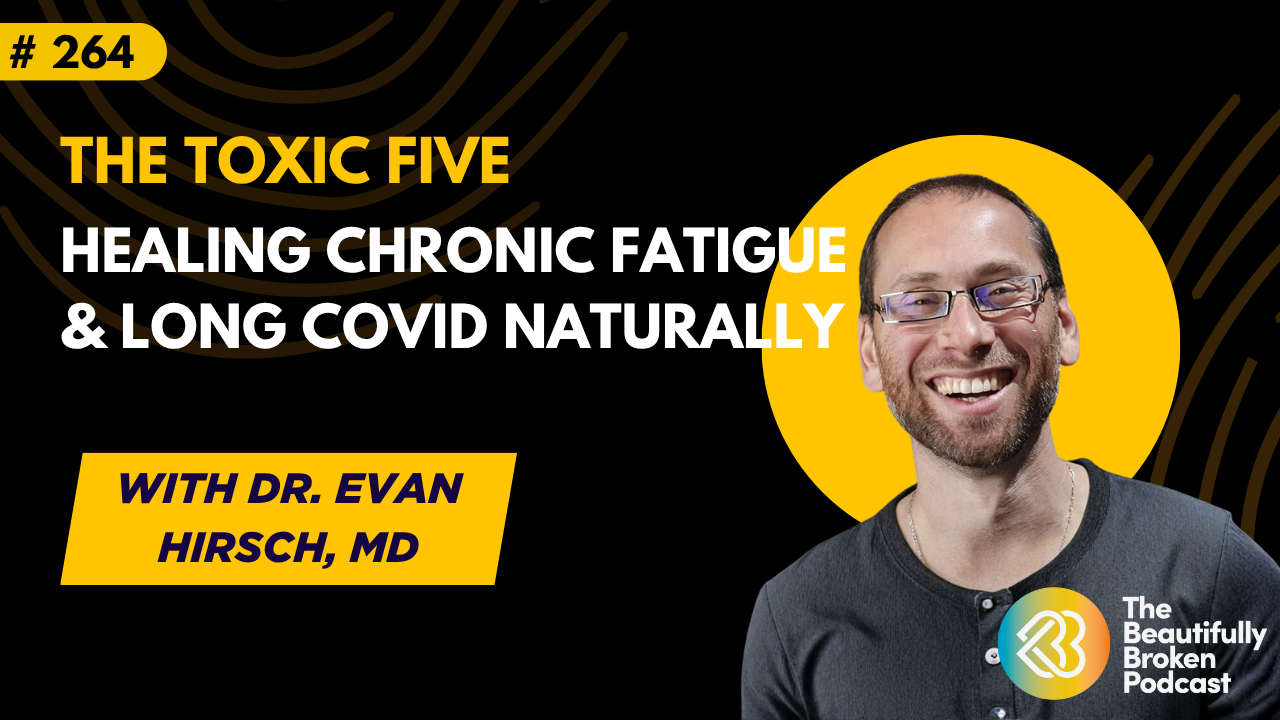
WELCOME TO EPISODE 264
Welcome back to Beautifully Broken, where healing meets high performance. This week, I’m joined by Dr. Evan Hirsch, a board-certified holistic and integrative physician who’s walked the talk of healing from severe chronic fatigue. After five years of debilitating illness that left him sleeping under his desk, Dr. Hirsch discovered the powerful interplay between environmental toxins, infections, and the nervous system — what he now calls The Toxic Five.
In our conversation, we explore the real science behind fatigue and burnout, why most lab testing is unreliable, and how Dr. Hirsch helps patients recover naturally without endless supplements or expensive diagnostics. We also talk about mindset, resilience, and the importance of emotional regulation — how nervous system retraining can be the single most important step toward recovery.
This is a masterclass in root-cause healing. If you’ve ever been told “your labs look fine” but you know something is off, this episode offers a roadmap to understanding your biology and reclaiming your energy.


Episode Highlights
[00:00] – Dr. Evan Hirsch’s personal journey through chronic fatigue and losing everything before discovering his healing method
[02:10] – Defining chronic fatigue syndrome and how it’s misdiagnosed in conventional medicine
[06:30] – The “Toxic Five”: heavy metals, chemicals, molds, infections, and nervous system dysfunction
[10:40] – Why most testing fails and how to heal without expensive labs
[16:50] – The “die-off dance”: how to detox without crashing your system
[18:42] – Breaking down the four-step process to overcoming fatigue naturally
[25:36] – Realistic healing timelines — why true recovery is a marathon, not a sprint
[27:32] – The power of limbic system retraining for emotional and physical resilience
[31:52] – Opening detox pathways: movement, hydration, saunas, and cold therapy
[40:10] – Building comfort with discomfort — and how resilience is trained
[44:44] – Red light, PEMF, and biohacking tools: when to use them (and when not to)
[58:08] – Spike protein illness, long COVID, and how they tie into immune dysfunction
[1:03:00] – Dr. Hirsch’s daily rituals for balance, presence, and joy in healing
Links & Resources
Dr. Evan Hirsch’s Website: https://www.energymdmethod.com
The Biological Blueprint Program: https://www.beautifullybroken.world/
Beam Minerals: http://beamminerals.com/beautifullybroken
— Code: BEAUTIFULLYBROKEN
Silver Biotics: bit.ly/3JnxyDD
— 30% off with Code: BEAUTIFULLYBROKEN
LightPathLED: https://lightpathled.pxf.io/c/3438432/2059835/25794
— Code: beautifullybroken
CatchBio: https://catchbio.com
— Code: BEAUTIFULLYBROKEN
CONNECT WITH FREDDIE
Work with Me: https://www.beautifullybroken.world/biological-blueprint
Website and Store: (http://www.beautifullybroken.world)
Instagram: (https://www.instagram.com/beautifullybroken.world/)
YouTube: https://www.youtube.com/@freddiekimmel
FULL EPISODE INTERVIEW
EPISODE TRANSCRIPT
0:00
I've had this really nice background already in holistic, integrative and functional medicine, but then five years later I got chronic fatigue syndrome and it lasted for five years and just about destroyed my business, my relationship with my wife.
I had a new child, you know, who I couldn't play with and I was napping underneath my desk and I had to keep hiring people to do the work that I couldn't do in my clinic.
0:23
I had 10 employees, 4000 square feet of office space, functional medicine clinic, and I was doing everything that I knew how to do and yet I still wasn't better.
Welcome to the Beautifully Broken podcast where healing meets high performance.
0:39
From cancer recovery to Wellness technology, we bring you real stories and real innovators to help you reclaim your biology and build your personal blueprint for health.
Let's go, ladies and gentlemen.
0:58
Welcome to another edition of the Beautifully Broken podcast.
So honored to be in the space today with Doctor Evan Hirsch.
Welcome to the show.
Thanks so much for having me on, Freddie.
You can call me Evan.
Evan, I love it.
I love it.
1:13
So let's jump in.
Evan, you have like a slide desk.
I tell you, everybody gets you get pitched guests all the time on the show, but yours was like the menu of choice for every listener that listened to the show.
It was like chronic fatigue syndrome, long COVID, Lyme disease, Bartonella.
1:33
I was like, I got to have this guy on.
It was like the calling card.
How did you get into that space, that conversation?
Why do you work in the world of, let's say, chronic illness?
Yeah, so I started off in conventional medicine in my family medicine residency out here, University of Washington and Olympia.
1:53
And then I met my wife, fell in love, She got chronic fatigue syndrome, and I was going through my residency.
I had no clue what to do about it, felt incredibly disempowered and didn't really know what to do.
Kind of talked to all of my mentors and they really couldn't help.
2:10
And so we kind of like piece some things together.
And then I graduated residency.
I started my own functional medicine practice.
I had been practicing holistic medicine and then integrative medicine.
I actually got board certified holistic medicine while I was going through residency.
2:26
I was doing acupuncture at that time.
I did the UCLA program for physicians.
And so I was, I've had this really nice background already in holistic, integrative and functional medicine, but then five years later, I got chronic fatigue syndrome and it lasted for five years and just about destroyed my business, my relationship with my wife.
2:46
I had a new child, you know, who I couldn't play with and I was napping underneath my desk and I had to keep hiring people to do the work that I couldn't do in my clinic.
I had 10 employees, 4000 square feet of office space, functional medicine clinic, and I was doing everything that I knew how to do, and yet I still wasn't better.
3:04
So I had to go through this process of learning about environmental medicine and heavy metals and chemicals and molds and infections and then nervous system dysfunction.
And that's what I call now the toxic 5, which is really the hill that I'm going to die on, where I found that that's really what got me over my chronic fatigue syndrome.
3:23
That's now what had helps other people in my program get over it.
And then that's also the big thing that's causing so much of a problem for people with long COVID.
It's more than just the spike protein.
Yeah, I join with you and all of that.
That's been my experience.
3:40
Can we define just for a minute, MECFS?
Like what does that mean when people see that term?
Absolutely.
So myalgic encephalomyelitis is ME.
That's kind of like what they call chronic fatigue syndrome outside of the USCFS is chronic fatigue syndrome.
3:59
And basically the definition is you have to have a certain number of symptoms for six months or longer.
And those symptoms are complete exhaustion with post exertional malaise where you exert yourself and you feel worse, sleep issues, brain fog, and then also body pain.
4:21
So if you've got those symptoms and you've got them for longer than six months, you can be diagnosed with chronic fatigue syndrome in the United States.
It doesn't mean that you're going to be able to get well though, because unfortunately with the conventional paradigm, they're just going to say don't do as much and rest and maybe eventually you'll get better.
4:37
But it really just doesn't work that way.
And then with myalgic encephalomyelitis, that has a little bit more of a neuro component in terms of some of the neuropathies that come into play.
But it really is a spectrum because there are people listening to this who are like, you know, I got brain fog and I got really bad exhaustion and I don't have the other symptoms.
4:58
What do I do?
And it's like, just because you you don't have a diagnosis doesn't mean that you don't deserve to get better.
So it really is the spectrum of chronic fatigue where there are some people who are like, I'm able to work, but my energy is a four out of 10.
And I've tried a bunch of stuff and I'm not better to people who can't get out of bed, you know.
5:17
And so we really were working mainly with people who can work a little bit.
You know, they've had to go to part time, but they can still kind of work a little bit.
We just find that, you know, those people are more successful in our program just because they're not as debilitated.
5:35
My heart just goes out to everybody who's there right now 'cause I man, I spent the better part of a decade just feeling like to doctors.
I say I have about an hour of functionality off my coffee that is with stacked with three shots of espresso.
5:53
And after that window, it was like everything was just when I say I would think about going to the kitchen and then turn around and go back to bed.
That level of fatigue like was just the norm.
And I definitely put on a great show for people.
6:09
I could get up, I could get into a conversation, especially when I was engaged and the larger chunk of the day was just so downtrodden with this like one out of 10 energy.
And I would say I really started to experience this personally.
It was after my second bowel resection and it's like I never came out of anaesthesia.
6:32
I'd hold my shoelaces and I'd, I'd look at them and be like, what comes next?
And obviously I know how to tie my shoes, but I would ask myself that it was like, what comes next?
So that's how slow.
I just want to give people scope for the brain processing power.
6:48
Now, like you, I didn't find anybody to a validate my experience or really give me much help.
I was really pushed into the fringe, which is why we're here.
Why?
Why?
I have a podcast today asking different questions, right?
7:06
I just want to pick your brain about this.
I found this guy down in Florida.
His name is Doctor Dantini, and he was doing this really interesting thing.
He was having people swish around acyclovir high dose like 4 times a day in their mouth and it was being absorbed through the his thought was is that we had high viral loads that it was like the cytomegalovirus, Epstein Barr virus.
7:27
And I actually did get a little temporary benefit from this antiviral therapy.
Can you speak to that or if you've ever come across any of this thought process?
Absolutely.
Yeah, I'm not familiar with what he's actually doing, but you know that hill that I'm going to die on about the toxic 5A big component of that is infections.
7:47
And so, you know, people who end up as sick as we were, where you're having a hard time getting out of bed, you're just pushing through your day, You've got the exhaustion, the body pain, the brain fog.
Whatever it is, it is always going to be this combination.
And everybody has all of the toxic 5.
8:02
So they have the heavy metals, the chemicals, the molds, the infections, and the nervous system dysfunction.
And so you can address one of those things and experience a little bit of an improvement, but you don't get complete resolution until you address them all.
And that's regardless of what your labs show.
8:18
Because I've been fooled so many times by labs, I don't even test labs anymore.
We just go through a process.
We address all the heavy metals, all the chemicals, all the molds and mycotoxins and all the different infections, including the viruses and the bacteria and the yeast and the spirochetes, the Lyme disease, the Co infections, the parasites, and then also the nervous system dysfunction.
8:40
Because I want to make sure when people are done with my program that we've left no stone unturned and their likelihood of going to is of success is so much higher when we're addressing 99% of all of the potential causes out there, right?
So the reason why you felt a little bit better is because there are viruses that were present and this was addressing it, but it was like pulling 1 nail out of the bottom of your foot when you've got another 10 there.
9:05
Yeah, yeah.
You know, years later after going through certification and biological medicine or regulatory systems of the body and understanding that maybe these things exist because you've got a perfect little plot of soil for them to grow.
As opposed to saying, well, I need to check this off the box.
9:22
I've taken care of Lyme.
Now it's the viruses.
Now it's the mold, now it's the metals.
And I do hear that a lot in this space is that people are constantly chasing the next hot topic of conversation, whether it is the spike protein or it's glyphosate.
But it's really, you know, we are quantum beings.
9:40
It's this holism, right, that plays into overall Wellness.
And it's it's everything that from my experience comes into the conversation about robust health.
Absolutely, yeah.
And I think and it's this, you know, we have a four step process that we take people through and we replace deficiencies, which is what the majority of natural paths and functional medicine doctors and stuff like that do.
10:01
And you can really help people with that.
And then we remove the toxicities and the infections, the toxic 5.
But it really is this push and pull where there are deficiencies that need to be replaced, mitochondrial health, etcetera, hormones.
But then they're all these, these, there are all these toxins that are draining your vital life force that are really not allowing that terrain.
10:24
Because there's this, you know, what you're talking to is this idea that, you know, we really should be able to heal ourselves.
And it's like, OK, well, how do we remove those barriers to healing?
Is it replacing a deficiency because you have a genetic issue?
Or is it removing toxins and infections and they're causing the deficiencies?
10:42
Yeah.
So let's talk a little bit about that system.
Before we do that, I just want to mention you said you don't do testing.
I don't you know, I've done, I'm very much on the fence on a lot of it.
It's very expensive to get a vibrant total tox panel which looks at metal and mycotoxins and spirochetes and Co infections.
11:04
It's you know, and then we need to retest.
So a lot of times for me early on in my chapter of my road to Wellness, that was a limiting, that was a rate limiting factor actually couldn't afford the doctor and the testing.
So a lot of times I would have to go through that thought process.
11:19
It was like, well, what am I going to change?
What am I willing to do about it?
So that's usually the road I took because I'm curious.
I do like to still look at labs.
I do like to look at things like goodness, you know, anything from metals or mitochondrial function to how my body is performing, like, how is my microbiome performing?
11:40
Not what's in it.
And so there are some things I like to look at.
But to your point, we're human beings and there are certain operating guidelines that we will always benefit from following.
So it I do believe it's possible to skip a lot of these diagnostic tests.
11:58
And I think we're also very new as far as how good are they?
Cause I've seen them change very dramatically from lab to lab.
I don't know if that's been your experience as a medical professional.
Absolutely, yeah.
And you know, I used to test every three months on all of these different markers, and it was very expensive for folks.
12:19
And what I found over the course of 12 months is that all of these toxins and infections ended up coming out.
Now the challenge with the testing is that if you do a urine test, which is really the gold standard for whether you're doing heavy metals with a provocation or you're doing chemicals or you're looking at mite, mold, mycotoxins, or even some infections with like some of the PCRDNA testing that are all really dependent on your ability to detoxify and get the thing out of the body into the urine that you're looking for.
12:49
And they're all for the most part bound up in the tissues.
So they're in your organs, other components of the parts of the of the body and they're not really coming out in the urine.
The urinary test really is more of a test of your ability to excrete than it is your total body burden.
13:06
So consequently, when I've been fooled time and time again, that's why I'm like, you know what, we're just going to go ahead and treat.
It's going to save you 5 to $10,000 over the course of a year because we're not doing this testing and people just have success, you know, and everything that I do is natural.
13:22
So I'm only doing herbs, vitamins and minerals now.
And so consequently, when you're doing double and you're using herbs that are kind of complementary and you're doing double and triple supports where you know you're going to be able to get at every single infection that's possibly happening in the body because you're using a different combination of these herbs that are all really cumulative, the just the likelihood of success goes up.
13:45
So that's one of the issues is the urinary testing is this test of excretion.
Another one is that if you're doing PCR testing where you're looking for the DNA of the infection, it has to be found in that particular compartment.
So if you're doing a blood test for PCR and the infection is found in the joints, you're not going to find it.
14:05
Or if you're looking in the urine and it's in the joints with the muscles, you're not going to find it.
And then when you're doing something like Lyme disease or like a serology test, which is really looking at the immune system's reaction to an infection, by nature of these illnesses, the immune system is dysfunctional.
14:23
So then you're asking a dysfunctional immune system to give you an accurate response.
And if you don't diagnose it, you won't treat it.
So I can't tell you how many people come to see me, and they're like, yeah, I don't have Lyme disease.
I don't have mycoplasma, I don't have Bartonella, because I did this test, and this test showed that I don't have it.
14:40
And I was like, let's just treat you anyway.
And sure enough, the symptoms go away.
So the testing is just too imperfect.
And as humans, we really want certainty, we want to know.
But unfortunately, and that's, you know, I think one of the spiritual lessons of going through this process is this notion that we have control, right?
15:00
So it's like being able to release control and understand what we can control.
We can control our reactions, we can control the next step we take.
I know you talk a lot about mindset, which we do in our program and we do a lot of nervous system retraining and how important those things are.
15:15
And it's like, you need to take the next step.
You need to continue and move forward.
But let's hedge our bets and let's understand the reality of lab testing and let's go ahead and let's make sure we address everything.
Now, just as a caveat, I do test for a couple things in blood.
I think that vitamin DB12, thyroid can potentially be helpful.
15:35
That's about it.
Yeah, awesome.
Can I ask you a little bit about just your personal journey with chronic fatigue, because it was probably was a phase while you were looking at some diagnostic.
I can only imagine, probably looked at everything.
Were there a few areas in which were like, oh, these were massive burdens on my system that you discovered?
15:55
I definitely had a lot of positives when I did my testing back in 2010, 2011.
You know, where I did have mycotoxins, I did have heavy metals, I did have chemicals.
The challenge that I had was I didn't have anybody to guide me as I was kind of like learning this and that.
16:12
As I started to detoxify, I felt worse.
And I was the main breadwinner at that point in time.
And I was trying to manage this big clinic and I needed my brain function and I needed to be able to bring home the bacon.
And so that was a real challenge.
16:29
And so I couldn't really detoxify until I learned how in step three of our process, how I needed to open up my detoxification pathways and then do what I call the die Off dance, which is basically as you're killing something, you have to make sure that it's able to exit the body, otherwise you're just going to feel worse.
16:49
And so that's kind of that dance that we go through where we want to make this as graceful for people as possible.
But they have to remember that, you know, you've got these toxins and infections in your body for decades.
And so extricating them, pulling them out of the tissues, getting out of the body, we try to make it as graceful as possible, but there's a lot of bumps in the road.
17:07
And so there is a lot of mindset work that has to happen around.
I'm going to get there.
You know, it's three-step forward, one step back.
And when I have that one step, it may feel like it's the end of the world, but we have to remember that it's just a step back and that we're going to get there.
I'll share this with anybody listening to this today.
17:25
When I would start to feel better and maybe get a couple days strung together.
It was so much worse to go back and have a day where I was on the couch because I started to see the light.
And there's this great line in Shawshank Redemption and the one character says hope is a dangerous thing.
17:46
And I started to feel hope that I would get better.
And the mind, the mind games, you know, that limbic system looping down on the severity of the one day first, the three days of Wellness was really tricky to manage, you know, and I didn't find the not neuro linguistic programming, the Annie Hoppers, the DNRS, the Gupta program, the RE origin programs until much, much later in my journey.
18:13
Yeah, it's wild.
Yeah, I thought the Shawshank quote that you were going to say, the one that I really like is that I had to walk through a mile of shit in order to come out clean on the other side.
And sometimes it kind of feels like that you know where you're going to get there, but you got to go through some shit.
18:31
Yeah, so good.
What a brilliant movie.
What a brilliant movie.
Can we talk about your process a little bit because you've alluded to this four or five step process?
I'd love to understand that a little more.
Correct.
Yeah, four step process, toxic 5, it's a little bit confusing some people, yeah.
18:48
So the first step is to figure out the causes that an individual has that we're going to address.
So we're going to address the toxic 5 and everybody but then and hypercoagulation.
But then is there concussion issues, traumatic brain injury that we need to address, other thyroid issues?
19:04
We're also going to address adrenals and mitochondria and everybody, B12, vitamin D.
What are your lifestyle habits like?
What needs to be addressed there?
We're going to address the mindset and the nervous system retraining and everybody.
So we already know about, you know, 70 or 80% of what we're going to do to make sure that we leave no stone unturned.
19:23
But then there are nuances and we want to make sure that we personalize everybody's program.
So that's the first step is figuring out what causes people have.
And we're looking at over 30 different causes to make sure we leave no stone unturned.
So this process is all about step 4IN getting rid of the toxins and infections, but we have to set the stage up for success.
19:43
So in Step 2, we start by replacing the deficiencies, the adrenals, the mitochondria, the thyroid, which I call the big three, because they're really the biggest needle movers.
They're going to decrease inflammation, they're going to make you more resilient, give you a little bit of a bump in energy.
19:59
Often times in the first month or two, about 50% of people go from a jump of like one point.
So either a three out of 10 to a four out of 10 or a four out of 10 to a 5 out of 10 and have a little bit less crashing.
So that really just helps make the rest of the process so much easier.
20:15
And it helps when we get into the die off in Step 4 because die off is really hard on the adrenals and the mitochondria.
So we want to make sure that those are all optimized, other hormone stuff, vitamins, minerals, lifestyle habits.
So replacing all of those are going to end up serving you throughout the process.
20:34
So that's Step 2.
And then Step 3 is opening up those detox pathways the way that these toxins and infections are going to get out of the body.
So we've got the liver and the kidney and the lymph and the neural lymph that's in the brain, in the gallbladder, in the intestines.
20:50
All of those pathways need to be open in order to be able to have success.
Now is that all we do for those?
No, because when you're going to step four, you're going to have to pivot back and do that die off dance.
We're going to have to increase some of the Step 3 support, but you've already got the stage set to make step four that much easier.
21:08
And everything that we're using is going to be herbal and natural.
And then when we get into Step 4, that's when we're we're working through this process of removing the heavy metals, the chemicals, the molds, the infections and the nervous system dysfunction.
One last thing on that is that it's more than just getting rid of them individually.
21:26
What's important to remember is that they're all kind of bound up into a, what I call a toxic matrix, where when you start to pull one thing out, the other things end up releasing, which is why it's so important, which is why partly why the testing is also inaccurate.
21:42
Because it could be that the mycotoxins are all bound up in this toxic matrix.
And until you remove some sort of infection or heavy metal, all of a sudden the mycotoxins are going to get released.
And if you don't have a binder, an AC, glutathione, whatever it is on board, you're going to feel worse.
21:58
And we're not going to know why.
And so that's why we go through this process of making sure that we're addressing everything because we know that even if we were to test that, there's going to be new things that are going to be released once you open up the toxic matrix or once you breakthrough the biofilm where a bunch of these toxic fiber also or toxic for are hiding.
22:18
So let's force that process.
Amazing.
Can we go into the timeline of some of these journeys?
You know, I got a friend I'm facilitating pairing him with practitioners right now.
And from my experience, this is not like a six week program.
22:35
It's not like a 12 week program.
This is like some of these burdens are going to take years.
It doesn't mean it's years to feel better, but it is.
It's a longer timeline than I think people want to admit.
It sounds painful to examine when you're like talking to somebody and sitting them down and saying, you know, I can promise you this by this date, but I don't see that happen.
22:57
I see it be, I mean, if you would have told me in 2011 that were 2025 and I would still be working with it, I think I'd be pretty darned depressed like that.
It's still a practice, right?
So how do you frame that for people and what are the timelines you see when people come in, let's say they're like a one out of 10?
23:17
Yeah.
So there's a number of key things that I tell people.
You know, this is a marathon.
It's not a Sprint.
What I found is that everybody gets better who addresses the Toxic 5.
It's just a question of how much time it takes for them specifically, individually, depending on how fast they can detoxify.
23:34
But when they join the program and they fill out the intake form within the first couple of days, I provide them with a plan of my best guess of what they're going to be doing over the next 12 months within seven business days.
So they have that plan in seven business days, and then their whole job is to implement and reach out when they need help.
23:52
And we've got a number of different ways to kind of support them along the way.
And so Step 2, replacing those deficiencies takes about two months.
We introduced 1 supplement at a time to make sure we, I give people a Google spreadsheet and then there's a column for them to put in the date that they introduced something.
24:10
And then any reactions that they have so that we can communicate and we can make sure that we're pivoting.
It's really important, this whole idea about pivoting throughout the program.
They're going to pivot 20 to 50 times over the next 12 months.
And so, you know, I give them my best guess, but then it's all about how do we personalize it for an individual and we guarantee a response to any question they have in two business days so that they can ask a question, they can get that response.
24:35
They're not waiting months to get in to see the provider.
They can pivot and then they can move forward and take that next step.
So they're introducing 1 supplement at a time so we can see exactly what's happening.
So Step 2 and replacing the deficiencies takes about two months.
Step 3, opening up the detox pathways takes about two months.
24:53
So then we're at month 4 or so.
And then Step 4 where we're removing the toxic 5 takes anywhere between 8 months and 18 months, you know, generally.
And so at that point, we're in Step 4I tell people it's going to take at least 12 months to get better, where the magic really happens around month 9.
25:17
And the reason why that happens is so from at the end of month 4, then you start introducing Step 4 supplements, which is going to be addressing the heavy metals, the chemicals, the molds, the infections, and you're doing the nervous system retraining this whole time because that just accelerates things and it makes you get better faster.
25:34
And so that's from, you know, month 5 to month 9 is a good four months where you're addressing all of these different causes.
And that's when you start to, you know, the benefits really happen when you remove the significant amount of the toxic 5.
25:50
And so for some people, depending on how fast you can move through the program, this is how another way we individualize it.
We want to detoxify people at a rate that their body can tolerate so that they don't feel worse.
So it's just a question of, OK, which is the most important toxin.
26:06
You know, when we hit that one, the toxin or the infection that we're addressing, you're tolerating the treatment, you're getting it out of your body.
How fast can you do that?
That is significantly related to the results.
So, you know, your symptoms resolve at the same rate at which you're able to get rid of the toxic 5.
26:27
And it just, it just depends on how long it takes.
And that's the individualization that we provide.
And it does require a lot of that mindset work because it's like 3 step forward, one step back.
And when you start to feel better, when you have a down day, it's the same as all those down days you had before, you know, but instead of having 7 down days a week, now you're having 3 or 4 down days a week.
26:49
But they feel so, so much worse because of that comparison with how you're feeling now.
And so there's a lot of mindset work that needs to happen.
And we try to be there for people when they're struggling.
And we just encourage them, hey, if you're struggling, please reach out, Let us know so that we can be there to support you.
27:06
Yeah, that's why I love having a limbic system retraining program on board everyday, all day.
You know, a lot of the groups run independent groups.
You can get in with a live person, a live coach, you can talk to other people.
People are very aware of the language that they're using as to not to trigger someone back into a response.
27:27
I just can't stress that enough.
And often times people tell me I'm having issues, this is continuing, I'm not getting better.
I've tried this and that and that.
I'm like, have you tried something to support the limbic system?
And they're like, yeah, I've heard about that, but it's rare that people go all in on that one.
27:43
And it's probably one of the most affordable therapies, you know, a few $100 for the whole year of coaching.
And it's interactive and it's live.
Yeah.
I just want, I hope everybody hears that I just from the heart stack that one.
And especially if you're in this loop that is considered chronic.
28:02
Yeah, about six months ago, we created our own program and put it, you know, alongside what we're doing.
But there's plenty of times where I tell people, OK, you know, I get on free calls with people to see if we're a good fit to work together.
And I'll say, you know what?
Right now it seems like you've got mast cell activation syndrome, You're quite sensitive to supplements.
28:20
You're going to be a lot more successful in our program if you do a nervous system retraining first because I have found that that is the number one thing that helps people decrease their sensitivities.
So I'll say go do that for three to six months and then come back.
Or if I'm seeing that, you know, there's really some mindset work they need to do or, or some other things, I'm like, you're not a great fit for us right now, go do this first.
28:44
Or there's a lot of people lately I've been talking a lot about, hey, if you've done brain retraining and you're not better, come talk to us.
Because what I've seen is that it really is the toxic five that all have to be addressed.
There are some people who get, you know, close to 100% better just by doing the nervous system or the limbic system retraining.
29:03
And that's wonderful.
And then what about the rest of us, Right.
And so, you know, it's going to be this combination.
But yeah, I tell people that the nervous system dysfunction can be 90% of your problem.
So you have to be doing the nervous system retraining and whether it's nervous system or limbic system, you know, I just use that as a, as a waste fest.
29:22
That's right.
But like, you have to be doing that work in earnest in order to get better in in our program in general.
Yeah, yeah, It's such a piece of the puzzle.
Often times I see at least in my path, I can see where lifestyle, where my ability to, I needed to achieve to feel love.
29:44
So I was probably going to drive myself until I got sick.
It was probably in the cards, I could say to some degree because I was never going to be able to work, work hard enough, right, to feel like I was just, I have value just for being me.
Actually don't need to do anything now.
30:00
That component is still part of my DNA and it sets me up in this capitalistic society to be successful.
But I have to watch it, right?
I can see I have to watch it.
I have to be aware, you know, so that drives me to integrate these things that are a practice, whether it's right before our podcast was like, I'm going to 20 minutes is me and the dog.
30:22
We're both going to go sniff things and wait till he poops, But we're going to be outside in the light.
We're going to wander around in nature.
It might be this morning.
I this morning I got in a, you know, an oxygen bath.
I'm like, I'm going to sit here and do a warm, lukewarm 20 minute bath and absorb some oxygen and then breathe.
30:39
I'll say this, I've built the container, I've built the road map of the day to complement like what I want to create.
And I have these three questions I keep asking people.
I'm like, how do you feel?
How do you feel?
What do you want?
What are you willing to do about it?
30:55
And I promise you there's a path there.
I promise I'd like I've seen it unfold.
Let me ask you this, as far as making a path for things other than self to leave the body, can you talk about some specifics when you say your drainage pathways?
Like in my mind I'm like, oh, I'm going to go do dry brushing.
31:14
I'm going to bounce in the trampoline outside.
I'm going to get in the flopresso.
I'm going to go get in the sauna for 3540 minutes today.
What are some things that you love for mechanically opening up those drainage pathways?
Yeah.
So I would say yes, yes, and yes, though we can talk about saunas because there are pros and cons to those.
31:32
But yeah, you know, we want people to get their Goldilocks dose of movement for their lymph system, besides doing some lymph brushing and then some lymph massage.
But by that I mean that we want you to move as much as you can without feeling worse because everybody in our program, they've got post exertional malaise.
31:50
If you exert yourself too much, you feel worse.
So that's kind of the Goldilocks dose that we're talking about.
So yeah, whether we're doing lymph or whether you're consuming 3 liters of water a day, which is essential when you're trying to detoxify, whether you're eating sugar, you know, so it's so much about what you're not eating.
32:08
So avoiding gluten and dairy and sugar alcohol, processed foods, that makes such a big difference.
You know, that essentially is is a bit of a detoxification as well.
And that's not necessarily mechanical, but that can be really helpful if people can do, I almost said bungee jumping, but trampoline, what you call it?
32:28
Oh I have a like a full on like 18 footer.
Outside I have a full massive backflip trampoline.
So I get on that thing it just because it's fun.
I mean, I I like the rebounder, don't get me wrong, but I have a yard.
So this has been for at least top of the pandemic.
32:45
In middle of the pandemic, when I was really struggling with the lack of social connection, I went and bought a trampoline on Facebook Marketplace because I had one as a kid and I was like, Oh my God, this thing is a blast.
Nice.
I just bounce or flop all over.
Love it.
So yeah, so the rebounder, that was the word I was looking for so that, you know, to improve your lymph and then, you know, for liver, besides the water, you can also be doing Castor oil packs.
33:10
Yep.
You know, for brain detoxification, making sure that you're sleeping 7 to 9 hours of sleep a night, getting good sleep, your brain is going to detoxify.
It's basically shrinks by 60% getting those toxins out every single night, you know, gallbladder, intestines, making sure that you're having a good bowel movement at least every day, if not 2, you know, and if you need some magnesium to make that happen, putting your feet up a little bit so that you're, you're doing, you're straightening out the colon, you know, by bringing your knees into your chest.
33:43
I can't remember the name of those platforms now, but Poop Potties.
Squatty Potties.
Yeah, I always tell people that they're fake health and Wellness people like if I walk in your house and they're like, oh, look, this is this is what I'm doing.
This is my son.
I'm like, you don't have a Squatty Potty.
You like are not this is all fake like you need to and that's it's one of the most frequent gifts that I send to people if I go to their house and they'll be like, what is this thing you just mailed me?
34:08
I'm like the legs flip down.
You're gonna slide under your toilet and you'll thank me later.
And then the next one needs to be the the bidet, right?
The bidet attachments.
To.
Go along with it, right?
Love the bidet?
My friend Caitlin just got she.
34:24
I was at her house and the seat warmed.
I was like, OK.
Wow, it's a game changer.
Yeah, yeah.
Amazing.
Oh, and then that's the other thing is so turning your, your shower to cold or doing some sort of cold therapy, as long as you can tolerate, as long as it doesn't make you feel worse, Wonderful for mitochondria, great for detoxification.
34:45
So these are a number of things that we include in our program.
But of course it's always about like, what can you do depending on if your energy is a one out of 10, you're having a hard time getting out of bed, or if your energy is a four out of 10 or a 5 out of 10.
So that's where the individualization, the personalization comes into play.
Yeah, friends, here's what we know about cancer.
35:07
It isn't just genetic.
Less than 10% of all cancers are purely hereditary.
The rest are driven by modifiable factors in our environment and our lifestyle.
And that's why I am using CAT Bio.
35:22
This is an AI driven prevention platform that integrates over 500 evidence based inputs.
Things like chronic inflammation, nutrient levels, viral exposure, gut microbiome, your sleep habits, and it maps how each one influences your cancer risk.
35:43
It's like having a precision prevention dashboard for your own biology.
You can actually see your risk score and the interventions that lower it.
It's all grounded in over 10,000 peer reviewed studies.
35:58
So you can go to catchbio.com and you can use code beautifully broken and see your body through the lens of data prevention.
This is radical ownership of health in practice.
Let's.
Go.
Team, it's 2025 and I was de platformed from YouTube. 10 years of work, videos, content, everything I believe about health, longevity and community is gone forever.
36:27
Why?
Because I talked about silver biotics, their toothpaste, their wound gel and their recovery cream.
That's why I was targeted.
But here's the truth.
This isn't influencer hype, it's science.
Silver Biotics uses a proprietary nanoparticle called AG four O 4 or silver salt.
36:46
These ultra small particles, just 5 to 15 nanometers, carry a unique silver oxide coating, giving them multiple modes of action against harmful microbes.
In lab studies, nano silver has shown antimicrobial and anti biofilm effects, for example, inhibiting Candida biofilm formation.
37:09
Reviews highlight how particle size and surface chemistry determine its effectiveness against microbes while remaining safe for human tissue.
And here's the kicker.
Silver Biotics Armor Gel is FDA cleared as a medical device for wound management.
37:27
That puts it in a rare class of company.
It's a natural technology with regulatory recognition.
I know I'm frustrated and I could have walked away.
I could have said, you know what, it's not worth the risk.
And that's not me.
Silver Biotics remains our top sponsor because I believe in what they're doing and the people behind it.
37:47
It's a brand for families, for moms, for anybody who believes in the body's natural ability to heal.
From immune support to skin repair to pet care.
They built something for everybody.
So I'm not quitting on this one.
And you can use code beautifully broken at checkout.
38:04
Try Silver Biotics today.
Let's go.
I launched a program like 2 months ago, which I really haven't.
I mentioned it a couple times called Biological Blueprint and it's just education around the regulatory systems of the body.
38:20
But we do a full module on.
I say temperature is medicine.
And how is it going to be medicine for you, Evan?
Because that will be different for me.
Like I'm a outdoor shower in the morning and then I jump in the bath.
38:36
I might do 30 seconds, sometimes I do 3 minutes.
I keep it around 5052 these days.
But for me, I get such a great boost for brainpower.
It really like is complementary to my Physiology now.
It wasn't that way when I started.
38:53
When I started, it was my first ice bath.
I shook for six hours.
It was way too much for my system.
I literally was shaking was like I need a my body couldn't regulate it.
But over time with the interplay of the heat in the cold and just being outside more without a jacket, I've developed that where I'm, I feel very comfortable in the cold, very comfortable.
39:17
And I actually, I enjoy being that be like people don't have a jacket.
I'm like, I'm actually feel really good.
I'm enjoying this cold hormatic stressor and I'm enjoying leaning into the breath and just experiencing the sensation as opposed to wanting to always say, you know, within our training, it's living in that 72° box in which we're just, we're a comfortable little pet who isn't fit to be a survival animal in the wild.
39:46
It's like bring back in some of those elements.
If you think about the majority of human survival, how much time we just didn't have these comforts, right?
And so how is temperature?
How could that be brought back in as to medicine as far as like this, You know, how do I retrain the wild animal inside of me?
40:04
Yeah.
And I think that it also really speaks to discomfort and becoming more comfortable with discomfort.
Right.
And realizing that we can, like when I turn the shower to cold in the morning, it's so uncomfortable.
And I'm reminding myself I can do uncomfortable things.
40:23
I can do hard things like I can do this and that is that reframing that is that nervous system retraining, the mindset work that reminds you when you come across something where you're, let's say you're having a health issue and you're ready to give up, that you choose not to and you choose to take that next step and move forward.
40:43
And it's resilience training.
You.
Know this is something we're working on with our 17 year old right now it's like it's not the end of the world, right?
Like, how can you see that this is just something that you have to navigate around?
You have to learn how to pivot.
You have to learn how to improve and things get easier, but they're hard so that you can learn something and that you can become more resilient.
41:05
Yeah, agreed.
Evan, in your practice, do you see a lot of people in person or is it mostly online?
I'm 100% online now.
OK, Yeah.
And so, yeah, everything is done over Zoom.
We have an online community, you know, whether it's one on ones or groups, you know, so there's, we provide a ton of support so that we're essentially in your pocket.
41:29
And so you have the support on a daily basis.
But yeah, it allows us, it allows me to practice across state and national lines.
You know, about 10% of our people come from outside of the United States now.
And it's it's been able allows us to support more people.
That's great, that's great.
41:45
And what about, you know, we get into this world of chronic illness?
I'm spent well over 300,000 bucks trying to get better, probably more than that.
Now, how does someone prepare the scope of like to financially afford, you know, again to work with you for a year, for 18 months?
42:02
What does that look like?
Yeah.
So at this point, right now, we tell people that it's approximately $15,000 / 12 months for the majority of what they're going to need.
So that's going to include supplements, labs, program fees.
42:18
The only thing that it doesn't cover is if we find that you're living in a moldy environment and you need mold remediation, it does not cover that.
If we find that you have an infection in your mouth from cavitations or whatever and you need cavitation surgery, it doesn't cover that.
42:35
But I feel like for $1500 a month all in, that's really reasonable to get your life back.
Oh, it's nothing, yeah, compared to what I spent.
And how long have you guys been doing this program totally online?
I went online in 2018.
42:52
OK.
So yeah, seven years now.
Wow, good chunk of time, good chunk of time.
Yeah, it's such a great resource for people to have because the monthly.
Let's talk about this too, because I'm a big, because you know this, I'm a big tech guy.
43:09
I love the toys, mostly because it's my way to have like toys as an adult.
But I love red light panels.
Huge fan of pulse electromagnetic fields, the supportive therapy, Flopresso, full body lymphatic drainage.
That's a medical device, not a home device.
43:26
You know, I built a big community sauna outside 'cause I like community and I can invite.
I found there's some like magic beyond magic that happens when we do these things with friends.
I got a Bimini machine, which is nano bubbled oxygen therapy in the bathtub, which is like I've got 100 sleep score for 14 days in a row.
43:45
That's never happened for me.
That's been amazing.
I love the tools, right?
How do you help people find discernment in the space when there are so many really great tools, But these things are very, now we're talking, most of the tools we're talking about are, are more expensive than your whole program, right?
44:05
Right.
So how do you help people discern in this marketplace like, well, should I buy this?
Should I buy that?
What am I looking for?
What do I need to support my Physiology at this time?
Yeah.
I find that one of the biggest challenges in the program is when people feel worse.
44:21
Yeah.
And so I always want to have as much control as I can around knowing why they're feeling worse.
And so for me, that comes from introducing 1 supplement at a time.
Half of our supplements, once you get into Step 3, the majority of them, almost all of them are tinctures.
44:38
So you're ramping up by a drop or two at a time.
So I have very good control, and we're only changing one thing at a time.
So I know when they feel worse and why they're feeling worse.
If we're ramping up on a tincture that's supposed to remove heavy metals and chemicals and you feel worse, I know that it's because we're pulling them out too quickly.
44:55
It's because you have a body burden of heavy metals and chemicals, right?
And so that's how I maintain control with a lot of these therapies that you're talking about.
They can be very helpful.
People ask me all the time, high dose IV vitamin C, ozone therapy, hyperbaric oxygen, red light, PMF, all those things.
45:14
I have seen too many people feel worse when they're doing them.
And sometimes like with Pemfi had some people who are doing Beamers Once Upon a time and they were set back for a couple of months, you know, and it's basically it's, it's just increasing oxygen and blood flow to the capillaries and to the the organs, which is so important.
45:37
And So what we do is we're using, we're addressing hypercoagulation and micro clots a little bit differently.
So using some fibrinolytic enzymes where people can still feel worse, but the set back is not as bad.
So when I get people to kind of like towards the end where their energy is now 8910 out of 10 and we want to see what's left, like I was just on the call with somebody yesterday and she's like, can I do EBU now?
46:03
I have these four sessions and I said yes because she did EBOO 3 months ago, felt like crap and it put her back a month, right?
So because sometimes you know, people, even though they're going through our program, they're still thinking there's got to be something else.
And they go they hear something and they go see somebody locally and then they get a treatment and then they feel worse and they're asking me why they're feeling worse.
46:23
And I say well what's changed?
They're like, I added this thing in.
I was like, don't add that thing in.
Trust the process right So.
Yeah, yeah, yeah.
But it's it's hard because, you know, the process is long, you know, it's 12 months, you know, if not longer, you know.
And so they're like, really.
And they're not getting most of the time people don't feel anything until month nine.
46:42
Yeah, right.
So it's really hard to stick with that.
But when they start to feel worse when they do these other things, then they kind of get that sense.
And even with red light, you know, if you, there are some people who get die off with red light, it's not a lot of people, sometimes they're doing more than 5 minutes, you know, And so it's all about managing die off and managing people feeling worse.
47:04
And so like I said, these are great technologies, but they're just not for people when they're kind of going through my program, or at least I haven't figured out how to do them low dose enough where it can be beneficial.
Now with sauna, the challenge with saunas is that, you know, the immune system functions better at a higher temperature.
47:22
So that's good for the immune system, but it starts killing infections and then you have die off.
And then the frequencies, if you're doing far infrared, near infrared and then infrared, those are all going to, they potentially can also kill infections.
And you can be fine in a sauna.
You're like, I'm doing sauna every single day.
47:38
I don't have a problem.
And so often times I'll say, yeah, you can just continue doing it.
But sometimes they're fine until they're not.
And sometimes that has to do with just getting down to the next.
That's the layer where maybe you're breaking through biofilm, you're getting to your next layer of healing, and then all of a sudden you're getting a bunch of die off and you don't know why because you haven't changed the sauna that you've been doing for the last six months.
47:58
You're stable on your tinctures, whatever it is.
And sometimes it can kind of throw a wrench into things too.
So, you know, I try to be accommodating, be like, I know you love your sauna.
I know you're cold all the time.
Go ahead and continue to do the sauna.
But just know we have to remember this if you're feeling worse and we're not sure why.
48:16
Yeah, it's so important.
It's so important.
Yes, I do just all the things you said.
It's the micro environment.
I always give people the example of it.
Like remember in your chemistry class, when you put the burner under the chemicals, it did nothing and then you increase the temperature and all of a sudden there was a chemical reaction.
48:33
You're changing that micro environment in the terrain.
So of course things are going to work a little bit differently.
It's wild to think about, man.
I don't know if you experienced this.
I was so intolerant to cold.
It would hurt me.
It would hurt me to walk.
48:48
And I was in New York City because I was walking everywhere, right?
Oh man, my feet would get, I'm like, I hurt from the cold.
Not that way anymore.
You know that all that stuff has changed and I can personally feel where 1012 years ago I was that hypersensitive person where I would introduce a new therapy and I would have a totally.
49:11
It would be the polar opposite of what should have happened.
My doctor was like, well, that shouldn't happen.
Like, well, it is happening.
And that just got that was the most common feedback I had that shouldn't happen.
And so it was I had to take ownership of like, wait, this is me.
49:28
My nervous system, my Physiology is choosing to respond this way because of something that I'm bringing to the table.
It's not my doctor's fault.
So letting go of that frustration and the anger for me was a really important piece of it.
And I, you know, generally I'm pretty iron like now in my response to most things.
49:49
I respond very well in a positive way.
But that's changed over time, right?
That's changed.
And like you, I've been doing this process of drainage, detox, movement, elite nutrition, sleep hygiene sense, you know, to really 2009.
50:05
Slow and steady wins the race.
The body like small changes, right?
And I appreciate you saying that because, you know, trying to be objective in this space, you know, where it's nobody's fault.
I mean, you want to you want to work with somebody who's seen it before so that they can.
If somebody says that's not supposed to happen, then you're probably not working with the right person.
50:25
That's right.
Because you want to be working with somebody who's like, yeah, I've seen this a number of times before, and this is the reason why it happened.
And this is how we work around it, right?
So yes, it's not their fault.
And they may not be as specialized as you need, right?
If you want to learn piano, you go to see a piano teacher.
50:43
You don't ask your car mechanic and if you want to fix your car, you go to your car mechanic, you know, unless your car mechanic is a expert pianist, right?
But you know, so it's that same sort of idea.
So if you've got Crohn's disease, you want to work with somebody specializing in Crohn's.
You know, we've kind of car guard dished out with chronic fatigue syndrome and long COVID.
51:00
That's what we do all day long.
And so, you know, we're just going to have a different knowledge that than somebody who doesn't do that, who like dabbles, right?
So it's like finding a coach, right?
You want to find a coach for a specific of a problem as you have that you want to dissolve, no matter what it is in life.
51:17
That's right, get your coach with their expert 10,000 hours.
Exactly right.
That's it.
You're right.
I mean, that's what I did.
That's how who I look for in a voice teacher.
I was like, I want the woman that is coaching the alpha buzz in Wicked.
That's what I want.
51:34
Do you know what I mean?
I was like, I need this.
I very specifically I the last big show I did in New York was called Cagney the Musical and I was a standby for Cagney who James Cagney had this very unique affect when he spoke and I was getting so much jaw tension.
51:50
So I went and and found I was like, and he never left stage.
And so I went and found a great coach who was working with the Alpha Buzz on Broadway.
I was like, I need an elite level coach.
And she was gold, right?
She's very expensive at the time, but I was like feeling a certain way.
52:09
I was willing to do anything to solve it.
And so that was my choice point.
I decided to invest.
It was really, it was very challenging at the time.
I was like, oh this is too expensive, blah blah blah blah.
It's always worth it, right?
You're not going to miss.
Always worth it.
You're not going to miss the money and you're going to get the result that you want and that's going to allow you to become the next version of yourself, right?
52:29
Yeah, yeah, yeah.
It's wild.
Can we do some quick fire questions?
Yes.
And I, I should say one thing in terms of like the $15,000 for the program, I realized like people don't have to pay that all up at once, OK?
Just so that people know who are listening to this, right?
It's not like you have to drop that kind of money.
52:45
Yeah.
Yeah.
And also for, I will say this too, for, and I don't know the program, right, but for your coaching and the plan and some testing and the therapies and your nutritional supplements, you could do that alone.
I could do that in a couple months.
53:00
I could log into my full script tomorrow and be like, oh, I want to do this high dose urolithin A and I want to do this, you know, I want to do the body bio phosphatidylcholine and I could go up to $800 a month in like 5 bottles of stuff.
So yeah, you can quickly get there.
53:17
What are your thoughts on methylene blue?
So I started using methylene blue when it first came out for COVID and started testing it in the number of people.
And I stopped using it.
It's great for boosting mitochondria, boosted, you know, 200 to 400% potentially.
53:33
But it's also an antimicrobial and it has interactions with neurotransmitters.
And so I found that I had a hard time controlling the die off and I found better tools that I could use where I would have more control of the die off.
So once again, making people not feel worse, right?
53:50
And then the interactions with the neurotransmitter stuff was just a little bit hard for people who are on SSRIs, antidepressants, anti anxiety, a number of those things.
So any tool that is going to be a little bit unpredictable for me after I try to get a handle on it and it's I'm having challenges, I usually try to find something that I have a little bit more control over that works just as well.
54:16
And I was able to do that and that just that just makes people feel better when I know why they're feeling worse and I can fix it and it doesn't set them back months.
And so that was just the challenge that I was experiencing.
But I do think that it is a good tool.
And I do think that if you are going to use it, you just have to ramp up very slowly and make sure that you're working with somebody.
54:37
Great, Hey, but join with you in that coffee enemas.
Big fan.
Not a lot of people are willing to do them, but they're really great for Step 3, for opening up the detox pathways and also once you get into the die off dance, if we find that we're kind of like maxing out financially on the amount of die off support that you're taking in order to be able to get through the process, it's like, let's get you doing some coffee enemas.
55:03
Even if it's one every couple days, one a day, yeah, it can be an incredibly great support.
Yeah, it's one of the ones that's most frustrating to me because I want to find support in the medical literature and it's pretty non existent.
Like there's people will often say, oh, boost glutathione, you know, however, it's 7000% and I'm like, I've actually seen the negative.
55:26
I've seen it doesn't boost glutathione.
However, my experience, especially when I was in chronic fatigue, I would have beautiful windows of clarity definitely had diminished pain.
I had scar tissue around my bowels.
So bowel function was has something that I to this day I have to work on and be aware of.
55:45
I'm very high risk for an obstruction and it's been magical.
It's actually it's, it's actually, I could say it's probably they probably saved my life a couple times from avoiding the ER Anyways, thank you for that.
Liver gallbladder flushes.
56:02
You know, I think that it depends on how those are being done.
I think the idea of those being stones that are coming out is not true.
I think that's more saponification, which is basically you're making a soap from the oil and the base and.
56:19
Acid base, yeah.
Right.
Yeah.
So I don't think that you're actually getting out the stones.
I haven't seen, I've seen some people feel a little bit better, but I don't have enough data to say for sure.
Like they're bad or they're not.
I think that they're a lot of work for not a lot of benefit.
56:35
And I'm trying to remember if I've heard any negative reactions.
I haven't that they're probably some out there, but I don't I don't use them.
Yeah, same.
I haven't done it either.
I've always been a little worried.
Again, all that fat at once by what it's.
And So what we're talking about, we're basically saying it's the the liver gallbladder.
56:53
If you haven't heard about this audience, it's half a cup of olive oil.
It's like grapefruit juice.
It's malic acid, 4 to 5 days loaded up to and then you drink that before you go to bed, lay on your right or left side and then you're drinking Epsom salts the next morning.
So you are pooping your brains out and people are always showing these stones.
57:12
But that's what I have always thought.
It's the fat and the acid coagulated into some type of a rock and obviously bile from the body.
But who knows?
I have not done 1 yet.
I have had friends that have had amazing experiences and they swear by it.
So who knows, maybe in the future.
57:29
Oh, I want to ask you this.
You don't have to answer it because I know it's triggering topic post pandemic.
Yeah.
We're in such a little polarized world right there.
You know, there's lots of conversations around immune system dysfunction both from COVID as well as the COVID vaccine.
57:45
And for my money, I'm not a medical doctor, but I've always won.
I'm wondering what people are seeing.
Do you see people that have had negative effects that you can link to like doing a vaccination?
Or is it just they've had COVID 2 times?
58:00
Or is it impossible to separate those?
No, we can separate them.
I mean, sometimes people don't know that they've had a COVID virus.
And so, you know, if they if they had the virus at the same time that they had the SHOT, then it's hard to know.
But we've definitely seen people who've had the shot and ended up with long COVID.
58:21
And so it we call it spike protein illness.
It can come from the vaccine, it can come from the virus.
And you know, when when you look at the VARES data, you know, which should be a ERS, which is that database that self reporting.
The stats are, are really amazing at the number of challenges that people have had from both.
58:42
And it's very under reported.
So people are having a lot more symptoms than they report.
And the numbers are still crazy high on that database.
And it's it's managed by the CDC.
It's not something that is is necessarily validated or perceived as valid by the conventional community, but I think it can still provide some window into what's going on.
59:05
And there's so many people that I see who end up coming to see me because they have those issues from both.
Yeah, from both.
That's yeah, Yeah.
It's such an interesting time.
I've always thought just and this is, again, not a medical doctor, just in my head, you know, we have this, we have the two branches of the immune system, right?
59:23
And one's a memory that we're building.
And then we have this adaptive branch.
And so if we're always building up, like if it's like I'm always doing curls on my left arm and I never work out my right arm in the gym, then the balance of my immune system can be off.
59:40
So making choices about how I'm going to manage that long term in a human being, I always think about that.
It's like I, I do have some sort of a natural adaptive immunity, right?
And I benefit from getting sick and then getting over the illness is a thing.
59:56
Right.
Well, and when we remember at its, you know, its most basic function, the immune system is supposed to get crap out of the body that's not supposed to be there.
You know, which is why the toxic 5 is the hill that I'm going to die on.
You know, the toxic 4 heavy metals, chemicals, molds, infections like the shot and the virus are both in there.
1:00:14
And it's basically anything that comes into your body that's not supposed to be there, the immune system is supposed to get rid of.
If the immune system isn't able to get rid of, then it's kind of stuck in this.
Ongoing fight where it's trying to get rid of this thing, but The thing is hiding in a cell or whatever it is, and that's inflammation.
1:00:30
And inflammation causes all of your symptoms.
So if we were to work backwards from all your symptoms, you have a symptom, whether it's a headache or body pain or fatigue or whatever, and that's caused by the immune system reacting to something.
And that something is going to be one of the toxic or multiples of the toxic 5, right?
1:00:48
And so that's why my whole thing is like, we need to get rid of that crap out of the body so that the immune system can actually do what it's supposed to do and function normally and, and manage these other insults that come into the, I mean, part of the reason why people end up getting long COVID, like they get this virus, 35% of them.
1:01:04
And they ended up with persistent symptoms, loss in smell and taste, body pain, fatigue, whatever.
And it's because the immune system was not able to get rid of the virus when it came into the body.
It was distracted by the other toxic 5.
South in toxic 5 heavy metals, mold, infections, toxins.
1:01:22
I say chemicals, heavy metals, chemicals, molds, infections, and then the nervous system dysfunction.
Nervous system, Yeah.
I was going to say nervous system Emotions, yeah.
And you don't have to have trauma to have nervous system dysfunction, kind of like what Freddie was saying.
Like it's the same thing for me.
1:01:38
Like I grew up happy childhood.
There were two siblings.
We're all competing for attention from imperfect humans who have their own issues.
And then we go to school and we have relationships with other imperfect humans.
And I had rejection from a couple of peer groups throughout time.
1:01:54
And then you see that getting good grades is a way to make your parents happy.
Like all this shit ends up happening and you get nervous system dysfunction.
You don't have to have PTSD or some that other trauma in order to have it.
So we all have it and we all need to work on it.
Yeah.
1:02:10
And so my final question for you is, so how do you balance out the side of your services as a medical doctor and what do you do for fun?
Yeah, so I sing and I perform for fun.
So in the evenings I have the Olympia Musical Theater Singers.
1:02:27
So we sing musical theater songs in in community.
So there's a group we have.
I have a dad's group that I go to.
I spend time with my family.
I love to learn languages.
We have dance parties at home where we're dancing hip hop and especially to like the latest, you know, K pop Demon Hunter soundtrack.
1:02:44
We're enjoying that right now.
Yeah.
And we love to travel.
We're going to be spending a lot of time in Europe over the next couple years because my daughter's going to be going to school over there.
So there's a, there's a number of things that, you know, I try to, I try to balance out what I'm doing with work.
1:03:00
And sometimes work becomes more than what I want it to be.
But I've kind of worked at this place where I can help a ton of people.
I can work from home or wherever I am in the world so that I can, I can travel while I'm doing it.
And I also have a support team.
1:03:16
We've got health coaches, people are getting one on ones for me and from people who are not me.
And then we've got the community.
So I've got a bunch of support and structures built to help people reach the finish line that don't require 100% of my time like I used to when I was seeing people one-on-one for 8 hours a day.
1:03:35
That just really wasn't sustainable.
And so that's kind of how I've done it with my work and trying to balance and I work from home so I can, you know, 2 hours a day I have blocked off to help my daughter with her homework, you know, so, you know, just trying to make sure that my, my actions are aligned with my values.
1:03:52
Yeah, I love it.
I love it.
And give us some of the things that you've done this week that would be in alignment with your program that you do for you still.
So, so many things that I've mentioned, you know, so I wake up in the morning and I do meditation and I go through my four step mindset practice, you know, gratitudes and visioning my ideal day, looking at any sort of limiting beliefs that I have, flipping them into empowering beliefs, asking myself empowering questions.
1:04:19
And then I've also kind of started doing some Jinjinjitsu.
So I'm like, I'm like holding my fingers while I'm thinking about certain things and working on whatever emotion is kind of like coming up for me.
And then, you know, I'm connecting with my wife in the morning and we're chatting about our day and I wake up my daughter and we have a, a healthy breakfast.
1:04:39
I start off by drinking a liter of water initially, put some sea salt in there, take my morning supplements, and then I shower.
I flip the water to cold at the end for as long as I can.
Then I come out and I do my yoga and then I do my breath work.
1:04:55
I did a yoga teacher training at Kapalu back in 2004.
And so I have some pranayama that I do as part of that.
And then I get my day started and try to do with as much spirit and intentionality as I can.
At lunchtime, I go for a walk with my wife around the neighborhood.
1:05:13
We eat together, you know, mainly A paleo diet might have the second-half of my day.
I'll have, you know, calls with friends sometimes or I've got a voice lesson, you know, at some point twice a week.
I'm taking with two different voice teachers right now.
And so that I have that during the day.
1:05:29
And then I meet with my daughter to do her homework.
I do that also before I start my day.
And then we have dinner together and then, you know, we're doing something as a family in the evening or I'm doing something kind of like on my own.
We do like to watch some TV, connect in different ways, maybe go for another walk.
1:05:48
You know, I like to do some journaling couple times a week.
If I'm having a harder time, I'll do more journaling and have to do more practices.
But at this point, those are kind of the things that I feel like they keep me centered.
I love it.
I love it.
Thank you, Evan, for being a guest.
1:06:05
Super, super excited for the audience to hear this.
I'm going to get this right out like next week and hopefully one day we'll get to meet in person.
That would be fun.
Yeah, yeah, yeah.
And I can't wait to come on the show and talk all about the things.
Yeah, I'm excited to have you on my podcast.
1:06:21
Yeah.
Awesome, awesome.
Big love.
Thanks Freddy.
Oh my goodness, thank you for tuning in.
If you enjoyed the show today, head over to Apple or Spotify wherever you listen.
And please leave us a five star review.
1:06:37
And if you want to continue working together and learning, you could join the Biological Blueprint.
This is my custom program I created over the last 20 years of life experience and education to help you move from where you're stuck to where you want to be.
1:06:53
There are over 20 different medical professionals involved, everything.
Is a walk and learn we.
Can go outside together to the gym.
There's lectures, webinars, downloadable PDF on everything we've ever talked about on the podcast.
It is my opus.
1:07:08
It is my love letter to the human body and the operating manual I wish I had had when I started to get sick.
You can also extend our relationship and deepen the process by going to Beautifully Broken dot world and check out our store Listed there are the technologies, the supplements, the products that I love and I personally use and I've curated for you.
1:07:31
Most of them have significant discounts by using the link or the discount code Beautifully Broken and they do support the podcast through affiliations.
Now if you want to check out our YouTube channel, we've had some changes.
Unfortunately, the overseers at Google decided we talked too much about silver biotics and nano silver and all our content from the last 10 years was taken down.
1:07:53
But we have a new channel and that link is also in the show notes.
Now finally, a message from my vast team of Internet lawyers.
The information on this podcast is for education.
By listening, you agreed not to use this information found here as medical advice to treat, diagnose or cure any medical condition in yourself or others.
1:08:14
Always consult your guiding position for actual medical issues that you may be having.
And our closing.
We are in a paradigm shift.
The world needs you at your very best, SO take these conversations as a jumping off point for further exploration.
1:08:32
Remember, while life can be painful, how we put the pieces back together is a beautiful process.
I love you so much.
I'm your host Freddie Kimmel signing off.