Healthspan, Epigenetics & Peptides: Human Flourishing with Dr. Melissa Grill-Petersen
Jul 20, 2026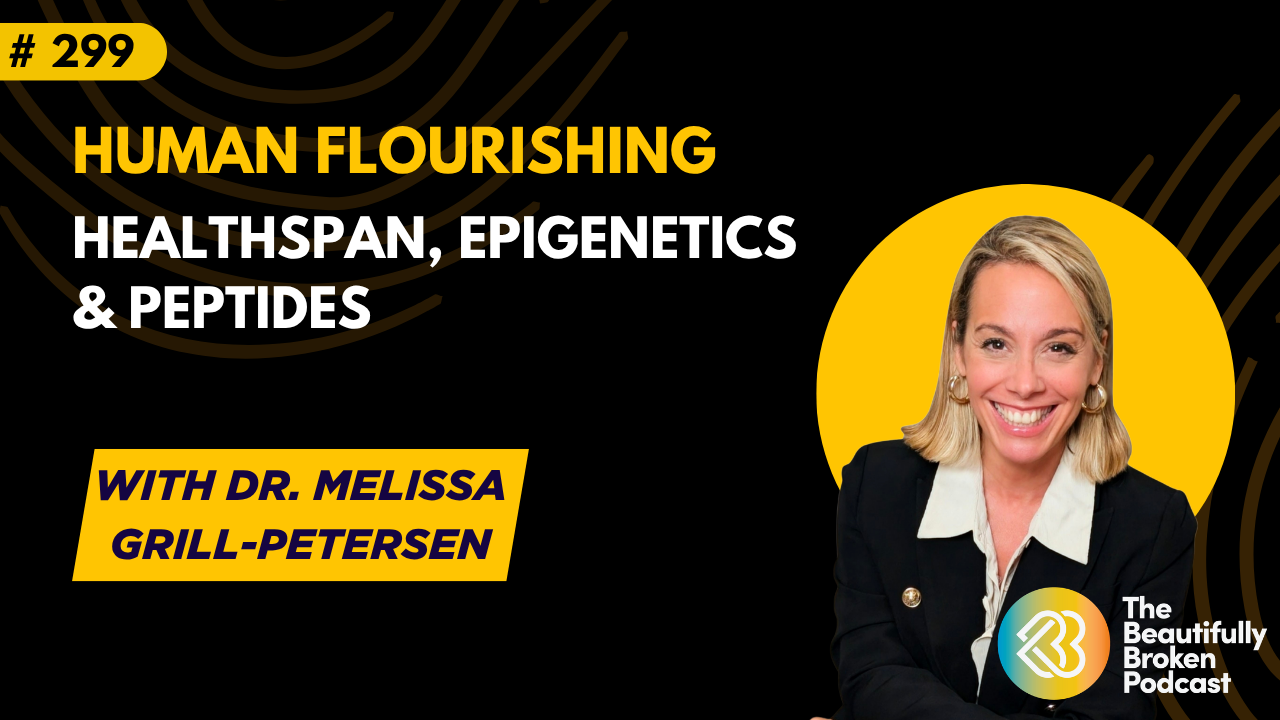
WELCOME TO EPISODE 299
Dr. Melissa Grill-Petersen, DC, MS, BCHH, is the founder and CEO of Human Longevity Global and co-founder of Peptide University, and in this episode she breaks down peptides in plain terms: naturally occurring signaling molecules that instruct the body's existing pathways rather than replace them. She and Freddie dig into why peptide quality of effect depends on foundational health — cell membrane integrity, nutrient status, hormone balance — and why she sees peptides as one input among many, not a shortcut around the basics. The conversation also covers the "exposome," the case for designing environments (cities, workplaces, healthcare systems) around healthspan rather than sick-care, and the emerging economic argument for longevity research reframed around health-adjusted life years.
Beyond the science, Dr. Melissa shares the personal story that shaped her mission — watching her mother's cancer go into remission through an intensive lifestyle shift, then return after returning to old patterns — and how that experience shaped her belief that inputs, not just genetics, drive health outcomes. The episode closes with a quick-fire round on her favorite peptide for cell membrane support and where peptide delivery research is headed next. A candid, systems-level look at longevity, personal responsibility, and human flourishing from one of the field's most recognized educators.


Episode Highlights
00:00 Intro and welcome to Dr. Melissa G Petersen
09:36 Mom’s cancer diagnosis and the power of changing inputs
10:01 Mind-body medicine, remission, and relapse
11:23 Processing trauma, meaning, and purpose
13:22 Wholeness, healing, and releasing what is not ours
29:43 Macro to micro: where health really starts
34:24 Healthspan vs lifespan
36:37 The economics of extending healthspan
38:03 Exposome, environmental inputs, and upstream design
43:06 Foundational habits: food, sleep, light, connection, purpose
46:45 Where to start: overload vs undernourishment
50:36 The flexibility principle in centenarians
56:25 Peptide University, education, and safe use
72:17 Peptides, supplements, and foundational substrates
79:21 Final message: wholeness, purpose, and potential
Connect with Dr. Melissa Peterson
Join Peptide University: https://mypeptideuniversity.com/
Use Code Freddie10
Upgrade Your Health
LightPathLED: https://lightpathled.pxf.io/c/3438432/2059835/25794
Code: beautifullybroken
Silver Biotics Wound Healing Gel: https://bit.ly/3JnxyDD
30% off with Code: BEAUTIFULLYBROKEN
MaxGen Labs: https://maxgenlabs.com/BEAUTIFULLYBROKEN
CONNECT WITH FREDDIE
Work with Me: https://www.beautifullybroken.world/biological-blueprint
Website and Store: (http://www.beautifullybroken.world)
Instagram: (https://www.instagram.com/freddie.kimmel
YouTube: https://www.youtube.com/@beautifullybrokenworld
FULL EPISODE INTERVIEW
EPISODE TRANSCRIPT
Freddie Kimmel (00:01.15)
All right, ladies and gentlemen. Welcome to the Beautifully Broken podcast. Hopefully this one's gonna be out Monday. It's gonna be out next week. We are bringing Doctor Melissa Melissa G Peterson to the show. Melissa, welcome to the show.
Dr Melissa G Petersen (00:16.142)
Thanks for having me, Freddie. Lovely to be here. Mm-hmm.
Freddie Kimmel (00:20.578)
Yeah. Yeah, I can't wait. What is this what is this behind you? You've got like a a beautiful geometric design going on behind your head.
Dr Melissa G Petersen (00:30.09)
Yes, I have some sacred geometry. And it's just, you know, so when we think about different yeah, I mean, I'm sure you're very aware of this, different geometries or mandalas, it just gives us a focal place of present moment awareness. And this one signifies masculine, feminine dynamics and balance and the the integration of wholeness together. So
Freddie Kimmel (00:33.173)
Mm.
Freddie Kimmel (00:51.597)
Yeah. Yeah. That it it really is. Isn't it interesting how the design and structure of societies change so much, but we very much operate on these very ancient old paradigms. And and in this age where it kind of calls or requests you to do this integration of what's needed of of these male and female roles, it's just so different from from the majority, I would argue ninety nine point nine percent of human history.
We're on this very, very new operating stage, which I don't think people always know what to do with.
Dr Melissa G Petersen (01:25.868)
Yeah. Yeah, we are at a you know, we're at a really beautiful time, I believe, my personal philosophy within humanity of remembering. And so, you know, we think that we have to that there's supposed to be a roadmap and we're supposed to problem solve and fix and and that there's these, you know, very black and white answers, but the reality is it's all already there. And if we are willing to kind of slow down and pause enough and let our inner voice be heard.
That's the act of remembrance. And it's all already there. You know, just the the dynamics, the balance, the wholeness. Yet we get so caught up in just conscious versus unconscious, conscious living, the fullness of life, the busyness of it all. It's very easy for that voice to be silenced or questioned or, you know, pushed back. And there just doesn't seem to be the way that society is designed today, really the the opportunities for the space.
To be there just for that reflection, let alone to hear that voice of remembrance.
Freddie Kimmel (02:27.936)
Yeah. Yeah. It is it is truly interesting to watch an animal, specifically in nature, move through space and go about being. And my goodness, can you imagine if you've ever driven through Yellowstone, having the buffalo just look at the people, they're just like, God, they're so busy. What it would they're just so busy.
Dr Melissa G Petersen (02:37.985)
Yeah. yeah.
Dr Melissa G Petersen (02:49.225)
I know. What must we look like through their eyes? Hmm. Yeah. Yeah. It's fascinating. It is.
Freddie Kimmel (02:54.674)
Yeah. It's wild. If we if we bumped into each other at Yellowstone looking at Buffalo and you had like twenty seconds, what would you tell me you do? How do you how do you show up in the world? How do you spend your time?
Dr Melissa G Petersen (03:09.653)
W how would the buffalo see me or how would I tell you just you're asking me out of
Freddie Kimmel (03:13.186)
How would you tell me? We're just we're both watching Buffalo. I usually say if we bumped into each other at a grocery store, what what would you what would you tell me you do, Melissa?
Dr Melissa G Petersen (03:22.285)
gosh, the do you question. Well, you know, I I support human flourishing globally. I just am here to support and design frameworks and pathways for true aliveness throughout humanity.
Freddie Kimmel (03:28.02)
Yeah.
Freddie Kimmel (03:37.565)
Yeah. We were we were introduced because I had a couple friends say, you've gotta talk to Dr. Melissa. She runs Peptide University. And I I went to the I went to the site, I listened to you speak a little bit. I was really, really impressed with the way you use language, the cadence, the quality of the the quality of the the embodied knowledge.
Dr Melissa G Petersen (03:48.159)
Mm-hmm. Yeah.
Dr Melissa G Petersen (04:00.91)
Mm-hmm.
Freddie Kimmel (04:05.374)
when you were speaking and I was like, I want to have her on the show. So we're finally doing it, even even after we're even after we we bumped into each other in the three D a few times. I would imagine there has been an evolution in your road in the world of wellness. Like what got you curious in health and human physiology and flourishing?
Dr Melissa G Petersen (04:09.57)
We're doing it. Yeah.
Yeah.
Dr Melissa G Petersen (04:25.812)
Yeah, I I love it. And I think if we do the, you know, like here today, it's I'm the founder of and this global thought leader for the human longevity global ecosystem that owns Peptide University and Human Longevity Institute and a lab division, research division, advisory division. And it is really fascinating because sometimes I don't even like it, I'm like, wow, I sound really like if I didn't
If I didn't know it was me, like I'd be going, wow, like that's that person looks like amazing and really cool and like so put together. And yet when we're in it, like our like our journey that gets us from where we're at, like to where we've been, to where we are. And it's all these little micro moments that we seldom don't appreciate or understand, you know. But yet when I do step back, I I feel like there's a really intelligent design to my life. And so I'll just share a couple of really interesting little little things.
you know, points along the journey, which is I can remember being very young. So one half of my family is full Italian and the other half, like my mom's side, was European. And so parents divorced very young age, two different households. And so it's a Sunday. And often in an Italian household where I was growing up, you know, we'd always have family Sunday dinner. So some of the family came in from New York. We lived in Pennsylvania at the time and
There's all my elders just and they're playing poker. You know, they're sitting around a Sunday afternoon after we'd eaten, they're playing poker, they're smoking, they're drinking, they're joking. Like they're just they are living full out for just what feels so right for them. And they were having a blast. And I don't know how this came to me as a 10-year-old child, but just watching, I just was like, I'm gonna live a really long time because my I mean they're in their 80s, some of them are.
90s, some are in their 60s, they're different ages, right? But I'm just like, I'm gonna live a really long time because I have good genes. And I again, where did a 10-year-old even hear that? And of course, today we know genes are not our destiny, and we can get into that. They're they're the they're the blueprint, but they're not necessarily the full terrain, right? It's the inputs that's gonna inform and influence. And and then, you know, as I go through it, interestingly enough, going along my journey, I began dancing when I was two years old. Dance was really my way into
Dr Melissa G Petersen (06:47.743)
Into fitness and to wellness. I started working out when I was in sixth grade. I was running fitness programs by the time I was 17. I was a choreographer. I did lots of things in the dance world and the television world. And you and I spoke a little bit about that. And so interesting, subsequently at the same time, simultaneously, when I lived with my mom, we were very poor. And so we didn't have a lot of money to do the things. However, we literally lived off.
Like we lived off of we'd have a garden every summer and you'd can stuff. My stepfather hunted, like we literally had frozen venison. And I can look now and go, man, the biohacking community, like we will go pay lots of money for all of this stuff, right? And yet I hated it as a kid because I'm like, where are the Doritos and the Wonderbread? And yet I feel like what a blessing. I didn't even know how that environment was influencing and informing me because I just got to live
in nature every day, my feet on the ground, in the garden, pull like pulling weeds, which I couldn't stand to do, right? But getting so much good information in certain regards into my system. And so that was interesting that it was kind of there. And then I'll fast forward because this is always an i a long question that I I have to figure out how to make shorter. But my mom got diagnosed with cancer. This was 20 years ago now, a little over well, probably 24 years ago. And
I was just getting into epigenetics. I think that was right around Bruce Lipton's, you know, biology of belief. And I was an early adopter into all of that because in my early days, my doctorates in chiropractic and natural medicine, and I'd be in my practice and I'd be watching, like, you know, patients come in and I would see short-term responses without long-term correction. And I just was looking and looking, and I've always been a systems thinker, and I'm like,
The things that we were taught really don't translate real time. There's more to this. It's not just about a treatment. Whatever that treatment is, whether it's a chiropractic adjustment, red light therapy, you know, even a peptide, it's never just about a single treatment. And so this was over 30 years ago. I started looking at that real time, going, huh. So I'm going down my own rabbit hole of understanding there's just so much more, and so much of it is the mind. How does our perception inform and influence?
Dr Melissa G Petersen (09:07.077)
our you know our psychology inform and influence our physiology and so then I'm getting into epigenetics and my mom gets diagnosed and of course she was lived the there was trauma, right? Tons of unprocessed trauma, a tremendous amount of it. She was very overweight, she was very unhealthy, but she was really deeply sad. You know, she her love was her career. So she overworked because she had a there was just a lot of not so good things in our everyday world, how we grew up, my stepfather, all that kind of stuff.
And so when she got the diagnosis, it was she was fifty. Now go back to talk to the little girl that was 10, who thought she was gonna live forever, to now be confronted with her mom at 50. And I'm like, my gosh, okay, wait, what do we gotta do to to support you here? I was unwilling to think that there was she was not gonna make it through this. And so we immediately started. Like at that time, I
was training under Dr. Bernie Siegel. He was in early in the 70s. He was one of the first people to bring out mind-body medicine, you know, psycho neuroimmunology. And I was training under him for all the cancer research and meditation and mindfulness. And we're actively applying all these things with her. Took her, she took six weeks off of work. We completely changed the inputs, changed her environment, changed her daily influences, changed what she was eating, how she was thinking, how she was sleeping, moving, all of it. And in under six weeks her tumors were gone.
Now we might feel like that's total magic. And to anybody, we're like, well, if we do understand that the inputs are directing the outputs, how our health expresses makes a lot of sense. And I know you've probably got a lot to share with us through your own journey. And yet then she went back into that work environment. So she gets clear, she's in remission, everything's gone. Doctor's like, I don't know what you did, don't tell me, just keep doing it. And then she went back into all the stress, all the demands, all the things and all the unresolved everything else that
Just kind of was back. And within 18 months, everything was back. Within another six months, she had transitioned. So right days after she turned 54, there she was, gone. And it was such a earth-shattering moment for me to question my own identity.
Dr Melissa G Petersen (11:23.509)
And it's not that that was the moment that I said, I'm gonna go build human longevity global. I'm gonna go be dedicated to human flourishing. I'm gonna go figure out longevity. It wasn't any of that. And it was never out of fear. It was just looking at her going, what do I actually believe? I think that I'm how I know my whole world. I'm a doctor. I teach, I'm natural health. Like everything I teach about is health and wellness and and yet all of a sudden I'm wondering if her tr destiny becomes mine. And I had to really sit with that.
And just say, well, no, her destiny isn't mine. Her truth isn't mine. And just because there could be some genetic predispositions, how we live, what our inputs are, what's in our heart, what's what's what's my what's my opportunity now to continue to heal the trauma, not only in myself, but that transgenerational trauma from her also that we lived and happened even before I was born, passed into me. So I would say it was when I
probably start I started doing inner work by time I was 14, self help. But I think at that moment, I was then 35, I was like, okay, like I'm looking at all of this differently with more meaning. Because if I live my whole life for work and all of a sudden like something happens to me because I had to watch her be replaced by the very thing that she loved. They're like, we love you, but life has to business has to go on. And that's the reality of it. So to have a whole life perspective of going, wait a minute.
Let's show up with meaning and purpose. And I just got to continue and I still to this day every day. What is true for me today? What is alive in my heart? Like what is and I just and and I started to surrender more and more. And although it took me a long time and just say, I'm here for my Earth mission. I'm here to steward the highest expression of flourishing. Like that's what's true for me. I like I'm not gonna tell people how they have to do it. It's not a set protocol. It's it's like
Tapping into that state of wholeness and aliveness within ourselves. So, how do we clear the disruptions? How do we set down the heaviness that we've all, many of us have been carrying for far too long? Release the ownership of responsibility that is not ours, that can truly help to, you know, to reset our systems, our frequencies, our interactions, of how we feel about ourselves and our dynamics, because
Dr Melissa G Petersen (13:49.952)
who we are within ourselves is who we bring to the world. And so i it's been an ongoing evolution from there, but since I just took ten minutes to answer your very simple question, I should probably come up for error.
Freddie Kimmel (14:03.27)
This is your podcast. People listen to me go on and on all the time. So you feel free to talk for 20, Melissa. I want to say thank you for sharing your story. and thank you for thank you for the work you've done to process that in such a beautiful way where there is a lot of agency in what you said without being tethered to this very heaviness that is an unfortunate event that was put upon you. And and I just
I would just ask everybody driving your car right now. You listen to this in the gym, wherever you're listening, just think about that. Think about where we do that as human beings. We put this very heavy tether of an unfortunate event that we are victim to. And when I listened to you talk, I was like, Well, here's a person who clearly could see this very challenging life situation, this very you ride in this really challenging wave, and you you at a very young age, you said, Well, what is this for? What's here for me?
The our d our WTF, we flipped that. and it's a just a it's a it it's a it's a beautiful practice. I'd say that's the one of the core top tive five things you can do as a human being and just ask yourself, like, what is this coming into my life for? Because we're all gonna face these waves. We're all gonna face these waves, and it's like you get to choose how you ride it, and it does not mean that we all get to reign victorious on the top of the mountain.
Dr Melissa G Petersen (15:04.072)
Yeah.
Dr Melissa G Petersen (15:20.46)
Yeah.
Freddie Kimmel (15:31.907)
And say, look, I did it, I beat it. That's not what it's about. In my experience, you know, we just get to decide how we climb, who we climb with, and how we get to do that.
Dr Melissa G Petersen (15:39.156)
Mm. Yeah.
And I love that you share that, you know, because it's it's easy to hear it. It's easy to hear it and go, yeah, that sounds so good. And and yet, you know, and and and believe it, yet in the throes of everyday life, like when we're really put to the test, it can be very challenging because so much of how we operate is so unconsciously driven and programmed, right? So to speak. And and I know you and I spoke about this when we got to finally connect in the 3D, as you said. I love it.
Freddie Kimmel (15:48.972)
Mm.
Dr Melissa G Petersen (16:13.125)
Is over it's coming up on a year ago when I started a Course in Miracles. And while I have done I I live, I I live it. I practice what I preach and I also don't like to be preachy to say my way is your way, because that that's really not true. And exactly as you said, it's like it's really how are we going to approach whatever we are given, however we perceive it. It's like if we go back to Buddhist principles, you know, is it is it good or bad?
Is it? Is it either? It's like it's typically most things, it's like where is our balance in all of it? And that's again, it's an inside job. What is what is stability for me? What is balance for me? And sometimes we have to begin by first noticing what is overloading me, what is taking me out of balance? Where are the things that I'm I'm exerting so much energy and and it am I getting as much back? It's not about a give to get. It's like if we look at a balance, like am I as an individual
in a balanced state because if we think of balance, I like to I always think of the like a lever, a a level, excuse me, a level. Like a level or even a teeter totter, right? But if you have a level that you're gonna go put up a piece of art and you're like, okay, is this balanced? You know, the it gives you a this little bit of movement. You're like, yeah, you're pretty spot on. Like the little air bubble goes back and forth. And I love that because I think in today's world we're all like seeking, especially in the health arena.
Freddie Kimmel (17:19.628)
Teeter Totter? Yeah.
Dr Melissa G Petersen (17:41.41)
People are seeking answers. And so many people want the definitive answer, the path, the protocol, the again, the molecule, the pill, the treatment. They want the one thing. And and if we really appreciate like life balance, if we go to clinical terms, homeostasis, it's not a stagnant state. It's this dynamic, right? Like
just kind of adaptability. And so I like to think of what happens with that little air bubble trying to find our balance. And so it's what are the things that really are tipping us. And that's that's usually a place to begin, not judging of oneself, but to say, Hmm, how is this serving me? What is this showing me about me? How am I feeling with this? To your point, how am I choosing to approach whatever's coming at me? How am I i interpreting it? Because we are the
We're the, you know, the authors of our own story. We're crafting that inner narrative. And while I've done so much over the years and every bit of it's been beautiful, I would say truly A Course in Miracles has been such a tremendous when I look where where I was last year to where I am now, and I did it probably a little differently than I mean, I don't know that there's a right or wrong way, but I did the audiobook and I'm still doing it. I'm not done yet.
And it's a little dense. If people have done it, like I'm going to the one back from the 70s, it's dense. It's like, this is hard. I'm falling asleep listening to this, right? but going through it and so journaling real time of whatever's speaking to me. And then with my own personal AI, I'm like, all right, we're gonna break this down. And so what I started to do is real time apply, like I wanna apply this right now to what's to where I'm out of balance, to what I'm noticing, to what's happening, because
My whole journey is how do I get to that wholeness within myself? What are the things I've had to put down? that I get to put down, and how has it kind of reoriented me? And it's been transformational. And I think that was one of the tools. Didn't you do something with that? Didn't we talk about that? That you kind of had that in your path along the way also?
Freddie Kimmel (19:53.72)
Yeah, yeah. And I mean, and I'd I'd I could take it all the way down to language. It's like I was never taught that my words created the the blueprint, the architecture for how I was I was going to be expressing over the next six months. And language is such a great doorway. It's such a great understanding that again, if we're reacting to the outside world all the time
Dr Melissa G Petersen (19:59.479)
Yeah.
Dr Melissa G Petersen (20:10.124)
Yeah.
Mm.
Freddie Kimmel (20:19.765)
you can f you could feel about that. That a reaction is very immediate. It's it's tense, it's doesn't make sense a lot of times. We're just responding to a signal, as opposed to like where can I extend that gap between stimulus response and say, what is the unnet me un unmet need that I is coming up for me and it's driving that like predominant feeling. So really I'd I'd say nonviolent communication, like a feelings and needs worksheet, which I have printed
all over the house, which I will just, you know, I'm like scriviling my unmet needs. Like and and but but that gives me immediate agency to the why internally. And the other version of that was like a a DNRS or a limbic system retraining program. And so I'm I'm deciding what I'm experiencing
Dr Melissa G Petersen (20:50.643)
I love that. Yeah.
Dr Melissa G Petersen (21:01.419)
Yeah. Yeah.
Freddie Kimmel (21:13.53)
What does that mean to me in this moment? What what do I lose by telling myself that story? What do I lose from this current state of imbalance or disease in my body? And what is do I allow that narrative to run wild or do I pause it?
Dr Melissa G Petersen (21:27.787)
And also, Freddie, what do we get from it? And I think that's I think that's a hard thing. Like none of it, and I'm not saying that we are giving ourselves a disease, we're giving ourselves trauma, we're giving ourselves a a bad relationship. I'm not saying that we are intentionally giving ourselves the very thing that we don't want. However, if we are willing to come from a place of non-judgment, like literally curious, and to go, okay, well, if I think about, like I I've had
Freddie Kimmel (21:30.896)
Yeah, that's right.
Dr Melissa G Petersen (21:54.858)
My life has not been rainbows and unicorn and I it there's been a lot of amazing blessings. So I'm not gonna dismiss that either. Like I'm I I love my life. Even in the challenge, I'm still showing up not to gaslight myself, but to say, okay, what's here for me? And as I've had to go through things that would have been very easy just to walk away from. Like I'm done. I'm like I'm out. Like I'm not. It's like, okay, this is what is this giving me right now? And so if I even look in patterns of how I've led, led my team at certain times, and
For a long time, the idea, especially of a of a woman, and a woman-owned, you know, founder and CEO and building teams and and consulting and doing all these things, a little bit of it for a for for a long time in my earlier days, it was about recognition, like feeling that I deserved a seat at the table, so to speak, finding my own validation in the work I was doing, but realizing in that unconsciously, taking on more and more and more and a bit of it to prove to myself that I could do it. But I think I was also
I was really thinking I was proving to others or showing others, see, I can do all this. Like I can, I'm the person you want to work with, right? There was a little bit of that, like, almost pick pick me because I'm really good at this. And I'm like, wait, no, this wasn't about them ever. I was trying to show myself to myself the entire time. So what did this challenge, right? What did this unmet need going through it this long or in this way, what is it really given me? And and it gives it all gives us.
It gives us and so at some point I believe we we come to a decision whenever we're ready. And I think many of us feel like we have to force it and it's gotta be right now because we're all used to schedules and times and so everything feels like it has to be instant. But if I've learned anything over the past year, it's like, listen, you will n the decision will come. Like the decision will come. And sometimes it's not about making the decision right now, yes or no. It's about understanding this is a classroom. And if you're not clear, it's not
fully aligned in your heart and soul, then it's still giving you something. It's still giving you something. So what is it giving you? And when you come to that place of saying, but I don't like what it's giving. It's giving me everything I've needed now. Like I'm, I feel like I'm complete with that lesson. I'm good with that teaching. Can we stop that teacher now? You know, that's again, I keep saying the phrase, it is an inside job. Only we really get to have that answer for ourselves. But it is often easier just to
Dr Melissa G Petersen (24:20.119)
displace and blame and point a finger and well they didn't he didn't she didn't it's not how dare it is easier and I'm not making a judgment on human nature for that because sometimes we're just not able to process yet. You know, and I like how there's different ways in. And like you said, a limbic system reset. Like there's different inroads. So sometimes being too cerebral, we can't get it. We can't find it. It's just not there. And you know, like we have to I often say like
Freddie Kimmel (24:43.607)
Mm.
Dr Melissa G Petersen (24:47.445)
Psychology does inform physiology, but we can't think our way out of things. Like I and you do so much, you do great work with this. Like when you can't get there in your brain, gang, go to your body. Because that that holds the innate intelligence. And I don't mean go obsess and start doing crazy workouts and do all that. I mean soften and be with and give yourself
Freddie Kimmel (24:59.286)
Yeah.
Dr Melissa G Petersen (25:13.441)
that space or that patience or that ability to get out of here, right? To get into here, to get into here. so it's it's the flow between it. And when we give the brain a little space and there's some silence and some boredom boredom and some processing time, some integration time, all of a sudden a day, two, three, a week or two later, we have a new like,
Freddie Kimmel (25:24.107)
Yeah.
Dr Melissa G Petersen (25:38.242)
All of a sudden, like we have the answer or we have more clarity and we're like as if it had always been there. We're kind of like, like, I I think it's could it it gets a little easier. So when we stop pressuring ourselves, then our systems are not as pressured, and we can digest the very things that we're asking ourselves to understand. But otherwise, it's like it can't digest, right? And then we can't get the what we need from it.
Freddie Kimmel (26:04.981)
Yeah.
Dr Melissa G Petersen (26:07.445)
assimilate and eliminate. Mm-hmm.
Freddie Kimmel (26:07.892)
Yeah. I think it's a time in in which we will see our leaders that it's gonna be the people that can do this to some degree and be vulnerable with that it's not gonna be perfect, but to show up and and do you're d you're doing what you're selling. You know, you're doing what you're preaching. That's quite rare in my experience. Talk to a lot of founders, a lot of thought leaders, a lot of famous people with a lot of books.
Dr Melissa G Petersen (26:32.001)
Mm.
Dr Melissa G Petersen (26:36.802)
Yeah.
Freddie Kimmel (26:37.269)
And it's it's oftentimes it's shockingly messy behind the scenes between what is presented, because w now we're interacting in a global community through like a supercomputer in my pocket, in which I can access this avatar of somebody else. And I was like, Wow, that's not that's nothing what they're like in in real life. Isn't that interesting? Without grandiosity or judgment.
Dr Melissa G Petersen (26:56.813)
Yes, yes.
Freddie Kimmel (27:01.084)
And so I think that is for me it's a call to go slow. I will I will add and and I will add before we pivot, and I do want to pivot, that there was a time after like being diagnosed with rheumatoid arthritis and metastatic cancer and being rushed to the ER and abdominal resections and late stage Lyme disease and da da da da. I remember one time sitting and just in tears and saying, universe
I am ready to learn lessons with ease and grace. And that's all I would say. That was my one sentence. I said, I'm ready for ease and grace. I don't need another abdominal resection. I'm total I'm open. I'm humble. Tell me where to go. I got goosebumps right now because that's like a very strong truth for me still. That I don't need it to be dramatic. And as a theater kid who is like love storytelling and love Broadway, and I'm like all in it, I'm like, it's
Dr Melissa G Petersen (27:30.541)
I love that. Yeah.
Yeah. Yeah.
Dr Melissa G Petersen (27:49.965)
Correct.
Freddie Kimmel (27:57.147)
You know, I said, I'm open. I'm open. I'm willing. Is there another way I can get this information and, you know, universe be blessed has has given me like a big chunk of time, right? A big chunk of time with some ease and grace. And so I'm I'm always thankful and that is a d comes up multiple times a day. thank you, thank you, thank you, thank you. I want to and and I do believe this is probably the most important conversation.
in the world of health and wellness right now, we we have we I I just feel like it so many things are hyper accelerated and that we're like in these silos, the conversations you've had about epigenetics, that'll be new for people. the terrain, the the the energetics of my language informing DNA expression, that's not a shared reality for a lot of people. And so we're in a country, and I think this is a
good conversation starting point. We're in a re we're in a country where we spend the most on healthcare. And for what we spend, we are definitively the sickest in the United States. And so that that's also if we're gonna meet people where they're at that are going to listen to a podcast and they're gonna they really want to feel better. They are tired of being tired. They're tired of feeling like, am I being gaslit? It should my bones be deteriorating? Should I be gaining all this weight? Should I be suffering under hot flashes? Should I not be able to think clear thoughts?
Dr Melissa G Petersen (29:15.213)
Mm-hmm.
Dr Melissa G Petersen (29:24.119)
Right. Yeah.
Freddie Kimmel (29:24.494)
You know, all the things. Like where where where do you point people to just walk into that door of like if I could build you like your your today, your agency, where do I start as somebody who is trying to seek better health?
Dr Melissa G Petersen (29:30.977)
Mm-hmm.
Mm.
Dr Melissa G Petersen (29:43.255)
All right. So I love it. and I'm gonna I'm going to you're gonna get a Melissa answer. Okay. So we're gonna talk from the macro to the micro and the micro to the macro. And I I wanna
Freddie Kimmel (29:48.814)
Great.
Freddie Kimmel (29:52.89)
Do you know I already wrote macro to micro on this? 'Cause I knew I was like, We're already in the black and white cookie, we're already on the teeter totter here, so I know we're gonna have to go back and forth. Hit it.
Dr Melissa G Petersen (30:02.341)
Uh-huh. I got you. I got you. So what I want to what I want to do for a moment is is go back to something you said just a couple of minutes ago about we are in this time and I accelerated silos and you know leaders basically have to kind of walk the talk and and we're just seeing a lot of a lot of different variations in different silos and different you know agendas of what's getting pushed where. So
As I look at that, as I looked at this, this has been over a decade in the making. we've recently published and released the Health Span Index. Now, this is a global framework to bring agencies, governments, innovators, leaders across the aisle. Because life does not work in silos. Health isn't siloed. The human system is not pieces and parts. It is a complex, beautiful, dynamic.
system and that is scientific. This is not just a woo language. And so if we appreciate that the outer world is a reflection of the inner world, okay. So we'll just go there for a moment and say that you really at a big level globally, everybody's kind of in their own silos and everybody's approaching things differently. There's the public sector and the private sector. They the two don't meet. We think it's all being driven by politics and the politicians, but they don't meet really with the private sector. And the private sector's driving things like
There's it's kind of messy, gang, in the world. And it's really interesting for years, as I've I've consulted and worked with patients and done all the things. People come in when they're having a health crisis, a health moment. I'm sick and tired of being sick and tired. I I'm not liking how I'm looking, feeling, what I'm experiencing. And it could be very dire or it could be just beginning, right? So there's there's a bit of a, you know, we've got a continuum.
Of where people might enter. But for all of us, it doesn't matter. It's relative. The moment we feel out of sorts with ourselves, that's our starting point. But it's typically out of problem and pain. Not typically out of I wanna have my greatest energy, my my longest vitality, right? It's it's usually I can't get the weight off, I'm fatigued, I've got Lyme, I've got a thing, and I don't want to have it anymore. And so from that standpoint, when we start there.
Dr Melissa G Petersen (32:26.273)
People will do whatever it takes, nine times out of ten. They'll go to doctor to doctor, they get misinformation, they get put on a pill, the pill doesn't work, they get on 10 pills, the 10 pills don't work. Okay, now traditional medicine didn't help me, so now I'm gonna go outside of that a little bit. Now I opened up my lens, and then people find their way into integrative, holistic, you know, I'm gonna be biohacking, I'm gonna try all these different things because something's gotta work. I can't do this anymore. So the interesting part is that it feels like work.
And if you ask people what they think about being healthy, most people are like, well, it's hard. I have to give things up. I have to stop doing things that I enjoy, right? I don't want to have to go do all this other stuff. And I would listen to this and I'd look and I'm like, we have a real issue here. Like we need a rebrand. We need a re we need a rebrand on what we perceive health to be, of what it means to us as individuals. And so I I also thought about it that I'm like, but it's
And it's all been placed on the individual. Like the responsibility has fully been placed on the individual. And I think what's really interesting about this current administrative administration, we're seeing things like, now for you and I, it doesn't seem this monstrous, like it took all this time to get red dye 40 removed. Are you kidding me? But for a lot of people, it feels like, yay, we're making headway. And it is a step. It's a signal, right? I'm I'm for it. It's it's a step to say, look, we have not been putting clean products.
on the shelves. The things that we are doing here in the US are radically different than the way they are in Europe and other parts of the world. So oops, caught us. We're gonna start to make some slow changes to clean that up. Okay, but this is an example. So we can be telling the person, that end user all day long, you've got to eat differently, you've got to breathe differently, you've got to move differently, you've got to have different lights. Well, you know, nobody tells people to try harder to breathe clean air.
Like if it's clean, it's clean because we automatically breathe. So I started to look at this and say, this is a design issue because we understand, to your point, we are in a time that we are living longer than ever and we are living sicker than ever. And we have a gap between what is referred to as health span, that's the number of years we are living in in health, free from sickness and disease, versus lifespan, which is the number of chronological years that we live.
Dr Melissa G Petersen (34:50.771)
And on average, right now we are at about a 14-year gap between health and checking out of life. So those last 14 years on average are spent in sickness decline. That's our cost of healthcare goes up radically and exponentially. And now we have people living longer, we have a lower birth rate, we have this, you know, inverse relationship of who's caring for the aging population, air quotes.
And so it's literally over the past, really in 2013 is when longevity became more, there was more of a framework, hallmarks of aging. Really, since about 2017, there was you know, with Dr. Fahy's work, Greg Fahey's work is when we first realized, hey, we can actually reverse the pace of aging. Now that's a whole other conversation we'll have, but meaning really for about the past 10 years now on average, just for historical context, this concept of wait a minute.
We've we are seeing the numbers around the globe. We are gonna have what's been referred to as a silver tsunami. Something's gotta change. We're spending more, managing sickness, we're not getting better. The gap is only growing. What in the world do we do? And at the same time, there was a flip. So in was it, I should know this. Was it 2023? Andrew Scott.
really well known out of in conjunction with Dr. David Sinclair and you know who they they put out and published a paper on looking at is there a dividend, is there a gain to being able to extend health span? So what if we lived healthier longer instead of sicker, right? Like, hmm, that's a novel idea.
So we are on average right now in the United States, kind of the the most up-to-date numbers, we spend 5.3 trillion annually managing, managing, not correcting, managing sickness. That's a little, it's about $15,500 per person every year just to manage sickness. Okay. We're not getting anywhere. And so he said, Well, what's what's the inverse? So
Dr Melissa G Petersen (37:06.709)
As they ran the calculations again, roughly what they found is for every year we can extend health span, there's an economic gain of 38 trillion. That's pretty big. We're spending 5.3 trillion. And we think that's a problem because it is. That's over 20% of our national debt. But now instead of spending, we can actually gain and money can go back.
into the economy, into society. And so that was a defining moment to say, hold on, there's actually there's a there it is more economically, you know, like incentivizing for us to fund health and wellness and longevity initiatives. And so what we've seen since then, and I'm gonna get to exactly what you've asked, but I'm threading the needle for this because I don't know that
You know, the average person understands all these really interesting things because this is what's driving our ability. Where do I start? What's available to me? What are my resources? And and can I can I do it? Like we keep putting the onus on the individual, but it's not just the individual, it's a design flaw, it's a design opportunity. So when I say macro to micro, the micro is the individual. There and we will talk about individual processes that can be done, but the macro is upstream.
What's happening? What's happening upstream? And if we think upstream, not just globally in governments, but even upstream as in the inputs. So there is something referred to as the exposome. And the exposome is basically this fancy clinical term for, you know, the the environment that we live in. And every single input from the moment we are conceived, from the moment of conception, that's adding up.
So it's every every every time you've breathed in particulates, right? Every time you've had red light or or blue light or green light or you've had a vegetable or you've had seed oils or whatever it is. Every single exposure, fabrics, air, all of it. Traumas, every bit of it, frequencies, EMFs, all of it. It all is informing what's happening. And that accrues over our lifetime. And the quality of the input equals the quality of the output, keeping it very, very simple.
Dr Melissa G Petersen (39:28.929)
So now stay with me because I keep going, okay, it's upstream, it's upstream, it's upstream. So as an individual, we get to look at what are the inputs coming in. And we'll talk about those in a moment. And how do we determine where do I start as an individual to move my system into a greater state of health expression? Okay. I'm gonna come back to that. Micro. Macro, as I'm looking at this, going, we've got to bring these siloed places together across the aisle.
And we can actually design environments, inputs, we can set standards that's really a framework. So think of it like a lead certification, a well-building certification. We've created the health span certification. Like we're literally doing a health span scorecard with Smart Cities Council, talking to governments around the globe. I go to Dubai in a couple of weeks, and they've just, you know, set the longevity initiative that they literally are building an entire council.
In their government around understanding that longevity, it's not just about a health metric, it's how it drives keeping people healthier longer, drives economy. It drives life force, human capacity. So it's human capacity is our new currency, really, a vitality of the human being. And I just said, Well, we can design for it. We can design the spaces. So it's very simple. It's systems, it's people, it's planet.
From the micro to the macro and the macro to the micro. It's a bi-directional that if companies and and governments and policymakers and architects all of a sudden understand simple things like air quality. So I just said, hey, it t costs nothing for us. It's no effort for us to whether we breathe clean air or polluted air, we're breathing air as the individual. But my health is being compromised, right? If I'm breathing polluted air. That's I I can't change that. I can put
HEPA filters in my house, I can put plants, I can do as much as I can in my space personally to improve air quality, but it's a shared responsibility, right? Upstream, governments, cities, policymakers. And when you've got all these isolated silos, when I've done these presentations, it has blown my mind how few people in these public positions to
Dr Melissa G Petersen (41:44.952)
Pat to create initiatives, to pass policy. They don't know. And they're not playing dumb. They're like blown away and they're my God, tell me more. They don't know about circadian rhythm at all. Like we think everybody, we talk about this stuff all day long. We think, my gosh, everybody knows about the 24-hour light dark cycle. Everybody knows that blue light at 10 o'clock is giving the wrong signals to your brain, firing off the wrong hormones, right? Creating inflammatory disruption.
Interrupting your sleep cycles, in impairing your ability to repair and restore at night and wake up, revitalized and fresh, and right? We know that. But the people and the governments and the agents, they don't know that stuff. So we have put together a very simple framework so that in time, this doesn't happen overnight, but in time, I see very a very real path within the next 18 months, three years, five years.
We are going to see an accelerated pace where upstream is saying, we get it. We got it, we gotta do better. And we now want to intentionally design better. And so, meanwhile, us as the individual, right, we get to take ownership and sovereignty of self and say, all right, well, what is where do I start? So while all of this great stuff is happening and people are realizing, wait.
We can design for health and health doesn't have to be hard. I come back to this very simple teeter-totter principle. So we all know it's the foundational stuff, right? I mean, Freddie, we know that listen, what's on the end of the fork? How much are we sleeping? What is our light exposure? Are are we isolated? Are we connected? Do we have a sense of purpose and well-being? Or, you know, do we do we not? Like these are very simple drivers that there's tons of data, just well-being alone.
Mindset and how we perceive do I think life is happening to me or for me? These are actually very well-documented statistical drivers that are informing the system. Do I am I healthy? Do I have a reason to get out of bed every day that I want to make sure I've got energy in my system? The brain saying to the body.
Dr Melissa G Petersen (43:55.352)
Do I need the hormones? Do I need like, do I have a sense of purpose that I still need to be here? Am I like I'm checking out? I'm isolated. I don't really know what I want to do with my life. Like life is like, I'm just gonna go watch some Netflix. It's like, well, there's we don't really need like we're gonna start to shut things down because we have to conserve energy. The system is very intelligent. It's trying to figure out like, wait, do we have to keep energy flowing and vital? And does is everything in check? Do we have enough resources to take care of this human system?
Or if we don't, we got to start identifying what we can shut off, turn down, you know, run at half mass so that we can conserve. And then that means things just aren't repairing at the same rate. They're they're not recovering at the same rate. So it's all about signals. So here's where I'm gonna tie a couple of pieces together and I will stop. Is you know, peptides right now are the craze. People love peptides. Peptides are signals, they are cell signals. So they are.
naturally they naturally exist in the human system. They're just small bonds of amino acids bind bound together and their code. All it is is instruction code. So amino acids form po you know, amino acids form peptides, polypeptides, proteins. They're just little amino acids that build to make the more they are, the bigger the molecule, the bigger the thing. It's a protein protein restores, rebuilds, does everything in the body. Our DNA
is code, it's protein that's like literally gonna go out and restore the system. So these are just small signals that are code. So it's like a key that goes onto a receptor and is traveling through the body and it sends out a very specific signal to go into these specific locks, aka pathways. Okay. So they send out, you know, instructions, okay, more of this, you know, damp, increase insulin, decrease glucose.
Increase angiogenesis repair activation. So they're just sending instructions. And people are using them because they work. And in a system that's been overloaded, out of balance, noisy from all the inflammation, we're putting a signal back in that the body already knows that's reawakening that activation. It's not that their body's not making those molecules anymore.
Dr Melissa G Petersen (46:16.521)
It's that it's so overloaded, it's not making them in the way and the amount that they should be. So we bring that little signal back in and it helps to kind of, wait, we gotta turn that, turn that pathway back on. We gotta dial that up. We're getting instructions that this is needed. So peptides actually are a really interesting intervention. And they're just an intervention, okay? However, the quality of the signal depends on the inner terrain. And now this goes back to where does the individual start?
So I go back to what I said earlier about balance. Step one, if you were to look at your own life, where do you honestly think that you're overloaded? And again, whether that's with work, stress, stress is physical, mental, emotional, chemical, environmental. So where do I have too much? Maybe I'm eating too much. Maybe I'm drinking too much. Where do I have too little?
I'm not drinking enough water. I'm drinking too many Coca-Cola's. I am not getting enough sunlight. I am in the dark all day long. I'm like sitting down working in at a computer. Right? I am isolated. I don't talk to people enough because I work from home. I don't get out and socialize. Okay. Where is it too little? Where is it too much? And just be honest with yourself. There's no judgment here, and there's not a wrong answer.
So listen, if you're eating once a day and you're not getting good macronutrients, guess what? Your body's never gonna have the energy it needs if you're not getting basic vitamins and minerals in for your cells, for your mitochondria. There's, you know what I mean? So it's like we all want some big crazy protocol, but oftentimes what we see is most people are nutrient deficient. We have 90% of the population has one or more nutrient deficiencies.
And all of a sudden, those nutrient deficiencies, they play the same as a lot of diagnoses, fatigue being one of the first ones. Okay. So I would say, let's make sure you're actually nourishing yourself, nourishing yourself with food, nourishing yourself with connect with things that that lift that feel alive in you. So quality of conversations, quality of communication. I tell people all the time, this little thing, what you consume consumes you.
Dr Melissa G Petersen (48:36.481)
So what are you putting all your energy into? Back to you with the drama, right? Are you watching stuff that's just like surging your cortisol on your system all the time? You can't understand why you've got hot flashes, you can't understand why you've got extra belly fat. You can't understand why you can't sleep. Because our hormones are dysregulated by the way, the very acts of what we're doing. So, first of all, where are you overloaded? Where are you undernerved? Like over too much, too little? Can we balance it out?
Freddie Kimmel (49:01.47)
Mm.
Dr Melissa G Petersen (49:03.489)
I'm gonna stop because I just went on a ten minute rant, maybe fifteen. So let me pause and we'll get very granular to say how we we can apply this right now.
Freddie Kimmel (49:13.703)
It's a great filter. It's a great set of questions. It's it serves a lot. And I think most people, even myself, I'm listening to you, I'm like, I'm good there, I'm good there, I'm good there. that could be so much better. So I I keep going back to this. It is it is the one. It it's always gonna come back to you. It's it's gonna be hyper personalized because you say, Yeah, let's come to a shared reality on what on the end of my fork is considered good, bad, nourishing, like a base layer protocol.
And in my brain, I'm like, what is the the outside world, you know, mouth to anus is outside world. What is that interface, just like throwing a soft floppy disk into my computer to play Oregon Trail, like this food comes in and it's giving my body information, what's that interface like? Because we have this other layer of like where many people don't understand, like, my my digestion is actually horrible.
Dr Melissa G Petersen (50:01.152)
Yeah.
We're
Freddie Kimmel (50:08.562)
I didn't realize that just I didn't I didn't realize like having loose duel four times a week and not pooping for then three days and da da da da wasn't the norm. So like we've got all these components of it, but I do th again back to your question and just where am I good? Where am I bad? Where is there a leak in the system? Where could I be doing better? Is there any driver of that from my lifestyle behaviors that I think might be might I I might be able to draw more awareness there?
Dr Melissa G Petersen (50:17.378)
Right.
Dr Melissa G Petersen (50:36.149)
And and Freddie, let me say this because I know we're getting close to time. And I really want to thank everybody if you're still listening. Thanks for taking this journey with us today. that one of the things I learned early on in all of my longevity research was the work around centenarians. And centenarians have a different approach to life than most people. They literally, and I I've termed it the flexibility principle. So they're always looking forward, right? They're they're looking forward, they're looking ahead. So
They're always looking forward, but they're not afraid to die today. They live in the present moment, but they're excited about what's coming. And so this idea and and they're not rigid. They're flexible. They're pliable. Meaning, if they are a vegetarian, but they're going to a gathering with friends and what's being served as barbecue, they eat barbecue. Because it's not about rigidity. It's about, it's like, I'm here for life. I'm here showing up. And I would
I would really offer to people, I think if I had to give you a starting point, because you're right, like we can go, okay, well, am I pooping or am I not? Am I chewing my food 20 to 30 times to help my digestion? Am I taking like like what what foods? Am I getting enough greens to help with that? Am I getting arugula that's gonna help my nitric oxide? Like, that's where people stress the freak out. And then we put on our wearables and my god, I'm not recovering. But like we get rigid. We get rigid. So if I had to tell everybody one thing, it's
Where are you flexible and pliable? Where do you feel soft or or just open, right? So maybe soft doesn't feel like a safe word for some people, but malleable, right? Because if we come back to this idea of homeostasis, like what is the expression of health in the body? It and we think about what does the body do? What does the immune system do? What does the autonomic nervous system do? It's all about being able to modulate.
It's about being able to respond to then, you know, to to be able to understand that, hey, there's something here. We've got to go respond, we've got to come back, we've got to recover. And in that recovery, we take that information in and we adapt and we gain resilience, right? New capacity. But we don't stay rigid. We're not supposed to always stay like this. It's kind of going, And that's that balance. And so.
Dr Melissa G Petersen (53:00.437)
Are we malleable? Are we pliable? That's neuroplasticity in the brain. Like when we get rigid in the brain, we start to have cognitive decline. We have literally hardening of, right? The plaque, the brain plaques. The arteries plaque. That's rigidity. We have calcium shells. We protect, we protect. So where, if any, opportunity exists? Where are the things that you feel are creating rigidity or hardness in your life?
And if there's a hundred of them, you can't tackle them all, not overnight. So out of all of them, what's maybe one that you feel safe? I feel safe enough that I'd be ready, willing, and able to just approach that with maybe a little flexibility. Instead of it being a hard no, could it be a maybe? Right? So, where can you allow greater pliability?
Freddie Kimmel (53:51.502)
Mm-hmm.
Dr Melissa G Petersen (53:59.636)
into your own life because perception drives reality and you could think of food is really good for you and I could think it sucks and I know some and I've got proof because I saw somebody get sick from eating all kale right like no no no kale oxalates kids like so it's also perception and what we believe up here about kale is good for me or bad for me is telling my body
Kale is good for you or bad for you. And we do have, plus SIBO, no SIBO effect, we have very real physiological responses. So it is not a hard and fast. And I think that's where coming back to where we started. We all think it's supposed to be a very specific path. It is not a one path for all. There are frameworks. And if we can understand the principles like light, dark cycles, rise with the sun, eat with the sun, move with the sun, rest with the dark.
fast with the dark, recover with the dark. That simple. If we can start just with that. Could you imagine if every street in the world like had timed lights? A couple of cities do, but that actually honored that when, you know, the lights go off. Like as you walk by, like and if it comes on, it's it's an amber at night instead of the big bright white that's gonna disrupt the the the the ecosystem, right? All of it, as well as us. Like simple things.
that governments can do, simple things that individuals can do, from the macro to the micro, the ma micro to the macro, to all of sudden create just greater ease, greater health expression, and greater well being.
Freddie Kimmel (55:46.399)
Yeah. Beautifully said. Beautifully said. Melissa, I'm gonna have to have you back just to talk about peptides.
Dr Melissa G Petersen (55:53.867)
All right.
Freddie Kimmel (55:55.683)
I I I I it's such an interesting topic and it's I get so many questions on it and I'm I'm back and forth and all over the place. And you know, we're coming into this again, we're this era where our our our global community, specifically in the US, we're just we're just driven by this by we're driven by capitalism. And right now it's like a million different opinions in this space. You have Peptide University. What are some of the principles you guys teach and preach and educate around peptides?
Dr Melissa G Petersen (56:14.274)
Yeah.
Freddie Kimmel (56:25.254)
Peptide use and integration.
Dr Melissa G Petersen (56:27.165)
Yeah, thank you for that. so we are a clinician-led platform. So we are really here to teach clinicians first because believe it or not, only about 10,000 clinicians are actually certified and educated in peptide therapy. And so because this has been a gray market for quite some time and we don't have time to get into all this right now, you know, the the demand and the shortages two years ago with GLPs really allowed the consumer
To go fend for themselves. You know, deep down, Reddit threads, I want to try this stuff, I'm gonna try and and it's not that peptides are dangerous per se. The molecule itself isn't, but where it's sourced from, what's actually in the bottle, right? What's the dose that you're using, just because they're amino acids, they're information that literally activate very powerful pathways. And this is something that's lost on the average consumer because it's super cool and chic and trendy for everybody to have their peptide dealer now, right? That's like the new joke.
And yeah, I got my pep my my Chinese, my my China peptide dealer. Okay, well be good luck with that. Cause you probably have a whole we're you're so I it what boggles my brain is that people will be obsessive about their their supplements, their food labels, their clothing labels, but they'll go get some gray market peptides that are filled with excipients. They're not tested, they're not 30-party tested, they're not regulated, they don't know what's actually in the bottle. Oftentimes these things have been tested.
There's baking soda in there. There's you like there's there's crazy stuff in there. So with everything that's happening, it is important for there to be some guardrails, safe lanes of access, better regulation and and quality control, so to speak, for the end user. But it's also important for the clinician to understand it because the can and all of a sudden this is chemistry, like this is really in-depth chemistry. So, what do we do? What are the principles?
First and foremost, you gotta get educated. Nobody should be dabbling in peptides. and if you're using them as an end user, as the consumer, it really is important to find somebody who's been certified, who's been educated to work with that can give some guidance because going back to the terrain, going back to the quality of the signal, people like, I did it. And then they think, well, a little is good, a lot must be better if they've already got preexisting conditions, if they're on other medications, you know, if they've got
Dr Melissa G Petersen (58:49.683)
gut health issues, pro they're inflamed, they've got cancer. Like there's a lot of reasons why you shouldn't do just go do a peptide. And but if people have pre-existing, we'll just call it an imbalanced system, then they'll typically do more of a dose, right? There's there are hundreds of thousands of reports to the ER of just people not knowing how to dose themselves and having big issues on these things. So we teach safe, legal,
confident, compliant pathways. We teach the science. We teach the mechanisms. We teach and the thing about these peptides, they're not like a supplement. They're not like a medication. It's not a one and done. You don't get on them and just stay on them. They cycle. They're signals. They they last they're delicate. They last moments in the system. They're for what reason? What are the outcomes? How should we be working with them in our body? And there's intelligence to it. and so what I love is it's also disrupting healthcare.
Because most practitioners haven't been trained because it does take more training to actually really understand. We're not just selling a molecule. We're really looking at what's happening in this human system. What are the outcomes that we are wanting to utilize this for? And how do we, again, design to it? What are the tools? What are the inputs? What do we need to reduce, remove? What do we need to replace, replenish? So we have full clinical frameworks, full legal oversight and guidance, full clinical training and teaching. And I think the biggest thing that we do, Freddie, that
nobody else does, is that we have a peer-to-peer clinical membership community. So every single week we are teaching live classes to our doctors. Our faculty is best in class worldwide. Many of our faculty have been using peptide therapy in clinical practice for a decade or more. And so they're not just guessing. It's not just a an animal study, right? It's like we're really crowdsourcing, we're looking at again and we are here to set the the standard of care.
And we're actually getting ready to roll out IRB studies. So it's just really helping to understand how do we use these powerful molecules responsibly, safely, intelligently, because I do believe that they are going to transform medicine completely because they don't just treat and manage a symptom. They can actually come in and help the system to heal, like literally heal. Heal, repair, stabilize, and
Dr Melissa G Petersen (01:01:13.409)
There's a whole category in longevity medicine where where healthcare, and we call it healthcare 3.0, is going, which is imagine the time gang when you no longer have to worry when's the next shoe gonna drop. my gosh, I'm gonna get symptoms again. my gosh, like what if instead we're like, I'm good and I'm just gonna keep getting better and better and better and better. And that's the whole lane of resilience, capacity, optimization. And I don't mean biohacking, I'm gonna be like shredded in 3% body fat. I'm talking about a life, if that's what you want, that's amazing.
But I'm talking about aliveness and vitality all the way. Happy, healthy, happy, healthy, happy, healthy, extending health span to meet lifespan. So we have an amazing life as long as we are on this journey. And that's really the opportunity that's here. That's what we teach clinicians. That's where healthcare is moving to, especially with the adoption of these small molecules. And I'm excited. I think it's good stuff to come.
Freddie Kimmel (01:02:09.313)
Yeah. Where do clinicians listening to this we've got quite a few go to your school? How do they do that?
Dr Melissa G Petersen (01:02:16.469)
Yeah. Please. Yeah. Thank you for that invitation. Mypeptideuniversity.com. And mypeptideuniversity.com. Yeah. and what I can do is we can make sure that in your show notes we can give your listeners a special, a special little love discount code for something. And we've got lots of free resources. There's a tremendous amount of downloadable freebies if they just want to kind of, you know, peek in a little bit.
Freddie Kimmel (01:02:24.547)
My peptide university dot com.
Dr Melissa G Petersen (01:02:44.405)
social media, we've got it's just at My Peptide University, tons of clips of everything from our clinical office hours, you know, breaking down case reviews to our business classes. We do a marketing class tonight, to you know, to all sorts of interesting posts and YouTube. We've got a longer form content there as well. So we'd love to if it resonates, come check us out.
Freddie Kimmel (01:03:07.361)
Great. So we'll do that. We'll include that in the show notes. Are you do you have a hard stop right now?
Dr Melissa G Petersen (01:03:11.819)
I can I can keep going for I got a little bit. It's it's one one one.
Freddie Kimmel (01:03:13.833)
Do got a little bit? You got a little bit, got a little bit, got a little bit. my god, it is one one. I have a question for you. I actually have 1211. because you're dealing with the the the the the colors that you're painting with right now, you're talking about a lot of peptides. How are you managing with peptide university compliance on the interface of social media? Because currently
Dr Melissa G Petersen (01:03:39.181)
Mm-hmm.
Freddie Kimmel (01:03:41.757)
I'm in Instagram jail for the next year. I can't do lives because I talked about I had Dr. Chris Shade on and we talked about a a a liposomal form and I got flagged for selling drugs. So platform has threatened to be taken away forever. I can still post for a year, can't do lives. I'm I'm trying to work around that. How do you how do you deal with that?
Dr Melissa G Petersen (01:03:53.63)
Ha ha ha.
Yeah, yeah.
Dr Melissa G Petersen (01:04:02.741)
Mm-hmm. Yeah, it's again, this is part of this is part of the that regulatory landscape because so many people there are so many bad actors in the space. Now there's really great actors. Dr. Chris Shade is wonderful, right? Love him. it is interesting that it seems like certain influencer accounts that really are just selling stuff can seem to stay open, but it's seemingly like doctors have been really tagged.
We can't quite put our finger on it exactly. However, if I pull back and I don't try to make it about an agenda, if I just try to stay neutral here for a moment, the reality is that the space is filled with garbage. And so it's there is a crackdown and it's more of a safety pathway. So if we're talking about peptides on social media, you're gonna get flagged. It depends on how you're talking about it. If in any way, shape, or form it sounds like you are selling or endorsing a brand, a
you know, a type, you're gonna get flagged for selling them. And they call it a drug because technically they're drugs. They really are. They're natural. Okay, depending on the delivery method. So what's nice about you know Quicksilver in this case is they technically fall under the nutraceutical division. So what we teach our clinicians, we have both prescribers and non-prescribers, everybody from coaches up to you know neurosurgeons and everything in between
If they're interfacing with clients and patients, they're coming in to get trained. And so it's the reality of the landscape right now is it really does truly depend on your license, your state, your scope of practice, the type of business model you have, the type of patients or outcomes that you deal with, and if you and how you're communicating about that. So you should never sell. You can educate and you can share science and you can share, you know, factual science.
You cannot sell. You cannot treat. You cannot cure. You cannot make these crazy promises. And you certainly cannot use anything from pharma's research. If you are not directly writing a prescription for Ozempic, Mongerno, Ogovi, any of that, but you're using their research, their stats, their information to talk about GLPs, no, no, you cannot do it. It's not yours. That's actually trademarked.
Dr Melissa G Petersen (01:06:28.651)
So there is a lot of regulation. and we think, it's not so much that we're being suppressed, right? It's a step one, there's the space is dirty and there's a lot of people making a lot of money selling bat excipient filled, you know, like heavy metal powder from some lab in China, because not every lab is a good lab. And and so most of it's junk. So unfortunately, I'm sorry that you went through that.
I got shut down last week. All my accounts got shut down because I did a share, but here I thought it was because I actually was talking about the upcoming FDA trials. And but what happened is it was how I shared it out. I we shared it across multiple platforms kind of simultaneously. So sometimes it's what we say, sometimes it's how we're sharing it, sometimes it's who we're saying it with, because some people have a bigger, you know.
Target on them, so to speak, because they are very vocal. Like I do a lot with Jay Campbell. And I I Jay's he will he's very vocal, right? And he's got a big target. All his stuff has been shut down. So what do we do? Well, that's why at mypeptideuniversity.com it is a private platform. We are behind gated walls. So you become a member. We don't we don't do it out on social media. I'll do replay clips.
And we clip it so that we're able to take the part that's a again a factual bit of information. And we are also a clinical education. We are literally an education business. So I'm not, we don't sell, we don't manufacture, we don't dispense peptides. We have vetted vendors. We've done a lot of due diligence to look at who are the good players and who are the bad players. And we share that with our members so that they have trusted places to go. And we also help to train them based on.
licensure, state, scope, et cetera. What pathways are the most appropriate for them? Because there's really like five divisions of how clinicians get these. And you know, every day I get asked questions like, well, is it gonna be legal? And will I lose my license? And should I do it? And should I get certified? And there's a lot of fear by clinicians. And I'm like, these molecules are not going away. And your your patients are coming in asking you questions point blank about these every single day. So
Dr Melissa G Petersen (01:08:43.134)
Whether you choose to make them available or not, you at least need to be educated and to understand what the consumer patient population is dealing with because that can ultimately impact the type of care, the results, the things that you're doing. So yeah.
Freddie Kimmel (01:08:54.585)
Mm.
Freddie Kimmel (01:09:00.386)
Yeah. Can anybody go through Peptide University if they're just like a curious learner and they wanna they wanna increase their education knowledge base?
Dr Melissa G Petersen (01:09:11.274)
We do have different certification programs. So ri it is gated in the sense that from a standpoint of community, because it's a liability. If you're not a if you're not somehow you have a certification or a degree in healthcare and you come in, we've had a couple of these people come in and they want they they basically want to ask questions in our clinical forums to try to get information for themselves. And it's just we're we don't we don't treat, we don't diagnose, we're not your physicians.
So we we do have to have it a little gated. However, the good news is we have a lot of front-facing information just for consumers. We are currently building a very robust directory of all of our clinicians that have gotten certified. so we are dedicated to being a front-facing resource for consumers. And we do have a very trusted telehealth.
platform partner that we will be announcing soon that so front facing if people need a great place to go and we're gonna build our directory in there we will make resources available on the front end that but they're not us right so a alignment of other places and if you want to come in and you want to learn you want to get certified you know you you can especially if you're even just a health coach a fitness coach you can do that and we do have a new coach
program that we'll be launching soon. Not sure when this episode goes out or what when people will hear it. So that will also kind of solve for that very question you're asking, Freddie, for those people that are like, well I'm not yet, but I'd kind of love to. I'd kind of really love to learn and be able to because I I use them personally and I would love and I I'd love to do more with people. We will have that coming out very soon.
Freddie Kimmel (01:10:54.562)
Yeah, I think that solves a lot and it definitely if you're sitting there and if you just have this base layer of education and you you can have a little better discernment because we are interacting so much with, you know, news media, outlet, podcasts, it's everywhere and you never you never know like where this information is coming from, who to trust, yada yada yada. I keep saying I'm joking. I I I invented this this seal on things when I write on Facebook. I
postwriting and I just say I have a seal. It says human generated content. And and all that means is like, look, I didn't, I didn't I didn't do garbage in, garbage out. It's like this is actually my thoughts on this. It doesn't mean they're right or wrong or indifferent, but this is me. And I think in the same respect, there's when I see somebody and I go look, I'm like, where do they get their training? Where are they practicing? they're not practicing. you never have had a li your license taken away. Okay. So in in the same respects I I
Dr Melissa G Petersen (01:11:48.494)
That's it.
Freddie Kimmel (01:11:51.315)
I think that'll be really great. I'm I'm all for the education and I d just wanna echo this that it is so important. With great power comes great responsibility. Go work with a a qualified provider. Go work with a qualified provider. My fear has always been that the signal is so strong from a peptide, I was like, first of all, this is gonna take a h this is gonna and I see this happening. It is gonna crush the supplement industry.
Dr Melissa G Petersen (01:12:14.24)
Mm-hmm.
Mm.
Freddie Kimmel (01:12:17.001)
Because here is a product where, you know, you open up most people who are in health and wellness, you open up the cabinet, it's like the supplement graveyard. Normally, normally, most of the time, you don't feel anything from a su supplement. You don't get these great like biological changes. And and with peptides, you can have one or two targeted peptides and you could be in a few weeks, you could feel the best you felt in 20 years. And again, it's just it's important that you have that guide that
Dr Melissa G Petersen (01:12:29.195)
Mm-hmm.
Freddie Kimmel (01:12:45.47)
that you're not suppressing the signal of fatigue. That you're not suppressing, do you know what I mean? That you're like, was my f should I been looking up the inside of my colon and is there a tumor developing and that's why I'm so tired? Like, you gotta look at the other things.
Dr Melissa G Petersen (01:12:51.956)
I do, yeah. It and but I will go ahead.
Dr Melissa G Petersen (01:13:01.761)
You do. And I will say that there is still going to be a need for supplements. And yet, to your point, I think it'll clean certain things up because we need foundational substrates. Like the biggest thing that I will say again and again and again is that peptide needs a healthy cell membrane to sit on. So if your cells, your mitochondria aren't working right, you have cellular inefficiency, you have poor cell membranes, which again.
Freddie Kimmel (01:13:21.395)
Mm.
Dr Melissa G Petersen (01:13:28.768)
The more symptomatic we are, whatever from for whatever reason, the greater indicator that, you know, there's probably compromise and some level of breakdown and degradation. And if we've got fatigue and we're not recovering, we're not healing quickly. Like those are all signs. You and I talked a little bit about this the other day. Those are all signs that we've got mitochondrial inefficiency, cellular inefficiency. And so it's not just, we need some more CoQ10.
You know, one of the things that I'll just back up for a moment and say, if we think about a statin as an example, and a statin is one of the most prescribed medications here in the United States, there's a good chance a lot of people going to use peptides are on a statin. And what happens with that mechanism is it literally is inhibiting right cholesterol production, but it inhibits proper cell membrane formation.
It is inhibiting key pathways within that cell for mitochondrial utilization. So it's actually blocking and shunting, you know, and interfering with both that that l lipid layer on the outside that the peptide has to sit on and energy production inside. So all of a sudden we think that, okay, wait a minute. We do need core substrates. We need our foundational vitamins. We need our bees, we need our zinc, right? We need our coQ10, we need our PQQ, we need
We need those precursors that come in and help to make NAD. We don't just need NAD. We need the precursors that make it because it's made inside of the cell. So there are certain things that we need. And there's also peptide that helps with cell membrane, right? But fundamentally, you know, we need phospholipids. We need essential fatty acids. We we need our basic vitamins and minerals. We need those. That need isn't gonna go away.
and then peptides and hormones, and we also need hormones. So a lot of people think, okay, I can peptide my way out of this when we're going into massive hormone deficiency. So, you know, there there is a hierarchy and we teach all of this. We teach again through these clinical frameworks, understanding upstream, understanding, okay, what is coming in.
Dr Melissa G Petersen (01:15:39.552)
How do we clinically assess what needs to be reduced and removed? How do we clinically assess what needs to be replaced and replenished, right? How do we clinically assess which molecules at which time and which cadence so that we can actually get a safe, effective, incredible result?
Freddie Kimmel (01:15:55.545)
Yeah, beautiful. Are you ready for some quick fire rounds? Close it down.
Dr Melissa G Petersen (01:15:58.509)
gosh. Okay. Always so stressful. I'm I'm ready. I'm gonna I'm gonna find my balance. I'm gonna flow.
Freddie Kimmel (01:16:04.155)
Find your balance. what is your favorite peptide to support the cell membrane?
Dr Melissa G Petersen (01:16:11.19)
To support the cell membrane is gonna be S S thirty one.
Freddie Kimmel (01:16:15.086)
Right. SS thirty one. what are three peptides coming down the pipe that you are most excited about in your research?
Dr Melissa G Petersen (01:16:24.076)
Coming down the pike. Well, you know, really what we're seeing is it's not so much new peptides, we're seeing new delivery systems. And so that's I think what's really exciting. So we're seeing more oral, we're seeing more buccal, we are so that's that's something and even liposomal like what you looked at. So that's what's the next wave.
Freddie Kimmel (01:16:43.714)
Hmm. Is it possible to take these small molecules and deliver them through a a strip interorally? Do you i is that is that within the physics realm? 'Cause I see that challenged a lot of times. Tricky answer.
Dr Melissa G Petersen (01:16:57.004)
Yeah, it is challenged. It is challenged. And that is that is still to be determined. you know, we just did something the other night in one of our clinical classes. We talked about the the patches. So when we look at ionotrophoresis, the ide like that I think out of everything has maybe a little bit more possibility behind it because we're using a current to help to drive it into the cell, but it is about particle size. And so do we know enough?
Hence a liposomal, that we can get it into the system because most of these have to be injected, right? This is a subcutaneous injection. So is there a different viable way that we are identifying we can get it into the bloodstream? We know the, you know, when we look at the buccal lining, that's one of the most highly absorbable spaces. So theoretically, it can get into that bloodstream quite quickly. And and what we have the science on is gonna be sub Q.
the opportunity for growing legs of science and we don't even have a ton of science on subcutaneous, by the way, hence why we are doing things like IRB studies. And that's one of the biggest claims by the government. We need more human data. So yeah, so we don't really have a clear answer on that yet.
Freddie Kimmel (01:18:16.192)
I love it.
I'm gonna close it down there. I I wanna thank you for being a guest on the Beautifully Broken podcast. Your last question putting these fractured parts of life back together. What does it mean to you to be beautifully broken?
Dr Melissa G Petersen (01:18:32.404)
Mm.
Dr Melissa G Petersen (01:18:36.01)
Well, I I actually I really don't believe that we're broken. So I think beautifully broken is an opportunity to see the wholeness that exists within oneself. So where we may think we're fragmented, where we may think we're broken, where we may think that things aren't complete and right. It's literally just a message from self. It's a mirror so that we may see
truly the wholeness, the beauty, the the love from within.
Freddie Kimmel (01:19:13.398)
Beautiful. Beautiful. And you can tune in all the cell phones in the world to channel Melissa right now. Given the state of the world, what would you say to people if you just had a a few minutes to speak?
Dr Melissa G Petersen (01:19:21.258)
Ha ha ha.
Dr Melissa G Petersen (01:19:36.033)
I think it's pretty much what I just said. I mean, really, just the state of the world, it's it's that's just a distraction. So let's tune into Radio Station U. So what I would want everybody to know is that you are a miracle. You are here on purpose with purpose. You are love, you are wholeness, you are pure potential. And it is up to you. There's not a wrong answer of how you want to get to know and express and experience your potential within yourself.
doesn't have to fit anybody else's mold. And you know, the more that you are daring and bold enough to listen to yourself, to feel your feelings without filtering it through everybody else's, that's where your truth exists. And I think if we can get back to ourselves, we can do more, create more space for more personal remembrance.
We are going to see such a radically different world in a very short period of time. All of a sudden the stress melts away, the tension melt melts away, the the diseases in what exacerbates them soften, healing can occur, and it's like I said, there's a whole other side. We've been beating the drum of the problem for so long. What if instead we reframe it and we look at the opposite end of that same stick and see what's over here instead, which is
It's resilience, it's capacity, it's adaptability, it's curiosity, it's connection, right? It's it's it's literally aliveness. And to me I think that's what I would love everybody to to be invited into knowing and remembering in themselves, and then do with it what you choose, because it's your journey.
Freddie Kimmel (01:21:25.895)
That's right. Doctor Melissa Peterson, thank you for being a guest on the Beautifully Broken podcast. We will catch you again very soon on another episode. Big love.
Dr Melissa G Petersen (01:21:35.671)
Thank you, my friend. Big love.