Internet Oncology, Terrain Medicine & the Truth About Ketosis and Cancer with Dr. Nasha Winters
Apr 13, 2026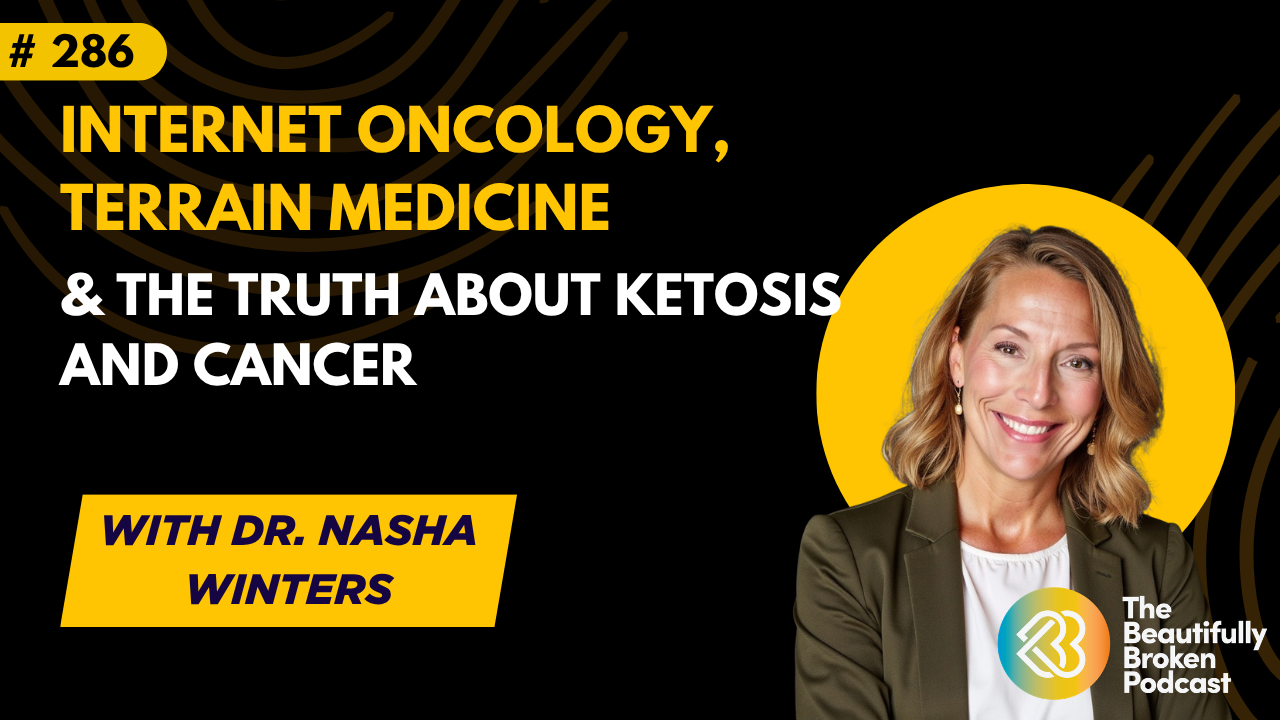
WELCOME TO EPISODE 286
Dr. Nasha Winters has spent 35 years surviving, studying, and treating cancer — and she's never been more concerned about what she calls "internet oncology." In this wide-ranging return to Beautifully Broken, she and Freddie get honest about the dangers of protocol-chasing, the overcomplification of functional medicine, and why more data is actively pulling people further from themselves. They dig deep into the ketogenic diet and cancer metabolism — why ketone bodies may walk through every hallmark of cancer in a positive way, why the how you achieve ketosis matters more than the diet itself, and why certain cancer types require a completely individualized approach rather than a one-size-fits-all protocol. Dr. Nasha also shares a powerful reminder: we've gotten so seduced by the sophistication of biohacking that we've forgotten the fundamentals — and she's shocked every day at how often they're missing from even the most committed healing journeys.
The second half of this episode ventures into territory you won't hear anywhere else. Freddie and Dr. Nasha explore CO2 therapy and the Bohr effect — including Dr. Nasha's near-hallucinatory personal experience with a CO2 suit, and how it compares to hyperbaric oxygen for patients who are already oxidatively overwhelmed. They map the critical and underappreciated role of the lymphatic system in cancer care, brain fog, and chronic illness — covering everything from glymphatic drainage and red light frequency research to why loading a body with IV fluids before optimizing lymphatic flow is "math that ain't mathin." And Dr. Nasha closes with a sobering look at glyphosate, generational toxicity, and why children born after 1980 may not outlive their parents — and what we can actually do about it.


Episode Highlights
[00:00] – Dr. Nasha shares the heat trial, whole-blood hyperthermia, and its surprising effects on viral and Lyme-related markers
[02:38] – Why Dr. Nasha’s work begins with a person’s story, patterns, and what makes them tick
[06:35] – The problem with internet oncology and how overwhelming cancer information has become
[08:24] – Why treating labs instead of people is one of the biggest limitations in modern wellness
[09:13] – Data can bring people closer to themselves or take them further away
[11:35] – Why personal healing stories can become dangerous when turned into universal protocols
[14:25] – When a ketogenic diet can help in cancer care and when it can backfire
[16:48] – Why ketone bodies matter more than rigid diet labels and can be achieved in different ways
[19:04] – The emotional cost of doing what you think you should do when the approach is wrong for your body
[21:37] – Why cancer is not just about sugar and how stress, hormones, and sleep shape the terrain
[25:36] – How dopamine overload, phone addiction, and disconnection can flatten libido and vitality
[29:42] – Why juicing can become problematic, especially when it concentrates environmental burden
[31:17] – The story of a child with AML, glyphosate exposure, juicing, and how testing changed the picture
[34:05] – Dr. Nasha on being publicly identified as the cancer person and why she resists that identity
[37:50] – Oxygen, carbon dioxide, and why some bodies need expansion instead of more oxidative pressure
[43:38] – How CO2 therapy may support overwhelmed systems and improve oxygen delivery differently than hyperbaric oxygen
[50:58] – Why the lymphatic system remains so misunderstood in oncology and medicine at large
[53:47] – Simple daily lymphatic practices and why movement, breath, and flow matter long before lymphedema appears
[57:07] – Why adding more therapies without supporting drainage and terrain can make people feel worse
[01:02:28] – Dr. Nasha’s thoughts on plasmapheresis, hyperthermia, and where these tools may have real value
[01:07:23] – Terrain capacity, oxidative therapies, and why prep and follow-through determine whether treatment helps or harms
[01:09:26] – The rise of ivermectin, fenbendazole, and repurposed drugs in cancer care
[01:12:03] – Why fungal and infectious theories of cancer are compelling but still incomplete without understanding the host terrain
[01:14:51] – Why younger people are developing colon cancer more often and what toxins, food systems, and grief may have to do with it
[01:20:46] – Where to start with Dr. Nasha’s work: The Metabolic Approach to Cancer, drnasha.com, and Tend the Terrain
[01:22:14] – The question to ask any cancer center: how do you support my terrain while you support my tumor?
Links & Resources
Dr. Nasha Winters: drnasha.com
Tend the Terrain Substack:: https://substack.com/@drnasha
Book: The Metabolic Approach to Cancer
Upgrade Your Wellness
Silver Biotics Recover Cream: https://bit.ly/3JnxyDD
— Code: BeautifullyBroken
CatchBio: https://www.catchbio.com/beautifullybroken
— Code: beautifully broken
CONNECT WITH FREDDIE
Work with Me: https://www.beautifullybroken.world/biological-blueprint
Website and Store: (http://www.beautifullybroken.world)
Instagram: (https://www.instagram.com/freddie.kimmel
YouTube: https://www.youtube.com/@beautifullybrokenworld
FULL EPISODE INTERVIEW
EPISODE TRANSCRIPT
Freddie Kimmel (00:02.238)
Ladies and gentlemen, welcome back to the beautifully broken podcast. have Dr. Nacia Winters on our show again. Welcome back.
Dr. Nasha (00:09.91)
Muchas gracias. So good to be here.
Freddie Kimmel (00:12.904)
So good to be here. we should have just hit record like 30 minutes ago and let people listen in on the preamble. Because it's good stuff.
Dr. Nasha (00:19.214)
I know, because it's good to be here, even in what you call the beautifully broken shit show of it all, we're here.
Freddie Kimmel (00:28.436)
Yeah. Yeah. What a wild ride. feel like, I think you were, you you said it hadn't been long. I think you were over like, I think you were over like a hundred shows ago. Yeah.
Dr. Nasha (00:39.982)
Gosh! Okay, first of you have been too busy, my friend. But it does feel like a snap. You just have that impression, Freddie. You stick with people.
Freddie Kimmel (00:45.151)
Yeah.
Freddie Kimmel (00:49.672)
Yeah, well you stick with people. I mean, your light is so clean and pure and you would walk up and we'd have a conversation for 30 seconds and you'd understand that like, how do I get more of this person? Where are they? What are they doing? And so I'll just, I will prompt the audience that I will put our previous show in the link so people can get.
download episode version one. And a lot of it we talked about, we talked about the metabolic approach to cancer. We talked about your book and you know, I know a lot of time has gone by, but I love this question. If we were in an elevator together and you were trying to tell me like how you work in the world of wellness, what would you tell me you do? You got like 10 floors. You got a while.
Dr. Nasha (01:35.508)
okay, good. So it's not just like a one drip, okay. Wow, ooh, that's so juicy. Okay, first of I would feel into you to see where we are in what you're able to take in or not take in. But basically, I thrive on people's stories. I wanna understand people's existence. I wanna understand their patterns. I wanna understand what makes them tick. And I wanna understand how to optimize on that.
Freddie Kimmel (02:05.365)
Beautiful. God, there's so many different directions I can go. I was talking with a friend yesterday, we were texting and we were saying, was lamenting on something that was challenging for me. And she goes, know, Freddie, it is your mind is your greatest asset. It is your greatest liability. And that is the paradox of existence.
Dr. Nasha (02:11.966)
I'm
Dr. Nasha (02:29.774)
It is my friend and no matter where you go there you are with it and I'm having such an incredible journey with that myself. It's funny how you think you got it all figured out until life throws something at you and you realize...
I'm just floating randomly on this big rock in the universe. It's a really, like, what do I want to do with this? What is that Mary Oliver poem about? What do I want to do with this one wild and crazy moment, this one wild and crazy life?
Freddie Kimmel (02:50.719)
Yeah.
Freddie Kimmel (03:00.689)
I know. I find when I have those similar feelings that I am reminded of the value of being able to be present in the mundane. I had my vacuum cleaner out this morning and we get a lot of flies in Austin, so we're sucking up the flies in the little portable vacuum cleaner and then I'm releasing them into the wild. was like, you could be like, I hate doing this or you're like, I'm really good at this.
Dr. Nasha (03:31.566)
That's really good. I love it. love it. The little release thing that makes me really happy, Freddie, that speaks volumes of your character.
Freddie Kimmel (03:33.894)
Yeah, just being present in
Freddie Kimmel (03:39.252)
we release them into the wild. do, I texted you in a moment of intense, energetic, emotional, I had a tide of, I was really frustrated about the internet and in the witch, the, even since we've last spoke, the accelerated channels of information coming at people, specifically around cancer. And I had said, man, I'm so tired of this
this, this like wholism, wellness, longevity side, I see it be just as dangerous as living off prescription meds. And I'm just, I was like pounding my fist on the table. was like, I want to just talk to Naisha about it and this concept of internet oncology.
And so how are you assisting people to navigate the information and tides in that space specifically around cancer?
Dr. Nasha (04:36.462)
Well, I probably should give a little context that you and I talked a little bit about on our first podcast, I think together, 100 plus episodes ago, was just in 1991 when I was diagnosed.
there was a very different time and place. There was no Dr. Google, there were no Facebook groups, there were not thousands and thousands of books and hundreds and hundreds of influencers in the space. In fact, I went out of my way to keep it very private for the first 21 years of my experience with it. Whereas other people start to, today, it's like a badge of honor to share these things. And that's not to show that there's something right or wrong, but just to show how different it was for me
and the time and the place. Even then, when there was no options, if you will, it still felt overwhelming.
I can't even begin to think what it's like for someone to be diagnosed today with everything they have coming at them. The well-meaning advice of your neighbor and your friend and your internet cronies and all the different things that are coming at you. I don't even know how people begin to navigate it. And so what I feel like I get to do today is for those who are tired of being in the overwhelm environment is to help start to make sense,
curate out what makes sense. And it's not about any particular protocol that works or doesn't work. It's about you and your individual patterns and what your body needs at any given time, not what this latest cancer treatment is all about. We focus on the treatment and not on the person. And that's what I'm hoping this conversation gets people curious to think about it differently.
Freddie Kimmel (06:20.071)
That's right. That's right. I was saying with a Dr. Scott Sherry yesterday, we're just, I was like, I'm talking to Nation of Marl. We were talking about the, well, I've talked about this a lot. It's like the, I remember being so excited about functional medicine. I was like, my God, finally somebody gets it. But the failure there has always been treating labs and treating lab values. Do you know I mean? It really, it was just that we just shifted, we just shifted the,
Dr. Nasha (06:23.768)
What?
Dr. Nasha (06:39.918)
Bye.
Freddie Kimmel (06:47.277)
We shifted the flashlight over to look at another spot in a very big room. There was not a lot of innovation. But it was exciting because it was new and we saw that what we were currently doing was not necessarily serving us. How do we have this? Again, I want to invite people into this conversation, what you're saying right now. It's like, we don't focus on the treatment, what do we focus on? What does the landscape look like?
Dr. Nasha (07:13.538)
Mm. Yeah.
Before we go there, I want to say something that I have contributed greatly to the deep dive into data because it is something that is informative and is exciting, especially when there was no compass, there was no metric, there was no way of understanding this. And then the pendulum in my 35 years has swung so hard to the other side that there is a metric for a metric for every metric that there's a metric, right? It's like now the data overload
is taking people further away from themselves rather than closer. So I was on the cusp of watching how data brought us closer to ourselves and I've also been on the cusp of watching it take us further away from ourselves. So I wanted to just own my contribution to that and to own that I don't throw the baby out with the bathwater, I still love data. But I want the context and I want the story, I want the biography.
that goes with that data. I want to understand that in its entirety. And so maybe I'll pause there. you brought up another question, but I wanted to cover that piece before we stopped the data discussion.
Freddie Kimmel (08:30.764)
No, mean, listen, we're we will follow the stream of consciousness with that. It's it's true. It's like, you know, I've watched it swing both ways. I know there were people there will be people listening to this episode that have never tracked their sleep data, or their bowel function or their microbiome or a complete genetic blueprint. And then there'll be other people have done everything.
Dr. Nasha (08:36.064)
you
Freddie Kimmel (08:56.653)
I, all I can do is offer my experiences that it was someone with all the data and all the information I've there. I've been equally as confused, if not more lost at times. I can identify with that. So I did this, I did this podcast nature a little while back about like the, the role of like the role of influence, like our responsibility when we have influence and that oftentimes when we make it through cancer.
when we make it through rheumatoid arthritis or post-surgical whatever, that we look back and we're like, let me create meaning of my journey. And I find all too quickly, you have people launching into this is a protocol for somebody else. And if you understand like how the human mind is selective and it's listening in information, that's crazy talk.
Dr. Nasha (09:46.958)
Yeah.
That's huge. It's massive. And it's massive in that even part of my secrecy of my own process all those years ago was I was afraid that people would think that the way I did it was the way everyone was supposed to do it. And I knew very, very clearly that my path and the things that happened for me were for me. And they were not to be compared and contrasted. And yet the first question people often ask me all these years later is, what did you do to treat cancer? I'm like, God, I'm still doing it every day. Like, Freddie, just like you, like we're still,
Freddie Kimmel (09:48.623)
That's crazy talk.
Dr. Nasha (10:18.208)
learning about ourselves. It's an ongoing self-discovery. And I think that that's what some of the data of today and some of the functional medicine speaking to that data is distracting us from the discovery of ourselves.
Freddie Kimmel (10:36.155)
Yeah. Yeah, it is. It's pretty boring when you think about it. It's like you really should you should rise and rise and fall with it with the setting and the sun. You should be outside you should journal should be able to express your feelings and and other than happy mad sad angry joy. Like there's there's a lot of it's this it's the boring stuff that is really so very powerful.
Dr. Nasha (10:59.118)
Yeah.
Dr. Nasha (11:03.886)
But you can't market that Friday. can't, you can't really, well, maybe you can because you're a wizard at this type of thing. So, you know, bringing the soul back into sales and what, mom, we were talking about that before the recording. But it's sad that we do have to reeducate about the fundamentals that we've gotten so, I don't know, like.
Freddie Kimmel (11:10.287)
I mean.
Dr. Nasha (11:23.918)
overly sophisticated or so sexy with all of our hacks that we've forgotten the basics. And so now when someone is consulting with me, I'll ask about the basics and I'm shocked at how often they're overlooked. How shocked, like just completely shocked that it's like, how could you have left the fundamentals off the table? Yeah.
Freddie Kimmel (11:46.372)
Yeah. Or someone that I have another friend who's literally been in this four or five year journey. He just yesterday, he was like, I went to a biological dentist and I have an infection in my jaw. And they think that I'm like, yeah, like the teeth. You know, we we miss stuff that seems so obvious, but it's just, it comes back to the journey.
Dr. Nasha (12:08.182)
Yeah.
Freddie Kimmel (12:16.622)
And I do think that that back to the health fluence or, you know, our roles and responsibility is that we can always be safe and imploring people to better know thyself, better know your habits, better, you know, how you operate in the world, how you react or respond to outside world. It's, it's just so good. That being said, I want to ask you, I want to, I want to, I want to
I want to drill down into me here. is the ketogenic diet beneficial? Why can it, why may the ketogenic diet be beneficial for somebody going through cancer? And why can it be the wrong diet for someone with cancer?
Dr. Nasha (13:01.934)
I love this question. mean, first of all, ketogenic diet by definition is a high fat, low carbohydrate, normal to low protein diet that was developed in the 1920s to treat children with epilepsy very effectively. And so effectively that when the drug Depakote came out in 1940s, it replaced the diet, but the diet always worked better than the drug. Yet, you know, people like to pop the pill over the do the diet. So that's one piece.
a therapeutic ketogenic diet of high fat, low carb, normal protein nature can be a tool, can be a therapy, can be an effective treatment for many conditions including mental illness, cardiovascular disease, diabetes, cancer, epilepsy, all the things. However, where it does get misunderstood or mismanaged or misappropriated is that not all of us will be served with a high fat, low carb way to achieve ketosis.
In fact, there are some of us who have certain epigenetics, single nucleotide polymorphisms that make that virtually impossible or very difficult to achieve or maintain or can backfire to push us into other conditions that are not favorable to, you know, conducive to life. However, what we have shown is that ketone bodies themselves, these little, you know, these little signaling molecules get kicked up.
Freddie Kimmel (14:08.984)
Hmm.
Dr. Nasha (14:26.572)
When we eat a high fat, low carb diet, that's one means of achieving ketosis. But you can also achieve ketosis with just fasting, both intermittent and longer term. You can also achieve ketosis with just carb restricting. You can achieve ketosis with exogenous ketones. And you can even achieve ketosis with certain...
supplemental or pharmaceutical interventions. So the real question comes to ketone bodies and what are they and why are they important? And for me, when I look in the cancer space specifically, there's a tiny...
There's one or two studies that have really come out to question whether ketone bodies themselves can be problematic for somebody with cancer. And I will tell you, as someone who's been in this field for 35 years, I've not seen that play out in my practice, but I have seen where a high-fat, low-carb ketogenic diet can be problematic for certain cancer types, such as prostate cancer, certain types of breast cancers. These are cancers that we learn about more through their blood and tissue biopsy testing to understand the personality of the tumor, per se.
And then I look at that data with their, here's the data thing again, I look at that data with their single nucleotide polymorphisms, the blueprint that they came into this world. And then I know that maybe the ketones aren't the problem, but the way they achieve them could be problematic. And that's where we focus our attention. For the most part, when we look at the hallmarks of cancer, there are multiple doorways. There's 10 to 16 different doorways that are considered hallmarks of a cancering process. Standard of care hasn't yet gotten to the point of asking why do those hallmarks express?
my job is, is to help understand that. But what we have learned is that ketone bodies seemingly walk through every one of those doorways in a really good way. so ketone bodies, no matter how they are achieved, some places more optimal than other, are going to enhance the treatment of the cancering process based on whatever hallmarks that patient is expressing. And so for me, it still becomes a very valuable foundational tool.
Freddie Kimmel (16:09.485)
Hmm.
Dr. Nasha (16:29.846)
to create ketone bodies, whether it's through fasting, high fat, low carb diet, carb restriction, or exogenous ketones to achieve certain therapeutic goals. So I'm not sure if I answered your question directly, but I wanted people to get a different framework and context that ketone bodies are a natural physiologic state that we've worked really hard over the past 150 years to avoid. We've become very ketone, hypo ketonemic over the last
150 years just by the nature of the world in which we nourish ourselves and function in.
Freddie Kimmel (17:06.305)
Yeah, you know, as you're speaking, I just I realize how many different ways we can get into that ketotic state or taking an exogenous ketone to boost our levels. And also realizing the different we all come to the table in a different place, our relationship with food, our psychology around food, what that social and what what is eating feel like in a social setting. And so that's so different.
for everybody and that's gonna play into role. And again, that's why I think it's so important that people discover the different layers of context as opposed to taking that information from Instagram and being like, well, this person said this, this person. That's where everybody loses.
Dr. Nasha (17:47.298)
Right.
Dr. Nasha (17:50.702)
100%. And especially when someone is doing something they are perceiving they should do, because of the should heads on Instagram that are out there. And when it fails them, they think they failed. And then they're blaming themselves versus maybe the approach was not the best fit for them, maybe not the right dose, duration, combination for them.
So that's something to keep in mind and I really appreciate Freddie that you brought up just even the relational aspect of this.
who you're eating with, where your food is sourced, when you're eating, also plays a role in how well your body produces these little endogenous signaling agents is really critical. If you're under a hyper stressed response, it's much more difficult to achieve ketosis than when you're in a normal, know, emotionally resilient state.
Freddie Kimmel (18:47.241)
Yeah, I want to insert here just for everybody listening that many times you'll find that conversation drifting back to the repair for this, the fix for this, your solution. What are the guidelines that exist in nature? What are the rhythms that exist? Because everything, including the tide and the sun and the moon and cycles and seasons all move on cycles and rhythms. And so the body does that in a lot of different ways. And so we can take
prompts from the majority of human civilization that existed on the planet and followed like a sundown, sunup approach. Or we can look to different cultures that existed and there was a, you just didn't have access to the foods during the winter months. So there was a preparation process in which visceral belly fat was a great asset.
Dr. Nasha (19:37.226)
Yes.
Freddie Kimmel (19:38.156)
Do know what I mean? And now we're like, we're in this weird black mirror culture and it's like, we're all trying to be this physical thing. And because the mind is really strong when we set on a goal and visualize it, fuck, I'm going to get there. Be it fasting, starvation, or a GLP. I'm going to get there because that's the body I'm told that I'm now worthy of love by having. That's, that's the thing. We go back to the mind. It's so powerful. You know, man, what a
Dr. Nasha (19:51.576)
Thank
Dr. Nasha (19:59.32)
Oof.
Dr. Nasha (20:03.907)
Yeah.
Freddie Kimmel (20:04.661)
but a powerful meaning-making machine. So I just wanted to say rhythm of nature. Now let's flip the coin and let's go back to, know, I see the post all the time. You can starve cancer by not eating sugar. Cancer is driven, cancer proliferation tumors, they're driven by sugar. Can we unpack that a little bit and why that may or may not be true?
Dr. Nasha (20:08.686)
Yes. OK.
Dr. Nasha (20:21.805)
He
Dr. Nasha (20:31.128)
Well, I think here's the key is that there's never a single cause and a single treatment or a single cause and effect. That just doesn't exist.
Can it enhance a cancerous process? Absolutely, and it can so when our glucose is elevated, our insulin responds to that elevation and as such kicks up something called insulin growth factor, which is a known cancer cell proliferator. And that is active in, depending on the literature, 70 to 90 % of all cancers. So let's just ballpark it, 80%. 80 % of people would do really well to car...
restrict to a degree that is different than their previous set point. Any amount is going to improve upon that, right? Maybe you just get rid of the soda or the juicing and suddenly you have a very different set point and your body responds gorgeously. But when we overshoot, when we get super
critical and maybe get our carbs under five grams a day, our body is so stinking wise that it's going to find a workaround. It's going to start to pull glucose out of a process known as gluconeogenesis, which basically takes your protein and converts that into sugar. It's going to move into burning fat as a major fuel source, which puts you into ketosis. And these are the types of things that the body is always going to strive to survive.
cancer cells have an even higher drive to survive.
Dr. Nasha (22:09.93)
to even the detriment of the organism in which they're inhabiting. So it's like my colleague and friend, Dr. Tina Kaysor, she calls cancer cells sociopaths and that they have no remorse and no regard for the harm they're doing. And they will take themselves out in the process with this. And so that's what's happening is, yes, we can starve things to a degree, but the work around will hop up. It's like the whack-a-mole game. You push too hard in one place, it will express in
So what that tells me is very much, Freddie, what you just alluded to is what else?
is signaling in the body. Because there's this concept I call it the four S's. So there's the sugar. That could be one big signal. That could be that you're eating too much sugar for too long and too much of the wrong sugar for too long. And maybe the timing of that sugar intake for too long, right? And maybe you don't have the genetics to even break down that sugar as easily as somebody else. That's one component. But let's say you dial that in and you're eating a super carb-restricted and you're still cancering. Then we want to look at the most,
most important next one, which is stress response. There's our cortisol dance, because when cortisol is high, your insulin is high, your glucose is high.
So suddenly you're eating perfectly, but you're not dealing with your stress response. You're not being very effective at starving cancer because you're now feeding it from a different doorway. The third one is sex. And when sex, I mean sex hormones. So estrogens, progesterones, DHEA's, pregnenolones, testosterone, thyroid hormones, the whole communication system of the body when it's off, when it's skewed heavily in one direction or another, especially when we're
Dr. Nasha (23:56.544)
pushing against that. We will also skew things like cortisol and insulin. So they bounce off each other as well. And then the fourth one is sleep. So circadian rhythm biology. Studies have shown that just a couple of nights of bad sleep directly increases insulin growth factor. So as you start to realize, you could have the most perfect diet, but if you're up scrolling, doom scrolling at 1 a.m. on your computer,
you're feeding a million different pathways that are far more detrimental than that piece of sourdough bread you could have had at 7 p.m.
Freddie Kimmel (24:32.309)
Mmm. Yeah, it's so powerful. I said this on on the show with Dr. Scott, but I was in a peer group and we were saying a Woman was saying a practitioner was saying she goes. man all the women my practice. She's like nobody has any libido They're like sex drive is through the floor and there's she's like, can we explore the hormone and the hormone balancing? I was like dude Asked asked people to take asked people to do to do a fast from their phone for 30 days and see how
the volume on your libido changes. Because that is, if you think about the dopamine pathway and the power of the phone, if you hit it for four hours a day, if you're pump, cause you're pumping it, what do you think happens to all the other, you know, the sub channels? It just drops through the floor. If you're not watching this on video, we're both dropping through the floor.
Dr. Nasha (25:19.702)
Exactly. Yeah.
Freddie Kimmel (25:23.622)
And it's not that the phone is causing the lack of libido, but it certainly is a lever that we're choosing to pull.
Dr. Nasha (25:32.492)
that's like the sugar conversation as well, right? Sugar is also a dopamine hit. you know, social media, a dopamine hit. Shopping, sex, drugs, alcohol, food addictions, all these things. What are we lacking in sweetness in our life that drives us to finding sweetness in other places?
Freddie Kimmel (25:50.217)
Yeah. I'll tell you a big thing that comes up for me where I feel the wind leave the sails is being a provider. When I'm not achieving or I'm not, you know, my income isn't to the place that I want it to be, feel, I'm like, I feel like where'd the wind go? Like I feel it leave the sail. mean, everything from like energy joy.
Dr. Nasha (26:01.585)
Dr. Nasha (26:13.166)
Mmm.
Freddie Kimmel (26:17.188)
And, and I get a little lost. And so that's like a core thing that I get to work with through all the channels that I choose to work with, but it's, it's a noticeable shift. And I could be like, well, maybe I didn't, you know, maybe I didn't have enough Matzi or methylene blue or whatever, you know, maybe I need to go contrast therapy, but that signal that comes up a lot about not feeling like I am being a provider. It's very strong for me. It's pretty wild.
Dr. Nasha (26:30.892)
Yeah.
Dr. Nasha (26:43.622)
and provider for your household or provider to patients or both. Okay, so there it is. mean, but that's so talk about ancient, talk about primal, right? And, know, before you could like go out for days and find an antelope and bring it home and everyone is rejoicing and there it is. But today it's like if it's not a constant
Freddie Kimmel (26:48.857)
household.
Freddie Kimmel (26:55.47)
Mm. Mm-hmm.
Dr. Nasha (27:10.689)
infusion, I've seen a lot of masculine emasculation through the culture we're in with regards to this as well. And I think the feminine has been damaged by it as well, but I'm really intrigued what you said about putting down the phone for 30 days, because I remember a time not that long ago, I mean, I've been with my partner for, we're coming on 35 years this year.
Freddie Kimmel (27:36.111)
I love it. How's that possible? You look 35.
Dr. Nasha (27:38.574)
Oh, could smell this. Thank you. It's just great. it's like we were we didn't have I mean, we lived in a teepee for two years. So talk about being completely off the grid. You have no screen time of any kind. We were in the pre, you know, face. We were in the pre computer era, like, you know, portable computer and pre cell phone era of our relationship. And some of the richest moments of our marriage and our relationship, all of them were without cell service or screen
Freddie Kimmel (27:41.409)
I
Freddie Kimmel (28:00.849)
Wow.
Dr. Nasha (28:08.648)
And I will tell you, it is a libido killer when the first thing you reach for, the last thing you put down, is your cell phone. Instead of...
interacting eye to eye, heart to heart, to knee, chest to chest, groin to groin, whatever it is with your partner, with your beloved. It's so interesting how we've prioritized something else because the dopamine hit is just so intense. It's like the, speaks volumes to it. I've seen so many write about the porn addiction world today because it's so much damaging of the dopamine centers of the brain.
Freddie Kimmel (28:42.416)
Yeah.
Dr. Nasha (28:43.404)
There's really no difference in just social media scrolling, even if you're looking at cute kitties, you know? It's like, it's like this is, it's still something that takes you away from the sweetness of life. That's huge.
Freddie Kimmel (28:56.219)
Yeah. Yeah. And what is, you know, what is, what is that about? What is that there for? You know, what's the deep longing that that's filling? That we can't be with that pain. You know, it could be the pain of existing, you know, that's everybody's going to have an individually answer, but what is that? What is that void filling? I want to, I want to comment on something that you said, we talked about car restriction and you, you verily brilliantly said, you know, stop the soda or stop the juice.
Because we can have these very seemingly, well, I, what did you, yeah, I did a juice today. I had a green juice. had a, you know, how many grams of sugar sounds fiber? Are we, are we hitting? Which can be, just as detrimental.
Dr. Nasha (29:39.564)
Yeah. Well, think about, I love how you brought this up earlier about, just think about our recent ancestors. Were they item mixing or juicing anything? Were they gathering pounds of produce to run through a blender or a juicer to get their nutrients? No. Like that's such a modern thing. as a recovering juicer,
Freddie Kimmel (30:02.512)
now.
Dr. Nasha (30:07.886)
recovering juice-aholic, my blood sugars were far, far more, I mean, we were not even borderline diabetic, we were full-blown diabetic in my biggest juicing days. And that was even doing the green juicels, because I was giving myself none of the fiber. And when I mixed it in like, oh, I'll bring in the fiber with the Vitamix and all the different things, it still was too much. And what was interesting, and buddy, this is a really interesting accidental study, I had a young...
family whose daughter had AML and went into remission beautifully with standard of care, you know, the whole bit and ended up with a recurrence five years to the date of her going into remission, which is unheard of. And we were looking into what was different. One of the things that was different is they lived on a cornfield.
So they bought this beautiful property and her glycocate levels and pesticide levels were beyond anything I'd ever seen. The other thing that was different is mom was like learning about functional medicine and integrative medicine and realized she wanted to clean up her kids' terrain. So she was juicing for her children, her son and her daughter. And she tested the whole family. Her and her husband were not imbibing in the juice, but the kids were. It was like a daily treat and a daily breakfast and they were having several juices a day. And off the charts of arsenic levels, they were choosing a ton
of organic spinach, which sequesters a lot of arsenic. And when the other members of the family tested that weren't juicing, they didn't have those levels. And so suddenly you just realize, again, the solution to pollution is dilution. These little beings were concentrating the pesticides from the cornfield, the pesticides and the concentrates and the oxalates and all the different things, even in the organic produce, to then push their systems into something that was not right.
you know, was not conducive to survival. And so what was really interesting is we stopped, the family moved away for a while from the cornfield and stopped all the juicing and within about six weeks their glyphosate levels were completely normalized, arsenic levels completely normalized. The beauty, Freddie, is that we can change that up really quickly and really easily and that, this little girl, a lot of times she really cleaned up her terrain and was able to do very, very well for a long period of time and so those were those stories that kind of haunt me that we think we're doing something right.
Dr. Nasha (32:24.784)
But you don't know what you don't know until you know and that is where something like data Can be really helpful because we get into as you mentioned the influencer Vibe and we watch people making these recommendations and we can cause more harm than intended
Freddie Kimmel (32:42.66)
Yeah, yeah, that's why there's not a Freddie Beat Cancer site. The Freddie Beat Cancer book, follow my 102 steps. Kills me, kills me. Kills people.
Dr. Nasha (32:46.702)
Ha ha ha!
Dr. Nasha (32:52.334)
Yep. Yep. And I still have student loans. I still have student loans as a doctor who doesn't have my own nation B cancer site. So yeah.
Freddie Kimmel (33:02.211)
Yeah, I know. Every time I talk to a marketing person, they're like, why do you have more pictures of you with like in the hospital and hooked up to all the IVs and your surgeries? And I'm like, because I don't want to live in that trauma anymore. It's up there. It's up there. But that's not, that's like fear. I mean, I get it. Probably would be great marketing and probably a bigger platform. I want to go back to something else you said. Do you want to say something about that?
Dr. Nasha (33:15.966)
my
Yeah. No.
Dr. Nasha (33:26.861)
Yep.
I would because I'm really grappling with this and I feel like of all the places where I could have this conversation, you're the place to have it. You know, I was very private about my diagnosis until about 2012 and my diagnosis was in 91. So again, very, very private and a few things transpired that really brought me sort of out of the closet, if you will. And then what happened in the next 13, 15 years of that is I became, even though I was doing the same level of really amazing work,
without people knowing my history, it did something different to my following and to the people coming through my door when they realized I'd walked this journey as well. And in the beginning, I really grokked with that because I was like, well, okay, I'm the same doctor, I'm the same person, I've got the same approach, the same philosophy. Why does me having a cancer diagnosis matter? Why did that matter? And I understood just the human connection side. And so I ran with that for a long period of time. I'm like, okay, I get it. People need to know that someone
understands and I again it was the relational human side of it but for me in the last few years what's happened is that I have been identified as the cancer person and I'm like cut I fought so hard not to be ever considered a cancer patient I fought fight against the concept of being called a cancer survivor and I fight against the concept of even just being my whole world being cancer that I'm coming full circle that
I don't know how or what this looks like, but that is what I don't want to be known for in this world. And I don't know, like that has become my identity, Freddie, over the last, you know, 15 years specifically. And so I'm super intrigued, just curious of you who've had, who's had a similar journey and met people like me along the way. What would you say to somebody like me really battling with this right now?
Freddie Kimmel (35:02.628)
Hmm... Yeah.
Freddie Kimmel (35:23.4)
Yeah, that will never control outside world that you can let people can carry with them the meanings that they're going to make up. But I think if you just lead with, lead with your, your, your North star driven from your heart, you're like, I'm just following what I'm doing. I'm improving people's position in the world. Yeah, that happened for me, but you know, it's just how much energy it's energy behind the actions, how much energy you give it to free yourself from that tether that could be waiting you down.
Cause again, everybody's gonna make up the stories they're gonna make up. We are meaning making machines with anxiety and a sense of our own mortality. So allow people to do that if that serves for them. And it is a part of your story, right? But I always feel it was like, look, I mean, and I always feel that people like, well, you must know you've been through it. And I was like, absolutely not. I mean, I can just tie together my points of story as I am making up a literal story.
Dr. Nasha (36:03.446)
It is very much a
Freddie Kimmel (36:19.943)
what did I say yesterday? I was like, Freddy said, I was like, story-driven science backed.
Dr. Nasha (36:26.102)
Nice! That's actually really good, TM.
Freddie Kimmel (36:29.304)
So trademarked story driven science back because that's what again the hit from everybody who's like I've I've talked about growing the message messaging platform is like that it needs to be more I need to talk about the disease states more and the things more the critique has been you're too philosophical but in my experience that's what health it is a philosophy journey. It really is because it's like you know it's there's just so much
Dr. Nasha (36:49.198)
interesting.
Dr. Nasha (36:53.976)
Yeah.
Freddie Kimmel (36:59.331)
There's so much physical that is going to be informed and taken place and switched on and off by my thoughts.
And that's science-backed. It's like, that's it.
Dr. Nasha (37:10.232)
Yeah, yeah.
Beautiful.
Freddie Kimmel (37:14.697)
Yeah. Now it doesn't take away. It doesn't take away from the value of me doing ridiculous things. Like yesterday I have, I have this new like, Anders Olsen. We talked a while ago. He's going to come on the podcast. We're going to talk about, cause I, you know, the, thing that I want to talk, we can now we can pivot to oxygen and carbon dioxide is that and tech because I love to have a tech whore. My house is ridiculous.
Dr. Nasha (37:27.406)
Yay, good.
Dr. Nasha (37:35.672)
Perfect. Cool.
Freddie Kimmel (37:41.931)
And yeah, you only need the rhythms of nature, then like, it's over at Freddy's got like, it's like literally got a net. It's my structure, my structured water blow to my face. I'll do our podcast and all the other things, right? Yeah. I did my MOT, you know, my MOTC and my N acetyl saline and my dihexid nasal peptide before we started, but you only need nature. yes, I will talk out of both sides of my mouth. I love all the technology and it does improve. It improves all the things.
So I talked to Anders and we were talking about oxygen and it really, stemmed from the idea that I've never pulled the trigger on a hyperbaric chamber, which claustrophobia and like time and like, I just don't like it. And so I'd always been looking for these alternative sources of increasing my oxygen. and carbon dioxide is like, well, that shouldn't have an impact on oxygen. but we
Dr. Nasha (38:30.796)
Mm.
Freddie Kimmel (38:38.56)
You know, we niche down to the Bohr effect and see how it actually makes oxygen delivery more efficient on an internal method. And then there's like all this research. I mean, like a way back to Greece, making carbon dioxide baths. How do you ever, do you ever dip your toe in the water of like carbon dioxide as a therapeutic? What's your understanding of it as a modality?
Dr. Nasha (39:04.28)
Well, I mean, first of all, one of my favorite pools to soak in is a carbon dioxide pool in Calistoga, California. It's like a giant swimming pool and you feel like you're swimming in champagne. It's effervescent and you feel the tingles. It's divine. It's such a really cool feeling.
Freddie Kimmel (39:15.553)
Yes.
Dr. Nasha (39:19.97)
Fast forward, I remember reading Breath with Nestor, who Anders featured in this book. And then I was speaking at a conference shortly after that where he and his partner were also presenting in the Maldives and I got to experience the CO2 suit firsthand. And...
Of course I'd read about it. had like the theory and the science behind it, but I'd never experienced it. And I'm a very experiential person. Before I write anything anybody else, I'm gonna put it on myself first. Good, bad, or ugly, right? And I had an experience, and I'll tell you, I had basically a hallucinatory experience. I had a very interesting process, and I could feel things, and I'm like speaking to him about every single sensation and experience I was having, and he was just like...
Freddie Kimmel (39:44.939)
Yeah.
Dr. Nasha (40:03.512)
That's like he was so taken back by what I was feeling because I was feeling what the science shows. I was explaining what was happening at that cellular and even organelle level of my being all the way up to the esoteric aspect. And I was freaking high as a kite. It was such an incredible experience.
And I've done a lot of hyperbaric and I always feel, and this is just me, this is just my experience, my story. I always feel like there's energy pressing in on me inside the hyperbaric chamber, which is that's what it is. It's pressure under oxygen, know, oxygen under pressure. So of course there's that quality, but I felt an opposite, like an expansion quality with the CO2. And I think my nature, my being really likes the expansion aspect of this. And the other thing I started to learn from speaking with Andra
is the idea that there's like a yen and a yang quality.
For me, the hyperbaric is pressure in to create an oxidative stress on purpose, right? And it's wrong. It's that very masculine. The CO2 was more like an invitation and an expansion outward, the yen of this, which is like inviting oxygen into the system versus forcing it in. And what I started to understand is that my patients with what I call poor terrain capacity, where they're oxidized out the gills for maybe too many standard of care treatments or even too many
Freddie Kimmel (41:03.67)
Mm-hmm.
Dr. Nasha (41:26.032)
the alternative stacks that have created a lot of oxidative stress.
they don't need more input, they need more expansion and release. And so the CO2 therapies seem to have some really powerful play in my patients that are really overwhelmed. And so I know that was a super esoteric conversation to have here, but I see this beautiful dance and understand I've talked about how we could do some research about what are we actually seeing? That is where the data gets fun. That is where I can groove out on this. But what I can speak to is just how it feels. And for me, it feels like an experience
expansive and calming and antioxidant type of quality versus WAPSID.
Freddie Kimmel (42:06.942)
Hmm. Yeah, incredibly calming, incredibly calming. I just have their little rebreather machine. So it's literally like a little computer desk and I went and got a CO2 tank and I'll breathe that for four to eight minutes and just, and I've gotten to the point where the first time I did it, I was like, dude, I'm so high right now. It's like, this is amazing. But then I like, like you, like you put on your
Dr. Nasha (42:20.558)
amazing.
Freddie Kimmel (42:33.034)
You know, like you put on your pants in the morning, you're like, these are tight. And then you never think about the constriction ever again, because the body's like, it's normal. It's not new info. So this idea that we entrain to the therapy, right, is we're not noticing like, what's it doing to me? Inside, I'm getting this same molecular activation of improved delivery all over, which is a big, big thing. I talk to people like, you know, did I feel it? What's it doing? You know, you can't, if I dump a couple water on your head,
All hundred people in the room, if I do it to everybody, we're all gonna get wet. If I put a P-MF coil on you, everybody's gonna have a boost in microcirculation and cellular voltage, whether you feel it or you don't feel it. So I'm always trying to explain it like this to people. It's just, it's not like an immediate always, it's a terrain element in which we're boosting oxygenation or energy and over time, if it's stretched out in the right therapeutic dose for your physiology, you're gonna get a training effect.
So you're gonna get a boost long-term. The thing I like about the CO2 is just try to do as many push-ups as you can and then breathe like eight minutes of CO2 and you're like, why can I do like 10 more push-ups?
Dr. Nasha (43:39.891)
yes!
Dr. Nasha (43:48.064)
It's incredible. That is a very interesting phenomenon. Very interesting. he's done, and Anders has like on his side, he's got some really cool videos of this for people to watch that in action, but to experience it. I mean, this is one of those things, right? It's got to be experienced to explain really, right? Yeah.
Freddie Kimmel (43:52.201)
Yeah.
Freddie Kimmel (44:05.747)
That's right. Yeah. Yeah. It's really, really cool. Have you heard of the, I'll just mention this quick, then we'll get back on track. Have you heard of the Bimini? Do you know the Bimini people in Houston?
Dr. Nasha (44:15.81)
That name is so familiar.
Freddie Kimmel (44:17.996)
Have you heard of cocoon in Up and Hungry? The cocoon oxygen nanobubbles?
Dr. Nasha (44:21.912)
Yes, yes. OK, yeah. Is this similar or is that what they're doing in Austin? OK.
Freddie Kimmel (44:28.617)
Bimini is in Houston is a US company that made a mechanical filtration for water, but they're doing it for like, it's like 90, 9,700 bucks. It's like a home unit instead of a hundred million, instead of a hundred thousand. So you can get a home unit for your bathtub, which I have in the home. I measure, I measure the parts per million, the bubbles, right? And it's a...
Dr. Nasha (44:41.846)
Instead of, yeah, wow.
Freddie Kimmel (44:54.61)
God, what is it? It's 0.01 micron nano bubble water stable. I'll go in and measure three hours later. It's still it's still oxygenated. But I got to be in there for 25 minutes to get a 90 % saturation deep, deep into the quad muscle. So I'm getting it. Right. And it's really interesting if I'm in there for long enough, I can start to feel like movement up in my tonsils and my glands and my mouth starts to tingle a little bit. It's so cool.
Dr. Nasha (45:21.102)
How much fun is this? Now you have to send me a link just so can check it out. Because it was fun. I like how you said speaking up both sides, like just get out in nature. And these are the cool things that help us understand why nature works.
Freddie Kimmel (45:24.798)
I know, know. Well, I'll put you on-
Freddie Kimmel (45:33.288)
Well, here's the other thing, and here's how my ego justifies this, is that in a body, for me, I went through 25 years of brutal, brutal Lyme disease. I grew up next to the corn fields in which the planes would fly over and they'd all be wet and we'd be building forts in the corn, because it's spraying fucking glyphosate on them.
Dr. Nasha (45:48.152)
Yeah.
Freddie Kimmel (45:56.991)
And, you know, as much atopocytes and cisplatin as the body could handle and then blah, blah, blah, blah, and I'm aging. So I'm not, I'm in a body that is in, it's the process of entropy. I'm going back to dirt. So while I'm here, I just want to be as effective and capable and not like brain fog and fatigued. You know, it's about, I want to be capable while I'm here. So that's why I, that's why I, that's how I justify it.
Dr. Nasha (46:04.397)
Yeah.
Dr. Nasha (46:22.85)
Well, and Freddie, I'd like to offer, I've met a lot of biohackers out in the world and they're really amazing, amazing humans for sure. And there are some that are just so mechanical that they don't even know how to have a conversation or, you know, interact with nature. You have this uncanny light about, you talked about my light in beginning. My God, man, it's like, it's just a reflection back to yours of just how you show up and how you interact. love watching.
you in action at one of the booths that you're calling. You are so stinking present and you are so like right there with the person experiencing whatever there is to be experienced at one of your you know booths and just the way you are living the F out of life and trying to metabolize all of it in like one giant bite. It's contagious my friend and it's really neat to do it.
Freddie Kimmel (46:56.061)
Hmm.
Freddie Kimmel (47:16.734)
thanks.
Dr. Nasha (47:17.646)
So see you saying, I'm nature boy and I love to have these experiences that maybe can help somebody else, because sometimes we need a runway or an enhancer or something like you said with the layers that you had built up for all those years, you might need some bigger devices to scrape down to the bare earth again. Very powerful.
Freddie Kimmel (47:26.396)
Yeah. That's right.
Freddie Kimmel (47:37.979)
You might, you might. look at the space right now and again, you know, you go to these, I'm going to a show in two weeks, there's a hundred technologies. A hundred. And it's like, it's just changed so much. There's only like four or five things like 15 years ago there, which just wasn't that much stuff. And now it's like, there's a hundred. And so it becomes increasingly challenging to have discernment. And I find, especially in the space, people are like, I bought that. It didn't work.
Dr. Nasha (47:45.87)
Yeah, amazing. Yeah.
Freddie Kimmel (48:05.669)
I bought that didn't work and I'm like, my brain's like, wait, wait, tell me it totally works. Timing, constitution, duration, dose. It might not have solved. And this was always my experience. The thing that I was always, I was like, I want, I want the rheumatoid arthritis pain to go away. And so I was always searching for the, I was going to the next lily pad for the thing.
Dr. Nasha (48:17.336)
Right. Yeah.
Freddie Kimmel (48:31.751)
that would erase the thing that was the pain point. And it doesn't work like that. It doesn't work like that. It's just, just, it's a, there are layers. You'll get there. Some, you know, you'll get there or not, or you just, you know, have improvements in your position so you can keep going a little bit, but it's, it's a journey. It's a journey. I want to talk a little bit about, I want to talk a little bit about the lymphatic system and, and, and oncology and cancer. So,
Dr. Nasha (48:36.462)
Right.
Dr. Nasha (48:40.288)
Yeah.
Dr. Nasha (48:48.206)
Exactly. Yeah.
Dr. Nasha (48:57.08)
Bye.
Freddie Kimmel (49:01.041)
You know, I'm four years every single day talk about lymph every single day. All the studies, all the modalities, all the different ways you can work with it. Obviously I work with Flo Presso and my pain point when I talk to doctors a lot of times really high-end MDs, physicians, hospitals, they're always like, you see, they're, they look at it and they're like, lymphatic drainage, lymph. Yeah, that's, that's interesting. And then they scan their head and they try to think of the one to two people in their clinic.
population with lymphedema. They're like, I've got, Cindy's got lymphedema. Nobody connects the idea that moving your lymphatic system is supporting the glyphosate, the metals, the toxins, the whole immune system, your NK killer cells. Why is there such a gap there with lymphatics?
Dr. Nasha (49:52.11)
Well, one of the things that you didn't mention, which I was surprised, I thought you were going there in the beginning, was how many people are telling somebody like you, or somebody like me, or a massage therapist or whatnot, don't, don't move the lymph. That's what you're doing. You're saying, oh, look at those lymph nodes. And here's the craziest part to me, is I'm trying to remember how long ago now, but it's probably been a decade. There was a study that came out that basically,
Freddie Kimmel (50:05.299)
We're going there.
Dr. Nasha (50:21.592)
highlighted the fact that it was like a 50-50 split in oncology, in conventional oncology, that roughly half of the oncology world and researchers believe the lymphatics to be where the cancer cells go to die or be sequestered or to be held or pulled out of circulation, to be, you know, phagocytosed or what have you, like to be broken down and removed, right, or walled off from the rest of the body. And then the other half believes that this is where cancer goes to spread.
This is where it does its damage. And so first of all, I mean, can both be true at once, probably. Let's just kind of, let's not gander on either side of this. And yet the simplest thing here, it's like, why do we so underestimate the power of our largest garbage removal system only up there with our colon, right? It's like, this is such a big over looked. I didn't learn about lymphatics in med school.
Very much like, you learned about lymph nodes in your anatomy class. You really didn't learn much about them beyond a few fundamentals in your physiology or your endocrinology.
So you just really weren't taught about how powerful these are, even in naturopathic medical school. Like you had to kind of talk about cleansing the lymphatics in like these obscure, clandestine environments. It wasn't given much scientific rigor or scientific thought, and yet this is such a big one. And so when people say, don't get massages when you have cancer, don't do lymphatic massage, or don't do this unless you have just lymphedema, and even then you have to be careful, I think we are really underserving our patients in that environment.
that this is one of the most profound tools. Have you had Dr. Perry Nicholson on your show, Freddie? my God, I love him so much. He is a doctor who, has like, you know Perry, so he does some most, he just like has this routine that is so easy and he makes it fun and he's so engaging in teaching. It's like, if we all did that every day, if we started doing that in our toddlerhood, in Montessori schools, like what would that do to our healthcare system?
Freddie Kimmel (52:05.155)
Not yet. Not yet.
Freddie Kimmel (52:10.713)
I know Perry. yeah.
Freddie Kimmel (52:24.207)
Yeah.
Freddie Kimmel (52:28.079)
Yeah.
Dr. Nasha (52:28.14)
starting to teach these littles about the movement of the flow of their lymphatics from the first moments they can even form movement would be pretty amazing. But yeah, it's a strange dynamic, Freddie, that it's so misunderstood or misrepresented or even put fear of God in people to want to mess with their lymphatics.
Freddie Kimmel (52:36.751)
Yeah.
Freddie Kimmel (52:51.929)
Yeah. Yeah, it's wild. It's wild when you really start to understand that it manages. It really does. It manages all cellular waste. It's like, and I tell people, like, if you, if you thought about like the interstitial space or like the space between cells in which we have this burden of fluid volume that needs to go back into the lymphatic system. By the way, the lymphatic system is smooth muscle and the little, the little, the little muscles, the lymph and Gion are moving when we're in.
Dr. Nasha (52:59.854)
Yeah.
Freddie Kimmel (53:22.157)
parasympathetic. So to create a stasis within the lymphatic system or slow down your drainage in sympathetic dominant state, just like as you're listening to this be like, where's my nervous system? Do you know what I mean? It's like, of course, we don't, we don't want to wait till we have lymphedema or lipedema or a disease of the lymphatic system or a nodule. We actually want to compliment this every day because if 94 % of us have metabolic dysfunction in the United States, do you think per chance
It's related to the lack of movement, sympathetic dominance, and environmental burden, or the net exposome stress on our cells. A little. Yeah, yeah. And then the other thing is being able to talk to so many clinicians and see, it just supports everything. It's crazy to me that it's not an ahaz. It doesn't matter what you come in with.
Dr. Nasha (53:59.79)
Yeah.
Dr. Nasha (54:12.654)
Well, and it goes.
Dr. Nasha (54:16.91)
even coming back to what you just were talking about, the CO2. Talk about something that helps you, I guess I'm use the word, undulate, or know, undulate the flow, the ebb and flow of the movement of lamps, sorry, there's a big truck going by. Speaking of ebb and flow, okay, of that movement, it's like that's what the...
Freddie Kimmel (54:30.659)
No, it's okay.
Dr. Nasha (54:35.83)
like the oxygenation, like that pushing and invitation for things to push and pull, that is so integral to that process as well. So most of us are walking around hypo, know, hypoxic and are walking around without any circulation, stagnant, thick, sticky blood process. Like everything, when we just leave any amount of fluid just sticking around, just sitting around, it's going to get funky and it's going to get funky fast. And instead, like here where I live in Mexico,
Freddie Kimmel (55:02.019)
That's right.
Dr. Nasha (55:05.754)
A couple nights ago, they did a big drive through with the dengue, you know, cancer spray, dengue mosquito canker spray. And we're like screaming, are you gonna close up all the windows? it's like, you know, everyone's like so worried about dengue. I'm like, we all live around dengue all the time. It's like, how about cleaning up the environment that you live in? All the standing water around your property.
Freddie Kimmel (55:13.684)
No.
Dr. Nasha (55:26.592)
and also cleaning up the environment you live in, the standing water or the lymphatics within your own property, to not be a nice vector, a nice dinner for those dengue rich mosquitoes. So it's funny how we think about things differently, just even our perspectives down here.
Freddie Kimmel (55:46.861)
Yeah, it's wild. I would just implore people not to wait. know, again, getting to talk to all these practices, because like you said this a couple times, I think in the beginning, you're like, well, listen, there's a gap between research and then being in practice. Like the data and the study doesn't always work on people. But understanding that like as a a terrain element, like boosting somebody, I see everybody get into health. And one of the first things people go to, they're like, I'm going to go to restore hyper wellness, and I'm going to get
I'm going to get infusions and fluids and vitamin IVs and Myers cocktails. like, if you were to look at your intracellular extracellular fluid ratio, which is already off, and then you're going to go add another liter of fluid, like what that cell can take in and let go of is based on an osmotic balance. It's like the math ain't mathin. So all these clinics that are doing it, and again, I don't say it's not, you don't need to bring in a lymphatic therapy to treat people. However,
Dr. Nasha (56:26.658)
Yeah.
Dr. Nasha (56:35.736)
Totally.
Freddie Kimmel (56:46.122)
understand like it's part of that like if you had a big wheel of like technology was going to complement health. like, it's not one to skip.
Dr. Nasha (56:54.668)
No, no. I mean, my gosh, right under my desk right now, I have like one of the ancient vibe plates that's like one of the Dave Asprey early ones that like astronauts use. mean, it's, it could shake my house to the ground. It's so intense.
Freddie Kimmel (57:06.922)
I know it. I know that plate.
Dr. Nasha (57:08.302)
It was a tank, like this thing to move it. My husband's like, if we have to move this again, I'm leaving you. I mean, it's just like, it's traveled all over the world. But between that and as when I had my private practice in Colorado for many years, we had a trampoline in the backyard. So between patients, would jump on the trampoline and that was my favorite lymphatic movement. And now I do things between hot and cold, between like, I love your spot for like hot and cold pumps, my lymphatics. And I do have lymphedema from my pelvic, you know, from my pelvic cancer that, you know, really took a beating to.
Freddie Kimmel (57:22.896)
yeah.
Dr. Nasha (57:38.238)
my whole pelvic floor and all the things going on there that I do have to do extra work to keep the lymph moving in this and because I tend towards the sympathetic dominance side of things, everything kind of squeezes up. So it's an opportunity for me to like think about my lymph health in a different way and one that I try and take.
Freddie Kimmel (57:44.268)
Hmm.
Dr. Nasha (58:00.27)
Great. mean, I've been dreaming, Freddie, since I had my very first Flo Presso with you of owning my own and figuring out how to strap myself into it. I can't imagine trying to get my husband to do this to me every day. Maybe I can. But it's just such an incredible resource, an incredible tool to address this first and foremost. Because if I don't have that working, nothing's working. Got the amunctuaries open so that I can pump the lymphatics to get the garbage out.
Freddie Kimmel (58:26.732)
Yeah, yeah, I love we have a big trampoline here. I love a lot of the trampoline. I love brisk walking. I love contrast therapy for moving deep diaphragmatic breathing legs up against the wall. All these things work. You know, they're all free. I do love the, you know, the other thing, like really, really been thinking about is this prevalence of of of
nationwide brain fog. Everybody's telling me brain fog, brain fog, brain fog, and that it's not alleviated and that it's a constant. You know, if we, if we think about the glymphatic system and these different postural adjustments, you know, as I'm rounding down and to get this thoracic outlet syndrome all day or like this forward head posture, you know, understanding that these lymph nodes in the face had a knack, you know, you got 600 to 1000 in the body got 300 in the face had a knack.
that are gates for the drainage where the glymphatic system ties back into the cervical nodes. That these need to be opened too all around here. That's a spot we skip. I've been playing around with different frequencies of red light. And it's funny, there's not a device on the market. I think it's 1237, which is a light frequency that's infrared that is really, it gets deep enough into the occiput.
Dr. Nasha (59:46.68)
Wow.
Freddie Kimmel (59:47.381)
gets deep enough into the meninges of the brain to complement glymphatic flow. And I've been playing around with a device, doing it on the back of my neck. I can feel, I can feel fluid moving when I start to swallow after 15 minutes. Pretty wild. Yeah, pretty wild. I gotta connect you with, I'm gonna connect you with Scott Kennedy too. Scott has a red light cap. It's like a ball cap.
Dr. Nasha (01:00:04.366)
So cool.
Dr. Nasha (01:00:14.104)
Cool.
Freddie Kimmel (01:00:14.497)
but it's got these flaps that come down and they get the sides of the neck. Or you can go under the jaw and you can get the tongue. It's a battery packed. You can just wear it. You can be chilling.
Dr. Nasha (01:00:17.228)
Good.
Dr. Nasha (01:00:22.017)
Ugh!
Dr. Nasha (01:00:26.188)
That's so cool. Instead of like, so we're like graduated from like the beer bong hats to moving into the loop that.
Freddie Kimmel (01:00:31.797)
Yah Yah yah yah Yah yah yah Yah
Dr. Nasha (01:00:36.136)
this year. See this is why we keep keep you close, Freddie, is you are again nature boy but you also show us the cool things that can improve upon or help us make sense of what's always worked, which I think is so cool. Yeah.
Freddie Kimmel (01:00:48.373)
Yeah. I said to my dad yesterday, my dad lives in Rochester and my sister's in Buffalo area. There's like none of this up there. It's so, so, like maybe one like, you know, they, some people with red lights or compression, it's very, you know, there's nothing like there is in Austin. Now in Austin, there's like literally 30 centers. I mean, we, Ways to Well is there, Alive and Well is here. Everybody's, I know the new thing is Plasma-Faresis.
Dr. Nasha (01:00:57.454)
Really?
Dr. Nasha (01:01:07.118)
your hub.
Freddie Kimmel (01:01:18.517)
What's your thoughts on total plasma exchange?
Dr. Nasha (01:01:21.87)
Well, it's interesting because I've had patients, there's a company called, well, Dr. Roger Vertrice is out of Texas, out of Dallas area and has verthermia, which is something that I had patients do. They all went through clinical trials called the HEAT trial many, many, many moons ago, which was taking the blood out through basically filtration, like a kidney dialysis machine.
Freddie Kimmel (01:01:46.208)
Mm-hmm. Mm-hmm.
Dr. Nasha (01:01:47.842)
then running it, like heating it to an exorbitant temperature to 107 degrees Fahrenheit and keeping it that temperature for up to two hours and then pumping it, filtering it, stream plasma ferrisis back into the body. And the thing that they were also going through was like gallons of sodium bicarb. I'm watching the, you know, the anesthesiologist over there on, I called it the DJ machine. You know, he's over there looking like he's doing something really cool, putting tons of sodium bicarb into this, which is like another little scrubby buffer, you know, to the whole system.
as well. And I was just intrigued because it was like next-gen apheresis of heating and killing and then scraping and filtering and putting it all back in and taking patients that were at the very end of their rope.
no other chance to survive and coming out of it and extending their survival greatly or even going into complete remission. And the craziest side effect was watching all of their Epstein-Barr viral titers and their Babesia and other Lyme titers and their CMV titers all go away, like gone, including hepatitis C, gone. And I'm like, that's where I, and this was probably 2010 or 2011, I was seeing this and they weren't testing those things, but I was in my practice.
Freddie Kimmel (01:03:00.31)
Mm-hmm, mm-hmm, mm-hmm.
Dr. Nasha (01:03:01.662)
these patterns going, wow, we've now removed some of the other triggers of the terrain that were allowing this cancer process to take root in these people to begin with. So I got really excited about it and then started learning about it having patients go to Europe to get this type of treatment. So we've had patients getting aphoresis, plasmapheresis, and all these treatments abroad for and in Southeast Asia for decades. But it's now kind of making its way into the U.S. And I think there's great utility. I think there's a lot of people who don't quite know what they're doing with it. And I think you have to be very
very careful and you have to prep the body appropriately. There's a lot of pre and post testing and you really need to make sure the rest of the amonturys are working and that you're not pushing them too hard because it can backfire pretty hard. But I think there's some really powerful utility for it, especially in the era of spike protein, which is really tenacious in many of us. I'm excited to see some of the outcomes, especially in patients I've sent to Germany for this, that are finally resolving.
Freddie Kimmel (01:03:50.709)
Mmm.
Dr. Nasha (01:03:59.86)
long COVID syndrome that wasn't resolving in any other way. Yeah. Yeah.
Freddie Kimmel (01:04:04.361)
Wow. Incredible. Incredible. Incredible. Yeah, I know it's a big, everybody's asking me, where do I go for this? Where do I go for this? Only because, you know, we've got our Austin Ways to Well, everybody's posting their bags of plasma or a pulse LD now. It's like, look, I took, you know, I took, I took 25, 30 years of toxins out of my blood. I was like, well, they aren't all in the blood. you know, yeah, you know, you got your circulating supply. Now what happens?
Dr. Nasha (01:04:16.046)
Yeah.
Dr. Nasha (01:04:25.902)
Right, Yeah.
Dr. Nasha (01:04:32.397)
Yeah, well now you've opened up the reservoir for all to come rushing out of the other tissues it's been hiding in. So that's why people can get much thicker faster if you're not careful. You don't understand that it will release in one level of tissue at first and then the next and then the next. It's a layered process. And then if you're not cleaning up the environment around you, you're just filling it up faster than you ever filled it before. You know, so it is a really careful process. It's like we got into the beginnings of IV chelation.
Freddie Kimmel (01:05:00.372)
Mmm... dude.
Dr. Nasha (01:05:04.157)
We're gonna have the same problems. We already are having the same problems. So you really need to know how to invite things out and gently keep going after it and then helping them clean up the environment around it all along. Those who come in and do like, I'm gonna go here for two weeks and do it hard and blah, you're gonna hurt yourself. Like you could really cause some problems with that.
So you guys, the hare or the turtle versus the hare, the turtle will win this race if you're doing it correctly.
Freddie Kimmel (01:05:27.272)
Yeah.
Freddie Kimmel (01:05:35.058)
Yeah, every time, you know, I think we had said this on the we said this on the show yesterday with Scott was like, nothing's free. Like, nothing's free. Like there is even energy, right? We, you know, if we if we do, let's say we do some of these new cutting edge mitochondrial peptides to give the body energy, and we run the engine real hot, the cellular engine is not different from that of a Ferrari.
Dr. Nasha (01:05:43.029)
Yeah
Dr. Nasha (01:05:57.651)
boy.
Freddie Kimmel (01:06:01.992)
And so there's a byproduct. And my question for people always is, do you have the hardware in place to process all that extra juice if we haven't earned it? Not to say we can't meet people where they're at and support their energy, but that's my question. And I would want to say, I'm not practicing. I'm not a practicing clinician, but I understand simple equations of thermodynamics. Yeah.
Dr. Nasha (01:06:27.992)
Totally. Well, that's my concept. I'm developing further this terrain capacity spectrum is to understand when to challenge the body. So when to push really hard and when to regenerate or pause and take inventory and give the resources, restore the resources so that it can handle whatever you're doing. And so we've understood this in the phase one, phase two detox pathways. We can look at your single nucleotide polymorphisms.
look at your cytochrome activity, your P54 enzyme activity, and know if you push too hard on phase one and your phase two isn't working, you are gonna get sick, right?
Freddie Kimmel (01:07:08.552)
Yeah.
Dr. Nasha (01:07:09.07)
And so that happens more often than we care to admit in medical in the medical field both from conventional and non-conventional world and so the same thing is happening when we're pushing people in these oxidative therapies like we're stacking our ozone and we're stacking our high dose IVC and we're stacking our photodynamic and we're stacking our aphoresis and all these things create extreme even high dose therapeutic ketogenic diet brings up a lot of reactive oxygen species and if you don't have the capacity on the other end of that to deal with that
increased pressure challenge in the system it will backfire and could actually proliferate in the cancer process a lot of problems but it can also just collapse the system altogether and sometimes we like to give that the name detox it's a detox side effect you're just detoxing those are detox symptoms yes and patients don't have to experience that if you're doing it thoughtfully properly
personalized and precisely. It's a really elegant way to practice medicine, but if you're hopping into kind of, that's the word I want to use, protocol centers that are just throwing you through the whole line of it.
They'll have a couple people, maybe out of 10, let's say two, have a really good response. Six will have a terrible response and the other will have just like a, meh. It's just, you can make it work better for everybody if you do the proper prep and follow through. Yeah, yeah.
Freddie Kimmel (01:08:39.419)
Yeah. Yeah, it's, it's so specific. tell me when you have to give me a time warning to when you're ready. got another thing coming up and the thing and the thing
Dr. Nasha (01:08:49.062)
I actually just postponed. I have a thing coming up in about 15 minutes. I'll have to take off.
Freddie Kimmel (01:08:56.123)
Okay, great. I just want to be efficient with our time. Also invite you back now. What about, you know, I've also seen in the interweb lately, I have two things I really want to talk about, is the idea of these broad spectrum antiparasitics, phenbendazole, ivermectin, having a mechanism of action with cancer. What's that about?
Dr. Nasha (01:09:22.65)
First all, there's some super cool things here. So my friend and colleague, Mark Linterne, he's not a doctor actually, he was just an engineer brain, a really brilliant systems thinking brain in another industry altogether that dealt with his own cancer process and started going down the rabbit hole and started to think about cancer going, okay, the metabolic approach is a far closer fit than the genetic approach or the genetic theory of cancer.
comfortable and interested in that piece, but he felt like there was one or two pieces still missing. So he dug a little deeper and feels like there's this sort of fungal etiology to the cancer process. Now this is not really a brand new idea. I remember early diagnoses in 1991, I was running going down the rabbit hole of others of times before who looked at cancer as a fungal disease or an infective disease process. So it's not that it's new, but the way he unpacked it.
Freddie Kimmel (01:10:06.524)
Mm-hmm.
Dr. Nasha (01:10:22.296)
was really new and some of the conversations around it. So his book, Revolution, if you've not read it, or Cancer Resolution, if you've not read it, fascinating Mark Lentern, really breaks down really well of what he sees is the reason for this. The reason why these drugs like Finben, like Mobendazol, like Ivermectin, like some of the anti-parasitics, like some of the anti-fungals are having kind of their day in the sun in the oncology space right now.
Freddie Kimmel (01:10:30.194)
Hmm.
Dr. Nasha (01:10:52.32)
Now, what I want to say is that there has been such a massive movement in repurposed drugs, off-label drugs over the last few years, that it is mind-boggling and head-spinning. And on one level, it's just as bad as what we talked about earlier of the influencer, of the people who jump onto the juicing wagon.
those jumping onto the off-label drug wagon are having just as many problems as those who jumped on the juicing wagon, right? Like, it is not meant for everybody. And again, timing, dose, duration, combination, as well as your own pharmacogenomics makes a difference. Your gut and liver tolerability make a difference. What else is it being stacked with makes a difference. None of these drugs were ever meant to be used by themselves. They were actually studied more in conjunction with standard of care pharmaceuticals. So they were to help overcome things
like drug resistance or to help more direct, like a Trojan horse, chemotherapeutics into the target, the desired target. But a lot of people will see one thing online, go and order it from China, and get themselves a whole lot more than they bargained for. So we have to be thinking of that. Coming back down into the research of the viral fungal etiology, and this is where Mark and I talked, I still, and this is just me, and this is not to discredit,
this theory because I think it's a very compelling theory. But for me, just like the hallmarks of cancer wasn't enough, I still want to understand why we're surrounded all the time by bajillions of organisms, fungal, bacterial, viral, mycoplasmic, all the things, and why we all don't succumb to them all the time.
I still want to understand the environment in which a fungal infection could suddenly come in and flip on and off certain switches that might happen for me that doesn't happen for you.
Dr. Nasha (01:12:40.05)
So for me, I'm still always digging into the why. Why is this fungal driver a problem? Why is this person responding to itraconazole or mebendazole when they don't even have any known from testing fungal infection that we are aware of? And so to me, what this era shows me is just a lot more of unanswered questions and a lot more curiosity of what I want to lean into. But what I will tell you is we've had this knowledge around us for thousands of
probably millions of years, but for thousands through the work of Chinese medicine and Ayurvedic medicine who have a lot of herbs that are rich in anti-parasitic, rich in...
Freddie Kimmel (01:13:20.88)
Hmm.
Dr. Nasha (01:13:21.868)
fungal, rich in antimicrobial that have been known to treat cancer for thousands of years. And yet we're looking yet again down the line of a pharmaceutical intervention where a dietary or even herbal wisdom did the job for millennia. And so I get curious as to why we're not putting more research into now, of course, some of those are because they're limited resources, right?
Pharma, can synthesize these things in a lab and want to maintain good, you know, protection of these valuable plants. But I am curious why we're not doing more research in things like berberine is a really good example.
Right? Berberine, one of those Chinese medicine cancer herbs that we've been using since I studied Chinese medicine. I've got a doctorate in oriental medicine and Chinese medicine and herbs and acupuncture. And it was always one of the anti-cancer herbs that we used. And that's long before we learned it had such a powerful metabolic impact. And so this is where these conversations are exciting, but I still don't think they're the answer.
Freddie Kimmel (01:14:06.373)
Yeah.
Freddie Kimmel (01:14:33.816)
Yeah, yeah. One more before you go, you know, there's been lots of interweb noise about the prevalence and increased rates of colon cancer in young adults. And then we just had a person from my community, James Vanderbeek, just passed away, you know, a couple months ago. He's such a, what a special human being. If you ever got to talk to James, he was just an awesome, awesome soul.
Obviously, we could probably theorize on a whole other episode why this is happening with colon cancer, why in young adults. What is your thought on this as it comes up in the news cycle right now?
Dr. Nasha (01:15:14.872)
Well, we started to see the trend in younger and younger cancers before the era of COVID hit. we, you a lot of people try and just blame that, but it started even before then. Part of it is that, let's just go back a little bit here. We never had plastics in our environment until the latter part of the 1960s, and they became ubiquitous. I mean, they are ubiquitous now. We're eating an average of a credit card a week of what is, I don't think anybody would fight me on the fact that this is a very dangerous
known endocrine disruptor. I think even conventional scientists are like, we're kind of screwed when we look at the plastics. Things like the aparesis is also interesting because it's pulling those microplastics as well.
Freddie Kimmel (01:15:52.633)
Well.
Freddie Kimmel (01:15:57.177)
That's right.
Dr. Nasha (01:15:58.094)
That's something that's been kind of woven into it. In 1969, Dr. Huber from Indiana, from Purdue, started whistleblowing on glyphosate that was happening in the lab and saying, you know, you guys, this is like nature's biggest antibiotic, and you're wanting to put this on all of our crops. Now, he was whistleblowing against it. He's actually had multiple threats on his life. He's now into his 90s and is still fighting this good fight who is one of the most dearest
dearest humans on this planet and I'm praying that he gets to see some of these changes before he leaves this planet. But basically...
We, by the 1980s, it became just part of our food source. And today it's found in every single droplet of rain, every piece of soil, every filtration of air. It's in all of our organic and our non-organic products. It's basically something you can no longer avoid. And so the place that it gets sequestered the most is in our grains and legumes. They are chelators of the soil. And so they take that right into the very
Freddie Kimmel (01:17:05.954)
Mmm.
Dr. Nasha (01:17:07.32)
We've also had a big push in the last several years to go back to vegetarianism and veganism. That's been a really big draw, which means by default you're eating a lot more of these grains and legumes. And that's been in the generation that we're seeing these younger and younger cancers. So I've seen in the testing of these a lot higher rates of veganism and vegetarianism, a lot higher rates of glyphosate and pesticides, a lot higher rates of plastics. And of course, it's the ubiquitous environment that we live in. It's just anywhere and everywhere now. Dr. Krenian, who was my teacher
and environmental medicine used to say, it's not about if you have toxicity, it's how bad is it and how does it interface with your terrain, with your blueprint. And so even studies coming out showing that children born after 1980 are not expected to have the same life expectancy as their parents should have caught some people's attention. It certainly did mine, but everyone else seems to just be sweeping that under the rug. The layers of new things that we've brought to our environment since the 19... Since World War II.
Really, when we decided, let's take all the leftover ammo and turn it into Big Ag and Big Pharma, that's where it really started. But we had a generation of people who already had a good runway without all those things. They also didn't have plastics. They didn't have glyphosates. They didn't have ultra-processed They didn't have any of those things. So when you look at it, it just makes sense. mean, Rachel Carson was speaking about this in the 1960s, the last spring concept that just generationally, we are sicker each generation that
Freddie Kimmel (01:18:22.295)
Mm-hmm.
Dr. Nasha (01:18:36.592)
through. There are 200 chemicals in our cord blood today and so it's just unfortunately catching up and the the crux of this is our mitochondria. Our mitochondria are the the center point of our longevity and when they're stewing inside the wombs of our mothers inside the wombs of their mothers
Freddie Kimmel (01:18:38.126)
Mm.
Dr. Nasha (01:18:58.614)
before we even pass through to enter this world, we're already exposed to more toxicity than any previous generations before have experienced. So those are some things to look at. And the other side, and this is more of my esoteric hat, my Chinese medicine hat as well, is that the large intestine is, in Chinese medicine, an organ of grief and loss.
I believe that the younger generations are carrying a bigger load, maybe subconsciously, of they carry a burden that is a world that is not a very safe and thriving place right now. And you just flip on the news for a hot second or scroll, do your doom scrolling, and you're taking a lot of that in. And where we don't process our shit.
is where danger lies. And so it's not exactly a mystery to me why. It's not a single cause. It's definitely not a single treatment to handle it, but there things that need to be explored. And my hope is that it wakes up the current generations to help to make the policy changes to help the future generations have a fighting chance.
Freddie Kimmel (01:20:13.984)
Yeah, beautiful, beautiful, beautiful, beautiful. Well said. Now, given this big conversation, people are listening to this and like, wow, I'm fired up.
Dr. Nasha (01:20:22.744)
Yeah, or they're ready to jump out a bridge. And I'm like, please don't do that. We need all of you here. The most beautiful energy is because it takes all of us, the collective, to craft the way we want.
Freddie Kimmel (01:20:33.438)
Yeah. Where can people follow and read more, Naisha, and dive into your intellect?
Dr. Nasha (01:20:44.344)
Well.
Go and follow me. Even my book is almost 10 years old now. It's still incredibly relevant. The metabolic approach to cancer, it really dives into all these concepts of what's driving the chronic illness and cancer process in all of us. So I think that's a really good starting point. You can learn more on drnacia.com. Just kind of follow me there. And I've been kind of processing my own. I've been sort of metabolizing my own life experiences on a free sub stack called Tend the Terrain, which is very Freddy forward, all very terrain-centric.
Freddie Kimmel (01:20:56.756)
Mm-hmm. Yep.
Dr. Nasha (01:21:15.086)
that's really the direction I'm going in all of this is, yes, we have all these amazing data points and stats and AI and tools out there, but we have fundamentally forgotten the foundational things that really create the environment in which we thrive or dive. And that's where I'm kind of digging in a little bit deeper there if you want to join me over there as well.
Freddie Kimmel (01:21:37.59)
Beautiful, well, we will have you on again if you will grace us with your time. Cause I had like 50 questions here, but it's just a great reminder how much power and advocacy we have, like that's immediately accessible. Right? We came back to that a lot. It really is the simple stuff. The last thing I want to ask you.
Dr. Nasha (01:21:41.473)
so honored.
Dr. Nasha (01:21:53.933)
Yeah.
Freddie Kimmel (01:22:00.712)
If somebody called you and they were looking for a recommendation, are there any centers in the US that you love that you think are really, they do a great job? If you're struggling with cancer right now, if you want to bring in the conversation around all these different therapeutics, is there anywhere you would tell people to explore?
Dr. Nasha (01:22:13.997)
not.
Dr. Nasha (01:22:19.63)
There are a lot of amazing places that have a lot of cool tools in their offices. My question, my ask of anyone seeking is to ask questions of the front desk or the doctor if you can talk to them directly, if you can get out of a discovery call, is to say, do you support my terrain while you're supporting my tumor? That would be my question, and if they can answer that to your comfort, then that's the place for you.
Freddie Kimmel (01:22:22.954)
Mm-hmm.
Freddie Kimmel (01:22:42.124)
Beautiful, beautifully said. My friend, thank you.
Dr. Nasha (01:22:46.678)
I adore you. Keep doing the great work, my friend. Keep shining your light. Yeah. Back at ya.
Freddie Kimmel (01:22:50.262)
I'm doing it, I'm doing it. Big love.