The Power of Neuroplasticity: The Gupta Program's Breakthrough in Chronic Illness Recovery
Feb 19, 2024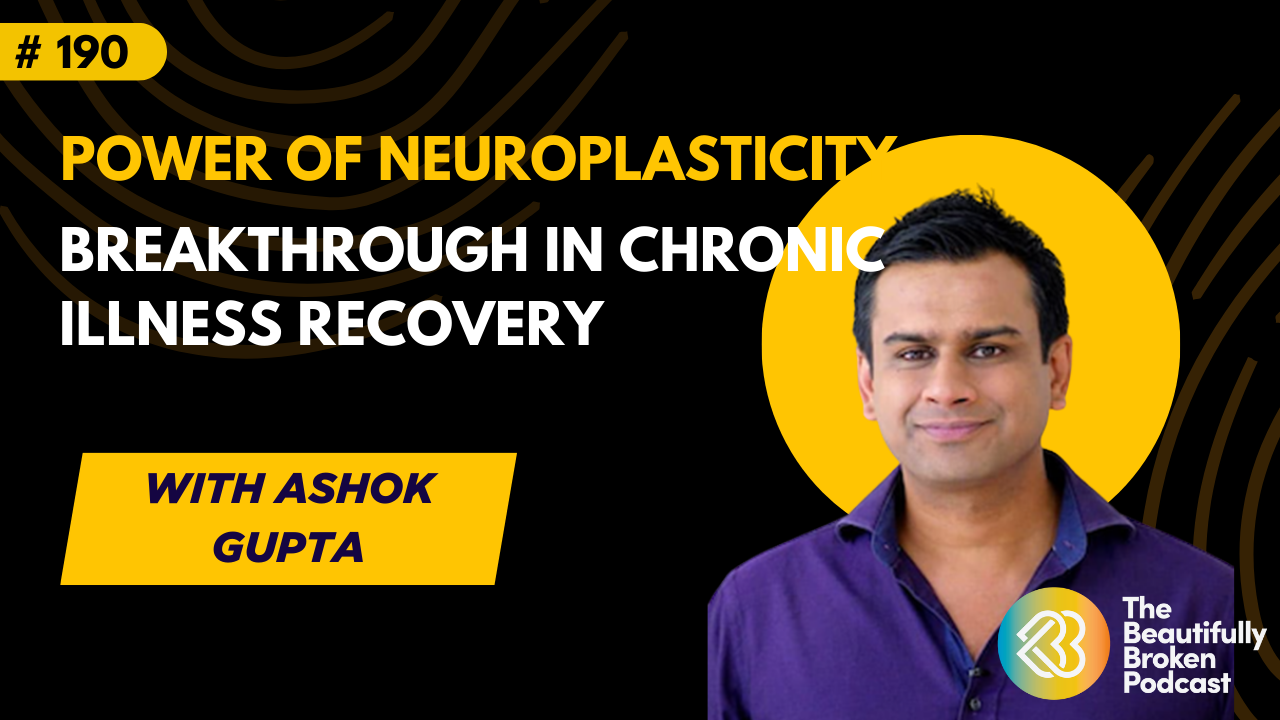
WELCOME TO EPISODE 190
In this fascinating chat, Ashok Gupta, founder of the Gupta Program, shares eye-opening insights into healing chronic diseases using brain retraining and neuroplasticity. Drawing from his experiences with chronic fatigue syndrome and ME, Gupta delves into how his pioneering approach has successfully tackled conditions like fibromyalgia and long COVID. He explains the science behind it, illustrating how our emotions and brain function are deeply intertwined and emphasizing the crucial role of the limbic system and the unconscious brain.
A key aspect of the Gupta Program is its unique, scientifically backed approach, demonstrated in a Randomized Controlled Trial to be effective compared to a control group. Unlike traditional treatments, the program focuses not only on getting well but also on staying well. By addressing the root causes of illness and promoting long-term health maintenance strategies, the Gupta Program has achieved remarkable results in reducing symptoms and pain, and in improving the overall health of countless individuals.
Tune in for an enlightening episode as we discuss how a fearful mindset can reinforce symptoms and hinder healing. Ashok Gupta shares how consistency and perseverance in brain retraining have led to amazing success stories through the Gupta Method, demonstrating how his simple techniques can transform lives."


Episode Highlights
[3:25] The Science behind Limbic Training
[5:25] Debunking Common Misconceptions
[7:48] The Origin of the Life-Changing Gupta Method
[18:10] How Fear Can Reinforce Disease
[25:30] How Long Does It Take to Retrain the Mind?
[29:10] Why Consistency Matters
[32:00] Inspiring Success Stories from the Gupta Method
[37:16] Dr. Gupta’s Advice for the Planet
[44:15] Where You Can Learn about the Gupta Method
[45:25] The Exciting Future of Neuroplasticity
[49:50] Letting Go of the Identity of Being Unwell
GUEST LINKS
Website: https://guptaprogram.com/aff/855/
Instagram: https://www.instagram.com/guptaprogram/
UPGRADE YOUR WELLNESS
Silver Biotics Wound Healing Gel: https://bit.ly/3JnxyDD
Code: BEAUTIFULLYBROKEN
LightPathLED https://lightpathled.com/?afmc=BEAUTIFULLYBROKEN
Code: beautifullybroken
STEMREGEN: https://www.stemregen.co/products/stemregen/?afmc=beautifullybroken
Code: beautifullybroken
Flowpresso 3-in-1 technology: (https://calendly.com/freddiekimmel/flowpresso-one-on-one-discovery)
CONNECT WITH FREDDIE
Work with Me: https://www.beautifullybroken.world/biological-blueprint
Website and Store: (http://www.beautifullybroken.world)
Instagram: (https://www.instagram.com/beautifullybroken.world/)
YouTube: https://www.youtube.com/@freddiekimmel
FULL EPISODE INTERVIEW
EPISODE TRANSCRIPT
Freddie Kimmel (00:01.31)
Ladies and gentlemen, welcome to the beautifully broken podcast. We have a very special guest today. We have Ashok Gupta. Welcome to the show.
Ashok Gupta (00:11.415)
Thank you so much, Freddie. I'm so excited to be here with you.
Freddie Kimmel (00:15.646)
I'm excited. And this is our second, I'll tell the audience, this is our second take. Sometimes you just got to start over right at the top. And it's a beautiful process of figuring out podcasting, but also life, which is why when your team reached out and we talked about doing a podcast, I was so excited because as the audience knows, lime, environmental toxicants, mold, chemical sensitivities are all something I've got to play with.
and work through and using the limbic system and understanding how that works is why your name is like synonymous with many people out there that are struggling in this way. I think it would be wonderful if you just started out and told if we pass each other on the street, what would you tell people that you do?
Ashok Gupta (01:05.643)
What is my elevator speech? Yes, what is it that I do? You know, I guess we are using brain retraining and neuroplasticity to help people heal from chronic diseases that the mainstream medical profession finds it difficult to treat. So that's what I would say in a nutshell is what we do. And, you know, initially we started off this road with ME and chronic fatigue syndrome, but we've gradually realized literally 20, 30, 40 different conditions are now being improved.
using the Gupta program approach and that's really exciting.
Freddie Kimmel (01:36.978)
It really speaks to the power of our thoughts and our words and the minds. How, uh, how, and how would you describe, uh, limbic system retraining? If somebody had never heard that term and they were really under wanting to know what, what the value is there.
Ashok Gupta (01:54.819)
So the idea of limbic retraining is that a lot of these diseases are caused in our unconscious brain. So that's the first thing because people start saying that the brain is equivalent to the mind, but obviously want to separate that with these two different things. So we're saying it's in the unconscious brain beyond our conscious awareness and it's in the limbic system or partly in the limbic system. So what's interesting is colloquially this type of retraining has got known as limbic retraining. But accurately, we don't believe that the retraining is actually.
only occurring in the limbic system, but there's actually some other brain structures, key ones, including the insula, which is outside of the limbic system. But essentially, we're training our brain to offset where it's got stuck. The brain's essentially got stuck in a pattern of chronic illness, and we want to reverse that.
Freddie Kimmel (02:42.142)
Yeah, it's so interesting. And when you say it's in the brain or it's in the subconscious, I remember many times being frustrated because I would be in a practitioner's office and there was no validation. And they would be like, ah, you know, this is probably emotional for you. That might all be in your head, which that was, it probably like triggered me away from doing some of this limbic system retrainment or, um, working with my neuroplasticity, and then I found my way back to it organically.
So can you explain that to me that it's that it's not just something that's made up in someone's head, but it's existing on a layer maybe they can't access.
Ashok Gupta (03:19.199)
Yes, you know, there's been many different diseases where initially they didn't know what caused it, so they thought a patient was just making it up. And then later on, like stomach ulcers, they suddenly realized actually there's a bacterial infection that's specifically involved in it. And in a similar way, when medicines or when medics don't fully understand a condition, it's easy to explain it away as, oh, well, it's in the mind because there's nothing we can do. And therefore, rather than looking like we don't know what we're doing, we'll just blame the patient.
And that's really unfortunate because there's this intersection of realizing that medicine separates neurology, immunology, psychology. You know, you go to a hospital, they're all separate departments. But actually we are one living organism that shares one nervous system. And that one nervous system actually doesn't work like that. It doesn't differentiate between biological threats, emotional threats. The brain simply says, what do I need to do to ensure survival? And my response
to the threats will be both emotional, physical, biological, immunological, it will involve all of those different things. And all of that is in the unconscious brain. And we just become aware of it as a passive observer. Now, of course, in psychological conditions, we have more of an input into that system. But when it comes to immunological threats, if you said to your brain, like stop triggering my immune system, it wouldn't be able to do that. You couldn't have that control. But what we've...
figured out through our 25 years of research is how you can actually regain that control and then moderate and switch off excessive responses.
Freddie Kimmel (04:55.478)
Yeah, I just had a friend over this week. She's just going through a her, her first, or maybe her first, maybe her fifth mold exposure, and we were talking about her, um, her, uh, inability to like, really feel like she could get a good breath, going up the stairs, heart palpitations and all these things, you know, we mentioned like, and I kind of, I actually did a podcast, I walked her through, okay, here's what I do. And of course, um, the Gupta method came up in that process.
Any type of dynamic neural retraining, you know, we're working with this body's response to outside world. And I love the way you put it. There is no, there's no division line. We're like, well, this problem's over here. And this part of the brain or this one's in the mind or this one's just the ulcer, right? It truly is interconnected. So how did you get started on this, on this path and this, you said 25 years of research.
Ashok Gupta (05:47.583)
many of us who've started along this path and wanting to help patients, we've come from our own challenges, right? Our own illnesses. And so in the mid 90s, you know, before a lot of these illnesses were even recognized, in the mid 90s, I suffered from chronic fatigue syndrome and ME. So I was studying as an undergrad at Cambridge, and I had some kind of virus and the virus went away. But I seemed to progressively get worse. I got worse and worse, the point at which I had to crawl to the bathroom. I couldn't read the words on a page.
And it felt like I'd been precipitated into my 90s, almost, into 90 year old, and I couldn't do anything. And I went from doctor to doctor and they tell me, look, we don't know what causes it. We don't know really what to call it. We haven't got any treatments for it and you might have it for the rest of your life. And that was like almost like a death sentence to a young man. And that started my lifelong quest to try and understand this. And I met hundreds of other patients who also suffered from these types of conditions.
Freddie Kimmel (06:22.158)
Mm-hmm.
Ashok Gupta (06:46.027)
And I made a contract with the universe and I said, if I can just get myself 20% better, 40% better, I will dedicate the rest of my life to trying to help others with this because it's so, I mean, for anyone who's suffered from it, it's very difficult to explain to someone what it's like, but it's like your worst day of flu times five is the way I describe it to people who've never had it. And from that point onwards, I managed to research brain neurology.
I started getting interested in brain neurology and physiology. And I figured out what may be going on in an ad hoc way, retrained my brain, just experimenting, and managed to get myself 100% well, and then set up a clinic to treat others. This was in the late 90s. And then we were the first program to publish as a neuroplasticity program in 2007. We published the Gupta program. And ever since then, we've been doing randomized control trials to really finally prove the power of this approach. So that was my first.
Yeah, that's the journey I've been on.
Freddie Kimmel (07:45.502)
Yeah, beautiful. Beautiful. There's I made a very similar contract one day of, you know, yeah, being brought right to your knees and saying, look, if we can get through this, we'll, we'll just dedicate our lives to a little role of service on the other side. And it, and it is that level when you say your worst flu times five is, is very accurate. I would have times where I'd hold my shoelaces and be like, I don't know what comes next. Cause it was so much weight on my nervous system.
just the fatigue was oppressive. So when we look at these, when we look at these different ways in which the body can have a virus or like the initial onset, it's like there's, there's like an infraction against our health. And then why do you think you, um, as opposed to like maybe five other people in the area who had the virus didn't go down that route? Why did your brain go into the area of creating this chronic fatigue?
Ashok Gupta (08:42.403)
So it's a big question. So I always like to start with, because you're asking about this kind of hypothesis that we have. And so I'd love to start with the biggest question of all, why are we here? To be able to answer your question. So why are we here? Yeah, so you could answer that question from a philosophical perspective. I'm sure maybe in the future, we'll have a beautiful philosophical question on why we're here. But let's look at the scientific reason. So the scientific reason is our brain, our nervous system, our body, has evolved over millions of years of evolution.
Freddie Kimmel (08:54.315)
Oh I love that.
Ashok Gupta (09:11.191)
to adapt to the environment, survive, procreate, and pass on our genes to the next generation. Yeah, so that's from a scientific perspective. And people don't realize this, but actually we haven't just evolved as human beings. Our DNA actually contains the DNA of the lineage. So from plant life to invertebrates to vertebrates to reptiles, mammals, human beings, we actually have the same, 40% of our DNA is the same as a banana.
which I find absolutely fascinating, right? And so we've evolved to survive. And so let's say COVID comes along. So, because I know a lot of people have, we all know someone who's gotten along COVID or been impacted by COVID. So COVID comes in and normally our immune system switches on, it fights off the COVID infection, it then switches off, system comes back to balance. That's the normal way of things occurring. But sometimes certain people's brains, it will maladapt.
that situation. And to explain this in a really simple way, Freddie, I don't know, are you a fan of Game of Thrones by any chance? Or are you a huge fan of Game of Thrones? Well you'll love this analogy then, you'll love this analogy. So imagine you are King Freddie, right? King Freddie, it's got a nice ring to it I think. King Freddie, you're the master of your kingdom, okay, so you are the owner of your kingdom, you're the king of your kingdom, and you have an army and a navy. So your army is your nervous system,
Freddie Kimmel (10:16.642)
Huge.
Freddie Kimmel (10:26.754)
I'd go with it.
Ashok Gupta (10:38.795)
Your navy is your immune system. And they are in charge of protecting your kingdom and your castle. Yep, so far so good. And in comes an invading army. Let's say it's COVID-19. Your army and navy are galvanized. Your nervous system and immune system have the intelligence to find the invading army, figure out how to defeat it, and then go on to defeat it and fire off their war machines to defeat the infection. And then they go back to balance.
But let's say there's been a drought in your kingdom. So suddenly the kingdom is weaker, but the army and navy is weaker as well. So this goes back to your question of why do some people get it and not others? So let's just say there's some unique vulnerability in the kingdom. And suddenly COVID-19 comes over the hill, but your army and navy now need to work twice as hard to defeat it. And imagine a scenario which often happens where you've got like five or 10 soldiers and there's suddenly 200.
enemies coming over the hill, those soldiers become traumatized by that effect of war because their very existence is under threat. So now your army and navy fight valiantly and they only just manage to fight off the invading army, but they're left traumatized. So the generals of the army and navy, they come to you, King Freddy, on their weekly meeting and say, King Freddy, we need all the resources now because we only just managed to defeat the invading army.
We need the corn, the wheat, the metal, all the resources now need to be channeled to the army and navy. And you as the king think, well, that makes sense. We've got to, if we don't protect the kingdom or we all fall, then we all perish, right? So it's a logical thing for the brain to do. And then what happens is the brain becomes what we call, there's something called differential activation. It's a very fancy neurological term, but essentially the brain now starts hyper responding. So before it took an army to come over the hill,
for your army and navy to fire off their weapons of war. But now a man on a horse coming over the hill, that's enough for your immune system and nervous system to get galvanized and fire off their machines. Then what happens is, as they are using up all the resources of the kingdom, some of those arrows start falling back in the kingdom. And that's where you get the inflammatory effects affecting the body and some of these autoimmune effects that can also occur.
Freddie Kimmel (12:41.571)
Hmm.
Freddie Kimmel (13:03.586)
Mm-hmm.
Ashok Gupta (13:04.099)
But then what happens is, because all the resources are going to the army and navy, normally you had a secret service that would fight off spies that had infiltrated your kingdom. But now they can't do that either. So now opportunistic infections, bacterial, viral, they start flourishing in the body, causing even more problems in the kingdom. And allergies and sensitivities go up as well. So the kingdom, the people in the kingdom are also getting riled up and trying to defend the kingdom.
Freddie Kimmel (13:25.483)
Yes.
Ashok Gupta (13:33.851)
not in homeostasis and balance. In this inflamed state, it keeps firing off its weapons of war against a non-existent enemy, keeping the whole system weak. And that invading army over the hill could be a virus, it could be a bacteria, it could be a toxin, could be mold or a chemical. Whatever is that invading army over the hill, now the system is in this hyper aroused, hyper defensive state. Because survival is more important. Like the army and navy don't care whether...
everyone's drinking and having a good time in the kingdom, what they care about paramount is defense and survival. And that's what our genes prioritize is survival. So our system cares more about survival than it does wellness. And that's how we stay in this altered state. And brain retraining is saying, when they come to your weekly meeting and say, King Freddy, we need all the resources, you're then saying, the war is over. You can stand down. Go on standby.
so that the kingdom can return to normal. I know you feel threatened, but the threat is over. And they won't listen the first time, and that's what, when neuroplasticity comes in, they've got to be told again and again and again. So that in summary is the hypothesis, and then go to specifically your question, why do some people get it and not others? This comes down to how pre-trained those army generals are. And this often comes down to our entire lifetimes.
Freddie Kimmel (14:35.379)
Mm.
Ashok Gupta (15:00.331)
So I believe that the factory setting of our brain in terms of how responsive it is, starts in the womb. So if our mother was anxious whilst she was pregnant with us, then that has an impact on the factory setting of our amygdala, which we'll come onto in a moment. Then the birth experience. But most importantly, those five to 10 years of life, our first five to 10 years, how traumatic they were for us. Did we feel a sense of nurture and safety, or did we feel those adverse childhood experiences where we went through...
Freddie Kimmel (15:14.692)
Yes.
Ashok Gupta (15:29.139)
certain challenges with our family or siblings or whatever it may be. That creates the factory setting so that as an adult, if we've become primed to defend against emotional threats, the same neurological systems are primed to over-defend against biological threats. Because as we said, the brain doesn't differentiate between the different types of threats. So that now as an adult, when we experience mold or a virus or a bacterial infection,
We are the people who are more likely to over respond and therefore potentially get these conditioning effects where the brain then gets stuck and we get chronic illness.
Freddie Kimmel (16:06.874)
Yeah. Um, that makes a lot of sense to me. I was just talking to a friend yesterday, my friend, Jason Earl from got mold. And, and we were just, we were walking this scenario. I was like, well, what would you tell a person who was dealing with a first time onslaught of like inflammatory condition? He's like, you know what? I've, I've never seen anybody get better from mold when they were afraid of mold. And, and so when you told the story right here, it's, there's a lot of fear driving that cycle.
You know, the single horseman comes over the hill and it's, you know, and you do, if you've, if you've been in this situation, if you're a person who's listening to this podcast and you, you know, I always tell this story about walking down the aisle of target and being in the cleaning aisle and, and the triggers from the chemicals, from all the cleaning products, like sent me right into a state of tears on the floor. So my body was just so spun and it was so overwhelmed. Like my resources were just not available for me to manage.
outside world stimulus, which is why, which is why I really like this work because, um, I want to get into it that gives us agency. It's always, I was like, listen, you know, you feel, uh, it's less about you walking into some very expensive practitioner who's going to tell you all the infections and co-infections and look at your labs and tell you how horrible everything is, as opposed to saying, wait, I'm choosing to respond to that stimuli on a conscious or subconscious level.
So how would you start? How would you start? Is it a little bit of, do you educate someone on how the system works first? And then we do the application. How would you walk someone through this?
Ashok Gupta (17:43.423)
Yes. So I think the like, so let's go back to our analogy again, if those generals are coming in for their weekly meeting, first of all, we need to give them an explanation of what's going on. Right. So you can't just say to them, right, stand down, because they'll be like, there's a threat, there's a danger here, King Freddy, we've got to continue doing what we're doing. So they need to understand. So the first level is an understanding of the hypothesis and what's going on here. And unfortunately, well, not unfortunately, but traditional medicine will make people think
Freddie Kimmel (17:50.147)
Mm-hmm.
Ashok Gupta (18:11.983)
I'm having a reaction, therefore the threat is real. It's here, X plus Y equals Z. I'm having a reaction, therefore what I'm reacting to must be real. And in no way am I saying it's not real. What I'm saying is that the brain is over responding. So often we get conditioning when 100% threat creates 100% response. 100% mold creates 100% response. But because the brain is efficient,
Now, 5% mold, 100% response. Yeah, so it's a both and approach. Yes, there may be mold in our environment, but if there was mold in our environment and it was a threat to everybody, everybody's brain would respond in exactly the same way. What makes one person's brain, who's living in a household of five, six people, one person's brain decides that mold is dangerous, the other people's brains decides it's not dangerous. There must be something that the brain has learned to do as a protective mechanism.
And of course, people will say, well, what about detoxification and buildup of mold and toxins and all these kinds of things? There may be a buildup of toxins, because when we are in this hyperstimulated state, our natural detoxification systems switch off. And therefore, this overreaction prevents us from doing the very things our body needs. And what we do when we treat hundreds of people with Lyme and mold and all these kinds of sensitivity reactions, and the first port of call is to...
challenge their existing notions of what's going on. Because we've all become programmed by support groups and practitioners and what we've learned that these things are dangerous, you need to minimize them, you need to remove them from your environment. So the point at which we treated people who've gone and lived in a caravan in Arizona, right, thinking that's the only way to stop mold. But when you do that, you train your brain at an even deeper level that these things are dangerous because now we're trying to avoid them completely.
And so that's the first thing is explaining this hypothesis and what's going on. And then secondly, when someone is ready, then they can engage with the brain retraining, which is a unique set of tools and techniques that we've developed.
Freddie Kimmel (20:21.49)
Yeah, it's wild. I remember those groups. There was one called mold avoiders where, where people would seek out areas of the country that had very little mold. And I wondered, I was like, Oh, I wonder if I'll ever have to go seek out some place that's more conducive to how sensitive I am, but I will tell you today. That yeah, I could walk into a moldy house or a really, really sometimes, sometimes I'll a hotel. I'll be like, I'm not going to stay here if it's really bad, but I can, I
You know, I can be okay. You know, it's, and I, I would say again, it, um, talking to those generals, reaffirming everybody that it, that it, that it is okay, that it might be a 5% threat, um, it's really fascinating and it's taken a long time, but it really is, you know, it's this art of letting go. How can I let go of that program? Cause they are strong. And it's also, it's, I think they're also reinforced by fear a lot of times. Um,
Yeah.
Ashok Gupta (21:40.341)
Yeah.
Freddie Kimmel (21:46.346)
Mm-hmm.
Ashok Gupta (21:48.779)
won't work, we'll still have the reactions. But over time through the brain retraining, the repetition, eventually those generals get the message, ah, okay, we're not in danger anymore, we get it. All right, we'll tone down these responses. And that is where the commitment and the repetition really help.
Freddie Kimmel (22:07.038)
Yeah, let's talk about the commitment. What is the timeline look for some of these programs to really effectively retrain the body's response to outside world.
Ashok Gupta (22:16.215)
So this often depends on how deep the conditioning is, but we find the biggest effect is how committed somebody is. And we don't want to, you know, this isn't about patient blaming or saying it's all on the patient, but it's all about when someone comes on the program, do they have faith and belief in what we're saying? And they're able to let go of other explanations. Because if you're retraining your brain, it's like the generals are coming to you. And if you say generals, the war's over, you can let go. But then you go and have another meeting with someone else and saying, well, maybe it's not just this. Maybe there's...
something else going on as well. Maybe we are being invaded by something. Then the generals will think, hang on, they're telling us that the war is over, but at the same time, they're believing that other things could be causing or could be threats to the body. So maybe the danger is still present. We need to keep firing off our weapons of war. So therefore that faith and belief in this explanation is incredibly important and to detrain and decondition ourselves from what we've learned in these various forums and support groups. And then secondly,
it is that commitment to the program. So we, as a minimum, say a minimum to 20, 30 minutes a day, followed by little techniques throughout the day. That's what we say as a minimum to retrain. And in terms of how long it takes, honestly, it's a piece of string because we've had patients within 10 days get up to 80, 90% recovery. We've also had people where it's taken three months, six months longer to really retrain because either they've got a lot of stresses in their lives or they're not.
Freddie Kimmel (23:34.894)
Mm.
Ashok Gupta (23:43.395)
perhaps doing the program every day. But when people really commit, it can happen in a short period of time. At the same time, we don't want the expectation because the moment you think, oh, it's not working, it's not working, I haven't got better in 10 days, then guess what? You're reinforcing to your generals that you're under threat. So there's a Zen-like approach which is required, which is I will do my piece, I will continue with my brain retraining for as long as it takes. And that's my commitment to this. And that's the people who have the best outcomes.
Freddie Kimmel (24:00.276)
Yeah.
Ashok Gupta (24:13.663)
And we recently just did a clinical audit on 16 different conditions that we treat. And in terms of mold, I think it was around, within three months, it was 80 to 90% improvement. And that's going to be published. Yeah, that's going to be published.
Freddie Kimmel (24:13.82)
Yeah.
Freddie Kimmel (24:28.298)
That's so profound. Yeah, and I know that's the, it's like there's the, therein lies the rub. Cause we want to say, well, if I do this, what can I expect? Bah, bah, but we're all so different. It's like you mentioned, it's like what are the outside areas of stimulus that are impacting my ability to not relax? That is that we have to look at job, relationship, home environment.
we do need to look at environmental air quality and the toxins in our home. But you mentioned in the beginning, what was your time like in your mother's womb? Like what were those zero to five years? It's so individualized. And I always want to just reach, I always want to hug people and be like, I know this, I've seen it work on too many people. I've had profound emotional releases.
working with this, this program or that is looping on something. Um, and I've, I've seen it work again and again and again, and then this is leaving aside all the, all the supplements and technology and the wellness devices and the retreats and the meditation. It's just working with the body's internal signal. So I really do. I really do believe it has a role. For everyone. I don't know. Who do you think this program is good for?
Ashok Gupta (25:52.599)
Well, I think if somebody has been through the mainstream medical model, and even the integrative and functional model as well, and they have done what they can, but they are still unwell, then that's when we say you're ready for a treatment like this. So you've ruled out other kind of organic objective causes that could be causing your condition. Then I think people are ready. But then, as I've mentioned once again, it's how much do you believe this can help you? Because if you don't, you cannot.
Freddie Kimmel (25:52.862)
And where are the limitations? Let's do those two.
Ashok Gupta (26:22.003)
it's difficult to retrain because you're reinforcing the very threat that your unconscious brain is aware of. And therefore, I think the vast majority of people can really make a great impact with what we're doing here. And we've made it a lot easier to use. So in the past, you know, people had to watch the videos and try and apply it to themselves. Whereas the game changer has been, first of all, we're now on an app, which makes it super easy to use on the go.
But secondly, we do something called daily Guptasize, which has been a game changer for our patients, which are daily Zoom calls with our coaches, where they take them through the nervous system regulation and they take them through the brain week training. So even if you don't wanna follow the program, we just pop onto our daily Zoom calls and you're led through it. You don't even have to do anything. And that has been massively profound. I mean, we have people who normally you would expect take months and months, within weeks, they're healing, they're getting better.
Freddie Kimmel (27:11.298)
Massive.
Ashok Gupta (27:16.555)
because of that regularity, the accountability, the motivation and the sense of community. And if we wanna go a bit woo woo, the impact of collective intention. If you've got, you know, we have two to 300 people a day coming on these daily Zoom calls. So you could imagine that collective intention and consciousness of healing is incredibly powerful, I believe, and that's also what's accelerating the healing.
Freddie Kimmel (27:41.294)
That's so inspiring. I often listen to some of these interactions, like a post-pandemic world. It's like, thank you, Zoom. That was a forcing function for people to come together. And I've always loved the book, The Power of Eight. I truly believe in accountability and community is something that we're lacking on some degrees. We get so much of our information and entertainment from a screen.
that a lot of times we are separate from the groups that we need to be with to heal. And in many cases, Zoom can be a great solution for that. Do you ever do live events or do retreats where people can go and do this work in person?
Ashok Gupta (28:22.467)
Yes, so pre-pandemic we did workshops around the world. And obviously they kind of shut down during the pandemic era. But now we're in kind of getting them back. So September 2024, we'll be holding a Gupta program retreat. And that will be a five-day retreat. So we're going to go deep into the content. There'll be meditations, there'll be healing, there'll be deeper group work. And yeah, so we do face-to-face things as well.
Freddie Kimmel (28:29.71)
Sure.
Freddie Kimmel (28:51.658)
Yeah, beautiful. Beautiful, tell me some of your favorite, do you have a couple of favorite success stories in which you're like, it was just like an incredible transformation. I'd love to hear one or two of those.
Ashok Gupta (29:01.819)
Yeah, I mean, the most inspiring story was there was a guy in New Zealand, and he was 82. Right. So like when you're 82, although we know that neuroplasticity is throughout our lifetimes, and our brains are flexible. When you're in your 80s, you wonder how much new can something, somebody really learn or de-learn, right? And he'd had fibromyalgia, chronic fatigue, mould for 30 years. Can you imagine 30 years of your life? And he started our program and within
I think three to four months, if I remember correctly, he got up to 85 to 90% recovery. He was super excited. And I said, well, what are you going to do now? And he said, this is the start of my life. I'm gonna travel the world. I'm gonna do all the things that I've always wanted to do. And I thought to myself, isn't that amazing that if somebody who's in his early 80s can do brain retraining and get their lives back, then anybody else can do this.
Yeah, our brain is flexible enough to do it because we know as we age, the brain just becomes slightly less, you know, neuroplastic. But if he can do it, anyone can do it. So that was a really inspiring story for me. And then a second one, in fact, his stories on our website, his video. So he was a guy in his 50s who had long COVID and he was a marathon runner. He ran marathons. He cycled for 100 kilometers at a time and he was, you know, super fit. And he suddenly got COVID and was flat on his back.
He was literally on the couch for 18 months, couldn't do anything, tried all types of different remedies. And he came into our program and you'll see his stories. Within about four months, he was back to running half marathons, back to cycling 50 to 100 kilometers a day, and just had his life back and couldn't believe it. And we've had people with long COVID, even in the space of, as I said, a matter of weeks being able to retrain because the conditioning is not so deep because they haven't had it for years and years.
And it's those stories that really inspire me when people have those successes. And of course, there are stories when people perhaps don't have that instant success, but they persevered. That's also key to me. So we've had stories where people have, perhaps in the first few months, not really noticed massive improvements. And I've said to them, keep going, because you don't know when the key hits the right lock and unlocks this. And they're so glad that they did, because maybe it's five or six months later.
Freddie Kimmel (31:22.075)
Hmm
Ashok Gupta (31:26.315)
things suddenly come into place, those generals start listening, and they have a step change in their health, and they think, thank God you told me to continue, because I kind of gave up on all of this. So it's seeing not just the instant success stories, but the ones where it takes a longer period of time, but eventually the brain will get the message, and you will get.
Freddie Kimmel (31:45.454)
Yeah, it's so important. You know, I was thinking back, something you said, you know, we can retrain, or it's, I think we mentioned the idea that it's thought to be very challenging to change our body's ability to tell my immune system to respond differently. And, you know, I'm such a big fan of being in ice, cold water exposure. This morning I got up, I was, I just was like, one of those days it's raining, thundering, so cozy in Austin, I was like, oh man.
to stand bed. But I knew, I knew the dopamine hit that like, it's two hours of just this elevated state. And I know Wim Hof has trained people to be able to control their immune system to a response immediately by being injected with botulism. So what do you think? Is there is there overlap there some of this work that Wim talks about and using the cold and breath to get into a state where you can access these areas of like the command centers?
thought not to be accessible.
Ashok Gupta (32:46.327)
think so. And I think this comes down to the resilience of the nervous system and immune system. So what happens is, so it's not just the command, but it's also the state of resilience within which the body is in. When the body is resilient, it's super efficient. So in comes, as you say, bacteria, whatever it may be, the system can respond in a very precise, targeted way, get rid of what it needs to get rid of, and then switch off. So
Freddie Kimmel (32:58.979)
Mm-hmm.
Ashok Gupta (33:15.287)
The resilience part is how quickly can the system recognize that we are safe because it feels strong. That's a subjective internal experience of strength. And when we're engaging in cold water plunging or physical exercise and activity, or we're keeping our brain mentally stimulated, the system is more resilient. When we're meditating, we're keeping the stress down. So then instead of lots of random inflammation in the body, which is using up resources, the system is now super honed and super precise.
And that's where I think those mechanisms are really powerful.
Freddie Kimmel (33:48.958)
Yeah. Do you have any, you know, you, you really interesting. I'm so I'm watching the show. I don't know if you've seen this one with it's Morgan Freeman. It's, uh, created by, um, Spielberg it's, I think it's called life on our planet. It looks at the evolution from the start of the planet through the plankton to the dinosaurs, to the ice ages, you know, and you said, you're like, we have, we share 40% of our DNA with a banana. Like there is, there's information from plants and, and which are contained in
purpose of life from a scientific method is to carry this information forward. You know, because of the people I interview and, and the people I connect with and, and this wellness space, what you would perceive it's like nature. It's almost like we're going through this process of natural selection, like the chronic disease, cancer, you know, we're, we're every single year. We're like, we're doubling the rates of like neurodegenerative conditions. Actually.
What was it? Parkinson's, the rate doubled from 1992 today. So it doesn't really matter. You know, I'm not really a fan of labeling disease. I'm like, well, it's, you know, there's very few, there's not a Parkinson's test. There's not an Alzheimer's. You know, there's symptom sets where people are agreeing, well, that looks like this, we'll call it this. But overall, it seems like people are getting sicker and sicker and sicker. What it what? Yeah. What's your advice for the planet? Answer me that one.
Ashok Gupta (35:14.543)
Wow, Freddie, I love these huge questions. Great. It's great. So the way I look at this is we are not living according to our genetic inheritance. That's the first point. So for most of our evolution, we lived in hunter-gatherer communities or small fishing villages or small agrarian communities. And we would be living outdoors in nature, plenty of light, plenty of sunlight hitting our skin. So we're producing the vitamin D and all the infrared.
benefits that we'd be getting. And we'd be living in community. So we'd be always supported and surrounded by loved ones and we would feel part of that tribe. Okay, fast forward to the modern era. We are now eating foods that are full of toxins and have less nutrients, more fertilizer, more insecticides and pesticides within them. So we're injecting all these toxins into our body continually. We're living inside in boxes.
So far less exposure to daylight and far less exposure of sun onto our skin. We are exposed to environmental toxins like pollution and the chemicals in our homes. Then fuel on top of that, and this is why we see anxiety and depression spiraling in the last 10 to 12 years, we now have social media on our phones. And what's happening is, before the threat levels that we experience, and we see this in colonies of monkeys and various animals,
was related to how we compared ourselves to the alpha male within that community, or alpha female. Whereas now we have almost continuous and constant comparison to our peers and the people around us. We're always on. So whereas before we used to have emotions or challenges, we would rest. Now, as soon as we have a difficult emotion, reach for our phone, reach for a screen, reach for distractions, which is also building up the toxic load of emotion within our overall system.
So we've got this bucket which represents our resilience. And inside that bucket, we're putting food toxins, pollution, we're putting it lack of exercise, lack of sleep, lack of social connection is all going into this bucket, filling it up, filling it up, filling it up, to the point at which when it drowns over the edge, then we get illness. And that is what I believe is going on, that we're not living according to that genetic inheritance. And that's why we are now seeing more and more disease and illness.
Ashok Gupta (37:35.927)
because emotional stress, physical stress, toxic stress is all increasing on this fragile system that's not designed to be living like this, essentially. We're almost bringing up people with a high likelihood they will go on to having chronic disease, anxiety, depression. It's like we're breeding people in that direction in the way that we are living our lives. And the antidote to that is what the wellness movement prescribes, which is what I call the MEND protocol.
M E N D. So M is for mind, we've got to take care of our mind first and foremost. And generally in this industry, when people think of wellness, they think diet first, that's the one they go to first, diet supplements, I need to improve that. I actually think that's a relatively small piece of the jigsaw puzzle. Actually, it's the mind aspect, you get the mind sorted, actually, the body can kind of, you know, function much better. And how much is it, you know, I know people, gosh,
who don't exercise, who sleep badly, who have a rubbish diet, eat fast food, and yet they don't have any illness, and they're completely fine just getting on with life. And then you have others who are like, God, I've got to have my chia seeds in the morning, otherwise I just can't survive, and I've got to make sure I'm taking my glutathione, and I've got to make sure I'm doing this, or otherwise I'm not going to survive, and I'm feeling ill now because I didn't do that earlier on. And can you see that actually it's the same, pretty much the same DNA, pretty much the same body, but there's a dysregulated gut.
And that often is connected to our emotions and our state of mind, which then triggers on a cascade of downstream effects and symptoms. And so getting the mind right in terms of regular daily meditation and breathing and the social connections. E for exercise, making sure we have that physical activity four times a week, really getting our heart pumping, doing some strength training. N for nighttime routine. So making sure we're sleeping the good amount, sleeping every day at the same time. Getting the right amount of hours.
And by the way, recently studies showing that around 10 to 1030 is the ideal time to sleep based on our melatonin and cortisol levels. D for diet. We all know about diet because we hear about it time and time again. So making sure we're getting the good supplements, having a good healthy diet, lots of phytochemicals within it. And that's the only way we can offset the way that we've set up society to breed illness and these mental health conditions.
Freddie Kimmel (39:36.971)
Yeah.
Freddie Kimmel (39:57.054)
Yeah. I would, I would join with you in all those. It's so, it's so interesting. It can be so simple. It can be so simple. You know, so I always say flood the body with oxygen, electrons, sleep, hygiene, time and nature, sunlight, community, joy, and, and ease the relative state of ease, but it certainly does make it challenging with the phone.
Cause it, you know, like we would watch television, which is television programming. The phone is giving you messages and insight and, you know, inciting emotion is going to make you a buyer. So it helps the economy, all the things, but it's really, I would, I would agree with you that, man, I just want to ask everybody just look at, look check in for the next 24 hours. You know, think about if you get trigger or agitated, or you feel fatigued, where do you go?
Do you go sit with your breath or do you go right to your phone? Cause there's so many times that I'm like, why am I on my phone? I don't need to be in here now. Actually, I don't need it.
Ashok Gupta (40:56.755)
Yeah, it's amazing. You don't need it. It's the most addictive substance on the planet. If you look at now, probably apart from sugar, I mean, most of us have sugar, but the phone is now the most addictive thing on the planet in terms of the numbers of people using it and how long they use it for. And what we're trying to do is fill the gap to say, okay, well, here's our app. So when you do feel bored or you're emotional or whatever, reach for our app, at least do something healthy on the screen, which is...
the somatic work, so we do somatic work in the app, or we do meditations or breathing techniques, or then people who have the full program can go on to do brain read training. So at least do something healthy if you are going to reach for that screen.
Freddie Kimmel (41:38.31)
Yeah, I think that's great advice. Where can people go to learn about the Gupta program?
Ashok Gupta (41:44.579)
So they can come to our website, which is GuptaProgram.com, G-U-P-T-A, program.com. And they can also go to the App Store or Play Store and just search Gupta Program and then download the free app. And we've got lots of free meditations and resources on there, lots of free videos, and even the daily events. The nervous system regulation events at the moment are free. So you can literally come on and an expert will guide you through that every day. And it's fantastic. I mean, it's fantastic.
the transformations people are getting just through that part, which is completely free, has been incredible. And I think what's really important... Sorry, go ahead, you go.
Freddie Kimmel (42:18.945)
Yeah.
Freddie Kimmel (42:22.678)
No, I was just looking at your site, and you've got all my, I got Neil Nathan's been on the podcast. If Dr. Lauren Lacks lives down the road, Christine Scheffner, you have wonderful practitioners here giving their praise to the program.
Ashok Gupta (42:38.027)
Yeah, absolutely. I mean, Dr. Neil Nathan, he now is telling the people he trains because he trains clinicians, he's saying, actually, they've got to do brain retraining first, you know, he's such an advocate of our programs, like do it first, before we even do all this rest of this stuff, because they will be better responsive to the binders and the supplements once they've done through the nervous system regulation type work. And for us, it's very exciting, because this is, to me, the new frontier of medicine that
Freddie Kimmel (42:48.205)
Yeah.
Ashok Gupta (43:06.035)
In five to 10 years time, I believe that when you have one of these conditions, you'll be prescribed a neuroplasticity program to help you overcome it. And that would be the first port of call because we're building the body of evidence. And people might say, well, anyone can say anything can help anything, right? Of course, right? But for us, the science is incredibly important. So we've now published three randomized control trials. We are got more in the field and we've just done a clinical audit. And a couple of them are quite interesting. So fibromyalgia within eight weeks compared to a control group.
We had a 40% reduction in fibromyalgia scores using the Gupta program, halving of pain, halving of anxiety, halving of depression. And when we did a long COVID study, we found that our program compared to a wellness program, which was diet, supplements, sleep, we were four times more effective. So a 400% response compared to the control group, four times more effective at reducing fatigue and exhaustion, which is the main symptom, compared to the control group, twice as effective at increasing levels of energy.
Freddie Kimmel (43:57.262)
There you go.
Ashok Gupta (44:06.099)
And that's a published RCT as well. So for us, it's now, let's get the proof, let's get the larger trials. And that can really make it easy for people to have that belief and come and do it. And for us, until we get large scale face-read trials with hundreds, if not thousands of patients, we even offer a money guarantee on the treatment. So if you use it, it doesn't help you, you can use the money for something else.
Freddie Kimmel (44:30.758)
Yeah, I want to take a moment. If everybody's listening at home live, just go ahead and give a little clap. Because you basically, you did what you're set out to do. You made your agreement with the universe. You're like, give me some functionality back and I'm going to show up as a role of service. And I know all the things that you're mentioning and the collection of data, building a community, making the service available, a refund. If it doesn't work for all of those things are just there.
They're beautiful and they're in such integrity, especially in this community, which oftentimes, um, whether it was their fault or somebody else's gets taken advantage of, um, and it's, yeah, it's just, uh, I, I celebrate you. Thank you for doing this and putting this together and making your life's work cause it's, it's effective. It's needed and you're doing a kick ass job at it.
Ashok Gupta (45:18.919)
Oh, thank you so much, Freddie. Thank you for your kind words.
Freddie Kimmel (45:20.786)
Yeah, yeah, it's really special. It's the world. We just said, we talked about a lot of things that are going on in the body and the world and the way we interrelate with each other. And I always go back to nervous system. I think it's the most, sometimes I feel like people are bored with it. They're like, oh, we need, there needs to be a more, you know, next age Star Trek convention where we can just scan and fix you with a button. But I think if we go back to the why are we here,
I really, I really feel it's to learn and to grow as a soul and to pass that, you know, that, um, that felt experience, the embodiment of all the things that I've learned on in some way, whether that's through family, whether that's through, you know, the content I put out with whichever way. And um, yeah, I just, I really, I really believe that and the nervous system it's creating the quality of your life. So what better thing to invest in? That's my call to action for everybody.
Ashok Gupta (46:20.363)
Yeah, no, Freddie, I agree with you. We thwart the purpose of life if we expect to be engineered to just be happy. Yeah, that is our skill to learn in this lifetime.
Freddie Kimmel (46:20.877)
Um.
Freddie Kimmel (46:34.142)
Yeah. I joined with you. Well, thank you for being a guest on the podcast. I am really excited to, I'm really excited for everybody to hear this. It's a great reminder. And I'm telling you what, from my experience of starting programs to work with my neuroplasticity and the limbic system and my behaviors, it can be the hardest work because it's scary to show up for yourself sometimes.
You know, a lot of times I've started a neural retraining program 10 times. And there's been lots of times where I'm like, Oh, I start to have a breakthrough. I start to have improvement in symptomology. And then I stopped, you know, life happens. And I was like, Oh, five days went by. I'll just, I'll, you know, what, what is my cue to pick it back up? It's really hard to hold yourself accountable. And I think sometimes it's like, Oh my God, who would you be without your story? Who would you, somebody asked me that. My therapist asked me that yesterday. He's like, who would you be without all these?
crazy how things happen in your body. What would that feel like to let go of? And I was like, I don't, that's a scary question to ask myself. It felt intimidating, kind of like you're, you know, you're looking over the edge of the cliff.
Ashok Gupta (47:45.027)
Freddie, it's so good you mentioned that because a later part of our program is helping people let go of the identity around being unwell. And this is a very important part of healing because there can be protector parts within us. So all of our parts, our different sub-personalities are all protecting us to ensure survival. And this comes with that kind of parts therapy. And sometimes we can have a part of us that is invested in having this condition because of various reasons. And therefore to not have it.
Freddie Kimmel (47:53.422)
Mhmm.
Ashok Gupta (48:14.667)
would expose us to other threats. And therefore the protection mechanism can sometimes be, I don't want to fully overcome this, or actually it's not so bad and I'll kind of ignore it. And we even deal with that and help patients recognize that to let go of that. And that's often when they then get to the 100% functioning.
Freddie Kimmel (48:21.742)
Hmm.
Freddie Kimmel (48:33.214)
Yeah, yeah, I know that's big. I can feel it right in my heart. I was like, oh, that's itchy. It's like, I know there's work to do there. So thank you for being a guest on the Beautifully Broken Podcast. I wanna ask you one more question. You can get a magic wand. You can tune everybody into the world into a television set and you get to speak to the people of planet earth for a minute. What would you say?
Ashok Gupta (48:54.912)
I would say the biggest problem that we have on this planet is simple. It's a lack of love. It's a lack of self-love for ourselves. It's a lack of love for people around us and for the planet. And so love heals and moves the world. So just focus on that, nurture that within you, and you'll be a gift to society.
Freddie Kimmel (49:17.87)
Ah, what a gift. What a great answer. Thank you for being a guest on the Beautifully Broken Podcast and namaste.
Ashok Gupta (49:26.271)
Namaste.