Mastering Behavior Change: Harnessing Natural Rhythms and Sleep Hygiene for Success
Apr 24, 2023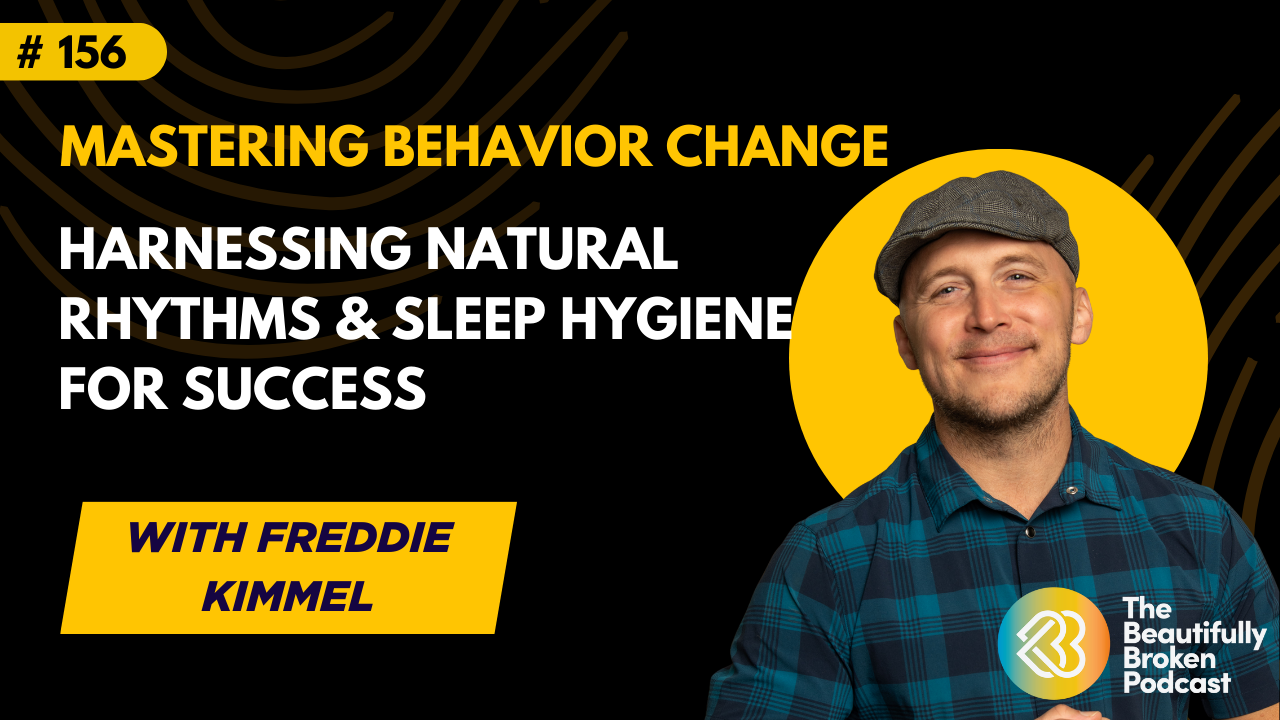
WELCOME TO EPISODE 156
But here's the thing: changing these patterns can be crucial to achieving personal growth and leading a more fulfilling life. So, what can we do to break past Limbic Friction and overcome the almost default state of locking ourselves into what we’ve known and gotten used to?
In this episode, we’re going to explore different, proven ways to encourage behavioral change to supplement the intentionality and awareness that we should bring to the table. Let's confront discomfort and uncertainty together and start taking actionable steps toward creating the life you truly desire!


Episode Highlights
[0:00:00] Introduction
[0:01:10] Limbic Friction: Why It’s Hard to Change Our Habits
[0:03:09] Hacking Our Bodies’ Systems to Encourage Change
[0:04:34] Journaling
[0:06:44] Using a Framework
[0:10:22] Looking at Your Natural Rhythms
[0:14:11] Tracking Your Habits
[0:15:26] Community
[0:17:39] Conclusion
MENTIONED LINKS:
Episode 106: Hair Loss and Heartbreak in 1996
https://the-beautifully-broken-podcast.simplecast.com/episodes/hair-loss-in-1996
Episode 21: A Cancer Survivors Story: High Vibration Living
https://the-beautifully-broken-podcast.simplecast.com/episodes/a-cancer-survivors-story-high-vibration-living
Be Loved Now:
https://belovednow.org/discovery-call
UPGRADE YOUR WELLNESS
Silver Biotics Wound Healing Gel: https://bit.ly/3JnxyDD
Code: BEAUTIFULLYBROKEN
LightPathLED https://lightpathled.com/?afmc=BEAUTIFULLYBROKEN
Code: beautifullybroken
STEMREGEN: https://www.stemregen.co/products/stemregen/?afmc=beautifullybroken
Code: beautifullybroken
Flowpresso 3-in-1 technology: (https://calendly.com/freddiekimmel/flowpresso-one-on-one-discovery)
CONNECT WITH FREDDIE
Work with Me: https://www.beautifullybroken.world/biological-blueprint
Website and Store: (http://www.beautifullybroken.world)
Instagram: (https://www.instagram.com/beautifullybroken.world/)
YouTube: https://www.youtube.com/@freddiekimmel
EPISODE TRANSCRIPT
Freddie Kimmel (00:00.974)
Welcome to the Beautifully Broken podcast. I'm your host, Freddie Kimmel, and on this show, we explore the survivor's journey, practitioners making a difference, and the therapeutic treatments and transformational technology that allow the body to heal itself. Witness the inspiration we gain by navigating the human experience with grace, humility, and a healthy dose of mistakes. Because part of being human is being beautifully broken.
Freddie Kimmel (00:34.723)
Ladies and gentlemen, I love you so much and I'm glad you're back for a solo soad. Welcome to season six. I'm gonna jump into mastering behavior change, which I will often reference within my story is something that is patterned into my DNA. It's like the ability to do it, to just do it, to identify something that you don't necessarily love, a personality trait, a word that you're regurgitating in a sentence.
Maybe it's just saying, I'm sorry, every time you interact with another human being, but being able to cut that out and just go forward with change. Well, as a very famous scientist once said, just because your pain is understandable, doesn't mean your behavior is acceptable. Now, while that quote might sting, I find it is this beautiful invitation to do this deep work. I often, I often,
experience and see when we heal ourselves, that it reverberates through our community. And we all know that behavior change is challenging for humans. We have been conditioned to think and act in a certain way based on our upbringing, our culture, our societal norms, our current systems that you and I live in, or structures, they reinforce our behavior that often, I find, go against our deepest values and desires.
making it very difficult to break free of them, almost like separating from the gravity of a rotating sun. Moreover, behavior change requires confronting the discomfort and the uncertainty that comes with stepping out of our comfort zone. You and I are wired to seek safety and security. So the prospect of change, it can feel threatening. It can be scary. It can be destabilizing. Now there's a term that I love,
that empowers me and keeps me in that state of curiosity. And that's limbic friction. Say that with me, limbic friction. What's that mean? It refers to the energy or the effort required to overcome a barrier such as anxiety or procrastination or fatigue that can hinder habit formation or have a change. It's the resistance or the friction we may experience in our limbic system. So I find it's important to understand
Freddie Kimmel (03:00.529)
that the area of the brain responsible for emotions and motivation and behavior is wired to keep us in a habit for safety. But we can also hack the system to modify or establish new habits. I'll give you some great examples. I should start my day with meditation and movement. I should write that novel that is burning in my soul to be birthed onto a page. I should speak to my boss.
about the fact that I'm worth more money than I'm getting paid. I should change the quality of food I'm eating. I only have this one body. It's this perfect pyramid. I only get it for a hundred years. Did anybody witness how I just, I was shooting all over myself? So this episode, we're gonna jump in and I wanna just make the invitation to better understand behavior change and how we can transition into a...
more effective way of being and certainly more joyful. I often believe and I often believe I often will say to people that behavior change is like the lock and key to better sex, more money, infinite joy, a strong sense of purpose. So if none of these sound appealing, go back to episode 144 and listen to George Weisman talk about Brown's gas. Great episode. However, if you are interested in changing your story,
in learning some tools that may help us rewrite the narrative, stick around. So let's start there, writing your story. I have found there is a growing body of evidence that suggests journaling can be an effective tool for behavior change. Research has shown that just writing about your thoughts, feelings, and behaviors can help us better understand ourselves, identify the patterns that we don't love, or the ones that we love, and track progress towards a goal.
There's actually one study in the Journal of Health and Physiology that found that individuals who kept a daily food journal lost twice as much weight as those who did not track their food intake simply by shifting their awareness. Do you know why I love journaling? It's free. It's very effective and you can start it today. So I have had a cathartic experience in actually writing out different areas of my story.
Freddie Kimmel (05:25.263)
There are three podcasts in which I published episode 21. This was a cancer survivor's high vibration living. And I walked through the whole, my whole disease paradigm. I also did this with my hair loss episode 106, hair loss and heartbreak. And then I also did this with my first day of chemotherapy and donating sperm episode 85. Now I wanna say on reviewing these,
articles or writing out my story, I was able to see. I'll just mention episode 106, and I wrote about hair loss. Revisiting that, I could almost see the amount of shame and embarrassment and self-hatred I held in my body could have been an onset for me being chronically ill and being a perfect terrain for Lyme disease or cancer. That emotion of shame is so heavy and powerful and thick, it's very tough to move.
And I never would have told you that in all my things, all the health things, that hair loss was the big one for me. But I carry that in the container for a long time. that check out 106 and just see where writing out that experience by the end, I really had processed it and I was able to truly release this attachment that any of these physical things, they're going to come and go. So I have found we can also use a framework.
that is very helpful to promote change. So when I say framework, I mean creating a framework for our habits and goals in which we can ensure that they are aligned with our natural rhythms and therefore more sustainable and effective. So a framework very simply can help us make conscious choices about our habits and goals rather than just going through the motions and following societal expectations with somebody else's setup. So a framework
or a natural rhythm could look something like this. And I'm just going to give you three prompts that I love. Number one, self-awareness. So we may very much benefit from understanding our natural rhythms and preferences in order to create habits that work for us. So this can involve tracking our energy, our mood, our productivity throughout the day. And what this does is it allows me to identify who, really, who am I? How do I show up in the world?
Freddie Kimmel (07:48.904)
Write out your perception of your energy and your patterns throughout your day and see if you're in love with that day and the person who shows up for other people. We need to understand where we're at so that self-awareness is important to know if we want to move away from that. Number two is prioritization. So we can find value in prioritizing goals and habits based on what is most important to us, what aligns with our values. This could be reflecting on a long-term vision,
and breaking it down to actionable steps that fit the natural daily rhythms that complement behavior change. So what is a priority to you? Building community, sovereignty, autonomy. I want to feel like I am aligned with a deep sense of purpose in the day to day. So number three is just flexibility. So this is a big one too. In my lived experience, I find value in keeping a flexible frame and being
adaptable in our habits and goals to accommodate change in our environment and their circumstances team. Environment and circumstances, my environment and circumstances are very different than a single mother with three children or a single mother co-parenting across the United States. We all have different circumstances. So this can involve setting realistic expectations and being open to adjusting our routine.
because it's everybody's, pond or the sandbox that you're playing in has different rules of engagement. So just stay flexible. The big example I have for this is I watch people do this program online called 75 Hard, and it's really interesting. Now I need to look up with 75 Hard. So 75 Hard, the net is, you know, it's a fitness program, but it's not a fitness program. If you skip a day, you start over. You pick a diet with no alcohol or cheat meals.
You drink a gallon a day. You do two really hard workouts a day. You read 10 pages of a nonfiction book and you try to take a progress photo every single day. It's really interesting and there's hundreds of thousands of people. I think there's a hundred thousand people have been through this program, but I watched so many people fall off and they never make the 75. And I think it's good to have a goal. I think it's even more important to stay flexible. I'd rather do it once.
Freddie Kimmel (10:14.74)
Creative program. Maybe it's called 75 Soft, the Freddie Kimmel program. Okay. Trademarking that. So another way to amplify behavior change is looking at natural rhythms. And especially, this is a big call out to, I think it's Matthew, what's Matthew's last name? I'm just going to say Molly McLaughlin, Sleep is a Skill, Andrew Huberman. All these people are talking about leveraging the natural rhythms of the brain and the body during different phases of the day.
to minimize again this limbic friction to bring ease to behavior change. So these leaders in the field of human optimization, they will stress the importance of sleep hygiene. Practical tips such as using like blue blockers, down regulating with a sauna, engaging in nighttime journaling, know, biohacking tools to optimize sleep. And for me, sleep is setting the terrain or readying the brain to make change.
If I haven't slept or haven't done my sleep hygiene, it's hard enough just to show up, let alone lay the groundwork for a new and better me. So one thing that I loved that very practical as Andrew Huberman does, the famous neuroscientist from Stanford, he breaks up the day into three phases. So phase one, two, and three. And phase one is like, it's the energetic section of your day. It's like zero to eight hours upon waking and
This is a great time to set the terrain. Your body is thriving with energy. This is a great time to journal, meditate, movement. I'm often on the red light and the vibration plate and I'll go through some hip cars because my hips are tight. You know, and these are things that I've written out in an agreement to myself that I actually, it's like my heart agreement with myself to always gratitude journal.
You know, that's the big one for me, just write out five things that I'm grateful for. But what it does for me is it keeps me so present and everything else in the day is just a bonus. It's a bonus. So there's nothing I'm achieving to bring in that deep sense of self-worth. I'm like, what do I already have that just lights up my heart? So the second one, phase two, is he says, ride the serotonin wave. This is really interesting because around, I think it's between three and five or 16 hours after being awake.
Freddie Kimmel (12:37.96)
Our serotonin is peaking. So this is a really good time and our adrenaline is crashing. This is a good time to be creative. So in the midsection of the day, it's like, where can we do creative things to compliment the body's rhythm? That could be creative writing. It could be singing. It could be, I tend to get into Canva and do graphic design, which is very much like painting and high school art class for me. Cause I used to be an artist and I loved it. And then phase three is just really prioritizing
Sleep. Now it sounds kind of boring that like 16 to 24 hours after being awake, you know, you're going to start prioritizing for sleep the next day. But the net is ready the terrain to have a kick ass day. And that's so important. You know, this is one reason I really don't drink alcohol anymore. It's not worth a bad night of sleep. There are special occasions, but it's just so important to me. So my down regulatory practices right now, I am doing some supplementation. I'm doing HRV.
product from Don Moxley. am doing sleep breakthrough from bi-optimizers. I am always wearing my blue blockers. I'm usually doing either a mental off gassing of the day's thoughts. That could be a physical exercise or I'm writing those out on a page. I am doing a what's called a spunk mat or an acupressure mat on my back and then some infrared heating pad. But it's all, you know, all really trying to down regulate and set my body up for
and the seeds that I have sown to grow. That's it. The next two I want to mention as we close here are tracking your habits. We really need to track if we want to change habits. There's lots of talk about 21 days to incorporate a new habit. So tracking allows us to assess which habits have become ingrained and are truly serving us. So tracking again could be journaling, could be a community pod or accountability group.
If you're trying to track fitness and dietary implications, it could be the Skycoo 3D scan, which is a fancy 3D scanner, which tells you exactly where the muscle and the fat is either leaving or gaining to your body. Caleb Greer at Dazine Health has one of these. So anytime we incorporate like an ARX or the green emerald laser, we'll get into what the green emerald laser is. We do an assessment on the body.
Freddie Kimmel (15:02.76)
man, these tools are great for just tracking. So I think that's important. Whatever your method is, the other one that I'm such a consistent with is my bio strap, always tracking my sleep so I know. I know right away I was like, man, you gotta do to something different, because it ain't making the dent. So how many times do we wanna repeat this day? Almost like a Groundhog Day. Like when am I ready to change? So the last thing I wanna mention is community.
And community plays just such a crucial role in behavior change by supporting your accountability and giving you that social connection. When we try to make our changes on our own, we can often encounter barriers, self-doubt, lack of motivation, a sense of isolation. Does anybody else feel that? This limbic friction, maybe that feels like a good term that doesn't feel so detrimental, but it's like, it's just like...
I like to think of it as the static in the TV. It's just noise. And we want this coherent, round, oscillating singing bowl speaking to us. But when we engage with community, supportive community, we are more likely to feel empowered and motivated for those positive changes. So community can provide that sense of belonging or acceptance, which can be essential in creating an environment where we feel safe to explore our goals and our aspirations.
When we share our struggles and our successes with others, we gain insight and perspective. We get feedback. We learn from each other's experiences. also find community can play that so pivotal role of accountability. And it can be crucial for sustaining the behavior change. Your community shouldn't let you show up and give the same story again and again and again without causing
throwing up their hands and saying, it's happening now. Or just saying, we are here to witness you and all your imperfections. How is this working for you? I just, believe in it. So one of my favorite online communities right now, it's for women. It's called Be Loved Now. It's a spiritual coaching program for women. It's my spiritual gurus, Kathy and Laura, who I call whenever I have a deep heart centered
Freddie Kimmel (17:24.742)
challenge that I need to work through with wonderful nonviolent communication. are my go-to's. They're resources on the podcast and the beautifullybroken.world store. And team, that's really it. I wanted to just say that breaking a habit requires this deep awareness and intentional effort. So I have found that the journaling, that community, and repetition
are the ingredients that I personally need to see these things true. And then ask myself, am I happy with the change? Am I happy with the rate at which this is going? In my experience, the ability to self-correct and add in new behaviors is the million dollar trait that we should be focusing on in our educational system. It's also what we should be hiring for. I would have this on an intake form. How good are you at adjusting behavior?
Right? It's just so profound. It's so priceless to me. I wanted to say, if I haven't said in a while, I love you guys. I really appreciate you listening to the podcast and joining me on this journey. I deeply appreciate feedback. Lately, people on the new website, beautifullybroken.world have written out and said, Freddie, this is going really well for me. I'm a longtime listener. And I've had some people say, hey, didn't love this one, which I also appreciate.
And it helps me grow as a podcaster. This show, The Net, I'll be honest with you, selfishly, it's for me. I get to lean in, I get to build a community. I get to ask the deep burning questions of people that I respect in the field of health and wellness and behavior change and human optimization. But it's a learning curve. And the only thing I can ask you, the only thing I can ask you if you ever hear something that just deeply resonates,
Share it. It makes the world go round. Yeah, I'm excited for 2023. I am having so much fun. I am making some huge changes in my life and reorganizing my time. And really, I feel this on a deep level. We overestimate what we can accomplish in a day. And I just want to call in quality. I drew a tarot card this morning that said, deep stillness.
Freddie Kimmel (19:55.598)
I had an interview yesterday, we talked about the idea that a manifest generator, which I am in the human design, will get it done. We will bring the energy. However, when it's from a place of alignment, it is channeled and amplified. When you are in a state of frustration and you push, are borrowing the energy from an energy credit card. Team, I feel that on such a deep level because there is a cost. There is a biological cost when I push through in a state of frustration.
knowing that I must get it done because that is my design. it's just awareness, stillness, the power of pause. I love you so much and Namaste.
Freddie Kimmel (20:38.994)
Ladies and gentlemen, you and I are moving on a four year relationship. That's gotta be some kind of a record. Thank you for tuning in. If you enjoyed the show, head over to Apple or Spotify and please give us a review. I know how busy you are. I know you got a list of things to do that's a mile long, but it makes more people across the world hear this mission. And one more ask. Before you go, there's a way that you and I can continue learning.
There's a way that you and I can continue to deepen the relationship that started in this episode. You could visit beautifullybroken.world and you can check out our brand new website and store listed are all the wellness tools, the supplements, the articles backed by scientific protocols to move forward in a wellness, the products that I am using and I personally love. Most of them offer a significant discount by clicking the link or using the code.
And the beautiful part? They don't cost you anything extra and at the same time they do support the show. Now, we have another new feature alert. I don't want to overwhelm you, but if you want to see the beautiful faces of our guests, if you want to watch me unbox and review products, head over to our brand new YouTube channel, Beautifully Broken World. This last message is from my vast team of internet lawyers.
The information on this podcast is for educational purposes only. By listening, you agree not to use the information found here as medical advice to treat any medical condition in yourself or others. Always consult your own physician for any medical issues that you might be having. Our closing, the world is shifting. We need you at your very best. So take the steps today to always be upgrading. Remember, while life is pain,
Putting the fractured pieces back together is a beautiful process. I love ya. I'm your host, Freddie Kimmel.