Metabolic Mastery: Dr. Jay Davidson Unveils the Power of Drainage and Lymphatics
Dec 11, 2023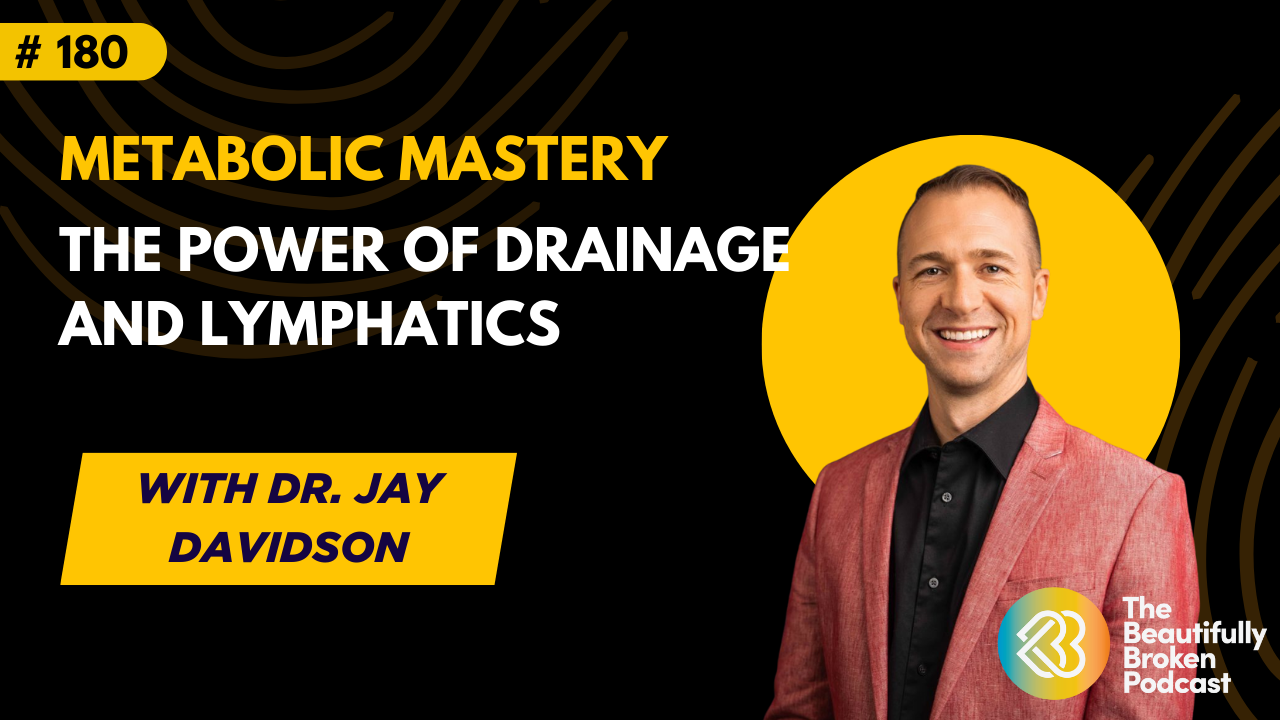
WELCOME TO EPISODE 180
In today’s society, 9 out of 10 American adults are considered metabolically unhealthy, which raises the question: What are we doing wrong?
In this episode, we’re diving into the transformative insights of Dr. Jay Davidson, a leading foundational medicine expert, co-founder of CellCore Biosciences, and two-time #1 international best-selling author. With a wealth of expertise in natural protocols for Lyme disease and other chronic illnesses, Dr. Jay is best known for his ability to simplify complex health topics and empowering audiences to address symptoms for long-term health.
Tune in as we dive into the importance of draining the lymphatic system, bringing down pathogen loads in the body, and activating our metabolic pathways. We discuss how people often underestimate how much we are exposed to microtoxins and how not listening to your body can drastically affect our wellbeing down the road. Dr. Jay also offers unique perspectives to the subtle influences that spiritual energies and traumas can affect our physical well-being. Don’t miss out as our guest shares his expertise on finding natural solutions for the gut, immune system, and overall whole-body health.


Episode Highlights
[3:45] On Lymphatic System and Drainage
[8:30] Understanding the Importance of Detoxification
[12:42] Unpacking the Body-Spirit Connection and Traumas
[18:48] What Causes Leaky Blood Vessels
[23:10] Why Most of the Population Is Unwell
[25:08] On Paying Attention to Your Body’s Symptoms
[31:24] Protecting Yourself From Toxin Exposures
[34:15] On the Drain Activator
[37:20] The Significance of Improving Mitochondria Function
[49:25] CellCore’s Long Term Impact
[58:15] Jay’s Top Recommended Health Diagnostic Tests
[1:06:33] Health Advice Everyone Needs to Hear
UPGRADE YOUR WELLNESS
Silver Biotics Wound Healing Gel: https://bit.ly/3JnxyDD
Code: BEAUTIFULLYBROKEN
LightPathLED https://lightpathled.com/?afmc=BEAUTIFULLYBROKEN
Code: beautifullybroken
STEMREGEN: https://www.stemregen.co/products/stemregen/?afmc=beautifullybroken
Code: beautifullybroken
Flowpresso 3-in-1 technology: (https://calendly.com/freddiekimmel/flowpresso-one-on-one-discovery)
CONNECT WITH FREDDIE
Work with Me: https://www.beautifullybroken.world/biological-blueprint
Website and Store: (http://www.beautifullybroken.world)
Instagram: (https://www.instagram.com/beautifullybroken.world/)
YouTube: https://www.youtube.com/@freddiekimmel
FULL EPISODE INTERVIEW
EPISODE TRANSCRIPT
Freddie Kimmel (00:01.49)
Ladies and gentlemen, welcome to the beautifully broken podcast. We are here with a repeat offender. We have Dr. J Davidson. Welcome to the show.
Dr. Jay Davidson (00:11.216)
Thanks for having me back, Freddie. A repeat offender. I don't know. I was like, whoa.
Freddie Kimmel (00:15.21)
Yeah, you need to be back. You need to be back. There's things that we need to talk about. And I got to say since January, I have been all up in the lymphatic system and drainage and it's, it's really changed so many of the lingering stagnant issues that have plagued me for years. And I'm just, I'm a such a freshman in it. And you know, when I went to eco and Boise and I heard some of your, um,
some of the things you were saying about the fascia and the interstitial fluids, I was just again confirmed how important it is and why people need to know about this. So you've really been onto this idea of drainage and drainage pathways. And I'd love from your clinical experience why this is so important to you.
Dr. Jay Davidson (01:02.22)
Yeah, yeah. This is an area I'm very passionate in because I see and have seen how impactful it's been. And my wife, you know, back in 2012 when my daughter was born and she, her body stopped, basically stopped functioning. She stopped producing breast milk after a couple months and shutting down. And there was a really dark period. But it was very eye opening for us of like, okay, clearly there's an issue here. What are we missing? And that's really when I started deep diving into toxicity.
But what I found is, you know, the experts quote unquote at the time were like, do this, try this, take this. And it's like she just seemed to react to almost everything. And that's what really, um, it was that moment that opened me up to realize, okay, why is she reacting where apparently all these other people are fine with, you know, such and such protocol. And that's when drainage just hit me, you know, right over, right in the face. I was like, man, she needs her pathways opened up. She might be.
little and not a huge person, but doesn't matter the size of somebody, like your drainage pathways could be clogged. And it's likened to the sink, right? So if your sink is plugged and you're just trying to put more water up top on it, right? You're just trying to kill some pathogens, just trying to detox. It's basically just pouring more water in the sink. Drainage is unplugging the bottom of the sink so things flow, so that when you do kill a
Dr. Jay Davidson (02:29.912)
it has somewhere to go and that's so critical just for normal functioning of the body. I feel like in the functional health movement, oh well drainage is fine unless somebody has edema, you know, gets brought up. But I mean in order for edema to show up, that means your lymph has to be 50% cut off and function just before it even shows up. So if your lymph functions 45%, you know.
or let's say 55 out of 100%, it's only 45% dysfunctional, you could have no swelling, no edema, which means from a physical side, you're like, oh, well I'm fine, I don't have any swelling. It's like, but yeah, your lymph's only functioning 55%. So just think when you get a little bit of stress, when you have a traumatic accident, or you get into relationship issues, or money problems, or career, or fill the blank in, it's like no wonder symptoms show up, because you're already.
not function 100%. And so there's a big difference between drainage and detox. Detox, I think of it's grabbing on the chemicals, pulling them out of the body. Drainage is just the normal pathways that need to be open, moving and flowing, right? It's the pipes, the colon. So if you're not pooping at least every single day, if not twice a day, you know, that pathway is just not open. The kidneys are a pathway.
the liver and bile duct system with the whole digestive tract and all the juices flowing, that's a pathway. The lungs, sweating, lymphatic like you said is a pathway, right? So we have all these different pathways that just need to be opened and moving and if any of them are clogged up, it can depending on the location, it can clog other ones up. So if the GI tract is clogged up, you're not pooping, that backs pretty much everything up. That's like the bottom of the sink. So that's why I'm just making sure somebody is, you know, going number two regularly is so important.
where the lymphatic system, right, if that's plugged up, well then the connective tissue or the extracellular matrix like you mentioned earlier, that's not gonna drain well because that's what—that's where a lot of the drainage actually happens from the connective tissue or the extracellular matrix is into the lymph. So it depends on what gets plugged up as to what gets impacted but I have yet to hear and maybe this is possible but I've yet to hear anybody that's like, Dr. J.
Dr. Jay Davidson (04:52.964)
I've just been draining too much. It's like, I mean, besides maybe taking something where you're having super loose bowels and pooping way too much, I mean, outside of that, I've never heard like, oh, I'm not well because I have too much drainage. It's always the lack of functioning in the drainage area.
Freddie Kimmel (05:13.574)
Yeah. I would also say in there as far as detoxification systems, I'm a firm believer that our nervous system also needs to detox. Like that is a way in which we get some pretty wretched things out of the body that kind of bounce around the fascia.
Dr. Jay Davidson (05:30.16)
Yeah, well, yeah, the nervous system is absolutely critical. I mean, there's so many different things when you're looking at the body. We're taught really on a science side. It's all about the biochemistry. It's about the chemical reactions in the body. But that's just a piece of it. I mean, we have electrical signals in the body. We have photons or light biophoton signals in the body. We have
magnetism or magnetic single signals that the body gives off or even senses. And then there's also this more unseen energy, scalar energy or ether energy that our bodies emit and also read. And so I feel like we're at the point now where we're starting to open up to maybe we don't know everything about health and maybe there is unseen energies or there's other things that we need to take in account and even the nervous system. I mean to think about.
that to think about that the nervous system would only function based on biochemicals going down an axon, a neuron to the axon, and going from point to point. To really think when they break it down and they say, oh, well, it takes such and such milliseconds per inch or per foot to get there.
If I'm operating and I want to move my leg from my brain to my foot, I'm six feet tall. So in order for that to happen that there's a little leg point but I can literally move my leg at the instantaneous moment which to me says there's probably something more even with the nervous system you know that is happening. I also forgot to mention sound right like our tissues can emit sound, vibration frequency can receive it. Connective tissue is a great example or the extracellular.
matrix like you said, even storing emotions. So just putting it all together, I think it's very humbling for us to just say, here's what we know so far but be open to the fact that there's probably a whole lot more. Just like when you said the nervous system needs to detox, totally makes sense. I mean absolutely. I mean I haven't heard people talk about it but I totally agree with that.
Freddie Kimmel (07:40.724)
Yeah.
Freddie Kimmel (07:45.906)
Yeah, it's fascinating. When you were mentioning your wife having these paradoxical reactions, like she takes this supplement and this happens, but that's not supposed to be that way. I hear that reflected across the board, especially with chronic Lyme, Mold, chronic fatigue syndrome. It's like, I'm not reacting in the typical format. Why is that? Why do people have those paradoxical reactions in your clinical experience?
Dr. Jay Davidson (08:11.976)
Ugh.
Dr. Jay Davidson (08:15.384)
I mean, this starts going down some rabbit holes, but let's go down them. So originally I thought, oh, it must be a mineral imbalance or it must be MTHFR, because that was like all the rage 10 years ago till you realize like most of everybody has some type of MTHFR variant, right? They call it defect, but I think just variant is a probably more accurate word to use. Really what I find clinically now,
to be why people react the way they do. And especially you mentioned it, mycotoxins or mold illness, this is classic for it, where people are in a mold environment. You know, the mold produces a toxin. Some people in the household react, some people don't. And then it permeates your physical clothes and bedding and all this, so people have to purge. And so it's like this life transition of just getting rid of stuff. And then going into a new...
Freddie Kimmel (09:11.491)
Hmm.
Dr. Jay Davidson (09:13.512)
place but you find with some people like it follows them. It's like no matter where they go, it's mold, it's mold, it's mold. They walk into a building, oh my gosh, it's mold. I can sense it. I can feel it. And it's like okay, there's something more than just mold because mold's been around for how many thousands and thousands. I mean it's been around since the beginning, fungi, right? So how can humans coexist with it? Now, obviously where we're at in this day and age with the amount of chemicals, right? The EPA and the 86,000 plus chemicals registered and…
how houses are built with sheetrock that just, you know, a little moisture, you know, can start brewing mold. Like I totally get that. But there's a moment where you just have to step back and you're like, something else is going on. And that something else is really, I believe, a spiritual. I believe we're in the spiritual warfare, the spiritual battle that's going on right now. And even if somebody isn't religious or spiritual, like when I say it, a lot of times people are like, yeah, it makes sense. I mean, this is, it feels like
war right now with all kinds of the chaos, all the emotions that are happening. And you have to understand that us being on earth, there's…and us being on this earthly experience, you know, be…you know, spiritual beings being in this physical body in this earthly realm, like there's distortions, there's things, traumas, things that we've accumulated from birth to even before we were born to, you know, being inside the womb of mom to…
Freddie Kimmel (10:36.894)
Mm-hmm.
Dr. Jay Davidson (10:38.992)
birth to just growing up. I mean, how many different traumas and things happen from a child zero to age six before we even, like we're so young, you know, it's hard to even remember going back to that. And all those different traumas basically end up being grips or, what's a better way to say it? Yeah, they're basically like grips for these unseen energies, these attachments, these hitchhikers, whether they're entities, demons,
disincarnates, I mean, et cetera. Like there's such a realm right now.
Dr. Jay Davidson (11:15.728)
that needs to be opened up in the spiritual side of it to really connect to the physical health. And so what I see is somebody that's mold or lime and that just they're getting the opposite reactions. To me, there's a hitchhiker on them. There's an unseen energy. And as soon as you clear that off, it's like immediately you can see it in their face. Wow. And think about how many times, Freddie, I wasn't anticipating we were gonna talk about this on the podcast, but.
we're going down this route. How many times do you see human nature of the addiction problems that humans have? Whether it's food, gambling, sex, or porn. I mean, like, it's unbelievable. Smoking, you know, some type of drug, or just some repetitive activity to that. Even the person says it, I just, I don't know what's got into me. Like, it's just like.
Freddie Kimmel (11:46.306)
That's okay.
Freddie Kimmel (11:52.962)
Mm-hmm.
Dr. Jay Davidson (12:13.512)
something else is making me want to do that. And I'm going to tell you, yeah, there's an unseen energy in this world. And so just to think that in order for you to get healthy, all you have to do is change your diet and exercise. Like I'm sorry, that's, you know, there's so much more to health. But then to think, oh, well, I need to detox. I need to go get my feet on the earth. I need to see sun, sunrise and get some sun during the day. It's like, yeah, absolutely. Those are impactful. But there's also.
Freddie Kimmel (12:16.119)
Mm-hmm.
Dr. Jay Davidson (12:41.948)
going the next level. There's also the emotional, you know, the emotions and traumas we carry in us to let go. There's also these hitchhikers and unseen energies to let go. And it's, as you peel that onion back, each layer, you start to realize like, whoa, I wasn't even functioning at my optimum before. I mean, I might not even be right now. Like who knows how awesome I can be feeling as I peel these things back.
Freddie Kimmel (13:03.348)
Mm-hmm.
Freddie Kimmel (13:10.078)
Yeah. I would, I would join with you and, and saying there's, there's always going to be more layers, right? Cause you think you hear this all the time. People that we all start somewhere. Where's our road to health? What was the thing that really kicked you into overdrive to really reclaim the vibrancy you knew was inside you. And most of that from my experience, it's a people realize how life, how short it is. They're like, Oh my God, I don't have a lot of time. I don't have time to be this sick.
So there is that driving force. I have been really caught up in, I don't know if you watch the news or how much you're gonna, I love episodic comedies before I go to bed. I like to watch like a little short, funny, like episodic, and it just down regulates my body. And so I've been really, I've been revisiting Friends and the death of one of the main characters in that show who I followed very, very closely.
I just, he was such a comic genius and he was so talented. And here's a guy who was very public about living with his demons. And you know, going back and watching the show, you can see you're like, Oh my God, in season three or season four, I was like, I missed it then. But now going back and you can see how bad he was struggling at the time. There's these times like little, little micro moments off camera. And, um, I guess my point is like we all, we all, we are all addicts.
I firmly believe I am, you know, right now I'm addicted to health and I'm addicted to time and nature. I'm addicted to working on my lymphatic system. I'm addicted to empowering other people to learn better about their bodies. So we all pick something to spend our time here on the planet. And yeah, I think it's so important to have guides and have people that you can trust leading you down this path. And you got to do it with somebody else. Right. It's not a solo journey to go alone.
which is why I lean in so heavily to the education you guys provide. And I just, I just, you know, I just want to celebrate you. The webinar I was just watching in which you were just talking about these, the leaking microvasculature around the body being such a problem for, for human beings. I didn't realize 15 years ago, I was taking this thing called woe basime on an empty stomach. It was a proteolytic enzyme.
Freddie Kimmel (15:33.502)
And it was taking all my Lyme and all my like inflammation. It was like blunting it really far down. I was like, and my doctor was like, no, that's, it's an enzyme. It's for food digestion. Shouldn't be doing that. Um, and, and little did I know I was probably working on these proteins that were leaking through the microvasculature into my tissue. So I want to talk about that. Was there any validity to what I was doing 15 years ago with woe design?
Dr. Jay Davidson (15:59.8)
Yeah, no, I remember Warp and Slime too. I wonder if they still make that stuff. That was definitely... Yeah.
Freddie Kimmel (16:04.266)
I can I sidebar that it worked for a really, really well. And then some, the, I forgot what happened. It was a German company. I think they got bought and they totally changed the formula. And then all of a sudden it didn't work anymore. It was really wild. They had like a great year and a half on it. So, um, back to you on, uh, proteolytic enzymes and what was happening.
Dr. Jay Davidson (16:25.24)
Yeah, so well, if you look, if you back up and look at the human body and a lot of things are just estimates, so give or take, but they say we have about 60,000 miles of vasculature, like blood vessels in the body. 60,000 miles. And you're like, how's that even possible? Because a lot of these are microscopic or what you called microvascular, right? They're really tiny. They're capillaries. They're really small. And you're looking about 97% of that 60,000 miles.
is this microvascular, these really tiny, if you will, blood vessels, capillaries. And so that's what most of the vascular, as far as length of the blood vessel is made out of. So it's, you know, 58,000 plus miles of these microvascular blood vessels. And what happens, so the blood flows from, blood flows through the heart, be careful not to use the word pump, flows through the heart.
Freddie Kimmel (17:21.39)
Thank you.
Dr. Jay Davidson (17:22.944)
out the arteries and basically it's a thicker branch to a tinier ones. You know, it just branches off like a tree and gets to really small ones and that's, you know, it's carrying oxygen, red blood cells and it's doing its... Basically it slows down the farthest point away from the heart, slows down, pretty much almost stops the red blood cells, shimmies back and forth, releases its oxygen, then gets picked up by the venous, you know, capillary, some red blood cells, you know.
sneak through, get picked up by the lymph, et cetera. Like, you know, this plasma, if you will, that is blood, essentially blood plasma. And in this process, when we have traumas, so we are exposed to mold, we drink some radioactive elements in our water supply, we, you know, get exposed to glyphosate, some herbicide or environmental toxin.
These toxins basically damage, and what we know from literature, and this goes back a while ago as you heard on the webinar, is that it causes leaky blood vessels. And the leaky blood vessel is in that tiniest spot, the capillary or the post-venule. And so if the blood vessel is leaking, that means that it can't keep all the fluid it needs into that blood vessel and keep it moving back to the heart, you know, venous supply back to the heart.
So if it loses, if it's leaking, where's it leaked to? And it leaks into the connective tissue, it leaks into the extracellular matrix, depending on the names you wanna say, right? Fascia, it's all this, basically the same thing, just depends on the terms you wanna use. So it leaks into the connective tissue. And that's what causes overburdening of the lymph, where the lymph has to drain all this extra stuff that's leaking out. And then proteins and these other things sneak out of the blood vessels and get into the tissues.
And when they do, then it starts causing dysfunction. It starts causing inflammation. It starts lowering the oxygenation of the cells. And so all these different processes happen within the body to try to deal with this. And so if somebody were to take a proteolytic enzyme, and basically that means you're taking an enzyme on an empty stomach away from food, so it's not just helping to digest food, but what's happening because you don't have any food, you take out an enzyme, it's gonna get absorbed.
Freddie Kimmel (19:29.944)
Hmm.
Dr. Jay Davidson (19:44.644)
in the small intestine into the blood, gonna go through the blood and then those enzymes are gonna help to break down debris that's basically built up in the blood vessels and, you know, potentially get into the tissues and break it down. So an enzyme is basically a thing that's starting a reaction, right? Or the step in a chemical reaction to happen. And so if an enzyme is initiating a reaction, it's initiating—it can initiate a reaction to actually dissolve or break something down. So things that are—
Um, people have noticed from like proteolytic enzymes over the years is inflammation lowering, right? Uh, increase energy, better blood flow. And it's just because it's helping to dissolve these like built up things that are in our body. Um, so that's one of the functions at least that I know of for proteolytic enzymes.
Freddie Kimmel (20:27.458)
Mm-hmm.
Freddie Kimmel (20:34.083)
Yeah. To the leaking blood vessels, you mentioned traumas like mold or glyphosate or different traumatic impacts to the body. What do you think the percentage of the population that's dealing with this right now as far as like a leaking system, an inefficient system almost, which makes a lot of sense to me because we're really talking about...
If you just want to look at America, you just looked at our global health dropped below Cuba where I think we're number 65 now, which is, um, that should be an eye opener, the, um, or the metabolic rates, you know, in the U S we're always like, you know, the big question, everybody, everybody wants to lose weight. Do we want to lose weight or do we want to look at why our bodies are just starting to mass accumulate adipose tissue all around the organs? Like, what do you, what do you think? I know there's not a chicken or an egg.
But if you had to make your clinical observation on what's going on with our population, why are we experiencing this on such a level?
Dr. Jay Davidson (21:38.732)
A lot of people are unwell. Like if we're really truly honest, do I feel awesome? Most people are gonna say no. And if they say, yeah, I feel great, they're probably so detached from their physical body so they don't feel anything, you know what I mean? Like they've had so much pain over the years that they're like, I don't wanna feel the city more, so let me just completely detach from that. I mean, research shows that only 12% of
Freddie Kimmel (21:43.051)
Yeah.
Freddie Kimmel (21:54.177)
Mm-hmm.
Dr. Jay Davidson (22:05.416)
American adults, so I'm not sure what it is in other countries, but American adults are metabolically healthy, so 12%. So I mean that's basically 9 out of 10 people aren't metabolically healthy. So if 9 out of 10 people are not metabolically healthy, I would, I think that's a pretty accurate thing. And even those that maybe don't fall into the metabolically unhealthy, the question is what else is going on with them? Because we use, we use...
Freddie Kimmel (22:11.391)
Yeah, I saw that figure.
Freddie Kimmel (22:32.628)
Mm-hmm.
Dr. Jay Davidson (22:34.576)
Like when I feel something, when I feel a symptom or I feel a pain, that's not something happening to me, that's something happening for me. And this is a big eye-opener we need to shift our perspective on. It's like, oh, why do I have a headache today? It's like your body is trying to communicate with you. Your body's trying to tell you something. You know, you didn't feel that slight pressure in the back of your neck yesterday. So guess what? Today,
Freddie Kimmel (22:45.254)
Mm-hmm.
Dr. Jay Davidson (23:03.536)
You got a headache and you know what? If you don't figure out what your body's trying to communicate with you today, tomorrow it's probably gonna be a pounding headache. And what do we do as a culture? We try to numb the symptom. Oh, give me some Advil or Tylenol, let's get rid of that. Your body's trying to talk to you. So the moment that we realize, oh my gosh, I'm having a symptom because my, you know, physical body is trying to communicate with my soul, if you will, and tell me, hey, I need to address something.
Freddie Kimmel (23:11.677)
Mm-hmm.
Dr. Jay Davidson (23:33.532)
This is the thing, it's not always a physical issue. Right, if my knee hurts, it doesn't mean, oh, I got, you know, something's wrong with my knee. It could mean, hey, you know what? You got in a fight with your wife last night, you didn't remedy that, like, communication and relationship and now here's some symptoms so that you step back and say, wait a minute, what's wrong? Because without symptoms, Freddie, we would not look into health. We wouldn't care two bits about health because we would feel great.
Freddie Kimmel (23:48.686)
Hmm.
Dr. Jay Davidson (24:03.48)
And so if we feel great, there's no need to do anything but what we're already doing. So the only reason we ever exhibit symptoms or not feel well is so that we pause, reflect, and realize, hey, what am I missing? And a lot of times, it's not always just something health-related, but it could be something else life-related. Maybe you're walking, you go into a job you hate every day. Well, no wonder you have no energy, because you're not doing what your life passion or your purpose or, you know,
moving in the right direction. And a lot of times that symptom, right, of oh, I don't feel good, I don't have energy, I have this, now it's hard to breathe, you know, 20 years later it turns into a heart attack or cancer, it's like that didn't start today, yesterday. That started 20 years ago with all kinds of other symptoms that you ignored because you're like, oh, I'm too busy. And so your body is just trying to talk to you. So if you are not listening, it's just gonna go from a whisper to talking to yelling.
Freddie Kimmel (24:47.957)
Yeah.
Dr. Jay Davidson (25:03.196)
to just an all out brawl until you acknowledge that. And so I know it's a little disruptive to think of that because it's so easy to be like, why me? And oh my gosh, the things I'm going through, it's like, you're doing it to yourself. And the moment that you realize that, you take the power back and you start to listen to your body and you start to realize, oh my gosh, I have to start living a little differently.
Freddie Kimmel (25:17.996)
Mm-hmm.
Freddie Kimmel (25:28.959)
Yeah, I do find that radical ownership, when we're really taking responsibility of everything, we have immediate agency to turn that around. And I think that's the most beautiful thing, even though it's a big step for some people. I've talked about this for a long time saying that cancer was the absolute best thing that's ever happened to me. And I don't mean that. I'm not trying to be dramatic.
Um, I wouldn't be doing what I'm doing. I wouldn't be as passionate if I didn't have to turn things around. And I probably wouldn't have made the changes to the degree that I'm making now, had it not been so severe. Um, when we, I want to, I want to keep going on, on drainage it a little bit and a lymphatic system. And so what are, what are steps people do to start to correct this? Um, our vasculature system, you know, the idea of, of heart. I love that you said.
I'm pausing to say that the heart does not pump because like you, I am a believer that the charge of our red blood cells does cause flow of blood throughout the body. It is interesting to think about the force that would need to come from the heart, which is like one cell layer thick in certain spots would explode the heart if it were just a pump, one pump sent the blood all the way around.
but we won't do a podcast about that right now. What can people do to really improve their cardiovascular health and the health of their vascular system, in your experience?
Dr. Jay Davidson (27:04.972)
Yeah, well just to finish that thought on the heart. I mean, to think if the heart's actually a pump, right? The blood slows down at the farthest point away from the pump, the red blood cell capillary, you know, the capillary exchange. And it basically stops and then gets going. It's like, how does something stop and get going in the farthest point away from the pump if the heart is actually a pump, right? So it's just, there's so many questions with that. But as far as like looking at the blood vessels, I mean, it comes back to just your overall
Freddie Kimmel (27:14.851)
Mm-hmm.
Freddie Kimmel (27:28.622)
There are.
Dr. Jay Davidson (27:34.8)
health of the body. I really believe that toxicity, toxicants, chemicals that we're exposed to is one of the biggest things that holds us back from expressing health. And even in the last few years, as it's kind of been the whole viral pandemics and this kind of thing, these bugs are out to kill us and beware, wash your hands, do all this stuff. It's like we're missing the clear obvious thing that's really going on as we're being poisoned. We're being poisoned.
in our food supply, we're being poisoned in our water supply, we're being poisoned in our air supply, like we're being poisoned everywhere around and if they're not talking about toxins and chemicals that are affecting us as human beings, then to me, I'm like that seems like the most obvious thing that we need to address is how do we limit as many chemical toxin exposures as possible and you're never gonna live in a bubble so there's always gonna be some. But how do we limit the obvious ones? And then how do we…
promote the body to detoxify because if I'm bombarding my body every day with chemicals and toxicants or toxins, then I'm creating inflammation. If I'm creating inflammation, I'm automatically making chronic leaking blood vessels. If I'm making chronic leaking blood vessels, my cardiovascular, my cardiovascular and my heart and you know, arteries and all that, they're never gonna be 100% well because I'm– I have chronic leaking blood vessels. It's like having a hose.
outside you're trying to water your garden but you poke holes in the hose on the way. It's like yeah you're gonna get some water probably through to your garden but it sure isn't gonna be optimal and there's gonna be other consequences that happen. So I really believe in limiting toxin exposure, detoxifying is absolutely critical. In order for that to happen though, we have to bring pathogen loads down. Parasites are one of the top things to lower because parasites are there in the body.
in response to the toxins we're exposed to. They're basically like garbage collectors or garbage sponges, if you will. But the problem is we don't wanna leave them in our body and be overloaded with them because they're manipulating us with their own chemical secretions that they do. And basically, the easiest way to think about is bug poop. They steal food from us, they produce.
Dr. Jay Davidson (29:49.692)
their waste products and then we react from the waste products and think, oh, it was the dairy I was drinking. No, it's the parasite that's drinking, you know, that's basically eating up the dairy protein and amino acids, pooping. You're reacting to the poop and then your brain is linking, oh, it's the milk that I'm allergic to. So we need to bring pathogens loads down and in order to and just backing up, right? So if a lot of it's about detoxifying parasites hold toxins, you get a
clear parasites out to truly get to all the toxins. In order to prepare to get ready for parasites, then we need to support mitochondria and we need to open up the drainage pathways like we were talking about earlier.
Freddie Kimmel (30:29.55)
Mm-hmm. Amazing. And I know that Cellcore has a new product called Drainage Activator. Can we talk a little bit about the formulation and why those unique herbs are in that product?
Dr. Jay Davidson (30:45.456)
Yes, yeah, drainage activator. I'm just gonna pull the list up here.
Freddie Kimmel (30:49.575)
That's okay. I can grab it from my cupboard. I'm beta testing it by the way. I'm pooping like crazy. Went up to like three times a day. And I really do. I notice less. I just feel less inflammation in general. And it's probably, I'm two weeks in doing two twice a day. Yeah, I'm early.
Dr. Jay Davidson (30:52.144)
I got it. Oh, it's
Dr. Jay Davidson (31:13.304)
Okay, see you early.
Freddie Kimmel (31:17.494)
I'm early.
Dr. Jay Davidson (31:18.596)
Yeah, if there was, so we have products, para, the paras we call them, para one, two, three, four. If I was.
Freddie Kimmel (31:23.672)
Mm-hmm.
Yeah, for people that might hear this for the first time, maybe we can just do a mini walkthrough because Cellcore has so many offerings. Not the product catalog, but your main ones.
Dr. Jay Davidson (31:33.785)
Y-yeah.
Dr. Justin Marchegiani Yeah. So we kind of break things down into different categories, right? So if we look at pathogen elimination, or what we'd really term immune support, we have the parasite formulas, para one, two, three, and four. We've got the ISs, which stand for immune support. And those are the Borb, Ab, Bart, Boost. So we kind of have the pathogen category. We've got drainage category, which is like advanced Tudka, which you just mentioned, drainage activator, kale support, lymph active.
Freddie Kimmel (31:46.361)
Mm-hmm.
Dr. Jay Davidson (32:06.896)
bowel mover, those are all basically things to help move— move the pipes. We've got the mitochondrial category of things which really BCATP is probably the key one there. But a lot of things in our products, you know, there's a lot of overlaps if you will. So like CT minerals is really good for the mitochondria as well too. And then we have the big category of detoxification, which is really the carbons, the bioactive carbon technology, the fulvics and humics that help to bind, restore, repair tissue.
Freddie Kimmel (32:21.324)
Mm-hmm.
Dr. Jay Davidson (32:36.08)
and really grab on to those toxins that we don't want and leave. Those are like the Virad chems, the biotoxin binder, HMET, carboxy. And you could put, you know, CT minerals. You can put BCATP in that category too, right? Again, there's a lot of overlaps there, but the first four I mentioned were really the main ones. But drainage activator, that was such a tough one to name because it's like, man, this is so good for the extra cellular
Freddie Kimmel (32:52.82)
Mm-hmm.
Dr. Jay Davidson (33:05.128)
extracellular matrix something, right? ECM or connective tissue. But as we looked at it, it's like, man, it's doing so much more than that, like metabolically speaking. And it's helping detoxing that, you know, other formulas hadn't touched yet. And then it's like when we got a bunch of people on this, you know, trialing before we ever officially came out with it, you know, out of the lab as we're trialing and on, you know, tons of people.
We've seen people getting rid of parasites. It's like, oh my gosh, this could be like para 5. So we basically settled on, yeah, drainage—drainage activator for the formula. Just that it's activating metabolically a lot of different pathways, which is helping with detoxification support. It's helping with, you know, immune support. Obviously, it's helping with drainage support. It's also, you know, it's gonna inherently help mitochondria just because when you—when you clear a lot of the stagnant—
debris, when you bring pathogen loads down, when you help remove chemicals, like the mitochondria just function better. And that's really what the core of the cell is. That's where our name cell core came from is focusing on mitochondria because we're—we're made of cells as they say. Inside of every cell is hundreds if not thousands and sometimes in the case, you know, a couple million mitochondria per cell. So when you break it down to the really tiny, tiny level, it's like the mitochondria—
don't just make ATP, they're also the main things that store intracellular magnesium. So most of the magnesium in our body is actually stored in the my— into the mitochondria. So mitochondria are— make 95% of the melatonin in our body. So it's not the pineal as we thought now research is coming out that 95% of you know melatonin like I mentioned is made in the mitochondria. Mitochondria are huge with cell danger response. Bob Navio's stuff is something—
you know, I believe everybody really should look at and study as a cell danger response and how important the mitochondria and ATP are even with cell signaling and communication and immune system. So that's really what we're always looking at. It's getting down microscopically down at that level and how everything fits together to improve health.
Freddie Kimmel (35:19.344)
Amazing. So if visiting back to Drainage Activator and components and why you chose a certain elements in that product.
Dr. Jay Davidson (35:28.604)
So the big thing that we were originally targeting was, well, I guess backing up. So I was trying to figure out why do people get puffy as they age? And of course, human being.
Freddie Kimmel (35:38.676)
Mm-hmm.
Some people, some people look fit as fuck. That's amazing.
Dr. Jay Davidson (35:45.152)
Exactly, right? There's a huge difference. You know, you're like, why do some people struggle? You know, after they have a kid or after some trauma or just they hit a certain age and it's just like they're never the same and they all they talk about is I used I never used to be like this, etc. And so this puffiness and of course, the puffiness would immediately get associated with oh, they're fat, right? But I was like, it's not fat. It's like fluid, which then I kept coming back to
Freddie Kimmel (35:59.315)
Yeah.
Freddie Kimmel (36:09.45)
Now.
Dr. Jay Davidson (36:13.404)
connective tissue, exercise of the matrix, like lymphatic system. So we really were looking at how to solve that and also how to solve this chronic candida where people, you know, they go on the candida diet where they basically cut sugar out, maybe take some antifungals or something like that. And it's like, great, I got a little bit under control. And then as soon as they have a bite of sugar, it's like comes raging back. It's like, okay, like again, why do some people are able to eat a lot of sugar and some people can't?
Freddie Kimmel (36:37.358)
Mm-hmm.
Dr. Jay Davidson (36:42.408)
touch it and their candida flares up. And so what we found was the area of the digestive tract these microvilli, if you will, like a shade carpeting, they have these things coming up into them. It's a it's an artery and a venous, you know, basically really tiny arteries in each of the microvilli. There's also a lymph what's called a lacteal coming up. And what we were figuring out in our testing clinically is that there is debris or build
Freddie Kimmel (36:52.852)
Yeah.
Freddie Kimmel (36:58.669)
Yes.
Dr. Jay Davidson (37:12.508)
this inflammation and this Candida to chronically be there because the Candida was trying to basically biodegrade or dissolve this debris that was just building up. And so what—that's what we were originally trying to target. And then as we dove into it and figured out this whole chronic leaky blood vessel syndrome that's actually happening with majority of the population where it's chronically leaking, it started leading us to all kinds of other things. So that's how—that was our main focus when we formulated it. Now we found that—
Freddie Kimmel (37:37.419)
Mm-hmm.
Dr. Jay Davidson (37:41.124)
Obviously, we've kind of hit the mother load of things that it's affecting so many other things. It's one of our biggest sellers all of a sudden. It's even as new as it is because of the testimonials that are pouring in from it. So the ingredient-wise, we were looking at was originally to target that. But then, of course, as you combine things, right, if I add one ingredient, great, you know, I put some olive leaf extract in there. There's olive leaf. But if I add another ingredient with it, one…
plus one, right, two ingredients. Doesn't have to be one plus one equals two, it could be one plus one equals four, depending on the impact or effect you're actually going for. And so we're really big with a lot of our formulas of taking multiple ingredients, because every, even though quote unquote it's natural, like an herb, it could still have a negative reaction or it could have a side effect. And I know people don't wanna say that in the natural world, but that's, you know, legitimately what's happening. Pharmaceuticals obviously have side effects, but so do herbs.
And so when we're combining herbs, we're looking for how to magnify the things we're looking for and also how to nullify some unwanted side effects that we don't want. So one of the ingredients in drainage activator, which is a great example, is St. John's wort. Well, St. John's wort usually at a higher dose, you know, people talk about, oh, don't take it with antidepressants or SSRIs. And obviously, it goes a little bit more in depth on certain compounds that are actually in the St. John's wort.
extract when you're manufacturing it. So we make sure we're lower than that so it's not going to, you know, be impactful for SSRIs. But by us using the St. John's wort, we're getting like some amazing benefits even with the nervous system that you mentioned earlier in the show. It's actually amazing impact positively on the nervous system and some other things with St. John's wort but we're using some other ingredients like especially
Dr. Jay Davidson (39:38.192)
potentially pull down any of the side effects that happen. So in the drainage activator basically, we're looking at mangista, which is an Ayurvedic herb, definitely known in the lymphatic drainage world for a long time. It's like red. That's what I think mangista means in Sanskrit is like red. We have olive leaf extract, go to cola, black cumin seed or nigella sativa seed, St. John's
Freddie Kimmel (39:41.361)
Hmm.
Dr. Jay Davidson (40:07.66)
extract, like that I mentioned, mushroom blend. And there's a bunch of mushrooms that we have in there, cordyceps, reishi, shiitake, lion's mane, turkey tail. I think there's another one too. And then we have our carbons, our bioactive carbons, our fulvic and humic blends. And that's kind of our bread and butter. It's a weird saying, bread and butter, but that's our bread and butter with our company of just being able to take herbs. Because if I take a capsule of an herb,
And let's say it's just got ashwagandha in it, right? 100% ashwagandha herb, I take it. That capsule generally opens up in the stomach. You meet a really low pH, which starts tearing apart the herb. So by the time that herb actually gets to the small intestine, you have maybe 80% of it gone or dissolved, maybe 20% left because our digestive tract is what it's supposed to do. It's supposed to break stuff down, you know, extract things, break it down. But if we pair it with fulvic humics, it can help buffer that stomach acid.
that low pH, it can help meet it there. So it doesn't tear apart the herbs so we can basically shuttle things through the stomach acid to get them in the small intestine so they're more intact. So a lot of people when they're looking at—I shouldn't say a lot—some people, they're very sciencey and like, well, I see it, you know, 300 milligrams is this dose that does this. It's like, well, first of all, back up a second. If I take something with the product to help more of it get through, then inherently, you're not gonna need as much. But the second thing, just like the carbons.
The second thing to understand is when they're doing research, these labs and manufacturers—or these suppliers if you will, it's like, hey, we got this ingredient, let's get some research out to show the benefits. Like they're thinking about what's the biggest amount that we can do for research, right? 800 milligrams, 1200 milligrams because they want to sell a bunch. They're not always looking at what's the lowest amount I can have to have this, you know, impact. And so you're taking a lot of things into account when—when formulating. That's just some of them. And then—
you know, another thing I see in the health realm is like, oh, we scavenge the internet for, or you know, PubMed and research for every single ingredient that's beneficial to mitochondria. And here's the formula, you know, you take these 12 horse pills or these three scoops, you know, and it covers everything. It's like, well, ingredients also, like I said, they can be one plus one equals four, or one plus one can actually equal zero because it could be a minus, it could be a nullification, right? Like if I look at the liver, there's different
Dr. Jay Davidson (42:33.072)
three lobes of the liver, they have different functions. So if I want to target the liver, I don't want to take an ingredient that's going to, you know, accelerate this metabolic process and then had that same ingredient, another ingredient into the same product that could basically nullify that metabolic process. And now it's like, well, but this one's supposed to do this and this one's supposed to do this, but it's like, yeah, but they also could nullify in certain points. So that's just part of things that we take into account when we're formulating in the lab and clinic.
Freddie Kimmel (42:50.817)
Well, this one's supposed to do this, this one's supposed to do this, that's like, yeah, but they all have to be all over the place.
Dr. Jay Davidson (43:02.832)
testing things out and I think we've been doing this long enough now in Cellcore that we're like hitting our stride and really figuring things out to a higher degree which I think drainage activators are a great example of that.
Freddie Kimmel (43:15.462)
Yeah. Do you, uh, does the company ever have the intent to go back and modify preexisting recipes or formulations or are things pretty much set as you go forward?
Dr. Jay Davidson (43:25.316)
No, we're always open to that. Great question. You always have great questions, Freddie. Such a good dude. So behind the scenes, as we figured out the drainage activator, for instance, and kind of nailed that down and started looking at its impact and how it fits in with other products and what it's doing and then getting feedback. And now we're getting more feedback. Now it's out to the masses, you know, the practitioners.
and all their patients were getting more feedback. And what we figured out is that, like for instance, lymphactive, we wanted to target a couple other areas a little bit more as we really dove into literature and figuring how we believe the body is functioning. So like we wanted to give a little more support to the spleen with lymphactive. And so that's one of the formulas coming out. I don't have an exact date because I don't handle that part. I mean, we have quite a large team.
But I know we reformulated that just to make some tweaks to make it that much better. So we don't, I mean, we don't want to touch things that people love, but also when we identify like, oh my gosh, we could take this to a whole new level. Like I'm always, Todd and I, Dr. Todd Watson, myself, we're always like, you know, talking to everybody like, will you let us, will you let us? Like, I know it'll be even better, you know? So that's, yeah, we're always open to making things.
Freddie Kimmel (44:32.193)
Mm-hmm.
Dr. Jay Davidson (44:48.132)
better and improving. Like we did that in the last year or so with CTIodine or iodine product. We turned it into a liquid form that people could dose better and we put a lot of cofactors in it. And then what we found is like you hardly need any—you don't need the megadosa iodine that we were thinking previously. And then the amount of reactions people were having like just almost dropped off like the cliff. Like CTIodine was our most reactive product as far as people getting symptoms and things with the higher amounts of iodine.
Freddie Kimmel (44:59.325)
Hmm
Freddie Kimmel (45:15.04)
Mm-hmm.
Dr. Jay Davidson (45:16.544)
And so yeah, we completely reformulated that one. And that's what's called metabolic activator. It's a little similar name of drainage activator, but metabolic activator. It's like a liquid. And so we love that one. So yeah, we're not like, this is what it is. And it's gotta be set in stone. Like, I mean, if it's working, let's not touch it. But if we figure out like, oh my gosh, we can make it better. We're always striving to do that.
Freddie Kimmel (45:25.378)
Yeah.
Freddie Kimmel (45:43.282)
Yeah, I love that. I love that you have that lateral movement ability, whereas institutions don't. You know, I think that's one of my favorite things about holistic health. I think it's one of my favorite things about being like, you know, a really good functional diagnostic nutrition or School of Applied Functional Medicine is we have so much time to read and research and look at
Freddie Kimmel (46:13.15)
you know, clocking in and clocking out, they're just seeing a landslide of people come in and out of a hospital. There is no room to be current. It's, it's just, it's a, it's a, it's a severe blind spot in, in the system. And I think this is where, um, it's so important, which leads me up to my next question, why, why is Cellcore, um, why is it a practitioner only line?
Dr. Jay Davidson (46:40.448)
Um, so we had, we had a retail line called Microbe Formulas and we have our Cellcore Biosciences Practitioner line. The products work so well. And I would say the potency is pretty strong that we felt it was best that people work with practitioners to help on dosing and what they
will take or won't take, you know. I understand there's people that don't all fit into that realm or there's people that have been to 30 practitioners and they're like sick of seeing a practitioner or you know, finances and I'm sure you can get our products somewhere online, you know, without a practitioner at some point or you know, use somebody's shopping cart type of thing. But yeah, we just, we just really, we started teaching practitioners in October of 2019, our very first seminar.
And Todd and I's idea, it's called Eco, exponential clinical outcomes, which you mentioned you were at the most recent one. And we had 90—we had spots for 90 people, right? Sent an email out within three weeks, it was sold out. And then a bunch of people pissed because they're like, I want to go. It's like, well, we literally don't have any rooms. It's not a big room, you know? 90 people is like slammed. So then the next one, we made it bigger, 120. And that was February of 2020. Sold that out like almost immediately.
And— and it was at that second seminar when I said— I told Todd, we're— I think it was like between day one and day two, I'm like, the practitioners are getting it. They're seeing what we're seeing with mitochondria, with drainage, with parasite cleansing, with the carbon technology, the bioactive carbons and what they're doing and how different they are. Like I'm— I— I told him like we need to go all in on the practitioners because if we can influence a lot of practitioners—
Right? If I influence one person in the general public, they might have impact on some friends or family members. But if I could influence a practitioner and they have a thousand patients or they're gonna, you know, you know, have such and such and they have more authority to help guide people. So that's just the direction we personally take. We decided in 2020 just to put more and more effort and time into the practitioners and you know, that's where ECO.
Freddie Kimmel (48:39.319)
Mm-hmm.
Dr. Jay Davidson (48:59.364)
you know, started in 2019 of 90 people to the last one you were just at was about 1500. You know, I think we had 800 and some in person and you know, the rest virtually, which was just I mean insane. It was the energy in there is just so amazing. And so yeah, I wish we could be everything for everybody. But I guess we just decided to go all in with the practitioners and really focus that direction. And I think it's the right one. Of course, somebody listening might be like, well, Dr. J is like, I know. But
Freddie Kimmel (49:04.962)
Yeah.
Dr. Jay Davidson (49:28.652)
We each gotta stay in our lane and say what we're good at. And honestly, some of the stuff is so, it sounds weird to say this, but it's so cutting edge and it's so disruptive that I feel like practitioners are best to hear it initially, you know what I mean?
Freddie Kimmel (49:43.767)
Mm-hmm.
Dr. Jay Davidson (49:46.384)
I mean, we've had so many disruptive type talks, whether it's Lyme disease and it's pleomorphism to vitamin D and it's different in thought, our different thoughts than what everybody basically says, you know, take a vitamin D and you're fine to, you know, chronic leaking blood vessels to the germ theory. I mean, in 2020, in August, our third eco that we had to go virtual because of the climate of the world was in. I mean, we just blew the lid off of the germ theory, virus theory thing. And it's just like, it's just been a rocket since then. So I
I feel like we just want to try to find what seems to be the truth or facts and just explore that area, even if it's not a quote unquote the standard institutionalized thing and run with it and see where it goes. And obviously it's, you know, it's definitely feels like there's been some divine, you know, help we've had, you know, navigating and just being okay going through some of these muddy waters against some of the big institutions and things, but it's going really well.
Freddie Kimmel (50:26.539)
Mm-hmm.
Freddie Kimmel (50:44.946)
Yeah. I think it's really important. I mean, I join with you. There's just so much, even from 15 years ago, and I just did an episode the other day and I was like, man, I would get so buzzed searching the internet for all these different things. And 15 years ago to today, there's so much more information and opinions and you'll drown.
There's, I don't know how someone would ever come up with a clear pathway other than somebody that is working in a clinical practice, seeing people and understands what an outlier is, understands how to work with a, you know, I like the, I like the term icky yucky feeling as opposed to a side effect or a react. Cause those they happen. And so who is going to be there to support you and keep you on track. Cause in my experience, I'm such a bad editor and how I'm doing.
Like I need, I need another person to mirror back to me and to tell me that it's going to be 120 days might be 90 days, um, before I decide something has or has not worked for me in two weeks, which is the norm, right? People very quick to say, Oh, it's not working. It's like, well, what's not working. It really is. You got to have somebody that can look at the whole picture. Like, like we've said a couple of times on this podcast. I don't know if you have any thoughts on that.
Dr. Jay Davidson (51:53.849)
Yeah.
Dr. Jay Davidson (52:06.736)
Yeah, it could, oh my gosh, yeah. I mean, people that come in, I haven't worked with patients individually for a while now, just doing all the research and education for Cellcore, working on that day in and day out, last, you know.
for almost five years now. But I, and I still write friends and family, like I'm still gonna help people, like I have a huge heart. So I see something I'm gonna assist you, but I don't formally have a clinic, right? But it's so easy where somebody's like, man, I have horrible migraines and gut issues and my ankle hurts. And they start going down the program, they're like, oh my gosh.
Freddie Kimmel (52:32.962)
Mm-hmm.
Dr. Jay Davidson (52:52.932)
My ankle just kills. I don't think this is helping, just like you're saying. That's like, well, how's your migraines? Oh, those are gone. What about your stomach? Oh, that's fine. And it's like we get, the human nature, we get so short-sighted, you know, like sighted of forgetting about what we, what, where we were. Like, I think we just need to take a moment, pause, reflect, look backward and be like, where was I a year ago or two years ago or five years ago? Where I'm at today? And just have some gratitude of like, oh, I've learned.
Freddie Kimmel (53:05.133)
Yeah.
Dr. Jay Davidson (53:22.008)
Even if you quote unquote don't feel better, there's probably a lot that you've learned that doesn't work or learned about certain things of like, man, this is a bad habit or I shouldn't have probably spent time in that direction. Like I maybe should have navigated this. Like we always are learning from it. Where human nature is always looking forward of like, what's the ideal, what's the perfect scenario? And then we compare back to that, which is always anxiety, frustration, anger, because it's like, when are you ever gonna reach that ideal? Like we need.
Freddie Kimmel (53:50.422)
Mm-hmm.
Dr. Jay Davidson (53:51.0)
a goal that we need of like, this is the direction I want to move. But when we measure, we have to look backward of like, where was I a week ago? Where was I six months ago? And in just that little shift can make immense, immense roads into peace and harmony and balance in your mind. Because a lot of this is a mental game. Like in the best of the best, right? Musicians, singing artists, sports people, golf, baseball.
Freddie Kimmel (53:58.317)
Yeah.
Freddie Kimmel (54:11.425)
Yeah.
Dr. Jay Davidson (54:20.528)
guess what they all have? They all have coaches. Even if they're quote-unquote the elite and the best, like they all have coaches. So it's like why wouldn't everybody else want coaches for different areas of their life? I mean I've had coaches for our relationship, my wife and I's relationship after she got well, quote-unquote well, you know 2012 she almost died, it was about 2014 where it was like life coming back into her. But then we looked at our relationship and it's like we're—we're like roommates. We're like friends. We're not—
like husband wife. And so we look for coaching, somebody that we looked up to was like, I want what they have, right? And we did that. And now I'm happy to say it like, our relationship's the best it's ever been today than it ever was, you know what I mean? But that wouldn't have got there as quickly without a coach. So I'm absolutely stoked that people put the time in to listen and research, but also you need to just, you know.
Freddie Kimmel (54:51.991)
Hmm.
Dr. Jay Davidson (55:17.784)
sometimes get an evaluation of yourself outside of yourself to be like, hey, what do you think? Because sometimes a coach or like a practitioner will say like, hey, you're just missing this. Oh my gosh, I never would have figured that out. It's like, yeah, exactly. That's the whole point of this, right? This is this earthly experience of, you know, like taking it up a notch. Like take responsibility for yourself, but then don't be afraid to reach out to others for some assistance or...
some help to help speed it up, speed the process up.
Freddie Kimmel (55:50.782)
Yeah, yeah, if you want to go fast, go alone. If you want to go far, go together. I would love to ask you two more questions. As far as like taking a look at the body, pulling out a little bit, what are some of your, what are your three favorite diagnostic tests to do on a body? That could be anything from body adipose index to thermometry to thermography to blood chemistry.
Are there things you love to look at that are just kind of like your three fave?
Dr. Jay Davidson (56:24.08)
Wow, you got some great questions, Freddie. The first one that comes to mind is sleep score. I really love to measure sleep. Now, this can be a double-edged sword because I hear people that they're losing the mental game of like, I can't measure my sleep because I see the score to just wrecks my day. It's like, okay, like there's that piece of it, but I really, I feel like the more that somebody can optimize their sleep.
Freddie Kimmel (56:31.822)
Hmm.
Dr. Jay Davidson (56:52.444)
how much deep, how much REM, the quality of their sleep. Oh my gosh, a lot changes. So like we're in a new house that we moved into. So we've been kind of living out of suitcases for about six months. And now we're finally in our house that we've been remodeling, maybe six weeks, right? So we're in this middle of just unpacking and things like that. And last night, my wife's like, hey, can you raise the bed up? And so in Puerto Rico, when we lived there, we had inclined bed therapy, where basically the whole frame of the bed
is just lifted up on one side so it's completely flat, right? It's not like a, not any concave. And she's like, I just slept so good. So we did that last night. And then before bed, she, I just love her. She's like, I want to beat you. I'm like, what? In sleep? I'm like, oh, it's on, you know? So it's like, okay, put the phones away, lay down, you know? And I got 87, 87 on my Aura. I like the Aura just because you can put it in airplane mode. And then my wife, you know, she's got an Aura too.
Freddie Kimmel (57:21.019)
Mm-hmm.
Freddie Kimmel (57:46.973)
Oh yeah.
Dr. Jay Davidson (57:50.244)
She beat me. She had like 91 and 90. I was like, ah dang it. But it's a friendly competition. So I like, and that's the first time that she actually ever said that, which is funny. But her sleep score just went up five points, even just flipping the bed up. So it's like, okay, maybe that is impactful because we slept like that for so long and then didn't for now like seven, eight months in this whole transition and now back to it. So I'm just, I'm a huge fan of just testing things out for yourself. See how you respond to different things.
Freddie Kimmel (58:18.05)
Mm-hmm.
Dr. Jay Davidson (58:19.844)
I love measuring sleep. I think that's a great one.
Dr. Jay Davidson (58:26.76)
Gosh, I'm a really big fan of muscle testing and that type of evaluation. So I really like somebody else checking me out and just, you know, muscle testing or resonating or, you know, some form of feedback like that to see what's going on with the body. I also think just like digital or paper assessments, going, that would probably be my third one is filling that out, different categories, right? So there's
categories for drainage and rating your drainage and parasites and lime and you know these different things, thyroid, that kind of thing and just taking a self-assessment because it's so easy six months or a year from now just to completely forget about like how you felt and it's kind of like a way to journal to track yourself and to see because if you can see that you're like oh yeah I do feel better it just helps mentally to know like hey maybe you're not exactly where you want to be but you're moving in the right direction like keep moving.
Right, some of the hardest things for human nature is just to feel like you're not making any tracks. If you're not making any progress or forward, you know, like I said tracks, like making any progress, then a lot of times you wanna stop. So if you can see that things are moving in that direction, which the only way to do that is really document or you know, have some way to assess, I think that's great. So I'd say sleep score. What was my second one now? Yeah, muscle testing assessment.
Freddie Kimmel (59:24.33)
Mm-hmm.
Freddie Kimmel (59:49.45)
Muscle testing. And then subjective experience, intake form.
Dr. Jay Davidson (59:54.608)
Yep, yep, I like those. But I'm a huge fan of running labs, but there can be, depending on the specialty lab and the cost.
Freddie Kimmel (01:00:05.579)
Mm-hmm.
Dr. Jay Davidson (01:00:08.996)
Yeah, I like that. There's also some really cool technology now too, just body composition. You kind of mentioned that earlier, where you can literally take a picture of yourself and AI can estimate your body composition just from a picture. And the accuracy now is literally about the same as a DEXA scan. So it's pretty crazy right now what's happening. And that just gives the ability for somebody at home just to privately check yourself like, oh my gosh, I'm...
Freddie Kimmel (01:00:15.01)
Yeah.
Dr. Jay Davidson (01:00:34.5)
you know, like 24% body fat. Like I was 19 last year. It's like, okay, well, it's not about losing weight, it's about being healthy. And as you're healthy, your body will change shape. Your body will look different. Your eyes will sparkle different. Your skin will look different. Your whole being will be different. So it's just ways, what makes sense to you to measure and what will help keep you on track. Cause we just need accountability.
Freddie Kimmel (01:00:59.262)
Yeah. I work out in Austin, Texas at a place called Lifetime, which is like, you know, it's like the Walmart of gym. It's like, it's a really nice gym, but there's like, it's massive. It's like a huge big family center. There's a water slide inside. There's a water slide outside and they've been getting more and more into the recovery. So they have some compression gear. They have some, some beds that do water massage. They have massage guns and balls, but then they have an in-body scan. And I was like, oh, they've got in-body,
Dr. Jay Davidson (01:01:09.016)
It's huge. Yeah.
Freddie Kimmel (01:01:28.866)
for people not understanding or not in the belief system that we are an electric body, it's a pad where you step on two galvanic plates, you hold two galvanic skin responders and it runs electrical current and the time that it takes from go to each side is how fat you are, how much water you have, how much skeletal muscle. And that thing is, it's within 1% of what my DEXA scan was. I was like, this is amazing. And so anybody, you know, there's probably 25,000 people in this gym in Texas.
can go do that metric, it's free. I can text it to my phone. I put in my code, it charts me every two months. I was like, man, we have come so far to the tools that we have access to. It's just incredible, incredible time to be alive, which I'm always stoked about. Yeah.
Dr. Jay Davidson (01:02:15.548)
That's awesome. That's cool that they're moving in that direction. It makes sense, but it's really cool to hear that.
Freddie Kimmel (01:02:21.086)
It does because how many times can you look at the thing and be like, Oh, it's not working. What I'm doing is not working. Why, why show up? Why show up to the gym every week? So I'm, I'm a really big fan of, I really like the skeletal muscle and, and how much water you're, if you're dehydrated, what a great metric to be able to use. And then, or, or does all the HRV and stuff now.
Dr. Jay Davidson (01:02:40.144)
Well, in the...
Dr. Jay Davidson (01:02:44.112)
Yeah, yeah, I really, I'm a big fan of the HRV. So that, I should have mentioned that with the sleep scores. I like measuring sleep time HRV. I also have a chest strap polar that you can measure HRV during the day or first thing in the morning. I do find it's different than at night. So just being able to track that. But I was just gonna say with the lifetime fitness it's cool to see them getting into recovery because it's been so much time about just diet exercise. But it's like.
Freddie Kimmel (01:02:56.376)
Mm-hmm.
Dr. Jay Davidson (01:03:12.524)
you could only exercise so much to how fast you can recover after the exercise before you exercise again. And that's again, the sleep emphasis is just recovering, like repairing and getting into a rest digest, right? The whole, you know, polyvagal, ventral vagal stimulation, right? Just being able to calm the body down and come into a healing side. So it's really cool to see gyms doing that. I'm sure more and more are gonna keep moving toward that.
Freddie Kimmel (01:03:40.01)
Yeah, I think there's a wave of collective consciousness going across the country and where people, they for the first time, more than ever are understanding the importance of their health, that they really have nothing without it. And think about how hard we work, how many hours we spend endlessly to just buy this like, you know, for lack of a better term, material shit that gives us no joy, gives us nothing.
But everybody will pull back and be like, oh my God, I could never invest that in my health. I think that's slowly whittling away. I see that anyway. And the other thing that I'm seeing more and more of are people who come to me asking questions that are in amazing shape. They have like 12 packs and they're not healthy. They're not healthy. Just because you have muscle on your body does not mean your lymphatic or your drainage is working at all.
And I've seen that I just did a, just did a class, um, with Desiree to spawn from flowpresso last weekend. When I was a, I was an example for manual lymph node release. It was telling, I mean, you know, where the body holds, um, fascinating, fascinating stuff, uh, I want to ask you your final question, if you have a magic wand, you can wave it across a magic TV screen that you can get access to everybody on the planet. You get.
a minute and a half to talk to everybody. What words would you offer the people of planet Earth at this time?
Speak from your heart. It's a big one. Ha ha ha.
Dr. Jay Davidson (01:05:10.812)
That's a pretty big, yeah, it's a pretty big request. I would say we've been lied to on so many things and it's time to wake up. I mean, from looking at the pharmaceutical industry and the whole petroleum Rothschilds, you know, basically annihilating natural medicine and thinking that the standard medical care is the only thing and the best thing that's out there, like wake up, we've been lied to. I mean, we've been lied to on the energy crisis, we've been lied to on climate, we've been lied to on so many things and until...
we become aware of those lies, we can't step beyond and see what the truth is or start to explore what the other possibilities are. Same thing with the germ theory. I mean, bugs are not out to kill us. And as soon as we realize that, we start asking questions. And the place where we, as a society, begin to ask questions is when we're going to get answers that we're ready for. But if we're just being told what to believe and here's how it is, that's a...
Freddie Kimmel (01:06:05.325)
Hmm.
Dr. Jay Davidson (01:06:08.86)
completely different space than for us asking questions and does this make sense? Does this fit into a philosophy? Does this, you know, how does this fit into, you know, big view? How did, how did germ theory ever start? How did the pharmaceutical industry ever start? Like if you actually start going back in research, 1910, the FlexR report, and you start seeing these type of things, you start realizing, oh my gosh, what was the first virus ever discovered, right? Yellow fever, which was not ever a virus. They didn't even have microscopes to do that.
and it was a complete fraud, it's like, well, if that was a fraud, like what else is moving forward? And so I think we need to start asking questions. We need to start looking back in history and see what we got wrong and start reevaluating so that we can figure out what's truly right or start moving at least in a better direction today.
Freddie Kimmel (01:06:58.038)
Yeah, I think there's a lot of people out there that join you with you in that. And, you know, I know from so many of my friends that are in the medical industry, their doctors, their nurses, they are also frustrated and they're burnt out and they're tired. And I do see this, people are asking better questions. So I think that's great advice. Ask better questions and you'll probably get the answer that you're ready for. Dr. J.
You are an awesome guest. You'll definitely be back a third time. If you'll, if you'll spend a, spend an hour with us, it's such an honor to have your insight on this and I'm going to see you at Eco in 2024.
Dr. Jay Davidson (01:07:36.112)
Sounds great, Freddy. Yeah, I'm up for a three-peat, so.
Freddie Kimmel (01:07:39.138)
Great. I love it. Well, thank you for being a guest on the Beautifully Broken Podcast. Namaste.