N=1, Clinical Application, Accountability in Medicine
Jan 09, 2023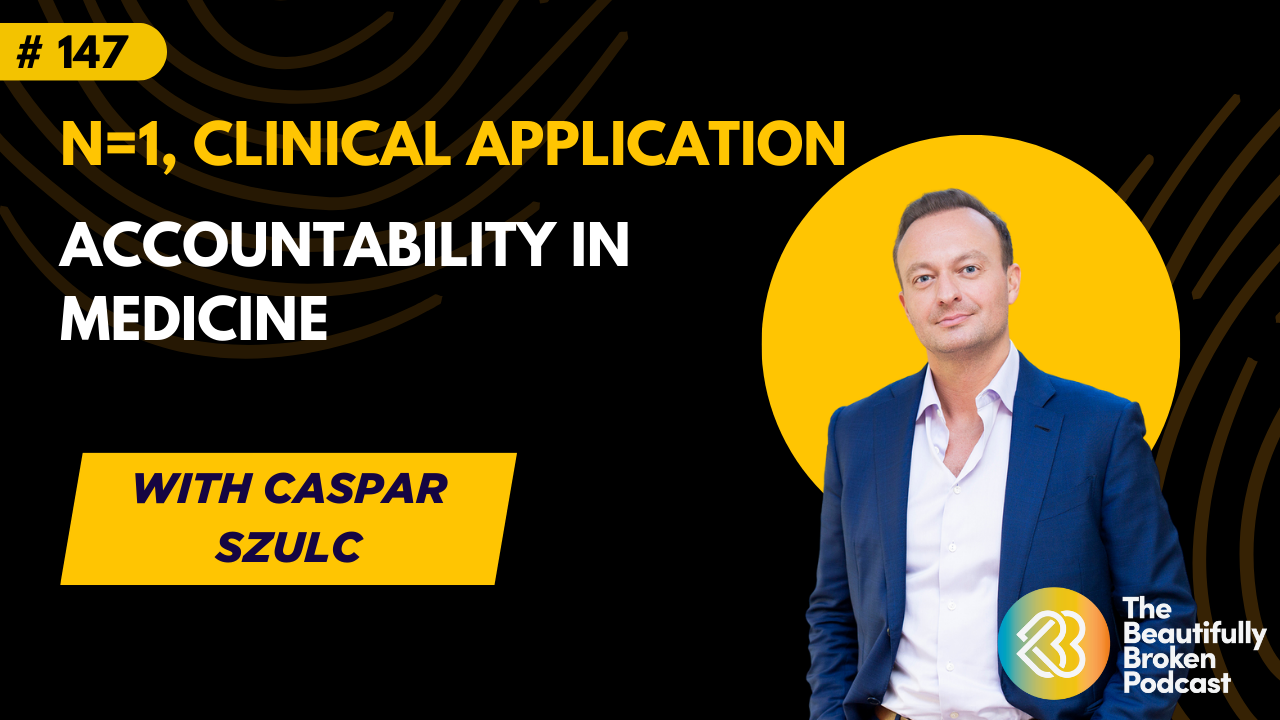
WELCOME TO EPISODE 147
Caspar Szulc is a wellnesspreneur and the president and co-founder of Innovative Medicine in New York. His company is dedicated to using personalized, integrative methods that factor biological, spiritual, psychological, functional, allopathic, and other aspects of medicine to revolutionize healthcare.
More than an expert in the field, Caspar is a fellow enthusiast of alternative medicine and biohacking. We discuss how we can use technology to enhance the human body, the importance of collaboration in the field of medicine, and some of the standout devices he would use to outfit his own personal wellness sanctuary.
With his unique position in the frontier of medicine, Caspar is a fantastic source of knowledge on the latest development in healthcare, and I’m excited for you to hear what he has to share!


Episode Highlights
[00:00] Introducing Caspar Szulc and His Work
[05:41] Caspar and His Company’s Approach to Medicine
[08:11] The Importance of Collaboration in Medicine
[13:39] The Effect of Capitalism on Medicine
[18:48] On Managing Your Dopamine Levels and Getting Out of Your Comfort Zone
[24:31] On Being Accountable for Your Own and the Environment’s Health
[30:52] What is the Top-Most Health Concern for People Right Now?
[36:21] The Importance of Exploring Meditation and Other Ancient Healing Traditions That Can Help
[40:33] On Taking Charge of Your Own Healing Outside of the Clinic
[49:40] Caspar’s Favorite Wellness Devices
[55:45] The Wellness of Minimalism and Decluttering the Mind and Your Environment
[1:01:37] Connect With Caspar
UPGRADE YOUR WELLNESS
Silver Biotics Wound Healing Gel: https://bit.ly/3JnxyDD
Code: BEAUTIFULLYBROKEN
LightPathLED https://lightpathled.com/?afmc=BEAUTIFULLYBROKEN
Code: beautifullybroken
STEMREGEN: https://www.stemregen.co/products/stemregen/?afmc=beautifullybroken
Code: beautifullybroken
Flowpresso 3-in-1 technology: (https://calendly.com/freddiekimmel/flowpresso-one-on-one-discovery)
CONNECT WITH FREDDIE
Work with Me: https://www.beautifullybroken.world/biological-blueprint
Website and Store: (http://www.beautifullybroken.world)
Instagram: (https://www.instagram.com/beautifullybroken.world/)
YouTube: https://www.youtube.com/@freddiekimmel
EPISODE TRANSCRIPT
Freddie Kimmel (00:00.352)
Ladies and gentlemen, let's jump on in. My guest today is Casper Schultz. He is the president and co-founder of Innovative Medicine in New York. This is a company dedicated to transforming healthcare through an advanced and truly comprehensive form of personalized integrative medicine. Casper is a fellow wellnesspreneur. We talk about the limitations
of our current medical system and how we can improve those for the collective. really interested in finding solutions. We talk about the biohacking container and how to move that mission forward, optimization of the body through technology, people have to start working together. It is about collaboration, not competition.
And we also get into the items that Casper himself would put in his dream home, his sanctuary of wellness. So it's a great podcast. He has traveled the globe. So as far as someone with access to what's coming on the front of modern day medicine, he's one of the more educated human beings out there. I'm excited for this conversation. I hope you stick around. Let's do it.
Welcome to the Beautifully Broken podcast. I'm your host, Freddie Kimmel, and on this show we explore the survivor's journey. Practitioners making a difference and the therapeutic treatments and transformational technology that allow the body to heal itself. Witness the inspiration we gain by navigating the human experience with grace, humility, and a healthy dose of mistakes. Because part of being human is being beautifully broken.
Freddie Kimmel (01:52.098)
Ladies and gentlemen, welcome to the beautifully broken podcast. I'm here with my good friend Casper. Casper, welcome to the show.
Thanks for having me, Freddie. Great to see you again. It's good to see
to you. If we were passing on the street and you just, someone said, well, what do you do for a living? How do you spend your time on planet earth? What would you say?
I'd say, why don't we sit down over a cup of coffee because this elevator pitch is not give it justice. Now, it's an honest question. And it's like, what do you do? Like, and I actually just had like a meeting with with your employees and everything to share like the vision, what we do, and like really kind of break it down. So it's like, you know, if you asked me what I do on the like three words, right, or two words, even it's transform medicine, it's changing.
medicine. It's acknowledging that there is something wrong when you have 60 plus percent of the population that's chronically ill and getting worse. Year after year, it's being able to say we have to do something different. And then it's providing those solutions in a medical way through doctors, through practitioners, through experts, through patients even, to do that, to transform away from a kind of old school protocol driven symptom, know, subsidizing.
Caspar Szulc (03:04.576)
and moving in towards a more comprehensive approach that truly acknowledges self-healing and acknowledges there is so much more out there in the world than what conventional medicine shows us. And that's something I was fortunate in. This is way over the 30 seconds now. So, but if I were having that cup of coffee, if we actually sat down, I would say that I was fortunate enough to travel the world with my father, who was sort of a pioneer that started off in surgery, pain management, very conventionally minded.
And then we got frustrated and disappointed with his results that he wasn't really curing people or helping people. I traveled the world with him as he sought out different solutions in different ways to help patients really regain their health, not just manage disease, actually regain their health from things that were considered incurable by conventional medicine. And through those travels, I saw how much the world really has to offer the past, the present, the future, like, you know,
every spot around the world has something to offer within the healing arts. And medicine truly is an art form. As much as it's become a technicality of what's the protocol, what's the latest clinical research show, you need artists and you need skilled people to be in medicine to truly help heal mind, body, and soul. So, you know, I applied that to a business which is called Innovative Medicine and we are truly trying to transform medicine through that.
Yeah.
Freddie Kimmel (04:31.182)
Yeah. And the clinic that you're referring to, Integrative Medicine, that's out in Long Island, correct?
Yeah, innovative medicine, that's the New York center for innovative medicine. So NYCIM to shorten that down and make it little digestible. But the New York center for innovative medicine is the initiation point where it all started. So basically I wouldn't even start a company if that wasn't there proving itself for so many years to the point where I was like, why is this not out for more people to take advantage of? If you have suffered suffering from chronic disease for 10, 20 plus years.
And just going down this vicious disease cycle, spiraling downwards as they go from specialist to specialist, trying everything. And then if you ended up at our clinic and you got better, it's, it's, want to showcase that a little bit more. You want the world to be able to take advantage of that. So it's kind of been my journey to help get that out to more people and hopefully start to spread this out into other areas, not just New York. Yes, we see people from around the world travel there, but
It's not always convenient to travel just to New York. So we'd love to have more of these, but yes, clinic is right now the New York Center for Innovative Medicine.
And how would you categorize the offerings at just to take the clinic as an example, like a pilot study, you know, we have functional medicine, we have very standard of care, we have our allopathic, and then even there's this conversation around biological medicine. Do you guys have like a do you have a label you identify with?
Caspar Szulc (06:03.554)
You know, not really, because I don't believe that there's any one of those is the right solution. Listen, we're the first people that would tell you, you need surgery if you need surgery, right? You need to go on some kind of pharmaceutical drugs. If you're in that of acute state, you know, we understand there are limitations to all facets of medicine, biological, functional, energy medicine, spiritual, all of that. But we have that under our roof and we do acknowledge that they are all useful. So
To me, this is the true unification of medicine. It's looking at all the facets of it, European biological medicine, spirituality, consciousness, psychology, all of it, and being able to take little pieces from each and personalize it to you. So, I I like to just call it innovative medicine, because that's really kind of what it is. It's not even the name of the company. It's this type of innovation that was able to say, let's look at everything that's available out there in the world.
Let's look at all the different experts that are giving out so much great information, but let's not just stop there. Let's add them all together. Let's put them around the table and place the patient in front of that table and say, what is best for this individual? Not for their disease, not for their symptoms, but for the individual themselves. So it really is a comprehensive approach. And that's what I found to be, you know, the one thing I see as an issue throughout medicine is the separation.
not even conventional medicine, but alternative. It's specialties within that, right? I'm the herbologist, I'm the acupuncturist, I'm the chiropractor. And again, just like in conventional medicine, a lot of that downfall, they don't talk to each other. You know, you go to a chiropractor and the acupuncturist usually isn't talking to that chiropractor about what they did, about how that could influence their energy healing sessions. So we're trying to change that. And we really do this team approach where you have these specialists that come together.
and discuss the patient as a whole. There's no one singular person that is in charge and kind of dictating this is the protocol you're given. It's everyone speaking together and giving you a truly comprehensive entailer.
Freddie Kimmel (08:11.104)
Yeah, it's really interesting. As you were saying that I was just, I'm aware of how important it is for the team. Like imagine the Knights of the Round Table that are going to help this one individual move forward, that they are talking together because you can almost imagine, I just go through my own little timeline of me going to see an acupuncturist and a Cairo and then biological medicine and then maybe an oncologist. And within those people, you can imagine the different egos that are involved and just really
because I've had this happen that they'll actually, my guides would actually start to infight with each other and they would start to argue. So as a patient, I just felt pulled in the middle. I was like, well, he says, everything you're telling me is total bullshit. Where this guy says, if I don't do this, I'm going to die. So it's really, as a patient experiencing having to have all these different types of conversations, it's so important that as healers that we heal our bullshit.
And obviously you can have discernment in that with who you bring into your circle and they're like, guys, if we want to have this conversation about innovation, we got to do it together. And which is actually, you know, it's why I called you. I called you when I was up in Toronto, because I was experiencing, you know, this like in fighting amidst this, whatever you want to call it, the biohacking container, you know, in the world of all this cool technology, you're getting these people that are just driving like the marketing and sales. And I was like, I just got
I was like, wait a second, I got so inspired about this like eight years ago. was like, alternative is gonna have all these different answers and really as human beings, I feel we tend to carry the same problems into it.
yeah, no, absolutely. I think it's human nature. Listen, I can understand that if you created something in medicine, why wouldn't you think it's the best? Why wouldn't you think your device, your system, your anything isn't the best? It's your creation. It's what you undertook. It's probably years of sweat. You know, think my company's the best. Is it really? No. Come on, let's be honest. To me, it is. But it's not for everyone. That's where I kind of draw a line. It could be amazing.
Caspar Szulc (10:16.502)
Listen, if you're not ready to take on responsibility and change your lifestyle habits, it doesn't matter how many procedures we apply to you, you're going to have a problem. know, whatever caused your issues in the first place were through your actions, So if you don't fix those actions, it doesn't matter how many high tech gadgets and know, things and IVs you do. And I think going back to your point that that is sort of the issue that we can all acknowledge. There are many people out there that have created amazing things.
in the field of biohacking, medicine, health, wellness. But I think we also have to acknowledge the limitations sometimes and that it isn't for everyone. We cannot apply. I hear this too much, like CBD, it's gonna cure everyone. Like, no, it's not, I'm sorry. That's a false statement. It's like, let's give that misinformation and censor that. But it's sort of like, it can help people, sure. I remember going to India and presenting in India and the person after me presented,
Here I was being like, we got to look at everything and, you know, put it all together and, really unify medicine. And the guy after me talked about cow urine therapy, how it stops cancer. It was like, Whoa, that's bold. I never even heard of that. I've heard of drinking your own urine, things like that, all these things and even them all sorts of different therapies. I never heard that cow urine would actually help for cancer. And this guy's up there saying it cures it. And at the end of his presentation, someone raised their hand and be like, how many
people have like you put on this protocol. It was like just myself. He happened to be in remission from cancer and he was presenting them like, did anyone vet this guy before he got up there? You know, it's a group of like conventionally trained doctors. So that totally ruined the vibe. I feel like they were like, uh, what about the guy before him? I wonder if he was bullshitting too. But I think that's a little bit of a problem of the ego. It's like, if it works on me and it works on some people. And then again,
Yeah.
Caspar Szulc (12:13.538)
What does that mean works on conventional medicine as a very good track record of subduing symptoms. And if that is success, they're very, very good. Do they do anything to actually cure you or help you heal? No. But that again is a win. So I think a lot of people like the CBD kind of thing not to knock on edges here so much is that it will subdue your pain, but are you truly getting at the root causes? And then you have this influx of fighting the minds better than yours. Yours is not doing this and
Unfortunately, I've always talked about this as collaboration over competition is what's best in the healing arts and medicine. It's to acknowledge the limitations, but also say, what if we apply this together? Is there a synergy to it? Just like I think there's a synergy to taking NAD plus precursors. Everyone's like, which one's better? And I get bashed on both sides. the NAD doesn't work this way. You gotta take a precursor. precursors do this. Why not acknowledge that they can both work? And maybe there's a synergy to it that you could take for some.
Not for everyone as well, as we've seen that too. It doesn't work right now. So think it's a industry like any other industry. It's a business though. There's competition. There's a scarcity sort of approach to it that I need this patient. You can't have them. I don't believe in that. don't think there's any kind of, it's abundance of people out there looking for help. think if you provide them with the best help, that's what really leads to success. And I think that's what leads to collaboration coming together rather than pointing fingers at each other.
Yeah.
Freddie Kimmel (13:39.458)
Yeah, I was listening to this really great podcast yesterday and they were just talking about, it was a guy who was writing a book on, he was following these trends as billionaires are going off and building these like end of days islands and bunkers and seafaring vessels to protect their net worth. Yep. He made a really great point. He's like, I wish I could get to these guys and say, you're going to be great at like $50 million. You could stop like this capitalism train.
But he threw out a number and I was like, man, it's such a subtle shift. But when you look at this wealth gap that we're growing right now, and you can start to apply that to like, you know, our container of wellness, like, I was just thinking about this, I'm looking at all these Black Friday sales, and I'm imagining like, I'll just take a sauna, for example, you know, barrel saunas, barrel saunas, and I'm imagining like, just forests being depleted.
on these things that many people will never use, or they're going to use them for like three months. And then they're going to need the new one in six years, just as an example. And your head starts to spin with like, my God, this consumerism, this hedonic treadmill of consumption, it's going to like destroy the planet. And it's like, I know it's a little nuanced silo that I'm thinking about, but especially Black Friday and the holiday spur it for me. I watch people just buying shit to try to make themselves feel better.
And I wish everybody could just pause if there was an on-ramp for everybody to say, okay, before we go do this, let's just look at, are you eating vegetables and not out of a box? Are you breathing? Are you trying to sleep eight hours a night? You know, the simple, simple things. But I don't know if you have thoughts on that, because it's it's the consumerism and unconscious capitalism. It just seems like this runaway train, which we also need to deal with to help everybody feel better.
Yeah, my first thought to that is quote from like the social network, Sean Parker talking to Mark Zuckerberg, like a million dollars isn't cool. You know, it is a billion dollars, right? You point to that trap of like a million dollars is pretty freaking cool. Like, let's be honest. Like, that's amazing. You know, we got to stop doing like, I remember when I first got into business as an entrepreneur in like early 2000s, it was like, it was wild to do that. If you even made it out a few years, it was like, congrats break even was like,
Caspar Szulc (16:04.686)
Wow, that's amazing. And then somehow it shifted where I used to tell people I owned a company like, oh my goodness, that's great. Like, is it successful? Like, it's profitable a little bit. We got like, you know, some people, they're small. They'd be like, that's great. Now I tell them like we've been in business 20 years. They're like, how many people do you have? It's like this man, like, oh, it's so small. Do you have a billion dollars? It's like, why are we doing this? Like stop all this.
Yeah.
I think happiness isn't a number here. Success isn't a number on a balance sheet. You know, that leads to greed and leads to cutting corners and leads to what has become one of the biggest problems. think of just feeding people crap, toxins, chemicals, like just bullshit to make money, not caring about them at all. Big pharma, big food, big tech, they do not care at all about your health and happiness. Now, my second thought to
solve this is focus on your health is prioritizing. Right. And I say that not in a way because I realized the more that I really put health first, the less I realized I need. You know, I love the gadgets, right? Like they're cool. They're interesting. You know, shiny things and I love all those. But at the end of the day, if I'm not
Come on, how do you not?
Caspar Szulc (17:25.408)
in nature, if I'm not meditating, if I'm not just getting enough water in me, if my thoughts are offer some, if my stress life, I don't need gadgets for that. That is all free. That is the one on ones of health and life. And I think as you get focused more on that, you realize this idea of minimalism is truly happiness. Constantly striving for things leads to unhappiness.
leads to disease, leads to depression, you you always want something. And that's why I think a lot of these guys that are the billionaires of the world don't start off wanting to be billionaires. I think they do have true benevolent missions in the beginning. And that gets changed as you start to accumulate things and your ego starts to grow and then want, you know, what comes in and it's like, that guy's still more than me, right?
The fact that Elon Musk is like joking around and sending Jeff Bezos like presence when he got over him as number one in the world just shows they care about this stuff. Like I am more powerful than you. Can you imagine that ego to it? I like Elon. I'm not saying he's a bad guy. I just think that is human nature to start to get to a point where you're like power hungry. It's not even like the billions of dollars, one billion lost here and there means nothing to you.
when that could feed like countries for months at a time.
I also think it comes back down to like, again, I always say the human operating manual, but if I better understood what got me out of bed in the morning and drove me to first get in like a cold shower or an ice bath and then do a little breath work, like that makes me really happy. But I'm understanding that I'm wiping the hard drive, you know, I'm setting my body up for a good hit of dopamine and it's going to ramp me through the rest of the day. Now you can imagine if you woke out of bed and it was like,
Freddie Kimmel (19:17.25)
you know, I need to hit this end day quota in order to feel satisfied. Cause my neurotransmitters, unless I do that, unless I get that stimulus to create a new emotion that was greater than yesterday, I'm going to feel depressed. Like drive to keep you going for more is this is the survival mechanism, which you could explain that to a child in like 10 minutes and be like, I want to just frame this for you this way. And it could be so easy.
Yes.
Caspar Szulc (19:45.88)
Yeah, I mean, there's a book, great book called dopamine nation I read and it really studies what happens to addicts because that's the ultimate dopamine dump, right? Right. You hit and then you just drop and it's like, that's why you stay addicted. It isn't the actual drugs or anything else. It's the dopamine rush. It's what your body reacts to and then drops out of it. You know, that happens with everything. Big tech knows this very well that when you see a ping notification on your phone, you get a little rush. You get a little bit of how high off of that, right?
let's do that, you know, this, that. And that's what we're training children to do, to put their value into that. And the book actually said that the way most of these addicts were able to stop being addicts was to find an alternative to the dopamine rush. So instead of doing drugs, one person did cryotherapy and cold immersion to the point where that became their addiction almost. They were pushing it to like splints.
that most people in that field, as you know, wouldn't go, you know, like 30 minutes and sub subs you and that became a better one, I would say. also the, I think understanding that it's okay not to always rush for good things. It's okay to have bad days sometimes. It's okay to change that norm. I think our norm, and I think you saw this during the pandemic is like no problems, no challenges, no nothing.
Yeah, it's
Caspar Szulc (21:10.162)
You look at every generation prior to ours really had some sort of calamity almost, some sort of really challenging piece that reset what is good or what you want in life, right? So I think when you went through World War I and World War II, those generations, they were happy with just like, hey, can we just have the American dream of a house and a family? That will bring me so much happiness because I almost died battling the war, which was gruesome and really put me through some trauma.
I almost died.
Caspar Szulc (21:38.03)
But I think this generation, look at even the economy and everything, like everything's been good for us. You know, it's been so convenient. We can just tap something on a phone and get it delivered in two days. Like that's wild. Like that's so easy. We don't have to get up anymore. We literally sit on Zooms all day on couches. Like we don't need to do much. And it's not bad. It's not like, oh, things are really like that. You could look at it from a new standpoint, you're like, things are bad, but I could say, all right, let's go back 20, 30, 40 years.
and then just keep going back in history and things were much worse. yeah, changes the dopamine route, right? When you get everything handed to you, you want more and more if you didn't. And this is why I also I state this a lot like go travel the world. If you want to have a change in perspective of how bad your life is and wanting more, go travel to Africa. See those little kids smiling and playing and coming up to you and being so happy with nothing with where they have to go walk miles without shoes and just to get clean water.
But they're really freaking happy Friday. They don't have problems of depression there They have problems of starvation and disease and everything because they don't have the necessities in life But we do and when you go there you shift you're like wow, it's so good I need to be grateful more for everything that's going on here and So from that perspective, I think you start to shift
what it means to be happy or what you want your life and the dopamine kind of factor changes in a sense. So I always advise people if they're feeling in a funk or unhealthy or something like that, going down, sliding down to go travel the world, go to places not like resorts, beautiful resorts, but actually go to places that are third world countries that are beautiful in their own right. But you'll see how the people kind of act there. And I think you'll get a greater appreciation for life.
Yeah, there's a song in Anything Goes called There's No Cure Like Travel. Yeah. And it's so true. Every time I leave home, I'm either deeply appreciative of what I have, or I meet somebody and I can hear their completely different narrative of how life is for them. And it's incredibly, incredibly valuable. You know, there's this deep sense of understanding and how different life can be for different people.
Freddie Kimmel (23:58.601)
And you're not going to get that unless you get out of your bubble.
Yeah, absolutely. I mean, I think the idea of trying something new, going to some place that is different and opening you up to new things is a part of life and evolution, a part of you evolving in a sense becoming greater. And I think if you're not evolving in life, you're going to have stagnation and stagnation is death. Stagnation is disease. So I think there's a big part of health that requires you to get out of your comfort zone, see the world and see different perspectives and try new things.
I want to go back to the idea of this, you we kind of talked about the Zuckerbergs of the world and this mindset where, again, we can look at this, the playing field is, I try not to put it in this good or bad wheel of life or death. And when I think about somebody like that, you know, you had a young kid that just wanted to make more friends and he was thrust into this. And now look at Facebook. I think as you'll see over time, that it's just this mess of
data collection, which is going to be lots of lawsuits eventually. But he was a young kid when he started this endeavor or the guy from my space, you know, and it's like become so distorted. So I think it comes back to us with our dollars, how we're spending our time, how we're sending our likes or clicks, we're spending these screen hours. We're the ones who are deciding, you know, whether these things go forward. So is it going back and just seeing
Can I diminish my Amazon spending by 50 % even 25 % can I shop locally? Can I take whatever it is three hours, four hours a week that I'm spending on screen time. Can I start to go attend like a local ecstatic dance? Can I go to a farmer's market? I just think there's huge, everybody looks at the world and I hear this at, it's too much. We're too out of control. It's the runaway train. I'm always like, you gotta find day-to-day moments where you can take your power back.
Caspar Szulc (25:59.052)
absolutely. I think there is a huge amount of responsibility in where you put your dollar and what you choose to do with it. Yeah, I think that a lot of people don't realize this and they complain like, listen, if you want to be an eco warrior, right, and truly change the world, you do that not by talking alone. I think that's wonderful, but by actions. And I think a lot of those actions, you could find companies that are truly eco friendly.
and you put your money there. But I think people like to say things and then have convenience too. And you can't have both. You know, you can't be conveniently buying things that are harming the planet because they're cheaper. And then talk about being an eco warrior. Like, listen, I even have beef with this idea that electric cars are really going to save the world. And I did a big post on it. It really got people upset.
And I understand that electric cars themselves are zero emission, but then you have to go back and there's a lot of data on this on, where does the lithium come from? How are you mining it? How much do you need to do? That's deforesting large segments of our world right now, lithium and nickel mining. And I'm not saying in the future it could change and get better, but where it is right now, it's doing a lot of harm as well before it gets to the car that's doing better.
it's really balancing out. And I think this idea that that alone is doing it is not the right approach. I think again, if you focus on your own health, if you focus on you, you start to use products that are usually friendlier for the environment, have less toxins in them, have less of a footprint in it. So the idea that you do have a lot of power. We do. changing.
And it starts by changing yourself. It starts by the idea that your wallet, whatever that amount is, can truly make an impact. And I think it makes an impact on you first and the planet. We are the microbiome of the planet, right? The healthier we are, the healthier the planet is, the more we want the planet to be healthy, the more actions we do to make ourselves healthier. It's this symbiotic relationship. When I see someone that litters,
Caspar Szulc (28:14.582)
I automatically think that that person probably litters things into their body as well. They litter toxins into their body. They litter chemicals that are bad for us. And then they just go back and litter into the environment. So it's this kind of back and forth that you got to realize the healthiest action you could do for the world, for Earth, the mother Earth is to be a healthy person. And once you start being a healthy person, you start to realize where you're putting your money. I don't put my money into big companies like that.
that I know are doing harmful things that are absolutely using chemicals, dumping things out, using a pesticide, all these things. Yeah, you can make the case. Well, what do you do that's completely green and clean? And I think there are a few of those, but that too, it's there are levels to all this. This is not a black and white thing, Freddie. It's like go someplace cleaner. Like that's not doing as bad. Don't talk yourself out of making a better action.
By saying it's not the best action. That is not the way to do it. And that is why when someone comes in, like says something about, you know, we got to be more friendly to the earth and we're killing it. And then you go inside their house and you see how their AC is blasting all the time. Their cupboards are filled with general mills and like all this stuff and excess too. It's like that could feed so many people over so long, but
I get it. You hoard these things and this is the way America goes in a sense. More is better and these are things you grew up with. So it's difficult to break free of that trend. But again, if you go back to like the Zuckerbergs and everyone else of the world, if they were able to just pull back a little bit and say, we don't need this many billions of users, we can do better with less. Quality over quantity is completely lost in the world right now. Everyone just wants quantity.
And that is not the way to health, either for us or for the environment in our place.
Freddie Kimmel (30:13.174)
Yeah, so beautifully said, Casper. just think it's so as you're saying that I'm like, we are the microbiome of the planet. I somebody posted yesterday a picture from my hometown and somebody had dumped a sofa on the side of the road. And it was just like, man, humans at their, they're not greatest. It's just, it's difficult sometimes and not to be reactionary, but it's also as above so below.
We can imagine like that's a great example. Well, what does that person putting in their, small intestine and their gut? And what is the internal environment of that person's body look like? It's probably not great. I would love to hear just because you are associated with a, a clinic, you know, you do have some clinical experience hearing people's stories. hear what people are, are struggling with. Do you see common themes that really jump forward for you that are most prominent for people right now?
You know, we've mentioned things like energy. said NAD nicotinamide adenosine dinucleotide. I just like to remember that I remember all those words. Things like glyphosate things like we could say sleep deprivation. Is there anything that you think is really on the top of the list for most people right now?
I gotta say it's like across the board all those things. It's to culminate like you will find so many people with high stress levels, emotional baggage, poor sleep and which one is the initiating factor that leads to the net, right? It's always different in each person. It's like you could have poor sleep because you're over caffeinated and you're eating poorly, eating late at night. Stress levels are high, but that leads to more stress, which leads to you eating worse, which
So it's like all these things, but I will say this because you asked me from the clinical perspective and we have a clinic in New York. In New York, we have a lot of people from the city because that's where we were originally for over a decade. We were in New York city. We over the last few years moved it outside of New York city to a more natural environment, less stress, because this is why I'm saying this. Most New Yorkers are actually quite healthy on the surface level. You know, a lot of them.
Caspar Szulc (32:25.464)
do yoga, they're CEO, they're high performance people. They really do care about their appearance and the health on that level. So they have trainers, have nutritionists, they have, you know, all these people at their disposal. From the outside, they look very healthy, Freddie, but when they come in, they're a mess. They have so much going on inside that is not healthy. And that's where stress really comes into play.
These people are in a high stress environment for most of the day. They do not take time out. They go, go, go. I mean, I remember moving to New York city and starting a company. If you weren't working 14 plus hours, you were a slacker. That just was unheard of. And in finance where my friends were in other industries, you sometimes worked 18 hours a day. You just go home, sleep and go right back to work in a high stress environment from your 20s.
on out, you continue that because you get a promotion, you have to work harder. And that's kind of like what I think a lot of the world right now is moving towards, especially when you talk about these things of consuming. So as you consume more, the levels of production to keep up with that, the levels of work have to go up. So, you know, again, I go back to this idea of Elon Musk, right, coming into Twitter.
And I do think he was somewhat correct to be like, we got to change things. We're losing $4 million a day. We're not profitable. You guys are getting all these perks and everything. But he went into it like you either work and sleep here or you quit. And it's like, well, that's not balanced either. You went from one whole side of being like maybe too little work and you're losing the idea of what a business needs to be to even run, which is profitable somewhat at least right even to the other side of you need to work all the time.
And that will lead both sides, think, are wrong because one side is kind of this leads to sort of the lethargy of the world leads to a little bit of the slow stagnation that we may see in some people that they're not moving enough or not doing enough. The other side is just such high stress, such sympathetic nervous system activation and autonomic response kind of dysregulation. Yeah.
Caspar Szulc (34:39.979)
That is what is leading to so many issues. And everyone just wants a pill or just says this, well, I'm healthy. I eat clean. I work out. I do this. I do that. I have all this money invested in all these gadgets I use and everything like that. But at the end of the day, if you are not balancing the stress with something else, then you are in a chronic stress state that will impact every single system in your body or at least cascade differently for each person.
If you ask me what I see across the board, it's this level of stress that is just so high. And again, if you were to take that step back, travel a little bit more, take the time off, you probably see this is kind of ridiculous. I'm killing myself and this is my choice. The stress is your choice, right? It is your choice what you want to do as far as mitigate that. You work less, okay, I'll get fired. Perhaps you need a new job, because if you don't get fired or you don't leave, you'll probably die.
Weigh that out a little bit and people don't believe it. And Freddie, let me tell you, they don't believe it. They leave because we say, we get it. You're pretty healthy, but the stress levels, we can help you. But if you don't change your job or don't lose the stress levels, you're going to get worse. They say, I can't. That's my job. That's my livelihood. That's what I do. That's who I know is myself. Next thing you know, months down the line, years down the line, state for cancer. Right. And they kind of don't know and they run back and say, help me. You go.
can help you again, but it doesn't matter if you continue to be an environment that is leading you towards this. stress is really such a killer and it's, I think it's so pushed aside. And I understand we have so many issues out there with toxins, EMF, everything out there going on, viruses, immune system, but this is kind of one of the simplest ways I feel like that everyone has the opportunity to address by being able to take a step back and saying,
Am I stressed and what can I do about it? And easiest thing is just to rest, to relax, to find, you know, happiness and joy in the little things of life, to be able to step away. And trust me, Freddie, I am the first person to be guilty of stressing a lot, right? You run a company, you do so many things, you stress a lot. And I acknowledge that, but it's also the reason I have to take resets. I travel a good amount. I do things like play tennis and I don't miss those even if there's something important.
Caspar Szulc (37:07.212)
going on because my health is most important. That's number one. So if I place my health first, then I realize I have to get a hold of my stress levels and that starts to change the equation a little bit as to whether or not I'll actually go in a disease state or stay healthy.
Yeah, I couldn't agree more. You know, everything you said, it's this idea of, know, if you wake up in the morning and you put your feet on the ground, I think it's easy to forget what is really driving happiness or what really makes us feel joy. But back to the dopamine loop and the idea of this hedonic consumption, which I have a podcast coming out on, that power of pause or the meditation or travel allows for this hard reset.
in which we can sort of feel into, you have to be the person that you hold your hands up and say, why am I working so hard? What am I running from? What am I running to? But in the United States, is this little God from every grade school on up through college. was like achievement as King. It was the gold star. There was no award for being, which I feel like now it's like, man, it's just the world is just crying out for balance. And so
It's really funny that the level of that people will go spend $12,000 on like a container to have 38 degree water, because they need to engineer something in their life that is hard. Isn't that wild? Right? Can you imagine if you went back 500 years and you're like, you're doing what with what with what?
No, I think a lot of our ancestors would laugh at us in so many ways. And I think we laugh at our ancestors in the stupid ways. We think we're better than them just because we're technologically advanced. It's like, you know, we laugh at ancient traditions. We belittle, you know, ancient healing in many ways. Look at doctors. I'm sure you know lots of conventional doctors where if you bring up some ancient ritual that would possibly help you, and I think definitely help you with your disease, they would laugh you out of the room.
Caspar Szulc (39:09.27)
Yeah, they would basically say don't believe in that voodoo crap. Take this drug. And meanwhile, it's backwards. It's like you should believe in that voodoo crap. It helped us for so long. I mean, for thousands of years, we lived without technology without all these things. And somehow I think we prospered many ways much further with our health. Yes, we had shorter lifespans because there are things like saber tooth tigers eating us and we didn't have clean water.
But it wasn't that we were dying of stress, of toxicity, of things that we absolutely have control of now. They didn't have control of that back then. And yet they were much more in tune with nature, with themselves. And this is one of the big things I will say that I wish more people had, because you say when you have that infighting in medicine, when you have different opinions in medicine, when you have a lot of options in the world right now.
It could become incredibly overwhelming and stressful in its own right. Which one do I go with? And we start to turn to others for answers. We turn to Instagram, we turn to news. What is going to solve my problem? You can only answer that. And that is intuition. So many of us have poor, poor intuition or no intuition, no gut feelings anymore. No ability to say this versus this, which one feels right to me.
Instead, we stress about this versus a million other options and don't really go anywhere or choose one that is truly not good for us. So whenever I have a patient that comes to me, let's say, and ask me, hey, should I come to your clinic? My best answer for that is sit with yourself for a while and see if you get an answer. Sit in silence. You know, yes, talk to other patients, talk to everyone.
Get the good in the bad, go on the forums, do all your research. At the end of the day, it has to be your decision though, because no one else is like you. And that's why I wish more people just sat silent with themselves and just sort of sat there with a question on their mind and just see what comes up. And even if it feels like it's forced a little, you're getting a silly yes in your head or something like that, go with it, run with it. Honor that that is something within you, probably telling you so.
Caspar Szulc (41:26.808)
Don't question it, don't doubt it, just go with that and cultivate that over time. And you will build this extra muscle in you probably never knew you had, which is intuition. And I think that is such a great way for people to start to realize what is healthy for them and what is not. And if they're in a disease state, get out of it quicker than being in this jumping around and always questioning everything.
Yeah. That internal voice. It's funny as time goes on, even when I'm taking a walk in the woods, sometimes I'll come to a path and I'm like, what? You know, I'll be pulled. like, why am I wanting to go left? I'm like, go down this left trail. I'll follow my intuition, you know, trail walking. have these little internal hits. Sometimes it's like I've walked out of the grocery store and then like, I'm going to go back. You know, I've walked back in and then you bump into somebody you haven't seen in like four years that doesn't even live in your state. You're like, what is this?
You know, there's this incredible, incredible intelligence I think we have that is guiding us spiritually and energetically, which I found great, great benefit from. And whether you put that power in the hands of a muscle tester to say maybe what supplement might be good for your body, or you're using that to choose who you surround your inner circle with, it's so powerful. And my favorite thing with like all this wellness talk, it's really hard to say an impossible, and I hope
If anybody tells you you're going to get a certain outcome that you severely question that advice, because nobody lives in a bubble. Like the story, if I were to come to you and say, Casper, what are the results I'm going to get if I come to your clinic? You'd be like, well, shit, let's see what you're bringing to the table, Freddie, because you're not like anybody else I've ever, you are literally a snowflake. Now, here's what we have, you know, that we understand that works. And I can only say that this skill for me, because I get to work with
some companies that are in the biohacking industry that have a product like doing thousands and thousands of phone calls and seeing different outcomes across the board. Now I do see patterns and consistencies, but what I've learned is that nobody lives in a vacuum. So your level of stress or glyphosate or air quality in your home or sleep practices, or maybe like a subclinically abusive partner narrative that you listen to at dinner every night is going to affect your outcome.
Caspar Szulc (43:49.588)
absolutely. It's no question that these are the things that are probably most important during any medical treatment. We all say, you know, any clinic only has you for a certain amount of hours a week. And of course, they're going to give you things that accelerate your own healing and start to address your underlying issues. But then what are you doing all of those hours outside of that clinic? Are you taking two steps back to the two you just took forward at the clinic? Are you taking three or four steps back even because
If you're doing a lot of the things that got you into a disease state, then you can't expect real results. You have to start to address those things. You've got to be brutally honest with yourself. And it does take this kind of huge ability to change from a victimhood mentality into you are completely responsible for everything in your life. And that's really difficult. It's not to put blame because blame and guilt are really low consciousness levels. You see that a lot.
healing when they start healing this is all my fault my goodness I did this to myself like no get out of that what is in the past is in the past you learn from it you move on but starting now you take responsibility for your actions and that is so empowering that is what gets you out of the disease state that is what gives you the power to say this is on me this isn't on my doctor who's giving me and this isn't on my team this isn't on my nutrition my acupuncture is my you know GP's all of that this is on me
And while incredibly scary, that is also incredibly empowering. And once you have that power, and I also think once you have purpose with that power, power alone is not enough to get you through. You got to have a purpose to go for something. I've seen this a lot too, Freddie, where people come in and they're sick and they're so used to being Lyme disease, know, GI or IBS or whatever they have that they don't want to change because they don't know their purpose outside of that.
They are used to being their disease and they're almost coddled and that's what they're used to doing. So if they lose that, they lose their identity and they don't have purpose anymore. And I think it's so incredibly important to have purpose in what you're doing, to have an idea. Like we always tell patients, picture what you're going to do when you're better. Are you going to go climb Mount Blanc? Are you going to go for a beautiful trip into the Amazon with your, you know, your grandkids or so, who knows, whatever it is.
Caspar Szulc (46:16.45)
that you have that and you picture it and you hold that with you, that is your purpose to get better. And when you have that purpose, like you know, that's why you get up in the morning and do those things, those healthy things. That's why you put more prioritization to not stressing at work, but actually taking a step away and meditating during your day, even though you know you have a ton of things to do and that are high priority at work, but your highest priority and what is going to get you to your purpose.
is healing and putting that first. So it's really, really important that people do acknowledge that whenever they're trying to do anything. I'm not just saying healing. If you're trying to reach a goal in life, you give it purpose, you give it meaning, and you have the power to actually reach it.
it seems very counterintuitive. I'll have this happen a lot where the day is just it's like I look at the Google calendar. It's like, it's like blue all the way through. I was like, man. And on those days, I'll purposely like I'll be late to a meeting and I'll go grab the technology that I use to assist. Maybe I'll go run 10 minutes on the amp coil or I'll grab brain tap and I'll do like a 10 minute session of just breath work and
Even me not getting something done. It's like the air I put into the tires of the car with that little 10 minute, like two or three times a day. I just stay so even keel and I become way less reactive to this like internal turmoil. Now I've done the other one, plenty thousands of days where by the end of the day, I feel like, my God, I don't remember breathing today. And I'm so wound up. I'm not like, there's no way I'm sleeping.
It's just not going happen. Like I can feel like it's almost like there's a clamp on my heart and I have to go, you know, try to get in 10,000 steps and do all the things just to be able to go to bed because there's so much stress in my body. And I know people are living that way. And I can only speak from experience and the value of living at the other way, putting on the shoes in a different pattern that it's night and day. Life is just better. And I don't have to do or buy anything aside from.
Freddie Kimmel (48:25.089)
shift my behavior.
Yeah, what you're talking about is really a shift from short term satisfaction or short term realization to long term. That's really it. Because if you think about it, yes, you could absolutely hustle hard, know, neglect things and really get a lot done in the short term. For sure. There's no doubt about that. There a lot of people do that, but you will burn out long term. You will be sick long term. You won't have the same results over that. So
It's the idea of like, you everyone wants to get rich quick. It's like, I want a billion dollars right away. It's like, don't want a billion dollars right away. You'll probably lose it all. You'll lose it all within a few years. You'll be miserable. Like build it over time. Enjoy the journey, not the destination. And when you do that, when you shift to long-term, it's okay that you didn't get two of your to-do on your to-do list done that day, but you did the meditation. You're going to sleep well tonight. So you're going to be more primed tomorrow.
to get those done and keep going. And again, if you shift all that, it's like, yes, we always look at the now as far just a few minutes and this and that in the day ahead. People gotta look long-term, years, decades. What is your legacy going to be? Not what are you gonna get done just in today or this month? I think that really changes it because even then you could have real failures, but you're still on this grander path to something bigger.
So even if you fail, all right, you fail, even that sets you back a year. You got a 10 year plan, not a year plan, or you got a lifetime plan of what you want to accomplish. And the same goes for healing. Do not expect healing to happen overnight. And that's where so many people like started treatment, you're probably going to get worse. Let's be honest, as your body flushes things, as change happens, as your body changes, it's going to feel difficult at first or challenging or not so easy on the body. And then that is discomfort.
Caspar Szulc (50:22.862)
But you got to fight through that because it's not about the short term discomfort. It's about the long term reality of a truly healthy body. So that's where I think a lot of medicine also has to be like, taking Tylenol for a headache and expecting to go away in 30 minutes, understand why you have the headache and address it in the long term. So you don't have those headaches ever again, moving forward.
Yeah. And with that, I want to be respectful of your time and our hour here. Now let's throw all that away. Throw it all away. You know, money's not a thing. You got a magic wand. Give me some of your favorite technology hacks that you like to get in that you find from your lived experience that give you a really nice reset. Cause you're around, you're at all the wellness events and you guys have some really cool toys in your clinic. Give me a couple of your favorites.
Yeah
Caspar Szulc (51:14.53)
I love lights, love lasers, I love all that gadgetry. My father was like in the 80s, he was one of the first to be looking at low level lasers and was a visiting professor at Yale to show how it works on pain and inflammation, all these things. So for me, if you ask me, like the idea of applying laser light within the body to the body is really cool and resetting things and just producing all types of effects that is no side effects, no nothing.
I love like intravenous light, transcranial light, laser therapy, even wrist application. So like all those gadgets are really interesting to me because they're causing a cascade of events just by shining light at the body, right? Just by shining coherent light at the body. So like I'm a big fan. I don't know if you've seen them around, but Weber Medical from Germany, they're all about light. Dr. Weber himself is like huge into ISLA, International Laser Association, whatever. So I would definitely get me some lasers and then just do it up.
I mean, and it's, you know this, it's very similar to, of course, red light therapy. It's all photo biomodulation, right? Red light therapy with LEDs, a little different, not as coherent, just as great, right? But lasers are a little bit more coherent, a little bit different in how they apply, but it's all frequency and light. And so I would definitely invest in that. You know, if you ask me like, and I'm thinking about this, I'm thinking of like moving out of the city and purchasing a home and building a sanctuary.
Like what would be in that healing sanctuary, which pieces would I invest in? Right. Right. Because the thing about some of that light, they're like procedures, like an intravenous fiber optics into requires a nurse and a skilled kind of practitioner around because it's a big needle that needs to go in your arm to get the laser in there. So I probably wouldn't do that, but I do think things like biocharger would be up there and coil would be up there because I think those applications of frequencies really.
helps on all levels, cellular levels. And that's the building blocks of everything. So I'd probably invest in those. I do think from a testing and evaluation method, I really do like a HeartQuest HRV or a Lego scan. It's like a really more in depth like aura ring, right? It's gonna show you a bit more. It's on that more professional scale of things. So that gives you kind of an evaluation measure of how things are going on.
Caspar Szulc (53:31.214)
between the both of them, think you can measure toxins in the body. You can measure nutrients with an oligo scan, just spectrometry tree that tests tissue, not blood. So I'm going outside of what you need, let's say in a lab. You got to go to a doctor, get the functional lab test. Yeah, you're going to get, but you could test right at home measures of what's in your tissue. And so you could, all right, my magnesium is down, this is down. Then you always got a question why, and I wouldn't just say just supplement magnesium. Perhaps it's again, something else there, but I would invest in that.
I always think about this, whether or not I'd want an H-Bot system in my plate, like, you know, hyperbaric oxygen thing, but we actually don't use that at the clinic. You know, it can be stressful on some patient, everything we do check for it and send out for that. But I think for someone that's healthy, that is a good healing mechanism. And looking at oxygenation, I would definitely purchase myself one or two nano V's and get that reactive oxygen species just going into the body, fueling the mitochondria.
doing those sorts of things. would absolutely invest in EMF mitigation. have some of Aedic here. I would definitely get those for a house. I would look at doing filters, of course, for water. Radiant Life, I think, does a great one, but there's so many. I'm just gonna throw one or two. Doesn't mean I'm endorsing anyone over the other.
Yeah, of course.
I would look at things like lighting, you know, your own bulbs in your house, like how that reflects on you. use something called Sora lights that are full spectrum lights, not ones that go in the blue spectrum and kind of cause cortisol spike. So look at lights in your house. There's so much Freddie that you could go into. And that's why it's really interesting for me when I'm like, all right, if you're going to build a house that you're spending all your time in, you know, so much of your time.
Caspar Szulc (55:18.036)
you're sleeping there and everything. Why not optimize that to health and all facets? I would not put a lot of wires or electricity around where I sleep. I would just change that. I would least try to mitigate that. I would use different technologies, whether that's light technologies or others to optimize the mitochondria. Red light beds are great, I think. If you had all the money in the world, you could have a little spa off to the side. Yeah, get yourself a red light bed.
and really stimulate that. PEMF of course, there really is a lot. At the end of the day, I would also make sure that you have an open patch somewhere on your property of ground that you can ground yourself with. Go outside in sunlight, get all those natural pieces. So I would love to build a house in a biophilic. And I think a lot of people need this too, meaning let's nature in, is part of nature.
and also understands the patterns in nature and brings that into your home. So I think a lot of just open concept, lots of plants and trying to bring nature into your house because we made it so unnatural where we are. It's kind of like just a box of chemicals and things that have formaldehyde. And now it's like all of these houses are so sealed now because they're energy efficient, but that just seals in all the chemicals we use from flame retardants and
anti-stain measures and all this and that, that just get there. So of course you need air purification as well. UV lights and all of that could do a great job. So yeah, I think when you look at it, like look around your house and do the research into what is going to make this the healthiest place for me to be and start to remove some of them. And that's where I think when you say like, I would add all these gadgets, but I would also at the same time remove so much and try to live a minimalistic life.
and get rid of all the options and the huge hoarding of lots of clothes, this, that. Because I think there's a paradox of choice to this. You add in the gadgets, that's great. You have a regimen that works for you. But you don't want this sort of your place being cluttered because first off, that clutters your mind, your environment reflects on how you think and how you act and how you feel. And number two, there is a huge paradox of choice. I've realized that I started to like change my apartment around, like get rid of stuff.
Caspar Szulc (57:36.248)
Like don't use that, get rid of Marie Kondo, that stuff. doesn't bring you joy, minimalize yourself, really become someone that believes in essentialism and can utilize the tech that you have then to just enhance yourself within a healing environment.
Yeah. Everything you said is spot on, very, very similar and what we would incorporate in the home. do think again, just for the sake of the planet, like the things that you have that are not bringing you joy, how can we recycle those as we move them out of the home? Because I promise you there's somebody somewhere that does need more clothes. They need shoes. They need some basic home goods. And that's I have had in the past when I've consulted and coached.
yeah.
Freddie Kimmel (58:21.196)
I'll ask people to send me pictures of their drawers by their nightstands or in their kitchens. I'm like, send me your dirtiest drawer. And they're like, the what? I'm like, your dirtiest drawer. I'm like your assignment. And they're like, what does this have to do with health coaching or my IBS? I was like, it matters. So I'm like, you have like 90 days, all the drawers in your house have to look like they came out of the container store. And just that exercise for myself, I just did that this weekend.
I just went through my closet and I just went through and I just was like, okay, this can go, this can be recycled. You know, this can go to goodwill, but that exercise of de-burdening the body before I'm going to go invest in anything else. And you realize you could look at the pile of stuff you load in a car and just do a quick add up. took a car load. was like, Oh my God, there's like $1,500 worth of different items here. That $1,500 came at a biological cost.
I traded my hours for those dollars to get those things at one point that seemed very important. And just as you go forward, be like, do I need to do that again? Maybe not. Maybe that is that $1,500 is like you said, is the light panel. Maybe that $1,500 is maybe that's three vitamin C IVs as I go through the holiday. So I have a better chance with any viral expression I might experience. And so it all becomes choice. I find the money is usually there. It's not
extra money for health, it's reallocating of funds.
Yeah, no, I think what you're saying is absolutely true because too many people look at it as simply the price tag of it without looking at the value of it. Yeah. There is a value to everything you do that matters. Even this, I'll give you an example. I changed from riding the subway every day to just using an Uber most of the time actually to go to work when I worked in the city. It was incredibly expensive change for me. It really was. And I wasn't, and this is at a time I probably, you know, was still,
Caspar Szulc (01:00:17.806)
not making that much in a time where I was kind of struggling in some ways. I did it because I had such a stressful experience on the subway. I couldn't handle that many people in the morning on top of me just not doing like, couldn't meditate, I couldn't do anything. I got to work stressed already and I needed time to just build into being productive. And I said, if I use my money and don't go out to eat or don't do this or don't have cable maybe for a month or so,
and use it to just be in a non-stressful environment, meditate on my way to work and actually come in ready and primed. Think about how much more I could make it work in that way, how much more stress and how much more of my health I have back and not stressing over it. So I think people need to look at it in that way of the value of health versus the dollar. It's just an energy shift. at money as energy. And if you're putting it somewhere that gives you that energy back.
in a positive way, that is what you need to be doing. So the investment in things that bring you health are my biggest ROI investments. I do not question that. You know, people wear tens of thousand dollars watches and I get it. That is complete your choice. Imagine you invested that in something like a hyperbaric chain, this and that. You could buy a lot of stuff with that. That will greatly improve your health. So don't, you know, just break it down that that's very expensive.
It could look very expensive, sure, but what is the value to you? When you are super productive, you might get the promotion. You might change and start your own business. You're going to feel good. People are going to see that they're going to want to be around you and reward you. You might get the investment you were looking for. So I always say, don't look at the price tag alone. Of course, you know, don't overdo yourself. You don't have it in the bank. Don't take out a second mortgage just to do all this stuff. But at the same time, do start to appreciate.
the value of what you purchase and bring into your home as something that is either going to bring you happiness, joy, and health, or is it just a consumable sort of thing that kind of sits there that maybe feeds the ego but doesn't really bring you into a happy place?
Freddie Kimmel (01:02:30.902)
Yep. And these are the things that we need to get clear on if we want to experience the planet in the other way. And this is for me. And I'm sure is for you. A lot of these ideas have come in times of stillness in the time of pause. I have these deep realizations of like, man, you, spend a lot of energy and a lot of heartache to get that thing. And it ain't getting a lot of use anymore. know, it's, it's stuff just starts to change. So Casper, I want to do this again.
It's awesome just to be able to like have no topic and just hit the ball back and forth. Where can people hear more from you? And I know you have a podcast and where can they learn more about your mission?
Yeah, so the podcast is a great way just to hear, hear me and the guests such as yourselves and other experts on there called Your Health, Your Story on Spotify, iTunes, all of that. So Your Health, Your Story. And then InnovativeMedicine.com. have our kind of everything going on there as far as the mission or if you want to be a patient, if you want to purchase, we have products as well we created like Natavine, the NA plus supplement.
So they could go to innovativemedicine.com. Finally, if you just want to reach out to me and just write anything, I'm most active on Instagram at Casper. I'll spell out Schultz, S-Z-U-L-C. So it's C-A-S-P-A-R-S-Z-U-L-C. Probably the hardest last name in the world to pronounce.
I love it. But once you say it, it just rolls off the tongue. Casper Schultz. It was a pleasure to have you on. Have a beautiful day and thank you for being a guest.
Caspar Szulc (01:04:04.866)
You too, my friend, thank you.
Freddie Kimmel (01:04:10.232)
Team, thank you for creating a wave of momentum that is driving season five of the beautifully broken podcast. My heart thanks you for tuning in. And if you enjoy today's show, head over to Apple podcasts and now Spotify, Spotify is new and you can leave a review five stars if you loved it. And before you go, I have something really important I need to offer. There are two ways we can build this relationship. The first,
is to join my membership program at buymeacoffee.com forward slash freddy set go. You get early access to all the podcasts, bonus episodes, discounted consults, and free webinars covering all the wellness technologies. The second is to support beautifullybroken.world. That's right, I have a brand new website and new store, beautifullybroken.world. Listed on here are all the wellness tools, supplements,
educational courses and products that I absolutely love. Most of them offer significant discounts by clicking the link or using the code. Please know that they don't cost you anything extra. And at the same time, they do support the podcast through affiliations. What? What's that? I just got a message from my lawyers, my internet team of lawyers. They wanted me to tell you that the information on this podcast is for educational purposes only. By listening.
You agree not to use the information found here as medical advice. Do you agree? Yes, you agree. To treat any medical condition in yourself or others, always consult your own physician for any medical issues that you may be having. Finally, our closing. The world is changing. We need you at your very best. So always take the steps to be upgrading your energy, your mindset, and your heart. Remember, while life is pain. Putting the fractured pieces back together is a beautiful process. I love ya. I'm your host, Freddie Kimmel.