Your DNA Has the Answers: Functional Genomics, Methylation & Personalized Health with Debi Bryk of MaxGen Labs
Jun 01, 2026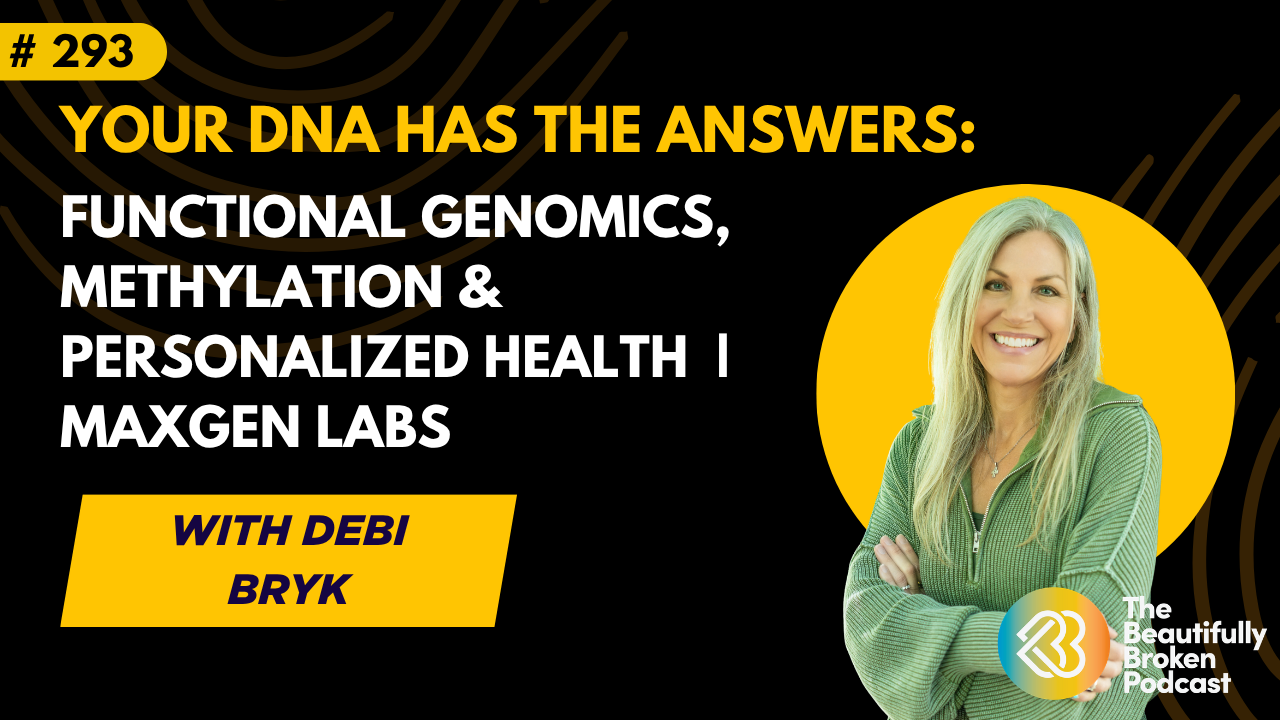
WELCOME TO EPISODE 293
Debi Bryk has spent over eight years using functional genomics in clinical practice — and what she found changed everything about how she works with clients. In this conversation, Debi walks through the MaxGen Labs WORX panel, breaks down methylation in plain English, explains why MTHFR is only one piece of a much larger puzzle, and reveals why jumping straight to methylated B vitamins without knowing your COMT status can leave you feeling dramatically worse. She also unpacks how genetic variants in toxic response to plastics, pesticides, and seed oils can explain why some people develop chronic illness in environments that don't seem to affect others — and what you can actually do about it.
Debi also explores the emerging role of lithium orotate in ADHD and Alzheimer's prevention, why low choline may be driving the mood and cognitive crisis more people experience every day, and shares her clinical framework for sequencing testing that dramatically accelerated healing and reduced costs for her clients by eliminating the guesswork entirely. Use code BEAUTIFULLYBROKEN for a discount on MaxGen Labs testing at MaxGen Labs.


Episode Highlights
[00:00] Understanding Genetic Variants and Their Impact
[09:40] The Power of Genetic Testing
[19:21] Methylation and Its Role in Health
[29:04] Epigenetics: Environment and Gene Expression
[32:17] Understanding B12 Levels and Genetic Implications
[33:31] Genetic Risks: Alzheimer's and Toxins
[36:33] Precision Medicine and Personal Health
[38:21] Neurotransmitter Dynamics and Mental Health
[38:52] The Role of MAO and COMT in Neurotransmitter Regulation
[43:33] The Impact of Supplements on Mental Health
[47:07] Nutritional Insights: Choline and Creatine
[48:32] The Importance of Comprehensive Testing
[50:09] Future of Peptide Research and Safety Concerns
[54:17] Closing Thoughts on Health and Wellness
Upgrade Your Health
MaxGen Labs: https://maxgenlabs.com/BEAUTIFULLYBROKEN
Code: BEAUTIFULLYBROKEN
LightPathLED: https://lightpathled.pxf.io/c/3438432/2059835/25794
Code: beautifullybroken
Silver Biotics Wound Healing Gel: https://bit.ly/3JnxyDD
30% off with Code: BEAUTIFULLYBROKEN
StemRegen: https://www.stemregen.co/products/stemregen?_ef_transaction_id=&oid=1&affid=52
Code: beautifullybroken
CONNECT WITH FREDDIE
Work with Me: https://www.beautifullybroken.world/biological-blueprint
Website and Store: (http://www.beautifullybroken.world)
Instagram: (https://www.instagram.com/freddie.kimmel
YouTube: https://www.youtube.com/@beautifullybrokenworld
FULL EPISODE INTERVIEW
EPISODE TRANSCRIPT
Debi Bryk (00:00.62)
Glyning. Yeah. So it's it's four amino acids. So when that amino acid changes from one to another, sometimes it doesn't have an effect. It depends on where, you know, if it's in the untranslated region of the gene, whether it's in the intron or the exon or the protein coating section. This is all the stuff that I learned is like where that gene SNP or that variant shows up in the DNA helix.
could alter that expression. But the good news is that even though genetics can increase our risk anywhere from like 25% to 33%, sometimes even less than that, sometimes only 5%, it's diet lifestyle and environment, two-thirds or more is diet lifestyle environment. So that's the good news is that we can improve or change the expression of our genes.
Based on our diet lifestyle environment. That's what makes the genetic testing so powerful is that, you know, I've had people come to me and say, you know, and I'd say, well, you know, I'd like to do the genetic testing. Well, I don't want to know. You know, I've seen family members die of Alzheimer's, and I don't want to know if that's gonna be my demise, right? And I explained to them that we're not destined to our genetics.
Freddie Kimmel (01:24.696)
Welcome to the Beautifully Broken Podcast, where healing meets high performance. From cancer recovery to wellness technology, we bring you real stories and real innovators to help you reclaim your biology and build your personal blueprint for health. Let's go.
Freddie Kimmel (01:47.352)
Friends, you wouldn't drive across the country without a map. So why are you navigating your health without one? Most people are spending thousands of dollars guessing. They're trying this supplement, this diet, this protocol with no real roadmap. MaxGen Labs gives you the map. Their works panel is a simple mouse swab that analyzes over 200 of the most clinically researched genetic variants in the body. It's processed in a CLIA lab.
That's certified. They own the machinery, meaning your DNA never leaves the facility and it's never sold. Here's what that looks like in real life. My report showed me I carry the APOE, E3, and E4 variants. That is a genetic predisposition linked to Alzheimer's risk. And immediately gives me a specific diet, supplements, and lifestyle protocols to address it. It also showed me I have a very slow comp activity.
C O T, meaning that my body holds on to dopamine and catecholamines longer than most. Which means methylated B vitamins, which all the podcast influencers tell me I should be taking, will work great for somebody else. But in me, they trigger anxiety, insomnia, and agitation. Yes, that happened to me. So I'm not guessing. And that's what your blueprint can tell you. It's one test, and you can use code beautifully broken at maxgenlabs.com for a discount on the works panel.
Check it out. It's an invaluable tool. Let's go.
All right, ladies and gentlemen, welcome back to the Beautifully Broken podcast. We're here with Doctor Debbie. How you doing, Debbie?
Debi Bryk (03:28.16)
I'm doing well, thank you. Although I'm not a doctor.
Freddie Kimmel (03:31.886)
Well, I call you Dr. Debbie because you're like my pro of genetics. And I I'm often referring like these questions through email to you. Now you work with MaxGen Labs. How would you describe the company or like value propositions? Because I have my explainer. I'm like, well, they run a really great dynamic report, but they're also really focused on security, on patient data. And that was really important to me. What would you say? What do you love about the company?
Debi Bryk (03:58.996)
my gosh, so much. So before joining them full time, I used their test in my practice for over eight years. And, you know, I'm certified in functional genomics. And I had looked at other companies many times. And I always stuck with MaxGen because number one, I found them to be the most comprehensive. Such a reputable company, and they own the equipment in a CLIA certified lab.
So the DNA never leaves the facility, is destroyed after processing once they have a good run on the test. So you don't have to worry about it going to a third party or being sold. And that's really important to a lot of people. And I do practitioner consults with them. In fact, everyone in the system is by a number. So if a practitioner gives me their patient's name, I can't even look it up. I'm like, I need that number. Otherwise, I can't even pull them up.
So security is like the number one and obviously accuracy. You know, they have geneticists on staff and I'm certified. So we're always deep diving, always staying on the current research. And so just the quality control is just incredible.
Freddie Kimmel (05:16.0)
Yeah, amazing. It's really interesting not to go into like a an episode of Black Mirror, but if if a company did have your data, think about the marketing profile they could create about what you will need possibly in the next 10, 15, 20 years as far as like health and healthcare. It's you could really be targeted.
Debi Bryk (05:37.683)
yeah. I mean it's your blueprint. It's your genet it's your, you know, more than a fingerprint. You know what I mean?
Freddie Kimmel (05:43.852)
Yeah, wild. Wild. I want to ask. So I've run a couple of reports throughout my journey and we got to sit down and we got to, you know, we got to go over some of the key findings and the data. I had some things that were really I've never heard before. And the one thing I just want to kick off with is like maybe we could do this. How many SNPs are we looking at in a max gen? Now I got a report called the works.
And what is describe for me like what the works is. So people that have never run a genetic report, what they could be looking at and what they're gonna get from this packet of information.
Debi Bryk (06:21.526)
Yeah, so the works is essentially three tests in one. It's the function test, which looks at more disease risk, histamine intolerance, hormones, toxins, oxidative stress, the whole methylation pathway, and even more. And then it also includes the food panel, which looks at potential food sensitivities, insulin resistance, a risk, diabetes, how your body responds to.
Fats, carbohydrates, it'll actually show the best dietary path based on the person's DNA. And then it also includes the fitness panel, which looks at how the body responds to exercise as far as injury risk, blood pressure, weight loss, and blood sugar. Yeah. So that's the most comprehensive. And it's it includes around 200 SNP.
Freddie Kimmel (07:18.734)
Around two hundred SNPs. And how many SNPs are people looking at on do you know I know there's a million companies out there right now, right? There's probably like five big ones in the space that are I'm probably on an email list for everybody and they're like, you know, everybody's advertising or marketing a different value proposition. They're like, we do this many, we do this many. How many are people looking at and why do you guys look at these two hundred?
Debi Bryk (07:43.894)
No, that's a great question. There's a whole spectrum. You've got the ones that give you like a handful, like 10 genes, and charge like $600. And it's not comp it's not enough. I mean, just 10 genes in the methylation. I mean, we have 21 that are just looking at folate and B12, but you also have to for like for methylation, but you also need to take into account the COMP T gene, the PEMT, which has to do with phosphatidylcholine. Glutathione is responsible for.
Methylation. There's just so many. And then you've got the ones that say, we test for 2000 or, you know, SNPs. The problem with those is most of those SNPs have either no biological effect on the body or they're not evidence and research based. So the gene SNPs that Max Gen has on their test, they're all evidence and research based to show clinical significance.
So I kind of find I found that those other tests that have like thousands of genes is just like a lot of noise and it causes people to get very overwhelmed, where the max gen test really focuses on the most important areas that really has been shown to improve health just following the test. The other nice thing about it is a lot of tests will just give you the raw data. So now you have to run it through another program to decipher it.
Where the max gen test, it's laid out the foundational section, then the core, and then the advanced. And so when people work through the test with descriptions of, you know, this is your potential genetic risk, this is the symptoms, here's the dietary recommendations, here's the supplement recommendations that can support you. So you follow along the test like that, and people just improve. And that's what's so great because if you just pull a methylation.
Like somebody that says, we have these 10 genes, here's your methylation, or they just know MTHFR. That's not giving you the whole picture. And what they'll do is they'll jump to methylated Bs, or, you know, take this mega dose of B complex and then they feel horrible. Well, if you don't address the foundation, which is your diet, lifestyle, toxins, oxidative stress, those things in gut health, prior to
Debi Bryk (10:04.172)
Going into methylation, it can backfire and sometimes can make you it either won't do anything or it'll make you feel worse.
Freddie Kimmel (10:12.15)
Yeah. Let's break down for the audience just the term methylation because I know that that's something we hear on podcasts often. Yeah. And it's probably the one tr when people walk up to me at an event and they're like they're like, my god, lymphatic drainage, you're here with flopresso, they're like, I need this. I've got the MTHFR. They say everybody says I've got it. Right. So and it and so that understanding of the education of what methylation means in the body. Can you break that down for us a little bit?
Debi Bryk (10:41.482)
Yeah, no, that's great that you said that because that's that's true. So methylation is the process of it helps our body with DNA synthesis and repair, neurotransmitter production. So our mood, our serotonin and dopamine, norepinephrine, epinephrine production, detoxification from toxins, and also from homocysteine. It converts homocysteine to methionine. So methylation is super important because if we're not methylating, that can essentially
Turn on gene expression or turn on and off other genes that we don't want turned on. So when we improve methylation, that can improve detoxification, it can improve mood and can essentially improve the expression of other genes so that they're not giving us symptoms.
Freddie Kimmel (11:33.804)
Yeah. So if I'm looking at this body that starts out for the most part, for most kids, we we start out pretty healthy. And then as we age and we are exposed to life, I guess we we more or less rust, right? We oxidize, we we manage that oxidation potential. We're kind of like a a browning apple, you know, that that goes over time. We get age spots and we our posture changes stuff. The my understanding is the better that that.
Blueprint that is Freddy can express the way the blueprint was initially built. Like the longer I'll be healthy. But the more that my pathways, my methylation pathways are compromised through lifestyle choices, eating the wrong foods, let's say lead in my water, that my methylation is going to be, it's going to have more of a burden.
So other genes will be switched on, trying to keep up with that process of aging. Is that am I saying that correct?
Debi Bryk (12:35.542)
Yeah, that's a great analogy. That's exactly how it happens. And then, you know, some people are more genetically prone to a toxic response to a lot of these chemicals and toxins, the insecticides, the pesticides, the plastics, the phytates and parabens. And so for those people, I mean, those aren't good for any of us. It's going to cause hormone disruption. They're going to increase oxidative stress, you know, like you said.
But for the people that are even more sensitive to those, that's going to cause a higher toxic load in their body and definitely hinder methylation, increase inflammation, increase the risk for even all the way up to like cancers and hormone disrupting chemicals, you know, the hormonal issues. So knowing this, obviously we all know we should try to avoid them, but when you have people that
They're trying to get better and they can't. And then you're realizing that they're slathering their body with bath and body works and, you know, chemicals and toxins. You have to think of your skin as one big giant mouth. You know, it's it's our largest organ, and anything we put on it is absorbed into the bloodstream within 22 seconds. So don't put anything on your skin you wouldn't eat, not in a taste sense, but in a chemical sense. And a lot of people don't think of that. And then the plastics in our
Environment are there's just way too many. And some people have a higher toxic response to those plastics and those BPAs, and they have a harder time detoxing from it. So when you know this, then we know, okay, we can try to avoid it, but obviously our environment is so toxic we can't avoid it 100%. So when you see this on the test, then you know that it will it'll show you things like.
And acetylcysteine, which is a precursor to glutathione, because glutathione will help the body to detox from those chemicals. And glutathione is our body's most potent antioxidant. And we make glutathione from antioxidant-rich foods. As we get older, our body doesn't make it as well. Same thing with superoxide dismutase is another antioxidant our body makes from antioxidant-rich foods. But things like NAC,
Debi Bryk (14:56.248)
Glutathion you could take glutathione like liposomal, vitamin C is awesome for helping with that. Selenium is a precursor to glutathione. We need our omega threes. There's so many things that some people have a more of a toxic response to the omega sixes, which would be the seed oils like vegetable oil, cotton seed oil, canola oil. I mean, you can't avoid those, especially if you eat out. I mean
Freddie Kimmel (15:20.806)
That's kind of yeah, that's kind of the natural wave. Now, and and I do I am coursing us here, and I will course us back to some of the nuance of of my report, which I do want to talk about. So now we're we're subject to, and I always try to tell people this, I love that you guys listen to the podcast, but remember like all these conversations are just a jumping off point for you to really like do self-application and go get a report and find an expert and get a guide.
Don't take the internet for your health information ever, because it's literally it's a castle built on sand a lot of times. And so right now we're in the marketing funnel. Right now, seed oils are big. They're a big trigger word and they're high on SEO. So a lot of people are using this as like I find not that it's not good or bad, but it is a trend. And right now it's like it's a way for people to get for you you to stop your car.
And to look at like the burning fire on the side of the road. It's like a gawkers gap. So tell me, is seed oil is from your understanding in genetics, is that a real concern for people, or is it a lot of like noise in the in the internet?
Debi Bryk (16:30.582)
No, it's definitely a real concern because when people have variants here, it increases their need for EPA and DHA, the omega-3s. And we need that balance of omega-3 to omega-6. And so if they're consuming a lot of these seed oils and they have a higher toxic response to them, it's going to increase inflammation in their body and it's going to increase their need for omega-3s. And so this is where it can be a problem. So now people that don't have variants there, maybe it's not.
quite as big of an issue, but you have to keep in mind that these vegetable oils go through a high heat and chemical process to extract the oil. When they do that, they already oxidized the oil. It's already damaged fat. So now when we consume them, then they cause oxidation like that rusting you were talking about in our body, which increases inflammation and disease. And so how do you know if an oil is like safer? Well, if it can be
cold press extracted, like olive oil, coconut oil, avocado oil. So look and see how is this oil processed? If it's not cold pressed, then it's usually extracted by high heat and chemicals, which damages us. And that's the big thing that I think people need to understand.
Freddie Kimmel (17:49.014)
Yeah. Thank you for making making sense of that. When we last spoke, you had just finished a course at Harvard. What were you doing?
Debi Bryk (17:57.966)
So that one dove really deep into the like genetics as far as the biological effect of the like the genes and testing as well as how genes are expressed and how overpopulations, how gene expression can turn on in populations based on the environment. Because genetics, this is the other thing that was very interesting to me is.
So like a SNP is a change in the amino acid sequence of a gene. So, you know, every gene has between like just a couple or thousands of SNPs can be in one gene.
Freddie Kimmel (18:40.385)
And a snip is a single
Debi Bryk (18:42.454)
Single nucleotide polymorph. Yeah. So basically it's a so genes are chains of amino acids. And so when there's an amino acid change, so it that's why when you look at the test and you'll see, you know, C or G or T or A, those are the amino acids, alanine.
Freddie Kimmel (18:44.43)
More.
Freddie Kimmel (19:03.744)
It's fine. You're not being graded on this test.
Debi Bryk (19:05.878)
Yeah. So it's it's four amino acids. So when that amino acid changes from one to another, sometimes it doesn't have an effect. It depends on where, you know, if it's in the untranslated region of the gene, whether it's in the intron or the exon or the protein coating section. This is all the stuff that I learned is like where that gene SNP or that variant shows up in the DNA helix could alter.
That expression. But the good news is that even though genetics can increase our risk anywhere from like 25% to 33%, sometimes even less than that, sometimes only 5%, it's diet lifestyle and environment, two-thirds or more is diet lifestyle and environment. So that's the good news, is that we can improve or change the expression of our genes.
Based on our diet lifestyle environment. That's what makes the genetic testing so powerful is that, you know, I've had people come to me and say, you know, and I'd say, well, you know, I'd like to do the genetic testing. Well, I don't want to know. You know, I've seen family members die of Alzheimer's, and I don't want to know if that's gonna be my demise, right? And I explained to them that we're not destined to our genetics.
If you know that you have a genetic predisposition, say two Alzheimer's, then we know what we can do to essentially prevent that from happening. And that's the goal is to improve, reverse, or prevent any disorder or disease. There's only one gene on the test that we cannot change the expression of. All the other ones, we can definitely improve function through diet lifestyle environment, methylation, all that.
Freddie Kimmel (20:57.612)
Yeah. So every I want everybody to just sit back in your your car, wherever you're listening, you're at the gym, and just just feel into that two-thirds. Right. We have a lot of opportunity here and there are a lot of levers to pull. Yeah. It makes such a strong case for things like, you know, I'm gonna plug my own course, the biological blueprint. It's like we have sixteen levers from light to environment to hydration to the language we use. Right. That can
Program genes. I mean, there's so much here for opportunity, but we often feel that it's like this, you know, we're tied to the tracks and the train is coming towards us, which yeah, I had some not great genes that I was like, you know, you don't, you're like, that one's associated with losing my mind. That sounds awful. I know that you said we have these, they're just chains of amino acids, right? And that's in the news right now, too. We have a lot of talk around.
small chain amino acids called peptides. Yeah. That are these small signaling molecules that can impact how the body expresses itself. So sometimes it's these little molecules that make the big difference. Yeah. Yeah. I want people to understand how much opportunity we have here. And so the expression, I will say I think my phrase of the year is probably environment informs biology. Which is which is pretty wild, right? You know, you can look at some of the epigenetic studies and
Debi Bryk (22:13.292)
Yeah, I like that.
Freddie Kimmel (22:20.588)
I always say, you know, again, environment and forbs biology. So my life choices are going to inform gene expression. How would you define epigenetics?
Debi Bryk (22:30.166)
Yeah, that's exactly right what you just said. Epigenetics is, you know, the impact of our environment on our gene expression. And it was interesting in that Harvard course how they showed like different populations of people. And it's really interesting how, just like for the lactose intolerance one, for areas that people need dairy to survive.
they can digest lactose into adulthood, like throughout their life, they have no problem. They can digest it.
Freddie Kimmel (23:06.478)
What do you mean that they need dairy to survive? Can you say more about that?
Debi Bryk (23:09.986)
Well, in the area where they live, in the country where they live, their food source for nutrition is most yeah. But you take that person and you move them into an area where you don't need it, where there's food is more abundant, they have other areas of food, they eventually like that gene expression can actually change. It's just kind of wild how we will adapt to our environment.
That's another thing that I learned in that course, which was pretty wild. But it's just interesting how with the environment and the toxins and things, how it can, like we were saying, change gene expression and where maybe our ancestors had no issues, but now we do because of our environment.
Freddie Kimmel (24:02.185)
I think one of the greatest expressions of epigenetic influence is the freshman fifteen.
Debi Bryk (24:07.576)
Yeah.
Freddie Kimmel (24:09.024)
You leave the home environment and you're left to your own devices and your own drinking habits and food habits and sleeping habits. And all of a sudden there's like pretty across the board, everybody's, you know, gaining a little weight for the first time in their life, right? That's pretty wild. You could have more extreme examples like look at the vegetation and the fish surrounding Chernobyl. Yeah. Right? We've got all these wild things happening in the soil and the environment and these mutations and these animals and plants.
the board because there was an influence from above. There's a ton of examples for it. I like the, you know, the example I like, which is is very true. It's like this idea of a fishbowl. You know, if I change the environment around a fish tank, which is a closed environment, if I take away sunlight, sunlight, and and bubbling oxygen into the tank and I leave it alone, there'll be mold in that tank and viruses. But nobody came in and injected or coughed into that tank. They were in there in the environment in a check.
But they were kept in a responsible ratio because sunlight and oxygen, then we changed the information coming into the environment. And so now there's disease.
Debi Bryk (25:19.534)
That's a great analogy, is basically that's exactly how that works. And that's exactly how I learned it. When you put somebody in an environment that's toxic like that, then it changes everything biologically.
Freddie Kimmel (25:33.356)
Yeah. Let's go a little bit to the report and let's just go through some of the things that you you're like, okay, these are really interesting around Freddie's genetic report.
Debi Bryk (25:36.59)
Okay.
Debi Bryk (25:47.456)
Okay. Well, the first thing that I always like to look at is that gene I was saying you cannot change the expression of because that plays a huge role in like your gut health. And that would be the F U T two gene. That one
Freddie Kimmel (26:00.846)
That's what I had pulled up first as well. That was my most interesting. The foot two.
Debi Bryk (26:05.27)
The foot too. And so people are either born a secretor or they're born a non-secreter. And I'm also a non-secretor like you, you're a non-secretor. So what this gene does is it produces this beneficial prebiotic sugar called flucose and it expresses into the mucosal linings of the body. Gut, saliva, sweat, semen, tears.
Freddie Kimmel (26:27.086)
We have music mucus everywhere. We're not just talking about our nose, everywhere, between every organ and all tissue. Right. This is this will be another one that you take away that I've I still think that when people say mucus, that I'm like, my nose is congested. But when we get a cold, we make mucus and this thickness everywhere, by the way. Right. Fascinating fact that I never really understood until like in the genetic world, they know this, and then like in Chinese medicine.
Right. My acupuncturist was like, Yeah, you're very thick mucusy. Anyways.
Debi Bryk (27:01.708)
Yeah. No, it's it's crazy. And the the mucosal lining in the gut is extremely important because if that's broken down, then we have leaky gut, increased intestinal permeability.
Freddie Kimmel (27:12.92)
That's right. Team, I was deplatformed from YouTube. Ten years of work, videos, content, everything I believe about health, longevity, and community is gone forever. Why? Because I talked about silverbiotics, their toothpaste, their wound gel, and their recovery cream. That's why I was targeted. But here's the truth. This isn't influencer hype, it's science.
Silver Biotics uses a proprietary nanoparticle called AG404 or Silversol. These ultra-small particles, just 5 to 15 nanometers, carry a unique silver oxide coating, giving them multiple modes of action against harmful microbes. In lab studies, nano silver has shown antimicrobial and antibiofilm effects, for example, inhibiting Candida biofilm formation.
Reviews highlight how particle size and surface chemistry determine its effectiveness against microbes while remaining safe for human tissue. And here's the kicker. Silverbiotics Armor Gel is FDA cleared as a medical device for wound management. That puts it in a rare class of company. It's a natural technology with regulatory recognition. I know I'm frustrated and I could have walked away.
I could have said, you know what, it's not worth the risk. And that's not me. Silverbiotics remains our top sponsor because I believe in what they're doing and the people behind it. It's a brand for families, for moms, for anybody who believes in the body's natural ability to heal, from immune support to skin repair to pet care. They built something for everybody. So I'm not quitting on this one. And you can use code beautifully broken at checkout. Try Silverbiotics today. Let's go.
Debi Bryk (29:10.178)
So, this beneficial sugar, what it does is it feeds good bacteria like bifidobacteria, the healthy bacterioids, as well as the bacteria that produce key amino acids like lysine, tryptophan, and tyrosine. So non-secretors are missing this beneficial prebiotic sugar. So it increases their risk for IBS, IBD, which is inflammatory bowel disease, celiac disease, UTIs, SIBO.
Candida overgrowth and other gut infections. But it also makes you immune to the norovirus and the rotavirus because that it's these ABO blood antigen groups that it's the sugar. Those viruses need that sugar to latch onto the gut. So secretors are prone to the neurovirus and the rotavirus. Non secretors are not. But that's the only, the only benefit to it because they because we it feeds those.
beneficial bacteria, we can suffer from dysbiosis or imbalance in the gut flora. And that's why we're more increased risk for those disorders. It's really interesting. And so since the bifidobacteria is the main bacteria that breaks down carbohydrates, non-secretors can have a hard time breaking down carbs. And that's why they get a lot of gas and bloating if they're eating a lot of grains and vegetables and things like that. They have a hard time breaking it down. And they're also more at risk for
Canker sores and cold sores because of potential lysine deficiency, anxiety and depression, and chronic fatigue because the tryptophan, tyrosine, you know, these our amino acids help us to create neurotransmitters. And so does our B vitamins. And yeah, that's important for people to know too, is that our neurotransmitters are created in the gut to be used by the brain. So when we have anxiety, depression, things like that, it's not really a brain issue, it's a gut issue.
Freddie Kimmel (31:05.654)
Really, as we're talking this, I really want my parents to run this. I'm really interested to see how I am an amalgamation of both their patterns. Yeah. And my brother and sister, I would love them to do this just because it's phenomen. What a fun little family getaway weekend where the whole family runs to report and be like, I got that from you.
Debi Bryk (31:27.308)
Yeah. And what's what's interesting about that gene too is it's a recessive gene. So what that means is the person would need two variants or homozygous to be a non-secretor. So if they just have one variant from mom or dad, they're still a secretor. And then wild type, which means most common form in a population, not always ideal, but most part it usually means normal function. They're also a secretor. So the interesting thing is my sister did run the test.
I'm a non-secretor. My sister's a secretor. So what that tells me is my mom has one and my dad had one variant. And I was the lucky one that picked up two. I got the couple. I and then I married a non-secretor. And so all four of my kids are non-secretors because they didn't stand a chance.
Freddie Kimmel (32:05.443)
Got the cup.
Freddie Kimmel (32:13.954)
Got it, got it, got it. That's so wow. What natural selection is is actually like a thing. So homozygous. So I'm explain word homozygous to me and heterogeneous.
Debi Bryk (32:26.316)
Yeah. Homozygous means you've got two copies, two SNPs, two variants. One from mom and non-secreter. That's why you're a non-secretor. Got it. When you have one variant, it's called heterozygous. So you get one from mom or dad. We don't know which one unless we ran their genetics. And then wild type is still a homozygous because you have two alleles of the same. So anytime there's two of the same allele, which are those.
Freddie Kimmel (32:32.824)
Why I'm the non
Debi Bryk (32:53.91)
amino acid letters that I was saying either A, C, T, or G, that's homozygous, two of the same. Heterozygous would be, you know, like an A and a G.
Freddie Kimmel (33:05.974)
Yep. Yep. You know, the other thing that was interesting about this variant, the foot two status being homozygous, is that I will have really high B twelve levels. Yeah. And it's elevated and and nobody ever has mentioned this to me. Why is this a thing associated with the F U T two SNP?
Debi Bryk (33:24.642)
Yeah, so non secretors can have falsely elevated serum B12 levels up to 23%. And that's because it causes a transcobalamin binding in the gut. So it it holds on to that B12. It elevates the B12 in the gut, in the bloodstream. But it doesn't tell you really what intracellular levels are. This is interesting because people will be like, I don't know why my B12 is so high. I'm not like I'm
supplementing all these B12 supplements. And many times it's because they're a non-secretor. Yeah. And so subtracting about 20% gives you a little bit more accurate level. But having higher levels in a non-secreter in serum is actually usually fine. But if they wanted to know like, do I need more B12? Like what is my intracellular B12? Then testing methylmalonic acid.
Because if methylmalonic acid is elevated, that signifies low intracellular B12. Also testing homocysteine. Because if our homocysteine is high, that can signify low B12 folate andor B6.
Freddie Kimmel (34:31.83)
Yeah. Excellent. Yeah, good information. All right, let's move on. What's another thing that we found was an interesting talking point on Freddie's genetics?
Debi Bryk (34:42.75)
well, we talked a little bit about toxins already. So well, you do have an I believe you had an increased risk for Alzheimer's, right? You had an E4.
Freddie Kimmel (34:52.756)
Yeah, A P O E E three and E four. Right. And then C Y P one A one homozygous. So there was a compounding Alzheimer's and estrogen risk.
Debi Bryk (35:06.72)
Right. So if you were to look at the test, E3, E3 is a normal average risk of Alzheimer's. When there's an E4, it increases the risk of Alzheimer's. When there's an E4, E4, it can greatly increase the risk of Alzheimer's. But you do also want to take into account the additional genes that are listed on the test. Because, like I was saying before, genetics can increase our risk anywhere from like 5% up to 33% or so. It depends on the gene and it depends on.
How many variants we have in a pathway or additional genes that can increase that risk. So Alzheimer's, you know, there's many things that can cause cognitive decline, in addition to having an E4. And that would be a toxic overload that's going to cause inflammation in the in the whole body, including the brain. Also, a diet high in refined carbs and sugar. This is why they'll call Alzheimer's.
Type 3 diabetes. So even if you don't have an E4, that doesn't mean I'm like, I can just eat and, you know, drink and smoke and do whatever I want. You're still increasing your risk, but it's compounded when you have like that CYP gene, which is the cytochrome P450 genes, which there's several of those tested on the test, which what those genes do is they help your body to break down toxins as well as drugs and hormones.
So when there's variance there, that can increase like again the toxic exposure in addition to methylation. So this is why a comprehensive test is so important because if you just have one marker, you essentially don't really know everything that you could possibly do to improve your health.
Freddie Kimmel (36:51.65)
That's right. That's right. The other thing that's really interesting to me. Now I ha I work with a precision medicine for the last, goodness. Yeah, I want to say since like 2021, I've been lucky enough to be in Austin where I've just got I have people that have a very high level or ability to take the genetics with the lab work, with like an environmental toxic and panel and make sense of it all. This is not something I ever had, ever.
Going through Lyme and mold and cancer, we were looking at just we were kind of looking at the fires and trying to put out fires. Understanding how my body processes toxic burden and chemicals and mold. Like when I looked at the report, I was like, of course I had Lyme. Of course I had chronic fatigue syndrome. My environment was right for it, but then I also had I had the network for it internally.
And so it makes sense. And I always say this, I was like, disease, you don't catch a disease. It's built. It's built over time. So the sooner you guys can if it inspires you to like understand the network and the pathways that exist within your body, it will actually help you to alleviate stress, to release tension. Right. Because you have a deeper awareness of how you should be living your life. And it's not I always say it's not definitive. It all these all these things that we're taught, it does not mean
Could I get Alzheimer's? Yes. But it does not mean it is in it's not in the stars. Right. You know, it's not guaranteed. At least the way that's I look at it, Debbie.
Debi Bryk (38:28.938)
Yeah, for sure. And you're a great example of how you overcame a lot of your your health issues. You know, you improved your gene expression. You overcame that with changing your diet and lifestyle and environment. Yep. Yeah, for sure. Yeah. You know, and those CYP genes too can increase your severity to viral infections like Lyme, Epstein Barr, COVID.
It can, you know, some people have variants. That that's why you have some people that get COVID and they get over it pretty good and they're fine. And then you have the ones that are long haul COVID sufferers. And a lot of it it it goes down to the g genetics.
Freddie Kimmel (39:12.854)
That's right. That's right. And there's then we can go back and we can also say, okay, how can I support my body, my body from a micronutrient level? Right. And detox pathways and liver support. So each time, you know, I don't think we'll run around I don't think you can run around, look, you can do whatever you want, but I think it's really hard to live in a world where we're dodging bullets. I think it makes a lot of sense to be a little more bulletproof to be able to take a couple hits.
I think your life will be more expansive and I think you'll have more fun. This is just my take on it. I wanted to talk about this MAO and this idea that like I have very fast activity or low serotonin running against a very slow comped, like high dopamine pathway. Can we explain this one a little bit? I thought this was fascinating. Yeah. As far as like how my body deals with serotonin and neurotransmitters. Right. Because this is a big conversation right now. It's like a lot of people are struggling with depression.
Debi Bryk (40:09.293)
Yes.
Freddie Kimmel (40:10.102)
And we're burning the engines really hot. And we can think we can utilize, we can burn through our neurotransmitters based on our genetic blueprint, hence why people trend towards depression or like a positive buoyancy.
Debi Bryk (40:26.092)
Yeah. So these are huge, especially like the COMP T. Well, both of them are huge. So the Comp T, yours is slow. So what that means, so when somebody has a slow comp T or and or a slow MAO, then which Comp T is responsible mostly for dopamine, norepinephrine, epinephrine. MAOA.
Freddie Kimmel (40:46.88)
All our all our feeling chemicals, right? All the things that we elevate in a in a hot sun or an ice plunge.
Debi Bryk (40:52.47)
Right. And then MAO is responsible mainly for serotonin, but also does play a role in dopamine and norepinephrine. And then MAOB has to break down PEA. And so when somebody is slow, that means they don't utilize their neurotransmitters efficiently. And they can have a buildup of neurotransmitters in the brain. And so when that happens, you can have symptoms if it's expressing, like ADHD, anxiety, depression, sleep issues, gut issues. It's
Even if it's a slow MAOA, you like even anger, especially in males, because for for an yours is fast, but for a slow MAOA in males can be worse because testosterone can slow the enzyme even more. So when you have a slow COM T, it can actually make you sensitive to the methylated Bs. And this is another reason why it's so important to know this, because if you know you have MTHFR or methylation issues and you don't know.
What your comp T status is, and you jump right to methylated bees. After about a week or two, all of a sudden you have increased anxiety, agitation, you can't sleep, and you're like, what is going on? Why do I feel worse? This should be making me feel better. But it overstimulates that pathway. And they don't do well with methylated bees, at least in high amounts. Some people can tolerate very low amounts of methylated bees, some people cannot. And then we would choose other
Options instead, like maybe folinic acid would work better for them. So, and when we have variants, I just want to point out in the methylation pathway, like MTHFR, SLC19A1, which has to do with getting folate from the bloodstream into the cell. And they can have trouble getting that folate into the cell. FolH1, which they have trouble absorbing folate from the gut and getting it into the bloodstream, FOL R1.
Has to do with cerebral folate or brain levels of folate in the brain. All of these play a huge role. When you have variants, and and DHFR is another big one. We can't convert synthetic folic acid, which is an all-fortified wheat products, into a usable form of folate or methylfolate. So what happens is this synthetic folic acid and all these breads and pastas and cereals that people are eating.
Debi Bryk (43:16.16)
Is building up in the blood. It's going to block folate receptors. It causes like folate trapping. And now when they do eat their leafy greens and their folate-rich foods, that folate can't get into the cell. It can't be absorbed. So now they can't methylate. And it can mask a B12 deficiency as well. All of our nutrients work synergistically with each other. So if that can even happen if you megadose folate, methylfolate, and you don't have sufficient B12.
You can mask a B12 deficiency. You can essentially deplete your B12. So it's really important to have a balance so that buildup of neurotransmitters, how do we, how do we fix that? Well, high-intensity exercise can help burn up those neurotransmitters. And then there's certain, you know, supplements and things that people can take, which are on the test that can help calm those people down.
fast MAO, so now when you're fast, whether it's a fast COMP T or fast MAO, if that gene's expressing, that means you can have a deficiency in neurotransmitters. So potential deficiency in serotonin. And so the interesting thing too is that tryptophan can increase serotonin. So if you have trouble sleeping, winding down that, you know, because of low serotonin, the amino acid tryptophan can help.
produce serotonin and help with sleep and things like that. You have to, I just want to note though, though, like don't do amino acids if you're on any type of antidepressants or anti-anxiety, because a lot of the amino acids can improve neurotransmitters naturally and they can cause serotonin syndrome and things if if you're already on those. So I just wanted to point that out.
Freddie Kimmel (45:01.174)
Yeah, it's a that's a rough one to I've talked with some people trying to navigate that. It's so funny. Since we in in conjunction with us doing this test, my friend Skyler had launched a company, Neurobalance Therapeutics. Wait, let me see that I'm getting it right. wow. It's integrative neurotherapeutics.com. And he had given me a sample of the supplement, and like within two days, I was like, I didn't have a lift. Like I was just like, I feel really positive. And
After going through my poor report, so it's basically here was the supplement stack. It is lithium oretate, it's B6, is pridoxyl five phosphate, it's adenosine cobalamin, it's five HDP, it's L-tyrosine, and it's taurine. And no fillers, no like yucky fillers, very, very clean. And I was like, it's just a very noticeable difference when I take this supplement.
Yeah. And I don't need to take it every day, but like I'd say like four days a week, five days a week, especially when I'm working, I'll remember to do this in the morning. Hundred percent. There's just a different I have a different mood.
Debi Bryk (46:10.35)
I'm glad you mentioned lithium orotate because that's something that has been more researched more extensively recently. And it's lithium. If people think of lithium, they hear lithium, they're like, no, it's not lithium carbonate, like the prescription. Lithium is actually a mineral that should be in, you know, soil and water and things like that. But most areas are deficient in it. Just like we can't get magnesium really in our soil anymore because it's so deficient. So that's why most people
Feel better taking magnesium because pretty much we're all deficient in magnesium. And no matter how much magnesium-rich food we potentially are eating, it's we're not getting enough. But lithium oritate in studies has been shown to improve cognitive function in ADHD, autism, and Alzheimer's. Yeah. And it, yeah.
Freddie Kimmel (46:58.858)
I'm so ADHD. I have a I have a problem.
Debi Bryk (47:03.86)
Exactly. It's it's very prevalent, obviously, in our for many, many reasons. But so lithium oretate definitely can help. And it also can help push B12 and folate into the brain. So for those people that are sensitive to the methylated Bs or can't take higher doses, lithium orotate can really be helpful in that methylation. Same thing with phosphatidylcholine. So the test looks at PEMT, which is the main phosphatidylcholine.
Gene SNPs is PEMT, but there's also two other genes that are in the folate. They're part of methylation. the MTHFD1 and the BHMT, not only do those two increase the need for folate, but they also increase the need for choline. And so choline or phosphatylcholine or choline is part of the methylation pathway.
And low levels of choline are linked to the incidence and severity of ADHD, autism, and Alzheimer's. So the best food source is egg yolks. And then there's also beef liver is a great source. Chicken, fish have choline. But when there's a lot of variance there, if people have symptoms of mood disorder, it's also low levels of choline because it's a phospholipid, breaks down fats in the liver. So
Low levels of choline are linked to non-alcoholic fatty liver disease and high cholesterol. So I will recommend you probably should supplement this. It's gonna be very beneficial for you. So it's huge. And that also can take stress off of the methylation pathway. creatine, too.
Freddie Kimmel (48:46.094)
I know, yeah. Creatine was indicated a lot for me. Lithium was indicated a lot. It was like awareness around B vitamins. For me, what it did was it actually the report has saved me money because I can see what's truly indicated in my blueprint. And then I can fill everything out with diet. There was like a lot of great information about me just being aware of saturated fats that possibly the carnivore diet is not the optimal diet for me.
that you know, like a Mediterranean slant, which is always I've always felt better on, and I intuitively know. It's you know always. Yeah, it was just, it was very refreshing. And I find these things to be, listen, it's all how your personality is gonna take it. Not so much as a restriction, but a tool of liberation. Like, I have a little more freedom because I don't have to here's the blueprint. Here's the lifestyle choice. Here's the levers I can
Debi Bryk (49:34.466)
Yeah.
Freddie Kimmel (49:42.254)
Pull for better expression of myself. Yeah, it was really helpful for me. And I I've had my buddy Bobby Creighton, who is a another Broadway brother, who actually is based in Buffalo now. wow. I'm gonna have him go over his report. He should have it back really soon. I've had a couple of their people get it. Cause they've asked. They're like, hey, I'm doing function labs and I want to take a closer look at my health and I want to get a DEXA scan. I want to know what my bones are doing. I'm like, well, get the high level lab work, get the genetic blueprint.
Understand what's going on, you know, whether that's at full body MRI or whether it's just something, what's the visceral body, what's your muscle tissue doing? And then we'll have a much better picture to make some very clear recommendations that can work for you. And it's like, you know, simple levers. Simple, simple levers. So for me, it's like I don't know how you do it without at this point, because the the reports are so much better.
I did twenty three and me in like two thousand and six or seven. It was not you know, it didn't really tell me much. Yeah. And now that data's leaked to China, so
Debi Bryk (50:48.2)
Yeah, I know, right? Yeah. But no, that you made a great point. In my practice, in the beginning, I would give people a choice whether they we ran the genetics or not. And then towards the end, like the last few years when I was practicing, it was just part of what I did. And the reason and I it didn't even really have to convince people. When I explained to them the benefits that they would get, it was a no-brainer because I went from working with people for months and months and months on end.
Trying to figure out, let's let's try this diet, let's try that diet, let's try this supplement, let's try that supplement, to having this blueprint where we had a clear path that we could do. And not only took the guesswork out, but like you said, it saved my clients a lot of money because now we're not guessing. They're not buying supplements that aren't going to work for them or might backfire. And it decreased the amount of time we worked together.
It accelerated their healing in a much faster way because now we knew what to do.
Freddie Kimmel (51:52.504)
Now I understand there's very little research on this right now, but have you guys thought about releasing a peptide report?
Debi Bryk (51:59.344)
my gosh. I I I can't so funny you said that because that's actually what I'm doing right now. I'm researching which peptides for which genes. And I've already been experimenting on myself since December. I've taken a course on peptides, you know. James Lavelle's book, Peptide Handbook, is like my peptide Bible. Love it. And so that's definitely something that we're looking to put together because we've been asked to do that and
Yeah, for sure. That is
Freddie Kimmel (52:30.872)
I mean, there's a lot of claims out there and it's the wild, wild west. And I just saw someone today that's like, You guys, all these peptides are gonna cause cancer because it's a synthetic signaling molecule and there's no control in the body and that doesn't align with my understanding, but there's a lot of people both sides doing fear porn around it. Right. And I will say there's very little data, but I'm wondering if there isn't something a little more concrete that we can stand on from a safety at the very least, a safety profile.
To understand, you know, like things like prone to bone loss or you know, all these other things that can come up as a result of just leaning too hard on the peptide.
Debi Bryk (53:09.536)
Yeah, I mean there are some that have been around for a long time that are FDA approved, that are researched, like CMAX and CLANC, those two can help improve brain derived nootropic factor and improve symptoms of ADHD. And so
Freddie Kimmel (53:24.63)
I I I blasted some C Macs before I came up here and I got my when I got my pen.
Debi Bryk (53:28.942)
That's one of my favorites. I love C Max. That's my
Freddie Kimmel (53:32.138)
I like Celank and I like CMAX and I had started to try dihexa, which is in it's in some type of a trial for Alzheimer's right now, creating all these neural connections. And then I've seen it flagged that it can activate some oncologic gene pathways. So it could be associated with a cancer risk.
Debi Bryk (53:51.51)
Mm, that I haven't seen. I know that one is also used for sleep. There is still conflicting information on which ones. I know the growth hormones, like
Freddie Kimmel (54:01.326)
The secretagogs like the Tess Morellin or CJC Ipper Morellin or Semorellin.
Debi Bryk (54:07.424)
Right. Some of the studies say when there's active cancer. So again, you're right. There is some caution and that's where too we have to be very careful, you know, to like recommend anything. So it would have to be well documented and researched. And that's the other thing about I like about the book that I mentioned is that he has the studies in there, at least the studies that we have so far.
And the warnings and the benefits and the dosage and all of that, which can be really helpful. But yeah, I mean that's definitely something that, you know, we need to, you know, make sure that we have the the data on that.
Freddie Kimmel (54:48.95)
Yeah, proceeding with caution. Yeah. It says it says I'm just a quick search here. Dihaxa carries a theoretical cancer risk due to its mechanism of action as a cement activator, which promotes cell growth and repair. Well, no human data confirms this risk. The activation of the cement pathway is linked to tumor progression, making a potential concern. Now I have a friend who's worked in how do I want to say this?
Very high level circles in which they have seen this play out a little bit. And so my warning was from a friend who has worked in the intelligence circles because this was used a long time ago at a very high level and they saw that. And so, and I've seen it, I see it come up now. It's like, you know, you can get it in a lot of places. So I just and I don't know. And I'm not saying I'm not trying to again make a red flag here or create a fire where there isn't one.
But I do think it's it's it's just a good time to pause, get this data. I'm really curious to see what you guys come out with. Everybody, I'll put this in the front of the podcast, but you can use code Beautifully Broken for a discount and you could get your works. I'm definitely gonna lobby. I would love my dad to get this. I would love it. I don't know if he'll go for it. He's retired, so it's all about living on the budget now. He's like, I gotta make my money last.
Debi Bryk (56:01.495)
Right.
Debi Bryk (56:10.168)
I know, I was gonna do it on my mom. My mom's like, I don't wanna know. I'm like, Okay. Yeah.
Freddie Kimmel (56:14.542)
I would just be curious. Yeah, just curious for me. I think my mom would probably do it. I think yeah, I think she'd be fascinated. I'm certainly now when I'm right now, like the things I like to see when people are like, Freddie, what should I look at? I don't feel great. I'd like to tune up. I'm like, well, let's let's do a poop test. 100%. Let's see what your your interface between outside world and inside world is. Let's understand a comprehensive lab, you know.
Comprehensive lab, functional labs, which is not your CBC. It's a little beyond that. I really like an AMPM cortisol test. What's that waking natural curve of cortisol and what happens at night? I really like the genetics. And I think the other one that's interesting, where I I can kind of tell you it will be high in everyone, but I do like, and it's very expensive, is an environmental toxicant panel. And understanding like,
Debi Bryk (56:51.886)
Mm-hmm.
Freddie Kimmel (57:12.47)
It what that tells me is I I'll probably can see somewhere like, are you getting a current exposure that's super high? Did you put green turf in the back of your yard, which is just flooded with microplastics? Or you know, are do you have like what's your glyphosate? What's your current mold activity? Is mold coming from food? Is it environmental? So if you were poisoning yourself, that it's possible you we might be able to tie that into the the home environment, but
For most people, I would say it's gonna be high anyway. And you're gonna you're gonna wanna complement lymphatic drainage and sweating and hydration and mobilization in a safe way of these things outside of the body. But that's a really good comprehensive picture. And I think there's a lot of other things you could do, but that's like my base case right now. I don't know. Do you have thoughts on that? Debbie, other things you'd like to see?
Debi Bryk (58:01.132)
Yeah, so no. So my take on it, and I don't know, I don't feel like I'm biased because of the genetics, because I I mean I've love them, but I also could run the stool testing, organic acid testing goes really well with genetics, hormones, all of that, in the toxins. What I would always do is start with the genetics, and then I would make the changes, the dietary lifestyle supplement if needed changes based on their genetics. And then I'd wait about three months of that.
Many times they're feeling so much better. They're like, I don't want to spend the money on a stool test. That is another way that saved them so much money. If they're still having symptoms or we're still not right where we want to be, then we would go into the deeper testing because now is there mold or is there maybe again, like you said, like maybe toxins that they're still having trouble getting rid of, but now we have their blueprint. How do we detox from these toxins? We have that. So usually
I never usually ended up running those other tests because they were feeling so much better by making the changes recommended by the test. That's what I found in my practice.
Freddie Kimmel (59:07.854)
Yeah, yeah, that's a really good idea. Yeah, and organic acid is great. It's something that I was never trained to understand. And I know that's a test that is ripe for misinterpretation, but I I do know people are a huge fan of that. That's a big one in the FDN world, functional diagnostic nutrition. I love that test. Yeah, I love it. Well, let's close this one down because we're at an hour. We're actually 59 minutes and 39 seconds. We're taking it. Debbie, thank you so much. we didn't even get to mention that you're like,
in Orchard Park in Buffalo. So we're like we're blood brothers essentially. Yeah. Yeah. Hometown represent. When people get a Max Gen test, can they book you for their console?
Debi Bryk (59:42.286)
Yes.
Debi Bryk (59:50.168)
So I only work with practitioners. So when practitioners sign up, but what's great is on the MaxGen website, they have a find a practitioner tab. So you can go on there and all of those practitioners are well-versed and trained in the testing as well as all types of functional medicine. They're amazing.
And that's what I would recommend. I mean, people can get the test on their own as well, obviously, or they can get it through, you know, if they decide to work with a practitioner, or they can get it and then work with a practitioner either way. But if you have a lot of health issues and things, it is good to have the guidance of a practitioner. That being said, the test is laid out to be very user-friendly and easy to understand. It really, if you you they can go on the website and they can look at the each of the tests.
That are offered, like you got the works, which is the three and one. And I s that's the other reason the test is affordable because Max Gen owns the equipment. And that's one reason why Chad went ahead and purchased it all himself, not only for the security of it, but he can keep the price low because he's not paying someone else to process it. It's processed in-house because he wanted to try to make it as affordable as possible to people. There's also
payment options available. But the function test, which is the largest part of the test, tests for a hundred gene SNPs, and you still get the whole methylation pathway, you get the neurotransmitters, you get the hormones, you get the oxidative stress, the histamine, you can see it. And that is only one one ninety nine retail. And then if they use your discount, my God. I know.
Freddie Kimmel (01:01:33.506)
Yeah. That's great. Are there any of the versions that come with a console?
Debi Bryk (01:01:37.642)
Not at this point. Not for not for consumers. No. Practitioners, they're free consults with me.
Freddie Kimmel (01:01:45.25)
That's great. So a practitioner can get a free consult. Great. So we have a lot of practitioners that listen to the show. And so I'm sure there's going to be some level of like integration. The report is clear. I will say I needed your help to really I read it and I understood some things, but I got more out of it going through it with a professional. So I do I'm a huge proponent of having a functional health coach, having an integrator practitioner that understands where this data really applies. Do you guys do any training or education?
Debi Bryk (01:02:15.448)
So yeah, we have there's a lot of education on our YouTube channel. So if you go to MaxGen Labs YouTube channel, a lot of education on there. We do live QAs where, and those are geared to the more to consumers, where it was me and Dr. Chad and even Dr. Don, the three of us, where we answer the most common questions. We've done three or four of those already.
And we plan on doing more also on the website under articles. Great. That's our blog. There's education on there. And if you sign up for their email list, they're always sending out education and we're building on that. That's one thing that even though I work with practitioners, I also do educational handouts and videos and things for MaxGen. So we are building more on that.
Freddie Kimmel (01:03:08.022)
Yeah, amazing. Amazing. Well we'll do an I'd love to do another one, Debbie. Yeah. There's so much to talk about here. And maybe when you get more information on some of the peptide things that you can speak to in a way with like a little bit of clarity, that would be really fun. Just to continue the conversation around how we can use these reports to better navigate our health map. Health health and wellness roadmap.
Debi Bryk (01:03:32.214)
It's on my list of things to do.
Freddie Kimmel (01:03:34.35)
Cool. Cool. All right. Well, go, Bills. Yeah. Thank you for being a guest here and big love. Yes. Same to you.
Debi Bryk (01:03:40.398)
Thank you for having me. Thank you, Freddie.
Freddie Kimmel (01:03:48.174)
Season 9, year 7, nearly 300 episodes built on one belief that healing doesn't need to pick sides. And neither do I. If this show has added value to your life, please take 30 seconds and leave a five-star review on Apple or Spotify. It is the single biggest way to help people who need to find us. And trust me, they're out there looking. And when you're ready to go deeper, head over to beautifullybroken.world. That's my website.
It's not a wellness store. It's everything I personally use to rebuild my body after nine tumors and chemotherapy. This is the technology, the supplements, the self-quantification tools, curated without an agenda, with significant discounts, and completely free from the marketing noise. You're also going to find a direct path to work with me one-on-one and access to the Biological Blueprint Academy, where the real transformational work happens.
No guesswork, no bias, we just give you the full picture. You can also find us on YouTube at Beautifully Broken World for unboxings, product breakdowns, and a face to go with a voice. So, quick note from my vast team of internet lawyers, they are very expensive. Everything here is for education only. Nothing on this podcast is medical advice. Always consult your doctor for your actual medical needs. And as we close.
Your oncologist may have saved your life. What comes next is what we do here. We are in a paradigm shift, and the world needs you at your absolute best. Use these conversations as a jumping off point. Listen to your body, trust the process. Life can be painful. But how do we put the pieces back together? That's the beautiful part. I love you. I'm Freddie Kimmel. I will see you in the next podcast episode. Let's go.