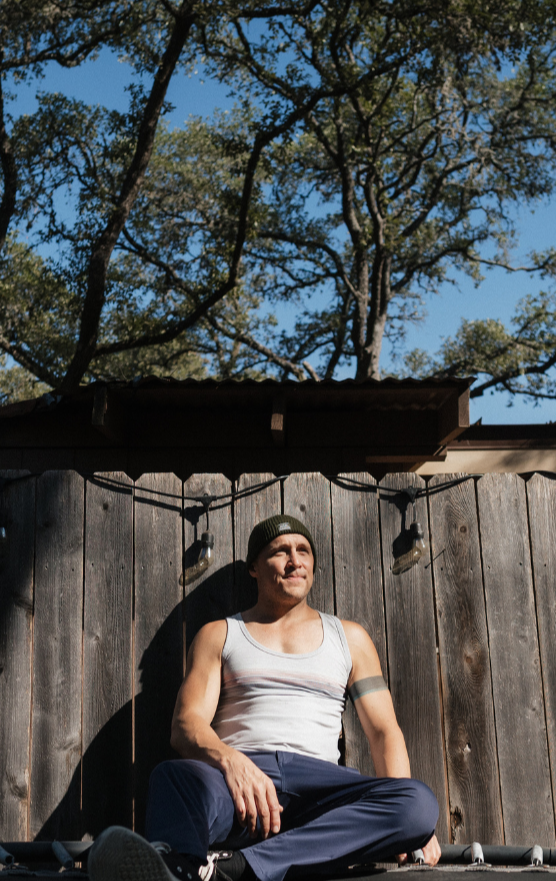
Radical Brilliance with Arjuna Ardagh
Oct 03, 2019
WELCOME TO EPISODE 36
Arjuna Ardagh is a Radical Brilliance Coach, writer and public speaker, and he was the original founder of Awakening Coaching. He has trained more than 2,000 people to become Awakening Coaches over the last 25 years.
Arjuna is the author of nine books, including the 2005 #1 national bestseller The Translucent Revolution, featured in “O” magazine. Arjuna has been a speaker at conferences all over the world, and has appeared on TV, radio and in print media in 12 countries. He has spoken at Google and at the United Nations. He is a member of the Transformational Leadership Council. He lives with his wife, Chameli Ardagh, in Nevada City, California.
In this interview I dive deep with Arjuna on what brings our lives meaning, how we can overcome our blocks that keep us from living a meaningful life, and steps we can take today to get us on our best possible path. This is a long conversation, but you won’t know how much you will benefit from this conversation until the end of the podcast. A must listen.


Episode Highlights
1:51 - Arjuna reflects on the name, beautifully broken
3:57 - The experience of having a national best-selling book
6:17 - What is the catalyst that gives our lives meaning and depth?
12:15 - Seeing the full spectrum of wealth and poverty in 24 hours
16:26 - The false narrative of a soulmate
20:56 - The 4 elements that contribute to a fulfilled life
26:54 - Consciousness without boundaries vs. flow state
27:24 - The Brilliance Cycle in detail
37:01 - Why depression can follow from major accomplishments
42:37 - The most important gifts that we receive
44:17 - The practical purpose of the Brilliance Cycle
47:20 - 4 ways that the cycle gets blocked
51:32 - Why do we need radically brilliant people in the world?
55:16 - How we find the best version of ourselves
58:53 - What blocks Freddie
1:00:23 - The reason why there is no one solution for everyone (or even you)
1:05:47 - Will Radical Brilliance revolutionize the coaching industry?
1:08:18 - Connecting to the Radical Brilliance Community
1:10:57 - One practice you will never regret
1:15:50 - If you have that tug on your heart for more, this is where to look first
1:24:22 - Your call to action
UPGRADE YOUR WELLNESS
Silver Biotics Wound Healing Gel: https://bit.ly/3JnxyDD
Code: BEAUTIFULLYBROKEN
LightPathLED https://lightpathled.com/?afmc=BEAUTIFULLYBROKEN
Code: beautifullybroken
STEMREGEN: https://www.stemregen.co/products/stemregen/?afmc=beautifullybroken
Code: beautifullybroken
Flowpresso 3-in-1 technology: (https://calendly.com/freddiekimmel/flowpresso-one-on-one-discovery)
CONNECT WITH FREDDIE
Work with Me: https://www.beautifullybroken.world/biological-blueprint
Website and Store: (http://www.beautifullybroken.world)
Instagram: (https://www.instagram.com/freddie.kimmel
YouTube: https://www.youtube.com/@beautifullybrokenworld
EPISODE TRANSCRIPT
Freddie Kimmel and Arjuna Ardagh (00:00.264)
Any form of acquisition is based upon the underlying consciousness of not enough any movement of contribution if I move towards you to contribute towards you I am moving from a place of fulfillment you see and so these underlying assumptions they become creative if you move into life to contribute you create as an assumption that I am enough
Welcome to the Beautifully Broken Podcast brought to you by AmpCoil. I'm your host, Freddie Kimmel, and on this show, we discuss the common thread survivors share after walking through the fire, the practitioners making a difference, and the treatment modalities that deliver healing back into the hands of the people who need it most. Witness the inspiration we gain by navigating the human experience with grace, humility, and a healthy dose of mistakes. Because part of being human is being beautifully broken.
Freddie Kimmel and Arjuna Ardagh (01:04.931)
Ladies and gentlemen, welcome to the beautifully broken podcast. I'm here in Nevada city, California, and I have a very special guest that this audience is going to benefit from. And you don't realize how much yet until you get to the end of the podcast. But we're sitting here with Arjuna Arda, and we're gonna talk about radical brilliance, which is a book.
that he's just published. And we're going to get into the nuts and bolts. Arjuna, welcome to the podcast. Thank you. I love the title, Beautifully Broken. That's just, that is just such a, it's just, there's so much to unpack in that title. There is. And you know, can I, can I just reflect on that for a moment? I wish you would. Because something I often love to remind people of, which, which speaks to Beautifully Broken.
is that you could drink the most perfect champagne, the most expensive Mauais Chandon champagne in the world, and you could drink it from a cracked cup. And the cup might be cracked, but it wouldn't affect the quality of the Mauais Chandon of the champagne. And it's often, and this I think will be very germane to what we talk about today, that often, you know, the benefit of like
transformation and healing and all the things we want to do to become better people is that you become a better person or you feel better. The downside is that it can lead to postponing your true gift. It can lead to postponing a life of contribution and making a difference. And the beautiful thing about your phrase, know, beautifully broken is that
there is a way that the best possible champagne of contribution and generosity and art can flow through a broken vessel. That really speaks to our highest potential, doesn't it? Yeah. Yeah. Yeah. Yeah. I love that. So you're here with us today and now we're going to talk about radical brilliance, but you've had some great success in, authoring other
Freddie Kimmel and Arjuna Ardagh (03:26.768)
pieces of literature over the years. That's true, correct? I've written, I think it's 11 books at this point. I've actually lost track, but I think it's 11, yeah. And we were just talking about 2005, and you had a bestseller. Yeah, The Translucent Revolution was for a short time, it sat on the giddy peaks of number one national bestselling book.
You know doesn't doesn't stay very long, but yeah, it was there for a little while And I assume you don't set out to achieve that and maybe you do have a number one Number one on the top of the peaks of the book chart But what did what did that feel like? Surprising because it wasn't in any way and it was it came completely out of the blue It wasn't one of those things of you know getting all my friends to mail on the same day it was I I woke up that day my kids were young it was 2005 so
Uh, my kids were, yeah, they weren't, think my, my youngest was 10. My oldest was maybe 13 and we would, you know, we were getting packed off to pack up to go off to school. And I was in the habit as they ate their breakfast, we had, had a laptop in the kitchen and as they ate their breakfast, I would, I would flip open the laptop to see where I was. And it was like 13,000, then it was 7,000 that it was number 4,000. I it was great. I'm the number 4,000 bestselling book.
And on that morning I flipped the laptop open and I was like number, I don't know, 19,000. What? And I kept refreshing the page. It must be a mistake. And then that morning it crept up 19, 11, seven. And by lunchtime it was the number one national bestselling book. It was just a coincidence that Amazon, my publisher had a deal with Amazon.
that, at that time, Amazon would, a few times a year for, for certain publishers, they would send out this email to their, to their readers saying, if you like this book, you'll probably like this book. And they sent it out, for, you liked Eckhart Tolle's power of now, you'll probably like this. it just by coincidence happened to it. It happened on exactly the same day that somebody else mentioned it.
Freddie Kimmel and Arjuna Ardagh (05:44.007)
And so by chance, we sold like 2000 books in a day and that was enough to be number one. That's amazing. I love it. And then to have the impact of something that you'd put your heart and soul to. I mean, I'm sure this resonates with many people across the transformational network, whether it's health and wellness or body work or transformational tech, but to have something that you've put your heart and soul into.
know that it's getting into all these homes and all these mines and you've got this opportunity. Well, know, Freddie, I think that really opens up a really big question about what is it really, what is the catalyst that gives our lives real meaning and depth, right? Because it's so many people.
lean their ladder up against the wall and spend their life climbing the ladder only to discover too late that the ladder was leaning against the wrong wall. You know, does that make sense? It shakes my core. Yeah. So that's been, that's been a really a kind of a core inquiry for me. And it, it, it revisited in a big way when I had a car accident a few years ago where the car was like, looked like a crumpled up piece of paper.
But mysteriously, for reasons I don't understand, I didn't have any broken bones, which was really, I was knocked out unconscious, but I didn't break any bones, which was- Where was the car accident? It was in Washington state. And actually, because I was knocked out, I really don't know what happened. I mean, I was in the middle lane, you know, on a freeway, I was in the middle lane with cars on the left, cars on the right, we were going at full freeway speed, like 70 or something. And there was a collision.
And when I came to from being knocked out, I was in the middle, you know, where there's that grass between the opposite directions. the car was absolutely crumpled, but I was, I just, I didn't know what's going on. I stepped out of the car and I started walking along this grass and somebody shouted at me like, like, stop, stop, you know, and I didn't understand why they were so, because apparently I had blood all over my face, but I didn't know.
Freddie Kimmel and Arjuna Ardagh (08:03.399)
but I had no broken bones. So after that, I went home and I thought, well, I'm okay. But I actually wasn't okay because whatever happened, the impact was such that it rendered me completely incapable of activity for about three months. It's what they call post-traumatic stress, you know? And I'd always heard about post-traumatic stress. happens to people in wars and things. But I didn't realize how utterly you are rendered incapable.
when you have this condition. For me, it lasted three months. I had to keep the room dark. I had to just lay down in a dark room. And I had a school that I owned at the time. It was a coaching school. And I just had to let other people take care of it.
But during this time, somehow, you if you lay down in the dark, eventually, without any distraction, really, eventually some of life's big questions start haunting you. You know, like I was, I was turning 60. I was going to turn 60 that year. No, I guess I was 58. don't know. was 60 was on the horizon anyway. So some of these big questions are, you know, like, like what is it that really, what, is it that allows you to live a life that you will not regret?
Okay. What is it that will allow you to live a life where you can feel confident that you that when you breathe your last breath, you don't have regret. And there's been some research into near death experiences, people who die and come back. And apparently most people have huge regret. I've not physically died, so I can't report, but this is what I hear. But also I have done a kind of a process with people.
many times where you have people walk, you have people walk a line where they imagine walking 10 years into the future when nothing changes in their life. So you can imagine like all of the circumstances of your life stay the same except you get older. And a lot of people say when you, when you guide them through this, that they, would rather die. Right. It's a strange thing. I would rather die than have my life stay this. So everybody's hoping things will improve. Right. Well, we're, hungry for change and we're hungry to,
Freddie Kimmel and Arjuna Ardagh (10:18.72)
The way the brain works, complacency does feel like death sometimes, to be that stagnation hurts. So it led me, having this car accident, led me to do a little review of what are the things that we imagine are going to make everything great and how well do they work? And so, of course, one of the really popular answers that we have is money. And back in the 80s and to some degree into the 90s,
people believed that if they made enough money, everything would be okay. And by now that has really been thoroughly disproven that actually the relationship between money and wellbeing is something like a bell curve. So if you're making 25,000 a year and it goes up to 30,000, you probably are, everything is going to get better because you'll be in less stress. know, it levels out at about in America at about a hundred in, countries with nationalized medicine, it levels out less.
But the surprising thing, this is the people at the Center for Positive Psychology, Martin Felligman and his associates at Penn State. Is it Penn State? I think it's Penn State. It's some university in Pennsylvania. It's either UPenn or Penn State or Penn U or Penn something. anyway, the surprising thing you'd never anticipate is that it actually then starts to go down. So at a certain point, mean, less than a million a year, it goes down.
And which means that if you, if you're making 2 million a year and it goes up to two and a half million, the chances of drug addiction, the chances of, your marriage breaking up of the stranger from your children or the chance for alcoholism, all of these things increase, which is actually interesting that, you know, when people win the lottery, they frequently end up suing the state, which you should the lottery ticket cause their life got so bad. Yeah. It makes sense to me.
I've thought about this a lot. really does. You know, there's a, there's a, there's a study I like to look at at which society starts to unfold and there's, there's, there's evidence of that in groups over 10,000. know, look at, look at the modern design of the world we have now. And when I think about that figure of people getting up to this, this, um, that money is access, right? So they have access at these things that are just beyond
Freddie Kimmel and Arjuna Ardagh (12:45.27)
what you could even imagine. like, what can you do with two and a half million dollars? And it almost pulls you for me. I can see how easy it is to get pulled out of orbit. Cause you've got this, I don't want to say unrealistic operating principle, but you do in a way. Well, one way to see it with money is that the more money you've got, the fewer things there are that can fill you with awe and wonder. Right? So if you have very little money,
You get to taste the Kiwi, which doesn't grow at least where I live. Kiwis don't grow locally. So if I was, if I had very, very little money and I got to bite a Kiwi, that would be an awesome experience. If I'm very rich, you know, and I go to the Hilton and they give me a, you know, the fruit salad or something with a Kiwi in it, I'm just going to, you I'm going to complain if it's not perfectly prepared or something like that.
So I actually observed this, I was in India some time ago, 10 years ago or more, and I woke up one morning, I was staying in this place, and I woke up one morning and went for a walk in a rural area of India, where, you know, it's in the countryside. And some children ran out who were living in a literally a mud hut, people say mud hut, this was literally actually the real thing, a mud hut, you know? And...
They were saying, hello, hello, hello. They weren't asking for money. They were just overjoyed. And I know those kids, owned a pair of, you know, there was a pair of shorts and a shirt. And when they, when it was time to wash themselves and the clothes, would all go in the river at the same time, but bright, shiny eyes, you know, laughing. Now I'm not advocating poverty. I'm just saying, you these kids were like super happy. There was joy. Yeah. Joy. And, that day I was driven from this place where I was staying to the
to Chennai, it used to be called Madras. I went to a shopping mall, I was gonna buy some things. And there were middle-class Indian people, just people who lived in their little house. And you could see they were little bit like, you know, but they were together, they were a family going shopping, a little bit more kind of nagging and irritation, but basically good. Later that day, I got on a flight.
Freddie Kimmel and Arjuna Ardagh (15:10.307)
from Chennai to Washington Dulles, you know, which was half Indian people, half Western people. And there was more complaining, more, you know, more like tiredness, irritation, more complaining to the stewardess. They didn't have their needs met. And then I arrived in Washington Dulles and I took a local flight from Washington Dulles to Sacramento. That last flight, they upgraded me to first class.
So I was sitting at the front of the plane, you and that's when I really saw unhappy, stressed, complaining people. So in one day I got to see the whole spectrum, you know, from the very, very poorest people in the world living on the ubiquitous a dollar a day, probably much less than that even people had really nothing all the way to people traveling first class in supposedly the richest country in the world. And I realized that.
I saw brighter eyes, more excitement, more aliveness at the poorer end than the richer end. Now I'm not advocating poverty by any means, but it does indicate that the pursuit of money as the key to happiness is clearly misplaced. And then we could, we could apply the same argument to lots of things. You know, there's also the pursuit of finding your soulmate, which is another big thing people are energy into. If I could just find.
There's one person wandering around out there somewhere in this overwhelming sea of humanity. If I could just find that one person who's got the key to my happiness in their back pocket, then everything would be okay. And I hope they don't sit down before I find them, you know? But of course, you how that works out, you is we, you, you, you fall in love and you feel great for a few months. And then after that, the key to your happiness seems to be how to actually get free of that person again.
that's often what happens in relationship. I, I, I, I have not figured it out myself, but I'm always in awe and I'm very, it's fascinating to me to watch relationships and watch how different people function in these little ecosphere as they've created some very functionally and it's incredible in them. And I'm, I'm just in total amazement of how well they make it work. And then most of the time I'm.
Freddie Kimmel and Arjuna Ardagh (17:37.433)
I'm thankful that I don't have to take part in the dysfunction. Because you see, it looks so hard. It's hard enough for me to be with me. Like I'm always, you know, I'm like trying to figure stuff out. We're on this self-improvement and discovery and how to get deeper and how to get real and more present and how to make impact in the world. And then I see how challenging it can be with another human being.
So I'm just very observant of that, of again, the spectrum of how amazing relationships can be and how challenging it can be. And a child of divorce too. My parents are amazing. Sacrificed everything to make this wonderful family and give their kids every opportunity in the world. But the relationship, it was really hard to watch sometimes. And Bear Witness too. Are they still together now? No. No, but they're partners.
The irony is they're partners, compliment them so well. I see. On each end. Like they're both very, they just, everybody won. Where did you grow up? Rochester, New York. All right. I was just there recently. Yeah. There are many other, you know, just to finish this train, there are all kinds of other answers people come up with that we are actually in.
fed to what is the key to real fulfillment. We talked about money, relationship. There's also the pursuit of kind of perfect health. I don't feel really good in my body, so if I just pop enough pills or exercise enough, that's going to allow me to feel great. There's power, prestige, there's all kinds of things. But I realized during this time after the car accident, I realized one by one that none of these things that we pursue
And that we are actually encouraged to pursue and marketed to pursue. None of them really deliver. So I got to a point where I had actually flipped. I started to think about people I had interviewed or people I knew well, who were way above average fulfilled. People like Lynn Twist, Barbara Marx Hubbard. And I started to, there are so many people who just exude wellbeing for no
Freddie Kimmel and Arjuna Ardagh (19:59.152)
for none of the reasons you would expect. They're not necessarily particularly rich, not particularly famous. They don't always have great relationships. You know, so I thought, what is the, what is this common element which, which brings a twinkle to the eyes? And another answer that a lot of people will suggest is that something spiritual, you know, that if you just discover you are one with everything, you know, if you meditate enough that that's going to produce fulfillment. And although,
Although there are examples of very fulfilled people who have gone through some kind of shift, making your life about spirituality, know, like making spirituality the driving force of how you make your decisions actually doesn't seem to work very well. People who devote their lives to spirituality often get into an endless hamster wheel of chasing enlightenment. Same with psychotherapy, you know, trying to heal. And internal conflict as well. Yeah, yeah, yes, exactly. So,
Doing this kind of reverse engineering, I realized that there are elements that very, very fulfilled people have in common. And the way it revealed to me, the way it revealed itself to me, Freddie, was a bit like a jigsaw puzzle. Now, my father, he bequeathed to me various habits. He was also a writer, so I got my kind of writing habit from him.
But my father was very enthusiastic jigsaw puzzle enthusiast, A very practitioner of jigsaw puzzles. And he was so purist about jigsaw puzzles that he would get the puzzle, he would not look at the box. He would just keep it out his eyesight. He would empty the pieces onto the table and then put the box away, hide the box. So he didn't know what the jigsaw puzzle was of. He would spread out all the pieces and then he would start to assemble them. And there'd be some red pieces that go together over here.
some yellow pieces here, here's some sky, put that together. And as he assembled the jigsaw puzzle, he would find out what the picture was of. And that was how this happened for me in doing reverse engineering on real fulfillment, on really the way to live a human life so that when you die one day, you have no regret. And so that each day or so, at the end of each day, you can breathe a sigh and know that your life has been well.
Freddie Kimmel and Arjuna Ardagh (22:24.934)
So there are actually four value sets or four elements which appear to be contradictory. This is a confusing thing. They appear to contradict each other, but when they coexist together, you kind of win the jackpot on human existence. Well, let's deliver that to the audience. So you can think of this, I call this the brilliant cycle that kind of revealed itself. And you can think of this like, imagine a clock.
Right. With 12 at the top, three on the right, six at the bottom, nine on the left. So at the top of the clock is what we could call awakening. That may or may not involve meditation or being a spiritual person. Awakening simply means a moment when you have direct experiential realization of who you are outside of the usual.
contraction of thoughts and reactive feeling in other words you experience yourself to be consciousness without boundaries right now that may sound a little woo woo esoteric but actually we're all we're all dropping into that all the time whether it's conscious or not everybody when you go to sleep at night there is a part of your sleep which is deep Delta sleep right where or dreamless sleep in dreamless sleep where you're not having thoughts you're not having having mental activity
That is a time, of course it's unconscious, that is a time when there are no more boundaries. Now how do we know there's no more boundaries? It's very simple thing, okay? If you look at something, I've got this roll of tape here, I'm holding up a roll of masking tape. When you look at that, it has a size, okay? It's about three inches across. If you look at any object, it has a size, it has color, it has texture.
But that which is looking is that which perceives boundaries, right? So the attention almost never returns to being interested in that which is looking. But when the attention, when consciousness doubles it back on itself to become interested in the nature of consciousness, there are no boundaries. If there were boundaries, if there were limits in space, then we simply would ask, good, now there is awareness of boundaries. So what is the where of the boundaries?
Freddie Kimmel and Arjuna Ardagh (24:44.509)
And if that inquiry just goes back into itself, keeps looping. Now this is actually not so foreign as we might, as it might seem. may seem mystical, you know, actually any time you walk outside of your house and look up into the sky, you perceive something that has no boundaries, right? You look into the sky and it extends. There's no wall at the edge of the sky. It extends forever.
And your mind cannot possibly grok that. Your thinking mind cannot comprehend the possibility of infinity. Also, your mind can comprehend yesterday or last week or last year. Your mind can even think about a million years ago. Your mind can't contemplate eternity. It can't contemplate what was there being no day before. It can't think of a day and then think that there was no day before that. However, whenever we have a moment of awakening, which happens in lots of ways,
The boundaries drop away and there is a feeling, a recognition of spaciousness of limitless consciousness. Now it happens actually in orgasm. Wow. But very briefly and not always super clearly, but that's, if you think about it, that's why people have sex. with this not to make a baby, it's the house. So you'll for at least for a moment, your thoughts drop away, your emotions drop away and everything becomes magical. Right? Yeah. It's why people take.
substances like LSD or psilocybin or, MDMA a little bit different, there are certain, there are certain substances which are MDMA gives you more of a feeling of love, which is maybe connected, you know, but there are certain substances which, which boost the release of serotonin and the pre synaptic neurons and which, which inhibit the uptake of serotonin. So you get more serotonin hanging out in the synapse. And then in the same way you have this kind of,
You have this recognition of spaciousness. it also, happens also if you, if you do something very dangerous, like if you ski off a cliff, you know, in midair, you're not thinking about income tax, right? You're, you're flying through the air and you have no thought, right? Flow state. Well, yeah, let's come onto that. It's actually a little distinct from flow state. Flow state is what comes out of this. What we're talking about is infinity. We're talking about the recognition of infinity.
Freddie Kimmel and Arjuna Ardagh (27:06.634)
The recognition of consciousness without boundaries, where there's no time, no me, no person there. There's no, without thought, without memory, without thinking about the past, you become undefined, you become simply consciousness itself. So that's 12 o'clock on this. Can that also be viewed as being completely present? Could we simplify it that way? Does that fill that checkbox?
Well, let's move on a little bit because that actually comes out of it. Really. Okay. What we're talking about is consciousness without an object where there isn't really anybody to be present or anything to be present to. There's just emptiness, emptiness of form, but fullness of every possibility imminent. So it's actually what in, in physics is referred to as the space time continuum, you know, or the field people sometimes call there's lots of different words.
physics points to the fact that every subatomic particle is just energy. an electron isn't a thing. It's a vibration. It's a vibration, which is actually everywhere until it needs to be perceived. This is the observer effect of Heisenberg. When it, in its being perceived, it becomes localized without the perceiving it's a wave, which is actually everywhere. It's a wave form, which is everywhere. And actually every electron is like that. Every
Components of the neutron is like that which means every actually every everything is made of subatomic particles Which are all wave like except when they need to be localized So physics kind of points to the same thing. So we're talking about we're talking about a moment of recognition of That field and that's that awakening at 12 o'clock 12 o'clock now, let's just let's start off by identifying the four
the four stations and then we can still, if you look at the diagram, I don't know how we'll do a diagram audio, if you get a chance. We can put it in the show notes. And if you go to, if you look at radicalbrilliance.com, you'll see the diagram too. And I'll give it you for sure for this show notes. So you can see how one flows into the other, right? So let's just start with defining the four stations and then we'll see how they move into one another. So the next station is three, right? Which is what you call, what you referred to as flow, creative flow.
Freddie Kimmel and Arjuna Ardagh (29:29.238)
This is where, you know, for example, if you're a musician, you know, you're jamming together and it's just, it's just happening and the music, just the music takes you over. If you dance, it's where you're just being danced by the music. It's like a, you know, if somebody, I just recently completed a novel. I wrote 300 pages in three days. That was, that's what you call a flow state. It's like, it's just happening through you. Right. Yeah. So, so let's, let's define that as three o'clock, right? That's.
like creative flow, maximum creative flow. Six o'clock is the domain of accomplishment, right? So it's all about the boundaries of time and space. It's completing things within time. So that's where the CD gets made, the book gets published, the deal gets signed, the con, you know, it's, it's, bringing things home, right? And finally nine o'clock on this, on this, on, if you can imagine the clock, nine o'clock is a place of humility.
It's a place where there is minimum esteem of localized self, right? Which doesn't mean you put yourself down. It just means it's the recognition that I am as an individual, I'm like fairly flawed. You know, it's forgivable, but I'm just like, not, I'm nothing special, right? It's humility. So now that we've defined those four, what becomes interesting is how they actually give birth to one another. And this is where the brilliant cycle
Yeah, I suppose you could say different than different than how we may have looked at these things before. Okay. So let's, let's look at that. If we go back to awakening at 12 o'clock, let's think about like 12, five, right? Just are if this is a cycle, there is a natural hum humming, you know, within infinity. Okay. In Kashmiri Shaivism where they have.
explored this the most of any tradition, they call it spunder. Spunder is the natural vibration, which is a quality of infinite consciousness, but it's a vibration. It's not empty now, right? That's spunder. The best way that you and I can access that is through the body as the very, very beginnings of sexual arousal, right? So if you're just like at a party and you see someone attractive and you look across the room and it's just like,
Freddie Kimmel and Arjuna Ardagh (31:49.957)
And there's just a little, right? It's just that first flicker of slightly aroused energy, right? That's spunder in the body. If that grows, of course, physically, if it grows, it would eventually become sexual arousal. But if that grows as a sound, it would eventually become musical creation, becomes music. If it grows as a story, it could just start as a flavor. As it grows, it could become a novel.
As it grows as an idea, could become political movement. It could become a new app. It could become anything, right? So this is a particular way that new things emerge out of nothing. Just like in quantum physics, new forms arise out of nothing. That's the whole understanding of quantum physics, that everything arises out of the field. So in consciousness, everything arises out of a unified state. So that's the movement from 12 to three. And you can see,
As you go from 12 to three, you're going from the faintest vibration until three o'clock full on creative flow. Now in terms of, we can also understand brain chemistry up at three, up at 12, sorry, have, we had mostly serotonin happening, right? Mostly a serotonergic brain by the time we get down to three, we've got mostly dopamine happening. Dopamine is excitement and arousal. see.
Between 12 and three, there's an interesting relationship of serotonin to dopamine. Right after 12, a tiny bit of dopamine released in the presynaptic neuron will create a huge response in the receptor site. So tiny trickles, tiny amounts of dopamine release will produce a strong response. That's akin to a very, very faint sound of a violin from across the valley that actually fills you with joy.
By the time you get down to three, you've got massive amounts of dopamine being released, relatively less effect. And that's like standing in front of the speaker at a rock concert. It's blasting at you. You're really feeling it through the whole body. it takes, so this is actually the addictive quality, can be the addictive quality of making your entire life about stimulation, you see? Yeah. Right. So let's go to the next phase. The next- that stock of active climbing a ladder. Yeah, yeah.
Freddie Kimmel and Arjuna Ardagh (34:13.145)
So the next, yeah, exactly. The next movement is from three to six. And the next movement is from that creative flow to accomplishment. It's how creativity turns into an accomplishment. So again, if we look right after three, like 3.05, just a little bit after three o'clock, there is a kind of creativity, right? It's a kind of creative act called intention. And intention is really a creative flow
now with a future outcome Velcroed to it. So you're jamming together, you're jamming, you're completely taken over by the music, and then someone says, hey, let's make an album. So that's all coming out of this flow, but now you've set an intention in the future. The movement from three to six is the movement from intention to actualization. And there's a kind of a, you could say there's a masculine and a feminine style to this.
doesn't necessarily mean male and female, but there's a more masculine, more feminine way of this happening. The more masculine style, which we're more familiar with is testosterone driven. And that would be, don't need any help. good. I can do this alone. I'm just going to plow through that. Maybe obstacles in the way, but my force, my willpower is going to barrel through them. We're going to get it done. Right. The more feminine style is we've got each other's backs. We're a team. We're trusting in the outcome, you know, maximum trust. We're going to do this together, right. Which is more.
connected to estrogen and anoxytocin. But either way, as the clock keeps ticking closer to six o'clock, because we get to like, you know, 545, we start to see the useful release of a neurotransmitter called neuroadrenaline, which is has a very similar effect on the brain as adrenaline does on the body. It's that feeling of urgency, that feeling of, you know, I'm going to get this done. Now what happens is, there is a there is an
an increase of sympathetic nervous system activity and a suppression of parasympathetic nervous system activity. Right? What that means is if you're tired and your eyes are itchy, you don't notice anymore. You're going to tune it out. If you need to go to the bathroom, you can work for hours without even noticing. If you're hungry, you could eat. could go all day without eating. You don't notice that you're hungry. So all of these messages from the body get tuned out so you can push through to meet the deadline. Right. But equally, it's not just physical messages.
Freddie Kimmel and Arjuna Ardagh (36:37.239)
Equally emotional messages get tuned out. So if you feel hurt, if you feel, you know, slighted, if different, if you have different emotional messages, they also get tuned out when you're in sympathetic dominance. Now we get to the next crossroads. We're at six o'clock, we've released the album, right? We've published the book. Yay. You know, it's time to celebrate, but you know what? You know how there's this thing, how when a woman has a baby,
And she has very often women will get postpartum depression. There is a kind of postpartum depression that goes along with any accomplishment. You've released the book, you know, it's published, it's made its way high on the New York Times bestseller. You release the baby. And you feel depressed, you see. This is because of a phenomenon known as parasympathetic flooding. And parasympathetic flooding means that you've been pushing aside these signals.
from the body, from the emotions, from everything, from other people, you've been pushing aside all of the feedback and suddenly it floods in on you. And suddenly you feel really tired. You feel really like regret. You feel like, you know, either you feel regret that you haven't talked to your kids for five years. You've been so busy pushing, you know, for the deadline, or you feel regret that you've abused your own body, but you feel this feeling. so this begins another cycle.
which is a little less comfortable. right after six o'clock, you get this phenomenon of parasympathetic flooding, which is often accompanied by feelings of remorse, regret, guilt, failure. If you're like, you know. These feelings are made very unpopular by our pop psychology culture because they were rammed down our throats by certain kinds of religion, right?
So up until the sixties, guilt, shame, remorse, you know, that was just like the diet of certain religions. So then there was a rebellion in the seventies. I'm never, those are toxic feelings. I'm never going to feel shame as a toxic feeling. Regret is a toxic, don't ever feel that. But actually, if you think about it, a human being who is unable to feel remorse or shame or regret becomes shameless. then you could legitimately say to some people, do you have no shame?
Freddie Kimmel and Arjuna Ardagh (39:01.053)
Right? Do you have no shame? Like lying, cheating, you know, you just being driven by profit or political gain or something. Do you have no shame? Right? So actually shame is a useful thing to feel occasionally when you've messed up. So this is the journey from six to nine. Not that we become overwhelmed by shame all the time, but we are able to feel the effect of our mistakes. And it might be that we regret the way we've abused our own body by pushing too hard.
It might be that you regret the way that you treated your spouse or your children or your coworkers or whatever. But this is the movement now from six to nine. It's the movement from regret into learning, useful learning. It's how we learn from mistakes until we get to nine o'clock. Nine o'clock, now to come back to the brain chemistry, as you go through parasympathetic nervous system activity, you build up another neurotransmitter called GABA.
So as you increase GABA, by the time you get to nine o'clock, you've got a GABA drench brain. A GABA, a brain that is fully nourished by GABA, you could say, we feel forgiveness for ourselves, forgiveness for everybody else. You know, I did my best. I'm a good person. I'm a good human being. I forgive myself. I forgive everybody. Everything's okay. And you can sleep well at night, you know? You feel good about yourself, people. It's almost called that self-love, right?
So that's nine o'clock. It's not that you're pumped up thinking you can do anything, but you forgive yourself and you accept the limitations for your humanity. Now that begins another movement, okay, from nine back to 12. Right after nine, where you're full of humility, that's where you have a little inkling, a little intuition of something bigger than me, right? Something beyond me, yeah.
you turn that inwards, if you shine that intuition in towards your interiority, it becomes an intuition if you could call higher self, know, or true nature or something, it's the quest for meditation or enlightenment. If you shine it outward, it becomes the intuition of divinity. And that's where we start to see the beauty in everything which is not created by the human mind. So either way, it brings us back
Freddie Kimmel and Arjuna Ardagh (41:18.155)
Again, there's a kind of an outward and inward direction to it. Outward direction would be, which is actually more feminine, is to see the beauty in everything and to, and to surrender your life to God. Inward direction, which is a little more masculine is drop back into, into deeper and deeper layers, drop back through inquiry through the different layers of the mind until you discover pure consciousness. But either way, the movement from nine to 12 brings you back.
to awakening and back to a serotonin drenched brain. Now, the ideal thing is to be able to move through that cycle every day, right, to have moments, a moment of awakening in the day, ideally first thing in the morning, moments of creative flow, moments of getting things done and keeping your word, moments of learning from mistakes, and moments of returning back to awakening. But also it's great that we can go through that every week, you know, every...
We can go through the seasons, so every year you pass through this, and so you can move through that as a creative project. Incredible. Incredible. And this all came from a car accident. Well, I guess all this came from the same place that all great things come from. But the recognition for me, yes, came through a car accident. But it's brilliant. It is. It is. I imagine, I also imagine it would have been very easy for you to be
because of the self-development development you've already done in your life, it would have been easy for you to be, you could have just focused on your health and getting back to before, dealing with the PTSD, but you chose to go dramatically inward and in those moments of darkness, really look inside.
think there's a certain way sooner or later that we all realize that
Freddie Kimmel and Arjuna Ardagh (43:22.7)
Most of the important things in our life are given to us. You know, there are things we reach out and grab for, but actually the really important things are given to us, you know, as a gift. When I think about how I met my wife, when I think about a lot of the meaningful relationships in my life, when I think about the things that have saved my health and it was going downhill, it was given despite my efforts rather than because of them. And this cycle, it,
It feels really, like I was saying, like with the jigsaw puzzle, just felt like it just slowing down and being still and receptive, it revealed itself. it, it's, have no idea where things come from when you don't, when there isn't a sense of you doing them, but it, felt just in, it felt to me that in that stillness, something could be revealed. Yeah. That resonates with me on a very high level. The more people I talk to,
Survivors, artists, creators. I see the pattern that, and the pattern that I really enjoy connecting with, is that the ego melts away and it's all a process of discovery. It's all inside. these, know, movers and shakers, whether it's in health and wellness or authoring books or creating television shows or starring in Broadway shows.
that it's a period of just discovering and like peeling away layers and there's truth under truth under truth under truth. it's just, it also, it's so, you know, when you talk about this power of creation and this cycle, I love this. I love this and I just want to, I want to lay into it. It's very empowering. You know, that we know that we have this ability, we have this mechanism.
that unfolds within us every day, every week, every year. We've got these wonderful designed neurotransmitters that compliment the process, which sidebar, I go over and I'm like, well, I wonder if I can supplement with some NAD and some GABA and some nutraceuticals I can boost the process to become superhuman. You your brain kind of goes where can you intersect and make it even better, but it's just, it's incredible. Well, you know,
Freddie Kimmel and Arjuna Ardagh (45:46.379)
What you mentioned in a boosting the, there's quite intelligence in times to use, to use support, but it's important to use it appropriately. And that's actually where this whole cycle gets to be useful. because what we've described so far is actually, you could say somewhat theoretical. And what I mean by that is I've never really never met anybody, including myself, who perfectly moves through this.
cycle with all parts of it equally balanced. What in fact happens is that this, this map becomes really a map of, to understand blockage, right? Just in the same way, when you go to the acupuncturist, they take your pulses, you know, and there are, I think 12 primary meridians in the body, if I remember correctly, when they take the pulse,
They are reading where there is excessive chi and where there is depleted chi. Yeah. wanted to say dampness, but yeah, depletion. and then the needles are to create restore balance. Now it's, I don't think, I don't think acupuncturists almost ever experienced somebody come in where everything's perfectly balanced. So in the same way, this model, it's a, it gives you a theoretical, theoretical understanding of the components of brilliance, but it also gives you a model to understand why
We are not always at our most brilliant possibility of ourselves. So we've been together with a group of coaches. We've been able to recognize four different kinds of blockage, right? Four ways that the cycle gets blocked and all four styles of blockage actually show up in all four quadrants that we've talked about, right? From 12 to three, three to six, six to nine, nine to 12.
So it's very simple to recognize. one kind of blockage is addiction. Addiction means that you start to, you crave one of these four phases over the cycle itself. And that's actually what most of us are doing. Right. So you could get addicted to the pursuit of infinite consciousness and that becomes spirituality. And then your whole life is only about that.
Freddie Kimmel and Arjuna Ardagh (48:09.251)
You can get addicted to flow states and then your whole life is just about being creative, but nothing else. Right. You can get addicted to accomplishment. I just want to get things done. I want to make money. I want to build things, you know, and, and the expense of everything else, or you can also get addicted to self-improvement. I just want to do one more workshop, one more therapy, you know, then I'm going to be fixed. But of course it's, it's, it's a hamster wheel. So that's addiction. Addiction means that one part of the cycle.
becomes the center of your life instead of the cycle itself. You see? Another form of blockage is the opposite, which is resistance or judgment. So one part of the cycle becomes just horrible. So instead of seeing that you're addicted to 12, you might look at people who are making money and accomplishing things and saying, you're just like a, you're not even a human being anymore. You're a human doing, you know, it's like, so you can, we can have judgment about certain aspects of the cycle.
which has a slightly different quality than addiction. There's also something we call aspiration resistance, which means you aspire to something slightly further along the cycle, but you resist it at the same time. You aspire to moving forwards, but at the same time you resist it. I know there's people in the audience raising their hands. I'm going to say, I'll just say the last, the last, the last kind of blockage. Then we, that okay? we can keep it. Yes, please. So the first was
It was addiction. Yep. The second was resistance was judgment. The third is aspiration resistance. And the last is looping. Looping is the results of specialization where you just go round and round and round in one tiny bit of the cycle, never inhabit the rest. for example, let's say a project manager is somebody who would loop somewhere around five o'clock and become a specialist in that area. So,
somebody who, who, who facilitates, you know, emotional release therapy, like, you know, like, what's it called? The primal scream or something that would be somebody specializing in six 30. Yeah. In a child work would be somebody specializing in eight 45. You see, so you can, or there are different kinds of spiritual specializations. So you can, you can end up looping and just getting very, very good at and very interested in one part of the cycle.
Freddie Kimmel and Arjuna Ardagh (50:31.996)
So those are four styles of blockage, addiction, judgment, aspiration resistance, and looping. And they all apply to all four quadrants. So now you've got 16 ways that brilliance can get blocked. And once that becomes clear, like as a coaching method, for example, when a client comes to a coaching session, there are only really two possibilities. Either they are completely taken over with their gift,
They are totally on fire with serving the future of humanity. Or you can diagnose blockage, one of those 16 kinds of blockage, which is very helpful, you know, as a coaching method to help people who want to make the maximum possible contribution. It's an incredibly helpful model to be able to see what gets in the way. So obviously this, this technique to move people through their blocks is,
It's needed. Why do we need radically brilliant people in the world? Well, just there's a site, there's a website you can go to, right? And that gives you the answer to this. It's called, do you want to write this down? Sure. It's a, I'd be better write this G O O G L E. Right. Got it. And that's got a tab called news.
Go to the news tab on Google any time of the day or the night. Look at latest stories. You could pick any one of like 40 different parameters or more, and you see us collectively heading to an unsustainable future. And it's true with global warming. It's true with the replenish, the rapid depleting of non-renewable news resources. It's true with plastics, which don't break down.
It's true with financial inequality. It's just true in so many ways. And so you could see that as multiple different material problems, or you could also see it as a problem of consciousness, that human beings are mostly driven through a trance of acquisition, a trance of more for me, a trance like state of believing that I don't have enough, I'm not enough, I don't have enough approval.
Freddie Kimmel and Arjuna Ardagh (52:55.048)
people don't love me enough, I don't have enough money. The not enough trance, you see, you can try to somewhat antidote it with the practice of gratitude, but the real antidote to not enough is contribution. Because you see acquisition moving into life in any form of acquisition, whether it's to get money or power or fame or love or anything, or love from other people, any form of acquisition is based upon the underlying
consciousness of not enough any movement of contribution if I move towards you to contribute towards you I am moving from a place of fulfillment you see and so these underlying assumptions they become creative if you move into life to contribute you create as an assumption that I am enough now there was a theory propagated in by a very brilliant man
back in the 70s, think, Abraham Maslow, you know, with his hierarchy of needs, right? You've heard of this, the hierarchy of needs. So at the bottom of the pyramid is basic physical survival. And then if you have enough of that, then bonding within the tribe. then, and at the peak is what he called self-actualization. But by now, many people are kind of proving that this is not really a very accurate model.
Like Lynn Twist, for example, she spent a lot of her life in war-torn areas, famine-inflicted areas, where she'll go in and she'll meet people there who don't know where their next meal's coming from, who don't have a place to sleep that night, but who are grateful for the opportunity to make a contribution to other people, who will donate their time to helping other people. So actually, at any level of physical security, the opportunity to serve
is always there and is always nourishing and actually propels you through. So the, the opportunity to serve other people, to be creative makes you more creative. The opportunity to help people become more affluent makes you more affluent. The opportunity to share love actually allows you to feel more love. yeah. So, why today? Because you know,
Freddie Kimmel and Arjuna Ardagh (55:21.042)
Imagine that we're standing, we're having this, we're doing this podcast on the deck of the Titanic. Okay. You and I, and, the Titanic's a pretty amazing ship. You know, there's people playing cards in the card room, trying to make a few extra bucks at the card table. There's people eating delicious food, know, savoring their many course meal. There's people making love, you know, there's people, maybe that maybe this, they even offer some kind of therapy group to heal your inner child, you know, on the Titanic. You know, there's all sorts of things going on.
But if you and I are sitting on the deck of the Titanic and we look out and we can see the iceberg, and it's not quite clear if we could even steer the boat clear of the iceberg, but there is a chance, then all those activities are going to seem futile in the light of that recognition, right? Because if you actually know that there's a very limited time to do something about this, then the few extra bucks you make at the card table become irrelevant.
becoming the most popular person on the darts floor becomes irrelevant if in fact we're about to hit an iceberg. The only relevant thing, the only meaningful thing you can do at that moment is all hands on deck to avert a catastrophe. Service. So really, I mean, people can agree or disagree. are, you know, there's the possibility to take many different dispositions, but many people today recognize that this is an extraordinary time to be alive.
It's a, we're facing crises of unprecedented proportions, but we're also facing a possibility for evolution that is unprecedented. And we're seeing advances in all kinds of fields in technology and medicine and in the acts and the access to knowledge, you know, through, through connectivity. We're seeing the possibility for us to be our, our best version of ourselves.
And I think if that becomes obvious, then the call to be of service, the call to make something meaningful of your life becomes overwhelming. It just, seems some of the pleasures of life that would be more meaningful if you had plenty of time become sort of weird, you know, in the light of the urgency of the situation. So I think many people, many people are yearning
Freddie Kimmel and Arjuna Ardagh (57:38.271)
for way to be of service, to be a real service and to find real, meaningful dedication for their lives. And that's why this cycle can become so useful because it actually gives you the technology, the technology of hacking consciousness to become the best version of yourself, not necessarily the most successful or the happiest, that could be a by-product, but to become the version of yourself that you can feel most fulfillment and meaning around.
That's powerful. I had all these movie quotes coming to me while you were speaking and I love that visual of the Titanic. And I say that all the time. You know, I said, right now, you know, I'll look at a situation and people arguing, we're talking about what needs to be done and over the next two days or to make something move forward. you know,
The saying is guys, we're arranging the deck chairs on the Titanic right now. What are we doing? We've got to really, we've got to look at the problem, look at the bigger picture. yeah, I just, it blows my mind. And again, while you were speaking about that, I'm thinking all the things that I've held space and energy and stress over in the last week that I probably could have avoided myself, energy, bandwidth.
I could have put that somewhere more focused, but it's a concept we just don't think about. It's a me generation, right? So we're the other movie I was going to quote was a fight club. You know, we're kids who were promised on MTV to be, to be rock stars and rock gods and legends. And we're not, and we're angry because when that promise wasn't fulfilled, it's like, you know, we, were programmed to think what is happiness? What is fulfillment?
You know, it's a film in a Ferrari or a BMW. it owning a four bedroom cottage in the mountains? it being able to be out of the city and go skiing for the weekend? You know, what is happiness? And we look at all these things that are far off in the future. I know for me, my loop, my addiction, because I just want to out myself here, it's probably the addiction to to wellness. You know, feeling well. Like, you know, out of,
Freddie Kimmel and Arjuna Ardagh (01:00:01.991)
Lyme or cancer, whatever, it's that you really want to get to that level where I'm vibrating, where I feel good, when I'm excited to get out of bed in the morning and whether that's supplements or food or the next transformational tech, I'm all over it. But it's a loop. It's definitely a loop. And I'm very, very aware of that right now. So I want to give people that listen to this an action step.
Well, let's do, let's just do one last, one last look at it first, because this will put a lot of it in context, because once we've discovered this as a map of blockage, can now become prescriptive for what you can do to shift your consciousness, you see. And one of the big challenges we have with any sort of, um, consciousness hacking or biohacking.
is there are so many ways that you can shift yourself. You could go jogging, have sex, take a nap, take a bath with Epsom salts. You could take about a gazillion different supplements that are available, all of which somehow look useful. You could say thank you. You could stand up for yourself. You could tell your truth.
I mean, it's just endless. The things you can do to change your consciousness in some way, to kind of so-called improve yourself is endless. And now we can see how this, when we understand the nature of the cycle, just about anything you can think of that changes your consciousness. I mean, when I say anything, the list could be in the hundreds of thousands. Anything you can think of that changes your consciousness in some way.
actually becomes a way to move you through a part of this cycle. So now you can see that a practice, a discipline that's really great for one person at one time could be disastrous for the same person at another time or for a different person at the same time, right? So as an example, if say somebody is addicted to 1130, okay.
Freddie Kimmel and Arjuna Ardagh (01:02:25.683)
That would be a spiritual junkie who keeps going to India or on retreat or going into silence because they just, they, they have the idea of I just go deeper and deeper and deeper and deeper in meditation. Everything will be okay. And there are plenty of people like that where the solution to everything is spiritual. So somehow I've just got to not be caught up in my ego and get more and more spiritual. Right. So somebody who is addicted to,
wanting more and more and more 12 o'clock, right? Will probably also have difficulty with finding purpose in terms of action, right? So the kind of courses, you there are courses offered online to find your true purpose. Those courses find your true purpose are most popular with spiritual people. Because if you pursue emptiness, emptiness, emptiness, you know,
then you're constantly wondering what am I supposed to do with my life? So if you're addicted to 11.30, you're probably gonna have a lot of difficulty with making things real in the world with the activities of six o'clock. So consequently, if somebody was addicted to 11.30 or equally had judgment of six o'clock of getting things done, they might self-select meditation as their favorite practice, you know, but it might actually be
exacerbating the imbalance equally. Let's go the other side. Let's go to like 5 45, somebody addicted to getting things done. They will prescribe for themselves and an endlessly, extending to do list. People who are very productive, they'll say, I'm not happy. I just need to add one more thing to the list. You see, but that actually is the nature of the imbalance equally. You could say.
If you're addicted to three o'clock, your prescription is going to be more creative, more new ideas, more new ideas. If you're addicted to nine o'clock, it's going to be more therapy, more therapy, more therapy, you see more fixing myself. So very often when we self-select, we may be doing a lot that looks like we're really working on ourselves and making ourselves into better people. But the nature of what we choose for ourselves exacerbates the imbalance.
Freddie Kimmel and Arjuna Ardagh (01:04:51.741)
So now the brilliant cycle becomes an excellent way to see that any practice you can think of under the sun. And I'd be, I'd be glad to give you examples, but any practice under the sun fits somewhere into this cycle and is an excellent way to move through one part of the cycle, but would actually exacerbate a different part of the cycle. would, it would, it would make the problem worse. see, right? So, you know, so really good example, as I said, is meditation.
know that meditation is not the solution to everything. It's the solution if you can't connect with the infinite, but it can also become the problem if you can't get things done and you see, so this is where the cycle becomes really practical and a really great foundation for coaching because it allows you to recognize that the right practice at the right time is going to restore balance. Hmm. It's beautiful. So
So who would you take into this community first? Do you see radical brilliance being a true, is this a catalyst to really change the coaching industry? Or do you see this as more of a, probably anything and everything, but more of a one-on-one, whoever can pick up this book and make these changes? Or do you see this be facilitated in workshops and with coaches?
Insha'Allah, you know, insha'Allah. So we'll see. What I personally do is I work with people who want to make the greatest possible contribution to the future of humanity. That's my little niche, you know? So we met at a conference, which was hosted by one of my clients, Jan Bonhoeffer, who has taken it upon himself to facilitate
the future of medicine, heart-based medicine. So I work with different people who have a vision of a more evolved humanity. who have, so very often I'll work with entrepreneurs who have exited already their gig that they put together and who are really looking for something meaningful. That's mostly what I personally do.
Freddie Kimmel and Arjuna Ardagh (01:07:08.841)
And I have trained at this point in this particular model, I've trained a handful of coaches. I've trained 2000 coaches previously in another coaching school. But certainly this becomes a really excellent model for coaching. Yeah, for sure. It becomes a way to really hold a mirror up so people can see that it's not like they don't need to use every tool under the sun.
in order to become the best version of themselves, they simply need the right tool for the right time. And then you can just actually tweak things in very gentle, subtle ways to come back into balance again. And if somebody's looking to pick up the book, are there additional resources for helping them? Let's say I pick this up and I start reading and I start trying to work through some of the exercises. Are there additional resources online for them to use? Yes. So we've got website radicalbrilliance.com.
Yeah, the website, even before you get the book, if you go to the website, it's got a place where put your name and email and then it will send you a little kind of course, a day-by-day course that guides you through all of the principles of radical brilliance. Yeah. And then what about community? Do you connect people who are doing this work or who are going through this path that they might align together? Yeah, we have an online radical brilliance community where people, which actually...
guides, we have 108 practices tied to different places in the cycle. You could map way more than that. We've just mapped 108 useful practices that, that once you recognize where you're stuck in the cycle, they're useful practices to move you through to the next phase of the cycle. It's funny, you know, going through this with you, I just, my head spinning right now. My head spinning.
I guess I would say the drivers of why I do what I do and why I focus the energy on the things that I do. you know, beautifully broken podcast. It's a huge passion project. And I'm always very evident. I'm always very aware that it's evident that whatever you supply people with as far as modalities to move forward or
Freddie Kimmel and Arjuna Ardagh (01:09:32.511)
put together the broken pieces in a feel whole that it's never about the tool, it's about the individual. And it's about where they're coming from and why are we putting the broken pieces back together. And when you get someone that comes from that really strong why, that it's just, it's synergistic. You can feel like lightning coming off this person, you know, and then other people, it's the loop. And just to be able to just,
You know, my head keeps going around in the dial. And when people get this, when you go to the website and you follow the flow chart around, you'll see, because now my head's going around, I'm like, I get stuck there, and I get stuck there, and I move through this well, but this is a loop for me. You know, and it's really, it's great to see it put down in a system. Well, you know, the great thing is that once you take that attitude of, I get stuck there,
then it's very, very quick and easy to give the right practice, to recognize the right practice. And then what actually happens is instead of being, instead of your life being about more for me, because it brings you back into balance, you wake up in the morning filled with the longing to make a difference, you know, the, the overflowing generosity to make a difference to other people. Arjuna, if you could go back and just, and just
speak to let's say the 21 year old version of yourself and knowing that there was a radically brilliant human being in there, what advice would you give that 21 year old?
Freddie Kimmel and Arjuna Ardagh (01:11:19.189)
interesting.
Yeah, it's funny. I was actually talking to a young man, little, a little bit older than 21. And he, he had intelligently been devoting his himself to practice, you know, to getting up early in the morning and changing his state. And I think, you know, that's probably
The most important thing is to that I'm aware of if I could go back and advise my younger self is you know that any time spent on changing your state incrementally, whether it's sitting silently or taking care of your body, but any practice devoted to
elevating your state, that is an investment that I don't think, I can't imagine you would ever regret, you know? The other thing I guess is, that's actually much more tricky is many of us when we realize that, when we realize that there is a, like a dynamic tension between who we are today and who we could be.
That's kind of, I suppose, what gives rise to any sort of life of shifting yourself or improving yourself or healing yourself. It's because you recognize there is a more actualized version of myself possible.
Freddie Kimmel and Arjuna Ardagh (01:13:06.613)
I think a really big mistake that I made at 21 and that a lot of people make is because there is this overwhelming variety of possible interventions that we just don't know how to choose. We often then seek out guidance from somebody who's got a shtick to offer. In my case, back then I was at 21, I was...
Very involved with Marishima has Yogi who's since died, who had transcendental meditation. So I was like a teacher of transcendental. I was all over that. He's a good guy. You know, it was a good thing. I mean, it's better to practice transcendental meditation than, you know, get drunk every night or something. Yes. But still it's, I realized that along with the aspiration to become the best version of yourself, the most contributing genius version of yourself.
Along with that there is a very strong tendency to want to follow somebody else's teaching or way or prescription and ultimately this is the tricky thing you know ultimately you you get the best you get the best knowledge through self-reflection through you know through realizing that you you are living a unique you are the star of a unique movie you know you you have the lead role
In a unique movie. So borrowing tips from the, the plot of a different movie will not work. is the movie of which you were the star. So how do you deal with that? You know, and I think that's been the great gift of coaching, know, finding a great coach who doesn't have a rigid agenda of what you should do. They don't have one way, but, who is really willing to sit with you and reflect back to you where there is.
to you see where there is blockage and a kind of objectively sane way of addressing that. That's probably the best way you can live your life, know, is to have the motivation to become more self-actualized without adopting a dogma or a linear set of practices from one tradition. Yeah, yeah. I couldn't agree more. The value of coaching is unparalleled and
Freddie Kimmel and Arjuna Ardagh (01:15:33.361)
some of the biggest leaps forward I've made my life are from a good coach. Yeah, for sure. And just having a guide that operates from this space of the way you described it, sort of a neutrality. Yes. Yeah. You know, have one more question I want to ask. Yeah. So, sort of the person sitting at home, wherever they're hearing this,
in the 56 countries that the podcast is listened to.
Freddie Kimmel and Arjuna Ardagh (01:16:10.751)
And we've got that listener that they know inside them is this radically brilliant human being waiting to find its direction. They're compassed to point north and they're spinning and they're a little frustrated. Where do you tell them to look first?
Hmm.
Freddie Kimmel and Arjuna Ardagh (01:16:38.421)
Well, I guess I'm a little biased, you know, because, because this model has revealed itself to me and it proves itself to be so universally useful. I guess being extremely biased, I would say, well, you know, check out the brilliant cycle because it's going to include so many diverse elements in one vision. I think if it was, if it came down to somebody, as you said, sitting alone, you know, kind of wondering, what do do with my life?
it depends so much, you know, it's, is again where I'm very hesitant about one size fits all answers to any question. Cause it really depends so much on what your life's about. think it's. Okay. Well, here's a, can I answer your question with a little tool instead of with a, here's a little tool that could be really helpful to what, to what you've just asked, you know, is,
Take a couple of cushions, right? Take a couple of cushions. This would be a good starting point for anybody to explore what we talked about. Sit on one of the cushions and then just imagine, visualize, imagine that sitting on the other cushion is a future version of yourself who has somehow already resolved whatever is unresolved in your life. So if you're struggling with money, in front of you is the version of yourself who is no longer struggling with money. If you're struggling with your health,
Front of you is the version of yourself who is no longer struggling with health, you see? And sit on the cushion that's now and just ask out loud using your voice, you know, you don't want to do this in a crowded place where people think you're crazy, but just ask out loud, you know, what should I do? How did you get out of this rut that I'm in? And then initially it's a good idea just to listen, right? Just listen, see if you can hear something being said from the other cushion.
And then you might have questions, you ask a question, but at a certain point, you can actually stand up and then sit your body down into this future version of yourself. And then you can go backwards and forwards. Now, of course, that would be probably a hundred times more useful if you had someone to facilitate it for you. And I do have actually a recording of that process I'd be glad to give you that you can.
Freddie Kimmel and Arjuna Ardagh (01:19:07.283)
Make it available as a download. Call the future self, you know.
That's a really nifty little practice that will allow you on your own to find a unique journey between where you are now and with that thing resolved. You now you mentioned you've dealt with cancer in your life and also Lyme's, and I'm sure there must be ways that you've become a more resourceful, saner...
version of yourself as a result of triumphing in those areas right? some people have born with some people were born into families where there was really incredibly unjust abuse which could be violence or sexual abuse some people are born with you know an incredible poverty like it was poverty such that
You don't know where the next meal is coming from. People, everybody actually, it seems almost everybody is born into some kind of challenge. And the particular hero's journey of your life is going to be unique. it's your, you become the best version of yourself through masterfully addressing the unique set of challenges that you have been given. And it's actually through the challenges that the medicine is alchemized. You know, if you don't.
If you avoid your challenges, you don't find the medicine that you were born to bring. So that I would say is a, if you wanted to, cause you know, when you asked, you know, what would you say to somebody listening? I mean, if it was somebody, if somebody just exited from a company that they'd sold for 56 million, right. Uh, and they were wondering what to do next. would say, well, you know, come talk to me because I'm really good at helping people to, um,
Freddie Kimmel and Arjuna Ardagh (01:21:07.613)
To realize the way that they can make a unique contribution, but I don't, wouldn't want somebody who's not in that situation to feel guilty if they're struggling with a health issue, because somebody struggling with a health issue. The next thing to do is resolve the health issue and you, and you want, you want to do that first, you know, or if, if. I don't know if you're dealing with depression, which is a kind of health issue. know, the first thing you want to do is resolve that so that you become a version of yourself who has something to give, you know.
some degree maybe you could be doing both. But usually that's the benefit of coaching. Usually things are confusing and overwhelming if you try and look at the big picture all at the same time. if you look at particularly with help, with the help of a coach, if you look at what is the most intelligent way for me to focus my energy in the next seven days, that's usually pretty clear. know it's like it's not
It's not that many things. It's like in the next seven days, these would be the smartest things to do. And these are the distractions that I know I'm subject to. So let me focus on these things and let me be aware of these distractions. And that's where coaching can be super helpful. And that's also where this model that I've described to you can be really helpful because you don't have to do everything. If you just make these three tweaks in your life this week and be aware of these places, your energy gets distracted. You're going to have a much better week than you would do otherwise, you know, and that's that.
breaks it down into being very, simple. And if you do that this week, at the end of the week, you'll be standing on slightly different ground. You know, if you think of it like a hiking, you know, you'll be standing 30 feet higher on the hiking trail than you were. You'll have a more expansive view and then you'll be able to see the next. Now it's three new tweaks you could make because you've accomplished that, you know, so.
I mean, some people I coach, the next obvious step is they're going to bed at two in the morning, waking up with an alarm clock and drinking a lot of coffee and why they're going to bed so late because they're eating late, their life's out of balance. So, okay, what's the next useful thing you can do? Go to bed 10 minutes earlier every day for the next week. at the end of a week, we've got it an hour earlier. Great. That's a great step you could take.
Freddie Kimmel and Arjuna Ardagh (01:23:28.38)
What's another great step you could take is, okay, well, you're not having lunch at the moment because you're super driven and super. So the next step you could take is stop for half an hour. Don't look at the cell phone. You these are just little incremental steps, but if you actually take the incremental steps and create some form of accountability, whether it's with a friend or if you can afford a coach, you know, if you take, if you just get it down to three to five steps per week, that, that will
take care of that and think of that over a year. You know, it's like if you're pointing, if you're pointing in a certain direction, you just shift it by half a degree in a year, half a degree in a week, right? At the end of a year, you're going to be facing in a completely different direction. Yeah, that's it. Arjuna, it was,
It's an honor to sit here with you and share these ideas, truly. And this is everybody's call to action. know, nobody's exempt from this. No one listening to this recording. It is your responsibility and it's needed. We need you. We need you on this mission. So I suggest everybody at the very least, you you owe it to yourself to pick up a copy of Radical Brilliance.
I was at the Heart-Based Medicine Summit that Arjuna had a huge hand in guiding and orchestrating in San Francisco this weekend, and it was incredible. There'll be more on that. And he's a powerhouse, and he's moving and shaking the world. So I challenge everybody to get on board, and this is the Beautifully Broken Podcast. And Arjuna, again, thank you for being here.
Thank you so much and thank you for what you're doing. think beautifully broken is the most gorgeous marriage of two words. Well, I took a lot of time to think about it and it was the moment I spoke and I knew it was, that was true. It's like relaxed urgency. Relaxed urgency. Thank you so much, my friend. Thank you. Namaste. Yeah, back at you. Ladies and gentlemen, you made it to the end of the podcast.
Freddie Kimmel and Arjuna Ardagh (01:25:50.748)
Now in a world where the average attention span is less than 10 seconds, we just spent almost an hour together. And I think this is the beginning of something really beautiful. Now one way to support the podcast is to head over to freddysacko.com and check out my newly launched page, Freddy's Faves, where I've linked every five star product and healing modality you hear about on the show. Most offer significant discounts by clicking the link. And please know it doesn't cost you anything extra.
and at the same time, they support the show through affiliation. So check out Freddie's faves on freddysecco.com. episode of the beautifully broken podcast was brought to you by our sponsor, AmpCoil, upgrading the vibrations of hearts, minds and bodies all over the world. Thank you for tuning in. If you enjoyed today's show, head over to iTunes and leave a five star review. Grabbing a download is like giving this virtual thumbs up that we're doing it right.
And if you want to connect with me, shoot me a message on Instagram at freddysetgo.com or at freddysetgo. That's all for today. Our closing, our closing, the world is hurting. We need you at your very best. So take the steps today to always be upgrading whatever it takes to move the needle. Remember, while life is pain, putting those fractured pieces back together is a beautiful process. I'm your host. I love you. Namaste. Have a wonderful day.