Rewiring Stress: How Vital Neuro Uses Real-Time EEG to Reset the Brain with John Golden
Nov 24, 2025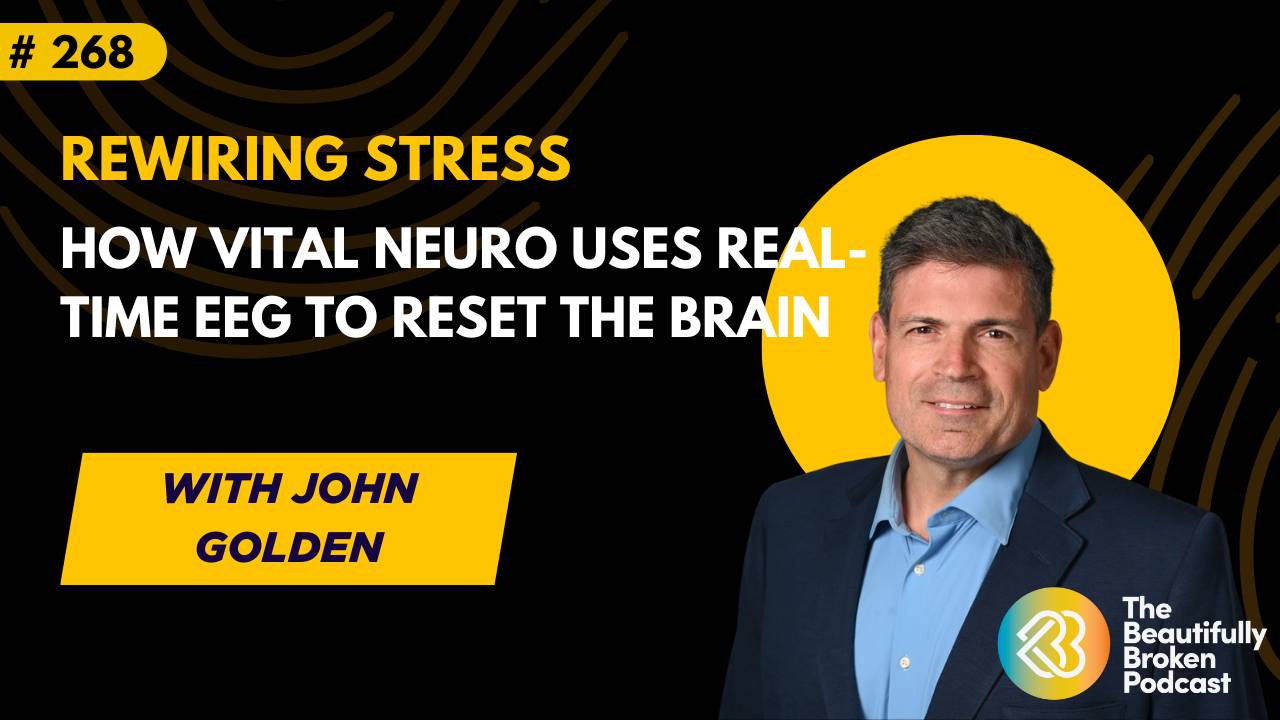
WELCOME TO EPISODE 268
Welcome back to Beautifully Broken, where healing meets high performance. Today’s guest, John Golden, is a walking miracle—and a man who’s defied odds most of us can’t even imagine. After coding on an ER table from a full arterial blockage known as a “widowmaker,” John was revived and left with a second chance at life. We talk about the raw emotion of facing death, how gratitude becomes your default operating system afterward, and why community, family, and reflection matter more than anything else.
John shares his journey from college football linebacker to multiple knee surgeries, a human bone transplant, and ultimately, summiting Mount Everest. Through that journey, he learned how the body compensates, adapts, and rebuilds—and how the same principles apply to the brain. Now as CEO of Vital Neuro, he’s leading a new era in personalized neurofeedback—where real-time EEG and neuro-responsive music help calm the nervous system, restore focus, and reduce overwhelm.
Together, we unpack the neuroscience of balance, the volume of modern life, and the small daily practices that bring peace and performance back online. This one’s about more than surviving—it’s about learning how to be vital.


Episode Highlights
[00:00] – “I died last week”: John’s Widowmaker heart attack and the miracle of modern medicine
[05:50] – Facing mortality: emotional recovery and gratitude for a second chance
[09:40] – Lessons from near-death: family connection, presence, and living intentionally
[15:22] – John’s football career, catastrophic knee injuries, and the first-ever leg tissue transplant
[20:50] – Relearning how to move: compensatory patterns, 20 surgeries, and climbing Mount Everest
[24:08] – From EXOS to Vital Neuro: merging neuroscience, music, and mental health
[29:10] – How Vital Neuro reads your EEG and tunes music to your personal brain frequency
[35:45] – The “volume” analogy: why our brains can’t think clearly when overstimulated
[41:26] – Cold plunges, fly fishing, and the daily rituals that bring us back to zero
[47:15] – Tiny habits and behavior change: building resilience through practice
[51:40] – The next evolution of wellness tech: oxygen baths, vibration therapy, and data synergy
[57:00] – Setting realistic goals and finding community support for lasting change
[1:11:30] – “Be vital”: John’s message of compassion, control, and collaboration
Upgrade Your Wellness:
Get the Vital Neuro headset: https://vitalneuro.com/BEAUTIFULLYBROKEN
Code BEAUTIFULLYBROKEN
Work with me:
https://www.beautifullybroken.world/biological-blueprint
Silver Biotics: bit.ly/3JnxyDD
— 30% off with Code: BEAUTIFULLYBROKEN
Get Redlight Therapy: https://lightpathled.pxf.io/c/3438432/2059835/25794
— Code: beautifullybroken
CatchBio: https://catchbio.com
— Code: BEAUTIFULLYBROKEN
CONNECT WITH FREDDIE
Work with Me: https://www.beautifullybroken.world/biological-blueprint
Website and Store: (http://www.beautifullybroken.world)
Instagram: (https://www.instagram.com/beautifullybroken.world/)
YouTube: https://www.youtube.com/@freddiekimmel
FULL EPISODE INTERVIEW
EPISODE TRANSCRIPT
Freddie Kimmel (00:01.703)
Ladies and gentlemen, we are back with another episode of the beautifully broken podcast. John Golden. Welcome to the show.
John Golden (00:09.948)
pleasure to be here, Freddy.
Freddie Kimmel (00:13.023)
we should have pushed record when we just started talking because that's one of my greatest lessons in life. Sometimes before you get going, it's just like, there's magic in the room. And maybe that's not for everybody to share. Maybe it's just part of the conversation, but yeah, I'm excited to invite people into where we're at this morning.
John Golden (00:34.51)
You know, I think, part of that is your personality. You get on, you have an infectious amount of energy. And I think, you know, that makes these topics very approachable. So I enjoy the conversations with you. we jump right in.
Freddie Kimmel (00:51.603)
Yeah. And our dog in the background, usually dogs affirm that we're on the right track. I find that to be, I find that to be true. Our furry little friends.
If we could start this morning, can we, can we jump in to just, we, we got on the, we got on the call and you said, Freddie, I'm, I'm lucky I'm here. I, I died last week. And I sort of sat there for a second and I didn't know what to say. What, what happened in your week, John?
John Golden (01:23.278)
Yeah. So having to tell the story, I was preparing for a trip to San Diego and California, and I was supposed to fly out on a three o'clock flight to the West coast. And my flight got canceled because of the government shutdown. And they rescheduled me on a different airline for later in the day. And I was like, oh, wow. I got moved from first class to row 20, middle row.
a different plate. And I was like, ah, and then they delayed my flight again for 11 o'clock at night. And I was sitting at the kitchen table and I was adjusting, you know, kind of all the things you have to adjust when the flights change. And all of a I felt a really sharp pain in my chest. And this was a pain I had never felt before, it was really intense. And it was followed by this kind of overwhelming feeling of not being able to breathe, right? Just, and I didn't know what was going on.
I got up like I typically would do when I feel something and I walked around the house, this little path I have, I come sit down and I just felt worse. I just kept building. So I went to my spouse and I said, hey, something's not right here. This is not good. Sharp pain. Couldn't breathe. Started moving down my arm. So we literally, was, I was in clothes that I would be working in the yard in and I threw on my son's shoes. We took off for the hospital and you know,
They have a great process. Next thing you know, I coded in the hospital, in the emergency room. They were able to resuscitate me after a couple of attempts and then I was wheeled in for surgery. I had a full blockage of my, what they call the widow makers. And I led a healthy life and hadn't any issues and man that...
that rocked my world, right? So this time last week I was in intensive care and today I'm feeling good though, feeling great.
Freddie Kimmel (03:31.207)
Incredible. Modern medicine is incredible. I'm so glad you listened to your body and didn't hesitate. It's like, you know, this is a great example where you didn't reach for the essential oils. You got in the car and you went to the ER.
John Golden (03:39.31)
Yeah.
John Golden (03:51.022)
Yeah. Yeah. mean, they have, they, they, they clearly, you know, a couple of things I learned, right? You better have a good belief system, right? Number two, you know, I've had a lot of chronic issues, health wise related to autoimmune in my family. And so I've always wanted to make sure I've lived in this kind of fear of making sure I'm in great shape because I don't know what's going to come next. And so I'm so grateful that I was in great physical shape that I could rebound.
But I was so impressed with the staff at the hospital. mean, they knew kind of they had this playbook and they knew what was happening and they do it with such class. They make you feel, you're thinking like, what's gonna happen? And when you have a heart attack like that, not to get too graphic, but I'm in very sharp pain and you're twitching and you're trying to.
explain what's going on at same time you want a cure and they put, you know, one nitrous pill and a second nitrous pill and a third nitrous pill and nothing's working. And you're having this fear like you're going to just die right there on the table. And so that's very, there's this strong emotional component to the pain component. And after you go, you know, I sat there and I said to my, the team there and my spouse and I said,
wait a minute, I'm gonna black out. I'm feeling dizzy, literally. And from there they said, my eyes rolled back to my head and I fell back and blah, blah. I woke up, I didn't know what happened, right? I didn't know I crashed. I woke up and it's kind of not to get kind of wonky with people, but I woke up and all of a I didn't feel any pain.
And I had this mask. I was trying to get orientated where I was. had a mask on my face and they're pumping with oxygen and probably other stuff into my lungs. And I remember them calling my name and it was all white and clear and amazing. And then I responded and then all of a the pain came, right? Came right back, screaming back. And they're like, John, we got to take you right now to the surgical, you know, surgery.
John Golden (06:11.638)
So, but the way they orchestrate that is incredible. Right. So, yeah, so I'm, I'm grateful. I'm always grateful, but I'm very grateful today to be here. and, you know, my cardiologist shared with me that the emotional part of this is as, as, as difficult or as more difficult to get over than the physical, you know, you're, you're in good shape. Luckily, my heart's in great shape. Everything's good.
You know, rhythm came back, everything. I'm very fortunate for that. but now it's kind of the emotional part. Nobody wants me to leave the room without them watching me. Right.
Freddie Kimmel (06:52.041)
Yeah. What, what does the, what is this week like to sit with that brush with mortality? And you know, we're you're right back on a podcast. Like what has changed in this week, if anything.
John Golden (07:12.318)
I do a lot of thinking, you know, it's you. You go so quickly. I come home and you see your dogs and you're thinking, wow, I got to see them again. Right. My son's a college football player and his team has been very successful and it was senior day. Yes. on Saturday, right. Their last home game of the regular season. And, I got to see that. Right.
And I'm like, wow, he might've been at a funeral instead of me being there. And so I've really tried to be more present. At the same time, I know there's always things that you wanna focus on. What's the priorities, right? And I believe in being transparent and sharing messages with people. We can all learn from each other and...
I don't know what all those messages are for me right now. I'm asking myself lots of questions, lots of questions. You know, like, is this how I should be spending my time? You know, how do I, you know, you know, what are those things that you'd love to do? And should I be doing them? Because you don't, you don't know if you get another chance, right? So at the same time, I don't want to overreact. So that's about.
Freddie Kimmel (08:33.427)
Mm-hmm.
John Golden (08:38.414)
you know, being as raw here because it's real time. You know, that's what I'm processing through.
Freddie Kimmel (08:44.853)
Yeah, well thank you for having the presence and the strength to be with us on the show today. I'm so grateful that we're here. I had no idea any of this was happening. I feel so much empathy in my heart. can feel my My heart has like an empathetic contraction or hug towards you right now on the show. can feel it. so, yeah. I think about this all the time. I think about it.
John Golden (09:07.363)
Yeah.
Freddie Kimmel (09:13.459)
You know, I was driving home yesterday, John, and I came to a light and there's a grocery store down the street. There's a Sprouts where I always go shopping. And at the light, it's a very bad light. And I'm going to say I've seen 20 accidents there. And at this point, the light is just, it's just dusted with this green glass where all the windshields and glass from these cars have been shattered. And I just, every time I go through it, I look at the glass and I was like,
man, somebody's life changed there. That's not glass. know, millions of intersecting stories, whether it's the ER, whether it's the first responders, whether it's the police that are going in there, coming in there, and they're helping to hold somebody's life would probably change pretty dramatically. Because there are always these bad accidents, a terrible blind spot. Every time I go through it, I was like, I have this moment of, we never know.
You know, I may feel stressed. want to get home and get my, I'm cooking, maybe I'm cooking dinner cause we're coming out of a 24 hour fast for my partner. And I'm, I'm just thinking to myself, it was like, go slow. You have nowhere to be. in the moment. Relish the process of creating this. You don't need to rush to be to the meal. Maybe just relish in the process. So you guys get to eat a meal together. Every week I have these moments where I'm just like,
It's good to be in a body. It's good to be functional. It's good that I can walk. It's good that I'm eating food, let alone, you know, the daily gratitude, which comes from, I can eat food and I can go to the bathroom. It's all the simple things that it's a daily wash over of this extreme gratitude that I get to keep doing this. And it becomes, for me, it cuts the tether of
John Golden (10:53.934)
Bye.
Freddie Kimmel (11:10.313)
I have to make impact in this life. have to change the world. You know, it's all this stuff outside of myself, right? It really does bring me back home when I have that experience.
John Golden (11:21.516)
Yeah, that's very well said. Yeah, you become very reflective. Having that good foundation. You know, I grew up in a world that was like always you got to prove yourself, you got to work hard, you know, and it's about making sure everything's right for everybody. And it puts a lot of pressure and demands. And maybe you don't reflect on enough like what's really important.
I I look at this last week and the things that I wouldn't have said to you, I would have said my spouse was an amazing partner, right? But she was amazing in the calmness in the reality. We're driving in the car, it's about a 12, 15 minute ride to the hospital and she's trying to navigate traffic, get me there. And the conversation her and I were able to have was...
an amazing conversation in that few minutes, the things that we could share. know, those little words that we said to each other and the things that we said were so powerful. I come home and my youngest son, right, the impact that this had on him, he's 22 years old. And I know this spooked him severely. So, you you
you understand that connection. Because last week I'm saying, hey, why don't you got your room clean? Why aren't you doing this? Why aren't you? And we don't always fully appreciate the connectedness that we have with each other. I'm observing that, realizing that this week, and now trying to figure out how do I respect that better.
Freddie Kimmel (13:11.333)
Mm-hmm. Life is such a gift. You mentioned that your, your son is a football player. sounds like 22. It's probably in college ball, correct? That's great. And now you had a football career as well.
John Golden (13:20.558)
I know. Yeah.
John Golden (13:25.422)
Correct. Yeah, I played. I played linebacker. He's a big offensive lineman, but I played linebacker. Yeah, he's had a lot more success. His his his I'll give a shout out to his team is North Central College. Last year they won the D3 national championships and they're undefeated this year. Number one rank going going forward again. So proud of it's amazing. Coach Spencer and his team do an amazing job of this process. If I look at the way they.
Freddie Kimmel (13:32.977)
Amazing.
John Golden (13:53.27)
they play and the way they practice. you know, for me, I played on the old Astro turf, right? So we had turf burns and, know, got all beat up and, you know, my football career ended in an injury.
Freddie Kimmel (14:06.355)
Yeah. Yeah. And tell, tell the audience maybe if you will, a little bit about your story with professional football and the injuries and what was your body like after going through that defensive lineman career?
John Golden (14:22.38)
Yeah, so for me, I think I was put on this earth originally to be a football player. love football. And I had the fortune to play for the school Northern Illinois. anyways, my football career ended on the field. I had a horrific knee injury where somebody grabbed my ankle, somebody else hit my kneecap, my toe met my shoulder.
no longer had a patella in my right knee and or my femoral head was all messed up. So think about the mechanical parts and things that you were put in. This is in the mid 80s. Okay. I have subsequently had four revisions to that over these years when they put a, you know, when they put some sort of metal components.
In a knee in those days, they expect the last 10, 15 years, but they're putting them in 70 year old guys, not 20 year old guys. was 21. So, what, really transformed for me though, is that that was the end of my career as a football player. was a, math major and, decided, okay, I can't play football anymore. So I went into my professional career.
And I went through all the rehab that you'd go through to make sure you're, you I had the biggest quads in the world, right? They'd always say, you know, build your quads up. I remember you used have to buy pants that had, you know, bigger, they were bigger on me because I could get my thighs in them. but what happened was, you know, I went into my professional career and my, my knee, my other knee started to give me trouble, my left knee. And, it would.
Freddie Kimmel (15:50.709)
Hahaha.
John Golden (16:06.24)
It was wearing, right? So you'd go in and they'd do a scope on that. And then they do another scope and they're like, yeah, well, you know, and then pretty soon it's bone on bone. Right. And then the next thing that that transpired was that it was extraordinarily painful. My left side. And I ended up having to have that knee, that knee needed to be replaced. And it was, and I'm like, how did I get here? Like I've got the.
the right knee, what happened to my left knee, right? And what I learned was that, you know, I had a tremendous amount of compensatory movement patterns, right? That I had developed over the years to compensate for the right knee. It changed the way I walk. So my femur and my tibia on my left leg didn't walk, work like it's supposed to. Instead, my femur would pound on my tibia all the time. And that's what wore the cartilage down, eventually wore down the tibia.
And I ended up having this revolutionary transplant and had a human bone put in for my tibia femur and the cartilage in that joint. I learned about the compensatory movement patterns after I had all this surgery. And I'm talking 20 plus surgeries. I learned like, wow. Right. And that, that learning transformed my life. Right. That, changed my career direction.
It changed the way I looked at everything. The story I would tell you is that when I was going to have, they wanted to put a metal rod in my left leg and they were asking me what angle I wanted it at. And I'm like, we've got to do something different than this, right? There's got to be something more. I'm in my late thirties at the time. And I said to the doctor, doctor, you're telling me what I can't do. Cause he literally told me to go buy a ranch because I'd never do stairs again.
And I'm like, what can I do? And he literally didn't have an answer other than to have this surgeon. So I left his office and I didn't know who to call. I didn't know what to do, but I reached out and said, okay, let me create a list of who's the top doctors in the world around this area of knees and transplant. And I went around the country to different places all over the world. And I stayed in the United States, but, and
John Golden (18:35.926)
ended up on this one procedure that I was able to have. And it changed everything. I finally broke out of my family. grew up about only, do what the doctor exactly tells you what to do. And I wasn't even telling the doctor what I really wanted to do. I just wanted him to fix it, him or her to fix it. I finally learned how to communicate. What is my goal? I want to be able to do what with my kids? I want to do what with my life? How do I want to move?
how do I want to live my life? And then have somebody that we could be a team together and figure out the right strategy that would get us there. We'd come in partnership, share in the risk, share in the responsibility, do the work together as a team and solve it. And that's what I was able to do as my left leg. And that led me on the journey that just totally transformed my life.
Freddie Kimmel (19:29.203)
Now you said you said tissue transplant. So what was that procedure like? What did they do for you that was not the metal rod?
John Golden (19:38.732)
Yeah, so what I got was a meniscus transplant, chondrofemoral cartilage transplant, right? So they basically rebuilt the joint from a donor tissue, donor leg.
Freddie Kimmel (19:55.094)
Wow. And are there physical limitations? Like, is there something you can or cannot do? Or do you feel like today you're like fully functional?
John Golden (20:07.33)
Well, who is ever fully functional? That's the way I look at it. Yeah, this is to get a little bit through the story for you. What I tell people is the list of what I can do is a lot longer than what I can't do. And I can do the things. I I usually say, OK, well, I climb Mount Everest on it, so I think it works. You know what mean? That's usually the way I can move at it.
Freddie Kimmel (20:10.928)
How do we define functionality? It's a good one.
John Golden (20:34.478)
Yeah, I mean, there's certain limitations, right? So, you know, anytime I'm open chain, you open chain, you know, it can dislocate, you know, the joint can dislocate. So that's most common if I'm swimming. So I've done a couple like triathlons and it'll dislocate in the middle of the swim, which is never easy. But, you know, it's the doctors did an amazing job. The therapist, the, you know, the
the folks that helped me through this whole process, it's a whole team. Yeah, I mean, I can get around very well. somebody has a bad knee, I'm a little better than them.
Freddie Kimmel (21:15.519)
Amazing. Yeah, and Mount Everest is quite a feat after a lower leg transplant. That's wild. I'm looking behind you in your screen, for everybody who's watching this end video, most people are gonna listen to it, 98%. There's a little headset there called Vital Neuro that I have been using. I had one of my, I tell you this story, one of my buddies, Skyler,
John Golden (21:26.136)
Yeah.
Freddie Kimmel (21:45.366)
He is like, he's a, he's a veteran. His, his zone of genius is biofeedback. And, and he said, I'm always asking him, I'm like, Hey, this is something I've wanted to invest in. You know, I want to, I want to up my meditation game. I want to be able to use this, this wandering mind that, you know, again, as an excitable individual, it's literally this morning I'm like going in.
I'm doing the podcast and posting a thing and all of a sudden I'm drawn and then I'm like paying a bill over here. And for me to stay focused, that's like where the money is. I do so much better in life. And he said, he called me and he's like, no, this one's good. This one's $40,000. This one's 10 grand. You're not going to get anything for under this price point. And one day he called me out of the blue and he says, Freddie, you got to try this vital neuro. He's like, somebody finally did it right.
They created a headset, which is taking a signal from the brain. It's using that in real time to offer a visual and a mental biofeedback element to really bring the brain into a state of higher functionality, like for under 800 bucks or whatever the price was. I was like, okay, I'm in, in. And I reached out to your team and.
I was like, Hey, can we partner? Can I get one? Can I try it? And they were like, we're so busy, not going to happen. was like, great. I'm buying it. So I bought it and I literally used it. I went for like a 40 day streak, three meditations a day. And it was. It's I can't to meditate now without it. It just don't get it's nowhere near. It's like meditation on steroids. So I've been so impressed with.
the headset and I always like to tell the audience, I'm like, look, these guys didn't send me one didn't pay me to do it. I trust certain people and I trust Skylar's opinion who Skylar is in Flagstaff, Skylar Wilkinson. If anybody wants this contact info, he's like the guy who'll go in and he'll map your brain. He'll tell you what areas need stimulation. He'll create a protocol for you. Really, really awesome individual really tapped into the wellness world. So I trust him and
Freddie Kimmel (24:06.399)
Just, yeah, I'm thankful I have a headset. How did you get involved with this and what's your, now you're the CEO of Vitalneuro, yes?
John Golden (24:14.302)
Yes, I am. Yeah. But I'm just one small piece of this great team. I mean, the genius behind this was Dr. Cameron Falapor, who's a he's a clinical psychiatrist in New York City. And he was seeing regular patients and he needed a tool that could extend his reach beyond just what he could see in the practice. And he had been up and he is an innovator in
Freddie Kimmel (24:27.263)
Mm-hmm.
John Golden (24:40.63)
in neuroscience. He's an innovator with technology, create a lot of Bluetooth innovations. So I spent 10 years prior in a leadership role in EXOS, kind of in the human performance space. And we had focused on mindset, movement, nutrition, and recovery as four big pillars. And
The team at Exos, amazing team, had done a lot of great innovations with partners that we had worked with over the years around everything, what I call the neck down, right? From the neck down on the body. But the brain, the human operating system, there was very little to help people get immediate control that would create personalization. It was either pharmaceutical, talk therapy, or fill out a form, some sort of survey that you take.
I wanted to do was we knew the science of neurofeedback was very, really powerful. And Cameron was a leader in that space. Cameron had a partner also that they were working on this pilot headset. had this headset they were working on to try to bring this to bear. I was fortunate enough to join the team and bring my kind of operations and technology background. And our goal was to create something.
We wanted to be outside of the box of typical neurofeedback. And what I mean by that is something that was so frictional is that you could just slide it on, press a button and go, right? And you could use it in those moments that you feel overwhelmed. We all feel overwhelmed at time. And in your case, you're talking about meditation, the ability to focus, right? Some people have fight or flight and they're dealing with, you I wanted to, we wanted to build something.
that people could just slide on and in a couple of minutes get them where they need to be. And we knew for that solution to work, it needed to be highly personalized. The brain is very, very unique. Your circumstances of the day are very unique. I might go to bed tonight weighing 180 pounds. I'm going to wake up tomorrow. I'm going to weigh 181 at most, maybe 179, but I'm not going to weigh 120. But my mindset
John Golden (26:56.844)
Might be ideal today on a scale of one to a hundred. might be an 80 today because I slept well, ate good last night, good weather. I went out and saw the sun shine first thing in the morning, right? Where, last Monday when I woke up in the hospital, I would have been a 20, right? So your days vary. Your emotional state varies much greater than your physical state changes. And so you, to be able to have tools.
Freddie Kimmel (27:09.033)
Mm-hmm.
John Golden (27:26.402)
that can understand that emotional state that you're in and uplift you. So you talk a lot about homo stasis and getting into balance. That's what Vital First does. Get you into balance and then we can upregulate to where you want to go. Focus, executive function, state of flow. If you're really struggling, then we're going to get you to balance.
Freddie Kimmel (27:48.438)
Yeah. Yeah. And, and for the, for the user at home, I'd like to walk through just a little bit of the connection points on the headset. Cause it's really interesting. I've got some like, there's like almost like gold connection points on the, on the front of my, almost like my jawline around the earphone. And then I've got these like, uh, three discs on the top of my head. It works out great for me cause I'm bald.
John Golden (28:01.934)
Mm-hmm.
Freddie Kimmel (28:17.321)
and it just, it's sitting on my scalp. So I've got all these connection points that are pulling an electrical signal from the headset, and we're getting this conversation with the brain. Can you tell us a little bit about the design of that and what the headset is doing?
John Golden (28:35.47)
Yeah, for sure. I actually have a headset I can show you here. So you've got the three sensors on the top. And we hold it this way. And then you've got the two sensors on here. And these two are what this is ground, this one here will be my left. And the right is reference. So we're getting a referential EEG here. So we know what's the overall EEG in the head.
Freddie Kimmel (28:39.624)
Yep. great.
John Golden (29:01.938)
And so you want to understand kind of what is the electrical signature of the overall what's going on in the brain here. These top ones, PZ, FC, CZ, right? So the front is executive function, right? This is executive function. Here in the middle is focus and the bottom would be relax, meditate, right? Help you get to sleep, right? So the key thing is you can measure EEG from anywhere. A lot of people like to measure it from the forehead because it's easy.
Right? And if you have good algorithms to get rid of the noise, because noise here would be like me moving my eyebrows or my big giant forehead that I have, moving that around. But if you want to train the brain well, right? So teach the brain the new neural pathways. You want to train the specific spot that you're trying to target. So if I'm going to get somebody into, like in your case, focus, you're going to use this middle sensor. That's going to be.
That's, we're going to measure where what's happening in your brain at this point of activity and how your brain is responding. So what we do is we met, capture EEG right away and we're, we're, we're constantly monitoring that multiple times a second. As we capture that, we then understand your state of mind by looking at the electrical signature across your entire brain. As we understand that, and you say, I want to get relaxed or I want to meditate or I want to get focused.
we will then optimize the music to get you to that desired state. So everybody understands there's music that's called psych acoustically designed. That's music more trained for your brain than your ear. Right? It's that white noise, binaural beats. And, you know, you can go into a lot of apps today that'll give you access to that type of music. The thing is it is very effective.
Right? But as I mentioned, if you wanted to get the best results, quickest results, particularly if you're having a really bad day, the music, finding your exact tone, frequency, all the different elements that are built into psychocousin music. If we want to optimize that for your brain, we'd want to find out what exact frequency you work at, Freddie, which is different than me.
John Golden (31:24.012)
Right? Everybody understands alpha, beta, and theta, but what specifically would be the right alpha frequency and tone that will get you where Freddie needs to be, right? To get that dopamine hit that we're trying to get, for example. And so what Vital and what our unique patent is, we have a neuro-responsive music. So we're not just, once the EEG says, Freddie is unfocused, so let's play certain psychocusic line music to get him
focused, we start there. And then what we do is we then test frequencies to find out what exactly Freddie responds to. And so we're seeing multiple times a second how you're responding to certain sounds and frequencies as we find your exact frequency. Let me just call it your reward tone, what you exactly respond to. Once I find that, we then customize the music throughout the rest of the composition going forward, reinforcing those frequencies.
that you more respond to, driving you faster and deeper to your desired state. So now the music is responding to you, you now are not just responding to the music.
Freddie Kimmel (32:34.195)
Yeah. It's been really interesting. I've definitely, there's a couple of tools I like. There's a PMF that I use is very down regulatory called amp coil. there's certain technology I've been playing around with that boost circulation and it's become my, my like midday most days it's become like my midday nap or my midday recovery. And I play this 30 minute session, which has like a down regulatory.
And then there's something to bring me into like functionality and then like a focus. So like it brings me back out. So it's almost like the nap because I'm playing this on the headset, kind of a take takes you down and then like brings me. So when I come out of the nap, I'm not, you know, sometimes when you lay down for 30 minutes for me anyways, I don't know how everybody else in the audience feels is that I'm done. I'm not going to make, I'm not going to write any content. I'm not going to go do anything brilliant at work. I'm kind of toasted.
But I'll get this nice like 30 minute, okay. I literally feel like I feel refreshed and that's never been the way I nap. If I nap, especially 30 to if it's over 20 minutes, it's like, okay, I'm done for the day. I'm just gonna, I gotta go do something that's very physical, but me being a creator or focusing personally, like my zone of genius is like 8 AM to 1 15.
And that's really like where I like to write and create and do interviews. I seldomly will schedule an interview at three in the afternoon. Brutal time for me to also do a meeting, which ironically the big company they're working with in New Zealand, that time schedule, they're like having cups of coffee and they're ready to get there. I'm all these emails at two 30 and three. I was like, man, this is brutal for me. But the headset has been really helpful.
really helpful for me. It's been awesome.
John Golden (34:35.914)
I'm really glad to hear it. The team would be excited to hear that. We encourage people to use it in what works best for them. We designed it so you could use it anywhere. Because you think about it, most neurofeedback is done in a very clinical setting. And it's very sterile and very controlled.
Our sessions and it's just a little bit over 80 % of our sessions are done what we call in the wild. People are doing it while they're, you know, walking their dog, cooking in the kitchen, right? I do most of mine when I'm sitting there doing emails and strategy work on my computer. And I sit there in the focus mode. just allows you to go through without, you know, when you, when you have to plow through your couple hundred emails and you're just mentally exhausted at the end of that.
Freddie Kimmel (35:11.603)
Mm-hmm.
John Golden (35:28.77)
When I wear the vital headset throughout, it just keeps me refreshed at the end. The other thing I like to do is we all get overwhelmed, right? It'll be sitting here at 3.30 in the afternoon, somebody will open the door and say, hey, what do you want for dinner? And you're like, don't ask me. I don't care. Whatever you want. I don't have to make another decision. And that's when you can, you know, those transitions of the day, we all need that help to just kind of clear our mind, right?
Freddie Kimmel (35:28.851)
Yeah.
Freddie Kimmel (35:34.441)
Yeah.
John Golden (35:56.878)
And I, if you don't mind, I'll tell you a little analogy I like to use about kind of when we think about our brain. And again, I, yeah. And, uh, you know, Dr. Cameron Fowlport would do a better scientific job, but I'm going to use the analogy of volume since we have headsets on, right? So you think of your brain and the volume is zero is low and 10 is high. Okay. So if we think about our brains can't multitask.
Freddie Kimmel (36:03.635)
Yeah, tell me.
John Golden (36:23.938)
They weren't engineered to multitask, but we try to multitask all day long in what we do. so think about my frontal cortex executive function, like on this call right now, hopefully that's a nine or 10. And, you know, I'm engaging with you and, you know, thinking through, you know, all those things. So it's a nine or 10. Then the middle part, like I'm trying to think about the tasks I needed to do and, I got to follow up on these things. Right. That middle is focus and the back, as I said, is relax. If you looked at the brain.
today compared to what it was 15, 20 years ago. know, today our frontal cortex will be at a seven, eight. Our focus will be at an eight or nine and our back of our brain will be at an eight or nine. And so the total volume in my head is 26 or 27. But if you go back in time, before we were trying to multitask, before we're sitting here in our computers on a podcast,
Freddie Kimmel (37:14.143)
Mm-hmm.
John Golden (37:22.414)
checking our phone, doing emails, right? Having all these things. When you used to say I could manage stress, when you had jobs eight to five, and when you went to work, you went to work and home didn't bother you when you were there, right? The volume in your head was an eight because it would be just executive function. I'm focused on what I'm supposed to be doing. If I'm a programmer, I'm just programming in my middle is at eight. When your volume's at 27, a couple things happen.
Right? The side effect of today's society is that when the volume is that loud, first of all, you can't hear yourself think anymore. Right? The rational thought in the middle part of your brain doesn't have volume control. It can't out speak the volume of 27. So that little angel on your shoulder says, Freddie, don't do this. Hey, Freddie, don't, don't try this. It isn't heard. So when you see people today,
do crazy things like road rage or when somebody puts their seat back in front of you on the airplane and you get pissed off and you push it forward or you get upset at the in the grocery store. It's because not because you didn't have the rational thought like let's not overreact. You can't hear that rational thought because your brain is so overstimulated. Right. The other thing is when your brain is that stimulated just imagine what it's doing with all of the hormones.
Freddie Kimmel (38:40.853)
Mm.
John Golden (38:47.118)
You now have this incredible soup cocktail going on. And I call it the teenage girl's brain, right? They're hangry, right? One minute you're excited, you're ready to go. You say, I haven't eaten for five hours. I can go. And next minute you're starving, right? You're sleepy. So then people have a tendency to then have to upregulate. They can't control it, so they take more caffeine, more...
different ways to elevate so they can keep everything. So the whole volume just gets louder and louder and we lose in that game. Right? And what you hear from people when they put the vital headset on, our goal is to take that volume, whatever it is, now in the 20s to zero. And what people say is, it's the first time in a long time I've heard my breath. I can actually feel my heartbeat in my chest. Because the volume is so loud, you can't hear those things.
Freddie Kimmel (39:35.071)
Mm-hmm.
John Golden (39:43.222)
And that's what we all need. That's how I start my day is get that homostasis that you're talking about, get that balance, get it to zero and then decide where do I want to go and up regulate controlling that one part instead of all parts. And that that's the story I like to tell is like the volume is too loud in our brains. That's why Freddie, we all feel so overwhelmed. You know, I always say to myself, what's your title? Well, I'm now the new VP of overwhelm.
Freddie Kimmel (39:58.164)
Yeah.
John Golden (40:13.698)
Right? And so many mothers, executives, sports, athletes, everybody is just feeling overwhelmed. And we built Vital. There's a lot of things it can do. We can talk about it. But the biggest thing is I wanted you to go from being overwhelmed to just be Freddie, nice and calm. And then you decide where you go.
Freddie Kimmel (40:34.811)
Yeah, I think you landed on it. We decide where we go. Like if we can't get there to this place of momentarily, think every day, once I like to do this to check in, right? Post ice bath, I have a really nice window of like, I'm here. I'm here. It brings me present.
John Golden (40:38.126)
you
Freddie Kimmel (40:59.369)
You know, I think people really get lost in the weeds. was thinking about this this morning and like, God, the influencers telling you that ice baths are good or bad or black or white. was like, everybody's missing the point. You are a biological being who evolved in harsh cold weather. This practice puts you back in that ancestral, holy shit, I'm in a cold river.
John Golden (41:27.374)
you
Freddie Kimmel (41:28.079)
nothing out the body has nothing else to think about besides getting warm. The idea that it is harmful that an ice bath is harmful or going to be your savior, I think totally lost in the sauce. This is something that brings us back. So that's like a practice, right? That I'll do most days. So funny. This is my cleaned it last night. It's like I went out. I always like start the morning cold plunge, hot shower, cold plunge. have an outdoor shower and that's my morning.
I'm getting the morning light. It's, just so good. I was so bummed. was like, I can't believe I didn't fill it last night, but multiple times through the day, whether it's doing something like the neuro vital or it's the cold or it's a warm bath or it's a flow Presso more and more, like I need this like pallet cleanser throughout the day and
John Golden (42:22.605)
Right.
Freddie Kimmel (42:25.485)
It is such a superpower. It's such a superpower. I really think it's like we were talking a little bit about how you, how do you have discernment in this world of like so much inflammation, sorry, inflammation. are inflamed information and just opinions, right? You don't know who to believe or who to trust, but doing some of these things and knowing the ability.
John Golden (42:39.178)
Yeah.
John Golden (42:43.628)
Yeah.
Freddie Kimmel (42:51.283)
that it is the mind, it is the supercomputer that is repairing proteins. It is deciding to let go of garbage in the brain. It is deciding to repair DNA damage or the brain is like, you know, it's all it's doing it. We're in complete survival mode. And so it is this net practice. Like I'm going to go back to this should rebrand the the podcast, a health is a practice. is the daily practice day after day, after day, after day, in which in a year,
You won't know you will not believe the change you've made, but it's this like, it's like educating. It's educating the end user. It's like, guys, this is not, this is not do this headset three times. Be like, it worked. It didn't work. It works. Like brushing your teeth works. It works. Like doing bicep curls, your biceps will grow. Your mind will grow only if we use the thing. Only if we use the thing. So.
John Golden (43:47.203)
Right.
Freddie Kimmel (43:50.302)
Not that we have to have the headset, but I would just say to your, this volume conversation is really interesting to me. Like this idea that we have like the seven on the prefrontal cortex, eight in the mid brain, eight, nine in the back. So we get this net like 27 of just lots of stuff going on at the same time and trying to bring us back to zero. You know what else does it for me? Which is, this has been wild fly fishing.
John Golden (44:03.384)
Mm-hmm.
John Golden (44:15.566)
What's that? Fly fishing? wow.
Freddie Kimmel (44:19.637)
fly fishing. Because I've always fished with like, I grew up in upstate New York with a bobber and a pole. We went like out on the bass boat, right? Or we'd, you know, casting a reel or fly fishing. It's this art of like, you're working the line and you're just focusing on like, you're watching it move through the water and you're watching the current and you can't think about anything else. If you do, miss the fish. The two times I've been
John Golden (44:26.06)
Yeah.
John Golden (44:44.91)
All
Freddie Kimmel (44:48.597)
fly fishing this summer. Shout out to my, my good friend Arnie Erickson up in Bozeman who is like, helped me get on this fly fish to these fly fishing floats, down the Yellowstone. And I'd get off there and I'd be like, I wouldn't notice it till I got off the boat. And I'm like, I feel like I did plant medicine. I am so blissed out right now. Cause it's, it's just this act of the one. Right.
John Golden (45:09.987)
Yeah.
John Golden (45:17.357)
Mm-hmm.
Freddie Kimmel (45:18.717)
And so, because I can't afford to do that all the time, how do I figure out what is my fly fishing midday? that's been a neuro vital, vital neuro has been fabulous for that. Fabulous.
John Golden (45:26.7)
Yeah.
John Golden (45:33.868)
Yeah, first of all, just as a side note, I'm not a great fly fisher, but I do have similar experience in Middle Fork of the Salmon River. If you can get somebody to take you there in Idaho, incredible place to go. Just it's, I think it's the largest continuous wildlife preserve in the continental United States and the fly fishing is amazing in the Middle Fork. Yeah, it's...
Freddie Kimmel (45:47.306)
Mm-hmm.
John Golden (46:03.95)
those rituals that you talk about are really important. sticking with it, there's a gentleman, BJ Fogg, professor out of Stanford, who's written quite a bit around motivation and behavior change. And he's got some really, really interesting ideas and I'm a big believer in his kind of behavior happens when there's a motivation, right? There is a ability and a prop.
And so many times we think it's about motivation. Why aren't I doing something? Because I'm not motivated. And in reality is, do I think I have the ability? And I think that's always the challenge, right? Can I do it, right? And that's one reason why with Vital, was simple like, hey, just put the headphone on press the button. To you, know, fly fishing, can't just go do unless you and I lived in Montana, right, necessarily. But finding things that are easy, like cold plunge, right?
Freddie Kimmel (46:55.199)
Mm-hmm.
John Golden (47:00.588)
You know, there's different ways to do cold plunge. I live in Chicago. So you get water out, get our tap water coming right out of the system here is 51 degrees. It's not perfect cold plunge, but it's plenty cold enough just to put the colds on. Yeah. And so, yeah, so it's easy, easy cold plunge for me, you know, cold shower to be able to do that. So finding things that are, that you believe you have the ability and then the prompt, you know, the, you know,
Freddie Kimmel (47:13.256)
that's plenty cold. Plenty cold.
John Golden (47:29.88)
building a routine, like, you know, the looking up at the, at the sun in the morning, I find very helpful for me. I just enjoy and trust me these last four days, you know, we opened the blinds in the bedroom. I look outside and because of what happened, I'm even more grateful. I look outside and see, you know, the, the, the sun outside and just to look outside and just to take that couple minutes. I literally just now just stand out, look out the window and
just have that moment of reflection and gratitude to have that. I'm also a big believer in vibration therapy. So I like, for me, the power plate, right? So when you have the orthopedic issues I have, people think warming up is about stretching, and a lot of times it's about stimulating the nervous system. And now I've thought a couple times this week when I get on the power plate, what is that doing to the...
Freddie Kimmel (48:06.421)
Mm-hmm.
John Golden (48:25.58)
the surgery I just had. I think I'm gonna shake something loose. vibration therapy and there's so many great things out there and know, Freddie, you've talked about so many of them over the years, but there's so many great things. Finding the ones that work for you that fit into your routine that you can create a habit around, that you know you have the ability, you can create a prop to that and do that. I think we all win.
Freddie Kimmel (48:29.013)
I'm gonna shake a stent loose.
John Golden (48:54.776)
Right? You start, like you say, you start with one, get that going and then add another one, add another one. And if something doesn't fit in, it's okay. Try something else. But I think we need to be willing to experiment with it. And there's no silver bullet, no one thing's going to do everything. Right? But the accumulation of doing these good things will, will, make you a much more resilient person, a much more positive person.
and you're going to have a lot more success as you define success.
Freddie Kimmel (49:27.125)
That's right. Yeah. I just, uh, the audience is going to be tired about me mentioning it, but I've got this machine in the last two months called the Bimini, which is nano bubbled oxygen therapy, which turns your bathtub into an oxygen bath. Like it is 300 % times more oxygen, stable oxygen in the water. And because of the thing called the Zeta potential in physics, it just, you get these nano bubbles absorbed, uh, transdermally.
And so in a, in a society, and I, this is all working theory. I just put out a sub stack article on it. It's all working theory, but in a society that is sympathetically dominant. And we're not deep belly breathing when we're breathing 26, 22, 25 times a minute. The microvasculature of the body is what suffers. So we get oxygen where we need it from, from an external potential.
John Golden (50:09.187)
Yeah.
Freddie Kimmel (50:26.165)
And we're, and we're in a bath. You're not in a hard metal tube that's pressurized and it's very expensive, very clunky. Um, I always wanted a hyperbaric chamber when I was really sick with Lyme. I wanted one. I wanted to, I couldn't afford it. I, there was a good, really good clinic in Jersey. It was like $80 to get there. $200 to 20 a session. said do 40 sessions. And then by the way, if you stop coming, your symptoms will come back.
So it didn't fit into my bank account, didn't fit into my, I didn't have the time to do it. And now I see things like this come along. I'm like, wait, we can have an impact on tissue saturation in the quad and the brain in 25 minutes? Like this fits into life, just like a headset. I can wear the vital neuro to the gym.
John Golden (51:12.663)
Yeah.
Freddie Kimmel (51:21.351)
I can put on, I can put on focus or flow or whatever I want to put on and I can do my workout. That's been a fun one. And it, nobody really looks at you like you're crazy. It sort of looks like a unit. Wow. This guy's headset looks a little weird, but I'm okay with that. But you really do get into the flow, right? The downside is we've all been at the gym lately and you're like, there's a guy on like.
John Golden (51:27.373)
Right?
John Golden (51:37.549)
Yeah.
Freddie Kimmel (51:46.004)
You know, I want to do isolating to your point. want my quad, my VMO to be strong. I'm doing like isolating quad exercises and some guys there like for 20 minutes on his phone, like stuck in his social media. like, Hey Blake, brother, can I, can I get in there? You know, everybody's on their phone. Everybody's on their phone at the gym. You know, and what a great thing just to get lost in like good music and a workout. You know, again, another moment of like, if you're working hard enough,
John Golden (51:58.601)
Yeah.
Freddie Kimmel (52:15.485)
If you get to that, and I, a lot of people, talk about this in the training academy, that we don't under really understand what work is. Like, unless you've had a great trainer, like most people are counting, I watch people, I watch people in the gym, they're counting reps. Right? They're counting reps. They're like, there's my 10, there's my 12. No, no, you wait till you can't move that weight, as long as it's a safe extension.
John Golden (52:32.344)
Mm-hmm.
John Golden (52:38.339)
Right.
Freddie Kimmel (52:44.191)
closed or open chain, but if you get to a point where you can't move it, there is a psychological thing that happens in your body where it's like, talk about a beneficial state, right? That is very therapeutic, but it fits into your lifestyle. So I'm always, I'll join with you. I'm always like, what's realistic? What am I going to do? What can I see other people actually embracing? You know, I can see people embracing
John Golden (52:55.918)
Hmm?
John Golden (53:10.766)
Right?
Freddie Kimmel (53:13.333)
to your point getting up with the morning sun. Like just take your puppy for a walk without the damn phone. A bath, a cold plunge is phenomenal. I think anytime we can bring in these elements of community, we do these Sunday community days in Austin, South Austin wellness project at my house. So we have this big three house property and we have a big 12 person sauna and a cold plunge. make.
paleo muffins for everybody and everybody comes over on Sunday. And it's this great sense of community. It's not about the wellness gear that we're doing. It's just, we were all getting the upgrade, but you get all these beneficial neurotransmitters released as a result of this connection that
John Golden (54:00.046)
Yeah, that's amazing. mean, I think that sense of community and the willingness to experiment, Wellness isn't when we, least when I grew up in the medical space, it's right or wrong. It works or it doesn't work. And what we have to realize is that we're all so unique human beings and our lives are very complicated. And so you gotta find things that work for you and work in your world and you gotta be comfortable with experimenting.
Freddie Kimmel (54:00.809)
So.
Freddie Kimmel (54:08.169)
Mm-hmm.
John Golden (54:30.168)
You know, when I started lifting weights after my knee surgery, met Mark Verstegen. He's just a brilliant guy when it comes to all these different ways that you could work out. And I would do simple RDLs, right? And I'm thinking I'm doing well and I'm adding weight and now I can do a little more extra reps. And what he taught me was, first of all, experiment a little bit. And also you can work much more efficient, right? So all of a you can do an RDL.
And now you're standing instead of on a flat floor, you're standing on a pad or you're standing on an upside down, both soup all you're pulling it with a Kaiser cable. Right. And now you're engaging, not just the, you know, your glute, but your core, your shoulder, everything. Right. You know, simple thing like doing, dumbbells, right? We can all do dumbbells and we're all taught, keep your elbows close to your side. Try to do a dumbbell on one leg.
You know, get in an athletic position, slight bent knee to the ground, the other knee up at 90 degrees and try doing a dumbbell that way. Now you're going to engage your core, your breathing changes, everything. And what I say to that is it's not what's right, right? There's, there's always a lot to learn about what to do, but experiment and find out what, you know, what gets you where you need to go. And, it's,
I think it's exciting, all the things, right? And if you can find sources of information like yourself that can help people fare it through how to apply it. But the biggest thing is just go out and try it, right? And find, because guess what? You're going to awaken yourself. For me, that's been the journey that I've enjoyed, is meeting people like yourself that expose us
to so many different ideas, and then you find what you can work in your life, and then you find your life changing. I've totally transformed my routine, how I grew up, what I used to do, and what I do today. And it's been through these small micro changes experimenting what works for me.
Freddie Kimmel (56:33.374)
Hmm.
Freddie Kimmel (56:44.893)
Yeah. Yeah. It really does. It makes a lot of sense to me to, and I think about this problem or the opportunity to navigate this for people. It's like, do we need to orchestrate to get you like remove some of the blockades, you know, especially with behavior change. And I think you could make a really strong case for turning down, you know, this net
noise in the brain so we can figure out what we want. You know, I think it's a, you know, a really good case to say, I'm not saying, and I really, I do have a really mixed feelings about like a good diet or the bad diet or whatever it, but if you could just say, okay, just for two months, I'm just going to eat food that goes rotten. That's your whole paradigm. Just go.
John Golden (57:41.518)
Mm.
Freddie Kimmel (57:41.851)
eat food that's good, nothing out of a bag, right? Do, do chicken and fish and grass head beef and vegetables and fruit and nuts. You know, you want to take it up a notch. You want to, you want to unlock some of the, core components of your food, add spices and herbs, right? The elevate, we get different, we get the olfactory areas of the brain starting to get fired up and we get really good smells. You know, just do that.
just clear out the garbage and you'd probably have a terrain, which is better set up for success, to take that next step, may be like a comprehensive training program, or maybe you want to experiment with a fast, or maybe you want to learn about lymphatic drainage. I think they're all necessary, but if I were to take everything that I think about health and I'm like, here, here's my 130 page manual,
You know, most people are not going to get there. It's like, how do we build on like these, these foundational core principles?
John Golden (58:46.614)
Yeah. So Freddie, it's interesting.
Hearing you speak, really recalls back, I think setting the right goals are really important. And in talking to a lot of folks, we set very unrealistic goals. We either look at other people and we set our goals based on what we see other people do, or we set things that just aren't achievable. I'll use an easy one, weight loss, right? I'm gonna lose 20 pounds. Well, losing 20 pounds is really hard. It really is hard to lose 20 pounds.
Freddie Kimmel (58:58.441)
Mm-hmm.
Freddie Kimmel (59:15.923)
Mm-hmm.
John Golden (59:21.1)
Now, when you know all the things that maybe you and I have experienced and done and you have our lifestyle, it's not hard, okay? But if you're starting from flat-footed, it'd be like saying, okay, John, I'm gonna throw you in an NBA game. I know how to shoot a basket, right? I was somewhat athletic, not anymore, right? But I wouldn't stand a chance in making a basket in an NBA game. And for most people, that would be the analogy of trying to lose 20 pounds because...
Life is against you. What you eat is against you. How you sleep, how you're stressed, how you think of exercise, right? Most people think, if I don't have an hour, I can't work out. Well, if you give me five minutes, right? I tell the average person gets out of a chair 40 times a day. Well, don't use your arms to push yourself out of the chair. Now you've just done 40 squats, right? But you have to start somewhere. And so what's...
Freddie Kimmel (59:54.441)
Yeah. Yeah.
Freddie Kimmel (01:00:14.185)
Mm-hmm.
John Golden (01:00:17.044)
Setting that first goal is really important. So I'll take it back. We mentioned like Everest, right? Like I grew up in Chicago, right? After I had my transplant, I went to my doctor and said, Hey, what do you want to do? He said, no ballistic moves. So, you know, kind of got rid of basketball or any kind of that. said, how about climb a mountain? And he thought I meant a bluff in Wisconsin. I really didn't know what I meant, but I wanted to climb something real, right? I pictured like, I wanted to like accomplish something.
But my real goal was I wanted to play with my kids. I had young kids at the time. I couldn't even go to the grocery store and walk in the store. I was too painful. I watch them in the backyard. And what I wanted to do was play with my kids. And that was my first goal, which meant I needed to have energy to do that. I needed to reduce pain to do that. And so was about inflammation and energy, right? It didn't matter what I weighed.
Freddie Kimmel (01:00:56.725)
Mmm.
John Golden (01:01:15.374)
Right. And so it was thinking about that, that approach of how do I manage pain and how do I get rid of inflammation for myself? And, know, as you get rid of inflammation, you get energy, right? So, but I didn't know these things, but starting with the right goals. And then what happens is, so I didn't go from, I want to, you know, I had transplant. I want to go climb Everest. I laddered up that as I went and as I had success and
What I really learned from that was setting the right goals, changing small behaviors every day that, like I said, are achievable and that I could have a practice around them, simple things. Then I surrounded myself with people who fed me energy. Because you know, trust me, when I walked into my work, at that time I was operations leader for an insurance company. said, hey, I'm going to go climb Everest.
Freddie Kimmel (01:02:03.379)
Hmm.
John Golden (01:02:14.438)
People weren't like, It was like, wait a minute. People would say, what about your kids? Aren't you worried that you're going to kill yourself or your kids? How do you have time? It's dangerous, right? You don't get that support. So you've got to surround yourself with people who really have your best interests at heart. They asked the tough questions. But for me, that's what I found is anything that I've been able to achieve in life, it's been because of
the great people around me, right? What I went through last week, if it wasn't for Kristin, my spouse, wouldn't, you know, wouldn't have been anywhere where I was, right? And we have to realize that because in today's world, it's pretty lonely. You know, the sense of community is a challenge in today's world for a lot of people, the way we work from home, the fact that we all moving around, you know, a lot of the fabric of our community isn't there and finding great people that can help you.
Freddie Kimmel (01:02:53.62)
Yeah.
Freddie Kimmel (01:02:58.527)
Mm-hmm.
Freddie Kimmel (01:03:12.533)
Mm-hmm.
John Golden (01:03:13.39)
that's really, that's a wellness tactic that you should follow. Right? So anyways, those are just some of the things that I've learned over the years that like enable me to discover the things that you share and how we can apply them.
Freddie Kimmel (01:03:30.483)
Yeah. Yeah. It's so true. I'm so, we're so lucky to have this. say it all the time. We're so lucky to have the community that we have here in Austin. It's really phenomenal, especially the, the, you know, the world of wellness. There's some great people here. It's great companies based here. people are very willing to get together and have the backdrop, the, you know, breath work or sauna or an outdoor fitness class.
It's, it's really as a, it's a special town. It's a special town. think about, you know, the heat here is wild. It's oppressive in the summer. and at the same time it's, this is like a diamond as far as like the opportunity to build community. I know you can do it anywhere. I know you can do, I dream of my hometown is like between Rochester and Buffalo. I always think, cause there's nothing like, you know, you could go out in Austin. There's like.
12 centers which have every piece of cool tech and all the things in the world. But I've often thought that like doing this somewhere like Rochester or Buffalo would be incredible because these it's a great they're great blue collar towns. They don't have anything like this. You know it's really like an unknown. It'd be really interesting if I if I get really brave I might I might do it.
John Golden (01:04:55.636)
I think that would be highly invigorating. I'm known for taking on challenges. I'm just envisioning you there in Rochester, right? And just, how do you start that conversation, right? How do you spark that interest, right?
Freddie Kimmel (01:05:03.701)
Yeah, yeah, yeah.
Freddie Kimmel (01:05:14.259)
Yeah. Well, I've thought about this actually, the hospital that I was treated at was, it was strong. Now they changed the, was Golisano Children's Hospital, strong Memorial. And there's this great, great area up there. And it's like just around the hospital is massive. It's a teaching hospital and there's like, it's huge. It's acres and acres, but I've thought right around the hospital.
would be a great spot to buy a house that had like, you know, almost could your con convert an old barn for like the wellness space, have a big community sauna, big community, cold plunge, big community hot tub. And just that's all it is. It's a club. It's literally a wellness club and you just price it. So people can, yeah, as opposed to the Friday night cocktails.
You go do the wellness thing. There's a great space in New York city called other ship. And they've really done it on a huge scale. There's one in Toronto. There's two in New York called other ship. And it's just breath work and a tee lounge and a community sauna and cold plunges. And it's big. So they have stadium seating. So you get 45, 50 people at a time. It's awesome. Great music.
Instructors are leading you. There's men's groups, there's singles night, there's, you know, women only nights. And it's just really like, they're pretty maxed out. Like every hour on the hour, there's another wave of 40, 45 people come in and because people, to your point, they're lonely and they are really searching for this better sense of community. And the business does a sliver of that, right? But I think at the community level, there's more opportunity for that.
John Golden (01:06:55.864)
Mm-hmm.
Freddie Kimmel (01:07:03.637)
And that's where we're kind of building this here. We're actually, we were doing our first event December 5th in Austin called the South Austin Wellness Project, where I just literally invited, you're invited by the way, December 5th. We got all these great thought leaders, got people coming from New Zealand and people coming from Houston and people coming from Martha Carlin, who is one of the,
John Golden (01:07:16.781)
Mm.
Freddie Kimmel (01:07:26.237)
She was on a couple of weeks ago. She's the, she's the accountant who opened up a lab and got funded by the NIH and changed the face of Parkinson's. The poop lady. She's like, can I come? was like, hell yeah. Get a ticket. You know, but the whole thing was to invite all these companies and do it for like 75 bucks and, just do like a 9 a.m. to 2 p.m. it's an extension of what we do every single Sunday. But what if we invited Flo Presso and amp coil and.
John Golden (01:07:32.972)
The poop lady?
John Golden (01:07:43.214)
Uh-huh.
Freddie Kimmel (01:07:54.666)
You know, Martha's the quest biotics and we just had little, no force panels, no talks. It's just a big old food, high end coffee, snacks, and we're going to do a community and we're just all going to share and we're going to have all these treatment rooms set up. So we're doing event number one, December 5th.
John Golden (01:08:13.912)
That's exciting. Yeah, definitely. Yeah, I think, like I said, people need to be, they've got to be open and experiment, right? But if you can help teach them how to set the right goals, because that really don't overshoot what the goal is, right? Because when you walk around, like in my circles here, I live in the Chicagoland area, and the number of people
Freddie Kimmel (01:08:15.155)
Yeah. Yeah. Yeah.
Freddie Kimmel (01:08:24.244)
Mm-hmm.
John Golden (01:08:43.274)
in their 40s and 50s that are looking for solutions today. As we spoke before the podcast, was sharing with you, people have now, we're starting to pay the consequences for our lifestyle, good and bad. You start to have some financial freedom, but then you start to have all these compensatory movement patterns that you've paid the price for. I always say you deficit spend in life and
Freddie Kimmel (01:08:47.957)
Mmm.
John Golden (01:09:10.722)
You just try to be aware of where you are because you're gonna have to solve for it at some point. And they're looking for solutions. They're looking for ideas. And I just try to encourage people to say, try simple things. Find people who are willing to share, build a community, talk. I've got a great group of friends that we just love to talk about being transparent about what I'm.
dealing with, what are you dealing with, right? What, you know, cause we all have complex lives. I was once shared that when you get to my age, which for me, I'm in my late fifties here, right? Really late fifties and the complexity of our lives because we have, our parents are depending on us, our children still need us, right? You're usually in some sort of career transition and you're in a health transition at this age. All of that puts a big burden on your,
Freddie Kimmel (01:10:06.633)
Mm-hmm.
John Golden (01:10:09.762)
How do you balance it and how do you make these life choices? We've been kind of in a flow here. It's like, whoa, a lot of change right now, a lot of responsibility. And that creates stress. And so how do you seek answers for that? Where do you go get those answers?
Freddie Kimmel (01:10:13.876)
Yeah.
Freddie Kimmel (01:10:19.327)
Mm-hmm. Yeah.
Freddie Kimmel (01:10:24.65)
Yeah.
Yeah. Yeah. Yeah. That is the big, that's the million dollar question.
John Golden (01:10:33.55)
So how do you solve that, Freddy?
Freddie Kimmel (01:10:36.017)
I mean, we start, well, I start with me. I figure it out for myself. I stopped going outside myself to solve it for other people, which is my, probably my number one piece of offered device. So people are like, I want to change the world. was like, look in the mirror, baby. What are you going to do? Do you know what I mean? How am I going to, how am I going to communicate with my Uber driver? How am I going to, how am I going to slow down and just really look, look people in the eye for a moment and be like, Hey, what do need?
John Golden (01:10:38.964)
huh.
John Golden (01:10:52.494)
Yeah, exactly. Yeah.
Freddie Kimmel (01:11:05.983)
What do you need right now? That's kind of how I'm doing it. That's kind of how I'm doing it. You know, it does take both, right? We do have to put on the oxygen mask for ourselves first before we go run away, starting to do it. You know, again, the world doesn't need another startup in the wellness space, honest and truly. It needs collaboration. It needs collaboration with a lot of these technologies. So yeah.
John Golden (01:11:06.446)
Hmm?
John Golden (01:11:10.606)
Mm-hmm.
John Golden (01:11:30.51)
Mm-hmm.
John Golden (01:11:34.294)
and compassion.
Freddie Kimmel (01:11:35.912)
And the passion. Yeah. Yeah. We're definitely at the end of our hour, John. I, we have a code for vital neuro. know we do beautifully broken as a code. can get a discount on the headset. We definitely want to have somebody else back from the team. and go, well, we should do niche down really, really, really just on the technology and, and how it unfolds. But your story is fabulous. The company is so lucky to have you. We're lucky that you're still here.
what a week. Yeah, I'm breathing with you. What can I do to help you? Let me ask you that.
John Golden (01:12:08.332)
Yeah.
John Golden (01:12:16.738)
You know, I think Keith spreading the word that, you know, everybody matters. You know, we like to say it vital, you know, be vital. You are vital. And what we try to do is vitalize people. And so just recognize that that's important that you are vital. And, you know, I think from our standpoint, getting the message out that
If you can just give yourself peace of mind each day and give yourself control, get control because then you can make good choices. You can do the things that are important, right? So helping us spread that word, know, that is why we created Vital is to give people space to be able to make the choices that they know they want to make. Give them the space, you know, in this very loud noise.
that 27 volume that I talk about, you let's turn that volume down so that you can focus where you need to be. What's important, where you matter, right?
Freddie Kimmel (01:13:22.9)
Yeah.
Can I ask you a technical question? Because, and we didn't touch on this, but within the headset and the app, I have a history. So I can see how many sessions I've done, total minutes. It lets me know if I'm on a streak that week. It's like, Freddy, keep up your streak. Do you see performance stats on people's brains over time with the app? Can you see what the changes, especially now whatever your user group is, right?
John Golden (01:13:34.307)
Mm-hmm.
Freddie Kimmel (01:13:54.762)
Do we see entrainment and improve functionality of this net 27 noise coming down over time?
John Golden (01:14:02.572)
Yeah, so there's we have vitality indexes. So we have for your ability to approve in focus, sleep and relaxation. Right. So we have you can see that there if you go under training section, there's a benchmark so you can run a benchmark session and then we encourage people to run them every 30 days and they're going to show you how you've improved in each of those metrics. So you can see that. And then there are we work with
different populations. So think about military, think about corporate populations. And we work with people who are coaches who have their own population and we're able to provide additional detailed metrics. Right. So we can, we can show you from, the neurophysiological change that's occurring over time. Right. So, yeah, like our number one use case is something we didn't think when we created this.
Freddie Kimmel (01:14:56.38)
Awesome.
John Golden (01:15:02.422)
And that is the pre-medical space. So think there's 1.2 billion procedures in the United States where somebody's going in to have oral surgery, LASIK, cataracts, you have an infusion, a procedure where you're awake for it, but you're highly stressed. And what we now have is hospital systems and physicians that actually have vital sitting there when you go to the pre-op space.
You slide the headphone on, they press a button and we'll get you to a level of value in about 11 minutes, nice and relaxed so that the people are there. And so we start to see this data. One, get to see people have, know, doctors say, well, they're only in the waiting room 10 minutes. I can trust you. It's more than 40 minutes on average that people wait for procedures. But we can see the brain data, right? So we have that brain data and we can see that change. And I think, you know,
We'd love, you you asked what you could do. We'd love to connect with somebody who's got great data about the body, right? And let's bring the brain and body data together because that'll tell a powerful story for people.
Freddie Kimmel (01:16:11.829)
Awesome. Yeah, I've had a total light bulb moment that in the coaching space, this would be phenomenal for coaches to be using with clients. Would there be a dashboard that was accessible and so we could see? I think that's one of the things in this space of human optimization and longevity or improvement of your position. Can you show me from a data-driven viewpoint?
what is changing. A lot of times it's hard to do that. There's a lot of moving parts. This would be an example where we have a clean enough reading where I think that would be very powerful in the coaching space.
John Golden (01:16:54.882)
Yeah. So we launched the coaching platform, about two months ago now and what we're able to do for, so if you have a client, it could be in the spiritual space, the wellness space. could be in the clinical, like, psycho psychiatric space. We're trying to help a patient or client improve. We can show them how fast or excuse me, how, how, how deep they change their state of mind. So how deep do they go?
How fast can you change it? Once they get there, how resilient are they? And then what's the cumulative impact? So I can get you from a zero to a five in your level of relaxation, right? I can, how fast can I get you there? How deep can I get you there? And once you get there, once you, how do you stay there? Right? If you look at most people's sine wave out of vital, it'll be very spiky because they get to get to a certain peak and then they think about something that distracts them.
Freddie Kimmel (01:17:29.258)
Mm-hmm.
John Golden (01:17:54.21)
and then they get in again, get in again. So our goal is to get those spikes up as high as possible. Once they get their plateau and stay, everybody always drops out, but when you drop, just drop a little bit before we bring you back. So that's what we're trying to measure. So we can provide that information to a coach now for all their clients is how fast, how deep, how resilient are they?
Freddie Kimmel (01:18:08.841)
That's right.
Freddie Kimmel (01:18:14.505)
Mmm.
Freddie Kimmel (01:18:18.581)
Yeah. For the investment, it's, it's a really good ROI. Like really good. mean, I can tell you all the things. just, my brain goes to all the precision functional medicine clinics I've been to where I paid. I don't know. Anywhere for $25,000 a year, just to be under that person's care, not treatments. And you know, we're, we're pulling levers on hormones and supplementation and infusions and movement, whatever, whatever the lever we're pulling, but
you know, what the person does at home, in their little isolated cubicle. That's really, that's the long-term change. can always send somebody to the moon into these peak states, but do we fall below baseline or do we let, we, is there improvement over time? I think that's, that's a lot of these, a lot of the tech it's, it's hard to show that.
John Golden (01:19:09.088)
All
Freddie Kimmel (01:19:14.419)
You know, and again, do you want to be plugged into a machine or nebulizing some gas or ideally you want to get back to life? Precious life. Yeah.
John Golden (01:19:14.594)
Mm-hmm.
John Golden (01:19:22.476)
Right. Yeah. Yeah. You want to be able to do it when you need it, not when you can schedule it. Right. And that's what we try to do is you can, you know, the headphone has meant that you can wear it in life and in the wild. And, you know, what we see what, you know, it's interesting that our patients and our clients have taught us is we have clients that have run, you know, we're talking thousands of sessions a a year.
Freddie Kimmel (01:19:28.979)
Mm-hmm.
John Golden (01:19:50.902)
Right? So they run three or four sessions a day. And what we've seen in the military is we work with folks, particularly veterans who have dealt with PTSD or traumatic brain injury. They were going to a place where they were getting wired mobile wired EEG or wire neurofeedback, and they could go once or twice a month based on the cost and access. And now they can run vital four or five times a day when they need it.
And so that the fact that like anything, the more training you can do, the better the outcome. So these are.
Freddie Kimmel (01:20:21.055)
Hmm.
Freddie Kimmel (01:20:25.203)
Yeah, literally like a few bucks a day, right? A couple bucks a day.
John Golden (01:20:28.876)
Yeah, our typical our typical client ends up paying about $1 a session just to give you an idea.
Freddie Kimmel (01:20:34.997)
Yeah, yeah, yeah. Awesome. I appreciate you. Amazing, amazing podcast. And I know we're probably going to do it again.
John Golden (01:20:45.966)
Yeah, Freddie, thank you so much for everything you do. Like I say this genuinely, I love listening to you, that your energy is infectious and you bring just a real genuineness to this space and that's really important. You humanize it for all of us. Yeah. Yeah, you too, take care. Thank you.
Freddie Kimmel (01:21:06.197)
Thank you. I accept your compliment. Have a beautiful day, John. Big love.