Sleep is a Skill with Mollie Eastman: Mastering Rest Through Nervous System and Circadian Rhythm
Oct 21, 2024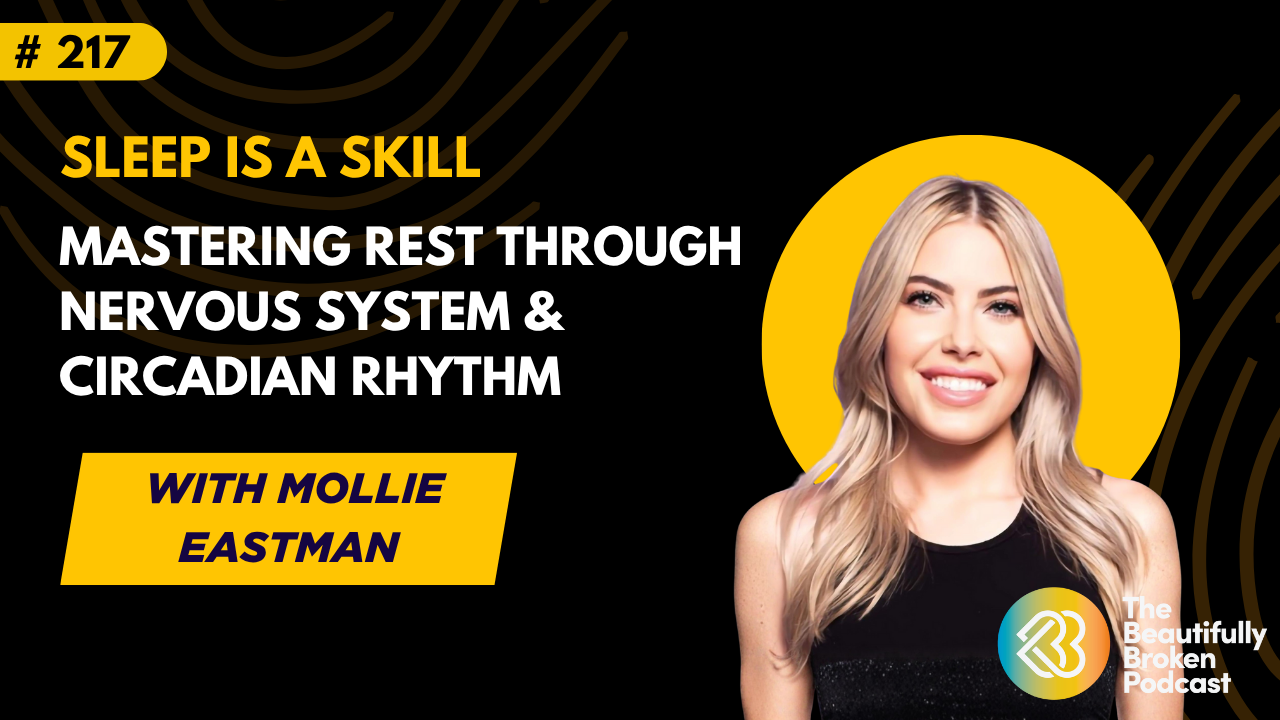
WELCOME TO EPISODE 217
In this episode of Beautifully Broken, Freddie Kimmel is joined by sleep expert Mollie Eastman to explore the often-overlooked intricacies of sleep and its vital role in overall health. Together, they delve into the idea that sleep is not just a passive activity but a skill that can be developed and optimized. They discuss the profound impact the nervous system has on sleep quality and how understanding this connection can lead to better rest. Freddie and Mollie share personal experiences with sleep challenges, including issues like sleep apnea and paradoxical insomnia, while highlighting the importance of recognizing and managing sleep disorders for improved well-being. They emphasize practical strategies such as circadian rhythm entrainment, the influence of environmental factors, and the value of tracking sleep data to uncover hidden sleep patterns.
The conversation goes beyond basic sleep hygiene to touch on innovative solutions for common sleep issues. Freddie and Mollie discuss emerging treatments like oral appliances and Inspire Sleep for sleep apnea, as well as the role supplements and natural light exposure play in melatonin production. They also explore the effects of detoxification on sleep quality and overall health, offering insights into how clearing toxins can lead to better rest. Throughout the discussion, the hosts advocate for embracing imperfections on the journey to optimal health and adopting a growth mindset to overcome sleep challenges. This episode provides a comprehensive look at sleep, offering listeners actionable tips and cutting-edge solutions to enhance their sleep and life quality.


Episode Highlights
[02:31] About Sleep is a Skill
[10:58] Sleep is a Barometer of the Workability of Your Life
[14:31] Practical Steps to Regulate the Nervous System
[20:16] Bed Cooling System
[28:41] Triggers and Patterns On Our Daily Routine
[33:28] What Does Sleep Apnea Test Look Like?
[49:12] THC and other Supplementation
[01:00:27] Things to Consider When Watching TV at Night
[01:19:55] Your Biology Influences Your Psychology
Work with Mollie
Website: https://www.sleepisaskill.com/
UPGRADE YOUR WELLNESS
Lightpath LED:
https://lightpathled.pxf.io/c/3438432/2059835/25794 Code: beautifullybroken
STEMREGEN:
https://www.stemregen.co/products/stemregen/?afmc=beautifullybroken Code: beautifullybroken
Silver Biotics Wound Healing Gel: https://bit.ly/3JnxyDD
Code: BEAUTIFULLYBROKEN
CONNECT WITH FREDDIE
Work with Me: https://www.beautifullybroken.world/biological-blueprint
Website and Store: (http://www.beautifullybroken.world)
Instagram: (https://www.instagram.com/beautifullybroken.world/)
YouTube: https://www.youtube.com/@freddiekimmel
FULL EPISODE INTERVIEW
EPISODE TRANSCRIPT
Freddie Kimmel (00:00.908)
Ladies and gentlemen, welcome to the beautifully broken podcast. My longtime friend and long awaited guest. Never have I done an episode on sleep, so I've waited and awaited and awaited. For Molly Eastman, sleep is a skill, welcome. well thank you so much for having me and thanks for bearing with me over. I felt like I was definitely the problem in our scheduling for so long, so thanks for waiting for me.
I had to, as we were chatting before we hit record, had to my own kind of divine timing and go through my own sort of realizations in, even as it will relate to some of the things I'm sure we'll talk about today around nervous system management and managing as my business was growing and how to make time for all the things. And now I'm finally in this place where I'm getting excited about beginning to see the possibilities around really truly designing our lives and designing
room for the things that are important like something like this. So thank you for having me. Yeah, I appreciate it. Lots of ah-hahs are going on right now. I know I know it's such a treat to have a guest live a and then to be be in your home. Yes, there's an energy that's not caught on camera or zoom or riverside. Exactly. So I you said you said my business. What what is your business? Like if we bumped into each other in whole foods, what would you tell me? I love that. Okay. So, yes, my my business is a company called sleep is a skill and
And it's really both a belief and a mantra and a company. And it came and was born out of my own breakdown with my own sleep. And what that looked like was about a decade ago, just burning the candle both ends, living in Manhattan. I know you can relate to what that looks like. And as a serial entrepreneur, having lots of ups and downs and all arounds, then in my infinite wisdom, thinking that it was a good idea,
to put all of our stuff in storage, my husband and I, and then get a one-way ticket to travel the world and bring our businesses on the road. And in that process, like the first night we landed, we landed in Madrid and I had a panic attack that first night. And it was suddenly like, did I make a horrible mistake? Like, you know, just it was one of these rock bottom moments in my life where just nothing was working. And so from that night, I couldn't sleep. Then multiple nights in a row and I
Freddie Kimmel (02:24.781)
in retrospect did everything not to do. So I'll certainly share some of the things that if people are finding themselves in similar situations of, know, acute periods in their life with their sleep, there are certain things that can really help with more velocity to get back on track, but I didn't do those things. And instead it became this period of time where it was so challenging and so scary. And really this time where it felt like, I stuck like this? You know, am I losing my mind? Like,
You know, I have a history with my family, has a lot of mental health issues. So the fears for me were like, is this some sort of moment in my life where now I'm gonna be dependent on different types of medications or what have you? And at some of my lowest points, then I went to the doctors and I was actually in Croatia at the time, because we were hopping around from place to place, lots of uncertainty, which sleep doesn't really love. And so went to Croatia and leave with sleeping pills and...
you know, in that moment, just so much fear and judgment and of myself, and just questioning of what is this gonna evolve into and yet desperation and still I'm gonna take the thing to help me sleep. And during that period of time, I ended up taking multiple different Benzos. So, Croatia, they give me Valium of all things, like it was, you know, 1960.
So Valium, then in Budapest was a mix of Xanax and Ambien. And then there was another Trazodone at one point. And then finally, just this whole journey was not working. So we literally took a flight back home to New York, tail between our legs to figure out this sleep thing. And that was how much this sleep problem really played a role in my health, my life, my wellbeing.
And that set me on this journey to really, not just from a philosophical inquiry, but from a place of like, I've got to get this figured out because this is like becoming a real problem. And the process of discovering what it does take to sleep and sleep well was so transformative in my life. And it was so triumphant to be able to start bringing this back and then to move into a conversation of optimization.
Freddie Kimmel (04:41.774)
which I didn't even think was possible for me in the past, because I had known myself as someone that just wasn't a great sleeper. I had a lot of labels. I would say I'm a short sleeper, I'm a bad sleeper, I'm a night owl, it's in my jeans, I'll sleep when I'm dead, and all these ways of relating to my sleep that weren't the most empowered. So to not only then restore sleep and sleep naturally without relying on something, but then to move into a world of, what about optimizing and sleeping better than even I had thought was possible? This opened up a whole new realm for me.
And from that place, then Sleep is a Skill was born and just I couldn't stop talking about it. It was very obsessive and passionate on this conversation. And, you know, so small groups start emerging and start, you know, kind of hosting these programs and what have you. And now today, what has gotten created is this whole not only company, but this ethos that sleep is a skill. And I say that even with my own
components of now I know so many of the things to do for sleep and I know you're been in this conversation for ages too and yet we can still be humbled for ourselves of times where okay even though I thought I had this all figured out now here's a new challenge now I'm gonna start throwing you know jet lag and travel and business growth and stressors into the mix and now we've got to build this new muscle around this area of nervous system management or what have you what it might
pertain to each individual. So that's why I think it's so important to label it as a skill. Like you're never done. It's just opportunity to keep growing. Yeah, beautiful. I mean, I'm raising my hand. Anybody watching this on video? How humbled? Yeah, same. You know, I had just had almost a year of just my sleep was amazing. Yeah. And I just, two or three months ago, I did a solo podcast about how I kind of lost the skill. Yeah. And A, it's
you feel like a fraud. Yes. Because I'm supposed to know and do better. If you're supposed to know and do better, I'm really supposed to know and do better. So it was very confronting for me over this past year to have this period. You know, I got COVID and then ended up doing these toxin panels and discovered all this mold and heavy metals that we're chatting about. And then that was messing with some of my hormones and thyroid. just, there was a whole moment of like, well, I'm going to throw out the window all of my professing because now I'm going to need to go back, be humbled and start
Freddie Kimmel (07:07.199)
a new and I think there can be so much beauty that comes about from that. How about for you? Where are you at? A million percent. I'm always as painful as it is. And if anybody's listening to this episode and you're going through a period while you're not sleeping, like I, I want to say of all the stuff I've been through, it's, it ties anything. I mean, you feel like you're losing your mind as you mentioned. The joy is sucked out of life. Every it's for me. I'm like, even when I'm with all my friends and
they're over and we're in a sauna or I'm at an event speaking, it's like, I wonder if these people really know how I feel on the inside right now, because I'm faking this. Like I'm really, I wanna, it's beyond exhaustion when you get a couple of those nights in a row. So I just wanna say, my heart is with you, but you will get through this. And one thing that we said at the top was that it's nervous system.
Like my nervous system is calling on the shots whether it's gonna allow sleep or not. Now, can things come in like a big piece of metal in the cog like mold, like a hormone disruptor, like a relationship changing its status. You we have all these things that can come in and like rock the ship, but that is to be human. So I find where I'm at today to answer your question is even being brought to my knees with this humility, I find
really incredible clues there that I never would have discovered had I not been brought to that base layer of sleep defibrillation. the one, I mean the big thing, like it's just, it all comes back to nervous system. However we're gonna do that and we can't force nervous system. The first thing I did when I started, I'm like, well let me try peptides and let me try more red light and let me try.
you know, I started to really go outside of myself for these external things that I were gonna fix the sleep problem. I should have just grabbed a ticket. I should have gone to an island. And I should have just stayed there for two weeks. And just been near the water in the sunshine and eat. That's I should have done that. Instead, let me go to, you know, my precision medicine clinic and get.
Freddie Kimmel (09:28.129)
fancy formulated IVs and do all these, I can't, if I were to tally up all the money I spent in the crisis situation. Because like you, I also had COVID twice. I had it back to back. And I think one thing that's interesting is, whatever, I'm not a virologist, but it's very unique. This is a very unique virus and it's definitely the time and duration that it tends to stay in the brain, especially
blood brain barrier. A lot of the medications on the market now are not crossing that barrier. That's why I always tell people it's good to stack things with the zinc, with an ionophor that's going to get in the cell wall. And you're going to have to do things to mitigate, especially a back-to-back infection. So yeah, I've learned a lot today. That's where I'm at. that's so beautifully said. And I think so many people can relate to that. And even if you're someone listening that's like, well, my sleep is OK. I'm just interested in optimizing. Don't worry. We'll address that too. But I think for those of us that
at some point, many of us will have some period of time where it really is becoming problematic or concerning or stressful or what have you. and I think what you're pointing to is so beautiful because one of the things I say often is that sleep is a barometer of the workability of your life. And what was clear for me in this past year was that how I was managing my life was no longer working and sleep became this very loud symptom.
that really to your point does have you come to your knees and suddenly, you know, the things that you would brush off to the side are not gonna work anymore. And it was a beautiful wake up call. Sleep continues to be my teacher. And this was the second real time that this was such a huge teacher for me because what I saw the first time was the need for bringing about these beautiful structures that we were always talking about circadian health.
you know, leaning into nature, having a lifestyle that aligns with the rhythms of nature and how so much kind of falls into place commonly with that. And I think what I also, I saw in that did a lot of the heavy lifting, but then this last time, what was so important was seeing that.
Freddie Kimmel (11:40.151)
kind of what you were pointing to of the going outside, know, we're trying to like all these external things to fix and change. And was exactly what I started doing. Cause I have so many things at my disposal as well to, you know, support sleep that are external. And finally, it was a beautiful kind of full circle to go within as well. And this was very new for me because for so long I've worked with clients and it was very clear they're dealing with stress issues and what have you. And for them,
breath work, meditation, yoga, all the things. But over here, I'm too busy for that. I got it. And so finally, I had to sort of eat my words and start practicing what I preach and really starting to go within and starting to do some of this work that I hadn't done. I know we were chatting about some of this really powerful stuff around looking at past traumas. And I grew up very
low income in Maine and a trailer and lots of shame and welfare and all kinds of you know background stuff of not that that was the only piece but just it's like a flavor of some of the stuff that I've been suppressing or not dealing with and then
you know, today it's about to be 40 going into in March. And I think just a lot of big questions are up there. So I'm not, you know, trying to make this a whole thing about me, what I'm saying is instead for each and every one of us, what we find is that there are periods of life, like you said, like major life changes could come about, like, you know, a relationship shift or a loss of a loved one or something happens. And
there can just be times where sleep becomes the symptom. And what I would like to underscore in this conversation too is the opportunities that can come from that because I would be very frustrated and mad almost at sleep. And yet what I finally always get to see on the other side of this down the road is that it's the biggest blessing because it has such major needles get to be moved. you we can certainly talk about what some of those needles might look like for people. Yeah. Yeah. It's fascinating.
Freddie Kimmel (13:45.735)
And in this field that we're in where we have so much information, we have so many experts, how do we drill down and create like, it's not the quick start guide, but there certainly should be something that people should go say, okay, I know I've got to have these six or seven things taken care of, and that is my checklist. Do you have something like that in your lexicon? Yes, okay. So you're coming to this conversation.
And most likely you want some practical takeaways. So beginning at the top, what we do at Sleep Is A Skill is we've really kind of created this framework around circadian rhythm entrainment and circadian rhythm entrainment being the overarching umbrella. And so going through that from a series of kind of order of magnitude.
So meaning the first one, which you alluded to, the beauty of just like, maybe I should have just gone to an island and just had that helped to regulate my nervous system. We know that there are physiological shifts that would come from taking that step. So part of that, what we call our first step is our light dark timing. And we do that intentionally because that is the most impactful zeitgeber, time giver for circadian health.
So we begin there and how can we design our kind of circadian crafted day to facilitate that you're maximizing, know, that balance, that two part system to your day, wherever you might be on the globe. So we're minding that and we're doing the work that we need to do to get brighter days and darker nights. And for most people that might seem like an obvious piece, but often as we kind of audit our day from the moment you first wake up till the moment you go to bed, there's typically things that many of us are just
doing or in our environment that we could tweak that can often make a measurable difference. So we start there. And then one of the next anchor habits underneath that is consistent wake timing. And I say wake timing intentionally because wake timing is something we can all control. And yet when we are dealing with issues with our sleep, to use myself as an example, what not to do when I first went through this, I had no idea what I was doing.
Freddie Kimmel (15:54.381)
I was jet lagged and so I was even more upside down with my kind of internal clock system. And so once I would finally fall asleep, I would say, thank God. Okay, I'm gonna sleep in super late. Just try to get as much sleep as possible. Maybe I'll take a nap at random times. Just whatever I can do to get sleep in my body. And not realizing how much that was then throwing off things for that subsequent night and just creating this vicious cycle.
So instead, what so many of us can do, and this can be a little painful in the beginning, but if you just trust the process over time, and it will often take, especially depending on how much stress we're dealing with and what the elements are, if we just stick with this for a few weeks, some magic can start to happen. So say you pick 7 AM or whatever. So 7 AM for seven days a week.
What's beautiful is in the beginning, you may have some really rough nights where there's a couple hours or whatever logged if you're really struggling, but then you still stick to getting up at around that 7 a.m. And we do have some variance, say plus or minus around 30 minutes or so. Maybe if there's other things going on, sickness, et cetera, we might swing it a little bit more. But for the most part, for most people, can we have it be about exactly around that seven plus or minus 30 minutes? So.
What you're doing there is beautiful because then it starts to train your strong circadian pulse to be pulsing at around that same time. So then you can start to actually wake up with more velocity and kind of natural coffee in you, if you will. So once we get to that point, when we want to be able to have that kind of experience of feeling fully awake and what have you, that's handled. But then maybe more importantly, or just as important, is then the pulsing of that
cortisol pulse in the morning is then tethered to when you're going to have your melatonin pulse in the evening. So if those poles keep moving all around with our inconsistent wake up times, then there's a lack of count on a bullness or count on ability for our ability to be able to get tired at the times that we want to get tired in the evening. And the magic comes when now we start to actually get sleepy at around the same time. And you just don't even have to think about this stuff of like the
Freddie Kimmel (18:08.555)
difficulties of sleep latency, which many people with acute insomnia periods, they're just like not falling asleep. Or if someone's listening and they say, well, the falling asleep is okay, it's the wakeups throughout the night, which is another very common one. We do also need that strong melatonin pulse to last and sustain us throughout the entire period of the night.
But then also, we need to manage our nervous system so that the morning cortisol isn't then waking us up earlier. And then there's many other reasons for wake-ups, so we can get into those. But going down that rung, so we've got light-dark timing. We've got our wake-up timing. Then we have temperature timing, which is a fascinating one, how much temperature will play a role in our ability to fall asleep with more ease, stay asleep, and then get quality sleep throughout the course of the night. I know you and I are big fans of being able to cool our
Bedroom. mean, yeah, again, I, you know, there was a sleep me situation in my bed and it's not there anymore. And it's, I really miss it. Yeah. I mean, I really miss it. And I find it's so funny cause this isn't my house, but something like the seasonal timer on the nest temperature control system is like some, for some reason it's firing the temp to 78 degrees at like one in the morning. And I'm like, it's waking me up and I come out.
And it's an auto, I just haven't figured out to reprogram it. So I have this like, it's like project wind tunnel in my bedroom. So I right now I have a bed jet. Yes, I saw that. Okay. I have a bet I'm using the bed jet. It's not my favorite thing in the world. But it was like, it's better than nothing. And I got here like overnight through Amazon. Okay. Yeah. So yeah, I'm doing what I can. And I have actually like a spinal
It's like a rollout spinal cooling system that I put in the freezer every night. I put it under a towel. my gosh, yes. And it keeps me relatively cool. But man, I really, my scores were markedly better with a bed cooling system. totally. It's one of the fastest things, ways that I'll see impacts on people's stats. for context,
Freddie Kimmel (20:14.655)
One of the things over the years that we've done with Sleep Is A Skill is having a large database of Oura Ring users. So we've been able to see so many things that can impact and move the needle with sleep. And so rarely is it like, you know, there are times when a supplement or something could show up, but most of the time it is things like what you were just talking about, the temperature piece, stress management, consistent sleep, wake time and getting outside, know, having darkness in the evening, just the things that are
take a little something behaviorally or environmentally. And those often move the needle. But you're so right. The temperature piece is huge. if anyone's listening to this and thinking, please, do we really need to spend like $1,000 to sleep? Come on. What I would put in is that there is a thinking that this could be more reminiscent of how we likely slept in the past.
So if we think of our back end for our ancestors, it's likely that we slept on the ground, and that would have been the coolest place in the environment. And so with that, it was almost like our own natural sleep me or eat sleep or what have you, just that's happening in the environment naturally. And yet now we've gone away from that. We've divorced ourselves from that sort of structure. And now we've gone into these very foreign type of bedding systems where for many people it's like,
foam bedding and just these things that trap and insulate heat. Yes. So much. mean, if we think 98.6 degrees or whatever we might be at, and then we put giant duvets on top under foam mattresses, we're just cooking in there all night long. And so it makes a lot of sense that then we would be having more frequent wake ups and even can change the architecture of our sleep too, because we know that temperature is coupled to the types of quality of sleep that you get. Yeah. It's so profound. Yeah.
It's so profound. So that was a big one for me. Is there anything else on the tier? OK. So now we've got our light dark timing. We've got our wake timing. We've got our temperature timing. Then we've got meal timing. And so I'll just scan through all of them real quick. So we've got meal timing. We've got exercise timing. We've also got thought timing. And that one I'm going to be putting a lot more content out around. One, because I went through my own period this year of dating to really start diving into even more modalities there.
Freddie Kimmel (22:35.661)
But two, because it is so crucial, thought timing is looking at an understanding that one, our thoughts exist on a circadian rhythm, which is only kind of newer research that we're starting to understand there. For one thing to allude to, to exemplify this, there's a study called the mind after midnight, where what they discovered is that the types of thoughts we're having after midnight or proverbial midnight for you, whatever your...
the sleep-wake schedule is your wee hours of the morning for each person, that those types of thoughts are very different than our daytime thoughts. So those type of thoughts tend to be more kind of black and white thinking, catastrophic thinking, anxiety-laced, and sadly have real-world consequences because they did find that suicidality rates would seem to go up in those wee hours of the morning. And so people actually acting on these types of thoughts.
So really a very real impact if we aren't aware of some of the natural changes that might happen with our thoughts. And then if we have some empowerment around knowing, so there's likely some kind of flawed logic going on in certain windows of our nights so that we can start to maybe create a personal contract with ourselves to not believe as much of what's going on with those thoughts, but to also then help facilitate an environment where we are
ushering in certain types of thoughts and then not, and setting up a situation where we're not indulging or engaging in types of thoughts that would be problematic at the wrong time. So meaning, like, you know, my husband Blake, so out of New York, straight talking New Yorker. So he'll give me a taste of my own medicine all the time at, you know, say it's whatever 10 o'clock at night. And then I start wanting to talk about.
I don't know, something that's been stressing me out or whatever. And so he'd be like, is that great thought timing? Come on. So really having to rein ourselves in. And it can even be eustress. So it could be exciting things. So my god, yay, let's talk about the trip we're going to take and blah, blah, But are those the types of thoughts we want to engage in at those times? Are those going to be wake promoting, or are they going to be down regulatory? So that looks at the thought timing piece. And I'll also say that for most traditional approaches to sleep,
Freddie Kimmel (24:50.689)
typically we do begin there for most people. if you, what the general golden kind of approach to sleep right now is supposed to be, if you go to your doctor and you say you're having trouble with your sleep, CBTI, cognitive behavioral therapy for insomnia is supposed to be first line treatment. It doesn't always happen, but that is supposed to be where we begin. And that really is meaning to tackle with our thoughts a bit more. And there's other structures in place, but.
there is a psychological aspect to that piece. So that's huge and it does really have high efficacy. So it's important to know about that. And then the last one is chronopharmacology or the timing of our drugs and our drugs. Cause you could do all these things if you're doing lines of coke or something at 10pm, then you're probably going to be in trouble. So we want to be aware of what types of drugs we're doing. And then for the most common ones being like,
know, caffeine, alcohol, THC. Yeah. But then even our supplements. And there might be certain things that well-intentioned that we might be taking at the wrong times that could be impacting us in a way we might not be so desirable. So that kind of gives you the general framework and overview. And for different people, there might be different ones that really stand out more than others. Maybe they're doing a lot of these things, but they're totally sedentary throughout most of the day. So the exercise timing is going to be key.
But for most, as an example, but for most people, there's little tweaks that we can do in all of these categories that can really result in not only improving our sleep, but our life as a whole. Yeah. So profound. I mean, I can see myself. like, at certain times, I'm climbing that ladder. I'm like, that's great. that sucks. That sucks. Totally. Same. It's funny. I have this list of things that I'm like, I know I have to commit to. Yeah.
I say to myself that it's like conversations that involve a high emotionality can't happen at nine or like eight o'clock even. Like, because I'll be, if I can't bring it to a resolve, I'll personally be ruminating. Like I need those conversations to happen in the morning, midday. And that's been really, really helpful. Things like for me, I get one cup of coffee.
Freddie Kimmel (27:11.251)
and my two caveats. So I like you, I went off coffee for a month, full month, in my lowest low of like not sleeping. I didn't, surprisingly enough, it was not a catalyst, I'm sure it helped move the needle. But what I noticed was, is that I was starting my day with caffeine. I was getting up and I was like, God, I need a kick in the pants. I would go over to the mocha pot, start brewing. And what happened from that,
sleep interruption is that I basically now delay caffeine. allow my body to be up. I get outside, I take a shower of an outdoor shower. So I shower outside. So that's my 10 minutes of morning sunlight right, right when I wake up and I go to the, try to go to the gym. I try to go right and get my workout. So it's like, earn right. If there's a catalyst, there's muscle, there's fascia gliding, there's piezoelectricity happening, all the things, breath work.
And then I get one cup of coffee. And I cannot deviate. I can't do a cup of coffee afternoon. I'm a very slow metabolizer. I've looked at my genetics to look at this. And then the other thing that's really interesting, chocolate. even a little bit. I make these great paleo muffins, which I have up on the counter. All organic, but I'll do organic chocolate chip chunks. And if I have a muffin or two, I've noticed that I get this second rising.
not dissimilar from a cup of caffeine for me. It's really, it's a strong pull and it's not enough that I would have been like, I'm eating too much chocolate. It's like, you know, seven chocolate chips, but sensitive soul. Sensitive soul. And I think that's what's so beautiful too is as we start to kind of go through these frameworks, we can begin to notice and identify what are some of these triggers for us and patterns that start to come up routinely. And then we tweak and hopefully going into it with the mindset of
kind of experimentation, progress, not perfection. And I know that's easier said than done, because when we are in those acute periods, just want it fixed. We want it fixed. We want it fixed. We want it yesterday fixed. And yet just, I think there's a couple important things too, if anyone is in that state, is knowing that we can sleep. We absolutely can sleep. And sometimes we can start to think, well, maybe I did something and I messed up.
Freddie Kimmel (29:33.261)
some switch was flipped. And it can be very concerning. And just knowing that we can sleep, knowing that, however, sleep is this process that often can take some time, and it can require some gentle shifting. And yet, over time, it can be one of the best things that ever happens to us these periods of time, because there's going to be such growth that often comes about from this. And so I think just holding onto that is important.
Now the last thing, would be really a problem for me if I didn't mention that there are over a hundred sleep wake disorders that are also present that so many people have no idea that they're dealing with and that they could have recently developed and they might not have had them before. So an example and very common example is sleep apnea. So, and also important for men, especially too, because we're finding
that for men in changes, even small changes in weight, but also adding in of testosterone can be another thing that can start to flare up sleep apnea for some, I'm not saying always, but I'm saying we're seeing tendencies for some people where sleep apnea might start to arise. The severity might go up if we then add in testosterone too. So there's some questions on the why, but that seems to be common. Now, another thing that seems to happen is for women,
while we are less likely to have sleep apnea when we're a bit younger than men, we still can certainly have it and still so many people undiagnosed. But once we get often around over the age of 40 as part of the thinking, as our hormones start to shift, then we become closer and closer and eventually one-to-one with our likelihood as compared to men of developing sleep apnea.
So even if someone's listening and it's like, yeah, back in, you know, whatever, you know, couple, 10 years ago, whatever, I tested and I didn't have sleep apnea, you could have it now, even though you didn't have it before. And it doesn't always look like the avatar archetype that we might think of. My husband has sleep apnea and he's not like wildly overweight or something. would have, I'm telling you, never really have known, except for the fact that I get sent all these tests and he's my guinea pig.
Freddie Kimmel (31:56.029)
and discover the sleep apnea. So, you he's an example, because I have permission to share, but as far as so many clients that were just, they were adamant, I don't need to test for this. I do not have this. They're like, I'm active. I run, I'm not overweight. I'm this and the other. We test, they have it. So I just want to put that out there because it's a huge one. And then even if it's not sleep apnea, upper airway resistance syndrome is another one.
So if you're someone especially that deals with a lot of wake-ups, then that's one of the first places that we always want to make sure we're not kind of stepping over. And if you're tracking, if you see a lot, say, like aura, like those little white ticks throughout the course of the night, or whoop, if you have lots of those wake-ups or any tracker, then that would certainly be a place that I'd want people to begin. You can test at home now for typically under about 200 bucks. Amazing. It's totally amazing. Also,
I am kind of Nostradamus style saying that I proclaim that we're going to see a lot of new instances of people realizing they have sleep apnea, partly because Apple just came out with a new sleep apnea detection component on their watch. And it seems to be pretty exciting. And then there's other tech that's going to be doing the same thing. So Withings has a little pad that you can sleep under, and that can help detect sleep apnea.
There's other tech that you can be sleeping on that's coming out that, you know, stay tuned, that will also be able to detect sleep apnea. So I think we're going to have lots of different angles now at more people that would have never even thought to test to getting this realization realized. And then there's also tests that you can do at home that are even closer to in lab than we ever had before. So those are really exciting, a little bit more expensive.
And those can also test for things beyond just respiratory based sleep disorders. So those we can get things like periodic limb movement disorder, restless leg, et cetera. Cause there's so many other sleep disorders that people just might have no clue about. That's wild. What's the home at sleep apnea test look like? okay. So how do they do that? I know. So there's a couple different ones.
Freddie Kimmel (34:06.261)
So probably one of my favorites is the sleep image ring. And that one's just a little ring. And you put it on. And it's easy breezy. And you just go to sleep. And then you can get multiple nights, which I love. Because sometimes people, especially if they're dealing with sleep issues, they might have some performance anxiety and the sense that, god, I'm spending this money. I only have one night. I don't want to be embarrassed with the doctors and stuff to show two hours of sleep or something. So people will get nervous of that one shot.
And whereas some of these, like the ring, can just give no fears because you have lots of nights. And then with that, you just have nothing else to do. Now there's other ones like the watch pad. That's a really popular one. Now that one will have a bit more of a watch. And then kind of there's some stickies that you use, but overall pretty easy.
The more elaborate one that I was sharing about that's newer, that one, if that's often, if we test with the more affordable one and then we still have some questions based on what we saw there, I mean, you don't want to go in lab, then you could take the next step to get the more elaborate test. And that one does have a bit more things that you got to shave a little spot. Got it. A couple of things.
But it's doing that because it's giving us way more data about like, are your legs moving at certain times or your limbs moving? It's giving us tons of information. And those are all at home. And then of course, many people realize that they could go in lab and sleep overnight. And just so people know too, they are getting better at having them be less sort of awkward. Many of them are actually in hotels. So you could just, it's like a night at a hotel. Have you done an in I haven't done an in lab, but I am.
gunning to do one to get some good content and go through the whole thing. So I've been in them, but I haven't done that. So interesting. And what information did it give your husband? What Blake? Okay. So what he got back was that he had rem dominant sleep apnea. and so his was mild, but still it could, so it's important for people to know too, that your sleep apnea severity can exist on a spectrum and it's dynamic. So
Freddie Kimmel (36:14.349)
What we discover is that there'd be different times where it really flare up. And what are some of the ways you can flare up apnea? You can eat later. You can have types of foods that can be inflammatory and kind of add to congestion, block airway. You can gain some weight. You can have some alcohol. You can sleep really flat instead of using gravity to your advantage. Cause a lot of this, if you think about it, it's trying to ensure that we're not blocking our airway with our tongue going back.
But there are other things for different people. So if someone has block in their nose, so I just got two surgeries. I don't know if I shared this with you. okay, this has been game changing. This has been one of the fastest changes to both respiratory rate for me and HRV was just in September 30th, I flew to LA for one day and then got a tongue tie release.
And then got this thing called Viveir, which is amazing. I think so many people should do this and I'm not affiliated. It's like a medical procedure, so I can't be affiliated. But all it is, it takes about 20 minutes. And so you use radio frequency, goes in your nose, and then it literally kind of like burns part of the inside of your nose. It expands. I had a deviated septum that I didn't even realize about for so long. And yet I knew that I would kind of.
breathe in certain ways and there'd be like this collapsing and I used intake, which I think I saw you have intake, right? I have it. have a trial one over there. Yeah. Okay. So I was using those and all the things, whereas now it's been amazing. It's overnight. My respiratory rate dropped about 1.5 breaths per minute. So it just nose dived, which is amazing. I've also experienced like less anxiety throughout the course of the course you're oxygenated. mean,
And then with the tongue tie release too, that's also been amazing too, because I was more clenching and poor vagus nerve was like, you know, just dealing with all of that. And both of those can impact sleep. And those are just two examples of things that might be out of, you know, kind of a blind spot for people that each one took about 20 minutes. So 20 minutes for the nose, even less for the tongue tie.
Freddie Kimmel (38:25.901)
And you had to go to LA to do that, the radio frequency? So you totally do not have to go to LA. I only went to LA because, so the Breathe Institute is there, Dr. Zaghi is the GOAT as far as tongue ties, background at Harvard, Stanford, UCLA, a part of, I think it was last I knew, 90 something papers that he's been a part of around understanding some impacts around tongue tie and anatomy on how you're able to breathe.
So I did go to him for that process and he's amazing. And then while I was doing the tongue tie, it was like, okay, I've been wanting to do the Viveir, so let me just do both at once. Yeah. incredible. I highly recommend people check this out. The way that you see if you're a candidate is called the Coddle Maneuver. And you literally press here and kind of expand and pull back and see if you can breathe better. So much better. Okay. Well, you should probably do it.
my deviated septum is out of control. mean, even from a little kid, they wanted to fix it. And I just haven't done it. If you want moral support or whatever, can come with you. I am such a fan. I can't even believe it. And I'm really just feeling it. I just didn't want to get a nose job. Yeah, exactly. Yeah. Yeah, so for this, a lunchtime procedure, really, I want more people to know about it because I just can't get over how different I feel.
And I was sharing that I've been doing all these yoga classes, whatever. And I'm seeing that even the ohms, I used to be one of the first people out of breath. And people are like, how are people going this long? What's going on? Now I can ohm until the end. That's probably not a good reason to get this done. But it just exemplifies how much of a, I just didn't know what I didn't know. And to experience that. And that's a really fairly affordable, as far as surgeries are concerned. This is around
2K each in most states and often what I've heard can be covered by insurance for many people. So highly recommend checking out these things. So cool. But it all goes back to this fact that there can be things that people might have no clue about that could be really, really messing with their sleep results.
Freddie Kimmel (40:37.005)
And if we think that maybe our primary care doctor might spot these red flags, unfortunately right now it's unlikely because the average doctor has around two hours of training, even out of Harvard Med in sleep. And it's unfortunate considering it's something we do a third of our lives on average 26 years are spent asleep. If you're doing your New Year's resolutions or something, four months out of the year are gonna be spent asleep. So if we're not doing it well,
You know, it's gonna impact so many areas. So I think that behooves us to learn more of these elements. And once we get some of this heavy lifting done, then we get to just reap the benefits for years to come. Yeah, so profound. There's, yeah, I have so many ideas spinning off my head. I'm like, I gotta do this and that and that. yes, okay, perfect. I mean, what did your respiratory rate go down to?
Okay, so I was stressed. So I was in like 14.3 or so, 14.5 at different points, what have you. So now it's been down to at its lowest 12.8, 12.9. That's great. I mean, overnight. And then overnight my HRV went up to over a hundred, which for me is higher than I normally am getting. So that was for multiple nights in a row. Then I did go into Ludiol, so it came down a little bit, but.
TMI but but then it's still been markedly higher than it had been. Yeah, or so that was a big deal So amazing, right? What a win and so back to Blake. Yeah But did he have to wear like a Mask at night and have a machine. Okay. Okay. So in case anyone's listening and saying the sleep apnea topic move on like I'm not gonna wear the Darth Vader mask or whatever So just skip it
Please don't do that. This can be so life-changing if people discover this. So what I want people to know is that there are so many new treatments that we didn't have ages ago. And so two of the ones that he did, to use him as an example, Excite OSA, which is like a TENS unit for your tongue. It's the only daytime treatment. And I actually have been using that for my tongue tie release to build up my tongue tie muscles now that it's not, you know, glued down to the bottom of my...
Freddie Kimmel (42:50.957)
you know, mouth, then I'm able to move it more. So I need to build the muscles. And so you can use this and it just kind of clamps onto your tongue and you can be whatever, do an emails, you can do whatever you And then 20 minutes a day for you did around like 45 ish days. But then after it moved to like a maintenance period and so it's just a few times a week. So for many people that can be enough for a mild sleep apnea. And then
But if that's not enough, it might be in conjunction. So you might do that along with oral appliances, which is another big one. So getting outfitted actually here in Austin, Sleep Better Austin is a great spot that they can help get a mold and get you, know, kind of great oral appliances that then you just put that in and go to sleep and it's moving your jaw forward a bit so that it's opening up your airway and helping so that the tongue isn't falling back.
So that's that. Then there's others though, depending on what's going on with your anatomy. So if it's more of a palate issue, like if there's not enough space for your tongue. So, and we're seeing so much more of this, this is a bigger conversation of like the why is it? Cause we're not getting outside and getting enough vitamin D. What's happening with our structure of our face and mouth breathing. It's a whole bigger topic, but the fallout is many of us don't have these more expansive palates that we used to have seemingly in the past.
So now there are procedures that we can do. Vivos is one, Marpy, there's different things that we can do to expand that palette and help really shift the size of our airway. I mean, I was just talking to someone the other day that was able to double in size their airway and just the difference that they feel is like just night and day. So those things can all help kind of get to the root of it more, but for some people it might be that.
paired with the nose, so if we've got the deviated septum maybe going on or other things, then it's kind of at all angles and we're struggling. And so then we're having this more of a stress response than we might want to be having. And then we're dealing with then sleep deprivation or poor quality sleep.
Freddie Kimmel (44:53.533)
So it's kind of this vicious cycle that keeps going. So those are gonna be some things that could be available, but there's more. There's Inspire Sleep, which is almost like a pacemaker for sleep apnea. There's lasers. You can do different types of the mask if people do wanna explore the mask, which is the gold standard, I will say, especially if you have more moderate or severe sleep apnea.
but there's things that you can use that can almost use like magnets on your nose instead of if you might think of a huge mask and you're all feeling claustrophobic or whatever. There's magnets that can be used like bleep sleep is called is the name of one, which will just clip right onto the nose and then you're more freed up throughout the night. So the big goal here is I would like to see a future where we have more of a bit of a sleep concierge system going on where we have
airway trained dentists so they can help be more of the gatekeepers and they can help spot certain signs, that we'd see ENTs really at the helm. So then they could say, but you know, yes, use that oral appliance, but don't forget about the nose with the blockage that we have going on. So we're treating all of these things. And then of course, sleep doctors as well. So we've got like a team so that nothing's being left, you know, unhandled. Yeah, it's so important. And this is just,
Again, primary care is not going to deal with any of this. Yes. You know we're going to treat, palliate. Yeah. So I think that's a really good thing. What about, I want to just touch on supplementation because that's a big thing, right? We're in the realm of human optimization, especially this camp, people listen to this show. Yeah. I mean, listen, I definitely have my stack. For me, and I'd love you to just give some quick fire on this, I
I typically, I can do like a little bit of THC from like a pen, and it'll help me wind down when I feel like I'm not able to get in a state where I'll sleep. do notice, HRV is not as good. Yeah. And I do notice that cognitively in the morning, it takes me a while to like feel like I'm on all 10 cylinders. Yes, well said. So here's what we see with THC. And I do think.
Freddie Kimmel (47:05.847)
there can be real spectrum for this. can be times where it's so important for us to know about these tools, because it can be really effective, say for dealing with pain, cancers, et cetera. To have that at our disposal could be absolutely a better choice than certain other pain medications. And there might be times where you would still prefer a little bit of that sleep over like a whole night of very little sleep, depending on what's going on for you. So there are times where it could be useful. And yet,
Our concerns with THC are that one, exactly what you said, we often do tend to see heart rate go up a bit, respiratory rate go up a bit, temperature go up a bit, heart rate go down, sorry, heart rate go up, the HRV piece go down, and then REM being often impacted with THC. And so the thinking is that might be part of why...
we're often having that kind of sleep inertia in the morning that's more augmented. So all of us will have some form of sleep inertia. It just makes sense. We're going from this whole altered reality of dreaming and whatever we're doing in the sleep state to being awake. And so it makes sense that that's never probably the best time to send an important email or go on social and start commenting on things or whatever, because you're still kind of in this twilight phase. So everyone goes through some form of that. But if we're sleep deprived or it's undis-
diagnosed or untreated sleep disorders, et cetera, et cetera, we might really have more trouble and more zombie-like feeling. And if we aren't getting sufficient REM the night before, which you can almost think of as like your inner therapist or that piece that's really helping to support our emotional regulation, part of that energy system, et cetera, it does line up with exactly your experience that.
you would feel like that the next morning. Because it just wasn't as maybe optimal of sleep as possible. But if people get confused or there are questions around this, because some people will see, well, when I take THC, I'm falling asleep so much faster. And I'm sleeping longer for some people. Like sleep duration improves. it can get layered. Now, I think trackers can help with this. Because the trackers can get more nuanced in showing, actually,
Freddie Kimmel (49:22.637)
It looks like my nervous system was struggling to recover though with all that sleep. So interesting, but I do think there's something to be said too for the dosage and and I do think there's a lot of promise and more intrigue and excitement around CBD and CBN for sleep and then maybe playing with the ratio of like a small amount of THC could that be helpful for people and maybe Delta 9 and different things for anxiety? So I think it's just useful to have it different
depending on what's going on for us. like for me, maybe if I have a long haul flight or something that I'm gonna be gearing up for, that might be helpful for me if I have to go to bed at certain much earlier times or just things that really throw you off or you're very jet lagged. It can kind of just help to getting things back on track, but it is a slippery slope for many because then once we see that, this is this thing that can help me.
that overnight's important. So suddenly, you know, might find yourself a little kind of addicted, but also you might find one important thing to know is that rebound insomnia can often come about when we get off of THC if we've been using it a lot. And then also rebound REM can come about. So if you have been suppressing your REM, then lots of REM tends to come about. And this can be concerning for a lot of people because they might have
very vivid dreams or the dreams when I might be waking them up and stressing them out. But it is important to know that that will pass over time. just if you can bear with it for a little bit, that kind of tsunami of dreams that were blocked for a while are now going to come out, but it will go back to homeostasis. What about now melatonin is a huge can of worms. Yeah.
and I've done everything. Most of my wellness duration being in some area of the know, I've said I shouldn't be taking this like innate hormone that's already inside me. I should be complimenting its production. But I've tried the high dose melatonin suppositories sometimes when I'm traveling. Really interesting. I'd love your take on that. And then even like some of the mitos and John LaRons has like a high dose melatonin.
Freddie Kimmel (51:40.557)
200 milligram trokies, which in this, again, in this last interruption of sleep, I happened into a store and they happened to carry mygyoza. I was like, wow, I think it was a live and well. yeah. So I grabbed some from a live and well and I was like the first couple nights I had a really, I was like a groggy in the morning. But I was like, wow, I really had my respiratory rate went way down. Heart rate variability went up.
I had some good results from it. And then clearly, like two weeks in, it wasn't fixing the problem, which was nervous system. Exactly. Again, I believe I've drawn my working theory to nervous system. What are your thoughts on the high dose melatonin? Yeah. So I will say that I am still very, remaining open on this topic of melatonin because
I do think there's a lot of caveats, a lot of times where it can be useful, other times where, you know, maybe is it more of the band aid or is this really the root cause for each individual? that the going to give us the biggest bang for our buck or are there other things we could be doing? So what I mean is that for most people, what I'm seeing is that if we address sort of that top down list that we're sharing, you know, the light, dark piece and really understanding what that would look like. Like, I know you're way well versed in this, but the
average person, as I go through their day, often we're finding they're barely getting themselves outside. They're wearing the sunglasses. They've got the bright lights in every room and the whole, you know, some of these things that once we start, managing some of that, they're able to create more subcellular melatonin. Many people don't realize that your ability to make subcellular melatonin is dependent on how much you are getting outside during the day.
And we used to only think that it was more brain-based production of melatonin, not realizing that this is a full body experience and that's created within the mitochondria. So these are all new kind of developments. So once we start teaching people that the light outside is going to support your ability to make melatonin at night, that can be a real game changer. Cause most people think of melatonin as the hormone of darkness, which it is.
Freddie Kimmel (53:52.929)
but it needs that fuel from the day. So it's very confusing. It's all a Chinese cookie. You need the yin and the yang. You need the black and the white. Always. Totally. 100%. And I love that you said that because I always say it's bit of a Chinese finger trap with sleep in that we're, you know, the more we try to force it, like if anyone's trying to force sleep to come, like, please, you're way stuck. So it's just like the letting go and that's another topic. so the evening, then having sufficient darkness at night.
most people are not really experiencing what that looks like. And so, and not realizing the numbers that we're talking about, how much this can impact melatonin production. So there are certain studies, there's one study that found that 30 minutes in ordinary room lighting depleted melatonin production by nearly 90%. my goodness. you know, these are just some examples of how much are just generalized and often familiar and comforting, you know, kind of behaviors. I don't know about you, but like,
that for so long it was a nice thing. I'd go to my Nana's and there'd be nice lights all over the place. And you're just like, that's what you do in the evenings. It turns out that that's really messing with our sleep results. So it does take a lot of shifting. And so for most people, even just that piece alone, we can often start to really bolster how much melatonin is being produced.
But then if we go down the line to these other pieces, the consistent wake timing, that's going to affect the when and the strength of the melatonin that you produce. So it's not pulsing at the wrong times. But then the temperature piece is a big one too. We know that it does appear to be supportive of the cold therapy, heat therapies, but then also having proper warmer body by day, cooler by night can help facilitate the production of melatonin at the right times.
But then the meal timing one is a huge one that we see for impacting our ability to make melatonin. So we know that we had Dr. Sachin Panda on the podcast last year, which was one of our most listened to podcasts. And he wrote the circadian code. And one of the things that he pointed to was that in their finding, when the pancreas is turned on by just eating anything, it could be healthy, it could be not healthy. But at later times into the evening,
Freddie Kimmel (56:07.947)
then that appears to be impacting the body's ability to produce melatonin. So how many of us, mean, most of us, we know that there's a wide range of the population that's eating most of their waking hours. So it's not allowing the body to produce sufficient melatonin because the pancreas keeps being turned on and now the body is like, well, I guess we got to be awake to use this energy for something. And so that's going to impact that supply as well.
Not to mention exercise timing. If we're not moving our body enough, we're not having sufficient muscle mass and more, so then that's going to impact our ability to have these proper systems and hormones in place. The thought timing piece, if you're cortisol going up into the evening, which delayed cortisol pulse is a signature of often insomnia. So many people are actually getting stressed exactly at the time that they need to go to bed, and that could be.
problematic, but melatonin and cortisol are like connected, but they're not like best friends. They don't like to play together and they don't play together very well. So if cortisol is pulsing, then melatonin is gonna be impacted. And then lastly, if we have that chronopharmacology piece and there's certain drugs then we might be taking that are kind of keeping us up at the wrong times, then that could also impact that. So I say all that.
because often I find that most people I'm talking to, there's little levers that we're pulling with all of those that our innate production of melatonin can return to be supportive of our goals with sleep. Now there are exceptions and there's certainly situations in our modern lifestyle with lots of travel and long haul jet lag. do see efficacy for utilizing melatonin during those times. We do see efficacy for if you've.
moved around your sleep-wake schedule all over the place. You were doing what I was doing and doing the wrong thing. You're sleeping late and whatever. Melatonin can be helpful to kind of move things back. And so you can have it triggering at the right times for sufficient night after night at the times that you want them to be firing. So you could utilize that. And then there are cases where people talk about cancer and high dose melatonin. Certainly viral load, we saw melatonin.
Freddie Kimmel (58:22.025)
become more invoked during COVID. So I think there's a lot of excitement or interest around that. I do think we need more research. So I'm not fully throwing that out, but I do. Just my biggest message is that I think most people have no idea how much these other behavioral and environmental pieces could really move the needle. Yeah. I'm going to give you, I've never done this before. Okay, we're almost in an hour. Okay.
I have to go to the bathroom. Okay. But I'm to pitch you a question. Okay, great. And you're just going to say it to the camera. perfect. And we're not going to interrupt the podcast. Although I could just have you ever listen to Rogan. He's like, I got to pee. And then it's like, so we were saying they keep the pee break announcement in the podcast, which I sort of love. I love that. So do you still watch TV? Yes. Okay, so give me your
Give me that, lay out the scene if you will while I take my bathroom break. Lay out the scene if you will. How do you watch Netflix at night given the lux? The lux is the unit of energy that comes off a TV at night. How do you do that and incorporate into your life without disrupting melatonin production and impacting sleep? Go. Okay, great. All right, so for anyone listening that also is like me and wants to be able to watch TV at night, what do you do? Okay.
So one, what we want to do is blue blockers are going to be supportive of at least blocking some of that light. Proximity is going to be important too. So ideally you're not sitting right in front of the TV like it's, you know, that old movie Poltergeist or something. We don't want to be staring into the TV. We want a little distance, but then I'll also say if you do want to get next level,
There is a company that will even make entire covers for your TV that are custom made based on whatever size your TV is. And they do have different gradients. I believe they still offer this of the intensity by which it will block out the blue. Now I will say this is might not be a fan favorite for everyone. Maybe not everyone under your, you know, the same roof wants to have your TV totally red screened or amber screened.
Freddie Kimmel (01:00:36.417)
But if maybe you live alone or you can get everyone on board, that could be an option that you could bring in, especially if you are watching a lot of TV, you're gonna be closer to that TV that is available. So the company, I know it's under, at least on Instagram, if you search, all know nothing, you can find that one. But also what I would say too is the more distance you can get, like the way you have it set up here,
Thankfully, we've got lots of distance, so it's not like you're bathing in that light. So that's helpful. And then I would say also the amber or red lens blue blockers are going to be helpful. I don't know if you heard the part. I did. listened to it. OK, beautiful. So good. I love that. And so all those can be helpful. Now, I think that this is where the thought timing piece can come in. So one of the things Blake and I will do is if we watch something that's more like,
I don't know, like thought provoking, intense, thrillery, whatever. Then we always say we wash it off with like an office episode or Seinfeld or just something very like familiar. So good. Yeah. That just puts you into a nice state, all is well, kind of brings you back. I think those things are just so important because we might not realize, especially for a bit of denial, which I can say I was during the period when I was leading up to my kind of burnout.
quite realize how the state of my nervous system and thought I was fine. And so you might be someone that says, I'm bigger than that. I'm not going to be impacted. You're probably going to be impacted. Your nervous system just wants to feel good, especially at those in that time leading up to bed. So just being mindful, especially in those key two to at least one hour before bed, having really just mindful, safe, familiar.
a sleep doctor who worked with the Olympics with different participants in the Olympic games. And one of his recommendations was a lack of novelty in the evenings is partly what we're looking to achieve, particularly in that one to two hours before bed. So meaning that that's probably not the time to start a new Netflix series and like it's all new and exciting and glittery that gets your mind going.
Freddie Kimmel (01:02:55.191)
Probably not the time. And so instead, could we just get something very just banal, familiar, light, not going to be too activating. I love that. Yeah, I love the, I've always, Tim Ferriss used to talk about this. He used to say episodics. Yeah. Short episodics, 30 minutes story comes to a close. Your brain isn't trying to tie together additional storylines. Exactly. That's been helpful for me. My nemesis was the boys on Amazon Prime. I never watched that, but I heard great things.
my God, it's so intense. It's so dark and amazing and funny. If anybody hasn't watched The Boys yet, it might be too much for some people, man, it's a great commentary on the ridiculous of just the total nonpartisan politics in the US. They do it through superheroes. So it's like just far enough away that you can like.
kind of giggle at it, you're like, that's us. Ha ha ha Exactly. wow. OK, we'll have to watch that. my god, it's so good. Anyways, so that would, but my heart rate would be like 89. bet. Yeah. I mean, sitting on the couch. It's just crazy. I understand. No, I know the worst one, my husband and I have been obsessed with From. I don't know if you've heard of this movie or show, series. It's so good, so thought provoking from the same creators of Lost, if you ever watched Lost a million years ago.
And it's just like, you know, these thought exercises and yeah, so and it truly there has been times that it has showed up. I wake up at three in the morning and now I'm trying to still figure it out. So, you know, you have to be thoughtful about these things. So what we've now done is we've moved it now to early afternoon for any of these. it's so, so amazing. Yeah, so good. That's so good. Yeah, that's a common one.
So we're, you if somebody hears this episode and they're like, my God, I know there's more I could get from life. The other thing that's come up for me just having this conversation is like, and again, having a beautiful, beautiful night's sleep. Maybe we'll do some B-roll content. We'll look at my scores. Because my camera, My phone right now is our camera on Riverside. So we'll see what scores look like. you know, on my good nights, it's so interesting, Molly, because like even on the nights where I'm like, I'm not sleeping.
Freddie Kimmel (01:05:12.429)
I'm in bed for nine and a half hours. I'm still getting a sleep score of 90. But man, it's like lucid. laying there and I'm like, ain't asleep. But the tracker is telling me, even so when I say, my sleep has been wrecked for two months, from a tracker, if you looked at it and you weren't educated, you'd be like, what are you talking about? Sometimes even, through some of these things we've been doing, I'm like 1030.
seven o'clock. Like those, that's my window. And I use BioStrap. have the clinical grade one now that, you know, gives me some different metrics. So I've been doing all these things and I have the blue blockers on and I've lost my reds. I've lost my ambers. So I got to go out and buy ambers. So there's little things that I'm jumping in on. But the way I feel is I feel like I didn't sleep an hour sometimes.
and it hurt like I have a headache, I don't get headaches normally. You know, it just hurt. Okay. So one, there's something called paradoxical insomnia that is, I think can be helpful for people to know about. So paradoxical insomnia can be the experience by which you go to bed at your 10, 30 to seven or whatever. But you feel like you barely slept at all.
And yet if you are in lab, you know, at a sleep lab, they would be like, no, you slept like here's all the time. And the same experience might show up on our trackers and the trackers do tend to be fairly decent at knowing when you're asleep or when you're awake, they are less decent at knowing, you know, your sleep stage classifications are certainly real spotty area getting better, but still not the best. So the thinking is that many of them are
closer to around 90 % accuracy for a sleeper awake. But to your point, there certainly can, there's fallibility for sure. But paradoxical insomnia can be really concerning for people because it can feel like, no, I just was laying there this whole time. And so, and they can have, it's not to say that that's all in their head or something because.
Freddie Kimmel (01:07:24.417)
they're certainly the quality of their sleep might be really light or different than what they're used to in the past. And so often what our understanding of that is does tend to go back to this nervous system piece of, it's almost like if we're not feeling safe or all is well, then it makes a lot of sense that we would be designed to kind of sleep with one eye open, if you will, or kind of just not be able to.
fully get to those deep, deep restorative levels, allowing the body, so the heart rate to really, really drop and get into those really periods of delta sleep. It's just not gonna happen in that same way commonly for people. And that's where we can feel in that real messed up state. But I think it can be important for people to know that it's likely that you're getting more sleep than you realize. So if you can just have that at back of your head to kind of like calm your nerves. I think that can be important. And to know
that it's not a life sentence. Cause I don't know about you, but for me, when I go into those periods of time, I can just forget it all and think, no, am I stuck like this? Is this my new reality? This is horrible. And knowing that this can just be a period of time where there's a great book called, Heal Your Nervous System, where they do color coding for your nervous system, where it's red, yellow, green, blue, and then it's like a purple fringe one. But if you're in your red and yellow too commonly,
The thinking is that this is where some of these processes start to go awry and kind of spin out of control and sleep gets impacted and other things. So then it becomes almost like a mathematical game of like, okay, how can I up more of the time that I'm spending in the green and the blue zone? What do I need to do to set that up for myself? And that can help the ratio to bring us back to homeostasis. Yeah, 100%. 100%. I didn't say this, but...
I had done a little solo podcast just about a little transparency podcast about, it's like this last few months have sucked a couple of times, COVID, dah, dah, dah, dah. One of the most profound things for my mental state was to stop looking at my tracking data until I basically negotiate. like, okay, noon to two. I've done enough of the day where I'm like,
Freddie Kimmel (01:09:36.429)
Well, whatever the score is, I made it this far. I'm okay. And so I delay the time. And it was magical. mean, 40 to 50 % of the nervous system bucket, like residual stress about me worrying how I was gonna make through the day was gone. Just with that little shift. Freddie, I'm in the midst of this radical change for me, because I've been tracking...
Because I think we've both been tracker people for a very long time. I even had the Zio back in like 2011 that was the brain based one that was like ahead of its time. so many, years always tracking in some way, or form. This last quarter is the first time that I'm not right now. I do still get eight sleep does give me my information. That's why I know about the respiratory rate.
But even it's still not to the level that like aura or whoop or bio strap or some of these others might give me. So, and I'm doing this now intentionally, cause I shared it in my newsletter and I'm also gonna, I'm so writing a book for sleep optimization, yay. And so one of the things I want to put in there is around data vacations and the importance for some of us at certain times to really give ourselves space to get to know our bodies as well, you know, to intuitively sense, did I sleep? To not.
get into that kind of, you know, rabbit hole or not rabbit hole, hamster wheel. That's what it is. Of, know, just really mulling over those numbers and making meaning of it. I think there can be really value for stretches of time in having a break from some of that. Yeah. But I also don't want to make it wrong too, because I think it's so valuable. We can pattern spot, we can spot trends in ourselves. We can see when we're starting to go into more stress states. We can...
have signs and red flags for things like sleep disorders or things that are just not agreeing with us. So I think there's a lot of self-development that can come from these trackers, but I do believe there are times when it might not be serving us in the same way. So it can be dynamic. 100%. The last thing I want to touch on is you had mentioned you had done some diagnostic work with Vibrant Labs to look at environmental toxicants, mycotoxins. What exactly did you do from Vibrant? Because this audience knows that.
Freddie Kimmel (01:11:44.619)
that panel very well. Yes. Okay. So I finally did, with vibrant wellness, the total talks panel. and so then I had a number of molds, and metals that came back. so now I'm on a cell core protocol, that is really more aggressive at this point. So I've got lots of binders, lots going on from the pair of ones pair of twos.
All kinds of detoxing is now going on for the past bunch of months. It started in the summer. And I am very excited about this because at the same time I got that Vibrant Wellness Total Toxin Panel.
and lots of blood work done and to see some of the differences now, because I just got a more updated one of my blood work about a month ago or so, and you're to be gearing up to get another set. But it was exciting because now my hormones are starting to come back around, thyroid starting to restore. it really is showing the impact of addressing this at so many angles. dealing with the detox piece, also nervous system management. I mean, I'm making it my job to
Really like, know, it's so much has been cut for some of the things that I just thought were so important. was living in this reactive zone of like, I gotta answer every email and like, it's not happening anymore. It's just not happening anymore, which is so, so great. And I think, you know, I can be stubborn. I think I had to go through, go through it all, go, you know, you're on your knees and then finally you get the power of that. So good. So good. Yeah, that's a,
And do you do any lymphatic drainage? Not a ton. I think that needs to be another area. I only mention that because with a binding, you know, the idea of a covalent bond formed with a toxicant, it still needs to go through an organ of elimination. So we have our primary among trees like large intestine, like skin, like lungs. It needs to leave the body. And so if those drainage pathways are compromised, be it scar tissue, it whatever.
Freddie Kimmel (01:13:51.083)
a lifetime of overburdening. It's like the toilet in your house has been on quarter drainage for 25 years. And that's very common with people. So opening up those drainage pathways, sometimes one session for people. And whether it's Flo-presso or it's like a manual drainage therapy or some other lymphatic drainage tool, it's incredible. I mean, some of the case studies that we've been looking at, we had a woman with Lewis nine pounds of fluid inflammation in two weeks.
Really? One 40 minute session a week. my gosh. pounds of fluid inflammation. So if you think about like where does the body park those environmental toxicants? Yeah. It's gonna pull it out of a blood supply. It's gonna put it in fatty tissue. It's gonna put it in the brain. You know we're gonna get all these different areas so that's another thing. I was listening to Joe Rogan quibble with someone today about
you know, all the stuff that's going on in the body. it's, I love experts, but when we get an expert, they're like, they got their lens in the one little thing. And like to have a picture of a holistic view, or I would look to like biological medicine. There's multiple regulatory systems in the body that are help facilitating health. can't, we can't just do one. So maybe we can get some B-roll content around that. I'd love that. Please. And beautifully broken podcast.
First of all, we have to do like a part two at some point because there's so many things we could just niche down on. I think the sleep apnea piece, think identifying ways to work with and maneuver around a deviated septum. And I also think like sleep environment, like the sleep cave, just the sleep cave because I know people are gonna listen to this and they're like, holy shit, I've got 25 steps. And I always say,
the new thing is like, just take this conversation as a jumping off point. So before we close, where can people find you, the platform, they wanna do the deep dive, where do they go? Yeah, that's great. So sleepasaskill.com can act as a kind of bucket for all kinds of things. So one, you can take a sleep assessment, so answer a few questions around what's going on with your sleep right now, will auto trigger back some things that can support you right away.
Freddie Kimmel (01:16:11.585)
Then we have our weekly newsletter that's been going out every Monday from over six years now. And it's been great because it's acted as a great place to answer questions. And I always get back to everyone eventually. Sometimes it takes me a minute, but I'm not too reactive anymore. But eventually I'll get back to you. And so the newsletter, I love to have people there. We have a weekly podcast as well with lots of different sleep experts. And I'd love to have you on to share your amazingness.
Love it. So we'll have to get that going. then beyond that, so if people are looking for more information or just want to go in deeper, we have cohorts. And those have been really wonderful. So those cohorts, everyone wears an aura ring to participate. We did a period where we had Whoop. We played with BioStrap. There's been different times. But I will say.
Our whole dashboard is using OroRing, so we're able to, as a group, see how the group is progressing. So that's been really cool. Cool. Yeah, so it's really fun. And so that's an eight week long period of time. And we dive into all of those features that we're mentioning, of like top down, and have people really bring those in. But then we have live calls to get everyone's questions answered in their small group. So then we get lots of kind of one-on-one time. So that's really, really a great option for people.
And then we have one-on-one options and those come with blood work, with sleep tests, so that we can really take things to next level and ensure that we're not stepping over any sleep disorders. If we have sleep disorders coming back, which so commonly they do, then we're treating those along the way. But then also seeing, there other things that play, whether it's mold, whether it's hormonal issues, thyroid, et cetera, that could be playing a role in our sleep results. So taking action there.
But ultimately at the bottom of it all, I just have to say that my mission on the planet is to help support as many people as possible with their sleep. I'm even more impassioned on this topic after having a second go around, which was very humbling this last year. I think it was so beautiful to have it go that way because it just reminded me of how if your sleep isn't working, it's just like life is not working. It's often the experience.
Freddie Kimmel (01:18:31.789)
But on the other side of that can be a whole new chapter a whole new beautiful experience. Yeah Yeah, so your closing question Beautifully broken podcast. What does it mean to you to be beautifully broken? Yes the first thing that comes to mind is Both my husband I love Japanese culture and we've gone to Japan of many many times and you probably what many many times But a few different times of want to go back more
And I love the, probably seen how they have this kind of ethos around say like a broken bowl, right? And instead of trying to hide all the broken lines and what have you, they'll put gold foil to really exemplify it and actually makes it more beautiful, the broken edges and lines and what have you. And I think that is something that's newer for me to step into. Cause I think for so much of my life, I used to think that I had to like,
get it right and be perfect and the pressure and the intensity of all that was just like killing me. And now I'm starting to step into what could life look like to air and show those broken lines, if you will, or what have you, and cracks and stuff. And that that actually can be a bonding experience for all of us, can humanize us. So I guess just owning those broken edges, if you will.
Beautiful, Kintsugi. Yes, well said. Kintsugi. then if you can just wave a magic wand, can tune into all, everybody's cell phone gets tuned in too. Channel Molly. If you look at the temperament of the world right now and where we're at, what would you say to people if you could talk to everybody just for a minute? Yeah, I would say I think some form of that your biology influences your psychology. And I think
why I think that's so important is realizing that and end the dual and bi-directional nature that's there. I think that that can be so powerful. So why that's so important to me is I grew up and I shared, know, I have family members, have a lot of mental health issues. And so I would see a lot of limitations of thinking, well, it's just how I am and kind of fixed a mindset.
Freddie Kimmel (01:20:48.619)
versus the opportunity that comes about for people that, maybe right now I'm dealing with depression, maybe right now I'm dealing with anxiety, maybe right now I'm dealing with whatever, right? That as we start to move our body, as we start to change how we're eating, as we do the lymphatic drainage, as we add in the sleep, all of these components that can absolutely change our experience of the world around us. And ultimately, mean, is there anything else? that how we're experiencing the world around us?
So I think that's so important to have that kind of growth mindset. And even if we're not feeling great now to trust and have faith that this too shall pass. that, you know, trying new things, new angles, listening to podcasts like this, know, just getting ourselves to see the world continually, newly. Yeah, beautiful. Well, it's been a treat.
Amazing. I mean, I'm so grateful. Yeah, me too. Me too. We did it live. Yay. And we'll do it again. And thank you for being a guest. thank you so much. I'm excited to have you as well. Thank you. Thank you, everybody. We will talk to you soon. Let's shut this down.