Stop Arguing Spec Sheets: The Truth About Red Light Therapy Devices, Dosing & Business Models with Scott Kennedy
Jun 15, 2026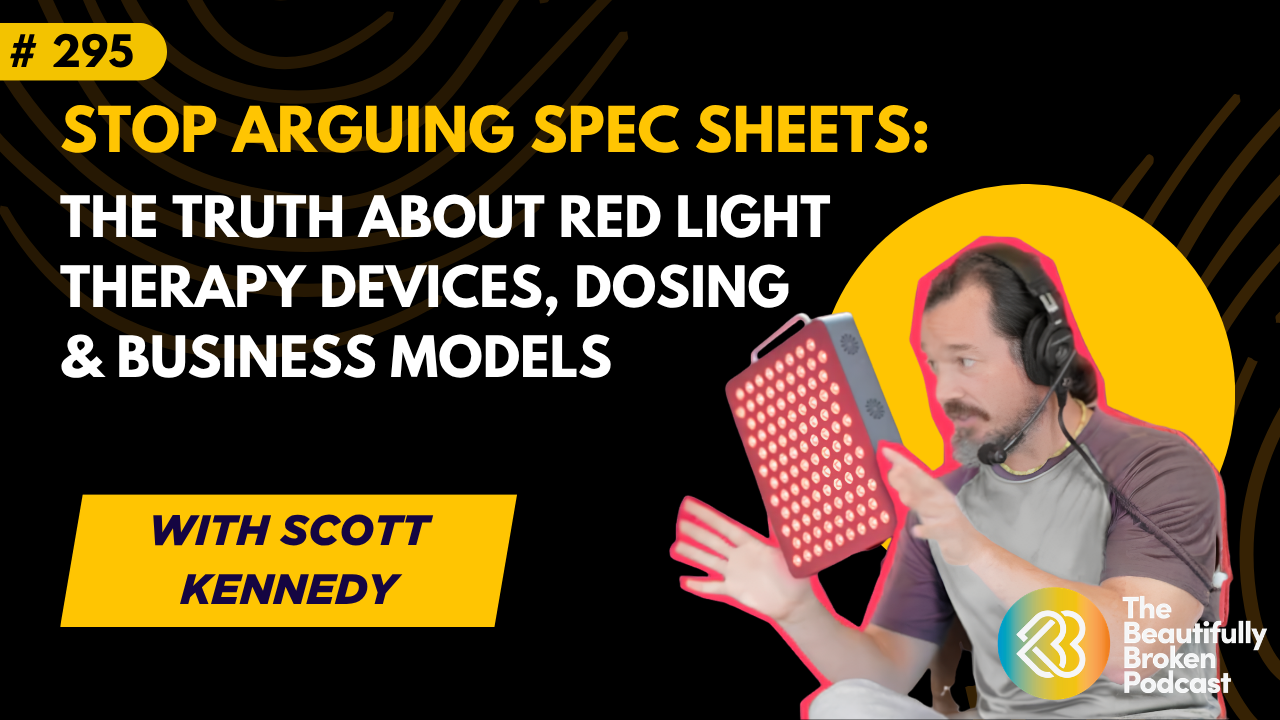
WELCOME TO EPISODE 295
Red light therapy is now at Target. It's on Amazon by the thousands. And with that explosion comes a mountain of marketing claims, spec sheet arguments, and consumer confusion that has Freddie and Scott Kennedy — founder of Light Path LED and one of the most science-grounded voices in photobiomodulation — more motivated than ever to cut through the noise. In this fifth conversation across seven years together, they break down exactly what happens at the cellular level when red and near-infrared light hits your body: how cytochrome C oxidase absorbs photons, why that turbine in your mitochondria spins faster, how nitric oxide release drives vasodilation and blood flow, and why the gap between 700 and 800 nanometers is essentially a dead zone. They also get real about power, irradiance, pulsing frequencies, and why the best panel in the world won't save a business model built on charging $100 a session for red light alone.
The second half of this episode is a full product walkthrough of what Scott has been building — including the new Titan, a six-foot full-body panel with an electric adjustable stand designed to deliver what $60,000 red light beds do at a fraction of the cost, and the TLC dork cap — three years in development, covering the full head, jaw, cervical lymph nodes, and occipital region with red, near-infrared, and blue light at 10 and 40Hz pulsing. Freddie and Scott also explore the torch, intranasal red light delivery, dental and gum applications, stacking red light with peptides for injection site activation, and the honest conversation about what a sustainable red light business model actually looks like in 2026. Use code BEAUTIFULLYBROKEN at lightpathled.com for a discount.


Episode Highlights
[00:00] – Red light therapy goes mainstream and why consumer confusion is exploding
[02:10] – Scott’s dental laser background and how he discovered photobiomodulation
[04:32] – Why red light supports the body instead of directly “treating” conditions
[06:22] – How light increases ATP, blood flow, oxygenation, and downstream cellular benefits
[10:00] – The difference between red light and near infrared light
[12:11] – What happens at the cellular level with mitochondria, cytochrome C oxidase, and nitric oxide
[18:45] – Why irradiance and power claims can be misleading for consumers
[24:32] – Therapeutic dose, joules, timing, and why more is not always better
[30:53] – The problem with too many wavelengths and marketing-based panel design
[36:05] – Lightpath LED’s wavelength choices, pulsing features, and near infrared focus
[44:11] – The Titan panel and why Scott designed a simpler full-body red light option
[45:51] – The Dork Cap, blue blockers, torch attachments, and practical red light tools for daily use
Upgrade Your Health
LightPathLED: https://lightpathled.pxf.io/c/3438432/2059835/25794
Code: beautifullybroken
MaxGen Labs: https://maxgenlabs.com/BEAUTIFULLYBROKEN
Code: beautifullybroken
The Biological Blueprint Course: https://www.beautifullybroken.world/biological-blueprint
Earn 200 in BitCoin + Change your health
BEAM Minerals: http://beamminerals.com/beautifullybroken
Code: BEAUTIFULLYBROKEN
Silver Biotics Wound Healing Gel: https://bit.ly/3JnxyDD
30% off with Code: BEAUTIFULLYBROKEN
StemRegen: https://www.stemregen.co/products/stemregen?_ef_transaction_id=&oid=1&affid=52
Code: beautifullybroken
CONNECT WITH FREDDIE
Work with Me: https://www.beautifullybroken.world/biological-blueprint
Website and Store: (http://www.beautifullybroken.world)
Instagram: (https://www.instagram.com/freddie.kimmel
YouTube: https://www.youtube.com/@beautifullybrokenworld
FULL EPISODE INTERVIEW
EPISODE TRANSCRIPT
Freddie Kimmel (00:00.842)
Ladies and gentlemen, Red Light Therapy is now on aisle six at Target. It's also on Amazon, Devices by the Hundreds. And with that explosion is coming an ocean of marketing claims, spec sheet arguments, and flat out confusion in the consumer space. Today, Scott Kennedy, founder of Lightpath LED, and one of the most honest voices in the world of photobiomodulation, is back for his fifth conversation in seven years because
Scott is family and I just love talking to him. We're gonna go deep into the science. We're gonna walk through some of the new products from Lightpath LED, like the Titan panel and something called the Dork Cap, you're gonna wanna stick around. And we have a real conversation about what red light therapy can do and what it can't do. You can always use code Beautifully Broken in the cart for a discount at lightpathled.com. And a huge thank you to Lightpath.
For sponsoring this episode with no commercials throughout. Let's get into it. Welcome to the Beautifully Broken Podcast, where healing meets high performance. From cancer recovery to wellness technology, we bring you real stories and real innovators to help you reclaim your biology and build your personal blueprint for health. Let's go.
Freddie Kimmel (01:26.848)
Ladies and gentlemen, welcome to the Beautifully Broken Podcast. We have Scott Kennedy from Light Path LED. Scott, welcome back to the show. What a treat. How many have we done now? I think we're on a five two.
Scott Kennedy (01:35.608)
Thank you again, Freddie.
I think we're on to five. I mean five over like five or six years. So we've been averaging about one a year update.
Freddie Kimmel (01:46.924)
That's right. And because we're in like seven and a half years, we'll be eight in February, which is wild to say out loud. And I haven't quit. We usually touch base because the space evolved. For the audience that doesn't know you or they haven't heard any conversations previous, Scott, how did you get into red light therapy? Just give us like the elevator pitch.
Scott Kennedy (02:10.134)
Okay, 30 seconds. My background is in dental. So after dealing with some physical issues, wrist, neck, back, I got into doing sales and training. So I was working with the company. We had a very large, very expensive dental laser that would it would cut teeth. So instead of a drill, it would cut soft tissue instead of a scalpel. It could be used for endo, for period, all kinds of stuff. What I was most fascinated with was.
We could take a laser that could ablate tissue. If I stuck it right here, it would just basically shoot a hole through the cheek. But if we pulled it back, we disperse the energy over larger area. So instead of cutting teeth, we just gave energy, photon energy to the cells. And what we saw was amazing results with people dealing with TMJ issues. We saw great results with people dealing post extraction sites that would heal up so much quicker, so much less pain.
Herpetic lesions, anything else into oral as well. We had a handful of dentists that thought outside the box. So they would, you know, they would treat their kid with a sprained ankle. They would treat their father who had shingles. You know, they would treat their wrist or other things. So I started to really delve into that, started to learn more and more about it. And it got to the point where I felt confident enough to where, hey, I know this stuff.
And I opened up a wellness center in New Jersey. So we had red light therapy, we had infrared sun, we had vibration plate, we had laser therapy as well. Soon after that, particularly when COVID kind of came and shut us all down, I was like, let's be real, I need another stream of income coming in. The second side is very few people just within my immediate area could actually gain help from me through light. So I thought, gosh, what a great way of taking light and bringing it to them and making it reasonably
affordable that they could do daily. And so that's where I started with my new company, Light Path LED. And this has really, with your help, evolved from kind of like a basic model to where we're designing, we're engineering, we're thinking outside the box on how can we make devices better for our consumers. And we can treat so many other types of issues, ailments, disorders, dysfunctions,
Scott Kennedy (04:30.414)
through light therapy. And that's where we are now.
Freddie Kimmel (04:32.652)
I love that. The only thing if I pop my compliance hat on that and this is true, we don't really treat, it is the body given a surplus of energy or extra energy, mitochondrial fuel, vasodilation, that the body is doing the repair. The body is, you know, almost absorbing the discolorations in the skin or it it's sending collagen to that area to boost this collagen fibers and the integrity. It's really the body that's doing it, right?
Scott Kennedy (04:58.914)
Well, you're always more articulate out this than I am. You really are. I wish I had your scale.
Freddie Kimmel (05:04.95)
No, I'm not articulate. I am so trained because all of these companies that I've been working with are now the things that were woo-woo and fringe, like when I started, like really working as a consultant and sales and marketing and product development, everything was fringe. And now every single like pillar from PEMF to light to lymphatics, they're all FDA devices. So going through the regulatory body, and you know, again, it's just
Going through regulation, you have to be so aware of how you use the word. And a lot of times, and it's true. I remember feeling very annoyed. I'm like, well, why can't we say that? This person gets that result. Why can't we say this? I've seen this person heal their plaxorisis. Why can't we say it heals it? The reality is, is because the biological system, it's not linear, it's not black and light, it's dynamic, it's ever changing. We can say the word quantum, but.
Everything from the bones to the organ systems has a role in healing damaged tissue. But it's when the body has enough energy to do that repair that it starts to happen. And a lot of the magic, I'll scall it magic, or the onus of healing comes from that body. But we're just putting a signal in. At least that's the way I I understand it.
Scott Kennedy (06:22.988)
No, that's exactly correct. And it's funny you bring up like woo-woo. A lot of these things are ahead of the science. Light is a perfect example. Science caught up to what they were seeing in the real world. There was a point where everyone said it's only laser can benefit. LED is BS. And people were using LED with great success. Science caught up. We see the same thing with pulsing. Pulsing was thought to be BS. Now we're seeing
Great success with cognitive issues. They're doing research on Alzheimer's, dementia, Parkinson's, with pulsing, which is the on and off of light. So you're absolutely right. If I put this in simple terms, light really only does a couple things. Light energy gets absorbed by the cells, specifically the mitochondria. We can get more specific about cytochrome C oxidase, water sheath, whatever else. What we're getting is increased energy output from the cells called ATP.
From there, the body does what it's going to do with what I call like the nutrient. That's where we see the downstream of benefits, all based on research. So whether that's increased blood flow, increased oxygen, hormonal balances, stem cell production, on and on and on, we're seeing improvements. And this is all based on, you know, 30 plus years of.
research, which you know, I I'm a science guy. That's really what I base my stuff on. When I make changes to my devices, I base it on the science. But again, like you said, so many of these other things, they've been around for a while and they've shown real improvements for people. And now we're finally getting the science to support it.
Freddie Kimmel (08:09.44)
Yeah. It's it's so funny. As you're speaking, you know, I've had enough people get panels, and that's primarily, you know, historically Light Path has had different sizes of panel systems. There have been some pads and some wearables, and you've had a torch, which is a handheld device in the past, but I've seen too many people have again these wild responses. I think the one was in in the middle of the pandemic when my friend Jen had sent me her husband's shin, who refused to change his diet, his lifestyle. And
Plaxoriasis. I mean just this thick, like red, flaky. It it looked horrible. I was like, my God, are they gonna cut the guy's leg off? And he just sat with a panel under his desk and it was like 89% gone. I mean, what is that? You know, I've seen enough things of that caliber happen over the years that I know it works. I don't question it. But now we're in a phase where you and I live in a world where and this has been accelerated by
large language models and AI that anybody can launch a business tomorrow, pretty much because it works. There are so many people that have launched products, companies, some opportunistics, some are really great. You know, again, I like praise innovation, but there's a lot of stuff in the market. If I walk into Target, I can now go buy red light therapy, which is amazing, right? It's wild. If I go on Amazon, how many products can I find for red light therapy?
Scott Kennedy (09:36.878)
Thousands.
Freddie Kimmel (09:37.73)
Thousands. It's incredible. And so we're at this place where it's like, okay, clearly we don't have to argue that it works. I would like to say you said there's only a few things light does. You know, my understanding is that light, red light specifically, we're talking about red light's a spectrum. What is it? It's like six hundred fifty, six hundred forty nanometers to like nine ten.
Scott Kennedy (10:00.246)
So when we talk about red light therapy, scientifically the name photobiomodulation, there's a reason why people call it red light therapy because who wants to say photobiomodulation? I mean, it's silly. So red light is a little bit of a misnomer. Red is one of the wavelengths. 600 to 700 will give you red. So if you ever see red outside, you see red in the sun, you see a red light bulb, see something blinking red, it's in that wave light for the most part. Now
For some odd reason, between 700 and 800, it does very little, if anything. It's kind of funny how light works. Now, once we get to 800, up to right about 1200, we're in that near infrared range. That's the range that's invisible for the eye to see, but it penetrates significantly deeper into the body. So why red is great for more superficial things? It's great for the blood supply. Near infrared is the one that is like
That's getting into the bone, the brain, the muscles, the joints, the organs. And it's creating a really positive systemic effect. Meaning, if I just put it in one spot, that's not the only spot that's going to get help. That's going to spread to other areas. So that's where light gets really very interesting and also sometimes very difficult to talk about because there's a lot going on. There's a lot to unpackage and there's a lot of misinformation out there as well.
Freddie Kimmel (11:22.39)
Yeah. From my understanding, the red, and thank you for clarifying what red is and what near infrared is, we got this range. So again, just to recap for my brain this morning, it's like six forty to like twelve hundred nanometers is our a range that we're working in.
Scott Kennedy (11:36.898)
Yeah, we could get down right down to six hundred.
Freddie Kimmel (11:39.224)
We're all the way down to 600. We can get right down there. I don't want to misspeak and have the internet cancel me and say Freddie doesn't know anything. And I don't know anything. The more I'm in the space, the less I know. But when we have this spectrum, we get a couple things happening, such as the release of nitric oxide. And so with the release of nitric oxide, which is an incredible supplement if you're not taking it over 30, you should be. And we get the activation of a unique enzyme. I think it's cytochrome C oxidase. Right. And so we're getting a
couple different effects. What's happening on a cellular level that we can kind of grasp and take home and take away from this podcast?
Scott Kennedy (12:11.726)
At a cellular level. All right. So if we think about chromophores, a chromophore is simply what is a light attracted to? Kind of like a magnet and metal. They're attracted. If I put it against wood, it doesn't do a damn thing. So we're looking at the curves. We're looking at like 600, 700, 800, and it kind of does this thing. And we've got hemoglobin. And we've got water and we got other things. And different wavelengths are attracted to different things. So red, very attracted to hemoglobin.
Hence why it's very good for skin. It's very good to get underneath the epidermis and the dermis to get into the blood supply. And then it can go further from there. But it basically stops at the blood supply because it's so well absorbed by hemoglobin. Near infrared, the 800s up to 1200s, not as absorbed by hemoglobin or color, so it can penetrate significantly further. So anytime we deal with photons, those photons get absorbed by the cell, the mitochondria that's the powerhouse of the cell. We remember back in high school.
We got the cell, we got all the organelles, we the nucleus, we got the the one mitochondria. Funny enough, like every cell, with the exception of red blood cells, you know, they have hundreds, thousands of these mitochondria. In each mitochondria, this stage, this stage of, you know, respiratory stage and the fourth stage cytochrome C oxidate. So that actually absorbs the light. There's this wheel. It's so wild to see this. It spins at 9,000 RPMs.
So this little wheel in the cell, just like in a car, spins. When we're not optimally healthy, that wheel slows. Like you get sludge in it, you get dirt, you get whatever else. It doesn't quite spin. And what's happening is certain things, the theory is nitric oxide kind of slows that process down. So we hit it with light. That takes the nitric oxide off of the mitochondria and the cytochrome C. It starts to spin faster. That faster spin.
Brings in certain electrons, and the result is it starts pumping out more of that ATP. So we get increased cellular energy, which is 90% of our daily energy. So that's everything. Breathing, the heart pumping, everything, the brain working. The most mitochondria is in the eye for obvious reasons. The second is the brain for obvious reasons. That's why we're seeing so much benefit to eye health and brain health with light.
Scott Kennedy (14:35.072)
So that happens. The nitric oxide comes off nitric oxide signals. There's like seven different steps that the nitric oxide signals to relax blood vessels. So they expand. We get more blood flow through there. We get more oxygen. We get more blood flow, more oxygen to any area. We're going to see benefit. We're going to see a reduction in inflammation. We're going to see an increase in the healing process. We're going to see our muscles be able to actually work.
Harder. We're gonna see our lungs be able to push ourselves. You know, so there's so many things that if we just all we're doing with light is we're increasing the optimal level of our cells.
Freddie Kimmel (15:16.918)
That's right. You know, as you're saying that, I'm like, and for everybody at home, you're also going to get a harder penis that is a male. Cause when we're talking about these drugs like Viagra or Cialis, you know, we're getting this expansion in the microvasculature and we're getting blood flow. You know, this is part of it. There's something you may be doing at home right now where you're getting a byproduct that you could be getting with light. I always like to paint the overlap for people.
And that these things don't live in a bubble. And with Scott's talking, you can start to see. And again, I want to say this. This is the way we understand the mitochondria today. This is what we know today. It doesn't mean we won't be back here in 18 months. You'd be like, you know, we thought the turbine was doing this, but actually it's this is what's happening. And there's some morphing of the mitochondria as it unfolds and repatterns that there's only so much we know. It's always changing. Cause this conversation is even a little different than the previous podcast we had.
But I think the important thing that we can always drill down on is that people do get the results from a red light therapy. And that's why we continue to talk about it because it's such low-hanging fruit. Now, I have this in the biological blueprint, which Scott is a contributor to, but if you want to get your good reds, that's, you know, being up within 30 minutes of waking around in that rising sun, there's more of these reds, as well as during sunrise. We've all looked up at the sky.
Red sky at night, sailor's delight, and you see all those beautiful spectrums, which are supporting the body's natural rising and waking of your circadian clock. So we can do it outdoors, but I think if you look at the modern design, like how long humans have been upright, it's been an incredible amount of time where we lived outside all the time, every single day. And now we've got like this century and a half where we've been in boxes and we're closed and we live in areas that are more uncomfortable to us because we can, because of technology.
You know, it really does, if you start unfolding it, why do I need this? Well, for a long time in our evolution, it made a lot of sense. And now all we're doing is we're taking technology, which is giving us a signal from nature, and we're engineering it back into the home. So we can get some health benefits from that. It doesn't have to be, I don't think it has to be more complicated than that. I think, Scott, I'm gonna put this back on you. You know, now that the market is flooded with stuff, it's now it's not, is it good?
Freddie Kimmel (17:37.876)
Now the conversation in 2026, my product is better than yours, or my product has this spectrum, or this wavelength, or this pulsing rate, or this irradiance, or these jewels. It is wild. It's wild. I want to divorce the biohacking community, but I love the biohacking community. Something I'm in. I'm in the world of human optimization. I don't think there's a shortcut or a hack, but it's just
So out of control. And there was a time when I was really frustrated when we were fighting for the validity of red light and I hated the regulatory bodies. And now I'm in the space where, like, wait, I want the regulatory bodies to step in and say, guys, you are getting lost in the sauce of marketing claims. You're listening to people argue spec sheets, but we've lost sight of the body. What does the body respond to? So I want to talk a little bit about power. How do I have the conversation about?
power. And when I say power, we can substitute in irradiance or there's a bunch of different terms we can use. But where do we start there, Scott, as a consumer, which I'm very empathetic to?
Scott Kennedy (18:45.76)
Yeah. It's a difficult one. We have enough knowledge of, say, a vehicle to know horsepower. We know enough about maybe a tool to say what torque is. Red light is so confusing because we don't know about it. We don't know until we know. And unfortunately, we gotta do that a lot of times you gotta do that deep dive, that rabbit hole, which kind of sucks. How many people I talk to, they're like, it's paralysis by analysis is what it comes down to.
And the issue is that you have so many companies out there and you have so many people that are affiliates with companies, whatever else, that they throw out these marketing kind of gimmicks, knowing very well that what they're espousing is not true to science. So I'll give you a couple of them. Like irradiance power. We generally hear something something milliwatts per centimeter square.
Could be 20 milliwatts, could be 100, could be 200 milliwatts per centimeter squared. That's just saying over this certain area, this is how much power we're getting. Now that certain power over time, we now get joules. Joules is really the more important number than just simply irradiance. But irradiance is a seller. It's a big seller, but it doesn't tell the story. So irradiance, people go, power. I want more power.
Wavelength is the most important thing. As we talked about before, red is superficial. Near infrared goes a lot deeper. I could have the panel behind me be all red. Red actually, even though it's the same output, red actually reads higher irradiance because it's a shorter wavelength. I could put all red in this.
Freddie Kimmel (20:26.712)
So if you had a panel with a digital control, you could put it on red and you could change the reading from your panel. That's what you're saying.
Scott Kennedy (20:33.944)
Well, let's just say I didn't have near infrared in this at all. I just put strictly red.
Freddie Kimmel (20:39.192)
Wait, let me do this just for the audience, because if you have a panel, you're saying you have a panel with visible red and near infrared, the both the visible and the spectrum that goes deep. What do you mean you put it in the panel? Can you change those frequencies? Is that pre programmed into a panel? Great. Okay, great. You're saying as a designer, I'm an engineer, I'm gonna put visible and near infrared in my panel.
Scott Kennedy (20:55.534)
Preprogram.
Scott Kennedy (21:02.87)
Right. Then that's what you'll generally see. But let's just say I engineered this and I just put red in. Okay. So I I put no energy towards near infrared. I just put a ton of red in there. Yep. That's gonna read higher irradiance. Now I can say I've got the strongest panel on the market, but it's still only going skin deep. Is that what you want? Of course not. Of course not. Beam angle is another thing. So beam angle is how it comes out and spreads.
If I do 90 degrees, both panels are 90 degrees, all these lights overlap. So it increases the power at a short distance. Once I go longer distance away from the panel, it dramatically drops off. If I have more of a focus light, 30 degrees, which my panels have, it's less power up front where most marketing companies are measuring six inches away. Mine has less power, but mine stays very consistent at 12 inches, at 18 inches.
And we're not a flat board.
Freddie Kimmel (22:01.59)
And why do we wanna be twelve to eighteen inches away from the panel? Why do you like that range? It's
Scott Kennedy (22:06.294)
Not so much the distance, it's the fact that our bodies are not a flat board. You know, our nose is going to be much closer to the panel than our neck is. If we've got large breasts or larger gut, that's going to be much closer to the panel than I mean, literally, we could be talking about two feet for some people on their backside. They got a big butt. Their big butt is going to be six inches from the panel. Their lower back could be 18 inches from the panel. So their butt could be getting a great amount of energy.
Freddie Kimmel (22:26.124)
Mm-hmm.
Scott Kennedy (22:35.96)
Their lower back isn't getting shit. You know, they'll have the healthiest butt in town, but if they got lower back problems, they're kind of screwed. They're literally getting probably 80% less power in that area. Where if it's 30 degrees more focused, they're getting less energy on their butt, but they're getting almost the same amount of power on their lower back. So it's significantly more consistent. Now that's one of those things where I made that decision because it was right for the customer. It certainly isn't right for my marketing.
Freddie Kimmel (22:38.84)
That's right.
Freddie Kimmel (22:48.546)
Got it.
Scott Kennedy (23:05.644)
Yeah. You know, if I wanted marketing, I'm gonna go ninety degrees. I'm gonna use a crappy solar meter that's good gives me an inflated number, and I'm gonna say I'm the most powerful panel on the market. You could do that. You could do that like that. It's just that's the issues that we deal with.
Freddie Kimmel (23:22.508)
Yeah, I want to keep going here with power and irradiance and beam angle and pulse rate. And again, that is a tech sheet. While it's good to look at and you do have to understand what you're looking at with a red light panel, it really is hard to compare. I think I wanna talk about like therapeutic dose and like what is the range because I mean, I've seen anything, and typically this is like
Milliwatts per centimeter squared. Is that right? Correct. That's how we're measuring their that would be Euro radiance. So we're trying to come up with like, again, it's kind of like a PMF device in Gauss. What is the density of the magnetic field in which I I try to compare these devices? You know, you want to talk about a shit show, like the PMF world, it's really hard to measure Gauss if you change where that meter is by just like centimeters, you know, eighth of an inch, you're gonna get a different signal. And so there's no standard.
It's really, really frustrating. So people are making all these claims and things. It comes down to like, am I getting the results? But then we also want to tie in what does the science say? What does the science say about irradiance? Like, what is the range that could be beneficial?
Scott Kennedy (24:32.044)
And this is where the more you read the science, the more confused you get. And that's one of the tough things because I can look at a grouping of science literature. You know, we could pick this is a good one, acne. Light is great for acne, particularly blue light. Each one of those studies is saying we're having positive results. And you're like, Great, perfect. Now let's focus in on what is going to give me the optimal results. One study, their participants use it one day a week. They have good results.
Another study does it every day and they have good results. One study is doing this much power, irradiance, you know, which equals a certain amount of joules. Another study is doing this much, and they're all over the place, but they're all positive. You know, so that's where it gets difficult. Right now, science is they're kind of in that ballpark of six joules per centimeter squared. So when we talked about irradiance over time, so if I have
A panel that's 100 milliwatts per centimeter squared at six inches or twelve inches just to make life easy. We need about approximately ten minutes to get that six joules to that second centimeter in the body. Again.
Freddie Kimmel (25:45.196)
I wanna make sure everybody understands that. It's like going to the gas station and filling up your car. After a while, you're spilling gas on the ground. There's a range where you're gonna start to get into that therapeutic dose and the body's kinda like, Hey, bro, I'm good. The thing I celebrate and would implore you to investigate, from my understanding, we're not gonna do damage, you know, unless you're heating that tissue. The body's kinda like, Yeah, I'm good. I've had enough.
But go over that again. So we just said a radiance. A radiance is milliwatts per centimeter squared, but then we said joules per centimeter squared. And there's a time function in there. Am I correct in understanding that?
Scott Kennedy (26:24.942)
Correct. In a basic one watt equals one joule, which is in one second. So watts over time is joules. That's all it is. That's all it is. Okay. So our body, through the studies, we know that the cells perform best by reaching this kind of ideal point. There's a wide range though. And it's roughly in that six joules per centimeter squared. Now, other studies have come out and said, you know what, we only need two.
Some studies even we only need one, but I'm always gonna aim for the higher side because it's not gonna hurt us. The gasoline is a good example. I like to use like a potted plant. I could take a bucket of water and dump it right on there. And guess what? Most of that water is just gonna shoot off of that and go someplace else. Or I could just put a little drop, a little drop, a little drop, and that's just gonna sit on the surface and most is gonna be evaporated.
So I gotta find that happy balance where I'm putting enough water into that soil to where it gets saturated down to the base of the roots, and then I'm good. You know, if I keep on putting more and more water in it, eventually the roots are gonna drown. But again, the good thing about light is we got such a wide range of therapeutic benefit that whether we're getting that two joules to that cell or we're getting 20 joules to that cell, we're still gonna see.
benefit. So yeah, we don't have to really people worry too much about it's like, am I doing too much? Am I doing this? Whatever. You're good. You're really good, you know? And everyone's going to be a little bit different depending on how much water is in their cells, their skin tone that they got darker skin, lighter skin. So all these factors. So we don't have to split hairs on this stuff. You know, if you're doing your light and you're getting the time that is recommended for you and you're at the proper distance, you're going to be pretty good.
Freddie Kimmel (28:16.908)
Yeah, I mean, it really is wild to see like if you get in and you're just looking. Here's the other thing I want people to be aware of. If you get on Claude or ChatGPT and you start saying, Tell me what red light, blah, blah, blah, they're pulling from marketing sites. They're pulling from whatever. I'm not gonna name any brands, but they're pulling from the large language model, the AI models are pulling from the internet. They're not pulling from just unless you make that criteria from
National Institute of Health or from PubMed. And then you have to separate out. And if you're gonna just look at NIH and PubMed, then you have to separate the studies which have a conflict of interest. Who is it funded by? Was it paid for by the company? Because then then a lot of times they start to break down. But like from my understanding, like when I look at the benefits, things like surface, like skin barrier surface is gonna be a little different than like pain and inflammation.
Is gonna be a little different than, you know, dot, dot, dot, dot, dot. But we wanna try to catch everything. You wanna get a panel that sort of serves all your needs. And that's why working with Light Path and working with Scott, we've like continued to have this conversation over time. It's like Scott said, he's like, Yeah, I could do that and make a higher number if I wanted to, but all I'm I'm chasing the guy, I'm chasing the business model next door. And it just becomes this. You see this in the red light industry. It's like,
You know, people came out with the digital panel and everybody got a digital panel. People came out with the one blue light on the panel and everybody started copying that. And it's just it's a snake eating a tail. And all of a sudden, where you're not following the research. A lot of it existed and it's old. A lot of it existed and it's old. There are studies to support point one irradiance to twenty five milliwatts per centimeter squared.
And then there's also studies to say the higher we go, like if we get up to 150 or 200 milliwatts per centimeter squared, that there's like this biphasic incidence that happens and the body starts to do worse. So I said there's a safety check and there actually is, Scott, you mentioned the beginning. There's like, well, if I point the laser at the side of my face, I can burn a hole through it. Like there will be a time when we get enough power where it's not good. There is. Yeah, there's that range. Like to light path.
Freddie Kimmel (30:42.604)
And let's talk about the diesel line because the diesel are like it's like the big fatty wide panel. And like, so what are those? What's the range depending on, you know, what frequency, what program we're running?
Scott Kennedy (30:53.662)
And one of the other marketing things that we talked about is they'll say, we've got the first company who started this out had two wavelengths, two perfectly good wavelengths, and then went to three wavelengths, and then four, and then five. We've got some panels that are up to like 10 wavelengths, and it just gets absolutely ridiculous. Like so each one of these has like a separate wavelength in them. So if I say,
Hey, I've got 620, I've got 660, I got 680, I've got 810, I've got 830, I 850, I got that sounds great. I've got all these great wavelengths. Well, out of this panel, what that means is I've got only 20 of these bulbs or 1070. Another 30 of them maybe 830. Another 20 of them maybe 620. So it's not like they're all coming out of one bulb, and this area right here is getting all those great wavelengths. No, this is getting 1070. This is getting 810.
This is getting 620. So it makes no sense. Stick with the wavelengths that science is telling us are the best and do that. Mine has three. I'm perfectly happy with three. I would rather have three of the wavelengths that I know are penetrating the deepest that are giving the best results based on science than to take away power from everything by putting in a ton of wavelengths. So that's the other big marketing gimmick. The other one is.
Hey guys, push this button for fat loss. You know, push this button for energy. Push this button for this. It's not how light works. You know, light, it's like the potted plant. All we want to do is saturate the soil optimally and walk away. That's it. There's no special button for these types of things. As we talked about, once the cells get that energy and that cytochrome C oxidase, they will do what they're going to do. The cell does not go, hey.
Freddie Kimmel (32:24.898)
Yeah.
Scott Kennedy (32:45.25)
This is great for fat loss. Let's start doing it. The other cell doesn't say, hey, this is great for inflammation. So let's put all of our time and energy into reducing the inflammation. Yeah. You know, it's just, it gets to be silly. Yeah. And that's what's unfortunately is is starting to kind of, I'm not going to say destroy that the the arena, but it's certainly saturating with a bunch of BS.
Freddie Kimmel (33:05.454)
Yeah, I mean again, if you get into the clinical trials, human trials, we separate out animal models. It's really two frequencies. I mean, listen, until someone comes along and shows me the verifiable results or shows me how different it is, it's not that I wanna I don't want to rest my hat on it. But for now, it's really like I see so much for 630-ish and 830. It's most of the human stuff, you know, in the 800s and 600s.
Scott Kennedy (33:35.17)
Yeah. And the issue was is most of the studies done earlier, even even some of the more recent ones, they're small studies. They're a a university and they're saying, Hey, we want to do a study on this. And they call up a company and they say, Hey, can you give us, you know, some of your product and we're going to do some studies? Okay, great. So they they publish it, it's positive, and they say, Okay, six sixty and eight fifty were used and we had positive results. Well, that's great. But
Could 620 have worked better? Could 810 have worked better? Could 1070 have worked better? So a lot of times their hands are tied because they don't have the finances to like go and you know, checking out, they're gonna get what they can get. The other issue is, you know, they're listening to what the company says is the irradiance without testing it. So they're saying, hey, we found that this irradiance is the best. Did you test it? You know, so that's where some of the issues come from. So
I have changed my wavelengths over time. I went from five down to three because I found that 810 through the research had the best depth of penetration and was actually showing the best for cognitive. So I said, let's get rid of a couple of the other near infrared. Let's just focus on that 810. We've got some new studies coming out showing that a higher near infrared, that basically that 940 to 1070 range, they're very similar.
But they work a little bit different on the cells. And they're showing a good synergistic effect between 810 and that higher 940 to 1070. So as science comes to me and it can be replicated to the point where I'm confident I can say, I feel like it's time to change my panel. I think it's time to add a 940 to this to some degree. But like, you know, my panel was the first one to add.
Pulsing to the panel. Now just about every panel pulses. Mine was the first one to add blue, which is good for skin, skin type issues, seasonal affective disorder. Now there's a lot of panels out there that are adding the blue. So even though I'm small time, I think the bigger boys sometimes pay attention to me. But the key is I base mine on the science, not what marketing people may tell me.
Freddie Kimmel (35:53.856)
Yeah, a hundred percent. So go back to Light Path LED and let's talk about some of the irradiance, wavelengths, and pulse rates that you use in the in the diesel panel series.
Scott Kennedy (36:05.838)
So I'm at 670, which is your red. I'm at 810 and 940. I always put 66% of the power is in near infrared because we want more energy dedicated to deeper penetration. Again, potted plant red. We're only going this far into that potted plant. So it's only getting this part up here. That takes a couple minutes. That's it to get to that point. That's great. I love this part right here.
I need this part right here. That's the key. So I think every other panda or close to is 50 50. 50% red, 50% near infrared. It gives them a higher irradiance. Good for them. I want my customers dealing with deeper issues. Sure, we all want the skin to look better. We all want the hair to grow better. We all want those little things, but we need the deeper issues to benefit, and we need that extra.
Near infrared. So as far as pulsing, pulsing is that on and off of light. So it's like this. So you may hear 10 hertz, 40 hertz, 1,000 hertz. That means 1,000 times a second it's going on and off. They found through research, mostly through cognitive, that the pulsing of light can help with brain issues. So again, Alzheimer's, dementia, Parkinson's. There's a couple things going on. There's a reduction in inflammation in the brain. That's huge. We're hitting areas like the glimpse in the neck.
That's helping to pull toxins out. We're raising brain wavelengths. So in the morning, we want to reach alpha wavelengths. So any kind of visible light is going to help benefit, increase the wavelengths of the brain to more of an alert state. At nighttime, when we want to get ready for bed, we can actually use lower hertz to lower the brain wavelengths more to that delta, beta, theta and help prepare us for sleep. So
I put the pulsing into the panel. I didn't invent pulsing that's been around in lasers, it's been around in pads and other things, but I was the first one to put it in into the panels. But I don't have the power at six inches. Yep. You know, I don't have 20 wavelengths in my panel. Again, because I need consistency for my clients. I need consistency of energy throughout their body. I need consistency of wavelengths that are supported.
Scott Kennedy (38:29.186)
By the science. So that comes first for me.
Freddie Kimmel (38:32.204)
Yeah, I just wanted to frame this for everybody. Like again, when you're really looking at the studies and the science, things people target will be eye health, skin health. Fibromyalgia is a big one, which is not cut and dry within that world. It could be a a chronic infection, it can be genetic, it can be a methylation issue. There's so many things that can play into fibromyalgia, but that's one of the with the areas where red light therapy really knocked it out of the park. And in their big meta-analysis.
I think it was it was like eight hundred and fifty-seven participants across 17 different studies. They've reviewed the literature again and again and again. And out of all the people who are using red light therapy, it's really about three times a week. 20 minute sessions, about three times 31.6% of the participants and all the studies that qualify as quality within PubMed and NIH no longer meet the diagnosis criteria.
For treatment, just using light. Now I'm not saying ditch your med, but I'm saying this is a really this is for me that's a great yardstick. And if you look at all the different devices and all the different frequencies, what we really come down to is the sweet spot was around 40 milliwatts per centimeter squared. If you start shopping panels, there's a lot of systems that are kind of gonna meet that criteria. It's not these, you know, again.
I talk to a lot of clinics that are shopping for business solutions for red light therapy. I want red light therapy in my business. Scott had a red light therapy business. Scott, you bought a red light bed. How much did you pay? Sixty thousand dollars. How much money did you make on that bed? How much money did you lose on that bed?
Scott Kennedy (40:07.062)
Sixty K.
Scott Kennedy (40:11.402)
Not sixty K. D.
forty K.
Freddie Kimmel (40:17.016)
Ballpark. Okay. How long was your business open? And you were in a high foot traffic area. Scott was right outside New York City, right in Fort Lee, walking distance to the George Washington. I mean a mecca of foot traffic. And you had people that knew you in the area. You had influencers. You had some rock stars come in to see you. I'm just giving you guys scope. Not saying it can't be done.
Scott Kennedy (40:21.218)
Five years.
Freddie Kimmel (40:45.08)
But I get a pit in my stomach when I sit down with somebody and they're like, we j we bought this and this and this. And I'm like, either one, I hope your community is okay with paying $100 a session, which they shouldn't and they won't, or that you're just treating like rock stars and Bill Gates level C suite executives. I'm not saying it can't happen, and I'm sure there are people out there that have done it. I'm sure there are. What I hear is that.
People are under on an equipment loan and they wish they hadn't have gone that direction. I love red light therapy, but you're gonna need you wanna do it three times a week. Don't you think that's a nice sweet spot? Three twenty minute sessions a week is good.
Scott Kennedy (41:23.49)
Yeah. That's kind of like the minimal. Like to see change. Sure. It's like anything. It's like I can run one day a week. Is that gonna help me? A hundred percent is two times. Right.
Freddie Kimmel (41:32.854)
Why make the investment of your time if you're not going to get the change? And this is a serious question for everybody out there. It's like the way we spend our money is so stupid. It's not the session cost. What is your time worth? What is the 20 minutes that you laid in that bed worth? Then I want you to add in the time that you got in the car and drove to dot dot dot to do the red light therapy and then put your clothes back on and then get in the car and drive back home. Like it ends up being a big chunk of time where
I do think red light therapy should be in clinical settings because it works synergistically with other therapeutics. Like if I had a magic wand, I'd be like, I want you to do red light therapy. I want you to do some type of an oxidative therapy, and then I want you to get in flopresso. Or I want you to do red light therapy and I want to open up all the vasculature and get the nitric oxide moving, get the energy going, and then I want you to do a little pulse electromagnetic, and then I want you to get in flopresso.
And then I want you to go sit and breathe or take a walk outside. And that's your stack for the day. That's a stack that most people aren't going to be able to buy or pay for. I mean, you know, again, talking to a different audience is here, but it becomes yes, that makes sense. Give them a stack that they're not going to be able to do at home. But this idea that we're going to make back money on a hundred and fifty thousand dollar, I mean, there's beds that are $220,000 or even $80,000, whatever it is, it's tough to do.
Unless it's a part of a care plan. And then we're talking about, we're having a different conversation. Whoa, you have an area of expertise. You can read lab work and genetics. So you're coming to see me for my primary care. And I'm getting these full body therapeutics, which are creating signals within the system for better health. And I'm gonna see you through to a different way of being in six months or a year. Then 100%. Then it makes sense as part of the package, as part of the membership.
Scott, you designed for this very reason because I have in front of my and behind me at my working desk, I have four diesel panels of an older model that I think we rechanged the naming. But I had four panels on a wall stand to make literally a red light wall, which I love. It's great. That was very expensive to put together. I mean, with the stand and the labor and the materials, I'm sure it was over eight grand. You came out with a panel that's better designed.
Freddie Kimmel (43:54.056)
easier to mobilize and is really compelling for the Freddy Avatar, you know, the guy who's like, I want a red light wall, or a clinical setting. Like tell me about the Titan that is launching, that's launched, that's going out, right? People are buying the Titan.
Scott Kennedy (44:11.81)
Yeah, it's out now. I've already got it in a handful of wellness centers. But it takes a lot of the complication out of things. So instead of having a bunch of small panels where you gotta hook them up and there's separation and there's different displays on each one. I built one that's six feet tall, twenty inches wide. So it's gonna fit the great majority of people from shoulder to shoulder. And it comes with an electric stand so it can just automatically raise and lower horizontally.
And then you just pull a little switch and you can adjust it to 45 you want. You can adjust it to vertical as well. So it's a very simple system as far as you get it in, you put together the stand, you put the panel on it, and you're really ready to go. So and we're getting so much of what's really what the expensive beds are doing with greater irradiance, better wavelengths, more pulsing, all that good stuff. Really like.
At a tenth of the price of what I paid for my bed.
Freddie Kimmel (45:10.742)
Yeah. I love it. It's really awesome. I always have panel envy when the new panel comes out and I'm not gonna get the Titan because I have a good setup. It's awesome.
Scott Kennedy (45:20.024)
You want it. I know, you want it. I want it. Yeah.
Freddie Kimmel (45:23.186)
Of course. It's a six-foot panel with 20 inches wide. It's like, it's pretty great. And so we get the systemic effect. Guys, go check that out. If you're a clinic, if you're again, if you're a high-end wellnesspreneur and you want to have a big old panel and you don't want to buy four, stack three together, go for it. The other thing I want to mention is in the world of like product development and new product launches, you have the red light dork cap. Tell us about the dork cap.
Scott Kennedy (45:51.982)
So the door cap I have been working on three years it took me. There was a couple times when I was like, I'm done. I'm out of this. It's not what I want. I'm moving on. I'm not even gonna bother with it. And then, you know, it would pull me back and it'd be like, come on, let me adjust this, let me tweak this, let me try to So three years later, the door cap is here. It's ready. So this is what it is. I could put it on. I mean, yeah, this actually looks better with this. It's less dorky, I think.
But the whole idea is let me go ahead and I'll I'll turn it on.
Freddie Kimmel (46:24.994)
Go ahead and light it up. Yeah. yeah, this looks great. Just hold that up under your hand, like put it on your hand just so they can see the irradium. It's like you are getting a high amount of red light therapy into your skin. Again, it's systemic, but it's a really powerful portable. And there is an option to add a battery pack. That's what I've done because I travel so much. So I'll be doing it in the car in the morning.
Scott Kennedy (46:49.214)
yeah. Yeah. And that's the good thing. You can do it wherever. But the key is, is there's a shit ton of caps out there, you know, hair loss kind of caps that are from here to here, basically, is all it covered. And I wanted something that was going to add benefit for people to increase their relaxation, to reduce inflammation in the brain area, to open up the lymph nodes, to affect.
Freddie Kimmel (47:00.888)
Hundred percent.
Scott Kennedy (47:17.314)
The trigeminal nerve, the TMJ, the Macetter muscle to get down more on the forehead area. So hence the reason for the flaps, hence the reason for adding this part down here, hence the reason for putting here. The reason for the brim is I never even wanted the brim, but it helps to hold the form of the cap. So and it makes it a little bit dorkier as well. So that's where I spent my time. Like I could have easily just
Gotten something, put a logo on it and call it that. But I just when I create something, I want it to be beyond what else is out there. And I wanted to really, really help people out. So hence the three years, you know, I could have had something out there in three months if I wanted to. But yeah, the door cap, I think I just called it one time that because, you know, I was doing a little video and it makes me look like a dork, but I don't care. I'm good with that. I'm good with looking like a dork.
Freddie Kimmel (48:10.401)
Yeah.
Scott Kennedy (48:10.904)
And I'm good with getting all the benefits of that's got the blue light, it's got the red light, it's got the near infrared, it pulses at ten, it pulses at forty as well. So we are purposely affecting a lot more than just here to here.
Freddie Kimmel (48:28.056)
That's right. That was my big thing. It goes all the way down past the occiput. So you're getting the back of your neck, and then you're getting your jowls. You're getting your jawline. You know, this is such a problem area for people. And then you're getting all these cervical nodes. The cervical nodes in the neck are the drain on the kitchen sink for the brain. Full stop. And because of forward head positioning, tight fascia, environmental toxicance, burden, it all slows down. It's a
Great way to get red light therapy on the cervical nodes. I mean, I that's what I'm using it for. I actually set it I set it to just the two reds and not the blue. It doesn't get as warm for me. So I've just been doing the reds and I've been pulsing it at at forty hertz in the morning. How long do people need to do it? Does it have an automatic timer on it? Does it just run till you say it should run?
Scott Kennedy (49:11.822)
Yeah, perfect. That's great.
Scott Kennedy (49:18.818)
Yeah, it's got a 15 minute timer. And that's really ideal. I tell people start off slow like anything, like exercise. Start off slow. Work your way up until you get to that 15 minute mark. And I tell people like, I always like the blue. I always do. But I use that more in the morning time. You don't want to use the blue in the evening because blue reduces our melatonin so it can make sleep a little bit more difficult. Blue light is fantastic, although we hear all these horrible things about blue light.
Freddie Kimmel (49:25.399)
Okay, great.
Scott Kennedy (49:45.986)
Blue light is great. We walk outside, what do we see? Blue light. It's clearly not bad for us. It's the matter of the time of the day. Most of our lights in our household, the newer LED, have a shit ton of blue in them, which is not good when it comes evening time, nighttime, because our our eyes send signals to the brain saying, It's daytime. Stay awake. That's a problem.
Freddie Kimmel (50:11.126)
Again, we become victims to the marketing and we become victims to our own belief system that all blue light is bad. I mean, people are like, my God, you have a little LED over there on your blender. Be careful. It's just the idea that it's harmful. I would wager, I'm not a scientist. The idea that it's harmful and that it's hurting you is worse than the biological impact it actually delivers. The belief system is so strong. The placebo, it's incredible what it does.
Or the no Sebio effect, whatever you want to say. But if you live in a world where everything's going to hurt you, and this is part of the evolution of awareness, I had no awareness that my cooking pans could be bad for me. I had no awareness, I never imagined as a child that my drinking water could be bad for me. I had no idea. I never imagined that my Lululemon sweatpants, I don't have any anymore, my Lululemon sweatpants, although I do have some tops from them, could be hurting me and absorbing microplastics into my system.
It's a journey of awareness. But I would pause and like set down the pitchfork and set down the blazing torch and don't chase the monster anymore. It's just easy and adapting and changing your awareness. You know what? I filter my drinking water. I wear blue blockers at night, right? I try to wear cotton underwear. Make the adjustments as you can, but don't live in a state of fear. I promise you that will make you sicker.
Than any change you could ever make because you become this little doing machine where I like little look at my checklists. You will get to a point where you can't expand the checklist anymore and you will be crazy. All right. Soapbox. Talk to me about another thing, Scott. And I know we may have mentioned this last time. I've got your blue blockers on. I've stolen them back from Cynthia because we have a hundred and ninety dollar pair. I know we bought them at a show, and you can't see.
The way the lens is bent, everything's blurry. These are so clear. So this is what I typically use to podcast. I'm using a blue blocking lens, which I have two big projection lights over here to make sure my light is really even. Why did you come out with blue blockers?
Scott Kennedy (52:17.398)
It kind of goes along with light as well. So I think the biggest issue was when I started putting blue into my devices. That's when I really, you know, before I did that, I really had to delve into blue light and understand it. And through that process, that's when I realized, okay, blue is great for us, but when we're sitting in front of a computer screen all day, when we're inside and we have LED blue.
Bulbs, even though it looks white, the great majority of it is blue. That's why incandescents were so good because they really matched the rays of sunlight. So when we're stuck inside all day long and we've got this blue light hitting us, something as simple as glasses. And they do a simple job. They just filter out a lot of the blue. So, like your yellows, they don't filter out all the blue because we don't want to necessarily filter out all the blue.
That filters out about 70% of the blue. Then I have orange tinted that filter out 97%. So those are great for driving, those are great for daytime, great for evening. And then you can put on your orange, and then you can block even more of that blue. So you're setting the stage for
Freddie Kimmel (53:33.742)
Check out how nice these are though. They're
Scott Kennedy (53:36.184)
Cute, yeah, I like I like a lot. They got the metal frames as well, so
Freddie Kimmel (53:38.254)
They're like beautiful.
Those are my favorite ones. I have red for nighttime at metal frame. And now I like the style of this frame better. But I will tell you, I tend to take off the red at night and I like s either set them under my pillow or set them on the nights. And if I roll over on, they're like fine. I know that's a really bad habit and that sounds stupid, but they seem like they have a lot of bounce to them. Like that metal frame has some springs. So they're like, those are a little more Freddy proof. Like I'll be like ready to conk out at night and I'll be like just kind of taking them off. But every single night.
And it's not because I'm have this hyper vigilance. I'm like, I like to wind down with TV, episodic television. I'm watching Widows Bay right now on Apple TV. If you guys don't have Apple TV, nobody is making television like Apple. Nobody's touching it. It's like what HBO used to be. It's incredible. Widows Bay is a comedy but a horror. Anyways, they work. I do it every night.
Scott Kennedy (54:33.838)
Except for Gilded Age on HBO, that's a big hit. That's a good one.
Freddie Kimmel (54:37.474)
I've never seen Gilded Age. I don't have HBO. Of course you have. Just little clips of your daughter in the show.
Scott Kennedy (54:42.862)
You've never seen Gilded Age? Yeah. That's a whole another story we want to get into. We should just have a story of how we met.
Freddie Kimmel (54:48.684)
Yes. Now people are gonna think you're Hollywood elite and you're independently wealthy because your daughter is in the Gilded Age.
Scott Kennedy (54:57.43)
Yeah. As I joke with people, talent in my family skips a generation. You know, my parents were talented, my daughter's talented. I'm in survival mode. Every day is a is a new battle for me, but that's just how life goes.
Freddie Kimmel (55:10.252)
You're self proclaimed though, you own you're like, I'm Scott, I get a little grumpy. You get grumpy.
Scott Kennedy (55:15.2)
put me on the pickleball court. Really? I will break some paddles. I fortunately got a a new paddle about six months ago. And my I tell you what, I have thrown that so many times and it does not break. I love it. But yeah, yeah, pickleball gets really intense for me. I've got to chill out. I've got to calm down a little bit, but I'm competitive when it comes to just about anything.
Freddie Kimmel (55:36.726)
Yeah, amazing. Let's close it up here. We can always jump back on and we can do a deep dive on one topic if we need to. We should do one of these once in a while, Scott, on YouTube, on you guys' channel. Your YouTube channel didn't get taken down. Although we're back. Celebrate. Yay! We are back. Our numbers are like so pathetic after they take your channel down for life and then you get it back because you know a friend at Google. I wanna say that the one thing I always tell people is like all these numbers and the specs and the signs, everything we talked about is fine.
Scott Kennedy (55:46.382)
Sure, absolutely.
Freddie Kimmel (56:05.676)
It's what we understand today. It will change. The one thing I can tell you is that Light Path LED has we have the longest warranty in the industry. Like that's something, you know, we talked five years. Some of them are six months to a year. I think some people have creeped up to two years. We have a five year warranty on the panels. They're engineered to last much, much, much, much longer. Well, how many hours are you supposed to get on a bulb? It's like it's very impressive.
Scott Kennedy (56:32.736)
Yeah, it's fifty thousand hours. Something which is if you ran it twenty-four-seven is five years. Something else will go before the bulbs will ever go. But right. I would love to line up what each company pays to manufacture one of their devices. And I could guarantee mine is two to three times more expensive to build. And I know from the company that builds mine, it takes three times longer to build my panel than it does.
their own because I have so many more features in it. I have so many more like higher end parts to it, whether it's the fan or the wiring or the little box that that kind of controls the power or the pulsing part of it. So we put a lot into our devices. And so I want people to know like it's always tough. Okay, well I've got panel A and I've got panel B. They both shoot out light. They both kind of look the same. When we open them up,
And we see what's inside and we see the time and effort that's been put into this, then you go, I get it. And we're not even overpriced by any means. And we're not anywhere close. We're kind of in the mid range of pricing because I don't put a lot of time into marketing. I don't put a lot of time. Who's the employee? You help me out. You're great. I have a a part time assistant that helps me with some orders. And that's about it. We're small time. But being small time, I can make the changes quicker.
Being small time, I can still dedicate time to talking to people on the Facebook group. I can still dedicate time to having people schedule phone calls with me to figure out how do I use this for my situation? Or they'll call and they'll say, I want your product because Freddie recommends it or something else, but I'm not quite sure which device is the best option for me. So we still have that ability being a small company.
Freddie Kimmel (58:25.882)
Yeah, a hundred percent. I'm super excited to help grow and you know, I'm not doing anything different than I've ever done. I'm just super excited to help it grow because I think there's so much potential in the space to bring more clarity, to keep cutting through the noise, to pull down the exaggerated benefits and be like, hey, it's just like, you know, you're not going to change your life by brushing your teeth. But I can tell you you're gonna make more money, you're gonna have a better partner because of the quality of your smile and your dental health. Like, so don't skip the little stuff.
And I do think this is kind of in that realm. It's like, you don't need to do it every day. Five days a week is great. You know, I think that like get a panel that's big enough to get the systemic big body effect. People are always like, Can I get the handheld? Can I get the table? You can, totally. But I'm gonna tell you what, knowing what I know, I at least want my trunk covered. I at least would get what's with the diesel shorty or you know, the diesel that's like three feet in a rolling stand, I would at least cover my trunk.
I'll get my extremities. They'll get benefit from the circulating cells. Man, I would go big and I would never buy a panel again. You know, you might have this panel for 20 years. It's kind of like I remember finding like one of those old, like, remember the shake machines that like with the band around your midsection that would like jiggle you, jiggle your fat off.
Scott Kennedy (59:43.062)
Yeah. The three AM info commercial.
Freddie Kimmel (59:45.826)
My grandma had one when I was a little kid. She had it in her bed. I mean, that thing was 50 years old. But we would like put it on and be like shaking you and all the stuff. Yeah, these things are gonna, they're gonna last. I want to mention one more thing. I want to allude to just my favorite pocket device. I actually brought it to Italy on my two-week trip. I didn't travel with a lot just for weight, but I did travel with my light path LED torch for numerous reasons. The torch is handheld.
It's got the ability to change the angle. I'm doing all this on video, guys, and in case you don't see it. It's just so robust. And then it's got all these different pulse. This is great for just doing spot treatment. I mean, really and truly, I would say any type of abrasion or skin issues, doing the acupressure points, spot treatment for pain, knees, tendons, but you can just chill at your computer and it's not going to light up the room. So
For me, it's like, yeah, get a panel, but these little torches are phenomenal when you're on the road and it's phenomenal for the workplace. Cause you're not gonna blind everybody else.
Scott Kennedy (01:00:56.332)
Yeah. I use mine for the pickleball. So I'm driving. I know I shouldn't be doing this, but I'm I'm driving. I got about 20 minutes generally to depending on what court I'm playing at. But I'll sit there and my shoulder, I've had problems 30 years ago from playing, you know, wiffle ball at a wedding. So I'll go through for that 20 minutes and I'll focus on different areas of my shoulder. Or I just kind of pulled my groin a little bit, doing a quick rush to the net. So that's been a problem.
So I'll put the light on that. And it doesn't take away the pain when I'm playing pickleball, but I can manage it. Yeah. And that's really the key. Just simply putting it there, increasing the blood flow, increasing the oxygen. You're reducing the inflammation. It's enough to where I could play pickleball and I'm not thinking about it. Yeah. And for me, that's everything.
Freddie Kimmel (01:01:43.67)
Yeah, it's great. I mean, this is like, again, you want to learn where to use this and how to use it. But you can see this if you're watching this in video, I'm showing you the torch, threaded inside. So I got like an eighth of an inch inside. But there's these great attachments in the box. I've got different lenses that I can add. And there's this concave lens that I can add. And then I can actually take this concave lens, I can push it into the dermis of the skin if I want to go a little deeper. If I want to use a pulse rate or a different
nanometer of wavelength on the settings. What are the nanometers on this again?
Scott Kennedy (01:02:17.33)
Six seventy, eight ten, nine forty, and then the blue four fifty.
Freddie Kimmel (01:02:23.99)
Okay, so if I wanna do the nine forty, right? That's my deeper deeper penetration theoretically, yes?
Scott Kennedy (01:02:29.634)
Theoretically, yes, the 810 actually goes further as far as the photons. The 940 is more superficial, interesting, but it creates micro heat. So a temperature change of like 0.1 degree. That heat actually penetrates. It's kind of like an infrared sauna, but not. Yeah. Infrared saunas only penetrate that deep because they're so highly absorbed in water. Yeah. But that vibration, that heat, that tiny little bit.
Freddie Kimmel (01:02:34.864)
interesting.
Scott Kennedy (01:02:58.264)
can go deeper into the body than like the eight ten.
Freddie Kimmel (01:03:01.918)
Yeah. And so what I've been having people do is because this is a big common question right now with all the peptide use, and that's a whole nother podcast, is that amplifying the impact of peptides with using red light therapy. It's one of your best stacks if you want to think about opening up the microvasculature and peptides for result driven impact. Because this concave light allows me to get that depth into the skin. This is amazing for sight injection soreness as well as.
Activating the mitochondrial energy around that injection site. Phenomenal tool, all my crazy peptiders. I don't want to talk about it too much online because I've had many friends losing their platforms lately. It's something they're aggressively, it's becoming the new silver, which is why I lost my YouTube channel. Don't talk about silver, don't talk about peptides. That's great. And then we have the other thing. Again, this is like the Swiss Army knife. I'm gonna put on this, I'm gonna put on this guy. Do I need to do the little coupling for this one or does it just screw in?
Scott Kennedy (01:04:00.94)
Nope, you should just screw it in.
Freddie Kimmel (01:04:02.702)
Now I've got this dental application and hold on. Let me do this now. I've got this guy, which I can set to my 810, and now I can pulse it. You're seeing this little dental laser. And I can get this. and I can do a sore tooth. Or I can do my gum line. How great is that? I look so ridiculous right now. Guys.
Scott Kennedy (01:04:27.222)
You should put the cap on while you're doing that. No, no, I mean the head cap, so you'd be like the ultimate the ultimate dork.
Freddie Kimmel (01:04:29.58)
This cap?
Freddie Kimmel (01:04:34.966)
The ultimate Doric, I can get this in my mouth and ha have the red light cap. That's a good video to make. This it comes with a little protective cap, little red cap. You're gonna wanna take that off, right? Or do you put the plastic cap on to put it in your mouth?
Scott Kennedy (01:04:43.822)
Yeah, correct.
No, no. The plastic is just to protect it 'cause it is glass so if it drops it can break.
Freddie Kimmel (01:04:51.374)
Great. So we got this beautiful little like dental education. My friend Sam needs this. She's had a bunch of dental work. Anyways, you can go in and do little spots around your gum. And this is incredible for the gum line. I'm just gonna go ahead and turn this off. And one, two, three. Wait, I think I got a s okay, there we go. Cycle through. And the other thing that I have that I don't have up here, Scott, because it's in a protective box, is that I have a nasal tip. I have a glass tip for intranasal.
I'm telling you what, guys, that is one of the ways where you can get red light therapy at a high irradiance and a high power for a fraction. They are selling a five thousand dollar helmet online for an intranasal light with a similar spec. How much are these?
Scott Kennedy (01:05:40.908)
I think I got like three forty.
Freddie Kimmel (01:05:42.99)
340, 340 bucks. Awesome. Awesome. It's a great, great device. And then you'll take, you got a great travel case and power adapter. And this one actually has, I really like this if you've ever had a red light torch. It's got a stand. So you can just plug that in your USB and this can just be on your work table. Keep the things where they're going to integrate into your life. Scott, I have to go. I gotta leave.
Scott Kennedy (01:06:03.983)
Tiffany just walked in and and she's trying to to talk to me with her hands and I don't know what the heck she's saying. so
Freddie Kimmel (01:06:10.606)
Hi. Well, let's close it down. Guys, as you know, as always, you can use code Beautifully Broken for some type of a discount in the cart. Check out the Titan. Check out the red light door cap. If you got somebody in your life that wants head support with a red light, I say I say you designed it for hair loss, but it does other things. But if you do have a man in your life or a woman who has thinning hair, it's not the only thing that I would use. But I think the frontline pharmaceuticals and red light are
100% synergistic, you're gonna get way better results for thickening up your hair. There's even things like GHK copper, other peptides we can do that are really, really good for hair. But 100% that's where I would look. And then check out the Titan. You know, again, if you're a person that's like you find yourself like, I want the go big or go home red light, it's really cool. I'm sure we'll get one down here in in South Austin at one point. But there's some really good things happening on the site. And that's about it. Scott, I'm sure we'll have you on again.
Scott Kennedy (01:07:08.59)
Again. Sounds great. Always a pleasure to talk to you, Freddie.
Freddie Kimmel (01:07:11.422)
dude. It was so fun. It was so fun. I'm excited to get this one out. We'll get this out in a couple of weeks. And everybody enjoy your start of summer. Big love. Right. Thank you, Scott.
Freddie Kimmel (01:07:24.622)
Season 9, year 7, nearly 300 episodes built on one belief that healing doesn't need to pick sides. And neither do I. If this show has added value to your life, please take 30 seconds and leave a five-star review on Apple or Spotify. It is the single biggest way to help people who need to find us. And trust me, they're out there looking. And when you're ready to go deeper, head over to beautifullybroken.world. That's my website.
It's not a wellness store. It's everything I personally use to rebuild my body after nine tumors and chemotherapy. This is the technology, the supplements, the self-quantification tools, curated without an agenda, with significant discounts, and completely free from the marketing noise. You're also going to find a direct path to work with me one-on-one. And access to the Biological Blueprint Academy, where the real transformational work happens.
No guesswork, no bias, we just give you the full picture. You can also find us on YouTube at Beautifully Broken World for unboxings, product breakdowns, and a face to go with a voice. So, quick note from my vast team of internet lawyers, they are very expensive. Everything here is for education only. Nothing on this podcast is medical advice. Always consult your doctor for your actual medical needs. And as we close, your oncologists
May have saved your life. What comes next is what we do here. We are in a paradigm shift, and the world needs you at your absolute best. Use these conversations as a jumping off point. Listen to your body, trust the process. Life can be painful. But how do we put the pieces back together? That's the beautiful part. I love you. I'm Freddie Kimmel. I will see you in the next podcast episode. Let's go.