Sweet Success: Mastering Glucose for Weight Loss, Mental Health, and Brain Power with Lauren Sambataro
Jul 10, 2023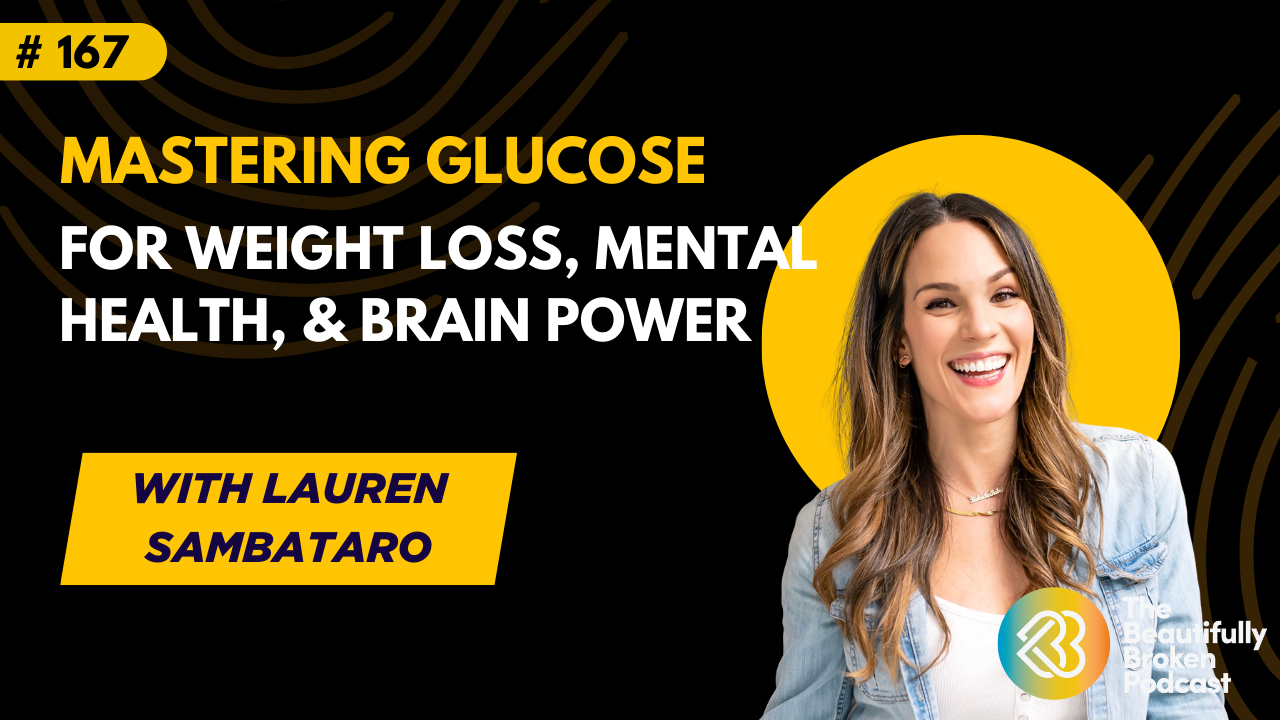
WELCOME TO EPISODE 167
We always hear “You are what you eat,” but while your diet does play a role in your health, it doesn’t paint the whole picture. In truth, you are also how and when you eat!
To dive into this fascinating subject, we’ve got one-half of the Biohacker Babes podcast today, Lauren Sambataro! She is a Functional Diagnostic Nutrition expert, corrective exercise specialist, health and wellness coach, and a fellow former Broadway performer.
Lauren joins us to share her expertise on glucose and metabolic health and provides valuable insight into understanding our body's response to food and the crucial role timing and framing play in our overall vitality and energy. Let’s get to it!


Episode Highlights
[0:00:00] Introduction
[0:05:49] Glucose, Diabetes, the Difference Between Hyperglycemia and Hypoglycemia
[0:12:49] The Benefits of Using a CGM and Understanding Your Metabolism
[0:20:03] The Factors that Affect Your CGM
[0:32:59] Resources to Deepen Your Understanding of CGM
[0:34:31] Microbiomes and the Glucose Response
[0:39:26] Connect with Lauren
[0:39:53] How to Learn More About Glucose Monitoring
[0:40:37] Outro
UPGRADE YOUR WELLNESS
Silver Biotics Wound Healing Gel: https://bit.ly/3JnxyDD
Code: BEAUTIFULLYBROKEN
LightPathLED https://lightpathled.com/?afmc=BEAUTIFULLYBROKEN
Code: beautifullybroken
STEMREGEN: https://www.stemregen.co/products/stemregen/?afmc=beautifullybroken
Code: beautifullybroken
Flowpresso 3-in-1 technology: (https://calendly.com/freddiekimmel/flowpresso-one-on-one-discovery)
CONNECT WITH FREDDIE
Work with Me: https://www.beautifullybroken.world/biological-blueprint
Website and Store: (http://www.beautifullybroken.world)
Instagram: (https://www.instagram.com/beautifullybroken.world/)
YouTube: https://www.youtube.com/@freddiekimmel
FULL EPISODE INTERVIEW
EPISODE TRANSCRIPT
Freddie Kimmel (00:01.994)
Ladies and gentlemen, welcome to the beautifully broken podcast. I am sitting here with my good friend, fellow biohacker, fellow podcaster, one half of the biohacker babes, Lauren Sanbataro.
Lauren (00:14.956)
I am 100% of my 50% of the biohacker babes. Hello. Ha ha ha. Great to see you as always.
Freddie Kimmel (00:20.928)
It's good to see you.
Yeah, you're glowing by the way, you look great.
Lauren (00:27.18)
Thank you. I've been working on my skin. My skin, yeah.
Freddie Kimmel (00:28.83)
Yeah. You've been working on your skin. Do you tell people how old you are in life or no?
Lauren (00:36.872)
When they ask, not a lot of people ask. I still think there's a little bit of fear at asking a female, especially around this general age category. I don't know. I don't get a lot of people that ask. When they do, I'm like, I'll tell you. I'll be 39 next week.
Freddie Kimmel (00:38.422)
Hmm, okay.
Freddie Kimmel (00:42.69)
Yeah.
Yeah, of course.
Freddie Kimmel (00:51.022)
39 next week. Thank you for sharing. I just look, I'm like, sometimes I have no idea what my friends are between you and Natalie and Kristen and Molly. I have no clue. I'm like, we're all 30s, 40s, 50s, somewhere in there. And so everybody, it doesn't matter. But it is a funny generational thing in which we don't want to jump into that where it's considered rude to ask, how old, I always mean as a compliment. I'm like, how old are you, by the way? You look awesome. Yeah.
Lauren (01:06.464)
Because it doesn't matter.
Lauren (01:18.22)
Mm-hmm. Yeah, I also think we ask because it's a way of comparison because we relate by comparison, right? People want to know so that they can actually have a familiar sense and then start engaging with you. But people are scared of that to relate.
Freddie Kimmel (01:31.661)
Yeah.
Yeah, it is, it is scary. And then at the end of that, that questioning, you could argue that it's like, oh, when am I dying? You know, it's like, mortality or like, shit. And it's Yeah, great question. When are you gonna die? I don't know. I don't know if it's tomorrow. The reason I had you on is because... Oh, you go.
Lauren (01:44.368)
Great question.
Lauren (01:50.538)
I was.
Lauren (01:53.884)
I just wanted to share, I was watching this Netflix documentary about infinity, all these mathematicians and physicists talking about what is infinity and how life just will go on. You can never stop counting. There is absolutely no end. It's fascinating and terrifying.
Freddie Kimmel (02:11.726)
scary, terrifying, I saw that, I can't watch that documentary. That title gives me agita and chills in my whole body.
Lauren (02:18.524)
You would like it though, because the mathematicians, it's beautiful how in love they are with the concept of infinity and just their work. It's really fun to watch them just speak about what they're exploring and not knowing.
Freddie Kimmel (02:29.227)
Yeah.
Freddie Kimmel (02:33.095)
Only to put a marker in the road, because I want to bring us back to talking about glucose and aging and cellular health and brain health, which you're an expert in. I went and saw Indiana Jones and the Dial of Destiny last night. And the whole premise, I won't spoil it, but they talk about Archimedes and a dial that could align through math where there were rifts in time that would allow for time travel. And it was really fascinating.
But it was, again, like you're saying, it was like very rooted in math. The guy's like, it's not science, it's math, and math works. It was fascinating.
Lauren (03:07.98)
There is a lot of ways we could relate to that, but I don't know, I think too hard and it's beyond my comprehension.
Freddie Kimmel (03:13.47)
Yeah. So why, what I asked you very candidly to come on the podcast. I said, what is, what is coming up for? What do you feel so passionate about right now in a container of health and wellness, what's really driving you and keeping you very curious and you, you told me glucose, ready glucose has got me curious. So why glucose Lauren?
Lauren (03:31.308)
Mm.
Lauren (03:34.4)
for so many reasons, but that's when I'm essentially spending my days and nights and weekends looking at, thinking about, talking to people about. Most of my clientele comes to me because they are curious about continuous glucose monitoring. So a lot of people are kind of turned on to the fact that diabetes doesn't exist in a silo, it exists on a spectrum. Our glucose functioning, our metabolic health, you could be metabolic syndrome, one end of the spectrum.
we don't become diabetic tomorrow, right? It's not a light switch. It's not one day off, the next day on. So people are getting turned on to this idea that the spectrum is really important. That's really what prevention medicine is. And so it's interesting why people come into glucose. Some of it is just biohackers. They're like, this is the next tool. I have to check it off the list, figure it out, explore it for myself, which is awesome. Some people are coming into it because they have a history, family history of diabetes. Some people want weight loss.
And then I think there's kind of this unexplored option that people are starting to look at more and more is how can we just use this tool as a window into our physiology for a multitude of root causes, factors, diseases, experiences that we're having in life. Really like there are so many things under that umbrella, mental health, neurodegeneration, depression, anxiety. How do we adapt?
Freddie Kimmel (04:53.302)
mental health, neurodegeneration, depression, anxiety. How do we adapt to toxins in the environment? The toxic exposure, chemicals, colds, microtoxins, air we breathe, water we drink, right at the very long list that you're looking at, that you're familiar with. Inflammation at large, also emotion, trauma, isolation.
Lauren (05:01.324)
to toxins in the environment, so toxic exposures, chemicals, molds, mycotoxins, the air we breathe, the water we drink, right? That's a very long list that your listeners are familiar with. Inflammation at large, also emotions, trauma, isolation, social isolation. This all comes up in the context of glucose because glucose is a way that our cells are responding and adapting to the environment. So...
Freddie Kimmel (05:19.626)
social isolation. This all comes up in the context of social because social is a way that our cells are responding and adapting to the environment. So to circle back, the CDM actually is a window into how you can handle the stress. Yeah.
Lauren (05:28.768)
To circle back, the CGM actually is a window into how are you handling your stress, whether it be mental, physical, emotional, how are you handling these toxins that are pervasive in our environment and getting worse and worse every year? Not to scare people, I'm not here to be an alarmist, but we have a lot of opportunities here.
Freddie Kimmel (05:45.255)
Yeah, can I ask you just for a bird's eye view, what is what is like a level one and level two of glucose mismanagement look like when people say I'm insulin sensitive or I am type two diabetes type one? Can you give a little bird's eye explainer so we can put those in separate categories?
Lauren (06:03.684)
On paper, it would look like going to your physician for your annual lab work, hopefully biannual. You want to get it every six months because our physiology is always changing. We could have markers in the pre or diabetic range. So looking at HbA1c, which is an average marker of glucose, three to four months average. You could look at fasting glucose, which...
I want to say it's not super valuable because you're going into a doctor's office getting blood drawn. We have a lot of white coat syndrome where cortisol rises. It's not your normal environment. People may be fasting longer or less than the time that they normally do. We can measure insulin, which is the hormone that is responsible for this whole response, reaction in the body. And then we can look at all the metabolic markers. So from a numeric perspective or diagnostic perspective, we can put people into categories based on numbers.
The other words I view is how are you feeling? And this is the part that people don't really know. Diabetics don't necessarily feel that they're heading towards diabetes. And a lot of my clients come to me and when they're having these glucose excursions, and we could talk about what is optimal, what is ideal. I don't know that we have a lot of long-term research on what it should look like in a healthy individual, but we have some ideas just based off of the evidence and research that we do have. But I find that's a huge missing piece. Not everyone feels when their other hyper,
or hypo glycemic. So traditionally we're really going off of labs and numbers to be diagnosed or put into a category or to say, hey, you really need to start paying attention to this. So bird's eye view is we use numbers on labs and the CGM also gives us numerical feedback. And the big missing opportunity is then using it as a tool like we do with any of our data wearables. What does this number mean subjectively? How do I feel?
when the objective data says this, can I feel it in my body? And that's a huge gap. People don't feel that they have high blood sugar, which is why we end up pre-diabetic diabetic.
Freddie Kimmel (08:02.946)
Hmm. It's fascinating. Can you also just, again, for the audience really quickly, what is the difference between hyper and hypoglycemia?
Lauren (08:12.78)
Yeah, hyper would be above the normal expected range. For example, you eat pizza. That one's fun. Everyone's like, shoot, how do I include pizza into a healthy normal diet? It all has to do with your baseline. So fasting glucose, so say my fasting glucose is 85. It all depends on the excursion from the 85. So say I'm at 85, I eat some pizza, and I spike to 185.
That would be hyperglycemia. That is beyond the normal expected range for a healthy glucose response. Of course, it's more nuanced than that because it depends how long are you staying up there, how quickly do you come back down. Do you then go lower than your baseline and rebound? And that's when we start to feel fatigue, brain fog, digestive upset, all kinds of things. Irritability, depression, anxiety. Hypoglycemia would be below your normal expected baseline. And we could have reactive hypoglycemia to foods.
So particular foods, if you're not eating the right macronutrient composition, protein, fat, carbohydrates, could also be a factor of things in your environment, water, air, dehydration, that list goes on. And then there's just standard hypoglycemia where you just tend to run a little bit lower. You could think of this as like your low energy people, like low cellular energy vibrating at a very just kind of low frequency. Sometimes also shows up as hypo, so under. Hypo would be low, hyper would be high.
Freddie Kimmel (09:37.494)
Amazing. I always just like to clarify that because sometimes I'll be listening to a podcast and we'll just we'll go over a term and there's an assumption made everybody knows what we're talking about. And it's a good reeducation for me. When I had my N equals one experiment with a CGM, it was really uneventful, which my doctor said, Hey, I want you to my nurse practitioner Caleb, he said, Hey, I want you to put this on for two months and just see because I don't know.
Lauren (09:46.667)
Totally.
Freddie Kimmel (10:07.386)
And my thought is your hormones are in balance, you're gaining muscle, you're sleeping good, I'm, I'm assuming that this is going to be pretty uneventful for you. You don't have resistance to weight loss. He's like, everything seems to be working quite well. Your labs look really, they're, they're on the uptrend. So I would man, I would imagine, but he wanted to look at those things with the history of Lyme in the history of all my mold exposures, if there was a possibility I wasn't regulating glucose well. So.
when someone wears a CGM and I wanted to wear one because I saw influencers wearing it, I was like, oh, that looks cool. It's like the badge of honor. You're like, look what I'm doing to bring awareness to my health. Yeah, I mean, it's fun, but if I'm not giving pictures of it every day showing you, look, always watching, always monitoring, is it really that cool? So I notice people do wear them a lot. And my question to you is, as someone who's studying this,
Lauren (10:45.544)
Yep.
Lauren (10:49.469)
in the club.
Freddie Kimmel (11:06.378)
What is the case to be made for wearing it all the time? Would you eventually get enough data where you sort of know how your body is responding?
Lauren (11:14.62)
Really great question. Again, it kind of depends on the goals, the personality, the lifestyle. My goal as a practitioner is to get my clients to get the most out of their data in a small amount of time. I want efficiency. Some people will wear it ongoing because they really like the accountability. They say, hey, my behaviors are better. I show up better, I make better choices when I have this accountability on my arm, right? It's like little birdies, little doctor saying,
maybe I shouldn't do that. Maybe I should do something a little bit different, right? And so there are people that make micro changes based on just having it ongoing. For me, I don't wanna be attached to wearables and technology for the rest of my life. And it's really important to me to train my intuition to be able to pick up on those signals and cues from my body and not from a device. We have a lot of blind spots and we're not really cued in and conditioned to feel those things and to know these numbers. That's why we wear our ring, whoop.
Bioswrap, get neurofeedback. So again, there's a lot of reasons why people come into it, but my number one goal with clients is, can we get the most out of this and move on? And then free up space for something else. But there is a subset of the population that says, I am a much better human, I make healthier choices when I have it. Fine, keep wearing it. If that helps you, that is invaluable.
Freddie Kimmel (12:24.695)
Hmm.
Freddie Kimmel (12:34.765)
Yeah.
Yeah. I would, I would agree. I'd say it's like training wheels on a bike or, or the, or the bumper lanes in a game of bowling. You could argue for both. And yeah. And it's really about your lived experience and your levels of joy and you, you knowing yourself. You know, for me, I, let me give you two examples. I tend to my joints, muscles and tendons. I feel so good when I do like a keto split. When I do five days of like being in.
Lauren (12:53.942)
Mm-hmm.
Freddie Kimmel (13:07.406)
measurable ketosis and then doing a refeed one or two days, one fasting day a week. It's like, I'm a different body. I mean, I can just kind of jump right up and do stuff with very, just like, God, my tendons all glide. Everything feels so good. I would assume that's related in some part, how I'm managing glucose. Just because there is a, how it's intertwined with inflammation. The other thing that I can tell you is, is that my brain.
Like if I, as of late, I've been doing, I think it's, I wish I could see the box. It's like keto for aid, keto aid. Do you know what I'm talking? It's like key for aid. Yeah. It's a little bottle, but I'll do like a shot of that. It tastes like acid batteries. That's the best thing I could say. It's not dessert. No, but, but I mean.
Lauren (13:45.46)
The ketones? Mm-hmm.
Lauren (13:56.632)
It's not dessert. Ketones are not dessert, kids. Yeah.
Freddie Kimmel (14:04.518)
I think it rivals any smart drug that I've done. I get really, really good cognition when my ketones are in a measurable range in relation to glucose. So I just wonder, you know, again, through my education, so I have this lived experience with trending away from glucose, leaning away from carbs, leaning into the ketones. I'll tell you the other thing is if I have like a couple bad days of like,
Lauren (14:13.504)
Mm-hmm.
Freddie Kimmel (14:32.686)
travel and I just can't find good food. And you're like, okay, the cleanest thing. It's like, I don't know if you've ever done this, like, even though it's relatively clean, like Chipotle uses seed oils, right? You get the white rice three days in a row. Maybe you get a side of chip and you just feel suboptimal. So that's like, that's been my experience like playing around with a better understanding my body as its own internal compass to make decisions about food.
Lauren (14:42.836)
Yep. Compromise.
Lauren (14:51.326)
Mm-hmm.
Freddie Kimmel (15:01.758)
Right now, I'm like, well, I'm good. I know right now. Now the things I haven't played around with are like, what are the implications to more? I've been moving more. Like every single day I've been starting walking with Sunrise, I'm five days in a row. You know, I'm starting to do things. I'm gonna do a 40 sessions of HBOT in a hard shell chamber. Like now I'm like, oh, I should probably put back on a monitor just to see if some of these new variables are gonna make a change.
Lauren (15:29.776)
Yeah, as you said, your lived experience is the most valuable. And that's where it's interesting when clients come and they say, tell me what to eat. Like, let's look at your glucose so we have some information to work off of. And then you need to tell me how you feel. You're very tapped into how you feel. I would say that's not the norm. Most people, you ask them, how do they feel in their body? And they go, oh, no one's ever asked me that. I don't know. I've never given it the time and the space to think about it. But yes, there will always be more experiments. I don't think the experiments will ever
run out, they are infinite, the way we started this conversation, they could go on forever. So I think if it creates a dialogue where you and your body can have a conversation to decipher the variables and the feelings and the data, then yes, you should put it on again. It also just, it exists on this checklist of metabolic health where sometimes it's not the only thing. And I think if you're curious about it, you should put one on so that either opportunities are revealed
Freddie Kimmel (16:05.131)
Yeah.
Lauren (16:28.812)
Or you go, oh, I'm okay. And then you have the confidence to go, I know that my insulin is functioning well. I have metabolic health. Maybe I need to look somewhere else. I think we get really kind of fixated on one particular thing because people are doing it, right? People are wearing the CGM, it's trendy. This has to be the solution to all of my problems. Sometimes it is. And then some people have the experience that you had. My dad put it on, no glucose issues. Okay, we move on. What else can we look at? What else are we not?
addressing, what are we missing? But there will always, to circle back, there will always be another opportunity to test, right? There's always gonna be more.
Freddie Kimmel (16:59.938)
Yeah.
Freddie Kimmel (17:07.568)
Yeah. Leading question for you. How many people do you think you've worked with, uh, specifically guiding them through the lens of glucose?
Lauren (17:17.576)
Almost 300 in the past two years. Yeah.
Freddie Kimmel (17:19.018)
Almost 300. That's amazing. So again, what I'm really finding is, I am so in love with.
We're going to take the name influencer. We're going to set it to the side. You influence people's health because you're putting yourself out there, but I don't like the name. Um, what I'm really in love with are people who are so passionate about wellness, sharing their lived experience and their story, but they have a foot in clinical practice and they're w what I've found is it's having p having people in your presence, having hands on bodies where the rubber meets the road. The outliers keep you very humble.
Lauren (17:33.806)
Yep.
Lauren (17:38.517)
Me either.
Freddie Kimmel (17:59.63)
Cause we don't start to, we, you know, we can listen to enough, you know, and I find this a lot in our space. People listen to enough people, they drink the Kool-Aid and they're like, Oh, well, blah, blah. Said, this is all I need to do. And I'm like, I don't see it always working out that way. So with your, with your clinical experience, which I'm just celebrating you for taking a moment to celebrate that, um, which one of these factors would you assume has the biggest impact on your CGM sleep?
Lauren (18:10.53)
Mm-hmm
Freddie Kimmel (18:27.411)
Stress perception.
Freddie Kimmel (18:33.25)
Food and nutrition.
Lauren (18:36.456)
put food and nutrition is that the last one? Is it ABC?
Freddie Kimmel (18:40.09)
I think it's ABC, yeah. Was there a four that you would put in there?
Lauren (18:45.606)
Again, the list is endless. I would probably, for the sake of the conversation, add movement, exercise in there, stimulating muscle.
Freddie Kimmel (18:47.806)
Of course.
Freddie Kimmel (18:51.338)
Oh my god, so important, what a blind spot.
Lauren (18:56.701)
I am going to put food and nutrition at the bottom of the list, which surprises a lot of people. And that's what I think just because of the historical context and connection with glucose and metabolic health, we think food. We think food is the only problem. If we go around the holistic wheel, stress perception is huge. I'm so glad that you brought that one up. And I would probably put stress perception against...
Freddie Kimmel (19:08.47)
Mm-hmm.
Lauren (19:23.292)
against sleep. I think that would be a really, those would be some pretty strong contenders. Probably have to argue that if we're getting good quality sleep, we're gonna be more resilient and potentially have more positive thoughts in reaction to our stress. And we could start to more positively engage with it. But I don't know, those are very two top contenders. Movement is really important. It's really hard to put these on a priority.
Freddie Kimmel (19:30.083)
Mmm.
Lauren (19:51.448)
because they all are interwoven, right, interconnected. There's never one root cause. I think this is like kind of a big thing in the industry. Everyone's root cause, its root cause is multifactorial. Everything is connected beyond our scope of understanding. Things are so connected. We need muscle for good glucose control. In fact, it's like the preferred storage site in the body. If we have excess glucose in the bloodstream, it has to go in one of three places. Muscle, liver, fat cells.
Freddie Kimmel (19:51.867)
Oh I know, well...
Lauren (20:20.676)
Liver has minimal storage space. We'll say it runs out quickly. We can think of Manhattan mini storage, right? We're not gonna get a big storage space compared to other places in the country. Muscle, also a little bit limited, but it depends on the context of your engagement in exercise. We can keep building muscle and create more capacity for glucose. The last one is fat. Fat is unlimited. And it's a little bit of a survival, not a little bit, it's a lot of a survival response.
We have fat storage to protect our bodies from excess glucose in the bloodstream, to get us through periods of famine, which we don't have because we have food 24 seven, but our evolution has created this survival mechanism that we can store fat in case of, but preferred storage site is muscle. But if we're not getting good sleep, we're not gonna have good muscle protein synthesis. So it goes very high up on the chain, but I probably would argue that sleep above all else.
But then there's also stress response to poor sleep. A lot of us think, oh, I'm not getting good sleep, and that's why you wear a wearable, because we get blind spots. Either you think you're getting terrible sleep and then you look at your wearables and go, oh, maybe it's better than I think. And then we start to have a more positive dialogue. Could be the opposite. So again, stress perception is super, super important, and I see that with glucose a lot. A really common one is I'm not gonna wear my...
Freddie Kimmel (21:27.534)
Hmm.
Freddie Kimmel (21:36.271)
Yeah.
Lauren (21:44.904)
CGM on vacation because I want to be bad or there's no possible way that my glucose is going to behave. When we go on vacation, we tend to be outdoors more, sunshine, better circadian rhythm, we're in nature, more negative ions. The whole stress response gets downregulated. Our nervous system is much happier on vacation, right? It's not because we're not working and we're drinking more. It's because most of us are outside. We have less stress.
Freddie Kimmel (22:07.319)
Yeah.
Lauren (22:11.016)
and the glucose actually behaves so much better because our nervous system feels better.
And so that's just one example, like perceived stress may not be what you think. So we have to be in constant dialogue with this idea of stress. Because your perception of stress could be way worse than the actual stress. And we know that's a huge bucket. Physical stress, chemical stress, emotional stress, mental stress. It's a big bucket. What is your relationship to it?
Freddie Kimmel (22:17.571)
Yeah.
Freddie Kimmel (22:36.426)
Yeah, because you're also a Czech movement specialist, and I will read a mini bio before we drop into the podcast with the listeners. What do you think about structural integrity or structural implications, whether that's scar tissue or limited mobility and the fascia joint mobility, where do you think that falls into the body's ability to regulate glucose?
Lauren (23:02.988)
Glucose and inflammation are buddies, big time buddies. Yeah, they regulate each other. And I think if there's any peripheral inflammation that needs to be addressed, because peripheral inflammation very quickly crosses the blood brain barrier, it can become neuroinflammation. Glucose can create neuroinflammation. So anything that's gonna trigger a stress response, it's gonna trigger an inflammatory cascade. And then of course, we come back to this root causes, right, gut brain access.
Freddie Kimmel (23:17.323)
Yeah.
Lauren (23:29.708)
We're gonna have to look at the gut, we're gonna have to look at the brain, we're gonna have to look at your perception of stress, we're gonna have to look at your sleep. The checklist ends up being kind of long because it is so pervasive.
Freddie Kimmel (23:39.949)
Yeah.
Yeah.
Lauren (23:43.165)
So if there's injury.
One, like what is your relationship to that injury in relationship to the pain? Because a lot of us think that pain is bad. And then we just, we end up in this dialogue of bad, shame, guilt, I have pain, it's distracting, right? Pain doesn't feel good, but pain's just a signal. Is pain inherently bad?
Freddie Kimmel (24:05.226)
No. I'm answering for the audience. Ha ha ha.
Lauren (24:05.844)
So the first question is, what is your relationship to the pain? Yeah, what's your relationship to the pain? And then once we can clarify that, how is it affecting your movement mobility? Is it inhibiting you from lifting weights, doing strength training to build muscle tissue so that we have more storage space for glucose? Is it creating inflammation, crossing the blood brain barrier, affecting your immune system? Because if we have peripheral and inflammation in the brain, it's gonna activate our immune system.
When our immune system is activated, it trickles down to the neurotransmitters. Once the neurotransmitters are in balance, then we have poor mood, poor motivation. We're less likely to be motivated and inspired to move.
So we have to figure out what is our relationship to it and how much is it hindering our goals? How much is it hindering this holistic wheel of the things we kind of have to, we got to go through the checklist and make sure that we're hitting. Movement is essential, sunshine is essential. Are you in a bad mood because your glucose is dysregulated? Probably. I would argue that maybe glucose is the initial trigger. Triggers an inflammatory response, triggers the immune system, triggers the neuro...
transmitters and we're like in a shitty mood. Like not being nice to our friends.
Freddie Kimmel (25:20.958)
Yeah. It's, it's certainly wild to think about, you know, what I just in this conversation, what comes up for me is if I were to put just like on my Tesla, I don't own a Tesla, but if I were to have a Tesla, I would have dials on the dash in which I'd want to know oil pressure, gas mileage, you know, engine temperature, all these things. I think on the human dashboard, you really want to understand.
through different periods of your life and different ages, where your glucose is riding. And I do think it's just so easy, it's very accessible. It's not an incredible investment. And in fact, I think mine was, both of mine were covered under my insurance, my CGMs.
Lauren (26:06.804)
I would say you're lucky. That doesn't happen so often, but it certainly is the first place you should try. If you can get a cover, it's fantastic. But yes, the investment in the scheme of health and wellness and the things that we're trying to achieve and the bang for your buck, I mean, pennies.
Freddie Kimmel (26:12.592)
Yeah.
Freddie Kimmel (26:25.474)
Mmm.
Yeah, pennies. I would agree. The other thing that came up for me on this list, so we had, I had said, initially I'd said sleep, stress, food, we had added movement. I have crossed my brain, I'm making notes. I said, lymphatics. Like right now I'm just on this lymphatic twist because of Flo Presso and just, I'll just say my one little sentence right now, the idea that there is three times as much fluid.
Lymphatic fluid is there as blood and there's no pump to drive it. It operates on the principle of fluid dynamics. It's a pressurized system. I E like there's a lot we need to manage to make sure it's functionality. And that is your immune system. It's like how the body is going through and like the little lymph nodes transfer as a transfer station in the mind. Imagine it as a transfer station, a sorting station, and it's saying virus, cancer, bacteria.
Lauren (27:07.724)
Mm-hmm.
Freddie Kimmel (27:21.63)
And it's literally the lymphocytes are marking these cells so the body can determine what the next step is. I'm like that system, no one knows about it. Nobody talks about it. It's just like, you know, the time it comes up is when you're, you, you find your, your cancer has spread to your lymph nodes. And, and the idea is that it's like, Oh, that damn lymph, it got cancer. It's like, actually the lymph was doing a job. It's slowing it down there. It's really fascinating. So.
Lauren (27:45.952)
Mm-hmm.
Freddie Kimmel (27:48.562)
I would be really interested to explore, and I just don't know, another podcast, the relationship of lymphatics and glucose.
Lauren (27:57.36)
Yeah, I haven't had any clients that have, it would be a fabulous experiment to get some Flo Presso people and a CGM. I've never seen that directly, but it's another form of movement, right? We're moving the lymph. Same as the benefits of movement exercise. Our bodies are dynamic, they're changing. We need stimulus. We need things to adapt to. When we have stagnation, that's where we have disease. We don't want things to stop moving. So it would be really interesting to see in the context.
Freddie Kimmel (28:09.951)
Mm-hmm.
Freddie Kimmel (28:18.146)
Yeah.
Freddie Kimmel (28:23.331)
Hmm.
Lauren (28:27.288)
of glucose, but we don't want to micromanage that or look too closely because we're supporting the body's natural healing abilities, right? So people are doing sauna and cold with glucose and they go, oh my God, the sauna spikes my glucose, that's bad. Or the cold plunge drops my glucose, is that bad? It's really in the larger context, how is it supporting your body's natural healing abilities? In the moment, maybe it looks scary and it looks like stress because it's a hormetic stress. But then we have to look at your stress bucket.
Freddie Kimmel (28:34.624)
Yeah.
Freddie Kimmel (28:54.099)
Yeah.
Lauren (28:55.408)
over time, how is it actually improving or stalling your health, right? So it'd be a very interesting experiment to see if we are supporting the lymph. Does that add up to more resilience, better blood flow, better resilience, better immune response? Because these are all responses in the body. Like insulin response or insulin resistance is actually a survival response. Our body's trying to protect us. Same with inflammation, not bad. Our body's trying to protect us.
Freddie Kimmel (28:58.87)
or sawing your house. It will be a very interesting experiment to see if you are supporting women.
Freddie Kimmel (29:11.012)
better resilient. These are all responses in the body.
Freddie Kimmel (29:23.918)
Yeah.
Lauren (29:24.332)
So we can't micromanage any one of these things.
Freddie Kimmel (29:27.386)
Yeah, it is really, again, this theme comes up, it's just this interconnected nature of it all. And it's funny, we started on the infinity and the model of time, just keep going, go by the numbers, that how connected it all is. And so, again, an important tool, good awareness, it's a way we can have insight into the body. These are things I'm garnishing from this conversation, and seems very, very accessible.
Where is there a resource in which you would point someone to say, here's a great guide, like understanding a CGM, the numbers, what's happening. Go.
Lauren (30:04.716)
Ooh, well, yeah, that market is exploding right now. So there's a lot of popular CGM companies, like Levels, who I'm associated with, but there's also Vari, there's NutriSense, and they all have fabulous websites with endless blog articles that you can read as an introductory education into these things. I would probably start there because they have written these articles for the public, for public consumption.
You could scroll through research journals endlessly and understand the connection of the gut brain access and inflammation and insulin and glucose, but it's probably going to keep your mind spinning and then you're not going to sleep and then you're not going to have good glucose control. So I think stick with the public education resources and maybe we can link some of those. But yeah, there's more and more coming out about it. And so I think it just has to be repeated over and over again that I think it is an experiment worth running at least once.
Freddie Kimmel (30:46.174)
Mm-hmm.
Lauren (30:57.46)
at the very least to give you confidence that aspect of your life is in control and managed. And I would say if you fall anywhere on the spectrum of depression, anxiety, mood disorders, energy dysregulation, poor sleep, any inflammatory conditions, be a really worthwhile place to look.
Freddie Kimmel (31:16.353)
Yeah, beautiful. What it's certainly, it's certainly something that I think most people can have access to. And it is good insight into better understanding our body and our health. And, you know, one thing that that's come up in a couple.
Podcasts of late, we're talking about metastatic cancers is the idea of these unique scans in which we give the body a bolus dose of glucose and our tumors light up under a PET scan like a Christmas tree. So those cancer cells are, they love it. They love that glucose. As they opt
Lauren (31:44.021)
Mmm.
Lauren (31:50.028)
Mm-hmm. Same as LPS, right? Both of those are used in research a lot. How do we actually create disease so then we can study it? Glucose, LPS.
Freddie Kimmel (31:54.987)
Yeah.
Freddie Kimmel (32:00.054)
Yeah, give us and give the audience just a quick little download around LPS.
Lauren (32:05.516)
It is a gram-negative bacteria that can flourish in our body. Bodies are actually really good at hiding it, so typically we'll create a biofilm around it to protect, again, another survival mechanism. LBS can cross the blood-brain barrier, so we often see it in the progression of leaky gut which becomes leaky brain. It is part of the inflammatory cascade and highly, highly connected to neurodegenerative conditions, to metabolic syndrome, insulin resistance, and multifactorial.
in terms of root cause, there's a lot of different reasons, but I'll just drop the gut health conversation. It is important. It's very important.
Freddie Kimmel (32:43.046)
Yeah, it is important. It is important. It was an incredible, um, dropping in a few weeks ago with Kiran from microbiome labs and just talking about, you know, the, the very small number of human genes, 22 to 23,000, and then the number, the number of, I mean, look at the guy, it's millions, it's crazy. It, and I've said this from the very first podcast, I think I did with him four years ago, it's we.
Lauren (33:02.757)
Look in the gut.
Lauren (33:06.604)
Mm-hmm.
Freddie Kimmel (33:12.514)
are grossly outnumbered, human to microbes, grossly outnumbered. So what a great time to foster that relationship with Inside Outside World and just let your mind run wild with that. It's like germs. I think we've definitively proven, especially through the pandemic, how valuable they are.
Lauren (33:33.388)
Absolutely, and gosh, this could pull up a whole other conversation around glucose, but the microbiome dictates your glucose response. And a lot of us have just sterilized everything in our lives, including like we're washing the crap out of our fruits and vegetables, or washing away the natural bacteria. So we have less gut diversity. When we have less gut diversity, or maybe we have overgrowth of opportunistic bacteria, or we have dysbiosis, that's a major cause for poor glucose response.
Freddie Kimmel (33:53.09)
Mmm.
Freddie Kimmel (33:57.634)
Hmm
Freddie Kimmel (34:02.399)
Yeah.
Lauren (34:02.42)
So yeah, if we're looking like germ versus terrain theory, we are microbes, we need them, we need to be in symbiosis with them, we need to get along, we don't need to sterilize and push them away because that is part of our glucose metabolism and metabolism at large.
Freddie Kimmel (34:16.606)
Yeah, I'm doing the Marion Institute certification for biological medicine. Right now that is based in their schools, they have a they have a the biomed center, they have one in Rhode Island, they have one in Arizona, Dr. robot, Dr. Tom. And it was, it was really fascinating. Just going through some of the initial material yesterday and just, you know, all the things that we're talking about.
Freddie Kimmel (34:46.466)
the gut and terrain and what the limitations of, it's really interesting, I'd never heard it framed this way, but functional medicine and their experience, it really operates on a lot of Newtonian science. Blood work goes here, level goes here, treat with drug or supplement. It's very allopathic when you really think about it, but something like a biomed is looking at, it's more like a quantum physics.
Lauren (35:08.219)
Mm-hmm.
Freddie Kimmel (35:14.174)
And that's where they bring in like, you know, the environment, the homeopathics. Um, how are we rebalancing this terrain and not looking at it as just, you know, just event, event equals trigger, but there are so many factors in the, into what makes a healthy body. It's just fascinating. And then just to learn yesterday in my intro course, just allopathic medicine, it's like 150 years. You know, when we look at, when we look at like things that have like,
grossly distorted, and that's a poor term, grossly distorted, incredibly amplified longevity. Some of these practices go back 5,000 years to the Egyptian civilization. So some of the essential oils and the remedies that they were using were just wild. And so they've got quite a track record. They've got quite a track record. So anyways, that's on my horizon right now. If anybody's interested in that, in that...
Lauren (36:01.149)
Mm-hmm.
Lauren (36:04.969)
Mm-hmm.
Freddie Kimmel (36:10.83)
course, there is a link on my beautifully broken dot world shop page for the Marian Institute. It's super affordable. And then there's a live component in New England in the fall with Dr. Tom. Yeah, really fun. I'm really, I'm stoked about it. I'm doing my, I'm doing my 40 sessions in the hard shell chamber. So I'm doing the course in there. It's, it's like perfect. Like,
Lauren (36:33.936)
Oh my gosh, what a place to study, like brain on, receptivity high.
Freddie Kimmel (36:40.154)
I know, I know. Lauren, where can people find you and you and your sister and download more information from your expansive brain?
Lauren (36:51.86)
So I have a website, laurinsambotero.com. I'm on Instagram a lot, lauren underscore sambotero. And my sister and I have a podcast, Biohacker Babes, which we chat back and forth with the beautifully broken podcast quite frequently. And also on Instagram, biohacker babes. Yeah, and if you're interested in glucose monitoring, because I think it is worthwhile, just once check it off the list. One, I would ask your physician.
Freddie Kimmel (37:16.96)
Yeah.
Lauren (37:19.156)
See if you can get it covered. Because more and more physicians, I think, are open to this idea that it exists on a spectrum, that even just a personalized diet or to kind of fill your curiosity, is this place in my health managed and optimized? Do it. Next level would be to look at one of these companies, like Levels, which I'm connected with, Very NutriSense. And there's some other resources, which maybe you can drop in the show notes. I think...
the possibilities are expanding, just like any new tech. It's expensive and hard to get, but it's becoming more and more accessible. So keep it on the horizon.
Freddie Kimmel (37:54.382)
Yeah. Yeah, I would love some resources just to put in the show notes for people so they can have a quick download. Are you going to be speaking anywhere in the next calendar year?
Lauren (38:06.316)
No, I have wedding on the brain. Getting married in October and once that is done, I'm going to step out of my shell and come back into the conference world. So stay tuned.
Freddie Kimmel (38:09.31)
You have a wedding on the brain.
Freddie Kimmel (38:20.258)
Great. Well, I will tell you, yeah, and I'm for everybody at home, I am in Lauren's wedding. And I got my suit and I've been really, I just been moving more and committing and pushing weight and I've like gained some weight. So I'm like, my suit jacket doesn't fit. I was like, whoa, it's like stretchy. So I got to go back for a 40 regular. I was a 38 regular. So, but the suit looks great. It's gonna be a beautiful wedding. I'm so excited.
Lauren (38:27.089)
Yes you are.
Lauren (38:46.752)
Ah.
But she put weight on because of muscle. More MPS, yeah, so glucose, glucose responses, dialed in.
Freddie Kimmel (38:52.074)
Muscle, yeah. Yeah.
Yep. Tiled in. Ladies and gentlemen, beautifully broken podcast, Lauren Sanbutaro. Thank you for being here. I deeply appreciate your time, your knowledge and your insight. And it's so refreshing to listen to you grow and staying so curious about this field of health and wellness.
Lauren (39:17.14)
Thank you, friend. It is my favorite trait, curiosity, right? Keeps things alive.
Freddie Kimmel (39:21.022)
Yeah. All right. We're going to shut this down. Big love everybody. Bye.