The Aristotle Test: A Game-Changer in Early Disease Detection - Insights from Dr. Paniz Jasbi
Nov 13, 2023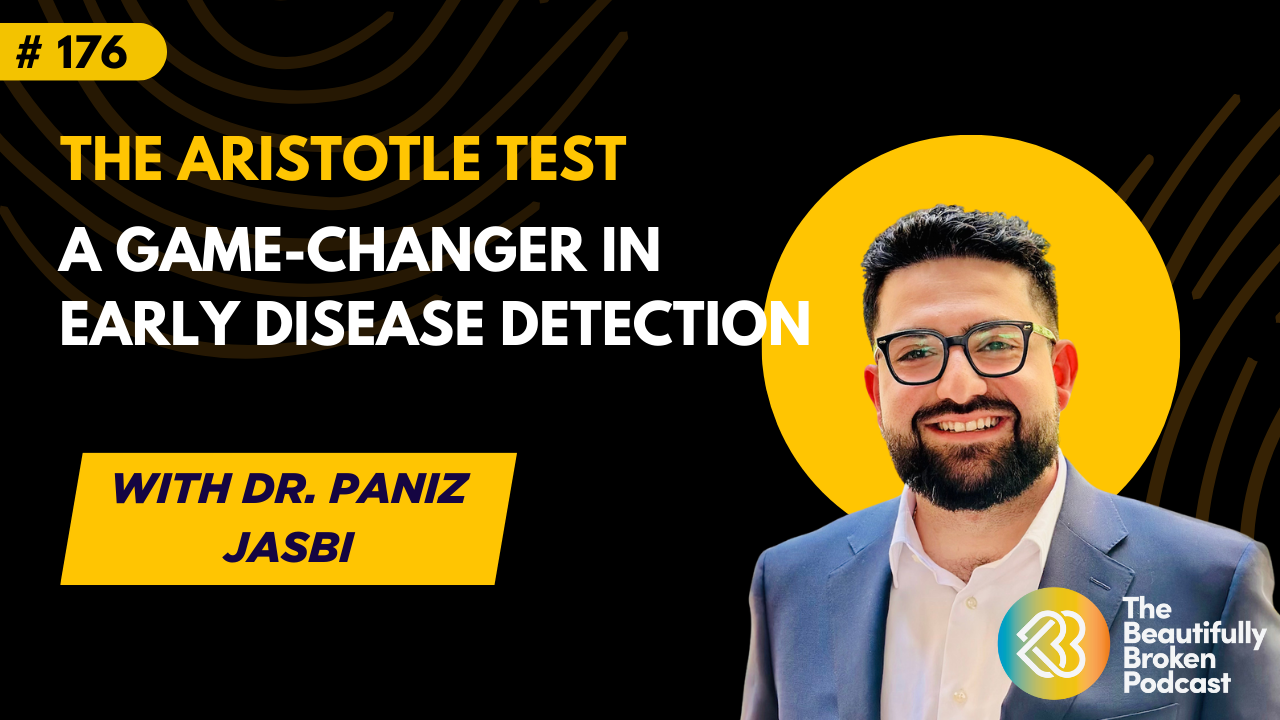
WELCOME TO EPISODE 176
Dr. Paniz Jasbi is a distinguished postdoctoral researcher at Arizona State University. With a close partnership with the Biodesign Center for Personalized Diagnostics and the Center for Applied Structural Discovery, he is at the forefront of pioneering metabolic research.
Dr. Jasbi has had an instrumental role in the development and promotion of the Aristotle Test, helping bridge the gap between systems biology, metabolomics, and the practical application of these fields in personalized healthcare. He also has been a pivotal figure at Theriome, guiding its innovative approaches in precision health.
With a passion and dedication to pushing the boundaries of how modern science can be harnessed to create new solutions, Dr. Jasbi joins us on the Beautifully Broken podcast to share his insights into precision medicine and the diagnostic revolution that is the Aristotle Test.


Episode Highlights
[00:00] Introducing Dr. Paniz Jasbi
[02:04] What is Multi Omics Data and What Drives Dr. Jasbi’s Passion for It?
[12:40] How Does The Aristotle Test Work?
[22:25] How Do We Get So Much Data from Blood?
[26:58] How the Aristotle Test Finds Disease Signatures
[31:41] The Level of Interventions from the Results of the Aristotle Test
[34:38] How the Aristotle Test Can Project the Benefits of Red Light Therapy in the Body
[40:10] Does the Aristotle Test Account for Energetics and Emotional Factors?
[43:17] How Does the Aristotle Test Integrate With Other Diagnostic Tools and Modalities?
[46:20] Who Should Get the Aristotle Test?
[50:02] The Process of Getting the Aristotle Test
[55:20] Dr. Paniz Jasbi’s Advice on What to Change in Your Lifestyle
[57:58] Outro
UPGRADE YOUR WELLNESS
Silver Biotics Wound Healing Gel: https://bit.ly/3JnxyDD
Code: BEAUTIFULLYBROKEN
LightPathLED https://lightpathled.com/?afmc=BEAUTIFULLYBROKEN
Code: beautifullybroken
STEMREGEN: https://www.stemregen.co/products/stemregen/?afmc=beautifullybroken
Code: beautifullybroken
Flowpresso 3-in-1 technology: (https://calendly.com/freddiekimmel/flowpresso-one-on-one-discovery)
CONNECT WITH FREDDIE
Work with Me: https://www.beautifullybroken.world/biological-blueprint
Website and Store: (http://www.beautifullybroken.world)
Instagram: (https://www.instagram.com/beautifullybroken.world/)
EPISODE TRANSCRIPT
Freddie Kimmel (00:01.047)
Ladies and gentlemen, welcome to the Beautifully Broken podcast. We are sitting down today with Dr. Paniz Jasby. Paniz, welcome to the show.
Dr. Paniz Jasbi (00:10.37)
Thank you so much, Freddie. Thank you for having me. I'm so excited for all the topics we'll get to discuss today.
Freddie Kimmel (00:16.799)
I am too. What an exciting barrel of monkeys we're about to open as far as the work that you are doing in the world. If you could tell us for if we if we were to pass on the street and you were to tell me what you do, how would you describe yourself your work in the world?
Dr. Paniz Jasbi (00:35.326)
Yeah, definitely. So when people ask me what I do, I always say scientist. And they're a little bit like lab co and scientific instruments. And yeah, that's actually exactly what I do. I don't say doctor, because then that means physician. They're thinking of like I see people and administer medicine to patients. And that's obviously not what I do. I tell them when they ask, and eventually, OK, what kind of scientist? Or they have a follow-up question. I always tell them.
I'm the CSO of a biotech, and we're looking to revolutionize the paradigm in health testing, both for immediate gains in health monitoring and patient assessment, as well as more long-term distal gains in research and scientific innovation, which can be realized as we sort of create this critical mass of multi-omics data from...
all over the country and throughout time.
Freddie Kimmel (01:38.503)
Amazing. Describe for me if you will, if I'm a person, and I say, wait a second, that all sounded pretty clear except for when you said the phrase multi-omics data. You lost me. I don't know what that is.
Dr. Paniz Jasbi (01:49.29)
Sure, sure. So the omic sciences, and it seems like as a researcher in this field, every day there's a new omic that pops up, and they're usually related to, you know, some subset of the currently established omic sciences. And by omics, we're referring to the sciences that end in om, omic sciences. And those are the genome, genomics, you know, investigating the proteome, proteomics.
They are the complete set of their respective prefixes. So we talk about genomes, we talk about the complete set of DNA and genetic instructions within an organism or a biological system. Same thing goes to proteome. All proteins, all post-translational modifications of those proteins, all isoforms, et cetera. We have the microbiome, which is the complete set of microbes. And so these are the omic sciences.
And when we talk about multi-omic testing, what we're talking about is essentially this concept of deep molecular fingerprinting, where we get data on a customer's genomics, transcriptomics, those are all the RNAs, the proteomics, the microbiome, as well as the metabolome. And that's where my focus really is, as far as my own research career. I specialize in mass spectrometry-based metabolomics.
mass spectrometry based means that we, I happen to mostly utilize mass spectrometry, although I have some tangential experience with other platforms. We mostly utilize mass spectrometry for the sensitive and specific detection of your metabolome, which is again, your complete set of metabolites, the end products of your metabolism. And so they are the end products of all the biochemical processes that happen within you. And...
there's advances and drawbacks, and there's pros and cons to every level of systems biology. But when we tie them together, and we integrate these levels for an individual, what we get is a deep molecular fingerprint, which is a multi-omic assessment. We use more than one level of an omic science. And by doing that, we sort of mitigate all the shortcomings that are inherent in any individual level of
Dr. Paniz Jasbi (04:14.738)
omic sciences because whatever shortcomings the genome has analyzing the genome, the metabolism largely and the levels downstream largely mitigate. And by doing this, we create the most comprehensive. And by that, I mean, it's really hard to imagine how you could assess a human being's biology any further. If you have all levels of these biology and you just start growing the panels and we get this incredible coverage.
of human health when you compare it to what's traditionally measured using, you know, a multifaceted array of diagnostic techniques, complete blood counts, organic amino acids tests, lipid panel, et cetera, et cetera. Then you have the imaging techniques and everything that goes on top of it. What we're proposing is a true multi-omic shift in how we assess people's health. And by layering this data, we can not only give them more specific tailored recommendations
usher in this new era of personalized medicine. How do we achieve that personalization? It's through this deep phenotyping. And then what we do is we use our data, we analyze it, and we leverage it for continued scientific discovery and insight. So not only can it be used for an immediate vertical advancement in patient care that we can realize today, but throughout time, this sort of data will lend to changes in how we.
investigate potential causal mechanisms. It will inform funding mechanisms on what types of research, on what topics should be prioritized. And we will become a more directed and efficient research enterprise as a whole, community of scientists.
Freddie Kimmel (05:59.923)
Yeah, there's that's very exciting. There's a million questions that I have popping up. Um, I mean, anywhere from what are the, what are the limitations in today's traditional diagnostic workup? If I go to my general practitioner, we'll typically maybe once a year, we'll look at our, our blood profile or CBC, and maybe there's something off and we'll do a little deeper dig than that, but other than that basic panel, we really don't do a lot until there's
a problem. So I've always seen the need for identifying signatures or patterns in the disease process well before they materialize in a tumor or late stage dysfunction, which takes away quality of life. What is the driver that's made you so passionate about looking at multiomics data? Do you have a personal experience? Is there something that really just lit your fire as far as you understanding the research and the potential?
Dr. Paniz Jasbi (06:56.382)
Yeah, what motivated me? That's a great question. And I wish I had some sort of like deep founders like story to tell you. And I have had people in my life pass away from early disease. I have had people in my wife's life, very dear to her, really go from diagnosis to passing away in matter of months. I've had those experiences, but I can't say it's really what...
lit a fire under me and made me go, okay, enough's enough. So me and my co-founder, Dr. Alex Moore, during our doctoral training together, which we were in the same doctoral program, he is a microbiome specialist, and he does some amazing work on the microbiome, especially the gut, athletic microbiota, as well as nutritional interventions for gut health.
He's an excellent human being, a fantastic co-founder, and a really stellar, truly exceptional scientist. And we had always realized that this is kind of where it's going. There would be these vague opinion papers we would read from fully tenured professors who we admired and respected and would go to conferences with and have dinners with and talk about these topics. But when we noticed we would talk to them, it was always sort of like this, oh, one day. And
The one day idea was really growing, making us weary. Because we looked back at the literature and we tried to figure out where was the provenance of such an idea really first formed? What is the seminal founding literature? And metabolomics is a science. Goes back to June or August of 1998, I think, summer of 1998, when a very esteemed, probably the founder of metabolomics, Professor David Wishart, used the term in one of his publications.
The actual ideas and underpinnings we can trace back to a 1972 publication that was entitled Analytical Chemistry, Gas Chromatography, and Computer for Personalized Medicine. I mean, computers were so nascent back in the day that the title said, and computer for personalized medicine. So we read it through and it was essentially the blueprint of so much, not all, but so much of what we want to do at Therial, which is to say we have the tools. These tools aren't
Dr. Paniz Jasbi (09:20.566)
available in your hospital system. Well, some hospital systems, if you go to the Mayo Clinic, they do have a metabolomics core. They do have a genomics core. They do these kinds of testing, but it's usually reserved for incredibly, you know, privileged pockets of healthcare or academia. And our idea was, and there's a reason they're not in doctor's offices or most hospital offices. First of all, there is a difficulty in understanding.
Freddie Kimmel (09:36.261)
And our idea was, and there's a reason that you're not in doctors office.
Dr. Paniz Jasbi (09:46.374)
so much data when your physician does the CBC or the OAT, they have personal experience in pedagogy and fueling their understanding interpretation of that data. They're not using AI algorithms that have been sort of modeled from mind data in databases and studies that have been curated. What we are doing is we're saying, listen, this is so much data. It's a vast amount of data that nobody can really model sort of intuitively in their head, like they can.
the sparse information that they get from, you know, CBC and the OAT, which they're used to, through decades, often, of medical training. But what we have is this AI that can analyze this data, corroborate it with known disease signatures, and then return and do some of that thinking for the physicians. Of course, not a diagnosis, but it can lead to really meaningful discussions and identify more probable routes of investigation for your physician, if you're, for a lot of our customers who are suffering from ambiguous symptoms.
For us, it really became, we need to do this quickly, because there's such a missed opportunity here. We have the, you know, it used to be in 1972 and in 1998 that we didn't have the computational power to really do this kind of work. We didn't not have the computational power to do Bayesian statistics. We didn't have the computational power to perform, you know, sort of, you know, out of the box AI services for our customers. And now we do.
We didn't have the wealth of databases that are fueling our inferences and our interpretation of customer data. This had to be curated from its inception of these sciences up to modern day, which are still updated. And most of the greatest academic groups are working on maintaining and updating those databases with more recent and more important findings. We also have this idea that, although we don't have these great stories of loss,
even though we've experienced loss due to delayed medical care. You know, the idea of health care isn't really caring for health. As you mentioned, most people are treating symptoms when they appear. They don't have the tools to really identify themselves at the molecular level, identify pathogenesis, you know, sort of before they become symptomatic. So really, we don't have this health care. We have this, you know, post hoc sick care that is just trying to treat sick people. And this idea of Medicine 3.0
Dr. Paniz Jasbi (12:10.118)
is truly to usher in the idea of healthcare, whereby people are taking proactive assessments. People are taking preventive measures rather than therapeutic measures. And so a tool like, you know, Therium and you know, currently we have one systems level biology test available, the Aristotle. We're working our way up to the second one, which will be available in the next couple of months. And we will expand to the full suite of systems biology testing. And I hope it'll get to a point where one day
sort of every aspect of a person can be known, anticipated, and hopefully corrected and mitigated for through easy things like diet and lifestyle, which are so much easier to implement than chemotherapy.
Freddie Kimmel (12:57.111)
Yeah, I think it's the, what you mentioned there is the idea that we can have these early stage interventions in which 10 years before the disease process, the lifestyle interventions would have a cumulative effect. So if we, if we, if we mention the, the tests that you're talking about, it's therium, um, can you speak to how this test works? It brings in all these sciences of multi-level omics, the different levels of data, the protein expressions, the genome.
the microbiome and we get this really, um, we get a new level of insight on health or wellness or vitality that we've never had before. Can you speak a little bit about the test and how it works?
Dr. Paniz Jasbi (13:36.578)
Sure, absolutely. So the test itself, the Aristotle test, which is named after Aristotle as he was really the first person to commit to writing some nascent theory of metabolism. But we named it the Aristotle and it is essentially a targeted aqueous metabolite panel. So it's looking at the aqueous metabolites and these are the sort of housekeeping metabolites or you would be known as sentinel metabolites. They're called sentinel metabolites because they largely are embedded.
in the most important human pathways. So these are embedded in pathways that are indicative of human health as well as indicative of early stage progression of diseases that are the greatest contributors to human mortality or morbidity, like heart disease or cancers or Alzheimer's. And what we do is once you order the air subtle test, we ship you a dry blood spot kit. You take the sample in the comfort of your own home and with just a few
drops of blood onto our proprietary filter paper, which maintains metabolite integrity and helps us in ensuring the fidelity of our results through shipping and processing, you send back to our labs. Once we get it in our labs, we undergo simple processing. The processing is basically where we separate the metabolites from the filter paper using various processes such as homogenization, sonication,
and then centrifugation. What we also do is we precipitate all the proteins because we don't analyze proteins in this test yet. One day we'll get to doing a full proteomics assay, but right now we can sort of analyze proteins or infer to the protein level using metabolite concentrations. But we're not directly measuring proteins. So we precipitate those proteins in our sample processing, and we keep the metabolites in an aqueous layer, which then undergoes
analysis by gas chromatography mass spectrometry. And that's what I've abbreviated previously in our talk to GCMS. GCMS, gas chromatography mass spectrometry, is a technique whereby we analyze. We separate these metabolites, and we look at their relative abundances. And we do that along two dimensions. First, we separate them based on what's known as a retention time, which is the time that a molecule
Dr. Paniz Jasbi (16:01.942)
takes, let's say ibuprofen or caffeine. There's a time that these molecules will take for interacting with this column we have. There's a chromatography column that, you know, is sort of, you know, your molecules are writing on a stream of helium in that column, and there's a certain amount of time that each molecule will take to attach to the inside of the column, the mobile phase of the column, interact with, and then dissociate from, and then keep going down to the column.
And that time that they interact with that column is dependent on their chemical structure. Certain chemical classes will interact more or less with others. And so we separate them on the time it takes to elute from the column, and then we analyze their mass to charge ratio, essentially their molecular weight, their molecular mass, using the mass spectrometer, which sort of filters different, it sort of analyzes a certain mass to charge.
range for every single retention time. Thereby, we get this incredible specificity by using two-dimensional separation techniques, by using gas chromatography prior to our mass spectrometry. Because although some molecules may fragment and have the same mass to charge ratio in the mass spectrum, it is incredibly unlikely that they would have the same retention time. And so we know the retention times and mass to charges of all of our 126-panel-
metabolites. We've tested this with standards and compared them to banked spectra in databases like the human metabolism database. And so we know their identities based on their retention time and mass to charge characteristics, and then we can quantitate their relative abundances using sort of the, we get these peaks, right, for every metabolite, and we can quantitate them using the abundance under that peak or the area that's contained under that peak. And so we then take those levels of 126 metabolites and
We analyze that using our proprietary AI, and that analyzes your data according to first 12 health domains. And these are including everything from cardiovascular health, liver health, gut health. These are health domains and models that we validated from mind data. So these are scientifically validated findings in peer-reviewed journals with publicly available data.
Dr. Paniz Jasbi (18:23.138)
that we've mined and we've created a validated model for each one of these health domains, liver health, gut health, integumentary health, reproductive score, environmental toxin exposure. And what we've done is we've said, okay, is this model overfit? And that's a real important scientific consideration. And that's something that we make sure that all of our models that we sort of infer to and infer using have been checked for overfitting. We need that the data.
isn't too rigidly conformed to the characteristics of the training set from which it was mined, meaning that the model that we formed isn't generalizable to new cases. Can we apply it to new cases, or is it overfit to the training data that we have? We make sure all of our models are not overfit and they pass the generalizability test, and we apply them to our customers. And we actually will correct.
So we collect a lot of biopsychosocial data, including everything from diet and lifestyle habits, environmental exposures, occupational health hazards, biopsychosocial factors like social connectedness or depression score. And we use this totality of information, along with the metabolite scores, to come up with multiplexed readouts, again, across the 12 health domains. And the scores are given on a scale of zero to 10, with zero being poor.
10 being optimal and five being neutral. And then we also corroborate that, not just with the health domains, but validated models for disease signatures, 344 disease signatures that have been characterized in the blood. And these are validated disease signatures that we corroborate using your metabolic profile. And in some instances where possible, data from your clinical and demographic survey. And we generate a list of percent match. So what percent of your profile,
is overlapped with the known profile for phenylketonuria, or the known profile for Soto syndrome, or the known profile for thyroid cancer. And we give you a generated list. And then at the end of all that information, you get the levels of all 126 profile metabolites individually. And you can see the levels of those metabolites. You can see the normative ranges for what's considered a healthful levels. And then we give you not only a brief description.
Dr. Paniz Jasbi (20:39.118)
of the metabolite in question and sort of something about the identity, chemical structure, some facts about how it was discovered, who discovered it, or why was it named that. And then we give you an implication of what the low values for that metabolite could mean, because each metabolite could be low or high, and that has its own implication, regardless of in addition to the disease signatures that are multiplexed, in addition to the health domains that are assessed using anywhere from, you know, six to 26 different metabolites.
And we give you the levels of each one, the implications of low and high values. And depending on your specific health results, everything is cited using the most accurate, up-to-date, peer-reviewed, high-impact research. And you can look up the DOIs and read the articles, read the science behind what we're saying, what we're suggesting, and what we're recommending. Because you do get also a list of health recommendations per health domain. If your aging index is a eight,
we might identify some factors in your clinical and demographic survey that are contributing to that and recommend you keep doing those. If your mitochondrial index is a two, we might recommend specific to your particular health profile and reporting of health information, we might recommend a CoQ10 enzyme. We might recommend HIIT training for increased mitochondrial biogenesis. These are all very personalized and based upon levels of your 126 metabolites. So in essence, what we're doing is...
giving you more information than a doctor's office currently can. And we're analyzing it in a way that no human brain can. And we're giving you, who's in charge of your health, a sort of leg up in understanding that. And we're giving, if you're working with your physician in managing certain aspects of your health, it gives them a head start of where to look. And as I mentioned, we're only looking at the metabolome right now, although we can look at things like the genome using metabolite levels.
Freddie Kimmel (22:25.86)
is them head start. And as I mentioned, we're only looking at the metabolism right now.
Dr. Paniz Jasbi (22:33.974)
we are building out our testing suite. So our ecosystem will soon include an at-home long-read 16S test of fecal microbiota. And we have so many plans for integrating this data and giving our customers even more insights than is just available for the metabolome alone. Because this is really a gestalt principle. This is a gestalt science, meaning some of the whole is always so much greater than the parts. The whole is always greater than some of the parts. And so we hope to include.
Freddie Kimmel (22:59.167)
Yeah.
Dr. Paniz Jasbi (23:02.586)
more testing levels soon. And then ultimately, you will be able to get a deep molecular fingerprint from Ethereum and analyzed by our next generation AI.
Freddie Kimmel (23:14.283)
It's so exciting to hear what's coming down the pipe for hyper personalized precision medicine. One question I have, and I'm sure other people are probably wondering when I, because I have the experience of going through cancer and biotoxin illness and Lyme disease, when I go order a panel from my doctor, we take quite a bit of blood. I mean, the nurse is always like, wow, we're going to do this. So she'll set out all these containers and we'll fill all this blood.
How do we get the level of data from a couple blood spots on a piece of cardboard? I know you walked me through it, and there's the idea that each of these metabolites has a molecular weight. But just if you couldn't for the audience at home, because I'm struggling with the belief system, I'm like, how is it possible to get this much better information off a smaller sample size?
Dr. Paniz Jasbi (24:04.422)
Yeah, absolutely. And I think a lot of people have this sort of misconception. But you are getting testing done via bench top assays. Usually these are bioluminescent assays. These are fluorescent assays. And they're kind of done in the old typical way. So for each, every single thing on your CBC, let's say you're looking at your ALT or your AST.
For each one of those enzymes, you need a certain aliquot of blood. And it will usually be because it is a sort of rough test that uses old techniques like fluorescence or let's say, ELISA kits, enzyme-linked assays. And so they're using very old sort of poorly sensitive techniques, super low sensitivity. And so it's not getting a hit unless the signal's pretty big.
For those kinds of things, the range of values that they can provide are very, very high. They're like in the millimolar range. And for each one, so for each one, let's say hemoglobin A1C, your cholesterol, your ALT, your AST, you need a certain aliquot of blood. And that aliquot, because again, the platform itself is not sensitive, is going to add up. So one tube may just be like 10 of your 30 parameters, and you need a few other tubes to get there.
Freddie Kimmel (25:28.705)
Mm-hmm.
Dr. Paniz Jasbi (25:28.714)
What we do is a little bit different. Not only is the system we use not a sort of kit. I mean, the way they do blood tests is the whole thing is contained in this little thing. We can't do that. The footprint of our machine is massive compared to what's traditionally used at the clinical laboratories. But the footprint of the machine is pretty big. And it is big because it can detect molecular weight. It separates things not based on
linking them with certain reagents and then lighting up and being sort of quantified, it counts them based on what is there at the molecular weight. And so we can actually get values that are at the picomolar or femtomolar level. And this isn't really like revolutionary or even like appreciated in science. In research and academia, if you go read our papers, we use 20 microliters of blood.
Freddie Kimmel (26:18.876)
And these are from academia, where we got papers.
Dr. Paniz Jasbi (26:24.078)
to do an assay on 126 metabolites and 14 short chain fatty acids, et cetera, et cetera, et cetera. And GC requires very, very little amounts. It's inherent in the system. Other platforms may require a little bit more, like LC, if you're using liquid chromatography, mass spectrometry. You could use about 100 milligrams of serum or plasma. But for GC, you need very good sensitivity, and we can use the separation on the column is very good, so we can get just 20 microliters is necessary. And this is, you know,
peer-reviewed literature, and it's not that impressive to us. But what we can do is we can separate them out first on the chromatography, then on the mass spectrometry by delineating them, as I mentioned, on those two dimensions. The specificity is really great. So we're sure that one signature is not the other. And with the mass spectrometry, the sensitivity is, when you look at the sensitivity of other platforms like NMR, mass spec is 10 to the sixth times more sensitive.
which allows us to get a wealth of information from just a few drops of blood. And I know there are entities in this space who have claimed certain other things, but those entities never published the results. Those entities were not active researchers in the field and were ultimately found of fraud. But we're researchers and scientists in the field. I have so many publications that do explain this and do use the same methodology with just 20 microliters of blood.
GCMS is a hypersensitive platform. And it has its drawbacks. It's very finicky. It requires regular maintenance. It requires regular analytical validation and constant tuning. But the payoff is that we're allowed to get so many parameters from such a small drop of blood, few drops of blood.
Freddie Kimmel (28:12.935)
Yeah, amazing. Amazing. You mentioned 344 disease signatures that you're looking at with the Aristotle test. Can you give me an example? Can we pick one that people might identify with like, let's say like, MS, or something like Lyme disease, you pick one that you could speak to a little bit and just tell me what we could be looking for in some of those results to identify as either action steps or
How do you look at a signature like that in the metabolites coming from the body?
Dr. Paniz Jasbi (28:45.458)
Yeah, absolutely. So one thing that, like, for instance, we'll do is let's just talk about the cancers. And we have everything in here from thyroid cancer to pancreatic cancer to breast cancer. A lot of my own work is in cancer. So I can speak to it really easily. And most of my publications are in cancer detection and the development of biomarkers for breast cancer and et cetera. So let's talk about cancer. One of the most.
Freddie Kimmel (29:10.363)
Mm-hmm.
Dr. Paniz Jasbi (29:14.43)
telltale signatures of cancer is what's known as the Warburg effect. Of course, the scientists who discovered it. And the Warburg effect is essentially a process of anaerobic glycolysis, whereby the cells will increase use of certain substrates even in the presence of oxygen, but that's not the important part. The important part is that we'll see disturbances in the TCA cycle intermediary, specifically citrate and succinate. We'll see increases
in oxaloacetate. What's basically important to know about these metabolites is that they're really essential for the tumor's growth in angiogenesis. So before the tumor sort of metastasizes and goes elsewhere and we find signatures of it everywhere, what it's trying to do is it's trying to recruit certain metabolites because those metabolites are really important to be the building blocks and the sort of pathogenic machinery the cancer tumor needs to build to become, you know.
metastasized to sort of recruit its own blood supply and to feed itself and continue growing. It's a really devious but elegant process. And so by monitoring, you know, subtle but consistent elevations in some of these TCA cycle metabolites, we can sort of pinpoint and infer the progression of maybe a tumor and it can be a tumor of a nonspecific origin, but a tumor nonetheless.
And those, you know, according to our data that we published on, those signatures can predate stage one breast cancer even. So you could not even have a tumor sizable enough to be categorized as stage one, although you could have the signature up to 18 months in advance. And yeah, and so we've shown this and we also have, you know, to go into cancer.
Freddie Kimmel (31:04.7)
Mm.
Dr. Paniz Jasbi (31:10.37)
We also have the glutamate addiction. So there's one thing that tumor cells love to do is they love to eat glutamate. What they do is they plug it into the TCA cycle again as an intermediary known as alpha-ketoglutarate or 2-HG. And alpha-ketoglutarate is again one of those subtle markers of elevation as the tumor starts to metabolize and consume the glutamate around it into alpha-ketoglutarate, that ratio between glutamate and alpha-ketoglutarate. If again.
indicated through time and sustained could be a warning sign of another set of particular cancers. And we do the same thing with Alzheimer's. I have research in Alzheimer's now, a few publications, a couple of publications, looking at Alzheimer's progression from normal controls with no evidence of disease, high pathology controls with plaques and tangles consistent with Alzheimer's, but no symptomology. Those diagnosed with mild cognitive impairment. So they have the plaques and tangles.
in some symptomology, but it's consistent with aging. It's consistent with age-related decline cognition. And then we have Alzheimer's disease, which is the full set. And by constructing our studies and getting from biobank samples that are from these known individuals with their associated clinical and demographic data, we're able to build these models and validate these models and show that palmitic acid and its increases are linear between these groups. And steric acid is the same way as.
you know, the pathogenesis and symptomology increases, they ratchet up levels of these palmitic acids. And so when we combine not just one or two or three, but 10 or more metabolites into a model for a specific disease, you can see it gives us a very hypersensitive and hyperspecific signature for that disease. So although one metabolite may be implicated in more than one cancers, the whole slew of metabolites in that model is specific necessarily to that.
cancer that we're profiling.
Freddie Kimmel (33:09.655)
Yeah. How, oh my God, I have so many questions for you. It's not even funny. I have like 20, 20 on the deck. How does this information change, uh, recommendations downstream? So I'm on the train track. I see that 15 years out, it's very possible that metabolites in my system indicate a terrain that would usher in some type of cancer. Um, what level of interventions does the test, if it does offer us.
Dr. Paniz Jasbi (33:38.55)
Yeah, so the levels of interventions, it really depends on you. We have some clients who are observing a purely carnivorous diet, purely carnivorous and high fat. And they come to us with symptoms of persistent IBD and diarrhea, and so we look at them and we say, okay, your nutritional index was a two, your gut health was a two.
and your liver health isn't doing so well either, we recommend a balanced, given your responses and your self-reported diet and what you're observing, we recommend switching to a balanced omnivorous diet. We recommend using, instead of your, he was using tons of seed oils, he was using tons of canola oil. We recommend switching to olive oil. We recommended some other things down the line.
And he goes, well, this is really basic stuff. And we explained to him that health is a sort of scaffold. And you have to get level one stuff down before we start recommending level two, three, four stuff. And so we have had some people who come in and we recommended very specific types of hormone therapies that could be good for their reproductive score. And that's because they have reported doing pretty much everything.
that guidelines for their specific demographics say they should be following. And so they're already monitoring basic lifestyle and diet and supplementation guidelines. And now we can sort of offer more tailored cognitive interventions for those kinds of people for certain things. And we've recommended, yeah, some stuff that, you know, is definitely under the purview of a physician, and we phrase it as, you know, you should definitely have...
discussion with your physician and see if these sorts of, you know, let's say antidepressants might be right for you or this sort of glucose lowering medication might be indicated for somebody with your metabolic profile. We're not recommending, we're not giving out scripts, we don't do that, we don't sell supplements either, like if we recommend a CoQ supplement, we, you know, encourage it to be USP verified and we can give you recommendations, but we're not selling it ourselves, we have no plans to sell it. We hope to
Dr. Paniz Jasbi (36:01.382)
obelisk of objectivity, where you come to us to be, you know, a scientific barometer on your personal health journey as you are incorporating things like cold plunge, as you're incorporating things like ozone therapy or red light therapy. These tests can be an objective measure of if you're healthy, how you're healthy, and how you can improve according to the latest scientific knowledge and data.
Freddie Kimmel (36:29.099)
Yeah, it's really interesting. Is there a place or is there a time in which we'll be able to project out what five months of red light therapy for 20 minutes a day would look like in the mitochondria?
Dr. Paniz Jasbi (36:41.558)
Yeah, yes, we do that now actually, somewhat. So what you're talking about is the concept of digital twinning. And it's this currently, I mean, it's a plaything of academics and researchers like me as we sort of build models and fiddle around with our code and try to make the data more useful to us. And hopefully one day, once we build out a user interactive package, this kind of method can be used in doctors' offices. But what we do is we take your.
Total health projection. Let's say we have a customer who's tested with us three times. And on average, our customers test with us at least twice so far. And so let's say we have a customer who has tested with us three times and we have their updated clinical and demographic survey responses throughout time and their metabolic profiles. So what we can say, so, I'm sorry, can you remind me of the prompt, Freddie? You're.
Freddie Kimmel (37:38.335)
Oh, well, yeah, what would it look like if we incorporated red light therapy for, yeah, digital twinning for 20 minutes a day for five months.
Dr. Paniz Jasbi (37:41.914)
Oh, digital twinning, right, digital twinning, right. But we take that entirety, yeah, I'm sorry, I just being at the side of my window that totally threw me off. Digital twinning is the idea that you take that totality of information through time and on a single person and you build a sort of in silico replica of them. You build a simulation of them. And you have this model that says certain amounts of
Freddie Kimmel (37:51.428)
No, no, it's good.
Dr. Paniz Jasbi (38:09.634)
daily activity or certain change in diet, or we can program it one day to say a certain level of red light therapy or duration and frequency of red light therapy, we can train it and we can see what it does to the in silico representation of you that has been built up using various bits of data collected from you through your metabolism, in a few months in your gut health and over on down the line will have your proteins, your transcriptome and your genes.
And what we'll say is for a person with this genetic makeup, this sort of protein structure and composition, this sort of microbiome diversity and these metabolites, what would three months of an omnivorous diet look like, or carnivorous diet look like for this sort of person, given the effects we have on, with the effects we've sort of discovered that the carnivorous diet has. And then we can replicate that and we can see what it does to you.
And we actually do that in our system of recommendations. The recommendations we give to you, one person, two people might be told to eat sort of probiotic or prebiotic foods. And one person might get a totally different set of those foods than the other. And it's not through chance. It's because we have looked at the global profile. We've looked at the diets that the customer is already observing. We're trying to make our recommendations in line, not just with their current habits.
So it's easily assimilated into their lifestyle. But also to look at their digital twin that we've assembled and see what sort of foods are going to give this person the greatest return on investment in terms of their gut health or in terms of their liver health, whatever intervention we're recommending. For some person, it might be the use of hyaluronic acid in their skincare routine because we feel like it might improve their integumentary health score. And we've replicated that given our known interventions that have been banked and gleaned from scientific literature.
and we're modeling that to again give you the most impactful recommendations that you can immediately use to improve your health and wellbeing in those domains.
Freddie Kimmel (40:12.747)
Amazing. So how many tests have you looked at or witnessed come through the Aristotle so far?
Dr. Paniz Jasbi (40:21.406)
Oh, we are somewhere past somewhere between 300 and 500 tests performed. Um, and, uh, I have had the pleasure of conducting a couple dozen of those, uh, post test consults myself so far. And, um, I can, you know, sort of proudly say that our customers have found this to be a deeply insightful, um, deeply relevant.
Many of our customers have followed up with their healthcare providers. One customer had a very low cardiovascular score. She considered herself very healthy. She goes in to do a calcium test on her heart and the physician tells her the score comes back zero. We've had other instances where we are seeing health markers that the patient is already concerned about and may have already had discussions with the physician and this is even adding an additional level of evidence. And so we do have regularly our patients take our
our reports to the doctors and the doctors, the physicians are so accepting of this because it gives them, we're not replacing them, we're giving them just another tool in the toolbox and it gives them a directed path on what to follow and what to test for and they'll look at it and they might say, hey, you know, of your seven report disease signatures, four of them just make no sense. It doesn't even, it doesn't make sense. These one disease might only be available in certain parts of Africa. You have the metabolites.
associated with it, but it's not relevant. But then three of those signatures, he'll go, yeah, that seems like it could be. Let's test those. And with follow-up testing and monitoring, a physician can more easily pinpoint. And there's a real cost to misdiagnosis, failed diagnoses, untimely diagnoses. And there's a real psychological burden in a lot of people who don't know what they're suffering from. And even if it's a diagnosis for which there's
No treatment. Knowing seems to be something that people appreciate. Seems to be something that we have gotten a lot of feedback from is, I figured it was something like this. I appreciate the direction. I'm gonna go do something about this, incorporate the recommendations from your report, talk to my physician. When should I retest? Three to six months, usually. So, we're very proud to say that it's become a great toolkit for our customers and for their physicians.
Freddie Kimmel (42:35.931)
Hmm.
Freddie Kimmel (42:45.799)
That's amazing. I am. Yeah. It's just, it's really exciting to me. It really clears away a lot of the guesswork. The question I guess I have for you, just because I'm of the belief system that so much of early onset of illness could be an energetic signature. It could be, I mean, we can look at the work around adverse childhood events and that eventually manifesting downstream in disease. Where is the place in the data set?
for something like the emotional body in this test, if that's possible.
Dr. Paniz Jasbi (43:21.846)
I myself am a huge believer in and observer of like the psychosomatic disorders. And these are really what you're talking about. It goes back to, you know, Freud and his idea that some people have experienced so much shock or trauma that there's a physical manifestation of that psychological harm. And I absolutely think it's real. There is, however...
a dearth of, there's really a paucity of scientific results speaking to those sorts of conditions. And if those studies haven't been completed on these and those molecular fingerprints, whether at the metabolite or protein or gene level, they haven't quite been identified to the point where we can leverage them in an accurate way to give non-erroneous information to our customers. However, we do have psychological...
um, uh, components, uh, monitored in our, in our tests. For instance, um, depression is one of the profile disease states of the Aristotle test. Also schizophrenia, um, is another one. Social anxiety is one of the disease states. Um, and we really do take a, uh, holistic approach to a lot of our health domains. For instance, our, um, reproductive health domain.
It's a little bit different, it's calculated differentially for men and women, but what we do is there are things in there, there are metabolites in there that are indicative of not just things like spermatogenesis and sperm motility or metabolites associated with egg dissension, but for instance serotonin is in our reproductive health panel. And it doesn't have anything to do necessarily with reproduction per se, but reproduction
does require libido and sex drive. And when you don't have serotonin, you could have a diminished sex drive. So your reproductive health is invariably affected because you are less willing or motivated to engage in reproductive behavior. So a lot of our panels do have this sort of cumulative appreciation for what they represent. And so in the context of our reproductive health panel.
Dr. Paniz Jasbi (45:47.762)
that could be monitoring metabolites associated with reproductive behavior, not just the physical act of reproduction or producing reproductive cells.
Dr. Paniz Jasbi (46:01.186)
Hello?
Ready?
Pretty ill-ass you there.
Dr. Paniz Jasbi (46:21.923)
Oh no.
Dr. Paniz Jasbi (46:26.466)
Hello, Freddy.
Freddie Kimmel (46:46.415)
There we go. All right. Great. It's still going. We're good. I was like, all of a sudden it just cut out. Hold on, let me get record on here. I did keep talking though. You were great.
Dr. Paniz Jasbi (46:48.066)
All right.
Dr. Paniz Jasbi (46:55.982)
I did keep talking though.
Freddie Kimmel (47:00.779)
This is a video podcast and editing is it will always be able to fix this stuff. I love it. So back to this idea of this differently, you know, as we were speaking about the, the idea that the emotional body can play into manifestation of disease and those patterns are not yet identified as far as like using good quality data to make recommendations. I do see the need or I guess my question is, how does
Dr. Paniz Jasbi (47:04.45)
Great. Excellent.
Freddie Kimmel (47:29.631)
information like this or this data integrate with the existing work that your doctor would be incorporating the value of an MRI with CBC, with the Aristotle test. Is there a way for people to understand how those things all integrate at this time or is that up to a leading physician?
Dr. Paniz Jasbi (47:48.702)
Yeah, that is mostly, I mean, how they integrate it, choose to integrate it is mostly dependent on them and their knowledge of systems biology, how to date they are on the literature, whether they do any sort of mathematical modeling or if those inferences are just a product of their tripping and eviction, but sort of more intuitive diagnosis.
Freddie Kimmel (47:48.963)
Yeah, that is mostly, I mean, how they integrate the truth to the truth. It's not actually.
um, in their knowledge of biology, how they, they are in the literature, um, whether they do any sort of mathematical modeling or for inferences or just, um, uh, a product of their trip to the animation sort of more intuitive. Um, which physicians are great at. So we can do a lot of things. We have the tabloids that are so created with
Dr. Paniz Jasbi (48:17.154)
which physicians are great at, right? So we can do a lot of things. We have metabolites that are associated with insulin resistance and glucose sensitivity. And so we can actually inform whether something is, you know, diabetes type two, or is it this sort of diabetes type three signature we see with early Alzheimer's. And that can be used in conjunction with parameters on your CDC that indicate, you know, glucose.
Freddie Kimmel (48:24.103)
insulin resistance and glucose sensitivity. And so we can actually inform whether something is, you know, diabetes type two, or is it this sort of diabetes type three signature we see with early Alzheimer's. Nothing can be used in conjunction with parameters on your CBT that indicate, you know, glucose, you know, stasis and insulin.
Dr. Paniz Jasbi (48:47.45)
and in insulin signaling. Additionally, though, we will one day obviate the need for every sort of clinical laboratory test, except for imaging techniques or things like EKG that are done in person. When we go to establish a proteomics panel, specifically an LTE MS-MS panel,
Freddie Kimmel (48:51.115)
Additionally, though, we will one day obviate the need for every sort of clinical lab or test, except for imaging techniques or things like EKG that are sort of done in person. When we go to establish a proteomics panel, specifically an LTMSMS panel, we will have all of the information here for the current test for.
Dr. Paniz Jasbi (49:14.806)
we will have all of the information your physician can test for. Essentially all of your liver enzymes, your cholesterol, your HbA1c, everything that is germane to a physician's overall assessment of your health and the tests they can order, we will have. We can do, we will be able to do certain antibody tests down the line as well. And so...
Freddie Kimmel (49:20.231)
essentially all of your liver enzyme, your cholesterol, your Hb1C, everything that is germane to a physician overall assessment of your health and the test they can order, we will have. We can do, we will be able to do certain antibody tests down the line as well. So when we get to that stage, there's this easy sort of assimilation into the doctor
Dr. Paniz Jasbi (49:43.85)
When we get to that stage, there's this easy sort of assimilation into the doctor's office. Right now, it is a supplementary tool that, although we could standardize into our models, we don't currently collect patients' health data beyond what's self-reported. We don't access health records. We don't ask for health records. The patient customers will essentially self-report their data.
Freddie Kimmel (49:50.767)
Right now, it is a supplementary tool that, although we could strategize into our models, we don't currently collect patients' health data beyond what's self-reported. We don't access health records, we don't have our health records. The patients will essentially self-report the most relevant clinical demographic data according to our audit survey, which is, again, this.
Dr. Paniz Jasbi (50:13.686)
most relevant clinical demographic data, according to our audience survey, which is, again, this plethora of psychosocial factors that are collected. And in the future, we will offer a first interpretation for physicians, but currently they are using it as a complementary tool to their, you know, albeit limited set of resources at their disposal.
Freddie Kimmel (50:21.039)
of special factors are collected. And in the future, we will offer the first interpretation for physicians, but currently they are using it as a complimentary tool to do their, you know, albeit limited set of resources. Yeah, beautiful, beautiful. And.
I guess my next question is, who is this test right for? Who would you recommend to go get this data?
Dr. Paniz Jasbi (50:53.002)
Yeah, so we have a myriad of, there's people who are just interested in their health information. They want to get the sort of next generation of healthcare, their early adopter or sort of forward thinking always on the horizon. They order it to just have fun. They're not really necessarily health minded. They want to do the biomedical research and they want to.
Freddie Kimmel (50:53.263)
Yeah, so we have a myriad of, there's people who are just interested in their health of the movement. They want to get the next generation of healthcare, their early adopter, their sort of forward thinking always on the horizon. They order it to just have fun. They're not really fairly health minded. They want to do the biomedical research and they want to have this level of access.
Dr. Paniz Jasbi (51:21.006)
have this level of access to data that is usually sort of roped off and for everyone, but only available in research and institutional settings. And then we have people who have been suffering a long time from vague or ambiguous diseases, and what they need is a new road chart. They need a new education. They need to sort of have a fresh break. And we are the first
Freddie Kimmel (51:22.875)
data that is usually sort of roped off and for everyone, only available in virtual and institutional settings. Uh, and then we have the people who have been suffering long time big or ambiguous diseases and what they need a new, um, road chart. They need new patients. They need to sort of have a fresh week. And we are the first at home with
Dr. Paniz Jasbi (51:50.11)
at home metabolome test. There is no test that is directed to the tumor and offers such a wide array of metabolites monitored. And because of the metabolome, and we haven't spoken to this specifically, but it's at the intersection of the gene, environment, and direction. It is at that nexus where almost all relevant human diseases take place. Diseases are genetic origins.
Freddie Kimmel (51:52.711)
There is no cat that is directed to tumor and offers such a wide array of metabolites monitored. And because of the metabolome, and we haven't spoken to this specifically, but it's at the intersection of the gene, environment, and the patient. It is at that nexus where almost all relevant human diseases take place.
Dr. Paniz Jasbi (52:18.706)
environmental influences, but they're rarely all environmental or all genetic. By analyzing, again, that intersection between the two causal factors, we are getting actually incredibly sensitive and accurate gauge of a person's health state, because that is necessarily the stage at which pathogenesis really does happen and is most sensitively monitored. So these people come to us because there's no other test like this on the market.
Freddie Kimmel (52:20.647)
but they're rarely all environmental or all genetic. By analyzing again that intersection between the two causal factors, we are getting actually incredibly sensitive and accurate gauge of a health state because that is necessarily that stage at which capidinocystism really does happen and is most sensitively monitored. So these people come to us because there's no other kind of this on the market and nothing else is.
Dr. Paniz Jasbi (52:48.39)
it and nothing else has worked. And some of them are quite desperate for health information, they're quite desperate to know. It's heart-wrenching reading a lot of these details where our customers will describe the symptomology that they've experienced for the last six years, the tests they've done, the inconclusiveness they faced, the often moot effect of the treatments they've been given, bouncing around from
Freddie Kimmel (52:51.299)
And some of them are quite desperate for health information, are quite desperate to know. It's heart wrenching reading a lot of these books where our customers will describe the symptomologies they've experienced for the last six years, the tests they've done, the inconclusiveness they've faced, the often moot effect of the treatments they've been given, bouncing around from physicians.
Dr. Paniz Jasbi (53:17.77)
physician, to physician, to hospital, to holistic healer, and nobody has been able to pinpoint a set of probable causes. And with the aerosol test and our broad monitoring and automatic capability, we're able to give them direction and at least a new place of investigation that they're not able to monitor elsewhere. And then we have the third group I've seen, and these guys are a team of some. They're the biohackers.
Freddie Kimmel (53:19.383)
to hospital, to holistic humor, and nobody has been able to pinpoint a set of probable causes. And with the aerosol test, in our broad monitoring, we've had a capability, we're able to give them direction and at least a new place of investigation that they're not able to monitor this way. And then we have the third group I've seen, and these guys are a... They're the biohackers.
Dr. Paniz Jasbi (53:48.066)
These are the guys who are going to Mexico for stem cell therapy. These are the guys who are doing ice paths three times a day. They're in the best shape. They actively and intentionally incorporate the best lifestyle and health interventions that we can recommend. They are already doing experimental therapies and treatments, and they want to know what has it done. Where are my schools? Am I the best me I could possibly be?
Freddie Kimmel (53:48.527)
These are the guys who are building Mexico for STEM self-help. These are the guys who are doing ice paths three times a day. They're in the best shape. They actively and intentionally incorporate the best lifestyle and health interventions that we can recommend. They are already doing experimental therapies and treatments. They want to know what has it done. Where am I schooled? Am I the best in the area?
Dr. Paniz Jasbi (54:17.974)
be. And so they're using it as a sort of objective problem with their health and they're looking to optimize. They're not sort of worried about their health. They're not doing it for fun and they're not doing it because they've lived in misery, chronic misery for an extended period of time. They're doing it because they want to optimize these and really sort of push the limits of their health and they want to know what's next.
Freddie Kimmel (54:18.975)
And so you're using that to get the sort of objective problem with their health and they're looking to optimize. They're not sort of worried about their health. They're not doing it for fun and they're not doing it because they've lived in misery, chronic misery for this time. They're doing it because they want to optimize these and really sort of appreciate the importance of their health. We want to know what. And if somebody was really interested in their.
They decided this is a step for them. They're ready to move forward. How does someone order a test and what does that process look like? Yeah, it's super simple. You go to our website, www.serio.me. That's T-H-E-R-I-O.me. And you go to our buy page, our products page, and you can add the air sold app to your cart.
Dr. Paniz Jasbi (54:53.406)
Yeah, it's super simple. You go to our website, www.therio.me. That's T-H-E-R-I-O.me. And you go to our buy page, our products page, and you can add the air style tag to your cart. Once you order it, you'll get a purchase confirmation.
Freddie Kimmel (55:17.407)
Once you order it, you'll get the information and purchase confirmation within 24 hours or shipping confirmation that goes to your house or home and you open the kit and you first register your barcode using our online registry system whereby you will register your test kit, register your ID and then you'll also register various clinical and demographic
Dr. Paniz Jasbi (55:21.474)
within 24 hours or if you're shipping confirmation that goes to your house or home and you open the kit and you first register your barcode using our online registry system whereby you will register your test kit, register your name, and then you'll also register various clinical and demographic information about yourself. Again that Omni survey, 27 questions long, meant to be a scientifically
Freddie Kimmel (55:44.631)
So again, that's on the survey, 27 questions long. You need to be scientifically relevant, but minimally argumentable. A lot of people don't complete surveys or their responses get inaccurate. So we intentionally abridge this, the most relevant and important factors to me. So you register your kit, register your barcode, enter the psychosomatic test. You'll take the...
Dr. Paniz Jasbi (55:50.914)
but minimally arduous as possible. A lot of people don't complete surveys or their responses get inaccurate. So we intentionally abridged it to the most relevant and important factors to do. So you'll register your kit, register your barcode, enter the psychosocial test. You'll take the finger prick, the drive-by spot, and there are...
Freddie Kimmel (56:14.307)
finger prick the dry blood spot and there are text instructions, graphic instructions, as well as a QR code you can scan to watch our YouTube video for seed collection. And then once you take the kit, you'll hold the instruction, put it back into the dry blood spot sleeve, that'll go into the aluminum foil envelope, bioprocessed foil envelope, that has a desiccant pouch to ensure drying and have a lot of integrity until it reaches our lab.
Dr. Paniz Jasbi (56:18.082)
text instructions, graphic instructions, as well as a QR code you can scan to watch our YouTube video for some collection. And then once you take the kit, you'll hold the instruction, put it back into the dry blood spout sleeve, that will go into the aluminum foil envelope, biopath for this label, foil envelope that has a desiccant pouch to ensure drawing and cat blood integrity until it reaches our lab. And then you will put it in the prepaid envelope and ship it back.
Freddie Kimmel (56:43.419)
and then you will put it in an envelope and get it back. And it's pre-played, pre-dressed, everything. It's super easy. Comes back to us and once we do take it, we'll get another email that says, your sample was received in a waiting process. And then within a week from that email, we will get a link, a secure patient link, which is again HIPAA compliant. All of our sample are HIPAA compliant from the data collection of the survey information.
Dr. Paniz Jasbi (56:47.918)
Preplayed, pre-addressed, everything, super easy. Comes back to us, and once we intake it, it'll get another email that says, your sample was received and it's awaiting processing. And then within a week from that email, we will get a link, a secure patient link, which is, again, HIPAA compliant. All of our software is HIPAA compliant. From the data collection of the survey information to the results reporting of your hair cell report, it all goes through.
Freddie Kimmel (57:13.315)
results reporting your aerosol report, and all goes through completely encrypted, secure predictions. And so you'll get your results back via that link, and you'll get the report. The report, like I said, outlines the details of the test, your name, our code for confirmation, when your sample was taken, when it was analyzed, by who, and any sort of general information you're aware of. We'll go through the 12 health domains.
Dr. Paniz Jasbi (57:16.75)
completely encrypted secure connections. And so you'll get your results back via that link, and you'll get the report. And the report, like I said, outlines the details of the test, your name, your barcode for confirmation, when your sample was taken, when it was analyzed, by who, and any sort of general information you're aware of. We go through the 12 health domains, everything from aging index, to traditional score, as we've...
Freddie Kimmel (57:42.151)
everything from aging index, nutritional score, as we've talked a little bit about with the heart, etc. We'll get the disease signature report after that, along with a list of recommendations, again, personalized and tailored to your survey response with your metabolic profile. And then you'll get the total set of 126 metabolites, their levels, normative ranges, descriptive values, implications of higher and low levels, as well as the site of the literature. So see to it that.
Dr. Paniz Jasbi (57:46.026)
we've talked a little bit about heart health, cardiovascular health, et cetera. We'll get the disease signature report after that, along with a list of recommendations, again personalized and tailored to your innervator response and your metabolic profile. And then you'll get the total set of 126 tablites, their levels, normative ranges, descriptive values, implications of higher and low levels, as well as the cited literature associated with that. And then the report ends with a overview of our methods, again explaining
Freddie Kimmel (58:11.159)
And then the report ends with a overview of our methods. Again, explaining some of the ideas of how we're able to get so much information from small drops of wood, the process of GPMs, sample processing, quality control measures we implement, and statistical analysis of generally how those are performed, and certain limitations of that we report going to be a transparent line of thought. The report will be extensive. It will take some time to review, although.
Dr. Paniz Jasbi (58:15.314)
some of the ideas of how we're able to get so much information from small drops of blood, the process of GDMS, sample processing, quality control measures we implement, and statistical analyses generally how those were performed, and certain limitations of the tech that we of course want to be as transparent about as possible. The report will be expensive, it will take some time to review, although it is distilled in various sections relative to...
Freddie Kimmel (58:41.027)
is distilled in various sections relative to our customer's comments. Interesting. And you can schedule a consult after you Google, or if you have any questions, you can schedule a consult with us. We'll sit down with you, and we'll even dive a little bit into the personalized recommendations we can offer you and identify which of your health reports are optimal, and identify what you can do to keep that up, which one of your health scores are optimal, and what you can do to improve them. Amazing.
Dr. Paniz Jasbi (58:43.63)
what our customers find most interesting. And you can schedule a consult. After you review the report, if you have any questions, you can schedule a consult with us and we'll sit down with you and we'll even dive a little bit deeper into the personalized recommendations we can offer you and identify which of your health scores are optimal and identify what you can do to keep that up, which one of your health scores are optimal and what you can do to improve.
Freddie Kimmel (59:07.619)
Well, I know I'm going to be ordering. I've had a couple of friends order already, and I would love to sit down with the data. So this would be a great follow-up to be able to go what a test looked like. I'm happy to volunteer mine and go over it. And we could do something like that live, but it's, it's really, it's, it's groundbreaking territory. And I'm so excited for you to be on this ride and excited to be part of the conversation and you guys are doing webinars all the time.
to help educate people on what this is, how it works, how it's complimentary to your current, whoever your medical sherpa is, guiding you towards wellness. So I'm excited to see that evolve. Thank you so much for kind words. We probably should be doing another one on our school, but we're trying to get them in at least one month. People have found that helpful. Thank you so much for the wonderful platform that is educational, informative, and a little bit entertaining. Thank you so much.
Dr. Paniz Jasbi (59:42.934)
Yeah.
Thank you so much for kind words. We probably should be doing webinars more, but we're trying to get them in at least once a month. And people have found that helpful. Thank you so much for the wonderful platform that is educational, informative, and a little bit entertaining. Thank you so much. And if there's anything else, I can answer any questions you have, please feel free to let me know.
Freddie Kimmel (01:00:03.759)
If there's anything else, like good questions we have, please feel free to let me know. Great. Dr. Paniz Jesby, thank you for being a guest on the Beautifully Broken podcast. I actually have one question as we close. You get a magic wand, you get to speak to the people of planet earth. And if you could tell them one lifestyle change to do for your health that you think to be most paramount, most important, what would you...
What direction would you point people in? Food. Your food is killing you. And we see that everything from the environment to the vegetation that is used, certain modifications to crops, to food, modifications to pesticides, the processing is killing you. It's many calories. Not fat. Not hard.
Dr. Paniz Jasbi (01:00:34.83)
Food, your food is poisoning, your food is killing you. And we see that in everything from the environment to contamination.
Dr. Paniz Jasbi (01:00:48.034)
certain modifications to crops, certain modifications to pesticides, the processing is killing you. It's many calories, it's not fats, it's not carbs. Those things are important, it's human degree and extent, and ratios of consumption. Macronutrients and micronutrients should be aligned. But most of this stuff that we've seen is that all of the processed food, regardless of the kids, low calories, low calories,
Freddie Kimmel (01:01:02.479)
Those things are important to a degree and extent, the ratios of the functions. Macronutrients and micronutrients should be aligned. But most of this stuff that we've seen is that all of the foods, regardless of the low calorie, you can eat a calorie-limited, low-fat diet that is high in protein, almost exclusively processed foods, and you'll still gain weight. So I always encourage people to, you know, eat.
Dr. Paniz Jasbi (01:01:16.962)
You can eat a calorie-limited, low-fat diet, low-high-improvisation, almost exclusively processed foods, and you'll still gain weight. So I always encourage people to eat the duck fat fries, stay away from chips. Eat real foods. Prepare your own food if at all possible. Eat at places that...
Freddie Kimmel (01:01:32.099)
Now, eat the duck fat fries, it's a way from chips. Eat real food, prepare your own food if at all possible. Eat at places that...
Dr. Paniz Jasbi (01:01:44.962)
make food. Don't stay away from the fat group, stay away from the presumptive incorporated fat group. This is all a financial scheme. It's not meant to nurture you. It fills you up, I guess. It appreciates hunger, but that's not what nutrition is meant to do. Not totally, but it is meant to nurture you. So a lot of the time, we see people eating highly processed foods.
Freddie Kimmel (01:01:45.223)
make food. Don't stay away from the fat food, stay away from the preservative incorporated fats. This is all a financial scheme. It's not meant to nurture you. It fills you up like that. It appreciates hunger, but that's not what nutrition is meant to do. A lot of the time, we see people eating highly processed foods.
Dr. Paniz Jasbi (01:02:16.062)
They have the metabolic fingerprint for that. And what I've seen in the literature, and it's mostly because we can all just cut it out quickly. We've got so much better shape. But stay away from the processed food. The low calorie, low fat labels on them does not mean they're not really healthful. There is something inherent in the processing of food which we don't clearly understand. That is killing people. And when we look at countries that have a low amount of processed food.
Freddie Kimmel (01:02:16.319)
They have a metabolic fingerprint for that. And what I see in the literature, and it's mostly because you can all just cut it out quickly. You get so much better shape. But stay away from processed food. Low calorie, low fat, low fat, low in that. Does not mean healthy. There is something in processing of food which we don't clearly understand. That is killing people. And when we look at countries that have no amount of processed food.
Dr. Paniz Jasbi (01:02:45.55)
they are invariably in a much more helpful state than typical Americans.
Freddie Kimmel (01:02:51.618)
they are invariably much more helpful than typical Americans. You heard it from Dr. Panis Jaspi to stay away from the processed food, eat clean, prepare your food, eat quality meals with families. Yeah, check it out. I love that too. And we also got a plug for the duck fat fries. Yes, duck fat fries. I had that for breakfast the other day. I would have that over.
Dr. Paniz Jasbi (01:03:06.034)
like to eat with people. Yeah, yeah, duck fat fries. I had that for breakfast the other day. I would have that over, you know, on the griddle anytime.
Freddie Kimmel (01:03:15.419)
riddle.
Beautiful, beautiful. Thank you for being a guest on the beautifully broken podcast. We will talk again. Namaste.
Dr. Paniz Jasbi (01:03:20.066)
Thanks, buddy.