The Healing Power Of Stem Cells With Christian Drapeau
Dec 04, 2023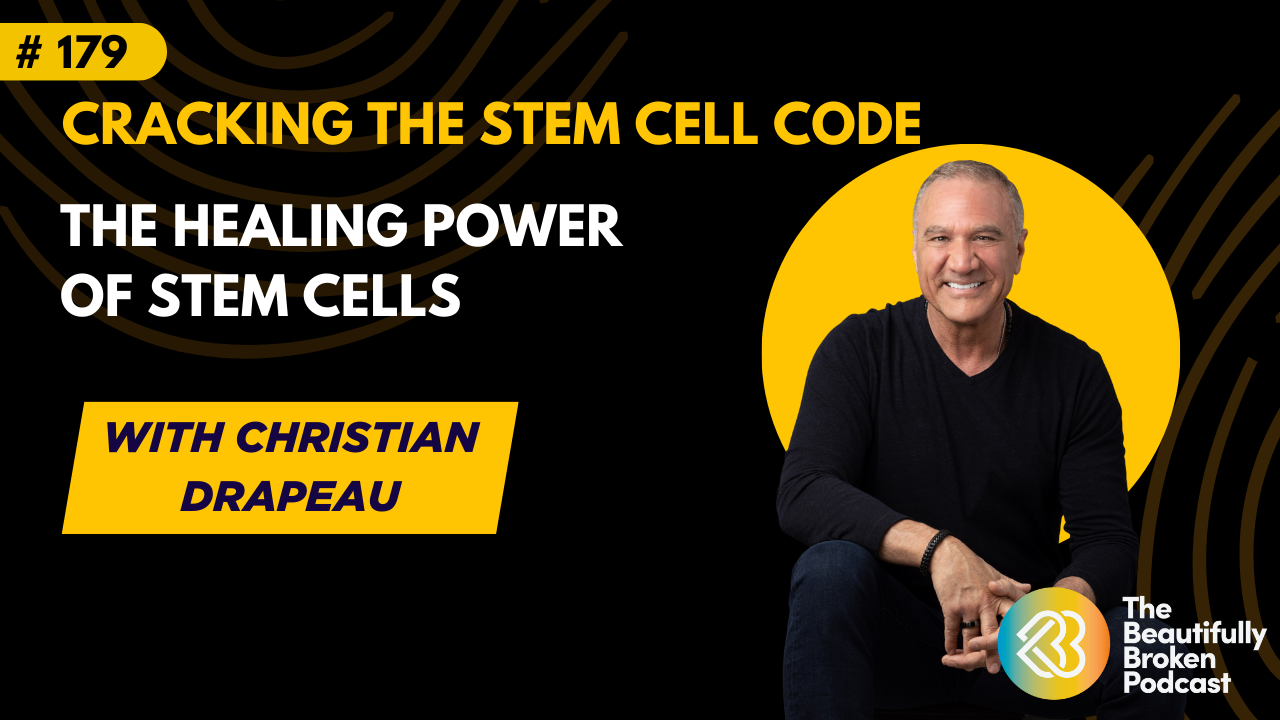
WELCOME TO EPISODE 179
When talking about stem cells, it often comes with the misconception that stem cells require incredibly expensive procedures or invasive procedures. Our guest today offers a simple yet extremely effective alternative that taps into our innate regenerative potential: STEMREGEN, a plant-based stem cell supplement that is capable of releasing 10 million stem cells in just 2 capsules!
In this episode, we dive into the remarkable world of stem cells, the body's natural repair system, and their profound impact on unlocking our potential for optimal well-being. Join us as Christian Drapeau, the visionary scientist behind the world’s first stem cell supplement, shares his research with plants around the world that led him to create STEMREGEN. As the author of dozens of scientific papers and the best-selling book “Cracking the Stem Cell Code”, Christian is dedicated to bringing the regenerative power of adult stem cells to anyone, anywhere. In his 20-year journey, Christian has since witnessed incredible healing moments for disabled and aging patients who had given up all hope for any form of recovery.
Tune in as well for an insightful discussion on how we can partake in the paradigm shift in our current healthcare—one that challenges the traditional disease-based model and embraces a holistic approach to achieving optimal health. Don’t miss out on this chance to learn about how you can take control of your own health from one of the pioneering minds in the industry and how you can easily integrate stem cells into your life for incredible transformations today!


Episode Highlights
[2:33] The Beginning of Christian’s 20-Year Stem Cell Journey
[6:30] Understanding The Science Behind Flow Cytometers
[12:15] The Power of Stem Cells as Our Repair System
[16:30] How Christian Founded STEMREGEN
[19:35] On Pioneering the Field of Stem Cells
[22:25] STEMREGEN’s Extraordinary Case Study
[31:10] The Unlimited Potential of Stem Cell Research
[39:55] Why Christian Is Now Working With Surgeons
[42:20] The Healing Benefits of Daily Stemregen Supplements
[48:32] On Creating a Holistic Approach on Health
[54:10] How the Current Health System Continues to Fail Us
[1:00:30] How Christian Amplifies His Personal Health
[1:05:20] Where to Get Started On Stem Cells
UPGRADE YOUR WELLNESS
Silver Biotics Wound Healing Gel: https://bit.ly/3JnxyDD
Code: BEAUTIFULLYBROKEN
LightPathLED https://lightpathled.com/?afmc=BEAUTIFULLYBROKEN
Code: beautifullybroken
STEMREGEN: https://www.stemregen.co/products/stemregen/?afmc=beautifullybroken
Code: beautifullybroken
Flowpresso 3-in-1 technology: (https://calendly.com/freddiekimmel/flowpresso-one-on-one-discovery)
CONNECT WITH FREDDIE
Work with Me: https://www.beautifullybroken.world/biological-blueprint
Website and Store: (http://www.beautifullybroken.world)
Instagram: (https://www.instagram.com/beautifullybroken.world/)
YouTube: https://www.youtube.com/@freddiekimmel
FULL EPISODE INTERVIEW
EPISODE TRANSCRIPT
Freddie Kimmel (00:00.182)
Ladies and gentlemen, would you believe you can take a plant-based supplement to boost 10 million stem cells within your own body? That is what we are going to talk about today. Our guest, Christian Drapeau, is a stem cell scientist. He is an author and creator of the very first stem cell supplement. He holds a graduate degree in neurophysiology and he has been involved in medical research for 30 years. And the last 20 have been specifically dedicated to stem cell research.
Christian is the author of the stem cell code and he's been published in dozens of scientific papers on brain research and the biological process. He is coined endogenous stem cell mobilization. This is a supplement in a product I use. stand behind, I can feel the benefits and you can use code beautifully broken to try it. You can go to stemregen.co or you can find this in the beautifully broken store. Keep in mind.
There is a beautiful 90 day money back guarantee. You feel the benefits, you keep going, you don't, you return it and get your money back. And that's what I love about this product. They really believe and see the scientific data that supports its efficacy. Let's jump in.
Welcome to the Beautifully Broken podcast. I'm your host, Fred Himmel, and on this show we explore the survivor's journey, practitioners making a difference, and the therapeutic treatments and transformational technology that allow the body to heal itself. Witness the inspiration we gain by navigating the human experience with grace, humility, and a healthy dose of mistakes. Because part of being human is being beautifully broken.
Freddie Kimmel (01:47.01)
Ladies and gentlemen, welcome to the beautifully broken podcast. I am here with my guest today in my living room. What a treat. Christian Drapeau. How are you this morning? Very good. And we're going to talk about stem cells, all things stem cells. So you and I have, we've known each other for a couple of years now. Yeah. We met at, I want to say, How Do You Health Festival? like two years ago.
Very good.
Christian Drapeau (02:09.022)
This is where we met, but I think you've met my wife before, didn't you?
I did, it's some type of a wellness event and we both had a little, she has a lot of history in television and film. have a very little bit more of the music theater. Right. Yeah. It's been a little bit, but it's been fun to watch you grow and your platform grow and your beautiful products, STEM Regen coming to the marketplace. Christian, how did you get involved with STEM cells?
You know, I think it's a nice story of what I call the traditional scientific investigation. You observe something, you don't have an understanding for it, you put forth hypotheses, you go and you test it and you move forward. And that kind of investigation took me from my background, which is brain research, and basically shifting into stem cells. And it's when I was working with a product that you may know, Klamath Lake Blue Greenology.
known as AFA on the marketplace, which stands for a fanizom and an anphlosa aqua species name. And so I was hired in 1995 to study that plant and provide and document the mechanism of action behind its effect on the immune system, on inflammation and on the mind. I wouldn't say most, let's say 50 % of consumers would report an improvement of mental clarity, a sense of wellbeing, mental energy.
And then we identified very quickly that it's a source of phenylethylamine, known as the molecule of love, the molecule of joy. It's associated with affective behavior, attention deficit, or the reverse pain, you know, focus. We documented that it contains phycocyanin, which is a cox-2 inhibitor, the polysaccharide, supposed the immune system. So we documented that fairly quickly. We published all of that. But I came across in this work, I came across people who reversed multiple sclerosis, liver failure.
Christian Drapeau (04:00.376)
heart disease, emphysema, Parkinson, severe joint issue. for me, the case that was, because you hear these stories and they're just stories, what do you do with them? From a scientific standpoint, they're just stories. And I have no proof that the story that they're telling me is not true. Now, why would they tell me that story if it's not true? I believe them, but scientifically, it doesn't have a deep meaning. But one day I received this package and it was a photo album, there was a letter with it.
And the lady was describing how when she was 12, she was walking with a kerosene lamp. She tripped and burned herself on the face, chest and arm third degree. So she was heavily scarred all her life. And at 60 years old, somebody provides her with some AFA. She starts taking it. She says the scars started to inflame, get itchy, red, but she felt that it was healing itchiness. So she kept taking the product. She took a picture of herself in the mirror every week and she says, go and look at the photo album.
And one year later, there's no scars left. That I can't deny. So it started to kind of really stick with me, like, well, what is this product doing touching the skin, the heart, the lung, the liver, the pancreas? And the whole shift in stem cell research is when I came across an article, the title was Turning Blood into Brain. It was to my knowledge, we need to go back in 2001, stem cells are only blood precursors. And everything we learned in neurology is that the brain does not repair.
And that study described a stem cell from the bone marrow going to the brain and becoming a brain cell. So the thought was if a stem cells can become brain cell, and there were already in the literature two articles that I knew of describing stem cells becoming heart and liver, then what could it be in the body that makes a stem cells to become liver, brain, heart, but not the rest? Makes no sense. So that means it's just a matter of time. Scientists will document that stem cells can also become long pancreas skin and the rest.
And if they can, then that means they are the repair system of the body. How do you want a stem cell to go to the brain, become a brain cell, and it's not its function? So we published an article in a journal, Medical Hypotheses, suggesting stem cells are the repair system of the body. And in the back of my mind, the question was, hypotheses, what if AFA is a stem cell mobilizer, but it was not a thing before, so nobody ever looked at that. So we acquired a flow cytometer that allows us to count stem cells and started to...
Christian Drapeau (06:24.322)
Take our blood samples, counts themselves, take AFA, count a few hours later.
is a flow cytometer function?
is that tool? A flow cytometer is a pretty sophisticated device, machine, but the concept is fairly simple. So it basically aligns all the cell, one behind the other, in a very, very fine tube. And at some point, the cell passes in front of a bunch of lasers, depending on how sophisticated your flow cytometer is, and a photoreceptor on the other side. And it's going to measure all the light emission that is coming from that cell, which means every single
type of immune cells will reflect light in a different way. So you can identify them that way, plus their size, because it can measure the shadow of that cell. So it gives you the size, it gives you the luminescence of the cell. But you can also then start to use markers, like antibodies that are attached to, let's say, a red dye, and it's an antibody for a marker, a protein specific to, let's say in our case, stem cells, CD34. So you incubate all your cells with a bunch of markers. Let's say a stem cell's
does not have CD45, but has CD34. So you use markers of both, and then you will see if a cell passes through, does not have one of the marker that is not for stem cells, but has the one for stem cells, then it's counted as a stem cell. And you can, using this machine, can count the number of cells adding specific markers so we can, and over the years, that's what we have done, you can count stem cells, but you can count small stem cells, V cells.
Christian Drapeau (07:57.74)
You can count endothelial progenitor cells. can count progenitor cells, meaning older stem cells that have started to commit into becoming tissues, those that are more primitive. You can start to document all of that with that kind of machine. So that's what a flow cytology And the study is very simple. So we do this crossover placebo controlled double blind. So the patient comes on one day, rests for about an hour because your stem cell population is extremely small.
well. Thank you for explaining that.
Christian Drapeau (08:27.49)
So if you sneeze, for example, and you squeeze your liver, you have put in your circulation a lot of lymphocytes. You could have put a lot of lymphocytes. It doesn't change how many stem cells you have, but it changes how many of them are in a, let's say, one milliliter sample, if you want, blood that you want to quantify. So in a flow cytometer, when we do a study, we're limited as to how many cells we can count. It's a matter of time. There's a point your cells start to deteriorate.
we count 200,000 cells, but typically in the blood out of these you only have 200 stem cells. So you see, it's like you need to have a protocol that is really, really well designed and well normalized for all variables. So anyway, the person comes in the morning, sits for about an hour, rests, then we take a blood sample, then we give them placebo or a test product, and then we take another blood sample an hour, two hours, three hours later.
And then the person comes back a week later on the same day, same time. We ask them to have the same meal the day before, to try to have everything as the same as before. And now we give them the other, either the plant or the placebo. And then we do the same work. And then we subtract the person's circadian cycle because we have a circadian cycle. The number of stem cells is not constant. It peaks at about 5 a.m. It kind of goes down throughout the day. So we need to subtract that from the response with the plant.
So that's kind of the work that leads us to document what is the effect of a plant on stem cells.
Incredible. So what did you see when you started to play around with these different compounds?
Christian Drapeau (10:01.706)
So we took this AFA and we started to test it and very quickly we found that the product was putting more stem cells in circulation. At first, actually, I thought, because we had already documented that the polysaccharide in the AFA had an effect on NK cell and the effect was to trigger their migration. So we started with the idea and it's, that's what I mean when I say scientific investigation. You have hypotheses, you're proven false, but you see something else and you take a different path. I thought,
Maybe the polysaccharide does the same thing to stem cells, trigger the migration into tissues. So as you make stem cells migrate into tissues, then they can repair. And that's how you stimulate the repair of various organs. And what we saw was not a decrease of stem cells like we saw in NK cell, but an increase. So we thought maybe there's a mistake. We repeated. And then it became clear very quickly the product is mobilizing stem cells. So we thought maybe it's the polysaccharide that is doing the same thing.
So we extracted the polysaccharide. When we give the polysaccharide to people, to ourselves, we see a decrease in the number of stem cells. So blue-green algae actually has two active compounds. One that triggers their mobilization from the bone marrow into the blood, and the other one, their migration into tissues, just like NK cells. So that's how it started. But at first, when you document something like this, the response from the scientific community, and it's not a criticism, it's sort of a healthy response.
Yeah.
Christian Drapeau (11:28.404)
It's, well, if you don't have a mechanism of action, what you're documenting may be just random. Like it may not mean anything. And putting more stem cells in circulation may not mean anything for help. If anything, maybe it's bad for you. So how do you now answer these questions? So we start to study mechanism of action and we documented the mechanism of action of the active compounds. We isolated the active compounds. We did proof of concept in animal models of injury to document the enhancement of healing or recovery and so on.
And so that's kind of how it was all developed.
Yeah. And when you notice the discovery of it's AFA, where did that lead you? Because there's multiple compounds in STEM Regen that you're using today. So how did you come up with that catalog, if you will?
Think of, and we can come back to that in more detail, but think of stem cells as being really, like literally, your repair system. You have an immune system, which is your lymphoid tissue releasing specific cells, immune cells, T cells, B cells, and G cells, that are going to follow a very well orchestrated chemical signal that will lead stem cells, immune cells to go exactly to the place where you have an infection and deal with the infection. Here you have your.
bone marrow that is releasing a specific type of cell, stem cells, CD34 cells that are going to be guided specifically to an area where they have an injury, where they migrate and they repair the tissue. So it is your repair system. The moment that we discovered that AFA had that effect on the repair system, we evolved in symbiosis with the environment. It's impossible that there's only one plant having an effect on stem cells. So the question was immediately, what else out there?
Christian Drapeau (13:12.376)
can even be better than AFA. And it turned out AFA was the first one. It's not the best one. It was just the first one. So, I mean, it's a simple question or even a simple answer to the question. What else has been associated in our history to plants with having many types of benefits? Just think of adaptogens. That is what an adaptogen is. It's a plant that can bring a lot of benefits and we don't have a mechanism of action. So we tested medicinal mushroom, goji berry.
plants of that Ficoidone and we all found they all have an effect on stem cells. Interestingly, mushroom, goji berry, polysaccharides have an effect on migration, like the polysaccharide that we have with AFA. And then after that, I went to remote areas of the world. I met with pharmacists, scientists who were traveling to Papua New Guinea, Madagascar. So my interest now was like, okay, what are they using in Madagascar?
outside of the global economy. They cannot go to the marketplace and get medicinal mushroom. Maybe they can, but my point is that it's not part of their economy. What are they doing there? What is the plan that they're using for a lot of different kinds of problems? And in Madagascar, they're using aloe macroclata. One specific species of aloe, of 65 species of aloe in Madagascar, they only use aloe macroclata to make a product called Vahona that is used for
old age, longevity, all kinds of health issues. So we tested Allomacroclata and we got so far the strongest response that we have. So all the ingredients in stem regen have been tested in that same way. Something is telling us that ingredient looks like it's having an effect on stem cells because of its broad spectrum of health benefits documented historically or locally in one population. we tested them and so they...
It's a top five plants that act as stem cell mobilizer.
Freddie Kimmel (15:04.238)
Yeah. So, what I'm hearing you say is there are ones that are the compounds that are mobilizing and then there are ones that are helping the body regenerate more stem cells.
make them migrate into tissues. So far, there are compounds that can help stem cells multiply. Take AFA, for example. In a test tube, AFA will make stem cell proliferate. This was published. Is it going to do it in the bone marrow? I don't know, because it's not a simple process to go in humans and say, give me a sample of your bone marrow to see how stem cell proliferate. And even there, you know, how do you quantify their proliferation? What I mean is that
stem cells have a very strong homeostasis in the bone marrow. They will multiply when needed, but they won't overpopulate the bone marrow. So if you take out 10 million an hour later, you're not lacking 10 million. You have a very, very strong homeostasis. How do you document the effect on the plant on the ability of stem cells to proliferate in the bone marrow? It's a very, very hard question to answer. So, so far we've focused on stem cells in the blood.
meaning that if they're in the blood, they were released from the bone marrow, so we document their release, their mobilization, and then we can document their migration into tissue because they disappear from the bloodstream when they migrate into a tissue. So, so far, that's the parameter that we have focused on in terms of quantification.
Yeah, incredible. What did this process look like as far as a timeline for me making the initial discovery for me coming up with a product where you said this.
Christian Drapeau (16:35.712)
is it? The first observation was probably March, May 2001. December, around December 2001, without a mechanism of action or an active compound, we filed our first patent to have something to go and do some fundraising to be able to continue to work. 2003, I believe we filed the second patent, which now had
the mechanism of action, the active compounds documented. And then we had what we needed to go and talk to companies. And as we're talking to companies, we face the same process almost everywhere. First discussion, they're staring at you and they just don't understand. They go back to their scientists and the scientists will say, this is nonsense. Stem cells don't become cells of other tissues. And having more stem cells in your blood doesn't really mean anything. In the meantime, I had shipped like,
hundreds of bottles to friends of mine who were working with cases, know, in France, for example, one naturopathic doctor who was receiving patients that their doctor told them, there's nothing else I can do for you. So they come with all kinds of conditions. I said, give it to them. So this product should help. It's hypotheses, you know, it puts more stem cells in circulation. They're your repair system. Putting more should mean something. Let's just see. And the results from these were absolutely mind blowing.
So we started to document some of these and they became answers to these questions, to these scientists. Here's the kind of results that we're getting. So yes, it can be good for health. After two, three discussions, these companies started to be really interested into it. And they took one or two two directions. Either their attorney would say stem cells will be shut down by the FDA because it's medical. I'm telling them, it's your natural repair system. Just like supporting immunity. But they listened to their attorney.
or the other side was, man, this is going to be the biggest thing that the industry has ever seen. So they went behind us in trying to find other plans that would do the same thing to beat us to the market. So when we started to have an understanding that that's what some big companies with way more, much deeper pockets than we had, were working on, then within about two months, we wrapped up everything and we launched the first product in 2005, October 2005.
Freddie Kimmel (19:00.544)
Incredible. There are so many different areas I want to go. First, just want to mention, it's so interesting to me. is a theme that's come up often is just capitalism, driving people to not only collaborate, but also they're like, I'm going to take this information and I'm going to run with it do my own thing. You must be used to this at this point, that people are going to, especially when they see something that has a lot of potential to imitate. How do you deal with that when it's something that you care about and you've spent so much time and so many years behind?
I mean, I can provide many answers to that. The deepest answer I would say is that I have seen what the product can do in people's life. I mean, I have seen it. I can say it. It looks like a nice statement. I mean, I have had so many stories coming and fathers talking about their daughters and with tears in their eyes as to how it changed their lives. So at the end of the day, so be it, you know, as long as something is available for as many people as possible.
I do believe that when, as a society, we tap into our own stem cells in that way with a product like stem regen, we're going to change just health, overall health in general. So let's make it happen in whatever way. It is kind of frustrating and a little bit annoying when people copy what I have done and kind of go to market.
with oftentimes, most of the time, ingredients that don't work because they're cheaper, they don't have the quality, they don't have the active compounds, and they obviously beat us on price, and people go to the cheaper product because they think that we're just charging a lot of money because we want to, and then they come back and they say, these stem cell products don't work. To me, that's the most damaging part, is that it tells people that the story of stem cells is not real, and it is very, very real. Outside of that, the way to protect it,
Obviously in the world of plants, patents don't really matter. So the game is really to establish ourselves as really being the pioneer in this field. developed, I developed this field. We made the first observation, the first publications that we really build this entire concept on the marketplace and also maintaining control of some of the key ingredients. Take the yellow macroclata, for example. It's a product that did not exist in the marketplace. So we had to go there. So I have a colleague there who did
Christian Drapeau (21:23.308)
an amazing job in Madagascar. He's still there today, John. So he developed a co-op of harvesters because it's a protected species in Madagascar, so we cannot touch it. It has to be touched by Madagascar people. So he developed a co-op of harvesters who can go now in the forest because it's a wild product, harvest it, and then we developed the system of harvest, the collection, the processing, the manufacturing of it. So we controlled the whole.
process now in Madagascar. So it allows us to provide even these ingredients if you want to the industry, to other people who want to make products that are going to work. Because at the end of the day, my main outcome is that people have access to product that works for their own stem cells. So the protection here is trying to control some of these key ingredients and control their quality and then make them available. I mean, what else can I do? It's going to be copied.
Yeah. Yeah. I mean, this is a theme, but it's, I've heard you speak 10 times. And I know, I know in my heart of hearts, I was like, man, there's something Christian is so integrist. When you speak, I know it's coming from a place of love and care for our aging population who desperately needs help. And I know you're the real deal. And I've taken the product. I've had some really cool results with it from time to time. I've cycled on, I've cycled off.
I would love if you could for our audience, even though we'll do this in a visual representation and maybe we can get the video and splice it in the podcast, but there was a video you shared of a young woman who was paralyzed with absolutely no movement in her lower extremities and she had done an experiment with stem regen. Can you walk us through? It's almost like a little bit of a case study that you had done in that presentation.
So this was a study that we had access to a center in Hawaii that was a spinal cord center. And you need to understand, in a spinal cord center, nobody, there's no treatment. Like nothing is done to treat you. You go there to basically be taught how to live with your problem. That's really what is being done. So in that center, we had access to a number of patients and eight of them decided that they wanted to be part of that study.
Christian Drapeau (23:34.528)
It was a long stretch. mean, I did not believe that releasing your own product could really have an effect on something like spinal cord injury, but there was literature. is scientific literature documenting that by injecting compounds that trigger stem cell release from the bone marrow in a mouse model of spinal cord injury, you can show and document significant improvement.
We provided the product at the time it was not stemregen as it stands today, it was a previous version of stemregen. It is a product that has evolved over the years and trying to always make it more potent. But we provided this product to these people and what happened is that of these eight people, four, I mean you need to understand, and I actually almost understand them. Medicine has not done anything for them for years and now this group is coming with.
capsules and is telling them that these capsules will change their lives. I think their belief system is just like, they're just not there. So they accepted to do it. Four of them just did not really follow through with. So we're done with four. Of those four, two at many times had to go to the hospital for infection, pneumonia, different things like this. And every single time at the hospital, they would take away the product. Don't take that, it's not good for you. So of those four, only two actually took the product.
all the time, and these two saw benefits. So one is that gal, so she had spinal cord injury something like 16 years prior to us meeting her. So you're talking about something that this is not a fresh injury, it's a long-term injury, and where she was is whatever medicine could have done with her. So she had a little bit of movement in her right leg, meaning she could lift her leg from her chair maybe six, eight inches, and that was it. No real.
bending at the knee, lateral movement, nothing like this. Absolutely zero movement in the left leg. And with no physical therapy, so no tension on these muscles, so the joints have all curved and so they're all, she's deformed. She will never be able to walk again, even if she gains back mobility. Anyway, she starts to take the product and we told him, take as much as you want. So she was taking a lot. But eight months later, she's in her chair and she can lift both legs from the chair, flex them, extend them, flex them.
Christian Drapeau (25:54.388)
lateral movement and she heard of this, the other fellow. The other fellow that had benefits is somebody who was diving in the ocean, in the sea, at the beach with his kids. And as he's diving one side, the other, at some point he hits a sandbank and he basically pop his neck. So complete paralysis. He could move, we ask him move your feet. I mean, if you really pay attention, you can see barely like a little movement, almost imperceptible.
And that's it. And he could move his arm just a little bit. And a number of probably like eight months later, he was able to kind of kick his feet and they would move forward and they would flap back. And at some point he says, and let me show you what I can do. So he removes his seatbelt, his chair belt, and then he falls forward and then he lifts himself back up like this. And he said, I can do like a hundred of these. And about two months later, he says, come and see me in my bed. So he is in his bed and
When you're paralyzed and you regain mobility, the connection is not all like one to one. So he needs a lot of re-education. So that means when you start to contact, flexor and extensor muscle contract together. So it's more a movement where it looks more like seizures. But he's in his bed and before everything is flaccid, like no movement, and now the whole body starts to contract like this. So the other gal hears about it, she says, come and I'll show you what I can do in bed.
So we are now 10 months in the process. I mean, it's beautiful. mean, she's in her bed. She lifts her leg completely up, use the weight of her leg to turn sideways. So this is somebody who had to ring a bell to be turned to avoid bed sores. So she rotates sideways. Then she grabs her leg using the weight of her leg, the strength of her arms, abdominal muscle, pelvis muscle, back muscle. She sits on her bed on her own and she's able to scoot back on her bed. So now she can hold the book. She can eat on her own.
This is somebody who was paralyzed for 14 to 16 years. So, and the story, the sad story to me in this is that the fellow, when everybody around him saw that he was regaining mobility, but you need to understand, I almost understand him, between starting to have contraction like this that go in all directions and it's not coordinated, to thinking that I can be able to resume a normal life, the gap is so vast in his mind.
Freddie Kimmel (27:51.776)
Yeah.
Christian Drapeau (28:17.826)
that he realized that he did not have the courage to do what it took to get there. So he dropped the study and he fell into depression because he could not meet the expectation of his family and the people around him. I thought it was a sad story, but at the end of the day, it proved one thing to us, which is if you can release your own stem cells, they can repair in your body. The product doesn't do it. It's your stem cells that are really doing the work of repair.
And if they can repair a spinal cord, they can repair anything.
Yeah. Yeah, that's incredible. I remember everybody. There were not many dry eyes in the room when we were watching those videos.
It's impressive, it has changed. When you meet a case like this and you see what the lady now can do, first she was speaking, nobody could understand what she was saying because she was pushed out of a car by her boyfriend at the time. So it's spinal cord injury but traumatic brain injury as well. And at the end of the 10 months, we no longer need the nurse to translate what she's saying because now we can hear what she's saying. It's still very, it's not clear, but now you can hear what she can say. So now you go from somebody who always needs his earners
to translate what she's saying, because nobody can understand, to now being able to communicate with the world. I mean, you just look at what that means in the life of a person. So those cases sometimes are indeed very touching.
Freddie Kimmel (29:39.712)
Yeah, it's magical. And it's been my experience that especially in this world of optimized wellness, when we have a chronic condition or an injury or cancer, that you would hope that it your belief is that you want it to work the same way for everyone. And it doesn't. We have this, you know, broad spectrum of, you know, there's a bell curve and there's extreme outliers, you were working with some extreme outliers. And what I always go to is the incredible
It doesn't.
Freddie Kimmel (30:08.584)
number of variables in a body, whether that's your mental, emotional, interrelating with the outside world, metal toxicity, hydration levels, raw nutrients. You said family a couple times, the environment, the environment around that person that they're living in every single day, is that nurturing them to be well? So it's always been frustrating to me, but that's where the scientific methodology comes in and said, have a tool that we're pretty sure what the tool does.
And we can insert that and then it's up to you to become the detective on what else can you change to make the adjustments to get the results that you know are possible.
Yeah. You know, in the drug world, if you have a drug that works for 30 % of the people, you've got a winner. So to now work with plants and to develop this view that it's not really working because there's 20 or 30 % of the people who don't see the results is just at odds with how they work. If you want in the pharma world, the product releases stem cells. We haven't seen people in whom the product does not release stem cells.
The question is more, once they are released, how well can they do their work? And at this point, this is kind of the area where we're going into the research. You release stem cells, a stem cell is bigger than a capillary. And the capillary is the only place where a stem cell can migrate into a tissue. So that means microvasculature is fundamental in this whole process of tissue repair. And microcirculation, unfortunately, I think,
It's not something that we talk enough or care enough about in general health. Anything like I take a blood sample and I tell you what is in your blood. It doesn't matter if that blood cannot effectively reach the fine capillaries. That tissue is deprived of all the good things that you may have in your blood. Microvasculature is absolutely paramount for health. And for stem cells, it's even more important because these cells are relatively big. So, and what is your...
Christian Drapeau (32:13.174)
microcirculation dependent upon, it's dependent upon fluidity of your blood. The vast majority of people have too much fibrin in their blood. So enzymes like natokinase, example, lumbrokinase, seropiptase, those kinds of enzymes will help make the blood more fluid. So there's no resistance if you want in the fine capillaries. You want to reduce your overall like debris of protein in your bloodstream with proteases.
because they neutralize the electrical charge on red blood cells and they will RULO. And now they form clumps that also can get stuck into capillaries. It's something that is very well documented in blood microscopy. Now you get into the capillaries. Nitric oxide will allow the dilation of these capillaries. But these capillaries, we think oftentimes that a fine capillary is like a fine artery, like a fine tube. Capillaries are not fine tubes. They're tunnels into a connective tissue matrix.
made of collagen with epithelial cells covering those tunnels. So it is a capillary, but the capillary, the integrity of the capillary entirely depends on your ability to make healthy collagen and healthy connective tissue. So collagen peptide is super important to support all this phenomenon. So I just talked about one right now, and there are many of those that once you release stem cells, you need to line them up to really get the maximum outcome of just putting more stem cells in circulation.
So we're working on products right now to touch these various aspects that sort of maximize what your stem cells can do once you have released them.
Yeah. mean, what comes to mind immediately is, you know, some of the tech that I have in the house, even the like Flo Presso, which is going to really compliment the lymphatic system with that deep pressure therapy, compression and infrared heat boosting circulation. And I said this a lot on podcasts, we have three times as much lymphatic fluid as we do blood. But blood is the thing we measure in a doctor's office to say, this biochemistry is off. about, what's in this interstitial fluid? There's three times as much of that as there is the blood.
Freddie Kimmel (34:16.972)
The other thing would be something like a pulsed electromagnetic field to boost circulation with energy. I always go back to that example of the Rouleau effect in which you can see these red blood cells have lost their charge, they're clumping. The idea that the cell being a battery has a net positive on the outside, net negative. And when that differential decreases, they just clump. They just clump. so this very small capillary being five to 10 micrometers wide,
blood cell is five to 10 micrometers wide. Yeah, you have a traffic jam. You do? More than anything. I wish I had met you. wish you were, know, my really, I say this, you know, all the things that I went through in life with the cancer and the Lyme and the mold. One of the worst things that I worked through was abdominal adhesions. post-surgical scar tissue, which I've been writing a lot of articles about lately and doing a lot of research. But man, that was one of the,
most complicated issues, really no treatment other than surgery that's offered by conventional medical systems.
which will create more these in tissue.
I was on surgery number five. I was on surgery number five. So I had discovered on my own through my own research, seropeptase, natokinase, I want to say lumbrokinase. were multiple that I was high dosing on an empty stomach. And that with visceral tissue work, with PEMF and red light therapy, I finally had great results. So I imagine the quality of the tissue had been
Freddie Kimmel (35:51.968)
redefined from all those modalities and stacks and helping with the fibrin as you had mentioned.
Yeah, yeah, yeah. But you see, this is one of the conditions for which, I mean, we're limited here in terms of resources to do research. Of course. We start with the conditions where we have had so much good results over the years that we know that we're not going to waste our research money. So this is where we have started right now. So we have a study on congestive heart failure. We're starting one now in Parkinson. We have one ready for colitis. And we can come back to that later.
But one thing that we have not yet studied, but we have great stories, is adhesion in scar tissue. Let me tell you two stories. One was the story of this fellow who had an accident as a teen with a chainsaw. So was a chainsaw accident where it hit the back of his leg and it basically ruptured the tendon of his calf. And the way that it reconnected, it basically shortened the tendon. And it connected the scar tissue, prevented
the stretching of all of that again. So he spent all his life walking with his knee bent, I would say probably something like what, 80 degree angle. And so a short leg essentially. all his life. And then he started to take, again, a previous version of STEM Regen, and he comes to see me in a lecture and he tells me a story and he says, look at my leg. And he was extending his leg and he was working normally. And he said, it was just like a slow process. The scar tissue started to just...
go away. And my point, and we have had other cases like this with scar tissue in the abdominal cavity, and the story, to understand the product doesn't do anything. And I'm not saying this as a sort of a nice metaphor or just a nice statement. It's to understand that once we grasp this reality that stem cells are the repair system, just like you have an immune system, you have a repair system. You would not even
Christian Drapeau (37:50.06)
blink at the fact that if you get a cold, well, stimulate your immune system. In this COVID era, well, you stimulate your immune system to take care of viruses. I mean, it's like the obvious thing to do. But we don't think of the repair system in that way. Anything that is broken will repair with stem cells. It cannot repair in any other way. You can do a lot of things that, antioxidant, anti-inflammatory, PMF, there's tons of things that you can do. But at the end, the repair happens
because the work of stem cells have been facilitated in one way or another through these different technologies. So now it brings the idea of stacking them. So do everything that you do and then provide the building blocks of repair and then see what can happen.
Yeah.
Freddie Kimmel (38:35.98)
Yeah, that's right. again, it just seems like, you know, when we do Garnish Enough research, that this would be something that I would be sending people home with out of the OR.
That is one of our segment, it's one of our target because the question that we had, so I'm working with this now for 20 some years. Stem cells are the repair system of the body. They can become heart cells, brain cells, they can become anything. So that means any kind of problems in your body can be helped by putting more stem cells in circulation. So this could be good for anything. And it took me 20 years, call me slow, but it took me 20 years to realize something that is good for everything.
is not used for anything. Nobody will use it because they want the thing that is specific to that problem. That's how the human mind is working. So we did a huge brainstorming to see, let's choose narrower targets on the marketplace and let's focus on those where we know we will get very quick results because you don't want to use a condition that takes six months because now your penetration is very slow, the recognition is very slow, and the idea here is to
penetrate a segment where we can say, see how it works for this kind of application. So it will do the same thing for the other one as well. So right now we're working with surgeons because a surgery is a controlled wound, but it's a wound. So a wound, nothing screams for stem cells or for repair like a wound. In nature, if you have an open wound, you are open for infection, which is systemic infection. So it's death. So your body is designed to just close this thing
as soon as you can. If you don't have enough stem cells in circulation, the local fibroblasts will kick in and will give you a keloid scar. But if you have enough stem cells in circulation, they migrate and they become keratinocytes, air follicles, sebaceous gland, they become everything. They become a normal skin. So the typical story is that somebody who is out of surgery would take something to put more stem cells in circulation. The surgeon will almost invariably tell that patient,
Freddie Kimmel (40:23.693)
Yeah.
Christian Drapeau (40:44.79)
man, I don't know what you're doing, but you're like two weeks ahead of time on your repair, on your recovery. It's like almost across the board. So now that is one of the segments where we're putting a lot of effort.
Yeah. Yeah. It's exciting. I had an experience yesterday listening to a podcast and a woman was, she was describing a medical doctor who's a regenerative medicine specialist. She was describing falling and really doing like a road rash, falling off your bike. We've all fallen off our bike. And she's like, do you remember when the wound happens and you know, it's bloody and you might bandage it up. And then in like a couple of days, you almost have like this yellow gloss over the wound. She's like, that's your plasma.
That's the body, just like people do a procedure called PRP, plasma-rich platelets, where we're spinning down the blood, getting that clear yellow layer. And in my head, I was like, my God, my body is making PRP. And it's healing up that wound and it's making that. Just to pull us back into the magic nature of the human body and its healing potential, that it just, not only does it repair the wound, but it's gonna regrow the hair follicles, everything right where it was. It's just incredible to me.
Yeah, amazing.
Freddie Kimmel (41:59.736)
Ladies and gentlemen, let's take a break from the show and allow me to get up on a soap box. I want to spotlight Silver Biotics Wound Gel. This is a product that is an antimicrobial layer that helps with cuts, lacerations, skin irritation, and first and second degree burns. So it utilizes silver sol technology, which we've talked about. This is the ability to steal electrons from pathogens, making it more effective in the body.
So the company has substantiated its claims with 420 independent studies, as well as 60 patents pending on this groundbreaking tech. So I endorse it because it works, but also due to the extensive research and scientific validation the company has done. So in an independent in vitro report, this is very important, we compared Armourgel
to seven other similar skin care products such as triple antibiotic ointment, the standard of care. The study focused on the kill rate for MRSA, VRE, E. coli pathogens responsible for severe emergency room infections. Within a four hour window, Armourgel completely neutralized the pathogens and this was a feat that was unmatched by any other product in the study. So the silver biotics Woongell
stands out not only for its performance, but actually its price point. So this is a must have for moms, for coaches, nurses, doctors, anybody concerned about the body's largest organ, the skin. And in today's environment, I just saw a fact where MRSA infections are up 35 % since 2020. This is crucial. So we just need to be prepared. Don't wait for an emergency room trip. This is something to have in your cupboard. It's under $20 and you get
30 % off using the code beautifully broken at checkout. This company is giving this to you at cost by using this code. And they are not only a sponsor of the podcast, but they are friends and I support what they're doing in the world. Let's jump back into the show.
Freddie Kimmel (44:09.486)
So with this product, do you ever talk about different dosing regimens? One phrase I'm on that's circulating right now in my head is that the tree doesn't fruit for four seasons. Like an apple, it's barren. There's buds in spring and then eventually come to having an apple on the tree. So is there a validity or have you ever played around with pulse dosing, stem regen, or is this something you say people can just stay on indefinitely?
I have never worked with the idea of pulsing it, which doesn't mean that there could not be a good argument that it could work. Actually, it could be a good approach. You released about 10 million stem cells with two capsules. You do this every day, so that means you have released 300 million stem cells at the end of a month. That's pretty significant. So you could do this a few times a year. The reason why I have worked over the years with the concept of taking it every day, it's just
the concept that has developed over the years, and I published that in 2013 in the journal called, I think it was Stem Cell Research and Therapy, and other hypotheses, which is the fact that we need to understand we are born with red marrow that makes stem cells, that red marrow converts into yellow marrow, fatty marrow fairly early in our lives. By age 30, we have lost about 90 % of our red marrow, and that is reflected by a drastic decrease
in the number of stem cells in circulation. You have roughly about, let's say, 100 stem cells, 120 stem cells as an infant per microliter of blood, but at age 30 of about six, at age 51 to two, stem cell per microliter. And that's your power of repair. So your power of repair really goes down as you age. And we all know this. We have no memory of the cuts and scratches that we had when we were five or 10.
And today you sprain your ankle and you carry it for six months.
Freddie Kimmel (46:08.2)
Christian, I remember we were up on a farm in my house. We had these horse barns and second floor windows. We would go running and jumping out of these windows. I mean, I would be in the hospital today.
And you hurt yourself and two days later you're doing it.
I don't even think we didn't we never got hurt we would
It was incredible. That's the power of stem cells. And we lose that as we age. now couple that with something else that has emerged from stem cell research. And that is another thing that has to penetrate. I wouldn't say even the medical world, but just the general understanding of health and wellness. We may never think of it that way, but if I say, let's say somebody who's 60 years old, we think that this person has a 60 year old liver.
60 year old pancreas these organs are aging but it's not the case if stem cell research has shown that every single organ is Constantly in a process of turnover your liver today is no more than three years Because it renews every two three years Your long is no more than like six years these cells renew constantly So why is it that we develop problem as we age if we have constant renewal?
Christian Drapeau (47:24.598)
It's because the population, you lose cells at the same rate. And if anything, with environmental toxin, with accumulation of various dysfunction, maybe we lose them at a higher rate, but we replace those cells. We're much less effective because we don't have enough stem cells in circulation. And so we accumulate a deficit. Past 30, you don't have enough stem cells to replace the cells that are being lost. So now you start to have a deficit. And that deficit is like a very slow bankruptcy.
Yeah.
Christian Drapeau (47:54.348)
Let's say all your life you have more income than your expenses. You're fine. You never think about your income. You don't think about your health in your 20s. It's like you never, I was talking to a group of young people to understand aging and I said, you guys, I've never got up in the morning thinking about your health. And they think the question was, they had never even thought of it. And in your 40s and 50s, you never get up one morning without thinking about your health. You're reminded by it, by all the little aches and pains and limitations that you have.
Which doesn't mean you're not healthy, but it's there, okay? And it's because your tissue cannot fully recover and you start to accumulate small deficit. When your income no longer matches your expenses a little bit, you're not bankrupt. You just start to worry about your finance, but you're not bankrupt. The bankruptcy can be like five, 10 years down the road. That's what the disease is. It will show up decades down the road, but it has started. For everybody in your 40s and 50s, it has started.
because you have a deficit in the stem cell. So the thought is then compensate for that deficit every day because it's a daily deficit that cumulates over time. So it's that understanding that has basically led to this concept that I've worked on for the past 20 years, which is put more stem cells every day in your bloodstream because it's a day-to-day phenomenon. Your stem cells are in your bloodstream for about six hours. So when you release stem cells, it's a very short-term
phenomenon that helps rebuild your tissue. So the benefit is long-term, but the effect is short-term. So it's something that needs to be repeated every day. But it's quite possible that within a month, you cover for the past three months deficit and then you could do this for a month every three months. It's quite possible. I have never looked at it this way. I never thought of it this way, but it could be.
Yeah.
Freddie Kimmel (49:46.83)
Yeah, it's really interesting to me. I love the idea of the energy credit card. You're borrowing it from somewhere. certainly, as I was just looking at a stat yesterday, it doesn't totally make sense to me, but it looked at the gross percentage of people that are going to be how that US population, the world population is aging. That we're going to have 62 % more people over 55 years, and that is going to be such an incredible burden on our financial system.
So what I've noticed, just podcast listeners or people visiting the website and people just they're more and more interested in what they can do to age better and have a better quality of life. Because we are, you we have the technologies like STEM Regen, like PEMF, like Flopresso, like red light therapy that are, they really do make a difference in the terrain, the overall terrain of the body. Another question I have about STEM Regen, you said you have
three areas that you're focusing down on for some studies right now. What else, you had a magic wand, would you like to see if you had additional funding? Is there a specific subset of a person that is struggling with some type of an illness that you'd like to see how STEM Regen works?
I mean, I would say right now from a research standpoint, my aim is not so much to prove the product for any specific application. I'm taking this path because the message is your stem cells are your repair system. They will repair anything that is broken. Here's an example when the heart is broken. Here's an example when the brain is broken. Yes. Here's an example when your gut is broken.
So now after you've touched three of those, get the message. They repair everything. You're right. The point is not to do research in everything. So once this is done, then the next round is going to be, how can we maximize the stem cells that have been released? So now let's couple, for example, with stem regen with what you do, pulse electromagnetic frequencies, for example. And we need to understand stacking, synergy is a tough thing to study.
Freddie Kimmel (51:59.436)
Yeah.
because it's not an all or none. You start to enter into a zone of gray. It's gray. By gray, I mean if nobody reacts all the same with one product, now think two that you put together. So you need to have a greater number. Your results are not as clear. But I would like to nevertheless go into the direction here of trying to really.
pinpoint the things that we can do if somebody wants to maximize. So you release stem cells, but I want them to go to my heart. What can I do to maximize going to my heart, to my brain, to my liver, to my pancreas in order to be a little bit more targeted when I start to think about my health? Because right now, if you release stem cells with a product like StemRegen, they will go where they're called, which is great in a way because somewhere, I like to tell people when they say,
You know, I'm doing it for my knee, but I haven't seen anything for my knee. Understand that in your survival, your knee is not relevant. You may have had other things that maybe you did not know. Stem cells work. If they did not work, think about it. You have a liver every two, three years. The fact that you're healthy today, that means your stem cells are working. You would not be alive if they were not working. So your stem cells are working. They're doing their job. But sometimes we want to direct them in one area or the other.
Let's start to work and stack with different modalities to start to target different areas. Peptides, electromagnetic frequencies, red lights, acupuncture. I would really love to play with acupuncture and how we couple these with the product. Ozone therapy. So we're thinking right now of coupling ozone therapy with a subgroup in our Parkinson study. So start to blend it with different approaches to increase the probability
Christian Drapeau (53:52.002)
that you actually get the results that you're looking for by putting more stem cells in circulation.
Yeah, beautiful. And I agree with you. And it's one of the questions I get all the time. It's like, what about Parkinson's? What about this disease? What about MS? What about on and on and on? You know, because people are where people are suffering is where you have to meet that person where they're at. But it's, it's actually, it's funny. I'm in a phase where I'm like, I don't want to say I'm bored of health, but it's if you had stage four pancreatic cancer or you had allergies, you need to address
all the different, almost like if you looked at the body like a pie chart, you need to address how you're breathing, how you're sleeping, what your food looks like, what your minerals, what your gut health is, what your temperament is, what your mental emotional balance. And I had a friend say yesterday, she was like, man, that's all so frustrating. It's just a lot of work. She actually said, this is, it's such a moving target. She was asking about gut health. She was like, what do do for gut health? I was like, well.
What's driving the gut and balance? Let's go make a list on the wall. I'll come up with a hundred items.
Yeah, yeah. It's a huge, huge, huge weakness of our Western medical approach, which is seen as being like so far advanced compared to more ancient approach like traditional Chinese medicine, Ayurvedic medicine, which is all geared toward the terrain. I think we suffer from labelitis. You we label everything and now we react with the label and not the condition of the body.
Christian Drapeau (55:21.462)
whether you have Crohn's or ulcerative colitis or barrel irritable syndrome or it doesn't matter. The basics of it, it shows up differently. It has a different label, but at the end of the day, it's the same phenomenon and it's based on the terrain. There's something wrong with the terrain. So to go back and really address the issues, not from a label standpoint, meaning I get that diagnosis, I go into the physician desk and...
that diagnosis calls for that drug, I take that and I feel like I've done a treatment. I mean, we should, we should at this point after decades of doing this realize it's not really working.
Yeah. Well, I think with the, if you look at the incidence of chronic disease and people having two chronic illnesses for the whole timeline of their lives, people are more more frustrated. So they're starting to ask different questions, what they can do to take radical ownership of their health. I really do see that coming. I feel it. feel it. People ask me like they've never before, because 10 years ago, some of the stuff I was doing, you know, I had bought an ozone machine. I was trying to figure out how to get myself ozone in a living room.
My mom, God bless her, I remember she was like, what are you doing? Where are you injecting that? You know, and at the time it was out of necessity, but now we're having more and more people wake up to the fact that these things do have a real impact. I also just back to the labelitis, I think it's a great way to frame it.
I don't fault anybody for that at the same time when I'm talking to somebody else in the medical industry because you have to come up with a label, you have to be able to put a code on it, and then you have to be able to bill your insurance to get paid or you go out of business. So, you have a system incentivized to keep operating the way it is and until we change those incentives, that will never change, which is why we also need people that are politically charged speaking to this.
Christian Drapeau (57:16.822)
It's not a criticism of the system. It's just like an observation that we are stuck in a system that works like this. And there's another aspect that is it's difficult to grasp because we're so deep in it, but I'll try to illustrate it. Our medicine right now is a statistical medicine. Our modern medicine is a statistical medicine. You are never treated according to your condition. You're treated according to a statistical definition.
of a condition. If you show those types of symptoms, 50 % of the people with these symptoms have that kind of problem, so now I give you the label. But it's not your label, it's a statistical label. Your label is very unique to a person. And that is why right now is emerging that kind of medicine where people are stacking things, where we're looking at DNA analysis, we're looking at all kinds of markers in the body to try to determine for you,
What would be your, did the treatment for you? And it's a very new thing that we see now in medicine because medicine in general is treating statistically. And to me, the biggest example of this is cholesterol. You know, COVID, okay, let's not get into this one for now, but cholesterol. lowering cholesterol reduces cardiovascular risk by about 50%. It's amazing.
Let's draw safer.
Christian Drapeau (58:43.982)
So it's basically, I don't remember exactly the number, but it's like, instead of two per 10,000 getting a heart problem, it's one. That's the 50 % reduction. And to prevent that on a society, you give the drug to the 10,000. That is what I mean by statistical medicine. So now you've got all these people treated because of a conclusion that it reduces by 50%, which is untrue.
people.
Christian Drapeau (59:13.268)
It's true when you analyze a number in a certain way and you say one instead of two will be affected. And now the other 9,998 people will have the side effect of the use of that drug. And most people who are on statins don't have just one because there's a lot of other side effects from it. And then you enter into a choreography of symptoms and linked to a medical treatment all based
Yes.
Christian Drapeau (59:41.454)
on a medicine that is statistical, meaning that drug really was not for you. It was for the statistical analysis of a marker that showed up in you. And our entire medicine is based on that kind of statistical analysis. You sometimes I have people say, you know, what is the proof of a certain herbal extract? And I'm thinking, it's been used for 2,500 years, you know, for that kind of condition. Yeah, but what is your double-blind study on it?
Yeah.
Christian Drapeau (01:00:09.878)
So what they're telling me without telling me is that they bought so deep in this concept that they're telling me that a study on those 20 people will validate 2,500 years of using these plants with success. If it did not work, it would not have been used for that long. They would have dropped it. But this is almost irrelevant until I show it on those 20, which statistically will show that this is true.
Yeah.
Christian Drapeau (01:00:36.064)
And for me, I'm looking at this, I understand the needs for these studies. I totally understand it. But for me, historical use, stories of people, if something has shown to not work statistically in a double blind study, but it worked for you, how stupid is it to say, I'm going to deny that you got benefits? It's all in your head because that double blind study showed that it did not work. Anyway, it's my kind of a position if you want with this.
modern type of medicine, which to me should be studied in a much, much broader standpoint. There's a place for these studies, but they should not make me deny real observation in reality. Just look at everything that we have on stem cells right now. What we're talking about stem cells being the repair system. It's observing cases that honestly, I could not deny. None of them were medically documented.
Yeah.
Christian Drapeau (01:01:26.434)
but they could not be denied. digging into these, actually every single scientific discovery comes from observing something in real life and deciding that my assumption that it should not be true, I will put that aside, I will assume that it's true and I'll try to explain it instead. Every single scientific discovery comes from that approach.
Yeah. Yeah. That's the way we have to lean into. is incredible. You know, I always think about the, it's so funny. I'm a huge Star Wars fan. So as of late, you know, Disney is just spitting out content on Star Wars, Star Wars. And they've had these different storylines in which like, they've done it a couple of times in which a stormtrooper will like rip off his mask and he'll like, he'll leave the dark side of the, he'll leave the empire and he'll go, you know, switch the other. And it's, it's just,
It's a great example of like, presume that that camp that everybody's bad because they're not in your belief system. And there's just, there's people, have just not seen the light yet. They haven't moved to that information and believed in it truly to like make a step forward. And more people are stepping forward. More people are leaving the empire. If people entertain that, that visual imagery and yeah, I'm really excited. It's a really exciting time to be.
God, we've never had more access to wonderful tools to manage our health and live well. Can I ask how you are very vibrant? Can I ask your age? 58. You look amazing. And so this is something that you do every day. Obviously you do lots of stuff to amplify your wellness. Is there anything else that you really believe in as far as like managing your vitality, your health? Do you have like a pillar of two or three things that you do?
Thank you. Yeah.
Christian Drapeau (01:03:09.902)
I mean, for me, you know, I'm doing all of this with stem cells mostly because literally it was kind of put in front of me. What I mean by this is that I read this article 20 some years ago. This understanding comes that stem cells are the repair system. And honestly, I remember I have the image of my mind that I was at the time at my desk and I have a product that puts more stem cells in circulation, stem cells are the repair system. I'm thinking, my God,
We're just putting an end to disease. And I was, I mean, profoundly excited by this sort of understanding. And I should say today, profoundly naive because the system is so big and strong and hard to penetrate. But what I mean is that when I got that realization and I'm starting to talk about it around me and everything I get is a wall, like nobody gets it.
So if I really believe that this can change the world in terms of health and wellness, mean, honestly, I almost feel like a traitor to not push it forward. So in a way, it became like my mission, not by choice, although I'm happy doing it and it's great, but it's not, if I were to choose what I would have done, for me, mean, meditation is probably the thing that is the most central to everything that I do. I firmly believe that
almost everything is coming from your psyche, is coming from your mental state, is coming. You can shape entirely your world. Not only you can, you shape it, whether we're conscious of it or not. So the one thing that is really central to how I approach all of this is really meditation. Just observe yourself and just realize that everything in your mind is not true. Very little of it is actually as the reality that we give it.
Yeah.
Christian Drapeau (01:05:06.09)
And when you take that distance, there's very little things that affect you in the same way. so, and then it basically has its repercussion in the body. Health to me is not the desired outcome. Health is just what comes when you develop more of that piece. So to me, that would be like the core, the core. Once that is taken care of with all the work that I have done, I think stem cell is like crucial. After that, I'm thinking movement, exercise.
because of everything that it brings, circulation. We are meant to sit all day like we're doing today. So movement is crucial. To me, these would be the top three. And then there's a lot of other things that we can do, of course.
all the things which we talk about on the show. But I would agree with you that there's so many studies to support just the idea of even when you're in a bad mood, just to smile. And the act of physically smiling positively benefits your neurotransmitters.
When something happens that puts you in a bad mood and somebody else has had the same experience and he or she is not in a bad mood, that tells you scientifically what happened is not the cause of your mood. It's how you dealt with it that is the cause of it. Because the other one dealt with it differently. So when you start to observe all these things and you realize why am I reacting to these situations in the way that I'm reacting, it changes everything. That's what I mean by.
taking a distance, observing everything and realizing that most of the things in your head are not, I'm not saying the fact is not a real fact, but the way we perceive it is not what we think it is. And it comes back to this metaphor from some sort, I think it comes from the Vedas, but you walk in the dark and then you see a snake on the path and you're afraid. So you're not going to take that path anymore because there are snakes in the area until the day you realize it was a rope that was laying down.
Christian Drapeau (01:07:03.48)
there on the ground. But let's you never know that it was a rope. Now your entire life you live with the fear that there are snakes on that path. We live our lives that way. Everything we see, we rarely have the whole story of what is that fact. We make a judgment of it and how we live with that. Every single aspect of our life is built that way. Stop and just look at everything with a distance and it changes everything.
Yeah, beautiful. When people are considering something like stem regen, is there a timeline or a recommended endeavor that you would tell people to take? Like, you know, you should really look at this for three months. You should really try six months. Like, if your experience, you're talking to a family member who wants to experiment with boosting their own stem cells.
We are, I would say unfortunately, we created that, so we're guilty of it, but we are a little bit at the mercy of the great stories that we have, you know, like this Parkinson patient that had no quality of life, you know, needed some sort of assisted living, and six weeks later, as resume is normal life, and suddenly everybody thinks, gee, in four to six weeks, everything will be resolved. These amazing cases are, to an extent, an exception. So I would say,
The best approach, you have not supported your stem cells ever in your life really. So I would say the first month, give it a good boost. If you can, I would say take two capsules three times a day. You will have released in that month, roughly a billion stem cells. So give that to your body. And then after that, go down. And if you go to two twice a day and you realize, no, I felt more at three times a day.
Hmm.
Christian Drapeau (01:08:44.814)
then your body maybe still needs a little bit more of that support for a while. And then you go back, and the idea is go back then to maintenance two capsules a day. And after maybe a month or two or three or four, when you have reached the benefits that you're looking for, then maybe you start pulsing like you talked about. Do it for a month, then stop for a month or two, and then you redo it. The time that it will take for people to experience benefit will go from two to 12 weeks.
You know, so I would give it some time to really develop. And if after 12 weeks we have not seen really any benefit whatsoever, then, you know, then it's your choice. Like you can obviously you can stop taking the product, but your stem cells still remain your repair system. You're alive because of your stem cells. When you release them, they do their job. The fact that you have not seen them does not take away the fact that they still do their work. But I understand people do something to experience an outcome.
So you can quit. I would say give it about, so front loading, give it some time, two, three months, and then after that you can taper off, understanding that maintenance then become an essential strategy for aging.
Yeah. Yeah, I was doing, I was probably six weeks in, seven weeks in, I was high dosing and I had texted your partner Stephanie and I had locked myself out of my apartment on the east side of Austin and I was like, okay, I'm going to jump the fence. And I just grabbed the fence and it was a high fence there, really high. I grabbed the fence and leaped over this fence and landed on the ground. I would never would have done that. Like I'm so careful about my joints and the way I move.
after going through Lyme and just creaky old joints. But it was really, I was like, my God, I just leaped a fence.
Christian Drapeau (01:10:31.054)
You know, there's a similar story. You know Jean, Jean Falacara with the Bayacers magazine. Wonderful fellow. And his partner shared with me the story. The first time that we met him, met them, it was at the Bayacking Conference last year, 2022. And they walked in front of the booth and capsules that released themselves. And his first reaction was like, this is impossible. So he kept walking, but his partner stopped and we started to have a discussion.
He realized, it looks like there's data behind this. So we did a podcast. So Jean saw the podcast and he thought, there's substance behind this. So now I had a podcast with Jean and so we went really deep in the discussion and I asked him, well, you have some products. And he said, no, I apologize. I send him some product. So he got the product and within about six weeks, similar story to what you said, he dropped me a text and he said in French, what would mean in English something like I am floored.
We need to talk. So I gave him a call and he says, you know, he does like things with his body that's just like out of this world, but there are things that he had not been able to do for a number of years. And after five weeks of doing it, he gave it a shot and he said, I could do like seven repetition of it. And when I started to quantify performance, he said, suddenly I was like on some of the things that he was doing, he had like 220 % improvement in his performance.
but he had not failed anything until he started to put it to the test. And I think that the mechanism behind this is just that the moment you start to repair all the small micro lesions that you make every time that you work out, these guys, you work out regularly. So you always have micro lesion. Like you never had in the past, let's say 10 years a day without some micro lesions. When you start to enhance the ability of these to recover faster,
That means your next session in the gym is not hindered or impaired by the micro lesions that you had two days ago. And by this phenomenon, every time you go back to the gym, you gain the full benefit of what you're doing in the gym. And then one day you put it to the test and you just realize this body is different now.
Freddie Kimmel (01:12:42.37)
Yeah. Yeah. Fun. Yeah. I'm excited. I really want to play around with ARX at Caleb's office and see, bet that'd be fun to do a pulse for like six weeks, seven weeks, eight weeks, and then go off and see what was happening.
Absolutely.
Christian Drapeau (01:12:57.474)
I did the RX the first time that I did it without taking STEM Regen and I'm maybe like for a day or two where climbing stairs is like a chore, moving around, you just, I mean, it's so sore. And then the second time that I did it, or maybe I did the reverse, the first time I did it, in any case, the day that I took STEM Regen, the day after, I kid you not, I'm moving around and I'm commenting to Stephanie, says, if I didn't remember that I was,
I did ARX yesterday, I said I would not really feel it. And that is the power of your stem cells repairing micro lesions.
Yeah, amazing. Amazing. Where can people go on the interweb to explore STEMregend?
Go to stemregen.co, that's where they get all the information. And I'm sure that you'll probably have a link on your podcast so they can click that and get there and give it a try.
Yeah, we have a great code on the podcast. beautifully broken as always. I implore people to check it out. think, especially if also if you're thinking about a stem cell procedure, if you're out there looking, we were just talking before the podcast, totally different. You're harvesting your own stem cells from your fat or your bone tissue or you're getting a donor, $5,000, $10,000, $20,000. This is certainly worth a try. What you had said before, it's really fun to consider.
Freddie Kimmel (01:14:22.498)
boosting your own stem cells and there's so much less risk. There's no procedure. This is from the safety of your own kitchen cabinet. I would personally try this first.
You know, when you say stem cells to almost anybody out there, the mental image or what it means is a treatment that works because we've heard about it so much. So you need to go and find a source, which could be your bone marrow stem cells, your blood stem cells, your fat tissue stem cells. They are taken out of the body and then concentrated and then put back into your body. And this is an expensive treatment. It works.
And the discussion that is never brought out of this is that, well, they're from your bone marrow, they're from your blood, they're from your fat tissue, so they're in your body to begin with, they're there. If they have soft regenerative potential, they're not better because you take them out and put them back in. So what if we had a mean of tapping into the potential of the stem cells as they reside in the body? And that's kind of what we're talking about here. Taking plant extract that just release your own stem cells. And we're doing a study very briefly here on congestive art failure.
because we wanted to document how it compares to stem cell injection and also by combining the two because we have seen a very significant synergy between releasing your own stem cells with a product like StemRegen and stem cell injection. And right now the preliminary data that we have is really giving us what we were hoping, expecting or thought we would get, which is releasing your own stem cells already give you great benefits. Stem cell injection.
give you similar benefits a little bit better. Combining the two gives you significantly better benefit. So the general message is basically, if you do a stem cell injection, couple it with releasing your own stem cells. There's a really nice synergy. If you cannot afford stem cell injection, well, releasing your own stem cells is a valuable alternative until such time as you can do it.
Freddie Kimmel (01:16:20.662)
Yeah. And certainly, you this is another thing that I prophesize to people that, and you said it a couple of times, if your knee hurts and you're taking stem cells to heal your knee, there might be spleen or kidney or liver or neurodegenerative issues that the body is going to repair first because that is a priority. So don't get frustrated. think anytime we manage like systemic inflammation, I personally feel I'll notice something like stem regen
quicker, faster, and more verifiable results. So that is the quality of food you eat, that's your hydration that's really committing to, eight hours a night of really, really good sleep and just being outside in nature. And all of these things, your body's working better. So compliment the terrain is what I'm saying to everybody listening to this at home. Compliment the terrain and set yourself up for success if you're going to do something like stem cells.
We know that, and that is just a small sample of issues linked to lifestyle. We know that cigarette smoking reduces your stem cells ability to migrate into tissue and to proliferate. You as a smoker or the smoker, and if I take the ambient air and filter it, it will do the same thing. So it's the smoker and people around him. Alcohol will do the same thing. Stress will do the same thing. Anti-inflammatory food will support stem cell migration.
fasting supports stem cell migration. So my point here is that we have studied a small segment of things related to lifestyle, but to me what I find amazing is that everything that we know is bad for you happens to have a negative effect on stem cells. A lot of the things that we know historically is good for you happens to have a good effect on stem cells. It's almost like the more we dig and go deeper into the stem cell science,
the more to me it emerges as the core of human health. It is your repair system. Anything you do to support it, just help the repair of anything. The product itself doesn't do anything to diseases. It just supports the innate ability of the body to repair. That's it.
Freddie Kimmel (01:18:28.984)
Beautiful. Beautiful. I think we'll close it down. It's been an honor and a privilege. Ladies and gentlemen, the beautifully broken podcast. This will be on YouTube, Spotify, Apple, Google Play, everywhere podcasts are listened to. And I can't wait to have you on again because we could talk about this for, yeah, we could do four or five episodes on stem cells. It's fascinating to me and a great reminder of the body's own innate repair system that is...
and genius in its design. It's incredible. It's incredible.
It's better designed than we could have thought of it.
Yeah, awesome. Big love, everybody. Ladies and gentlemen, biologicalmedicine.org. Don't go there yet. I have a question for you. Are you tired of standing around in this deep knowing that our health care system is broken, but we never do anything about it? Well, biological medicine for practitioners is the ultimate hybrid online and in-person certification course.
designed to help you integrate biological medicine or bio-med into your practice. So unlike traditional medicine that often focuses on treating symptoms, bio-med treats the whole body, addressing root cause of illness through three pillars, that is detoxification and drainage, nutrition, and immune building. This approach is truly patient-centered and yields exceptional results. So in this comprehensive course,
Freddie Kimmel (01:19:57.622)
You will apply foundational knowledge and hands-on experience with the latest diagnostic technologies and therapies, including bioelectrical impedance analysis, heart rate variability testing, pulse electromagnetic field. I know this sounds like it was created just for Freddie, but this is your chance to become a pioneer in the field of bio med. This is for healthcare and wellness professionals, all the way from doctors to personal trainers.
I want you to go to biologicalmedicine.org and look for the enroll now button. And if you use code beautifully broken, you'll receive the intro to biological medicine for free. That's a $200 value. Friends, let's go do this. This is our time to seize the day. Join the biomed and help create a real paradigm shift and the way we deliver results for our patients.
Let's do this.
Freddie Kimmel (01:21:01.932)
Ladies and gentlemen, thank you for tuning in. If you enjoyed today's show, head over to Apple podcasts or Spotify and please leave us a review. Five stars if you loved it. And before you leave, there is one big way you can continue the learning and the deepening of this relationship we started in this very episode. You can go to beautifullybroken.world and check out our brand new website store.
Listed are all the wellness technologies, the supplements, the educational courses that I love and I personally use. Most of them offer significant discounts just by using the link or the discount code, which is normally beautifully broken. And they do support the podcast through affiliations. Now we have a brand new feature. If you want to see the beautiful faces of our guests and watch me unbox and review products,
you can head over to our new YouTube channel, Beautifully Broken World. I do have to tell you our OnlyFans page is under construction, so stand by for that. This last announcement is from my vast team of internet lawyers. The information on this podcast is for educational purposes only. By listening, you agree not to use the information found here as medical advice to treat any medical condition in yourself or others, and you're always going to consult
your physician for any medical issues that you may be having. My closing, the world is shifting. We need you at your very best. So please take the steps to always be upgrading. Remember, while life can be painful, putting the pieces back together is a beautiful process. I love you. I'm your host, Freddie Kimmel. Big love.