The Lymphatic System, Flowpresso Technology, and Holistic Health: A Deep Dive with Desiree De Spong
Jan 01, 2024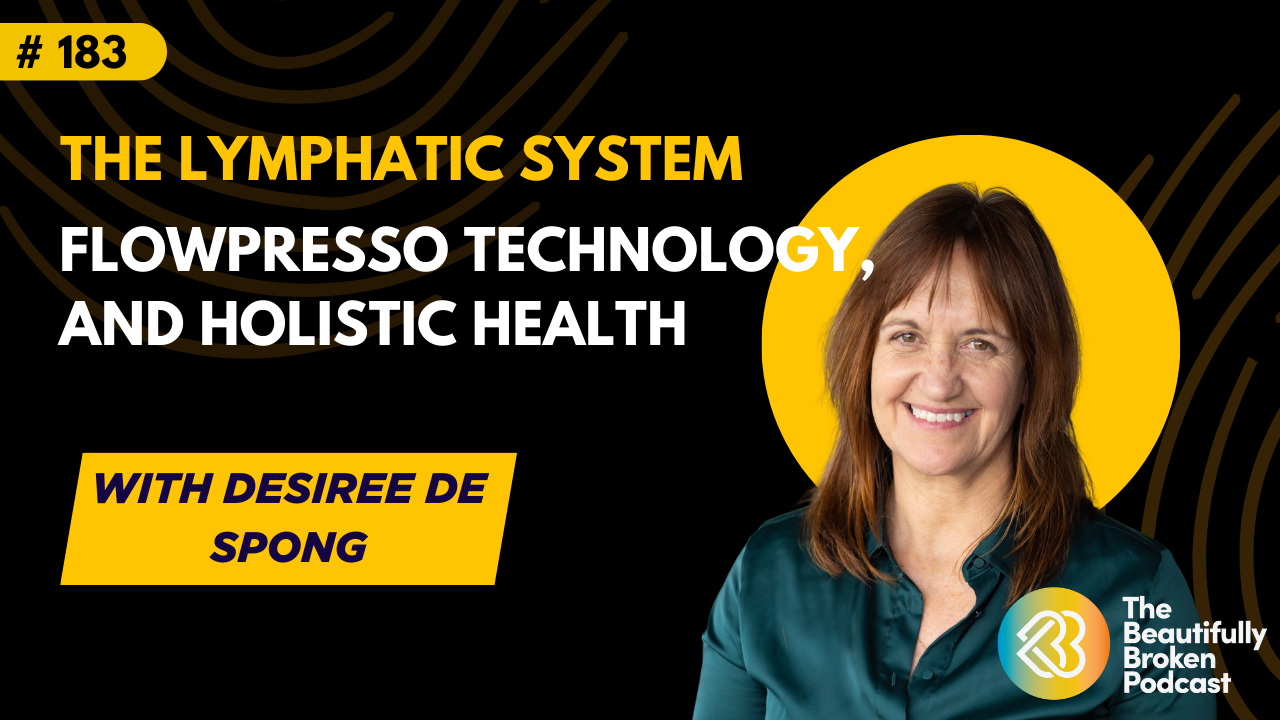
WELCOME TO EPISODE 183
In a thought-provoking podcast, Desiree De Spong, an expert in lymphatic health, delves into the intricate world of the lymphatic system. She illuminates its crucial roles in drainage, detoxification, and its integral connection to the immune system. Desiree elaborates on the dynamics of lymphatic movement and underscores the significance of heat and compression in lymphatic therapy.
A notable focus is placed on the innovative Flowpresso technology. This cutting-edge approach synergizes compression, deep pressure, heat, and frequency therapy to enhance lymphatic functionality. Desiree accentuates the holistic treatment of the body and the positive effects of this technology on heart rate variability, as well as the incorporation of frequency therapy within Flowpresso.
The dialogue also covers the unique and immersive experience provided to clients by the Flowpresso suit, highlighting its potential benefits on sleep and stress management. Desiree shares her research findings on sleep quality and heart rate variability and discusses ongoing studies. The conversation culminates with a powerful message about the importance of authenticity and releasing what no longer serves us, reflecting the holistic ethos that underpins Desiree's work and the Flowpresso technology.


Episode Highlights
[01:42] Understanding the Lymphatic System
[04:49] Mechanisms of Lymphatic Movement
[11:28] Lymph Node Involvement in Cancer
[14:56] Tumor Formation and Lymph Nodes
[18:02] Lymph Nodes in the Face and Neck
[19:36] The Importance of Heat in Lymphatic Therapy
[27:35] The Flowpresso Technology: Compression, Deep Pressure, and Heat
[31:04] The Impact of Flowpresso on Heart Rate Variability
[34:13] The Role of Heat in Flowpresso
[36:40] The Importance of Frequency Therapy and NVT Chip
[49:01] Body Inclusivity and Customization
[52:49] Longevity and Return on Investment
[55:38] Creating the Flowpresso Experience
[58:19] The Impact of Flowpresso on Sleep and Stress
[01:09:57] Future Research and FDA Approval
[01:16:29] The Lymphatic System and Letting Go
CONNECT WITH FREDDIE
Connect with Flowpresso one on one: https://calendly.com/freddiekimmel/flowpresso-one-on-one-discovery
Flowpresso: https://www.flowpresso.co.nz/
UPGRADE YOUR WELLNESS
Silver Biotics Wound Healing Gel: https://bit.ly/3JnxyDD
Code: BEAUTIFULLYBROKEN
LightPathLED https://lightpathled.com/?afmc=BEAUTIFULLYBROKEN
Code: beautifullybroken
STEMREGEN: https://www.stemregen.co/products/stemregen/?afmc=beautifullybroken
Code: beautifullybroken
Flowpresso 3-in-1 technology: (https://calendly.com/freddiekimmel/flowpresso-one-on-one-discovery)
CONNECT WITH FREDDIE
Work with Me: https://www.beautifullybroken.world/biological-blueprint
Website and Store: (http://www.beautifullybroken.world)
Instagram: (https://www.instagram.com/beautifullybroken.world/)
YouTube: https://www.youtube.com/@freddiekimmel
FULL EPISODE INTERVIEW
EPISODE TRANSCRIPT
Freddie Kimmel (00:01.458)
Ladies and gentlemen, welcome to the beautifully broken podcast. I am here with Desiree Despong all the way from New Zealand. Welcome to the show.
Desiree De Spong (00:10.689)
Thank you for having me.
Freddie Kimmel (00:12.562)
Oh, it's my treat. Desiree, I don't even know where to start. Other than that, I am so happier in my life, so happy we met, and that we're working together on many, many levels. How would you define your work in the world? What would you say you do if you pass somebody on the street?
Desiree De Spong (00:31.205)
Oh, it's multi-facet, really, but I think most of my life, I've been trying to change the thinking behind the lymphatic system and making it, you know, paving a way of change where they start to see it as such an incredible part of our body. That's probably been the last 20 years and then bringing technology in and aligning hearts, really, would be my big focus.
Freddie Kimmel (00:57.922)
Beautiful, beautiful. And let's start with the lymphatic system because I've said this a couple times on various shows that it was something I knew about because my cancer had spread there. It's something that, you know, I had some lymph nodes removed in a retroperitoneal lymph node dissection. But other than that, I really never knew. And it's so funny because I'm like such a health guy. I never knew anything about it.
And it's only been since January, February, that it became something that moved into my field of awareness. So what is your understanding of the lymphatic system? What is it? What's its purpose? What's it supposed to do?
Desiree De Spong (01:42.037)
Well, it's always been what I call the poor cousin to the circulatory system. You know, it hasn't gained the same notoriety. It's not as easy to manage. It's a little bit more complex.
and it's not as simple as other than as you stated removing lymph nodes is being able to cut it out or give it a medication. So it has been one of the areas in our body that you know it's taken a long time to really understand its value and it's probably been really since COVID that it really has all of a sudden created some acclaim. And I think just bringing it first really simply is the lymphatic system's a little bit like
garbage truck of the body, it's trying to take away everything that's in the cellular tissue, so around the cells, the fluid that's sitting in that we call the interstitial environment. And so it's kind of a cleanup mechanism. But more importantly, and I think the one of the most important things we should note is that it's part of the immune system. So, you know, the two go hand in hand. And so by moving lymphatics, by improving flow, not only you detoxing the
boosting immunity. So it really does play an incredibly important part in our lives and health and wellness.
Freddie Kimmel (02:57.482)
Yeah. How does it support drainage or detoxification in the body?
Desiree De Spong (03:02.945)
It's a good question. The thing is I've struggled a little bit in the last 20 years. We've really had a big thing about detox, but we really haven't thought about the pathways to encourage the actual drainage. And so the lymphatics is to me that like, we know about the bowel, we know about the kidney, we know about...
breath and sweat are the four main ways we try to eliminate. We know about the importance of what the liver does, but really it's the lymphatic system that's helping take all that tissue fluid back through to the blood to be able to be able to go through those whole processes. So if we're not draining efficiently in the lymphatic system, it's like recirculating. I say the body's a little bit like an aquarium, you know, if you think about the fish swimming
actual the container with the filter being cleaning the water that the lymphatic systems like that and unfortunately we don't have a pump in the lymphatic system like the heart does so the heart pumps blood around but the lymphatic system relies on other mechanisms and so thinking of again back to the aquarium if we're not moving that lymph through it starts to literally sit like it would in aquarium without a filter and think about
the fish floating around in there, if all of a sudden we're not moving that fluid and the fish is the cell, then what happens over time is you get that accumulation in the tissue space and of course the cells die, similar to what fish would in an aquarium. So, you know, for me, it's understanding that when you're trying, well, it's trying to allow people to understand that when we go through a detox program, it's also vital that we think about how the lymphatic system is draining that out of the body.
Freddie Kimmel (04:49.226)
Yeah, so you mentioned mechanisms of action of how the lymph moves. How does lymphatic move if it's not driven by a pump like the circulatory system?
Desiree De Spong (04:59.553)
There's three main ways. The first one, not so known, is what they call the lymphangion, which is a muscle that helps to squeeze the lymphatic capillaries and move the fluid through. The other two main ones are movement, skeletal, muscular, but I think the most important one is the breath. So breathing will actually help you move your lymphatics, and I think we all know, especially over the last few years, that the people aren't breathing as well as they can. And the diaphragm, for example,
If you're not moving the diaphragm sufficiently enough, it will not propel the fluid from your waist down. It's actually, will create a momentum to be able to, when you breathe deeply, to be able to pull that fluid up through the chest wall to meet with the right or left subclavian. So those are our main mechanisms. So if we're not moving much, so we're sitting at a...
desk, working all day, we're not breathing because we're stressed out and then we're sort of doing that, yes we're breathing to live but not breathing to really change life, then all of those things are going to impact on our lymphatics.
Freddie Kimmel (06:03.942)
Mmm, breathing to change. I love that. I also want to go back and just say that the circulatory system does have the heart connected. But I've talked a lot about this, the idea that how the heart is creating a vortex of fluid and may not be pumping. So we'll just, everybody can go like a hundred episodes back to the challenge that the heart is not a pump, maybe vortexing fluid and there's charge in a red blood cell. Do you have thoughts on that?
Desiree De Spong (06:35.081)
Well, the heart has a lot happening to it, and it's not just physical, right? It's a sensory thing, so if I'm not in my heart or my heart isn't functioning emotionally as well as it can, I'm in a place where I'm vulnerable and I'm not.
Freddie Kimmel (06:40.255)
Yeah.
Desiree De Spong (06:52.053)
being with life and being in the moment and you know being connected to others then the heart will miscommunicate to the rest of the body and the one other thing that I want to bring in with the circulatory system is blood and lymph it is a circulatory system so you can't have one without the other so if the blood doesn't flow and the vascular capillaries are leaking and there's
Desiree De Spong (07:21.967)
circulation in life, right? They both have to function well for us to circulate through life effectively.
Freddie Kimmel (07:28.222)
Yeah, I promise I'll bring us back to that. But I was just, I've been reminded of a couple moments in the last, maybe last calendar year in which I feel like I have my shit together relatively, like I hold myself pretty strong. But there are those moments when you don't expect it, when somebody comes at you sideways and challenges your integrity. And have you ever had that moment where your heart, it feels like your heart just crumbles? Like in it, somebody could say something to you and it just...
buckles your whole world and it's just like waterfall out of the eyes and you feel it in your heart. Like I, when you were telling me that I was like, Oh my God, I felt my heart say, Nope, we're going to go offline for a little bit because this really physically hurts in the heart space and it's wild. It's not my brain where I feel the pain. It's right in my heart.
Desiree De Spong (08:16.169)
Yeah, so we, you know, I think we underestimate the impact of...
our environment and the people in it. And therefore, you know, for me in New Zealand, we have a thing called whanau, whanau is family. And we're very, especially when we go through health, we're really considering who are those family. It's not necessarily biological because that's how powerful it can be. One sentence can impact you in such a way that it can set you backwards. And therefore, when you're going through any health journey, having people that are supportive, understanding, encouraging, and not...
challenging you other than to you know certain behaviors and how it's still working for you to continue that way if it's actually impacting on your health. I think it's paramount but I think people do forget that something like what you just explained can be just as much of a setback as what a physical ailment can be like breaking my foot like I did the other month you know so yeah it is a very big part of healing.
Freddie Kimmel (09:20.411)
Yeah. And I promise I'll bring us back to the lymph. You mentioned lymph moving through the breath and coming up through the peritoneum and chest cavity. And then you said it would go to the subclavian. Why would lymph go to the subclavian? Why is that important?
Desiree De Spong (09:35.489)
So we have two locations, we have right and left subclavian. So they meet with the blood because it has to go back through the blood via the heart to be cleansed by the liver and then we eliminate, as I said it before, through bowel or usually urine, but often.
lymphatic drainage, your smell, the breath will change, the actual breath will change and smell and some people like inflopriso for example will start sweating because it's another mechanism for the body to remove toxicity so that's why it meets up into the blood, has to go back to the blood and recirculate back through.
Freddie Kimmel (10:07.73)
Yeah, so what is the contact, how would I describe lymphatic fluid? What are the cells that make up lymph? And what does it look or feel like?
Desiree De Spong (10:18.717)
So it's often described as like a skim milk, so it's kind of a little bit thicker, and it can consist of anything from proteins through to cancer cells, viruses. It's made up of quite a significant amount of byproducts, so it's not just one thing. But yeah, we often might say to the...
you know, like you kind of start to go is, you know, when it's, but just to come back, one important thing is it's not called lymph fluid until it enters the lymphatic capillaries. While it's still staying in the tissue, it's completely different. So that's why we do compartmentalize so that we make sure that when you're talking about, I'm moving my lymphatic fluid, it's the fluid that's in those capillaries. But yes, it can, it can consist of a lot of different product.
because it is pulling out fluid from your tissue space. So it depends on what's in the tissue space. And as we know, we've got more junk going in than coming out at the moment because of our environmental situation, whether depending on, you know, whether it's the food you eat, the air you breathe, the water you drink, you know, it's all having an impact on our overall health of our lymphatic system.
Freddie Kimmel (11:28.722)
Yeah, I understand how the system could be overwhelmed when I'm thinking about all the environmental toxicants and chemicals and stressors that we can be exposed to in modern day living. Modern day design, there's always going to be a cost to the comforts of modern day design, a trade off that I think we silently or consciously agree to. It's really fascinating. We mentioned the...
We mentioned the lymphatic system having a role in immune function. What's that relationship look like with the lymphatic system in our immune system?
Desiree De Spong (12:07.133)
So if you think about your lymph nodes...
They're a powerhouse of immunity. So that's where your B cells, your T cells, so B's are the ones that are responsible for creating an antibody. T cells is, I always say it's a little bit like the general in the army, it's making the decision of the cellular immune response. So it's deciding who goes where. You have natural killer cells, which are kind of like the soldiers right at the beginning, trying to manage everything. So once you put that fluid into the lymphatic,
system then what's happening is it's going through at least one lymph node but probably more like 20 or 30 to be actually cleansed and processed by the immune system so you know it's sort of deciding do I
destroy it, do I recycle it, do I keep moving through because it's actually not creating any issues. So they are actually power houses of immunity when your lymph nodes are being used through the lymphatic system. So that's where the immunity comes in. Obviously there's so much more to the immune system, but just being able to break it down to understand that your lymph nodes do create a power hub of immunity.
There is some studies where they say that when you increase lymphatic drainage, you increase lymphocyte activity. Unfortunately, we still don't have enough research to really back up a lot of what we know, except more recently. We now know we've got a glymphatic system in the brain, which is super exciting because for years we've always taught about draining the brain and it never quite made any sense to me.
Freddie Kimmel (13:17.911)
Yeah.
Desiree De Spong (13:41.721)
anatomically that our lymphatic system would stop around the ears, you know, we wouldn't have any sort of circulatory response going on in the brain, yet when you did lymphatic drainage they would clear that, they would have less brain fog, we used to call it chemo brain because we'd deal with a lot of cancer therapists with chemotherapy and you know we'd be able to clear that. So it's very exciting that science is starting to catch up and give us insight to some of these things so that we can start to
you know, move forward with a greater knowledge of what the lymphatics is actually doing.
Freddie Kimmel (14:14.042)
Yeah. So in a case like, well, I'll use myself as an example. If I had a primary tumor in a testicle and then it had spread to the lymph nodes in the peritoneum and then typically for testicular cancer, then it would go to lung and brain. Why are tumors forming around the lymph nodes? Why are oncologists always looking for a lymph node involvement? I just had a really good friend that's going through...
squamous cell cancer in his tongue and they found engagement in the lymph nodes. So they right away, they opened up his neck, took all those lymph nodes out and now he's going through his chemo and his radiation. Why does it progress in that way from your understanding?
Desiree De Spong (14:56.361)
So from my understanding is it would naturally progress that way, because if you're pulling in fluid from the tissue environment and it's going into those lymphatic capillaries, cancer cells are too. So every one of us has cancer cells right now. It's just whether they progress to something that we can't actually do what they call apoptosis, so shutting the cell growth down. And so for me, they're going to end up in the lymph nodes. It's a natural progression. And to be honest, I think I'd rather have it there than anywhere else.
because that's probably where there is an army going on right now trying to destroy those cancer cells. I mean we still this
There's some research here in the US where they found out through breast cancer, for example, that removing the lymph nodes didn't make any difference to the outcome. There's some people now saying that we need to reconsider our approach so it's not so aggressive so we're keeping as many lymph nodes there. Probably the most exciting bit of insight I saw was a plastic surgeon that was...
trying to create breast tissue with cells and he was working with mice. And we've always been told that surface lymphatics will regrow but not lymph nodes. Yet you think about the body, it's quite incredible.
has an incredible ability to regrow like bone and liver and everything else. And I was always a little bit perturbed that how could then our lymph nodes not regrow. So, but in this particular example, he opened up that tissue and inside was a lymph node and all he had done was create cells in a blood supply. So, you know, the body will try to regenerate. We still don't have enough research to prove that could actually happen when it comes to lymph
Desiree De Spong (16:43.419)
contain that cancer in the lymph nodes because that is where the bulk of that immune response is going to be.
Freddie Kimmel (16:52.018)
Yeah, it's an incredible body. I want to go back and swing around to the glymphatic system. Before we do that, how many lymph nodes relatively are in the body?
Desiree De Spong (17:03.285)
Well, it depends on which anatomy book you read. So it can be between 600 to 1,000. I mean, the most detailed.
drawing I've ever seen was back in the 1800s. Obviously someone used a gada alpha to actually open up and have a look and milk the nodes to be able to find them because we're really not a hundred percent sure and I'm sure like everything else in our bodies we're all got something slightly different and therefore but the main cluster is in the abdomen we've got
a lot in our cervical or cervical if you're in another part of the world and then which is the neck and then obviously they're in our armpits that's why they're supposed to be called a pit not a puff and we have them also behind our knees and our groin we've got guinal in our legs so they're scattered and also around all our organs so there's an awful lot throughout the body.
Freddie Kimmel (17:59.766)
Yeah, and what about the face had a neck?
Desiree De Spong (18:02.749)
So in the neck we've got the cervical nodes. So these are running out the side of the neck. We've got them in our face. We've got them under our chin and we've got some around the back of the neck as well. There's none in the actual brain because of the glymphatics, but there is, yeah, a number of them through. And then of course you've got them in the termini or the terminus, which is at the, just above the collarbone, which is there's quite a hub sitting there as well.
Freddie Kimmel (18:31.15)
And that's where the lymphatic system is re-entering the blood supply. Interesting. What about you mentioned, this is so interesting to me, the body's ability to regenerate and scarring. I would imagine if we've got our surface lymphatics must be affected when we do surgery, when we do a scar, when we get in an accident, when we're a professional athlete, we're doing lots of bumps and bruises. What's your experience been with...
Desiree De Spong (18:34.445)
correct.
Freddie Kimmel (19:01.953)
that effect on the overall lymphatic system.
Desiree De Spong (19:05.869)
Ah, it does. It's accessible. So, you know, like, I mean, fascia.
for example, is finally getting the limelight it deserves as well too. And we know with fascia that the outcomes of releasing fascia, which is our connective tissue, is very similar to releasing lymphatics. Now fascia over time becomes rigid, so it's not moving. And so, you know, they say 60 to 70% of back pain is fascia related. So when you think about that, that scarring.
Freddie Kimmel (19:34.37)
Hmm.
Desiree De Spong (19:36.101)
anything is going to impede flow. So what happens unfortunately with lymphatics is in surgery, most of our lymphatics goes up, it's against gravity and it travels up rather than it's not so much like the river that you would see rolling through all the different hills in all different ways, it's trying to actually move upwards. So if you think about a surgical procedure cutting straight across it, then what's going to happen is as we said earlier the lymphatic vessels will try
But what happens is then they kind of, what we call reroute. So then they start to be a little bit like a stream where it's got a different route and it's trying to, because of debris, when we have a little stream and we put rocks, and as kids we always sort of created these dams and then it would reroute, right? It would take itself, the momentum came up with the fluid, it would send it somewhere else. And that's where, over the years, I don't understand why we're not considering compression. Post-surgical.
and working with the fascia and scarring because, I mean, I've got a colleague of mine who had shoulder surgery, for example, and he had quite a significant scar, so we got him to do scar therapy, and his range of motion within one day changed. So that means lymphatics is moving, he's getting better range of motion, and he's gonna get a faster recovery. So all of those things will have a massive impact on our lymphatic vessels.
Freddie Kimmel (21:01.754)
Yeah, I mean, I think just about plastic surgery in the United States. Like there's no conversation about that at all. That even though, you know, and it's whatever you want to do to your body, I support you. But there should be an awareness in that surgery office that there are possible implications for your immune system that are going to be forever changed by changing the fascia. It's really wild. And I knew...
Some really high level plastic surgeons will look at this. They'll do lymph work. They'll do lymphatic drainage pre and post procedure to support the healing. And I know there are other things. I'm a huge fan of proteolytic enzymes. I think the one I use is called fibrinogen that, you know, I'll do three, four times a day and man, there's not, on the scale of supplements that I feel a difference in one day, that's profound for me.
going and cleaning up the fibrin and the blood. It's just, I moved so much easier.
Desiree De Spong (22:00.861)
Yeah, I think I do want to, you know, it doesn't have to be complicated. Like most people don't have access to lymphatic specialists or they don't have access to certain technology, but I do want to bring back to that compression. So for example, a good friend of mine had kidney cancer. They had removed the kidney. He's in New Zealand. I'm in the U S right now and up at this moment. And so they reached out and said, he's still in pain. He's got swelling.
there wasn't someone I could recommend close by. So I just got them to go and get compression pants. And so instantly, instantly he felt a difference his pain reduced, the swelling reduced. So, you know, being able to even consider that in any recovery post-surgical or injury is one of the things you wanna be considering all the time is we need to get the swelling down so we get the inflammation down.
Freddie Kimmel (22:36.845)
Mm-hmm.
Freddie Kimmel (22:49.102)
Mmm.
Freddie Kimmel (22:57.642)
Yeah, beautiful. I feel like I should get some compression pants for when we're in Vegas for the next three days. It does, it does, it does. I gotta put that on my short list. We'll see what Amazon can do. So you mentioned at the top of the podcast that your role is, did you say opening hearts or connecting hearts?
Desiree De Spong (23:04.073)
Yeah, makes a difference. It really does.
Desiree De Spong (23:12.971)
Yeah.
Desiree De Spong (23:22.205)
Well, it's both.
Freddie Kimmel (23:23.786)
We'll have to go back and review the show notes. Then you also mentioned ushering in new technology. So let's talk about the technology piece. You said you've worked with the Lymphatics for 20 years. How did that start and what were some of the initial technologies that you worked with?
Desiree De Spong (23:40.949)
So I was introduced to the lymphatics, yeah, 20 years ago, I was actually at a training called Orthobionomy, and it was an American, ironically it was in New Zealand. And he was teaching us about Chapman's reflexes, which is the osteopathy way of looking at the lymphatic. So it's locating certain points in the body, and if they're imbalanced, you know that the lymphatic system isn't functioning correctly. And, you know, I'm...
As you know, Freddie, I'm always thinking of everything.
20 minutes of the day, 20 times a day, but you know I'm all over the show and my thought process and I get you know but when I get excited I really feel that there's something to learn and it was probably one of the first courses I've been on where I was, I'm going to use the word spellbound for two days, and could not understand why we weren't considering the lymphatic system as a whole, we weren't thinking about the impact that we could have on people's health. So that put me on a journey. I actually started learning here in the United States,
Freddie Kimmel (24:28.99)
Mmm.
Desiree De Spong (24:43.103)
gentleman here and I also trained with a woman in Australia that was more the hands-on and I was using a technology here that was made by a company called Arcturista and it was a technology that actually used more of an electrostatic energy through glass bulbs to be able to stimulate the lymphatics and
Within two years of that training, I became their international trainer, which is what got me here to the United States a lot. And then it was a discussion with a doctor one day who was getting frustrated about how hard it was to get practitioners in the lymphatic industry, because hands-on it's time consuming, you do need that extra bit of help. And so he, Dr. Jeff Drobot was his name, he actually asked me to go away and see if I could create something. And...
Freddie Kimmel (25:11.243)
Mm-hmm.
Desiree De Spong (25:30.953)
At the time I'm looking at him going, I'm a practitioner who's taught and worked in the Lefada Quilt for, I think that was about 12 years at the time or 10 years at the time. And I'm like going, how do you create technology? This is like turning into the mad scientist.
And so basically I did. I went back to New Zealand. I went on quite a journey of seeing what was around the world. I actually want to set up a museum of all the hilarious things I found and what I did. And we rolled out our first prototype, March 2019. And I actually brought it here to the States to three close colleagues to see if they could test it, one being that doctor.
And I wasn't even leaving the US. I was in the customs waiting to go through and I got sent a video of a woman who had limes for 25 years crying because she had never felt so good and that was one session. And so I'm in the middle of this customs crying at this experience because it was just like oh yay I'm finally finding the magic that we needed to.
But like with everything, it's not easy to develop tech. And so we had to go back to the drawing board. There was a number of issues. And long story short, we launched in February 2020 and that was the Flowpresso. So that's a compression suit that combines heat and compression. And we also have some frequency in there. And we of course got shut down in New Zealand in March, the whole country. So that was a little bit of a challenge to pivot.
But it also gave us this incredible opportunity to be part of a study with New Zealand Police and it was all because of a critical incident that it occurred. And that's when we learned that not only did that we were moving lymphatics, but we were also impacting significantly on sleep stress and anxiety. So that then opened up a series of other doors where we could reset, body reset.
Desiree De Spong (27:26.201)
someone so that they could have a sense of calm, but they haven't felt for a long time, which right now I don't know many people that wouldn't put their hand up for that.
Freddie Kimmel (27:35.098)
Yeah, that's amazing. So the FloPresso technology, you said compression, deep pressure, thermodynamic heat, infrared heat, as well as frequency technology. How would you define the difference when you say compression and deep pressure?
Desiree De Spong (27:52.393)
So deep pressure is the therapy it's delivering. So compression has been around for a long time, pneumatic pumps, it's used in hospitals, it's been, you know, using now in more of the sports arena.
The thing is, most of them are singular garments, or they may just be, for example, the legs. You know, and not many people, there's one other tech that does, they do it up to just below the chest wall. And so the thing is, but they don't have heat. So what we've found though, is when we combine compression and heat, it was delivering similar outcomes to deep pressure therapy, which...
For some people who would not know that, that's basically think about the weighted blankets. It's about that feeling of actually down regulating. But what it was pretty much like, I think, was most people felt swaddled again, like they were as a baby. We bind babies, we make them feel safe and secure and they're warm. And when you're in vitro, you're feeling safe and warm with your mother. So the thing for me is I think we're starting to create that with the feeling of deep.
pressure therapy because it's the therapy that it's delivering, not just compression alone because compression is about moving fluids, but the combination of the heat and the compression was what gave us deep pressure therapy.
Freddie Kimmel (29:10.922)
Yeah. Um, and, and that's a very common question. People say, well, you know, this flow press Oak, because it, you know, if somebody hasn't seen it at home and we'll definitely, uh, splice in videos of people being in the full body suit, you know, it's really like getting buttoned into a space suit all the way from your, your feet are wrapped, your ankles, your calves, your legs, your belly, your arms, there's a back piece. It's, it's like a whole body experience. Um,
but people often say they're like well I've done compression it's just the legs this looks like the whole body so what how do you what's the big difference.
Desiree De Spong (29:46.657)
For me, the Lymphatic system is a whole system.
And my concern was always being a practitioner for so long, is that if we don't move the whole system, we don't get the lymphatic system running efficiently. So for example, if I have someone that is managing health issues and I just put, say compression on their legs, all I'm doing is pushing fluid uphill to sit in their abdomen, to probably them stand up and it go back down again. Or more importantly, creating another issue where I'm what we call pulling fluid
area and that's always been a concern for me. I want the whole lymphatics functioning correctly and that's why the whole body experience came about because for me you know at the end of the day if I can't move it all you know then why am I moving it because you know it is a whole system and if we can effectively move all of it then we're going to then encourage that whole
lymphatic movement plus we're going to increase immunity, one would think, but also what we have seen, which I think is the most profound, is we change heart rate variability. We take them out as sympathetic and we put them into parasympathetic. To me,
that is the game changer because when you're just sitting there with them on your legs, for example, you're sitting there playing with your phone, you're not letting go, you're not relaxing, you're not unwinding, but when you're in a body suit you can't move, you know, I mean it looks intimidating but it's not. Once people get in they're like oh this is amazing and we, if someone deals with anxiety or stress we always don't put the arm pieces on to say that they feel comfortable but
Desiree De Spong (31:30.113)
nine times out of ten, they're definitely putting them on later because they just go, this is an incredible feeling. And so, you know, when we can down regulate someone, not only does your lymphatic function more efficiently when it's in parasympathetic, but we're also helping you reverse that fight flight. And that to me is what's absolutely valuable right now after everything we've been through in the last three years.
Freddie Kimmel (31:53.702)
Yeah, I would join with you in that. And I think that, as we said in different parts of the show, that the subclavian up here in the terminus, like if we're not going to get the elements out of the interstitial tissue up to where the body can then process it through the liver and the bowels, it's very incomplete if you really want to look at it like a systems approach. And honestly, it's like as far as a clinician or a practitioner getting the best possible results.
for the people that you're working with. I know we have so many people that do the cryotherapy or the spot treatment and where they're freezing adipose tissue off and that's a very big collaboration. Everybody loves Flo-Presso for that because it's the whole body. And when you're doing the heat, you're getting that deep pressure and that compression across the whole system. That's really interesting.
Desiree De Spong (32:47.925)
Well, the heat will also do vasodilation, right? So vasodilation is really important to increase that circulation of the vascular. So what that means is more nutrients, more blood flow, more oxygen. So also from that aspect, heat can be incredible for improving that overall, again, circulatory system.
Freddie Kimmel (33:08.338)
Yeah, I talked about that yesterday. I did a podcast with Christian Drupaux from STEM Regen and we're talking about different results across different sample sets of the population and well, why do we have such a varied result? And he said, he's like, you know, I think the big missing piece is microcirculation, vasodilation. You've got the circulatory system and the lymphatic system, which these capillaries are small and they tunnel through collagen. If there's restrictions, if there's poor diet, if there's...
cells clumping because they've lost their charge. It doesn't matter how many stem cells are in your system. They're not going to go to the repair sites. And I just was like, wow, this would be a good test to see. It'd be great to do a little pod, 12 week pod with stem regen and flowpresso just for optimizing delivery, right? Really, really interesting. Man, there's so many questions I have. So let's talk about the... So compression,
Desiree De Spong (33:51.037)
Yeah, be amazing.
Freddie Kimmel (34:04.418)
why again i would just like to repeat this why do you see and then what temperature ranges were important to you to include in the system.
Desiree De Spong (34:13.929)
So I have a background and my training was part of the Eastern philosophies. And in Eastern we're always being big about heat, especially in the kidneys. So kidneys, it's about raising the energy, the vitality, but also raising fluid movement or increasing fluid movement. So heat was really, really important with me. Now, if we go.
Freddie Kimmel (34:31.81)
Mm.
Desiree De Spong (34:35.713)
thinking compression, lymphatics, we think about lymphedema, you know, that was always a no-no, right? You never gave heat to anyone. We didn't encourage, especially spa pools or saunas, but for me, that is, yes, I would not encourage that, but there's a certain requirement of heat to get that tissue space to change. And that's what I found is using heat, A, the body softens.
it just lets go because there's something about warmth. And I don't know about you, but every person we put in flow pressure, they're like, God, that warmth was so nice because it's penetrating. It's like cooking you from the inside out rather than a surface heat where we all get sweaty and we don't like it. You know, very rarely does someone get out and go, oh, I didn't like the heat. Unless we're in the midst of summer, then it might be. We might take it off the extremities. But for me, heat was so valuable because, for example, in the lymphatic system,
Freddie Kimmel (35:17.249)
Mm-hmm.
Desiree De Spong (35:31.525)
One of the jobs of the lymphatic system is to return blood plasma protein. Now blood plasma protein is in the blood capillaries.
but it leaks into the tissue space and the lymphatic system is the only system that can return. So usually there is a vascular issue, like you're talking before, a circulatory issue, that's having a, you know, so you're leaking this plasma protein and then we're trying to actually get it back into the lymphatic. So the way the heat's helping is getting more and more circulation, more change to the interstitial environment and then the compression is helping to try and move it out and back to the blood
supposed to be.
Freddie Kimmel (36:11.462)
Yeah. And so just one more, can we do US temperatures? I know the heat in the suit, the baseline is 95. And then it currently goes all the way up to 155 degrees. So why that heat range? And you mentioned that we can turn off the heat to the extremities, like it's customizable, we could turn off the heat to the whole thing, or we can just nourish the organs. But why that temperature range?
Desiree De Spong (36:17.549)
Oh, yes. Yeah. Correct.
Desiree De Spong (36:37.921)
So a lot of it comes not so much from the lymphatics or say, let's say lymphoedema, you would only ever put it to 95. It came from more that when you're dealing with someone with cancer or autoimmune, they usually their body base temp or basal temp is always very low. And it's usually at least a degree, yep, below their body that the what the, you know, required body temperature is.
And so for me, it was about warming them up. It was about, let's use the funny term of cooking them, but trying to actually get that core body temp back up so that their body was able to adjust because you've just had that recent experience of the enjoyment of being sick again. And we know when someone's unwell, the first thing we wanna do is get them to have a temperature because the temperature will kill.
most of the virus, right? That's why now some of these more forward-thinking cancer therapies are using heat.
extreme heat, so hypothermia, to be able to get them to be able to destroy a lot of the cancer cells the body can. So that's why I, you know, for me that's one of the main reasons was to bring people's core body temp up. So that's why we needed the extremes in heat because I had a really interesting case with a young woman in New Zealand and she was at what would be the 150, 55 degree
Desiree De Spong (38:08.719)
And it was just starting to really worry me why she needed it that high all the time to get her core temp up. So sent her to get tests done and she had bowel cancer. So for me it's really important to understand when someone's not warming their core up or they can't adapt to cold and hot, you know, they can't do, I mean you guys tend to be really big in your ice baths, do saunas. The thing is, is it's important to understand that why is that core temp? And for women.
Freddie Kimmel (38:19.606)
Hmm.
Desiree De Spong (38:38.745)
often with our menopause issues, it's always to do with a cold body temp. And the first indicator, if nothing else, is you get the cold lower, so you get lower in the buttocks and in the lower stomach. You can run your hands around there and go, I'm always cold there. Cold constriction, so vasoconstriction, which means accumulation of fluid and accumulation of byproduct.
Freddie Kimmel (39:03.75)
Yeah, yeah, it's so fascinating. I definitely have a cold spot on my...let me see if it's cold. Sometimes it's not. Man, there's this right...it's right under my scar, but the bottom of my belly is always ice cold. It's funny, I have been, like you said, sick last week, week and a half ago, with really bad virus. It was the first time I've been sick in a while, but I was really... I know how important it is to rebalance the immune system, that TH1, TH2 pathway, like we talked about.
about and really fighting to get a fever back. But I'm definitely closer to a degree. But every time I ever went to any oncologist, Western Medicine, you know, for 20 years, they'd be like, oh, you don't have a temperature. Actually, a degree cold. It never was an indicator that there could be anything wrong with my regulatory system. And that is why it's something I really do commit to is the Saunas Weekly.
from biomed Dr. Tom is like, you know what you should do, Freddie? He's like, I love the sauna, but you should really do an Epsom salt bath and just let that core until it's so uncomfortable when you're like sweating in that bath. And it's, it's funny, I can do a 200 degree sauna, that hot bath, it's tough. You really feel the heat in a different way from the water, the fluidity. So I've, I've been committing to that and yeah, I'm going to get that temp. I'm going to get a fever back going for viewers again.
Desiree De Spong (40:19.18)
Yeah.
Desiree De Spong (40:22.782)
Mm-hmm.
Freddie Kimmel (40:30.354)
You also said frequency therapy in this technology. So can we talk a little bit about that? What type of frequency is involved in FloPresso?
Desiree De Spong (40:40.129)
So I was working with an engineer, he's actually from the US, on a technology he was doing with arthritis and that we were watching improvement to blood circulation and he had brought out another one that he asked me to study and it was for pain. And so I spent two years working on testing this theory, it actually helped and we were seeing some significant...
changes, especially in people that were struggling to weight bear, things like that, that I was able to put it on that particular area and they could start weight bearing, it was quite phenomenal.
Now, one of the issues I see, especially around the lymphatics, is most people are dealing with some sort of shoulder or neck pain. And so one of the things that we wanted to do is encourage that to change for people so that when they were lying there, they relaxed their shoulders and their neck, and were able to be more open, then we can move more fluid up into that termini area. With any sort of frequencies now we're learning like, you know, the information that's coming through is phenomenal.
for example, that the artifact will still continue in that mapping when we turn our machine off. So we know that the chip is creating change in the brain and what we found is in our initial studies it was beta and theta. So that's again another thing that we want. We want people more in that relaxed meditative state. So we're still learning more about the frequency of it, but the more that we understand science and the more we understand different ranges of frequencies, we're going to be able to understand more.
in the big picture but initially this is what it's just been designed I want to get your neck and shoulder pain gone so that when you're lying there you can and we do have some I call them miracles where people have had years of shoulder pain or neck pain have one session and it's gone like it's quite phenomenal but that's not the norm it's unusual but you know you do find most people get out they've got no shoulder and neck pain to the same degree and I've got to be able
Desiree De Spong (42:47.861)
there's a saying structure equals function. So if they're tight and stressed, their fascia's extremely rigid around this upper chest area, I'm not gonna get the same drainage I want in the lymphatic system.
Freddie Kimmel (43:02.102)
Hmm. Interesting. So, so the NVT stands for nano vibrational technology. And, you know, I always I'm listen, I'm a believer you're preaching to the converted from the world of amp coil and Tesla coils. And I understand the different healing properties of vibration. I love the example the tuning fork, we have two aluminum tuning forks that are not alive.
Desiree De Spong (43:08.854)
Yes.
Freddie Kimmel (43:30.774)
but we strike one, tune to an A flat, waves and particles move through space, the other tuning fork starts to vibrate and sing. In its fullest expression, it becomes alive. Always, always, always has amazed me. And so someone could look at the suit and be like, well, the chip, it's not plugged in anything. It's not powered by a cord. It's not plugged into the wall. Like, how is it doing that? How would you explain that?
Desiree De Spong (43:54.465)
So the genome behind this was a bit of a genius really. And so it's actually the heat of the body that's changing and it's used, it has a different audio range. So as the body heats up, those atoms are colliding and creating a shift and change and then generating the frequency. So it is, you know, for some people it'd be like, what, like I just don't get that at all. But it is part of what's happening. We are bombarded by frequency now, whether it's.
you know, from the microwave you're using or your phone right through to even the way that Earth resonates, impacts us. So it's not actually that hard to understand anymore. And I do know there's some quite some considerate research going on around this particular technology to be able to be able to
be very specific. It's very exciting. I've already been told what it is. I'm super excited but I've got to wait till they actually prepare to announce it because we're going through a few different processes with this information but it certainly then explains why we get some of the results we do in Flo Prezo. So I think he's you know it's just as we see there's some incredible frequency technology coming out now and I think it's the way of the future and we're going to see more and more.
Freddie Kimmel (45:07.186)
Yeah, I do too. And just for anybody at home, this is a military application in the United States. Like our Navy SEALs have patches to calm their central nervous system so they can better execute their job, especially when they're on no sleep. This is a thing that's been used for years and years and years. It's just not in the mainstream yet. It definitely will be. We're reaching that point.
You know, again, I'll join. I've done enough scans on people to look at predominant brainwave states and heart rate variability from just doing a frequency technology and watching people shift six fold, eight fold, 30 minutes, really, really profound. So I am, yeah, you're preaching the converted. But but I always think it's good to explain it to people because if that's not your worldview or you don't understand it, it's helpful to know. Going through the design of the suit there. So there's 22
chambers that are overlapping, that go all the way from the bottom of your toes all the way up to the body. How is, um, how does pressure work moving through the suit? And then how does that become regulated for different body types? Like if I have a person that's 300 pounds, if I have a little, you know, uh, Caitlin's kids were over the other day, one's 11 years old. How is that regulated in the suit to customize the experience and get similar results?
Desiree De Spong (46:34.701)
So, yes there's 22 chambers and so we've got one in the base of the foot, the ankle, four in the legs, two in the abdomen, two in the arms and then we have one at the back and that's not so much compression but to bring awareness to that subscapular area. We have a pressure of what's called 2.5 psi or 130 millimetre per mercury. So basically what this means is that it's the amount of pressure that will deliver to your body.
What's interesting is for years there's been an argument about how much pressure is enough, how much is too much, how much, you know, there's a lot of argument, but I have about five or six research papers now that's saying 120 millimeter per mercury is the correct pressure to use if you really want to move the lymphatics. So what we have done is we've, there's two different modes. So the first one is sequential.
So what that means is it's mimicking the lymphatics where it's coming around your feet, going around your ankles, then to your legs. But what happens is as it comes in and squeezes around say the base of the leg, before it comes in, it will start to squeeze on the second location, but it will not release the lower one until there's actually some momentum because lymphatic vessels require pumping and momentum to get the fluid up.
against gravity. So there's a very important sequence to what's been done here to try and absolutely mimic what the lymphatic system does. With different body types we can adjust, which is great, so we can allow for that type of person. It's absolutely vital to me and my therapy that I'm delivering a session that's specific to you as an individual, not just a one-size-fits-all. I really struggle with that, especially when it comes to a lymphatic system.
So we're wrapping you individually based on your size and circumference. And then what we're doing is then delivering the pressure to your point of preference. And how we do that is we do, we're very clear. It's not a blood pressure cuff squeeze. It needs to be like a hug because when you are wrapped and held
Desiree De Spong (48:47.613)
in a hug feeling, the body and the sympathetic vibe is under the skin, let's go. And when you let go, your fluid lets go. When you let go, your parasympathetic engages, and now we're going into some deep restorative healing.
Freddie Kimmel (49:01.554)
Yeah, and all your spirochetes and environmental toxicants let go. Yeah, yeah, it's so good. I hope everybody on this that gets to hear this podcast gets to experience a flow presso. And so it is the 130 millimeters per mercury is quite strong as far as the pressure capabilities. What about...
Desiree De Spong (49:06.741)
There you go.
Freddie Kimmel (49:28.77)
How did you account for in its design, like the idea of body inclusivity, or how it would fit on different bodies? We mentioned a kid to, I've had a world champion power lifter in my house.
Desiree De Spong (49:42.441)
Yeah, it was challenging and that's why we have incredibly tough Velcro and a lot of people find it, you know, as a practitioner putting someone on or a technician, it can be, you certainly get some great strong forearms as you try to put people out and get people out of it, especially. But so we have been able to decide to design one size fits all. It can be challenging, especially with smaller people. We may have to, for example, use the arms for their legs if they're really short.
and there can be some overlapping, but we have certainly been able to, you know, in a unique way accommodate for every size. I have not yet, I've only had one.
reach out where specifically around that lower part of the extremity around that ankle area that we can have some people, especially if they're dealing with lymphedema or lymphedema, they can be excessively large in that area, but the base of the leg piece overlaps it so it can hold it in place. But I, you know, to this date we've been...
We've been able to not only do you know you're really tall big basketball players in the United States like you said to the weightlifters so we've been able to accommodate everyone.
Freddie Kimmel (50:53.022)
Yeah. What about the materials? Like that's a common question I get. Like what is the suit made of? The inside and the outside and how is that resistant to... how do you keep a suit looking good and fresh? Because like we're mentioning, we're turning up the heat a little bit. You know, we've got different oils and things that are on people's skin. What's that made of and how does it hold up?
Desiree De Spong (51:21.717)
So it is made from a PPC, so polyurethane, but what we have done is we've had a heap of testing done. So we wanted to know that A, it was safe with heat, so you want it to be non-flammable. B, that the material wasn't toxic, especially to in vitro. So in other words, if someone's pregnant and they're in the suit, there's not a danger. So we've had all that testing done. The thing for us is people are fully clothed.
Freddie Kimmel (51:40.768)
Mm-hmm.
Desiree De Spong (51:48.093)
and that avoids them sweating into the suit. So we actually ask people to turn up clothed. Now, I never thought that was a thing.
But it's absolutely amazing, especially maybe COVID was a big part of that, but how many people are more comfortable about getting into this clothed, that they are actually more comfortable in the whole experience because they're clothed as well. And that definitely limits the sweating significantly in the suit. And then we use things like Brio-Tec, there's certain type of cleaning products that we recommend just to make sure that the suit remains.
in good order, but more importantly, that you're cleaning it in a way that you can be assured that you're not transferring any byproduct to your next customer or client or patient.
Freddie Kimmel (52:34.994)
Yeah. And as far as like if I were a practitioner and using, you know, let's say I've got 20 people a week, I'm spraying it down with some hypochloric acid, some Brio tech, um, after every use, is there maintenance for the suit at the end of the week?
Desiree De Spong (52:49.905)
I really like to encourage that they use some soapy water, soapy warm water to really give it a good clean down and then let it air out. So then that way you're just making sure you're getting rid of any residual that's still sitting on top, especially around the feet. It seems to be, you know, people even wearing socks. You know, we have, we provide booties, for example, or we provide pants that they can wear over top. So it's just to try and keep that teak lasting a lot longer and keeping it clean, because there's nothing like some walking into someone's clinic.
and it's not.
Freddie Kimmel (53:22.654)
Yeah, of course. Yeah, no, you want it to be like this fresh experience. And what do you, what do you estimate like the longevity of a flowpresso machine? How long have you been working with your original units? And as far as like a practitioner goes, like looking at their long term return on investment, what's your take on that?
Desiree De Spong (53:42.249)
So, yeah.
been going since February 2020 and we have not had any issue with the units. The lifetime of the actual controller, we give it five years, but I think that's a very conservative really. I think you're going to find it goes for a lot longer. The pieces that we are wrapping you in, where the issue comes in is how well you're looking after them, but also the heat. So we give them a year warranty. We only get a three month supply warranty from our actual people that manufacture them for us.
but we back them that strongly and on average most people are getting around about 18 months for their heat so what that means is if you think it's a little bit like a coil system inside to Maybe you'd call an electric blanket
in the US. And so what happens is because you're wrapping all the time it can start to put pressure on those wires and they can they can collapse. So what we do though is we always encourage you to keep them and use them for summer because a lot of the time you don't want to be putting heat on people and then it's only usually the legs or the feet that we tend to get the deterioration because people are such different sizes and you're always trying to wrap and make
Desiree De Spong (55:00.871)
term and so we just try to encourage you to use them the best way we can and we've got lots of training to show you how to do that to get the longevity.
Freddie Kimmel (55:10.858)
Yeah, it's all about, I find it's all about planning when I'm, especially when I'm consulting a wellness center or a medical center about buying technology. What's a realistic expectation? So can we talk a little bit about return on investment? So you've run a clinic in New Zealand with multiple flowpresso. So what's it like to run a flowpresso in a business?
Desiree De Spong (55:38.357)
But really, I mean, it's like everything in health, you've got to know who you're pitching to and what you're going to pitch and what your focus is. So I think that's really important. Who is your target market? And what are you going to, how are you going to consider this as part of your initial therapies? Where does it, as an adjunct, where does it bring value? And I think once you know that, then you're on the track really quickly. And we have...
In our resource center, we have pamphlets you can use. We give, you know, you're allowed to use social media, things like that. So we do try to help as much as we can on our side of it. I think that for me, it's, you know, it really, I think the price point and then they're being able to charge out is significant. So in the U.S. it ranges between 80 to $200 a session. So this is very much defined by your location.
what the average lymphatic massage would be costing, and then you're basing it on that. So most places in the US pay their unit off, and this is only like 10 or 15 sessions a week. They've paid it off within two, two and a half months. So it's not like it's unachievable. And what I have in my clinic is two. So I actually have them side by side because we've actually found...
how profound it is to get couples or mother and children in together because you know when you think about it if we're all under stress and I get myself sorted and I go home meanwhile I've gone back into the house or the environment or my work environment nothing's changed they're all as stressed out as they were and I'm trying to be this
new normal, then we've often found by bringing two people in like the husband and wife or they actually is significant the change because you also underestimate when someone's unwell the carer and they and them trying to cope with that as well so they are just as stressed they are just as much not coping but they put on the brave face because they're not the one sick.
Desiree De Spong (57:38.653)
And that's what we do, we do couple nights, like couple evenings and they date night. So it's fun, you get to bring in a whole different marketing tool on that one as well. But yeah, it's a...
It sells itself once you get someone in there. I think that's the key. It's such a sensory experience that once you put someone in, it's not hard to get them back. It's just getting them to go, I'm gonna get in what? You want me to do what? And you want me to get in that thing? Like it's that initial barrier of, you know, being in a tourniquet, right? Like being held down and there's a little bit of fear that comes up initially, but once you get a client or patient in, that's very, very rare they'll say, I won't do that again.
Freddie Kimmel (58:19.966)
Yeah, as you know, I'm not running a clinic in my house, but I see three or four people a week that know I have it. And they let them in once and they're like, can I come back next week? And so I've had regulars I've had for six months. It's really interesting. And it's lovely to watch, you know, people drop weight and people just say, God, I don't know what it is. I don't know if it's laying down, but I just feel so, so.
I had a woman fall asleep yesterday and I just kind of let her, I let her just stay there. She was like, how long was I out? I was just an extra 15 minutes. Not a lot, but you know, she just, she has fallen in love with it and I don't run marketing campaigns. I don't have, I'm not selling packages. I'm not following up with people. They are organically coming back because it's such a felt experience and it's, and again, you know, I have.
Tesla coils and PEMF and sauna and cold and hydrogen machines and red light full body panels. Yeah, nothing else returns a customer like Full Oppresso in my experience of any technology I've ever owned. So that's really magical there. And there is an energetic there. It's not just, you know, you can't reduce it to limp. It's the experiential thing, I think, of like being swaddled.
Desiree De Spong (59:43.841)
Thank you.
Freddie Kimmel (59:44.646)
I love serving. I love caring for people. People know that I'm caring for them. And I take a lot of pride when I wrap somebody in the suit. And I think that really plays into that model. I want to talk a little... There's so many things I want to ask you about. I also want to be respectful of your time and your hour. The experience. Creating the experience. It's like you have a design.
you have a wish for your technology and the way it connects or open hearts. How do you want people to create the Flowpresso experience? And what does that look like for you?
Desiree De Spong (01:00:23.645)
I think you touched on it before about the wrapping, you know, and how special it can be when you've got someone as a practitioner or technician really thinking that through. So holding someone and placing them in. Because how often do we let go? How often do we allow someone to care for us in a way that physically we have to let go? So in other words, when you're placing the foot into the foot piece, you're holding their foot. You're asking them to give the weight away straight.
away so that you're actually starting to create an experience where you've got it, you've got them, you're taking care of them 100% at that moment and allow them to let go so that when they do go into that session they're even more open to what's going to change and you know we wrap them up, we talk about the hug and you know.
Even people that don't like hugs get in here and love those hugs, you know, so that's what I find interesting. And then being able to get them so they're so comfortable in the experience, so we're adjusting their settings, we're adjusting their heat, and we're really making sure they're 100% okay. And then we add to the experience by putting some background music in. And what we're trying to do is take away any environmental stresses.
We're going to cover their eyes and we're going to have a room that's low lit so that they just feel like for 40 minutes they can disconnect from the world, but more importantly, connect with self. It's so rare that we get 40 minutes in life where we're not bombarded by something, you know, there's always something going on. Even when we're sleeping, there'll be something going on. You know, so the thing for me is that 40 minutes still.
Freddie Kimmel (01:01:51.266)
Mm.
Desiree De Spong (01:02:06.537)
with a sensory experience whereby you're getting wrapped around and hugged all the time and it starts at your feet and works all its way up to your neck. It's a bit like a wave. I mean you've got some great videos Freddie that shows how it operates but it's like a wave from your feet all the way up to your body that stops and then
slight little vibration squeeze and then it starts all over again and it's like being rocked, it's like being soothed into this place where you really are able to let go and that's why it's so important as a clinic that we're encouraging that environment, that we're allowing every thing that's around them is going to add value so that when they can go there they can really go there.
Freddie Kimmel (01:02:49.122)
Hmm. Yeah. Yeah, it's needed. I'm getting sentimental thinking about it and dreaming of being in the suit today. So, you know, we talk about this as a product that's a practitioner only model. This is not for the home. Mostly the reason being because you really do want someone to wrap you and set your pressures.
Desiree De Spong (01:02:57.812)
I'm going to go.
Freddie Kimmel (01:03:13.814)
and facilitate that experience. Although you can wrap yourself in it, it's really meant to be, there's someone being there in the room holding space increases, in my experience, increases like the magic about, I'd say, I want to keep saying 30% comes up for me. Do you have a thought on that?
Desiree De Spong (01:03:34.13)
Yeah, I would say that.
Freddie Kimmel (01:03:36.242)
Yeah, I get like the 30 per... it's great, but there's 30% more magic just for somebody to like... It's so silly even having someone put the headphones on and put the eye mask on with the essential oils and then telling you they'll be like, I'm in the other room. And so they're... Yeah, it really allows you to let go. Just that extra facilitation. So fun. I want to swing back around to just...
the suit material and you said in New Zealand, you know, you saw the unexpected side effect of heart rate variability and sleep and sleep improvement. Tell me about some of the research that you had done, specifically the ones around sleep and sleep quality and who was that sample section of the population.
Desiree De Spong (01:04:26.185)
Yeah, so as I said earlier, we had a critical incident in New Zealand, and so we had a group come in just to try police officers to see if it would help. Just down there you regulate that initial trauma experience that occurs, and then when you're in trauma you tend to go into flight flight. And so from there we went into a pilot trial of I think there was a 14, and we were doing
things like blood pressure, heart rate variability, and we were doing sleep as well as an indicator. And we saw that it was up to 90% change in sleep, and there was a blood pressure change. But more importantly, they went from being unsympathetic.
both lying down and standing out to becoming more regulated so that their parasympathetic was engaging when they lay down. So that's when we went into 135 candidate group of first responders, again, our New Zealand police officers, both male and female. And again, we got that 91% change in sleep. And what it was the overall quality was 24%. So what that means is on average, most people were getting an extra two hours of sleep.
eight hours for the first time in 30-40 years. We also saw a large again reading on stress, I think it was about 63 and then about 50 change in anxiety. So basically it was validating what we seen in heart rate variability, which was we could switch you out of fight flight and put you back into parasympathetic so that your body then can re-regulate. I think we've kind of forgotten
these last few years, I mean, it was happening anyway, but these last few years have amplified it where regulation is not something we talk a lot about with the autonomic nervous system. And I think it needs to be discussed a lot more because what happens is when we, a bit like I use the analogy of a deer in the, you know, out in the grass area, and then it's when a tiger comes, it takes off, it's running like anything, the tiger gives up.
Desiree De Spong (01:06:23.265)
the deer or lion probably more likely if I was correct. And then, you know, the lion goes up and so then the deer just goes back to eating, right? So it can re-regulate quite quickly out of, I've got to go to, now I can stop. I think over time what's happened for people is because we had a lot of unknowns, we didn't know what else was gonna happen and what was the next thing we were gonna deal with. We weren't regulating back to that parasympathetic, so the division between the two is quite large.
Freddie Kimmel (01:06:36.491)
Mm-hmm.
Desiree De Spong (01:06:52.381)
And what I always think is amazing in Flow Pres, and I've just done a road trip through Virginia where I was with police officers and firefighters. And we were only giving them like a 10, 15 minute session because we had so many to get through. And they would come out of it so like they couldn't speak. It was like a, wow, that was amazing. Or that was so good. Or gosh, I just.
I didn't realize how stressed I was. And I think that's the thing for a lot of people. They don't realize how stressed they really are and how they've created this division until then given something, an awareness to what is normal. And I think that's where for me, the whole experience, Flo Prezzo and the need for this is more now than ever, that we need to remember what it feels like to be calm again.
because so many of us don't know anymore.
Freddie Kimmel (01:07:50.017)
Mm.
Wow. Yeah, I watched a political debate last night in our country. I'm not going to say which party, but it was, it was sad. It was really sad how easily people were. You could see them in their state of activation and not be able to re-regulate. So there would be a point where, you know, somebody attacked another pundit. And then for the next 15 minutes, they were so aggressive towards everybody else. I was like, man, we're just, we're just like animals.
You know, we really are. We're just like animals. I remember, um, I remember being in my car one time in the middle of the pandemic and it was really dark. It was like three months in, it was really dark. And, and I was, you know, everybody's isolated, everybody's separated and, uh, really a really famous spiritual leader. He's like, this could be the end of the world. And I remember being like so thrown off my rocker. Um, I was, I was a mess. I was a mess.
for a little while. And I know, I mean, we look at the depression, we look at the suicide rates, God forbid. I was up in Connecticut where I hung out for the pandemic and ran into a state trooper and he was like, we're so fried. He's like, we go get bodies all the time. He's like, we're so numb. He's like, this is what we do. And we had the really unfortunate.
Yeah, that our law enforcement is struggling so bad. And it was already a very challenging, very taxing job in the nervous system anyway. So I always look at that, the portions of our population that are already living under an abnormal amount of stress. And then you add in, you know, the last three years, it really is, you know, it really is needed. You mentioned
Freddie Kimmel (01:09:50.394)
40 minutes, 40 minutes, give them 40 minutes. Why 40 minutes? Why did that come up as a standard session?
Desiree De Spong (01:09:57.193)
Well, it was actually the research I did. And, you know, it sounds a bit weird, but I was watching people to see at what point did they get to the degree where they were starting to get restless or start to fidget. And it was actually at that 40 minutes that I saw that, it was about 38 or 39 minutes. That was the sweet spot where if you just got them out after that, then they stayed in that lovely.
serene state, you didn't get them a bit like the alarm clock, you don't want them to wake up brutally, you want them to come out drifting out and that was actually the understanding. Now when you look at heart rate variability, if you're doing sort of live, that's usually when I think that's the critical point of when you're starting to detox too much as well and so that's why we made that decision. Now some people
Freddie Kimmel (01:10:42.363)
Mm-hmm.
Desiree De Spong (01:10:46.321)
especially if they're really acute, we may look at doing a 30 minute session to start with just so that their body can adjust as they're starting to drain and open up because once you open a pathway up the body's got somewhere to flow so there's always that we've got to consider that and that's one of the reasons why this is an over-the-counter product is because it is easy to detox too quickly or to drain too quickly so we're trying to avoid all those things as well.
Freddie Kimmel (01:11:13.734)
Yeah. Is there any other research that you can allude to that's happening in the next year or two with Flopress?
Desiree De Spong (01:11:22.229)
Yeah, there's going to be a lot in the new year. So one of the things we're wanting to measure is the fluid change, so BIA as well. So bioimpedance, that kind of like measuring what is changing. And then we're also looking at tissue density. So how the tissue changes. We've already done some preliminary and that was really exciting to see that change. And then we're looking at in the future also, in the near future, we're going well.
Interleukin 6, which is an anti-inflammatory marker. So I've just been able to get involved with a company that's prepared to sponsor us to actually do some studies pre and post. Because for me, it's really important to me, it always has been that I have some research to back up what we say. I don't like making claims or statements unless I'm really sure that we've got something to confirm that. Now I've done a lot of study.
on cancer patients and I have been able to understand a lot through blood tests but unless it's done officially through research whereby you've had ethnic approval and all the rest, I really don't believe it's a good idea to ever make claims. So this is the sort of thing we're going to be starting doing that we can actually get it through and then we can actually make claims around that and of course we're going through the whole FDA process as well so that will also allow that to be part of that outcome.
Freddie Kimmel (01:12:46.99)
Wonderful. Um, I feel very complete and this is a great part one for, for low pressure and lymphatics and, um, just the, the energy you bring to the world. So I have a couple, um, follow up questions for you, if that's okay. Great. So, um, the beautifully broken podcast, um, you know, it's the process of putting our
Desiree De Spong (01:12:54.177)
Hehehe
Desiree De Spong (01:13:06.72)
Mm-hmm.
Freddie Kimmel (01:13:14.99)
are moments of adversity in which we feel like we've fallen apart, put it back together. I always believe we're better on the other side. What does it mean to you to be beautifully broken?
Desiree De Spong (01:13:29.901)
To accept that there is the yin and the yang, there's the positive, the negative of every part of you. To not expect yourself to be perfect, to not expect yourself to always get it right. Because sometimes some of my greatest learnings has been through making mistakes and being raw and honest and open about it. I think we're really hard on ourselves to be everything when we're not actually here to be that. We're here to learn.
So for me being beautifully broken is being able to be at peace that there is aspects of me that I don't always like, but I have a choice to change.
Freddie Kimmel (01:14:08.482)
beautiful. And because the world's in such a unique state right now, and you're doing all the inner work that you see fit to do, if you could wave a magic wand and tune everybody in the world, they get to tune into the Desiree de Spong television session for a minute, what would you say to the people of planet Earth right now?
Desiree De Spong (01:14:41.125)
I think I would be encouraging everyone to be who they're here to be on this earth and not try to be anyone else. I think we're losing, we've lost sight that we're not all meant to be the same.
that we are meant to be a community with individuals that accept each other for their individuality and the blessings and the gifts they bring and to me that's what I would love. I just love all of us to go, I see you and I accept you.
whatever that is, and not need to make claim of it, not need to put labels to it, not just, I see you. I mean, I always loved that Avatar movie, when they used to say, I see you. And that's, I think people wanna be seen. They wanna be authentic self. In other words, I've talked about this before in New Zealand, we call it the Wairua, so the Wairua means the two rivers, one's the personality you come in, one's the sole purpose why you're here, and the key is to bring those to an alignment
with that and this comes from the heart. So being the heart of you, that's, that would be what I'd want to tune in to everyone.
Freddie Kimmel (01:15:50.37)
Hmm. Great. And you get a third question just because that inspired something in me. We can reduce any system in the body down to its cells and the organelles and the tissue and the immune system and it can all feel like it's this machine. It's got all these working parts and you know, part A functions part B. If we pull that away...
and we take the lymphatic system which you've spent so much time with, what does the lymphatic system mean to you? What does it represent in the body, the energetics?
Desiree De Spong (01:16:29.386)
Letting go.
Letting go of what no longer serves us, whether it's physical, emotional, or spiritual. That's what the lymphatic system is to me.
Freddie Kimmel (01:16:41.814)
Beautiful. Ladies and gentlemen, this is the Beautifully Broken Podcast. We'll be back for more. Desiree, thank you for being a guest on our show.
Desiree De Spong (01:16:50.241)
Thank you, Freddie. It was a pleasure.
Freddie Kimmel (01:16:52.321)
Oh, my pleasure.