The MAGIC of Peptides with Nathalie Niddam
Mar 28, 2022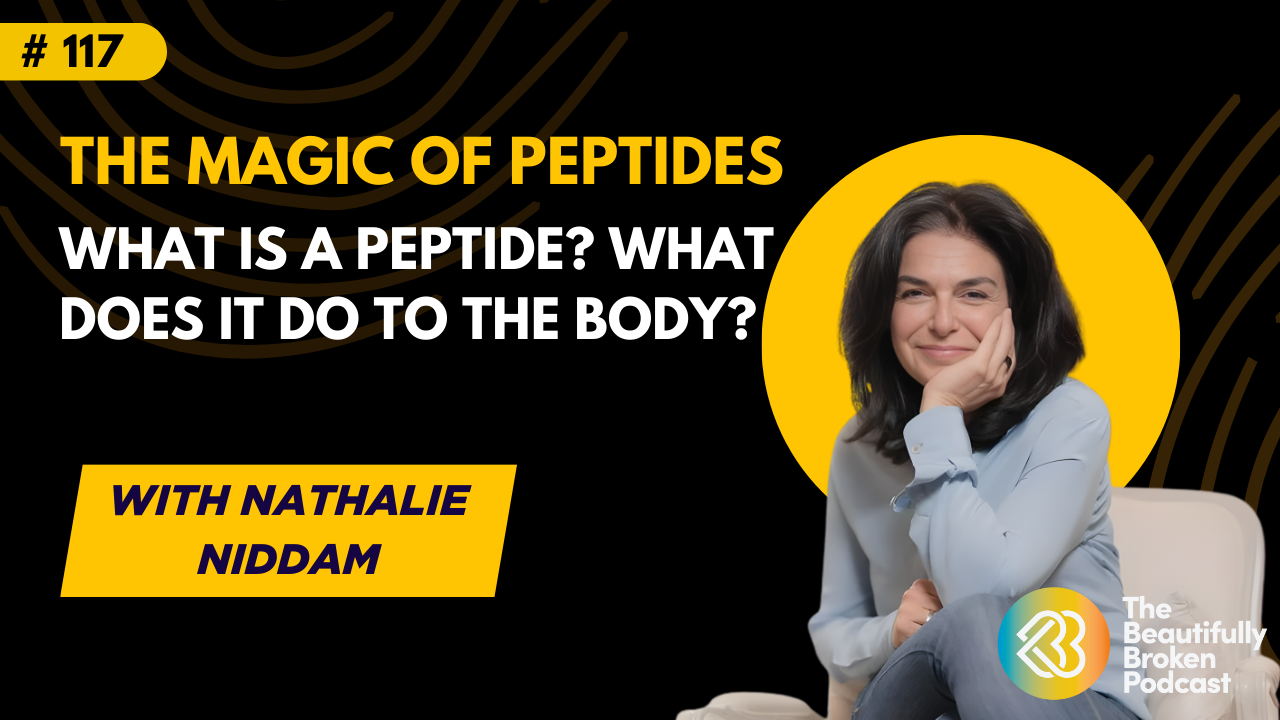
WELCOME TO EPISODE 117
If you are exploring optimal health then Peptides should be part of the conversation. Peptides are tiny proteins, they are strings of amino acids that provide a multitude of physiological benefits – from managing diabetes, sclerosis, pain reduction, anti-aging, and beyond. Your body naturally creates peptides, and current advancements in medicine have led to the birth of lab-made peptides that offer unique benefits to the body. The reason I LOVE peptides is their function as a signaling molecule in the body (opening the door to self-healing!). Are you seeing a theme here?! Natalie Hiddam explains their wide array of benefits, their proper integration into your wellness journey, and her own profound experiences with it make the desert island “BIOHACK” that will always be included. Want to hear her absolute favorite Nathalie is a certified holistic nutritionist, bulletproof human coach, Apeiron epigenetics coach, and a self-proclaimed science geek with a passion for health. She is also the host of the Biohacking Superhuman Performance podcast that tackles longevity, health optimization, and biohacking. In the world of peptides, Nathalie is a bridge to the sea of information that peptides occupy and she is my personal go-to when I have questions about this emerging science. This episode will open the door to understanding the untapped power of peptides!


Episode Highlights
[00:48] Relating the winter Olympics to the nobility of the sports
[05:15] Unravelling Nathalie’s identity, purpose in life and her passion for sharing information
[09:05] Living a life of gratitude in a world of abundance but not contentment
[11:35] What is a peptide? What does it do to the body?
[17:35] The proper way of introducing peptides to the body
[21:49] A starter peptide that may work for an individual who just started to take a peptide
[26:00] What is a Th1 and Th2 cell?
[34:30] Utilizing both conventional and alternative medicine to provide medical solutions
[38:15] Bioregulator peptides and the untapped benefits it provides to the body
[43:35] Getting your hands on a peptide
[50:14] Natalie relates her experience with peptides and the most profound benefits it has
[56:06] The unquantifiable effects of good sleep and Nathalie’s hacks for a great sleep
UPGRADE YOUR WELLNESS
Silver Biotics Wound Healing Gel: https://bit.ly/3JnxyDD
Code: BEAUTIFULLYBROKEN
LightPathLED https://lightpathled.com/?afmc=BEAUTIFULLYBROKEN
Code: beautifullybroken
STEMREGEN: https://www.stemregen.co/products/stemregen/?afmc=beautifullybroken
Code: beautifullybroken
Flowpresso 3-in-1 technology: (https://calendly.com/freddiekimmel/flowpresso-one-on-one-discovery)
CONNECT WITH FREDDIE
Work with Me: https://www.beautifullybroken.world/biological-blueprint
Website and Store: (http://www.beautifullybroken.world)
Instagram: (https://www.instagram.com/freddie.kimmel
FULL EPISODE INTERVIEW
EPISODE TRANSCRIPT
Freddie Kimmel and Nathalie Niddam (00:00.024)
These are the teensiest, teensiest, like the teeniest proteins you could imagine. What they're able to do is cross into the nucleus and bind to DNA. And so what the research that's been done, much of it that's been done in Russia over the last 40 years has shown is that these peptides seem to have the ability to help the body to regenerate tissues, organs, and systems from the inside.
Freddie Kimmel and Nathalie Niddam (00:27.033)
Welcome to the Beautifully Broken podcast. I'm your host, Freddie Kimmel, and on the show we explore the survivor's journey. Practitioners making a difference and the therapeutic treatments and transformational technology that allow the body to heal itself. Witness the inspiration we gain by navigating the human experience with grace, humility, and a healthy dose of mistakes. Because part of being human is being beautifully broken.
Freddie Kimmel and Nathalie Niddam (00:58.383)
Ladies and gentlemen, welcome to the beautifully broken podcast. I'm here with a very special guest north of the border. have Natalie Nidam. Natalie, welcome to the show. Thank you so much for having me, even though I'm north of the border. Even though you're north of the border. Well, I grew up in Buffalo and Rochester, so I feel like a partial Canadian. Yeah, yeah, yeah. No, you are. You've got status. Definitely. Yeah, yeah.
And now I'm in Austin, Texas, but I still have my snow hat on because I'm feeling winter. I'm feeling the winter Olympics, which I love the winter Olympics. I don't know about you. Yeah. I mean, I have to say that this year I have not been watching. I don't think I've watched a single minute, which is unfortunate, but that's because I've been flying around and traveling and maybe moving a titch too fast, which may have something to do with the fact that we're recording probably two hours after you thought we were going to be recording. Whatever.
Yeah, whatever. Flexibility in our scheduling. I know. It's the beauty of working at home. It's the beauty of working at home. I don't know about you, but for me, the Olympics, there's something that is so, and I've thought about this during the pandemic a lot lately, there's something so pure about sport, competition is this microcosm for
two teams or two individuals are going to battle. They're slugging it all out, giving it their all, and they'll be somebody deemed a winner, and that they're gonna receive, whether it's that, you know, the gold medal for status or a world record time. It's just very incredible to me, like, how much excitement and adrenaline you can draw, especially the Olympics, because I'm like, it was four years ago that these people went to battle, and some of them back are a second, a third time.
getting ready to rock and roll again. it's like the stakes are so high. Yeah, no, it is. It is. And the purity of it, to your point, is this, you know, it's battle in the perfect context. Right. Yeah, it's not. I don't know. It's just everybody striving for their ultimate performance in that moment. And, you know, and it's a culmination of so much dedication and perseverance and work.
Freddie Kimmel and Nathalie Niddam (03:16.303)
And you hope that there's joy in it for them too, right? You You really do hope that joy piece, which we forget quite often, even in the health space, right? We're working towards this. We're moving in a certain direction. And are we holding joy in the journey for ourselves? Yeah. It's a big piece I find myself having to go back to and remind myself and remind people as well. I'll say that watching the different sports,
and being aware of the dynamic between inter-relational, like between the French and the Americans and the Italians and the Chinese in between different sports is also a huge, there's a huge shift. Women's snowboarding when like all the women were done, they did like a tackle pile of love fest. Oh my God. They just jumped on each other. They were like, and it was like, Oh my God, some people lost and some people, you know, some people didn't even place and they, they didn't care. It was like, there was no metal. was like,
guys, we all got here. We won. And then there was women's big air competition, which is a skiing freestyle, skiing, big air competition. And like the gold medal winner went over and she put her hand on the woman who was bumped into silver and she wouldn't even look at her. was like, you're feeling this dynamic. Wow. This really shifted between sports and how the camaraderie will change in this. Anyways, isn't that life? Like these little microcosms, we're all so different.
Well, it's personalities too, right? But it is interesting in that one sport how the camaraderie transcended the competition, transcended politics, transcended all of these things. And, you know, is it certain sports that bring that? Is it just the individuals that happened to show up this year? Yeah. It's hard to know, right? It's hard to know. But the Olympics, I think, is a wonderful springboard, pun intended, for us to jump in to
high performance, biohacking, human optimization, which you are a leader in. So you're on the podcast because you're a special human being. And if you were stuck in, let's do an escalator with me, we're in a long escalator in a mall. Actually, let's do like Dallas airport. We're on one of the long escalators. Tell me if we just met, what do you do, Natalie, for a living? What's your passion? Why do you spend your time on the earth? That is such a good question.
Freddie Kimmel and Nathalie Niddam (05:43.077)
And I think it's the question, the answer to that question has evolved over the last number of years that I've been in this space. And it's funny because I was talking to my husband last night, we went out for dinner and I was saying, you know, I feel like I don't remember what I said to him, but I spent my whole career before health in sales. was an advertising salesperson. I sold space. I sold air.
And I woke up one morning, but the other thing that I did was I was always a fitness instructor and I started out studying human physiology in university. And I just, you know, I kind of fell away from that. And for a number of reasons ended up in a completely different space. And then I woke up one morning and decided.
I'm not happy doing this. This isn't bringing me any joy. I'm just moving money from one place to another and there's money that falls in my pocket along the way, but it doesn't feed me, right? Whereas when I would go teach a fitness class, which is the one way that I kind of held on to this health and science and helping people, was like, it was a performance, but it was an exchange of energy. was the ability to make a positive impact in other people's lives. And so I had a conversation with my chiropractor who,
was the recipient of all my downloads of all the books I was reading and the podcast I was listening to and all this stuff, which he would then download to his clients. And he turned to me one day and he said, you know, Nat, you should be getting paid to do this. You're really good at this. And I thought, geez, he's right. And inside of a week, I had registered for at the Institute of Holistic Nutrition in Toronto, and I was in a full time in class program. And even from there, which, you know, that started to feed me and it started to feed this
desire to help other people and to teach because I teach a lot. But it really didn't come together for me in a big way until I became, I did the human potential, the bulletproof at that. was called bulletproof at the time, the human potential coach training program, which brought the whole coaching piece into the equation. Because you the problem with becoming a nutritionist is you spend a lot of time telling people what to do, but you're not able to help them to actually do it. And so
Freddie Kimmel and Nathalie Niddam (07:52.574)
helping them to overcome their own stories, their own obstacles, the things, because there's so much information out there. People kind of know what they should be doing. I mean, they get confused because there's too much information, but it's about how do you push past your own obstacles inside of you? And so that brought me that piece. But again, it isn't until I became a podcaster that I think I really moved into what I love to do the most.
which is this sharing of information, you know, hopefully reaching a large number of people and helping to bring people information. And so therefore being able to help more people more of the time. So I still have a hand in the coaching because I love that one to one connection and I love working with people one to one. But the podcasting is, I'm sure you know all too well, gives us the ability to
bring ideas and concepts and share with people in a very different way. So if I had to tell you, do I do? I'm a bridge, you know, and I bring information to people. And what I try to do is be the bridge that connects people to the information that they need in this time, whatever it is that they need to hear right now to help them move along in whatever journey they're in. That's kind of what I do. That's beautiful. That's beautiful. What a role of service.
You know what? I'm so grateful to be able to do this. And I'm just grateful for the opportunity. it's hard to, you know, it's funny, I've been kind of swimming in this sea of, of gratitude this morning for some reason, as I've been running from one place to another and thinking to myself, I'm so lucky, you know, I'm so lucky that I have the healthy energy, the bandwidth to squeeze so much into so little time. And then to be able to sit down and have an amazing conversation with
someone in my field that, you know, I've been wanting to connect with and talk to more deeply for a long time. So I'm just like, God, I'm so fricking lucky to be able to do this. I think about that all the time. I always go back for some reason. I go back to like a feudalistic society in which there was like a royal family and everybody else was like a potato farmer. Yeah. Dying at age 33 of horrible.
Freddie Kimmel and Nathalie Niddam (10:17.846)
nutrient deficiencies or disease or the plague. Yeah. And the idea that if you think about that society, the idea of leisure time or like Instagram, let's just set aside the fact that if you gave someone the box that is like all the information in the world, that it would be like Star Trek. They'd be like, you're a witch. And then the fact that we have so much access to leisure and boats and
airplanes and like just the wild stuff that we have. mean, if you had told someone in a feudalistic society that you'll have all these things and then you had told them you'll also be more depressed than ever, you'll be on more prescription medications, you'll be 7,000 times more likely to kill yourself from suicide, right? From chronic depression, to be clear, yes, when you kill yourself, that is suicide.
that all these chronic conditions, the weight or the cross that we're bearing as a result of luxury and technology and money, isn't that wild? Like if you wanted to write out a fantastical story, you probably couldn't do it. Some of you are like, that's a little bit much. Yeah, are you kidding me? Anyways, I don't want to take us there. I want to go back to your superpower.
because one of your superpowers is a little bit of this arena, the sandbox of peptides, which I've heard you speak a lot about. on your show and your group on Facebook, why do you talk about peptides so much? And maybe we should just say for everybody at home, what's a peptide? Yeah, what's a peptide? What's a peptide? A peptide by definition is a tiny protein. That's all it is, right? So proteins are made up of amino acids.
and a peptide is an amino acids, think of them as Legos, like the one block Legos. And so an amino acid is the single dot on the Lego. And so you have Lego pieces that are one, two, three, four, 10, 15, 20. These Legos can get really long, right? And those are proteins. Proteins in the human body is ultimately how anything happens. Without proteins, we got nothing, right?
Freddie Kimmel and Nathalie Niddam (12:37.461)
Peptides are by the very definition small proteins. So depending on what definition you're working from, they're either less than a hundred amino acids long or less than 50 amino acids long. And the peptides we're talking about are signaling molecules. And so they have receptors in the body. Then your body, it's all about communication, right? It's all about signals and communication. And the communication is what allows the body to do what it does.
And what I love about peptides and the reason why they captured my imagination so irrevocably the first time I heard about them is that they are a way of us to tap into the ability to provide a signal to the body for the body to do what it does best. So it doesn't do for the body. when often when we take a medication, we're saying, you know, step aside, the medication is going to take care of this.
The challenge is that the human body is incredibly complex. It's incredibly amazing and wise. has this capacity that we don't understand. And so what peptides seem to be able to do in many cases is to be that little spark that initiates a cascade that allows the body to kind of take over and repair or regenerate or mostly repair and regenerate. Or, you know, when it comes to
peptides that happen to the immune system, maybe sometimes they help the immune system to come back into balance. So that's kind of what peptides are. And that's, that's the reason why the first time I heard about the meta conference, I was like, as a matter of fact, it was a paleo effects. was in Austin. And I was, and I was literally just looking for a place to sit down because I'd been in the exhibit hall, talking to the exhibitors for days. And I just, was like, oh my God, I need to take a load off. So I went to sit down and this guy was standing there.
And all of a sudden I'm like, what did he just say? I spent the rest of the lecture kind of like gobsmacked. And then literally at one point leaned over to the guy sitting in front of me, tapped on his shoulder and like, is he kidding? And the guy goes, no, babe, this is all real. And anyway, that was the beginning of my journey with peptides. That's amazing. I think I heard about them first from Ben Greenfield, probably. I was looking for support with tendon repair.
Freddie Kimmel and Nathalie Niddam (15:03.321)
inflammation, injury. And I think I started on a BPC 157 stack, maybe TB 500. You know, I got the little diabetic needles and I'm injecting myself all over. was like, you know, I have to be honest, my first experience was a little lackluster for me. Just because I think like all things and I, this comes up so much lately that I think everything that we talk about on these shows works.
everything or we would be having the conversation or wasting our time and companies wouldn't create products. And it's like, where does it fit in the paradigm? What else is going on? What does the terrain look like to which you're interjecting these signaling molecules? Absolutely. And so a lot of times I think as an N equals one experiment, we'll do the thing and we'll like, that's not these aren't good. So we'll start saying or overlaying or reaffirming the narrative that like peptides didn't work for me.
And I hear people say things like that associated with different like lights or hyperbarics. It didn't work for me. And I'm always like, in my head, I'm rolling my eyes. like, no, it works like it works. Like the faucet gives you water to wash dishes, right? Did you have soap? Did you have a sponge? Maybe there were other ingredients missing to the formulaic equation that needed you to help auto-regulate.
But I, yeah, so it was like, you know, that I had the lime and the mold and lots of like toxicity in the system. So I can only imagine why I had limited benefits. So it's not something I've really jumped into. And from my understanding, I had always explained it like the in Harry Potter. It's like, how many times can you use the in the Harry Potter book series? Millions, like everywhere. So that was like, I was like this small string of amino acids could help.
everywhere, know, BPC 157, whatever it was, you know, a small string. So I was very excited about them energetically and conceptually. And I just think I've yet to find like the application and understanding on where they fit in. But I listen to your stuff often and I'm really, I'm like pulled. like, I got to figure out where peptides go in my life. So if that could be a starting point for us to, you know, if you have somebody like Natalie, I'm like,
Freddie Kimmel and Nathalie Niddam (17:18.811)
can't lose weight, I'm dragging ass with energy, my joints hurt, and you're gonna talk about the whole picture. How do you start the conversation around peptides and what might be a right gateway drug, pun intended? All right, so let's keep going. Ladies and gentlemen at home, we actually had like a mic awareness between two podcasters, which Natalie offered me. She was like, your mic is scraping, you might wanna stop that. And I have two recording systems, so anyways.
I always think those things are fun for people at home. Totally. And then they'll understand why maybe it's a little less of a smooth transition as they may have expected. So definitely when I introduce peptides into the conversation is within the context of what's happening with the person. And as you know, I'm not a medical doctor. I'm not here to prescribe anything, but I am here to provide information to people to help them move themselves along on this path. And certainly
Peptides have a place that'll occupy a place that is very new to a lot of doctors. And yet that can be incredibly powerful. But the fact of the matter is, and as you were just saying, two things are true. One is in certain instances, applying the right peptide at the right time, even if you've got a lot going on, can very often help to move the needle for people. It can help them to feel better.
very quickly so that it gives them number one, the encouragement and the energy to then follow through with more steps. I love that. So sometimes it can be like, if you imagine climbing, when you're rock climbing, it gives you that first little toe hold that says, who, okay, I can do this. You know, I'm going to go look for the next hand holder, whatever the case may be. The other thing that's also very true is if your house is on fire,
and you send a contractor in to put a new kitchen in there, it's going to burn down. It's just not going to work for you, right? So if you're introducing peptides very often into a landscape that's completely disrupted. So we're not sleeping. Our stress is off the charts. We have massive inflammation going on. Our nutrition is way out of whack. There's just so much turmoil in the system.
Freddie Kimmel and Nathalie Niddam (19:43.138)
The problem is that people and look, this is human nature. We're all looking for the magic bullet. We're all looking for that one thing that's going to turn the ship around for us. And the bad news is it doesn't really exist. So for me, before I have the peptide conversation with people, and the truth is because of what I talk about, because of my group, people come to me, tell me what peptides to use. And I'm like, OK, we need to back it up. Right. Of course. What's going on?
Why do you need peptides? Do you have a serious medical condition at play? Because if you do, we need to get a doctor on board to help us here, right? To help to prepare the terrain for the introduction of something that can really be effective and magical and move the needle for you. But at the same time, you know, sometimes when you have someone who's got a lot of maybe autoimmune issues or they've got a lot of gut inflammation or they've got really like a very leaky gut.
And so things are getting through the GI, the gut lining into the body, kissing the immune system right off day in and day out. Sometimes something like a BPC one five seven and a change in diet and paying attention to all the other things that we know and talk about. can help to like just calm things down a little bit so that they can take the next steps. You know, the beauty of BPC one five seven for the gut is that it's end game is to repair.
But the challenge is that if you're still feeding that dysfunction from your behaviors or there's some other imbalance at play that's causing the leaky gut, you're pouring water into a leaky bucket, right? So to me, it's really important for them to understand that. And you said something earlier that that's so true. It's not that it didn't work. It's that we didn't do the work to allow it to do its job. Right. So it doesn't work.
whether it's PMF or amp coil or hyperbaric oxygen therapy or whatever the case may be, as you say, it's doing its job. It's more like, is your body ready and able to accept this to move itself to the next level? And sometimes we're not ready. Sometimes there's other things we have to do. Yeah. Yeah. Is there a favorite that you think is a nice, I know I
Freddie Kimmel and Nathalie Niddam (22:00.381)
might even know the answer. Is there a favorite starter peptide for people? Does it really depend what's going on? do you, is there something that you like to test to see how the body is going to receive this? Yeah. I mean, the bottom line is it depends. BPC 157 is a peptide that has many, different uses. And what's interesting about BPC 157 is somebody can be taking it to address their gut. And they'll notice that that sore shoulder suddenly doesn't feel so sore.
Or they could be taking it for a sore knee and all of a sudden they realize, hmm, you know, my gut seems to feel better. My digestion seems to feel better somehow. So BPC is definitely one of those. Another peptide from another part of the peptide world is called thymusin alpha one. It actually has orphan drug status in the U S which has made it much harder to get your hands on. And it is also an approved drug in many countries in Europe. I think about 30.
32 countries or something, and that is an immune peptide, and it's thymusin alpha one. It's derived from the thymus gland. So it's basically like BPC 157 is a protein sequence from something that we naturally secrete in our gastric juice. Thymusin alpha one is a sequence from something that you would naturally, from a thymus peptide, you would naturally produce in your thymus gland. Now we know that our thymus gland invalutes as we age.
And it happens, it starts to happen pretty early in the game. So sometimes reintroducing one of these thymus peptides can kind of help the body to come back into balance, right? So thymus and alpha one, it's super power. Many people are walking around TH2 dominant and their TH1 system in the immune system is kind of underperforming. You see this a lot in autoimmune diseases and things like that. And so by bringing thymus and alpha one into the picture, you now kind of
allowing the TH1 system to come back online and balance out that TH2 system. those are two. The other one, which is from another sphere of the peptide world, if you will, which is bioregulator peptides, is a peptide. And these peptides are incredibly powerful. They're no more than four amino acids long. So these are the teensiest, tinesiest, like the teeniest proteins you could imagine. What they're able to do is cross into the nucleus and bind to DNA.
Freddie Kimmel and Nathalie Niddam (24:25.086)
And so what the research that's been done, much of it that's been done in Russia over the last 40 years has shown is that these peptides seem to have the ability to help the body to regenerate tissues, organs, and systems from the inside. And the one, if you threw me on a desert Island and said, not, only get one. I would choose a pitalon, which is the bioregulator that helps the pineal gland.
to rejuvenate itself. Because why? Because the pineal gland, if you think about it, it's at the top of the chain here. And it is considered to be a master endocrine regulator. Doesn't do all the work, but it helps to kind of reset the orchestra, if you will. And it normalizes melatonin production. It lengthens, it activates telomerase, which helps to lengthen telomeres. It helps to reset a circadian cycle.
it can, in some of the studies that were done in Russia, it improved bone density in elderly people. It improved their quality of life, their sense of wellbeing. And all of these things, if you think about it, are downstream effects, better sleep, therefore better recovery. And the other word that's really important there, it normalizes. It doesn't boost melatonin production, it normalizes it. And this is where certain peptides are really magical, particularly the bioregulators.
in that they seek to restore homeostasis to the body as opposed to trying to boost or depress something. Yeah. Incredible. There were two big questions that came up for me. I wonder if we couldn't just skip on to like a little stone on the side of this path for a second and just talk about T1, T2, arms of the immune system. I think that's been a really interesting topic that's come up over the pandemic. People having a heavy-handed side of the immune system.
Could you explain that again to like the laymans at home, be like, and talk about how the immune system might operate in two different ways. Yeah. mean, one of them, like the one is the extrinsic, how you respond to the outside world. And one is how you're responding inside. Your immune system is responding inside. And so, you know, what's interesting about Thymus and Alpha-1 is that one of the things that's been shown is that particularly in elderly people. So what happens with elderly people when they get a vaccine, for example, is very often their immune system is tired.
Freddie Kimmel and Nathalie Niddam (26:49.064)
It's old. It doesn't respond appropriately to the vaccine. doesn't give enough of a response to the vaccine. There was actually a paper that was published that showed that thymus and alpha one can help to amplify, to improve an elderly person's response to a vaccine. so it's unfortunate that this has kind of flown under the radar, right? Because in, in, this pandemic, and I mean,
whatever we believe about vaccines or don't believe, there's no doubt that vaccines for certain populations has made a really massive impact in terms of their ability to weather the storm of catching COVID. And that elderly group is that group of people. So imagine if we maybe provided them with access to something like Finocenalpha 1.
so that they have a more appropriate immune response to the vaccine so that it gives them enough of immunity or I mean not immunity but it helps their body to kind of respond appropriately to the virus should they catch it. So I think that in autoimmune conditions very often that TH1 side of the immune system it's depressed, it's down, it's not doing its thing and so
if we have access to something that can slowly bring it up. And this is where, you know, people go it alone. And I do think that if you have a medical condition, you have an autoimmune condition, it's important to work with a medical doctor or someone who really knows what they're doing with peptides. Because here's the other thing I've seen in my group is people get super excited. They run out, they buy this stuff online, which, you know, if you know your supplier, that might be fine.
They buy the stuff online and they're like, okay, I read somewhere that this is the dose and boom, they go at it. And two things happen. One, nothing. Two, massive Hertz reaction. It like completely throws them for a loop because, you know, the rhetoric out there is, peptides are natural. Nothing can go wrong. Like it's going to be fine. You're, you know, there's this weird little narrative. And I think the narrative, I think what we're lacking in our society in every aspect of every conversation we have right now is nuance.
Freddie Kimmel and Nathalie Niddam (29:09.123)
Kill me. I stole my word. was like, nuance, nuance. It's honestly, it's my favorite word right now. Yeah. It's a really great quote from a very famous documentary filmmaker. And I'm going to, I could get it wrong, but I think he said that tyranny is the deliberate removal of nuance. Because through this tactic, we can create this narrative that is an us first them good verse evil. Yeah.
And that's not the way life is in my experience anyway. So that was very helpful to me. And I think that so many people listen to the show with Lyme and mold. And if we are all having that conversation around mass cell activation, some level of autoimmunity, right? Maybe the Lyme is gone. Maybe it's not detectable in your, you know, your fancy blood work that you sent over to Europe. However, it's very possible that a protein coating
from that spirochete now lives in the synovial fluid of your joints. And there is a memory that the body is continuing to attack. So there is some level of continued inflammation for many, many people with Lyme.
Hi friends, I hope you're loving this show. Let's take a quick break to hear a word from our sponsors. If there's one word that makes me feel really intelligent, it's photobiomodulation. Better known as red light therapy. Photobiomodulation has been clinically shown to increase energy, circulation, increase testosterone production and workout recovery, hair growth, even the improvement in the depths of fine lines and wrinkles. You actually don't have a lot of reasons not to incorporate red light therapy into your home and
not all panels are created equal, which is why the panel I recommend to my family and my friends is LightPath LED for the following reasons. This company continues to evolve their technology, including up to five wavelengths in each bulb. They include a three-year warranty. This is one of the most robust in the industry. And they also have pre-programmed frequencies to add the benefit of pulsed light to the body. And most importantly, after purchase support so you know how to best use your device,
Freddie Kimmel and Nathalie Niddam (31:21.262)
for your specific needs. Now what does the evolving science say around pulsed light? Pulsed light yields benefit to the mitochondrial health, leading to increased production of cellular energy, thus improved outcomes. So say it with me, let's mind the mitochondria. So check out their beautiful new website at Lightpath LED and use code beautifullybroken, all lowercase, for a discount and checkout. Now let's get back to the show.
Now we'll go from T1, T2. I got to track us so I can be sure to bring us back to peptides. We'll go to Instagram reels. I just said... Amazing, I love it. I only used my first reel last week, so I'm a real virgin almost. I've got a little mental map here on my cutting board next to me. So I'm just making little piles of things to trace this back. That in this video that I made, and an Instagram reel is just a video you put on social media, I had this video of me doing pull-ups.
Well, my initial area of attack for me was really knees and hands. Hands so much so that I hold a coffee cup. You know, I would fake it till I make it. years and years before I ever really told anybody how bad my hands were, I was living in New York City, I often thought, if I ever got mugged, I would be trying to whack somebody with the back of my hands. I could not make a fist to defend myself, which I was...
I remember that was one of the motivators. I was like, I gotta go see a rheumatologist. was a little scared. was like, how would I ever, you know, if the zombie apocalypse came, I'm done. So actually you'd fit right in. I know I would fit right in. I could play the zombie. So the, the idea that this chronic inflammation exists on some level for many of these populations dealing with chronic biotoxin illness, Lyme mold is
something that has never been brought up in the area of the pandemic. I'm aware how, you know, sometimes it, as you know, sometimes you are compromised, but in other areas you are actually, you'll mount a better immune response to things like viruses and bacteria. It's not like, it's not, compromise does not necessarily mean compromise. I'm just saying I would love the level of awareness that these are at least 500,000 people diagnosed
Freddie Kimmel and Nathalie Niddam (33:40.279)
each year newly with just Lyme. So that's a, this is a lot of people that's every single year growing and growing and growing. And somebody might misquote me, Freddy, it's 700,000. It's Freddy, it's 330,000. It's a lot of people that have this T1, T2 dysregulation. So to come in and then say, then say, now let's do this artificial intervention into your immune spondes. And we're going to further create a heavy handed nature.
to a viral expression, to me, I've always been like, danger, danger, danger. I'm so oversensitive, right? My blind spot, I would say, like, I've been some, like, can eat like seven or six foods or something at one point. Like, I'm just so sensitive to how in-balanced my body can be. So I think it's a really good thing to think about that like, everybody has different levels of health and we're talking about this. And to take us back to peptides, we'll go bounce back to.
the second lily pad with T1, T2 and like back into peptides. we're into this tran thought we're moving forward. It's a nuanced conversation where we're talking about any of these things from me and Natalie. Yeah. There's no one answer. You know, there's no, mean, I've seen again, you know, I have this luxury of living in this space with 10,000 other people and observing and hearing their comments and seeing what their experiences. And I will tell you, there's no panacea.
There's no one answer. And the reason is ultimately because there's everybody's got their unique thing going on under the hood. And there's no one thing that can really address it. And this is why, you know, it's my hope is that there's more and more physicians who move into this functional space, who really dig into these conditions, who are able to bring, because, you know, we land-based conventional medicine a lot.
We do. And the fact of the matter is that there's a lot of in conventional medicine. I wouldn't be sitting here if it wasn't for conventional medicine right now. And you can't be throwing out the baby with the bath water here. What we need is these physicians who can straddle both worlds, who can bring the best of conventional medicine, their learnings and draw from more alternative, if you will, alternative fields, be open to the possibility that there's other things that they didn't learn about in med school.
Freddie Kimmel and Nathalie Niddam (36:05.521)
that are going to enhance, sometimes replace, sometimes assist with all of these other conventional therapies that they understand or that they're able to use more effectively because they have a greater understanding perhaps of how the human body works so that they know where in the pathway am I trying to intervene to help the body kind of kick out of this, whether it's in a negative spin or whatever the case may be. Yeah, 100%. If we go back to
If we, to move forward from the peptide conversation, we kind of just mentioned bioregulator peptides, which are a little different. So could you again, could you give just a little descriptor on what we're talking about when we're talking about that very small string of amino acids? And you said there's a body of evidence from Russia, which is quite impressive. And I'm like, is Putin taking bioregulators? baby, by the boatload. Right. He looks, I'm going to, I'm going to say this with all joking aside, he looks.
He's been in power for so long. Isn't that wild? You think about like Gorbachev and like Putin and like their leaders are on board for like 40 years. It's coming to us. But anyways, no, but the guy looks like a beast, right? You look at all other. And you know, I never thought of this before, and I haven't seen a picture of him in a while, so I could be wrong. But the last image I have of Putin, the last time I saw an image of him, the guy looks strong. Yeah, a powerful. But you look at any other policy.
politician after they've been in power, frankly, sometimes after a year or two years, they've aged 10 years. Yeah. And certainly by the end of their first term, it's, it's not a Jesus out of them. I mean, it's a game, right? The media has done this. Here's a picture of so and so before they came into power, they're like all happy and rosy and whatever. And here they are at the end of their reign and they look like they're exhausted. Right? I know. Somehow this guy's not looking so exhausted. I mean,
whatever, love him, hate him, whatever you want to think about him, because I'm not going down the politics path. No, no, no, no, no. But at the end of the day, he's doing something right. And I think it has a lot to do with the access that he has to whether it's bioregulators or whatever else that he's doing. But the truth of the matter is that somehow this guy is finding it in himself and in his time to prioritize his vitality, like his health. So to come back to the bioregulators.
Freddie Kimmel and Nathalie Niddam (38:30.246)
Do you want to say something? No, no, I do, but I'm going to wait because it'll take us off topic. Bioregulators. interrupted at any time. So the bioregulators are by definition, they're only two to four amino acids launched. So these are the tiniest of the tiniest peptides. And they, because they're so tiny, they can get to into the nucleus of the cell and bind to DNA. And in that sense, they increase the expression of the DNA that allows the DNA
to manufacture proteins, to initiate the manufacture of proteins in the body. When Professor Cavinson, who is the doctor or the researcher doctor slash who really kind of brought these to light, and this is going back 40 years, he was a young dude in the military in Russia. And the powers that be came to him and said, you know, we need a way to address the health degradation that's happening.
who are cosmonauts when you send them out to space because they age, their rate of aging increases dramatically. Or the guys who are in the submarine, in nuclear submarines and coming back a hot mess because they've been sitting in a nuclear submarine and assaulted by radiation and whatever else. They were very worried at a certain time, types of attack from their enemies. And they said, you 20 something year old dude, get this, we're giving you carte blanche.
We're giving you as much money as you need. We're giving you access to all the resources that you need. You need to solve for this problem. I mean, he must have been obviously a fairly special person for them to come to him with this. Right. Like the Ian Mitchell of like the Soviet Union. Right. They're like, here's some money, go solve this. Go, go, whatever you need. and you need people to test, run tests on. We got like an entire factory of people who are really miserable over there in Siberia, go to town. Yeah. And so.
He did a couple of really interesting experiments where he took big populations of people, one from this Gazprom, which is this literally this factory in Siberia, and half the people got multivitamins and the other half of the people got given bioregulator peptides. And really not very many, like there was Apidolon and there was Thymogen, which is the thymus bioregulator.
Freddie Kimmel and Nathalie Niddam (40:49.194)
So there's a bioregulator for the thymus gland. And as we said earlier, the thymus gland starts to involute and lose its ability to function, to really work for us in our thirties. And it just declines. So, and we've talked over the last two years, we've talked endlessly about how the immune system as it ages becomes less efficient. It's more likely maybe to overreact or underreact. And so we're not able to defend ourselves in the right appropriately to whatever it is that we're coming in contact with. So half
the lucky people got the vitamins and the other half of the luckier people got the epitelon and the thymogen. And over the course of a number of years, they realized that the people who got the epitelon and the thymogen were less sick. They lived longer. They fared much better. So he basically upped the ante. He went after old people and he was able to show that by just giving these elderly people the thymus peptide and epitelon,
for two years, he improved their longevity and vitality even 12 years out. And with a group of 75 to 85 year olds, six years out, because at this point he's not gonna basically monitor them for 12 years, because most of them would be dead anyway, the decrease in all-cause mortality was dramatic just with those two peptides. And he may have added the sugin, which is the blood vessel bioregulator. So if you think about it, we're now...
helping the pineal gland to do what it does best, which has massive downstream effects in the body. We're helping the thymus gland, and it also affects the thymus, so it improves immunity. We're going after the immune system, and then we're just really improving or helping the body to rejuvenate the circulatory system. So from a systems perspective, if we think about it, so now we're able to get nutrients to the cells.
and systems and remove waste products, which is fundamental to function. We're able to improve function of the immune system. And then we're improving. We're normalizing melatonin. We're lengthening telomeres. We're doing all of these other things that bring other benefits to the system. They didn't change their diet. They didn't work on their lifestyle. They didn't do anything. Right. mean, Pitalan even has shown in certain studies to have anti-tumor effects. So
Freddie Kimmel and Nathalie Niddam (43:12.022)
That's pretty magical. it's incredible. It's incredible. It would be wild to have these conversations about the terrain of human beings having a challenging time in this pandemic. It's like wild to me. like, wow, there's so much great stuff out there. Anyways, yeah, it seems like the future is bright for peptides and where they fit in. I have a question about investment, investment in financially and then like in time. Like what is somebody looking at? Let's just.
make life easy. Let's talk about the bioregulator peptides, which am I incorrect in assuming they're actually like a whole food? it like so that's a really good question. I'm so glad you asked that because here's the landscape of bioregulator peptides. There's two ways to access them. But first of all, Professor Cavinsons speaks about how bioregulator peptides are present in food. And the body has, you know, certain, I guess, carrier proteins in the gut.
that will recognize these sequences and carry them across so that they don't get chopped up into their component units, right? Because if your digestion chops it up into single amino acids, then you're not left with that signaling molecule on the other side of the wall as it were to do the work. And then the other thing he talks about, which I think is really interesting, and I'm going to come back to the food question in a second, and I meant to say it earlier, is he talks about there's a 32 % biological reserve in every tissue and organ in the system.
So it's almost like this untapped potential that exists. And it's by using the bioregulators, we're tapping into this reserve of potential that we're not able to tap into otherwise. But to answer your question about food, if we think about where these bioregulators come from, particularly the biologic version. So there's two ways to get bioregulators. You can get a synthetic bioregulator where that amino acid sequence has been recreated in a lab.
So it's literally for epitelon, it's for amino acids and they've been able to recreate that chain and don't think it's a straight line. These molecules are 3D and if they're not arranged properly, if they don't have the right charge, they're not gonna work, right? Because the whole body works in this lock and key mechanism, the whole nine yards. If your key has one little bump in the wrong place or is the mirror image of the key that you need, it's not gonna happen. So number one, you've got the synthetic.
Freddie Kimmel and Nathalie Niddam (45:35.181)
The second, which I think is really fascinating is the biologic peptides, the oral peptides that people use are actually extracts from the tissues, glands and organs of animals. And so, there's 21 or 24 of these. So you've got for the heart, for the kidneys, for the pancreas, for the stomach, the thymus gland, for the spleen, for the bone marrow, for all these things. But let's think about this for a minute. Someone who eats a full nose to tail diet.
And we have those people out there right now. Yeah, we do. Or who are taking those, the supplements by guys being made by people like, I think it's... and soil. Heart and soil, like Saladino or ancestral supplements. These are desiccated organs. Even thyroid medication, desiccated thyroid. What's magical about those is there's no way you're not getting peptide in there. There's no way you're not getting bioregulator in there.
you're also getting the co-factors, right? Like we know that in the human body, nothing works in isolation. It's a symphony. Everything's a freaking symphony. And so you need all the other bits and bobs. So it's not to say that the synthetics don't work because they do. And in Russia, they will use the synthetics to get things moving a little bit faster sometimes because they, for the most part, need to be injected subcutaneously. There's people developing them as sublinguals, transdermals, intranasals.
I don't know, I haven't seen any real studies to see how effective they are versus the subcutaneous, but then the oral bioregulators still maintain that ability to deliver all of the other components, the cofactors, if you will, along with the bioregulators. So the way that Professor Kevenson speaks about them is he will say that the synthetic is going to be faster acting, but shorter lived in terms of results. Whereas the oral bioregulator is going to be slower to do its thing.
but the effects should be longer lasting. And when we go to the heart and soil supplements and those guys, my gut is that you're just not getting as much of the bioregulator, but you're still getting it. And if you wanted to save a ton of money, you'd put all your biases aside and you'd start finding a farmer or a butcher who's going to provide you with all of those organs, which frankly, most of which are probably ending up on the floor. Paul Saladino talks about this.
Freddie Kimmel and Nathalie Niddam (48:00.483)
He eats testicle, eats liver, he eats kidney, he eats all those bits that the rest of us are like, yeah, I would never touch that stuff, right? Raw. Raw. Raw testicle. Let's be clear. Give me some honey, dress that testicle up and I'm eating it raw with a fork. Put a raspberry on wild. Anyway, so cost-wise,
You can eat organs. You can eat a full nose to tail diet. Are you going to get the full? I mean, where you're going to find pineal gland, I'm not exactly sure. Like who's going to go find it, right? Yeah. But so your first level is eating organs. Your second level is getting your hands on those supplements, the heart and soil, whatever the case may be. Pretty, I mean, it's an investment, but it's, affordable. Yeah. See how you do the next level. I mean, I will say that the synthetics are way cheaper than the biologics.
you don't need a lot, right? There's a narrative out there about needing five to ten milligrams a day for 10 to 20 days. It turns out I interviewed Jean-Francois Trandé from CanLab, which is a lab in Montreal that synthesizes a lot of these bioregulators as well as other peptides. And he went back to Russian literature and figured out that there was a mistake in translation.
And they didn't mean 10 milligrams, what they actually meant was a hundred micrograms. Yeah. So, which is like a 10th, a 10th of a milligram, right? So people have been like mega dosing this stuff. The cool thing is as far as we know, to no ill effect, but it's wasteful. So if all you need is a hundred micrograms of something, it really doesn't cost much. So it's much more cost effective. The oral bioregulators.
It just, again, it's going to depend on how many use what you're using them for in the whole nine yards. But you know, you're looking at a 10 day course is going to cost you like anywhere from 50 to 60 bucks of one by regulator. And typically you would use them in stacks. You would use more than one. So it can add up pretty quickly. Yeah. I think I did the one that you had recommended. Like I did the whole shebang. I did like the thymus and the circulation and the
Freddie Kimmel and Nathalie Niddam (50:14.93)
testicles, all the things. And I think I'd done it for like 30 days, 60 days. It was, was an investment. It was like 600 bucks, 700 bucks, something like that. That's money. Yeah. And so I would love to hear from your experience, like in your body, what have been some of the benefits of using peptides or the bioregulators? If you want to niche down on one that you think has been most profound for you, maybe that's also helpful. Yeah. So I'm an interesting cat because I'm the canary in the cold night. So there are certain peptides I can use.
And there are other peptides I can't touch because my immune system is like, yeah, maybe you look like something I know, but I don't like you. You're not the real thing. So there are certain peptides that people love like thymus and beta four, which is TB 500. I can't that thing. My body blows up. Wow. CJC epimerelin, which are the growth hormone secretagogues, which is a really cool category of peptide for anti-aging for healing from injury and all that kind of stuff. So that.
What that little combination does is it sends a signal to your brain to upregulate the production of growth hormone. And it's really cool because whereas taking exogenous growth hormone essentially overrides your body's own feedback loops, it stops your own production of growth hormone. Here we're tapping into the body and encouraging it, giving it a little nudge to say, hey, can I get some more of that stuff while I'm sleeping maybe? And the body generally acquiesces. However, my immune system is like, no, no, no, no, no, we'll have none of that.
Yeah. So I did when I first, first started peptides, used BPC 157, thymus and beta four and CJC epimerelin, which is a very classic repair stack. And, you know, a lot of people will use it even as an anti-aging stack because it helps the body to repair damage and all that kind of stuff. Plus with the growth hormone, secretagogues are really good for skin, really good for sleep. Like it's good for your brain. It's good for so many things. And during that time, I was still doing CrossFit at the time. And I
for a very brief moment in time until my immune system mounted its defenses, I was like indestructible. I never got sore. I recovered from my root crutes really well. It was awesome. Yeah, it was great. So that was really profound until I couldn't. Epidolon is another one. Now I have to admit that when I felt the effect the most is when I mega dosed it, when I was still using it at that very high dose. And I remember the first cycle that I did, I'd be sitting
Freddie Kimmel and Nathalie Niddam (52:42.628)
And, know, at three o'clock in the afternoon and I would literally not off, which I never do. I've had a philosophical opposition to napping since I was two. So I don't, I don't sleep during the day. And I was sitting there going like, what is wrong with me? And it was just, it was kind of overriding my system and resetting certain things. So I learned in that 20 day cycle, we're going to go to bed pretty close to when the sun, you know, within a couple hours after the sun sets and we're then going to wake up and it kind of reset.
my circadian rhythm in a certain way. But here's the thing, I have to work with it because I could still choose to work against it. Exactly. Yeah. So I would say that those are the two big examples I can give you. I've definitely seen BPC 157 be a real game changer for people. But again, you have to be ready. It has to be the right thing for you at the time that you're using it. Yeah. And I can't stress that enough because it can be the best
It's like anything else, you know, anything else, anything else, like it can be the best supplement on the planet and it could just not be what you need right now. Or even worse, it could be what you don't need. Yeah. Yeah. I keep getting this, the vision of the easy button. It just doesn't exist. You know, there is no bypass for what we're suffering from. Really. You have to dig in. You got to do the education. You have to have a good guide. You need to get clear on what your body needs energetically, physically, and spiritually.
Yes. At the end of the day, right? And these tools are so amazing. They can really help us. Like you said, you're in a building burning. I need the fire out now. Sometimes we can get great assistance from these chronic pain and resetting the circadian rhythm, our melatonin production, which can be, you know, all of these things can be lifelong crosses to bear unless we figure it out. But you've got to do the work and you've got to have a, think, I keep coming back to this again and again. I'm like, why are we not developing like
I know we are independently, but a more robust standard for what is the functional health coach, the functional medicine health coach. Cause at the end of the day, holding people to accountability, holding up that mirror with compassion, love, empathy, understanding emotional, emotional trauma and wounding in the overlap of physical training and peptides and amp coil and red light. That's the fix. Yeah. And I'm so, yeah, I'm so glad you said that because mindset.
Freddie Kimmel and Nathalie Niddam (55:10.964)
where your heart is, how you're able to receive these things. you know, you can't override the mind. And if the mind needs attention and the soul needs attention and the heart needs attention, we owe it to ourselves to do that work at least alongside the physical. At least alongside. At least alongside. I'm not going to say you have to do it first, because if you're feeling like hell, you need help in that as well, because that helps you on the other side.
but so often we just we push this aside and we just work on the physical piece and Because it's easier right? Let's face it the hardest work to do is the spiritual and the emotional. Yeah, it's hard I Mean, who am I telling you know? Better than anybody like and it comes in waves and cycles and I forget it and then I reno learn it again And I forget it and I learn it again. So it is it is a wave
is we creep up on our hour here, Natalie, I'd love to, and I want to be respectful of your Saturday. I'd love to know, aside from peptides as an avid biohacker, what are a couple things that you're just loving on right now that you're using to optimize wellness and energy? Ooh, honestly, I'm loving on sleep in my own bed. Yeah. I just spent a couple of weeks away.
And unfortunately I ended up in a place that wasn't the greatest and physically. And my sleep was, I struggled with sleep and sleep is something I took for granted because I sleep really well. And I've got a sleep stack that is phenomenal and got me through those two weeks. So, and I'll share it with your listeners here because I do think it's quite magical. Let's do it.
What I do before bed quite often is I will take either a little bit of yogurt or if I don't want if I'm really attached to that fast that I'm doing overnight I'll even do this with water and I'll take a teaspoon of glycine and I'm a big proponent of spermidine as a supplement so I use primidine which I just I love that stuff and it actually tastes really good. So if I'm doing
Freddie Kimmel and Nathalie Niddam (57:29.492)
If I'm doing the yogurt, I will do like literally like one or two tablespoons at the most of yogurt with a teaspoon of glycine. I'll split open three capsules of primadine. I'll take some cinnamon. I'll smush it around and I eat that right before bed and it never fails. My deep sleep always goes up. got to check it out. my God. That stack totally got me through those two weeks. But when I came home and I, my husband and I, well, my husband who's learned now just
don't buy her anything shiny, ask her what she wants because it's going to be a sauna or a red light or something weird that I, you know, like I'm not the designer bag designer shoe girl. I've never had this. So anyway, so for, for my birthday slash Hanukkah slash Christmas slash something else, he got, we got a new mattress. So I got this amazing mattress and I'm supposed to be recording a podcast soon with Chili pad. So I,
got the the alert to try out when I came back home and slept in my bed like the last several nights, my sleep scores have been off the charts. And it's I think it's just it's being back in my own space and having been had the luxury of creating this sleep nest that allows me to get that restorative sleep every night.
That's what I'm really loving right now. I love the sleep stack when I need it. I love that. I actually think it's the ruler that I have. love that chili thing, the cooling of the mattress, having a great mattress. And then I've got my, my flex beam, which is my BFF. I never go with anything without her anywhere without amazing. a little red light therapy, some, some spermadine, a little bit of protein mixed in and some glycine. Tell me.
And for the listeners at home, the value of glycine in your evening stack. It's that it's an amino acid. There you go. One of those little amino acid guys. Yeah. And it just helps to improve your sleep. I actually, you know what? I wish I could tell you biomechanically mechanistically what it's doing. That's all right. I don't think I remember. It may have something to do with the GABAergic system. So it helps to calm the mind. I could be wrong about that. actually. And the other thing they will add to it is magnesium. Magnesium.
Freddie Kimmel and Nathalie Niddam (59:54.073)
And what's your favorite form of magnesium that you're playing around with right now? So the one that I use, the supplement that I'm using right now has seven different forms of magnesium in it. So it kind of takes a lot of the guesswork out. Magnesium is a really interesting compound and it will have affinity for different parts of the body and different processes depending on what it's bound to. So I think it's magnesium with L3 and A that will actually get to the brain. So it'll cross the blood brain barrier.
You've got other types of magnesium that are better for muscles and the other thing. So this particular formula has seven kinds of magnesium. so it just seemed for me, it kind of takes guesswork. I don't have to worry about which one. You know, I have enough supplements in my drawer. The last thing I need is to start worrying about am I taking this magnesium now or that magnesium now? There's a point of sanity we have to hit. Right. Great. So you've got a good stack there. And then finally, finally to close it out.
Natalie, what I'm going to have to for you actually, the Beautifully Broken podcast, what does it mean for you to be beautifully broken? What comes up for you? That's a good question. And I'm going to say to be beautifully broken is to embrace the parts of you that you know, still need to grow and evolve and accept them as the whole that you are right now, because I think that every one of us is working on stuff.
We're all working through our stuff and the temptation is to berate ourselves and to judge ourselves. And particularly when we're in the field that we're in where people perceive us as, you know, some degree of leaders and or they're listening to us and we take this on as a big responsibility. And it's like, well, I shouldn't be dealing with this or I shouldn't have to fix this or, you know, I should have my shit together.
And the truth is that we've all got stuff we need to work on, we can improve. so embracing those broken bits, embracing those bits that are not quite fully polished and accepting them as part of what, of the package that we bring to other people and the package that we bring to ourselves and to our families and our loved ones and not judging ourselves too harshly for it. I think that's what being beautifully broken is. It's accepting the not so perfect bits. Amazing.
Freddie Kimmel and Nathalie Niddam (01:02:15.394)
And then if you could, I'm going to offer you a magic wand and you can gift something to the people of the world in 2022, going into a brand new year here. What would you offer the people of the world? can give them anything. I would give them the ability to, it's kind of two things, but it's nuance and compassion. think we have to, everybody's got to get off the one side they're on.
I want them to join those of us who live in the middle and somebody who articulates that really well is Peter Attia in a couple of podcasts that he recorded recently and just understand that for the most part, nobody's out to hurt anyone. all like kind of stop with the blocked ears and only screaming your point of view. Open up, hear other people, accept where they're coming from.
and allow yourself to navigate with compassion and with nuance through this kind of mess we're in right now, because I think that's the only way we're gonna get out of it. I think we're just gonna have to be more forgiving and not so black and white all the time. And you know, I'm a person who's always considered myself to be super black and white. And as I get older, I'm learning that maybe that's not the best way to be.
I think there's a lot of work to be done there. There's amazing discoveries people can have in that space. I think, you know, I would also say the only thing I'll add to that beautiful, beautiful gift to the world is you don't have to make those explorations and discovery on social media. You can do it in the safety of a journal. You could do it with your best friend. I will often do that. know, people who have held, hold, holded, they've held.
wildly different belief systems than me. And I see their narrative online and I see mine and I'm like, I haven't talked to any of them. I'm like, I'll just like, Mike, can we have a conversation? want to ask you something. I'm like, can I like come out with you like about something and can we have a conversation? Cause I know we're good friends. know you love me. I love you. I love your family. And I want to have this conversation and it's went so well. So I would say if people
Freddie Kimmel and Nathalie Niddam (01:04:37.177)
want to do the work that you offered, which is develop some nuance and see if you can leave the extreme edges and lean into the middle, that maybe start playing with that work in a relationship or a container that is safe. Friendship, certain family members, not all of them, but probably not on social media, right? Yeah. Because you're setting yourself up to actually go to war, which we talked about in the beginning of the podcast, like that safe space to do that could be the Olympic Games.
not always, and set yourself up for success to make that exploration. And conversation and communication. yeah, I think in social media, you know, it's not to go on too much longer here, but social media has been such a gift in so many ways, but obviously it's such a double edged sword. Yeah. Anyway, I think that responsible use of social media is probably
Maybe another gift we can give to the world. Totally, totally. Let's make that course. It's been such a treat. We'll do more. I intuit. I intuit you're going to be a regular on the podcast. I would love it you'd be a regular on the podcast. You're so brilliant. I love talking to you. I feel like we share the same cloak or cape of citizen scientists who just wants to keep learning. So I can't wait for like part two, three, four, five, six. Thank you, Natalie.
Thank you, Freddie. Thank you for hosting me. And I can't wait to have you on my podcast and turn the mic on you. I can't wait. I love it. Thank you so much. Thank you. Bye. I've become increasingly aware of the way environmental toxicity affects my body. Now, in the past, I've tested high for mercury, lead, cadmium, glyphosate and mycotoxins from mold. Now know what you're thinking. That is a full bucket.
And even worse than the list of toxins was the fatigue, the neuralgia, and the brain fog due to the burden on the system. So luckily, I was introduced to the ion cleanse foot bath by AMD at a wellness conference. The system uses both positive and negatively charged ions to help eliminate these harmful toxins from the body. So my N equals one experiment? After four months, I've watched most environmental toxicity fall by more than 30 % through diagnostic testing. So for me, this is a win-win.
Freddie Kimmel and Nathalie Niddam (01:06:58.863)
The Ion Cleanse by AMD is a fan favorite of the podcast because it's safe, it's effective, and it's a non-invasive way to cleanse and purify the body. So as a special promotion, Ion Cleanse by AMD is offering a free 15-minute consult where you can explore your personal needs to see if this technology may be the right solution for you and your family. So schedule your free 15-minute phone consult by selecting the link in the show notes.
my instagram at freddysetgo or freddysetgo.com. Friends, this is a heart centered company, the support team is amazing, and they offer a 60 day, 100 % money back guarantee. That is zero risk for the customer. So if you're ready to purchase, visit www.amajordifference.com and mention the beautifully broken podcast is your referral source. Namaste.
Freddie Kimmel and Nathalie Niddam (01:07:57.054)
My friends, you made it to the end of the podcast. Can you believe this is season four? Wait, don't turn it off yet. Before you go, I have something very important I need to say. There are two ways in which we can build this relationship that we've been working on. The first one is to join me on my membership program at buymeacoffee.com forward slash freddy set go. You get early access to all the podcasts, bonus episodes, discounted coaching, and free webinars
with thought leaders in the wellness and technology industry. The second way to support this guy right here is to go to freddycedgo.com and download the Beautifully Broken Buyer's Guide. This is my ebook. It's a collection of transformational technology, supplements, and courses that have worked for me, my clients, and my family. These are things that I have found incredibly helpful in my personal healing journey, like the Ionic Foot Bath or Amp Coil or the Red Light.
Most offer significant discounts by clicking the link or using the discount code. Now please know they don't cost you anything extra and at the same time they do support the podcast through affiliations. Friends, thank you for tuning in. If you enjoyed today's show, head over to Apple Podcasts and leave a review. Five stars if you loved it and well,
I guess if you're compelled to listen to this entire thing and leave a one-star review, I'm gonna take that too. If you want to connect with me directly, I spend most of my time on the social media platform known as Instagram at freddysetgo. Or you can find me at buymeacoffee.com forward slash freddysetgo or freddysetgo.com. And lastly, from my vast team of legal internet lawyers, which I pay a lot of money to, the information on this podcast is for educational purposes only.
By listening, you agree not to use the information found here as medical advice to treat any medical condition in yourself or others. Always consult your own physician for any medical issues that you may be having. That's all for today. Our closing? The world is changing. We need you at your very best. So take the steps today to always be upgrading. Remember, while life is pain, putting the fractured pieces back together can be a beautiful process. I love ya. I'm your host, Freddie Kimmel.