The Stories That Keep Us Sick: My Biggest Loser Documentary Review
Mar 16, 2026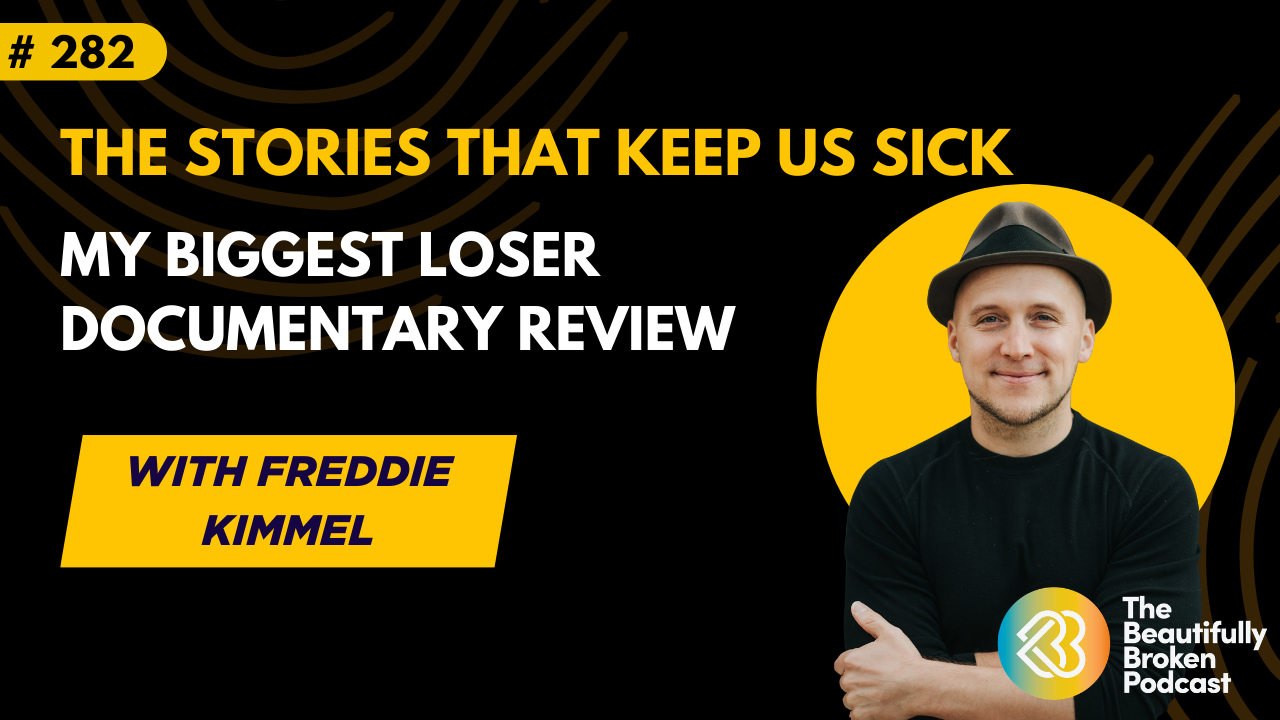
WELCOME TO EPISODE 282
In this solo episode of the Beautifully Broken Podcast, I share my reflections after watching the Netflix documentary about The Biggest Loser. The film examines the controversial reality show and the aftermath experienced by many of its contestants, including weight regain, emotional trauma, and criticism of the show’s methods.
But what struck me most wasn’t the production choices or the extreme weight loss protocols. It was the emotional stories that contestants continued to carry years later.
This episode explores the power of narrative: how the stories we attach to past experiences can either keep us stuck or push us toward transformation. I share a personal moment from my own health journey when a surgeon refused to operate on me, a moment that could have led to resentment but instead became a catalyst for radical ownership of my healing.
We also dive into the idea that environment informs biology, why extreme interventions rarely lead to lasting change, and how true transformation often requires deeper work around identity, self-love, and emotional healing.
Ultimately, this episode is about choosing a new story, and reclaiming the agency to write it yourself.


Episode Highlights
[01:02] – My reaction after watching The Biggest Loser: Fit for TV documentary on Netflix
[02:02] – How reality television shaped early entertainment in my life and community
[03:23] – The biggest insight: the stories we tell ourselves can trap us in emotional purgatory
[04:15] – Why holding onto resentment or past pain becomes a liability for growth
[05:50] – My personal story: the surgeon who refused to operate on my abdominal adhesions
[06:50] – The moment I chose radical ownership of my healing journey
[07:20] – Traveling across the country to pursue alternative healing methods
[09:12] – The powerful idea that environment informs biology
[10:24] – Why extreme weight loss interventions often lead to extreme rebound
[11:25] – What a healthier version of The Biggest Loser could look like today
[12:49] – The deeper work of transformation: self-love, identity, and emotional healing
[15:08] – Why real transformation is always an inside job
[16:30] – Addiction, dopamine, and choosing healthier outlets for reward
Links & Resources
The Biological Blueprint Program: https://www.beautifullybroken.world/
Get Silver Biotics: bit.ly/3JnxyDD
— 30% off with Code: BEAUTIFULLYBROKEN
StemRegen: stemregen.co/products/stemregen?_ef_transaction_id=&oid=1&affid=52
— Code: beautifullybroken
LightPathLED: https://lightpathled.pxf.io/c/3438432/2059835/25794
— Code: beautifullybroken
CONNECT WITH FREDDIE
Work with Me: https://www.beautifullybroken.world/biological-blueprint
Website and Store: (http://www.beautifullybroken.world)
Instagram: (https://www.instagram.com/freddie.kimmel
YouTube: https://www.youtube.com/@beautifullybrokenworld
FULL EPISODE INTERVIEW
EPISODE TRANSCRIPT
Freddie Kimmel (00:00.918)
Ladies and gentlemen, welcome to the Beautifully Broken Podcast. I'm gonna make this one short. This is gonna be one of my few documentary film reviews. I was sitting down with my partner last night and we watched the biggest loser documentary. I think it's called Fit for Television, or Fit for TV on Netflix. Excellent show in that I couldn't pull myself away. We both sort of sat on the edge of our...
on the edge of our seat watching with bated breath what was going to happen. My partner Cynthia, she'd never really watched the show. I had watched it. I was like, oh my goodness, babe, when we lived up in Harlem, this is 2004, 2005, didn't have a lot of money. You know, I was really that avatar of a starving actor. Reality television, it provided great, cheap entertainment. It was filled with lots of drama. You know, you name the show, that was kind of our binge at the time.
I remember the show very fondly just because it was something I shared with my community, my close friends, my roommates, something we talked about all the time. It really hit me. The documentaries push, and now this is what documentaries do, right? They push a narrative on an experience. They're storytellers. Like we are, I'll always say on this podcast, are, are, are, we are,
mortal beings with a knowing of our own mortality, filled with lots of anxiousness, so we create stories around experiences. And that's what we do as people. That's what people do when they get a topic as a documentary filmmaker. I want to bring a message about a subject or a story. But I could feel the lean in for the contestants on The Biggest Loser to feel sorry for them. There was a lot of time I felt on the camera, at least the way I viewed the film, that they were
put in the victim position, they were in hindsight, 2020 looking back through history, how they had been taken advantage of, how the show was harsh, how it was critical of their bodies, how they were, you know, the fat shamed, everything. Of course, people's experiences varied a little bit. There were definitely a couple of women that said Biggest Loser is the best thing that has ever happened to us. But for most of the people, you saw the contestants had not only
Freddie Kimmel (02:21.471)
had not only not maintained the wins of the show, meaning the weight loss, the dramatic weight loss that they experienced, but they had gained more weight back, and they were suffering even many times more than before. And my aha moment, I'll get to it at the top of the show, is that the stories we tell ourselves...
Freddie Kimmel (02:47.563)
They truly keep us tethered to an emotional purgatory in which we limit the growth in the human experience. And so to watch people sit and cry and lament and wish for a better past, it doesn't mean the show wasn't hard for them. It doesn't mean they weren't in some way taken advantage of.
But that story in which an experience in the past was still holding them down, I could feel that.
Freddie Kimmel (03:26.367)
I could feel it watching. I could feel it watching these human beings. And all I wanted to do was go in with a pair of ethereal scissors and cut that tether and change that story. Because nothing that happened 15 years ago, 20 years ago is real. None of it's happening today. And in the mind of that human being where you had a trainer like Bob Harper
or Jillian Michaels screaming your face and they belittled you and they berated you and you're still holding that hurt and you're holding that space of I am unable to forgive that person. What a liability in life.
Freddie Kimmel (04:15.691)
And I just thought about how many times we do that as human beings. So you can see this review really isn't about The Biggest Loser, fit for TV documentary. It's really about...
Freddie Kimmel (04:28.845)
I was just, I got a great gift from watching the show. I asked, I was asking myself all night long, I could barely sleep, I was like, where do I do that? Where do I hold on to a story that keeps me in an emotional state, spiraling with the inability to grow?
And we were sort of talking after the documentary, Amy and Cynthia, and she's like, do you think you do that anywhere? And I just, right away, I saw this scene where in the middle of, I would say, my lowest, like, rheumatoid arthritis, severe Lyme disease, going to the ER with abdominal adhesions, puking every three or four days for a night or two because I was having these partial obstructions. I sat down in Union Square and I begged a surgeon, I said,
You gotta, you gotta, you gotta open me up. You gotta clean up the scar tissue. What, what, what, what can we do as far as a surgical intervention? I'm in so much pain, my quality of life is terrible. And without a beat, he looked at me and he said, Freddy, I wouldn't touch you with a 10-foot pole. You're a liability. And that's all I could hear. He kept talking. I saw red. I was so angry. I started sweating. I had tears, you know, coming out of my eyes. I was so angry. And for a long time...
I don't even remember this doctor's name who I just had a consult with, this surgeon. I told a story to myself that what a bad man, what an unempathetic doctor, you know, this guy's, you know, that's malpractice, he wouldn't help me, he has to help me.
Thank God for that surgeon.
Freddie Kimmel (06:09.656)
He's the only reason that I am cured of any of the pain, chronic inflammatory bowel patterns, partial obstructions. He's the reason. Because in that moment, I walked out in a Union Square and I said, you know what, I'm gonna do this myself. And I flew across the country, I was in...
Southern California, I was in Florida, I was in Arizona, seeing people that were experts in visceral manipulation. They're doing long holds on scar tissue for abdominal adhesions. Even doing pelvic floor work. Work with, I know, work with the prostate. You know, things that just seem, listen, I knew nothing about the body, they seemed so fringe, but I was...
I was reading and listening to people write articles online about how they had reversed their adhesions. You know? And I did hundreds of hours of abdominal scar tissue work and used complementary tools like pulsed electromagnetic field to create blood flow in that scar tissue area and red light therapy, low level laser, low level LEDs. I could go on and on. The list is ridiculous. You, if you listen to the podcast, you know, some of the things I did.
but I reverse it, I healed. And I never would have done that had I not taken that moment to own and create my own narrative and take radical ownership of my health. That's really, that's the example. I understand that's not everybody's path. And we may find 20 surgeons where we just cry for six months or eight months and
you know, succumb to the reality of the decision and say, this is my reality. And what I did in that moment is I created a new reality. And I saw that moment for myself. was like, wow, that could have gone the other way. Or, or God forbid he did a surgery and then I was opened up to surgeries, you know, nine through 20. I don't know. You know, so I just had that. I was like, wow, wow. Do the stories we tell ourselves create a tether or a chain?
Freddie Kimmel (08:27.924)
the past. It's not unlike the story in A Christmas Carol in which Jacob Marley, I almost said Bob Marley, Jacob Marley is carrying around these chains, his sins and all the people he had wronged that he drags throughout eternity. Link by link and yard by yard. don't know, I don't remember the whole line, but that's something that, you know, near and dear to my heart. God, do I feel that.
And so I implore you to watch the documentary. See what it brings up for you. Now, what's really fascinating is weight loss. The conversation has changed. You know, we have one of the, again, most successful, highest revenue driving drugs ever to enter the marketplace in the GLP class of medications.
Freddie Kimmel (09:26.688)
It's too early to tell. quoted the figure at the beginning of the podcast. said, where, you know, 30 % of Americans were obese. Now we're up to creeping up to 40, 42 % now, 42 % of the country is, is, is obese. And time will tell. It looks like that is starting to curve.
Here are the things I want to comment on on weight loss and there's a couple more things in the documentary which I think are helpful from a philosophical angle that I pulled a lot of value from. Environment informs biology. So in The Biggest Loser, in which people are doing extreme weight loss endeavors, extreme caloric restriction, extreme exercise, hours and hours a day, you watch people dumping
50 to 59 percent of their body weight in months. Not normal.
Will there be a repercussion to that? Probably. You know, if we think about extreme actions, usually having an extreme rebound, that's generally the way this universe fluctuates from an energetic standpoint. So I just keep coming up with this, keep thinking of this phrase, environment informs biology. The reality was in the documentary, most of the contestants were...
just as obese or had more weight than when they started their show. And you took these people, you took them out of their fishbowl, you took them to a ranch, they went to a camp, changed the diet, changed their nutrition. Whether it was good or bad, we're not gonna talk about that, because that's black and white thinking. You can have your own opinions on that. But we put them back in the fishbowl. And then what happened?
Freddie Kimmel (11:16.64)
environment and form biology, they gain the weight back. And whether it was that emotional dynamic between a partner or it was the quality of life or it was the taxation of raising three kids and having a job and not having time to dedicate to the care of self, they're all valid, but they gain the weight back. And it reminds me of this thing, this idea of transformation, of the work of transformation.
You know, we talk a lot about, we talk about the book, Radical Remission, in which we look at all these late stage cancer, stage four cancers melting out of the body. You know, out of the nine or 10 things people changed, like two were associated with health. A lot of the changes were inner dialogue, belief in something bigger than yourself, you know, emotional self-love, a lot of these things. So in that terrain, in the transformational work,
There are so many inputs. And if you could redesign The Biggest Loser today, God would I love to be a part of that television show. Hollywood, NBC, I would love to be in the room. Because first of all, the show would take like a year or two years. But we would do this slow process of transformation. And I had so many, so many, so many ideas last night. I was like, just to be able to sit and work with
do some mirror work. What does that dialogue look when you talk to yourself in the mirror? What is the degree of self-love, acceptance, kindness, empathy, forgiveness that you can give other people that have hurt you? Yes, I would have all that work in my biggest loser. I would do education around finances and money and what is money. No more than a bridge to another experience, but a lot of times we directly correlate the amount of money we make
This is one of my tethers. We directly correlate the money we make to our self-worth, or for me, the ability to be a provider or a man. I feel so much better when I look at the end of the month and my LLC is net green. There's a change in my energy and my happiness when it's That's something for me to work on. But I would have that in the show's arc. I want to close this up.
Freddie Kimmel (13:41.242)
But a couple of the things, you I want to get into is, you know, I wish everybody had done the documentary. So you had the two star trainers, you had Bob Harper and Jillian Michaels, only Bob's in the documentary, who I absolutely loved and always resonated with him on the show. And I was like, I think we'd be buds. Jillian's not in the show. You know, as she self-stated and has in other interviews, she has made her life as a polarizing character.
The effort of the documentary is to paint, you know, this person good, this person bad, the producers is good or bad.
It was a reality television show and they were casting characters. It is theatrics. It's exactly what it was supposed to be. Or it wouldn't have met on for 12 years. It wouldn't have made hundreds of of dollars. It wouldn't have impacted so many people. We wouldn't be making, there wouldn't be a follow-up documentary. The only reason, and this is why I just want to think about the total arc of the story, the only reason it's happening is because it was what it was. And so now,
there is agency or avenue to comment on it. You know, again, now we can judge it as good or bad. Just very, very mind blowing to me. The other thing that I want to talk about is just like, there were a lot of things that they did right. You know, they had a medical doctor on Dr. Hazinga, who is a team doctor for the Oakland Raiders. And from my experience in the documentary was a great safety rail.
incorporated in which they were doing some things right. know? Having medical oversight on what the caloric burden should be. know, understanding like what happens when we put the body in a high workout stress environment. They actually had a really qualified medical doctor on the team. Yeah, I just thought it was fascinating. I would love your insights, really and truly. You know, I do podcast episodes. You guys know you can comment on YouTube.
Freddie Kimmel (15:44.088)
and you can comment on Spotify. can't comment on Apple, but you can leave a review and I'd love to know what your thoughts were on this one. Really and truly. I just, I just, I see such opportunity and growth and expansion and more and more I'm reminded it's an inside job.
that it's an inside job. That we, create this, I create the operating code to how my computer is performing. And so I thought this was a great opportunity to have a window into somebody else's life who has struggled with something, right? It could be drugs, could be alcohol, could be sex addiction, and this one, it's food. I don't think they're any different. And I think, and I, I've said this before, I think we're all addicts.
I am addicted to health. I'm addicted to dopamine. I'm a dopamine addict. You know, now I may get that through an ice bath and sauna contrast, but I'm an addict. So I guess it's choose your poison, but I would love your feedback. I love you guys so much. I hope this was inspiring to you. I hope you see opportunity for growth in this podcast.
I'm gonna drop this one in here just to close out. There's a couple ways you can support the platform. And one is to, you can go over to beautifullybroken.world and you can check out our new, we just dropped a five day kickoff for the blueprint. And you could do that for free. So for five days, you're gonna get emails on light, on breath, on lymphatics, on tools under $35 to amplify your sleep. You can read the email or you can scroll to the bottom and I will...
read it to you so you can do it in the gym. got your own private podcast. To go to the website, you'll get a pop-up you can join. And I also want to say just a big shout out to a few of our sponsors. Number one is Silver Biotics. Silver Biotics creating one of the most comprehensive lines of both immune support, skin health, and recovery on the market. They have the patented AG404 Silver Nano Particle, which amplifies all their products.
Freddie Kimmel (18:00.289)
I use their Recover Gel after the gym. It's phenomenal and on all my sore joints. It really does help. You could use code BEAUTIFULLYBROKEN in the checkout for a very generous discount. Next thing I want to mention is Light Path LED. It is the big red light panel. I stand in front of every single day when I do my morning emails and my morning breath work. Light amplifies everything. It helps to release nitric oxide from the cell. It activates an enzyme called cytochrome.
see oxidase. I think that's right. Don't burn me on the stake if I'm wrong. And basically what's happening is we're giving the body more energy so the body can self-correct. So we get better skin, fine lines and wrinkles are assisted, but more energy and also the release of nitric oxide for vasodilation. Everything just works a little better with red light. It works if you do it consistently. You can check out Light Path LED. You can use code beautifullybroken.
If you're looking for one panel that will kind of suit everything, I really like the Diesel XL on a rolling stand. You can get your full body in that seated on the floor. It absolutely works. And they got a five-year warranty. Love them. And the last thing that I want to mention is Stemregen. Now, Stemregen is a supplement that boosts your own stem cell activity. Two pills are said to boost 10 million stem cells. They've actually counted this in samples.
This is a supplement that I take. helps my body with repair mechanisms. But more importantly, I give it to my dog, Mr. Higgs, and I've given it to him for months and months and months and taken it away. This dog is bouncier and happier and skippier on stem regen. He gets one pill a day in his morning food, one pill a day at night, and pets do not have a placebo. It is a shocking difference. And this is a dog who does all the things. He does P.E.M.F., he does red light, and he does stem regen. That is his stack, and he does beam minerals. Also a phenomenal mineral supplement. We're gonna close it down. That's your 20 minutes. I love you guys so much. Have a beautiful day. Bye.