The Warrior's Journey: Casey West's Battle and Breakthroughs Against Glioblastoma Part 1
Jan 08, 2024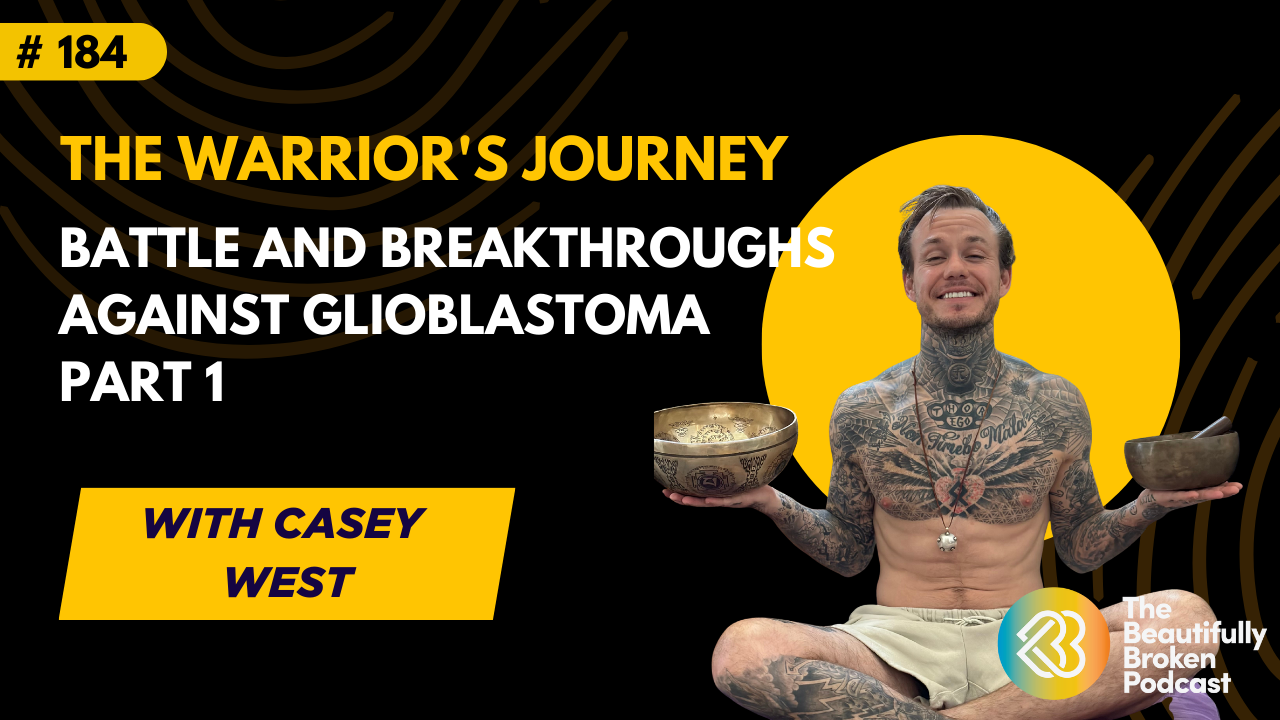
WELCOME TO EPISODE 184
In this podcast, Casey West shares his lifelong health struggles and his fight against glioblastoma. With an average life expectancy of 12-15 months for treated glioblastoma patients and only four months for those untreated, he discusses his decision to seek alternative treatments. This choice highlights the importance of understanding the root causes of his tumor to tailor a personalized treatment plan. Central to his healing journey are a ketogenic diet, fasting, and various supplements. The podcast also delves into the addition of new therapies to Casey's regimen, such as Methylene Blue and photodynamic therapy, while stressing the importance of balancing digital life with the benefits of frequency healing and mindfulness.
Casey West's story is one of heartfelt inspiration, and it has been my honor to help share his profound message and advocacy for the right to choose one’s health path and take radical ownership of one's well-being.


Episode Highlights Part 1:
[6:10] When was the first time he figured out that he should focus on his health?
[9:21] What does it take to "understand" yourself?
[14:39] How did things progress with Casey's health?
[17:14] Casey's process towards healing from surgery.
[29:27] Casey's battle with Glioblastoma and his healing methods.
[35:59] Branching out to Ketogenic Diets.
[38:47] Knowing what your body is going through is so important.
GUEST LINKS
Casey’s Instagram Account:
https://www.instagram.com/transmute_that_innerg/
The Metabolic Approach to Cancer: Integrating Deep Nutrition, the Ketogenic Diet, and Nontoxic Bio-Individualized Therapies by Jess Higgins Kelley and Nasha Winters: https://www.amazon.com/Metabolic-Approach-Cancer-Integrating-Bio-Individualized/dp/1603586865
UPGRADE YOUR WELLNESS
Silver Biotics Wound Healing Gel: https://bit.ly/3JnxyDD
Code: BEAUTIFULLYBROKEN
LightPathLED https://lightpathled.com/?afmc=BEAUTIFULLYBROKEN
Code: beautifullybroken
STEMREGEN: https://www.stemregen.co/products/stemregen/?afmc=beautifullybroken
Code: beautifullybroken
Flowpresso 3-in-1 technology: (https://calendly.com/freddiekimmel/flowpresso-one-on-one-discovery)
CONNECT WITH FREDDIE
Work with Me: https://www.beautifullybroken.world/biological-blueprint
Website and Store: (http://www.beautifullybroken.world)
Instagram: (https://www.instagram.com/beautifullybroken.world/)
YouTube: https://www.youtube.com/@freddiekimmel
FULL EPISODE INTERVIEW
EPISODE TRANSCRIPT
Casey West (00:00.46)
I'm already defying the odds. So, knowing how severe that diagnosis is and how grim that diagnosis is and how long you have to live, they don't give you very long. And if you do the standard of care options, everything goes right. You might get 12 months, six to 12 months, depending on where you look, they might say 12 to 16, but it's not very long. that's with the standard of care. tell you this is the only way that you can make it this long, but you're not gonna make it long at all is what they tell you.
They tell you that if you don't do it, if you go your other route, you won't make it three months. And that was so adamantly like right after the surgery. And by the way, right after the surgery, was walking around like my vision's back. I'm not hearing stuff. I'm not hallucinating anymore. And my life was great. I was like at an all time high. They're like, what is, what is this man doing? He's, I got in trouble for dancing around my room. You know, they're like, you need to get back in your bed. Like I was just, just.
Feeling incredible again, right after I had that tumor taken out, the inflammation was there like still from the surgery, but man, let me tell you, new world. I'm experiencing life without a headache for the first time. And as long as I can remember.
Freddie Kimmel (01:15.554)
Welcome to the Beautifully Broken podcast. I'm your host, Freddie Kimmel, and on the show we explore the survivor's journey, practitioners making a difference, and the therapeutic treatments and transformational technology that allow the body to heal itself. Witness the inspiration we gain by navigating the human experience with grace, humility, and a healthy dose of mistakes, because part of being human is being beautifully broken.
Freddie Kimmel (01:47.724)
Ladies and gentlemen, welcome to the Beautifully Broken Podcast. Sit down with Casey West and examine the wild ride that he has been through in his short life, from a troubled youth to the Marine Corps to a diagnosis of glioblastoma and all the medical misadventures you could possibly imagine. Sit tight, be with your heart, remove judgment, and just witness because we are so lucky.
in this day and age to have information shared this way. First hand from a survivor who is in it to win it. I celebrate Casey. I celebrate again, his story, his wife, his caretaker, his expanding family and the mission he is on to share the value of the body's ability to heal when given the proper signals. Let's jump in. Ladies and gentlemen,
Welcome to the beautifully broken podcast. We are here with Casey West. Welcome to the show, Casey.
It's great to be here, brother. Thank you.
Happy holidays, first off.
Casey West (02:58.326)
Yeah, right back at you. was really cool spending the first holiday with the newborn baby and the wife and cooking a good meal and just enjoying the life that we still have, man, showing gratitude. It's hard not to smile when you still got breath in your lungs and a good meal on your plate.
I mirror that. That is the most important thing. I have been waking up and starting a new morning routine, probably for two and a half months now where I've really been trying to get up at, I haven't been trying, I've been doing it. Getting up at dawn or pre-dawn and going for a little rucking walk with a vest. I will do a little breath work, get in the cold, do a little yoga. And I didn't do anything else until I've done that. And then usually there's a time when some gratitude stuff pours out of me. So I'll try to make a list.
And yesterday I was just so compelled. didn't make my list early. like halfway through the day, was like, Oh my God, I got it. I had to like go find a coffee shop to go sit down in. was like, I got to let it out of me. got, there's something bubbling up and there were some new things. There was really interesting, like just, you know, looking back on life, looking where I'm at now, it's really incredible. All the adventures, I would never wish it to be differently. I would never wish it to unfold different. It's, been so exciting. I don't know if you want to add anything on.
Yeah, I absolutely resonate with that brother. Every day, the rising routines are the most important to get the day started off right. And we all know that when you resonate with that gratitude and love frequency, and you can really pull in, you know, some sunrise and some meditation, some breath work. And then as you pull that in, and you can push out love and gratitude and, you know, activate that magnet and get the things that you most need in life.
I feel like for me, know, the sunrise, I get out there butt naked every morning, every rising, and get that sun on the full body and get that day going off right. And it's the best way to start the day to set yourself up for success. So absolutely can resonate with that.
Freddie Kimmel (05:01.836)
Yeah, it's cold in Texas today, right? Did you do that this morning?
Yeah, it was. It gets interesting when it gets a little colder. It's in the 30s, the low 30s. But it's beautiful. You see the deer out there prancing around, the wildlife waking up and the mist rising. it's good. You know, I get the chi moving around. And once that body is moving around, the energy is moving, that cold doesn't bother you. Grounded on the earth, connecting the circuit from father sky, mother earth, you know. So it's that cold only hits you for
a brief moment when you first step out.
Yeah. Casey, you know, one of the reasons you're on the podcast is because I have always, it had been in the roadmap to include survivor stories and people who had been through incredible realms of adversity. They'd walk through the valley of death and come out the other side with a new view on life. And that is, that is certainly you.
If you were to start us out in your story when you first had, maybe when you first didn't have access to robust health, when was that for you in your life? When was the first time you realized, this is something I need to focus on.
Casey West (06:10.414)
So I would say, you know, at the very beginning of my life, I was always kind of dealing with some issues, migraines at a very young age. And so that kind of, I've always been used to a level of pain, always been used to a level of discomfort in my life. So fast forward, get to the Marine Corps, get through all of that. And post Marine Corps, the health started to deteriorate. I had a false sense of what health was.
you know, working out very hard all the time, you know, having my protein shakes and all these things, like thinking that that was health and like, look good in the mirror, so I must, you know, must be healthy, but not really having a fully understanding on what health was at the time. Around 2014, I was already feeling the effects. The job I had in the Marine Corps, I was a helicopter gunner and an aircraft, helicopter mechanic. So I was getting exposed to a lot of
toxic things, radiation in the helicopter that was just blasting me on my flights the whole time I was there from those different systems we used. So didn't feel the effects necessarily right away, but 2014, 2015, I was in the emergency room pretty frequently. had, you know, things I couldn't explain like stomach stuff, brain stuff, and I just didn't really know what I was doing. So in and out of the VA system trying to get the help that I needed, and I'm not gonna
fast, the VA, like, you you hear a lot, but you know, they do, it's the system. It is what it is. And it really up to us to get our health on track. So years of doing that, getting nowhere. I'd say 2017, the hallucinations started the auditory, the visual hallucinations, the memory was like confabulatory in nature. was imagining things that weren't happening. And this was going on for years. And fast forward.
I met my wife 2019 and that woman for sure like saved my life. Like at the beginning of our relationship, I was knocking on death's door. I had really severe stomach issues. I had problems in my colon. I had a prolapse. Like it was rough. And the VA was telling me that there was nothing going on. So that's kind of where it started. 2019 is right when I started to take the next step into...
Casey West (08:35.424)
healing and figuring out my health and my wife was a huge huge component to that jump off point, you know, so after relying on doctors and the system to try to help me, I realized that I was getting nowhere. So I would say 2019 was the jump off point for me is when I started to shift and focus on my health and change everything up.
Yeah, you said really interesting. I love the word you said. never had an, I didn't have a strong inner standing. I don't know if you meant to say understanding, but I like that. was like, Oh, I, an inner standing of my health. I'm going to keep that one.
Yes. So just to elaborate for, you know, the listeners or anyone that that might not really know where I'm coming from. So we have an understanding, right? And that means that you're underneath whatever your focus is. You don't have a full grasp on what your focus is. So when I say understanding, I'm very intentional with my words. What we speak into existence is very powerful. So when you say an inner standing, I understand with my entire being what I'm saying, like
to fully understand that, to go through that experience, you have to really go through that yourself to have that understanding, that inner wisdom of whatever you're going through. So that's, when I say understanding, it's for sure on purpose. And I might say overstanding sometimes, but definitely a purpose behind the understanding phrase.
Yeah. You had also said that you had always been dealing with some level of pain. was something you were used to. Tell me more about that. Because that sounds like a heavy weight to carry from a young age.
Casey West (10:10.254)
So I started having migraines, like pretty severe migraines, loss of vision, know, the really bad swelling of the brain. And unfortunately, I didn't have a mother who brought me to a hospital to get a brain scan. My mother was fully treat the symptoms. So she was giving me her medications to treat my symptoms at, you know, three years old, four years old. And the trauma that came along with that, you know what I mean? Being forced into...
being treated by my mother ways that weren't exactly very pleasant. So the pain that I was going through physical was also very internal as a child because I had no idea what was going on with me and there was never any answers. So it started at a young age of me just questioning what's happening to me. Why is it just me? You know, was in the school clinic, you know, in elementary school and they were like, this guy's gotta be faking it, but I don't know how he's throwing up all the time. He's in here like every other day. So there was something
that was going on and I'm not sure, you know, like, I don't know how much we would get into this kind of stuff, but I had a pretty abusive childhood. So I'm not sure if it was, you know, I had a cyst when the first tumor was taken out, there was a cyst up there. So I'm not sure how long that cyst was actually up there. It was from getting beat upside the head or something like that. But the pain started at such a young age. And I just count that as a blessing, brother, because if I didn't know so much pain,
for so long. I don't know how I would be able to survive and like still meet, meet it every day with such a smile on my face and like so much gratitude for how good things are. that pain was, it was confusing as a child and I was definitely the only one my age going through such severe pain. So it was kind of a hard thing to deal with for sure.
It's really interesting to hear you to speak these words and to tell this as a, you know, your lived experience. And I remember high school, you know, high school was, it was funny. I'm sure everybody has such a different story or they created such a different story with their school. But you know, mine was pretty easy. I had a great, very loving family and I just can only imagine. I can only imagine what.
Freddie Kimmel (12:22.41)
the vast spectrum of different experiences kids had at home. That was something that I never would have ever taken into account as a child. I wouldn't have empathy for whether another kid might be showing up and presenting with bad behavior. That wasn't in the lexicon of my being. to imagine, now going back, like, I wonder if that's why Jason was like, I wonder if that's why he walked into school and was just push and beat up other kids. He was probably hurting. We can kind of almost like
celestial map like stars all over the way and different kids are showing up in school and it's very much like you're bad you're good you're you do excellent in school you're gonna go we're gonna put you in another classroom because you are non-conforming and and it's all about trying to get you back into the good but not really be seen or heard so man what a unique perspective incredible
Yeah, yeah, that was a, you know, I was the bad boy growing up and not because like I wanted to prove anything to anybody, but, you know, just the upbringing I had, you know, the what you're saying, I think back on that often, like, I wonder what my friends or what the outsiders thought about me, you know, because I was never really understood. And now as an adult, I've had conversations, you know, with some of my friends recently in the last year, which has been really cool.
to hear their perspectives on me because I never thought about what someone else may think of me. I was surviving. I was, you know, working two jobs. I was helping raise my nephews. I was in and out of sleeping on my friends' couches. You know, I was kicked out of my home early and, you know, living with this person, that person. you know, so I didn't respond to the outside universe, you know, outside world with love and gratitude that I have now. I was an angry kid. So you think about like what you're saying on what
the experiences are and I've reflected on that as well on myself and others and it's an interesting perspective to have now for sure.
Freddie Kimmel (14:22.284)
Yeah, it really is. And so if you couldn't walk us, where did things to, how did they progress with your health? Because I know you have quite a story.
Yeah, so 2019, things really started to progress. I I've lived a crazy life, man. Marine Corps, motorcycle stuff, drinking, partying. That was my escape. I was the escapist, the escape artist, the Houdini of trauma. Avoid it, slide it aside, find a way to get around that trauma without having to deal with the trauma. So all of that.
energy, all that trauma stored in my body mixed in with all the toxic exposure, mixed in with years of eating wrong and you know just all these things came started to come to a head. In 2019, I had to have a surgery, an abdominal surgery. I was passing out in pain. I had a stricture in my colon, my sigmoid colon, just from you know just not knowing how to
to really be healthy and making a lot of poor choices. But I really couldn't take care of myself at that time. Like I said, I was hallucinating. I was really just in a bad place mentally, physically, just spiritually. That didn't exist yet. I was so in my masculine energy at that time. I had no feminine side to think of spirituality. so, was just bulldozing everything. And you know how that goes. So 2019.
had the abdominal surgery, had to go to the hospital. The VA missed a prolapse, which I'm gonna be honest with you, man. It was pretty obvious I had a prolapse. So to go into the VA, get a colonoscopy after colonoscopy, and then they're telling me there's nothing wrong. And it's like, guys, there's something going on. I couldn't eat anything without throwing up. I would throw everything up. And if I was able to have a bowel movement, it was rough. It was...
Casey West (16:24.118)
really just a lot of blood, a lot of pain. And so went outside. Like I said, my wife comes in, she's like, Casey, we need to get you outside to go see a specialist. Immediately the specialist was like, bro, no, sir, you have something on for sure. And we need to get you a surgery pretty quickly to fix this. So the doctor saw that I had a stricture and the prolapse was pretty severe. So
I had a surgery rather quickly to repair that. And that was the first of the few surgeries to come. So healing from that was really rough. Didn't really know how to heal from that. I was on my own. My wife's Australian, so she's back and forth from Australia to America. So the healing process was very rough. I tried to escape the hospital.
24 hours after the surgery because I don't do well with being confined and Just the things I've been through so I made a daring escape from the hospital 24 hours after surgery like a roof made a diversion ran down the stairs escaped It was like 120 degrees outside in the summer in Houston Doctor found me passed out on the sidewalk so this is like the
why I've had so much trouble getting to a hospital is because I've already been through so much trauma with my health and with my childhood. so yeah, that was the interesting, that was the first part of my journey was getting my stomach fixed so I could live essentially, because it was getting to the point where a month later I was lost. I lost about 50 pounds. was about 220 pounds of muscle and inflammation. I wasn't healthy, but I was really muscular and
Over the course of a few years, I had lost like 50 pounds. So when I went in, it got the surgery, was about 180 pounds. so I was deteriorating rather quickly. And that surgery definitely helped get me on the right track again.
Freddie Kimmel (18:27.456)
That is incredible. Keep walking us there. I'm holding space for you to be able to tell this. I know it's a lot.
Okay, so as I go into this, the wife and me, she moved to America, left everyone behind in Australia for me. A really good woman loves me, obviously, to leave everything behind. And she knew that I needed some help. And the universe brings you what you need. And she was what I needed. She's still what I need, but she was what I needed to get my health going. So after the stomach stuff, her and I got to start running a house together in North Houston in the woodlands.
They have a pretty good healing community in there. So just getting my health on track. got, I went vegan for a little while because I really needed to clear the body out. really wanted to get more in touch with my spiritual side. So we were really just enjoying life. know, 2020 was going on. And for me, like a, you know, veteran that doesn't like to be around, didn't like to be around a whole lot of people at the time, man, it was a ghost town. Everybody's in their house and COVID's going on.
Me and my wife are living our best lives. We're going to stores, we're going out, we're having fun, we're spending all day like in the house just playing games and you know, set our house up like a little jungle gym for adults, you know, while the whole COVID thing was going on. But there was something not right. Like I was still, mental health wasn't right. The hallucinations aren't normal. The auditory stuff's not normal. Me feeling like I was having low blood sugar.
on the regular feeling like this drop in blood sugar and like passing out nearly and like the wife having to rush glucose tablets in my mouth like, you know, but I didn't know what was going on with me. Like there was no answers. I was trying to get help. And at this point I was like done with hospitals. Like I'm done with the VA. You know, I'm not going to go back and, deal with them. Like I'll figure it out. And the headaches were every day. The headaches were every day and
Casey West (20:30.838)
It just kind of progressed and we moved to Northern Texas to get away from the city to get out in the country. thought mental health, I need to be out in the country. I need to go get some land and we can build a house. So that's what we did. Me and the wife went out and bought a bunch of land in North Texas and just west of Fort Worth and beautiful, beautiful spot back in the woods. How it all happened, the universe does its thing, right?
The day me and the wife got married, the house flooded. We went to an Airbnb in North Texas and they were like, hey, where my parents are selling our land back here. We're like, dude, we want it. So, you know, these things are coming to play and coming together. But I was still so sick and building the house was stressful and, you know, the depression and like the suicidal stuff because, you know, the brain was just doing weird things and.
the visuals and the auditory stuff was at an all time high. And this started in 2017. Now we're at 2021, about to come into 2022 and things are not good for me. And if you know, like veterans are on the holidays and like mental health stuff. Now fast forward until the point where every single day the migraines are so bad. Go to a chiropractor,
try to figure out what's going on, go to this doctor, go to do this. And no one had any answers for me. They just kept taking my money. And they're like, oh yeah, eye doctor, get some glasses, chiropractor, I'm gonna do this, buy all my fancy stuff. And then this other doctor, this, and none of that changed anything. In fact, the chiropractor, I have a stress fracture or a compound fracture, mean, depression fracture, excuse me, from flying. And so she was like, that's definitely it. So she goes in there and just makes it way worse. And I'm like, okay, like I need to just,
take a step back. So I stopped going out in town because I couldn't drive anymore. couldn't, I was losing my vision. I was on the road and like, I literally was starting to go blind as I'm driving. was seeing these audit visual things and none of it made sense. And I was Google searching this and like, Oh, it could be this. It could be that. It could be that. And none of these doctors like, bro, go get a brain scan, you know, go and get a brain scan, see what's going on. suggested that. Finally,
Casey West (22:55.316)
After like years of not being, I mean, the migraines are so bad, dude. I was crying 24 seven. I would wake up, I would be crying. And like, I'm not some like hard, you know, hard dude. Like I'm very much in touch with my soft side now. So it's not like I was trying to be tough and I was in so much pain and my pain tolerance is so high. I knew I was dying. Like Freddie, I knew I was dying. I was leaving voicemails on people's phones, sending video messages to my twin brother.
my family like, don't delete this. I might not be here next year. You never know. Like, but seriously, just don't delete it. And I got new something intuitively, something wasn't right. And my wife was watching me suffer. She was doing everything she could like massaging my head. got all the things right. I got all these little devices to help with the pain. And, the VA was giving me like the TBI stuff, you know, the TBI is I have, they were trying to give me this pill and that pill and the most effective migraine medicine and nothing helped. My wife knew.
something was up and I just, you know, I refused to go to the hospital, man. I refused to go because of my experiences. And January 23rd, 2022, I went to an emergency room. My wife talked her friend into coming over and she brought me to the emergency room and I went and got a brain scan. And that's the day that they told me, hey man, there's a mass in your head. There's a huge mass in your head, dude.
And we got to send you to hospital immediately. There's no going home. Like you got to go and emergency surgery is going to happen. And I sat there, just pause right here, right? Get that news. Like when you get bad news like that, when you know something's up, the first thing that came to my mind was like, my wife, I can't leave, man. I got stuff I got to do. I got a wife at home and she needs me. So I wasn't scared. I wasn't afraid. There was no tear shed. It was like, okay, let's get up there. Let's go figure out what's going on. And
January 26th, I had a resection of a glioblastoma tumor. It was huge. The cavity in my head was huge and the tumor, think, I believe the doctor said it was the size of a lacrosse ball. I can't remember the size in centimeters, you know, how big it was around, but the cavity in my brain was pretty large and the amount of pressure in there. So yeah, I don't know if we need to stop there and if you have any questions, but
Casey West (25:20.984)
That was when I had the surgery, January 26th, the culmination of all this stuff. Boom, here we're at. That's where it hit.
Yeah, I'm teary eyed because I'm just, it's, I'm mentally with you where you're at and that man, just for you to go so long without being seen or being validated in your experience, it was in pain. It's so upsetting. I have a lot of anger around that for you and I'm sure you have processed that. Ladies and gentlemen, biologicalmedicine.org. Don't go there yet. I have a question for you. Are you tired?
standing around in this deep knowing that our healthcare system is broken but we never do anything about it. Well, biological medicine for practitioners is the ultimate hybrid online and in-person certification course designed to help you integrate biological medicine or biomed into your practice. So unlike traditional medicine that often focuses on treating symptoms, biomed treats the whole body, addressing root cause of illness through
pillars that is detoxification and drainage, nutrition, and immune building. This approach is truly patient centered and yields exceptional results. So in this comprehensive course, you will apply foundational knowledge and hands on experience with the latest diagnostic technologies and therapies, including bioelectrical impedance analysis, heart rate variability testing,
pulse electromagnetic field. know this sounds like it was created just for Freddie, but this is your chance to become a pioneer in the field of biomed. This is for healthcare and wellness professionals all the way from doctors to personal trainers. I want you to go to biologicalmedicine.org and look for the enroll now button. And if you use code beautifullybroken, you'll receive the intro to biological medicine for free. That's a $200.
Freddie Kimmel (27:22.594)
value. Friends, let's go do this. This is our time to seize the day. Join the biomed and help create a real paradigm shift and the way we deliver results for our patients. Let's do this.
So you went in, you were diagnosed with glioblastoma and glioblastoma, can you tell the audience from your knowledge and experience that type of brain cancer? My grandmother actually had glioblastoma and passed away. It's very much like there is, from my understanding, there's a primary mass. really? wow. Yeah, love my grandma Peters, Leona Peters. She was magical and it was so heart wrenching, but this tumor had basically like spider webs.
Mine too, brother. Yeah.
Freddie Kimmel (28:11.938)
you know, throughout the brain. there was a mass and then there was a lot of other stuff weaving in and out the cortex.
Yes. So just to speak on validation before I go into the glioblastoma, I had spent around eight years, eight years, Freddy, with certain issues. And it's not to say obviously glioblastoma doesn't happen overnight. It progresses. And sometimes it takes a cancer cell 10 years to turn into. And this is something that doctors don't want to accept sometimes. Some doctors are more hip on this stuff. Some doctors don't want to accept any fault.
So there's legal stuff that goes with it. it's like they'll deny the fact that this is even a possibility. But I've been dealing with a cyst in my head. Like the tumor grew off the cyst. So validation, I had an answer. Dude, you're not crazy. Brother, you're not insane. You're not hearing stuff. Like you don't have schizophrenia. And that's a whole nother thing. The VA put me on all this medication for schizophrenia for this, for that.
And I was killing myself with all these different medications, Freddy. was on 14 different medications at once. Psych stuff, body stuff, and they were treating the wrong thing the whole time. So the destruction of my body was well underway from bad diagnosis. So glioblastoma, that's a hellacious diagnosis. You talk to people that get diagnosed with glioblastoma, the tumor creates its own blood supply. And that's what makes it so dangerous. It can feed its own self. And if you don't know like,
hey man sugar your glucose is feeding the tumor hey man fermented protein and glucose feed the tumor like you're gonna keep feeding it it's gonna grow in a rapid pace like it's just crazy so most people when they say hey you got this diagnosis it's like hey say your goodbyes get your affairs in order you got three months to live and that was that was what i was told so my grandma much like yours diagnosed with glioblastoma three weeks
Casey West (30:10.926)
I can't imagine what it was because it was a while ago. And like I said, my memory is shoddy, but she was around like less than three months after her diagnosis. There was nothing to do for her. so glioblastoma is one of the, if not like the main killer brain surgery, mean brain tumors, the survival rate is shit, brother. you, I'm already defying the odds. So knowing how severe that diagnosis is and how grim.
that diagnosis is and how long you have to live. They don't give you very long. And if you, if you do the standard of care options, everything goes right. You might get 12 months, six to 12 months, you know, depending on where you look, they might say 12 to 16, but it's not very long. And that's with the standard of care. They tell you, this is the only way that you can make it this long, but you're not going to make it long at all is what they tell you. And they tell you that if you don't do it, if you go your other route,
you won't make it three months. And that was so adamantly like right after the surgery. And by the way, right after the surgery, was walking around like my vision's back. I'm not hearing stuff. I'm not hallucinating anymore. And my life was great. I was like at an all time high. They're like, what is this man doing? I got in trouble for dancing around my room. They're like, you need to get back in your bed. Like I was just feeling incredible again. Right after I had that tumor taken out, the inflammation was there like.
still from the surgery, but man, let me tell you, new world. I'm experiencing life without a headache for the first time and as long as I can remember. So oncologist walks in 24 hours after surgery, oncologist walks in, says, you know, we did the pathology and you know, it's glioblastoma, you know, or I can't remember exactly when the diagnosis came through, but he knew it was, he knew what it was before they could tell me. They had to wait for the
pathologist to come back, but they looked at the tumor and they knew what that was. hey, you know, what's, what's, what's your, what are you looking at? You know, I'm not going to throw any names out there because I don't want to, you know, make anyone look bad. Oncologists have their vested interest in getting you on chemotherapy because they make money off chemotherapy and not to say that every oncologist is out there for the money, but you just to put that out there, this is a fact. And he comes in there and tells me,
Casey West (32:36.426)
If I were his son, he would start me on right radiation right away. And I laughed. Like I kind of laughed in his face and not to be disrespectful, but it's like, you don't even know me. You haven't looked at my genetic testing. Like you haven't looked at anything and you want to send me right to do radiation. It's like, dude, I've, I've been in really rough situations for my cell health, you know, for the longevity of my cells, I've been destroying them. So going into radiation for me didn't seem like a
viable option and then chemo like dude, that's gonna kill me. Like you don't know what I've been through, but you're gonna be without doing any testing, you're gonna go send me to do this right away out the gate red flags. Not gonna buy that dude. I've dodged RPGs, machine gun fire, knives. I've dodged bullets for a long portion of my life. Three months to live, dude, I had seconds or split second back there not too long ago. So this is like a world.
This is an entire lifetime for me to figure out what I'm going to do. So there was no fear. There was no fear involved in my decision. It was the path less traveled is the one that's well known for me. So let's figure this out. And that's when we jumped into the research that's we saw a neuro-oncologist. We saw our oncologist. They told us all these things that what we want to do is not going to work. This research that's out there is it's just anecdotal. It doesn't mean anything. It's like, okay, guys.
I appreciate your time. I'm not going to waste any more of mine by being told you're a wizard, dude. You're casting spells on me. And I'm not going to accept that deflection. Time to do my research and continue to do what I've always done, which is go against the grain and not always to my advantage. But this time it was. So that's what we did. So this is where I'm at post first surgery. My wife just started researching 24 seven, just put her whole life's energy into figuring out.
another way. And that's where we started, right there.
Freddie Kimmel (34:39.595)
Wow. That's an incredible story, Casey. I really, for you to be able to be in that incredibly traumatic moment, and of course your history informed this, to be able to draw from your experience that yeah, there were split seconds in which you had dodged death, multiple, multiple times it sounds like. And for you to be able to use that perspective and know that you wanted to do a different, that was incredibly brave.
I know people could be like, that's stupid. But I just think it's incredibly brave to just be able to use your life experience in an instant. Because a lot of times I find where we are, you know, we're scared into treatment, we're pressured, we're shamed into treatment. I've heard many, many survivors have told me that when they were faced with their protocols, that they were told that they were idiots for wanting to explore something, not alternative always, but even complimentary.
So where did you go from there? When you guys started to feel like you had enough anecdotal research that you felt confident, you wanted to try something else. What was the something else? What did you want to try?
So I think that the research was so transparent. Like, let's break this down, right? At the very basic level, this is where we started our research. after this second brain surgery, I shifted my research and we'll get to that. But at first, how do we feed tumors, right? How do we starve a tumor, but what does a tumor feed off of? And that was the very beginning of the research, ketogenic diet.
right onto a ketogenic diet, starve it, get rid of the sugar, lessen your carbs because that's for sure the first line of defense is your metabolic approach. In doing that, we found the book, The Metabolic Approach to Cancer, which led us into this and that and this and like, so we got on with naturopathic oncologists and started getting my blood work and started getting all the testing done. And this is the thing guys.
Casey West (36:46.2)
When you get a diagnosis and you go do chemo and radiation, that's all great, right? You can get rid of the tumor and you do all this stuff, but you haven't figured out the root cause of why the tumor came about in the first place. What is it in your body that's failing you that is allowing the tumor to grow? Or what are you doing to your body that is causing the tumor to grow? Because not everybody has the genetic mutations I have. Not everybody has.
the DNA repair issues, the methylation issues that I have in my cells. that's, know, I'm genetically predisposed to these things based off the testing that I've done and heavy metal toxin screenings. Your boy's just riddled with uranium because what I did in the Marine Corps, not only was I flying in the helicopters and getting blasted by the systems on there, the FLIR system, which was just...
Standing more than in an x-ray for 18 hours a day when I was flying sometimes a little less sometimes more but so I'm huffing uranium when I'm working on the components So now I have a uranium component, right and that's affecting my homocysteines my ability my cell health my mitochondrial function is at a severe deficit because I have so much uranium in my bones and it's sucking out my nutrients my magnesium and so how am I even so this goes on right, but you have to test so
Heavy metals was a big one. Mycotoxins, your mold, your environmental toxins, your JP, your fuels that you're around. And like, because I was flying in helicopters, was around JP-5, JP-8 and you know, not to mention all the stuff I was doing, I wasn't wearing proper protection equipment. Like they tell you, where are your PPE? Look, we're Marines, man. Like we just don't do that stuff. And not to say that any other branch is different, but Marines especially, we're knuckleheads, man. Like I wasn't worried about what's happening to me today.
I wasn't worried about 10, 12 years from now. I'm ready to fight right now. So whatever I have to do to get this job done, we'll worry about that later and that later hit, but not too long after. So knowing what my body is going through was so important. So I went through all that, knowing your blood work, doing your regular blood work and not just allowing your doctor to tell you, Hey, this is what your panel looks like. No, dude, there's so many other levels to your blood work that you can start to learn. Go buy a book.
Casey West (39:06.306)
I tell everybody go buy a book, go do some research, get a PubMed article up. So testing, test on guess, that's like our saying in the household. If you feel something, go get a test done, go see what your blood work looks like, go look at your inflammation markers, your ferritin levels, all these things. And I was starting to learn and me and my wife are very, I'm not gonna say I'm smart. The more I learned, the less I know, honestly, but.
I'm a research kid, I'm a Gemini dude, so give me all the stuff, man. I wanna learn everything I can. And my wife is a powerhouse, very smart, very good at research. And she was teaching me along the way, like how to find the answers and where to look. And so that's where it all started, just diving deep into the research, getting the diet, ketogenic diet. First thing to do, I would tell everybody out there, you need to understand how cancer grows, what feeds cancer, the fermentation of glucose.
and amino acids, you need to understand that, understand that. And once you move forward with that, your diet, tailor your diet to the cancer you have, not all cancers, you you can do raw vegan diet for some things and certain cancers, but for glioblastoma, you have to be really careful on your sugar intake, your glucose, it's so important. So that's the number one thing. Second thing, all the testing and stuff, getting the supplements, you know, and I'll touch on the supplement thing later.
Most important part, we started off metabolically and getting with the naturopathic oncologists, finding all of the off-label drugs that were going to do far less damage, low toxic profiles. What are the things that we were doing? So I was using synergistic stuff like low dose naltrexone and mixing that with ketamine therapy because there's a synergistic effect. And if you do the studies, it slows the growth and
lessons of growth of a glioblastoma tumor. then you can look at like certain things like melatonin on a daily basis to help with radiation exposure. You have your cell phone and like part of what we do, Freddie, we have to share our story, right? So we put ourselves at a cellular disadvantage on a daily basis by trying to share and our, my cells, because I already have those issues. So we have to figure out how to bolster our cell strength as we're going to do this. And, that's a, that's a big thing. So
Casey West (41:28.768)
really getting through the supplements and how you can help yourself. But just to caveat off of this supplement thing, your cells need to be able to absorb the supplements that you're taking. So you can throw everything in the kitchen sink at your cell supplement wise, but there's only so much that that cell can take in. So just, I want to throw that out there so I don't forget just to remember like, you may not want to take 15 different supplements. Find your top 10.
and separate them throughout the day. Take your ones in the rising that are gonna help with your sugar levels. Like berberine is another thing that helps with sugar and benadine, which is oxaloacetate, which helps with the breakdown of carbs. And I believe it's the Krebs cycle. So knowing how to really get in there and prevent more glucose from being made in the body from the breakdown of carbs. And these are the things that we started to do at the very beginning.
throughout that first year. mean, Freddie, I made it from January till May 18th till my next resection. And the growth was very slow. And it goes to show you like how important that these things are when you're really going against glioblastoma. Those things alone and like your RSO oils really help if you do heavy cycle of RSO oils, those are really good for brain tumors.
One thing to keep in mind guys is that you have to get all this stuff through the blood brain barrier. It has to go through so you can work on your blood, right? Get your glucose levels down, do your fasting, which is a big part. Fasting is huge, right? In order to get these cells out of the body, these damaged cells or get the cells repaired that you need, you need to fast guys. And if not fasting on fruit juices for five days, I mean like,
Get your minerals in you, do a three day water fast. And it's not easy. You have to work your way up to it. Try 24 hour, do intermittent fasting first, right? Your 16, 18 hour windows of fasting and then, you know, eat your food and that leftover window and then go once a month. If you're a male, you know, work with the moon cycles. A male's energy is the highest on the new moon. A female's energy is the highest on the full moon. So if you're going to go without eating, you want your energy to be at your highest. So I...
Casey West (43:54.678)
We'll go at the new moon cycle and I'll fast for three days. And look guys, I won't always make it three days, sometimes really freaking hard and sometimes I'll make it five days. But you get through that and your cells are repairing themselves. There's nothing left to digest. You spend so much time digesting all this tasty food that we have available to us, right? We're not used to eating three meals a day. We didn't come from an ancestral lineage where we're eating three meals a day. Like this is the new thing. then, you know, so fasting is huge.
I would say that that for sure slow the growth probably more than anything else. then, you know, knowing how to go into your fast, knowing how to come off your fast, breaking your fast, very important things to know.
Ladies and gentlemen, let's take a break from the show and allow me to get up on a soapbox. I want to spotlight silver antibiotics, wound gel. This is a product that is an antimicrobial layer that helps with cuts, lacerations, skin irritation and first and second degree burns. So it utilizes silver sol technology, which we've talked about. This is the ability
to steal electrons from pathogens, it more effective in the body. So the company has substantiated its claims with 420 independent studies, as well as 60 patents pending on this groundbreaking tech. So I endorse it because it works, but also due to the extensive research and scientific validation the company has done. So in an independent in vitro report, this is very important, paired
armor gel to seven other similar skin care products such as triple antibiotic ointment, the standard of care. The study focused on the kill rate for MRSA, VRE, E. coli pathogens responsible for severe emergency room infections. Within a four hour window, armor gel completely neutralized the pathogens. And this was a feat that was unmatched by any other product in the study. So the silver biotics wound gel
Freddie Kimmel (45:59.19)
stands out not only for its performance, but actually its price point. So this is a must have for moms, for coaches, nurses, doctors, anybody concerned about the body's largest organ, the skin. And in today's environment, I just saw a fact where MRSA infections are up 35 % since 2020. This is crucial. So we just need to be prepared. Don't wait for an emergency room trip. This is something to have in your cupboard. It's under $20 and you get
30 % off using the code beautifully broken at checkout. This company is giving this to you at cost by using this code and they are not only a sponsor of the podcast, but they are friends and I support what they're doing in the world.
Freddie Kimmel (46:48.706)
Ladies and gentlemen, thank you for tuning in. If you enjoyed today's show, head over to Apple podcasts or Spotify and please leave us a review. Five stars if you loved it. And before you leave, there is one big way you can continue the learning and the deepening of this relationship we started in this very episode. You can go to beautifullybroken.world and check out our brand new website store.
Listed are all the wellness technologies, the supplements, the educational courses that I love and I personally use. Most of them offer significant discounts just by using the link or the discount code, which is normally beautifully broken. And they do support the podcast through affiliations. Now we have a brand new feature. If you want to see the beautiful faces of our guests and watch me unbox and review products,
you can head over to our new YouTube channel, Beautifully Broken World. I do have to tell you our OnlyFans page is under construction, so stand by for that. This last announcement is from the team of internet lawyers. The information on this podcast is for educational purposes only. By listening, you agree not to use the information found here as medical advice to treat any medical condition in yourself or others, and you're always going to consult
your physician for any medical issues that you may be having. My closing, the world is shifting. We need you at your very best. So please take the steps to always be upgrading. Remember, while life can be painful, putting the pieces back together is a beautiful process. I love you. I'm your host, Freddie Kimmel. Big love.