Thyroid Health, Hashimoto's & Mineral Balancing for Women's Hormones with Sophie Shepherd — She Talks Health
Aug 24, 2026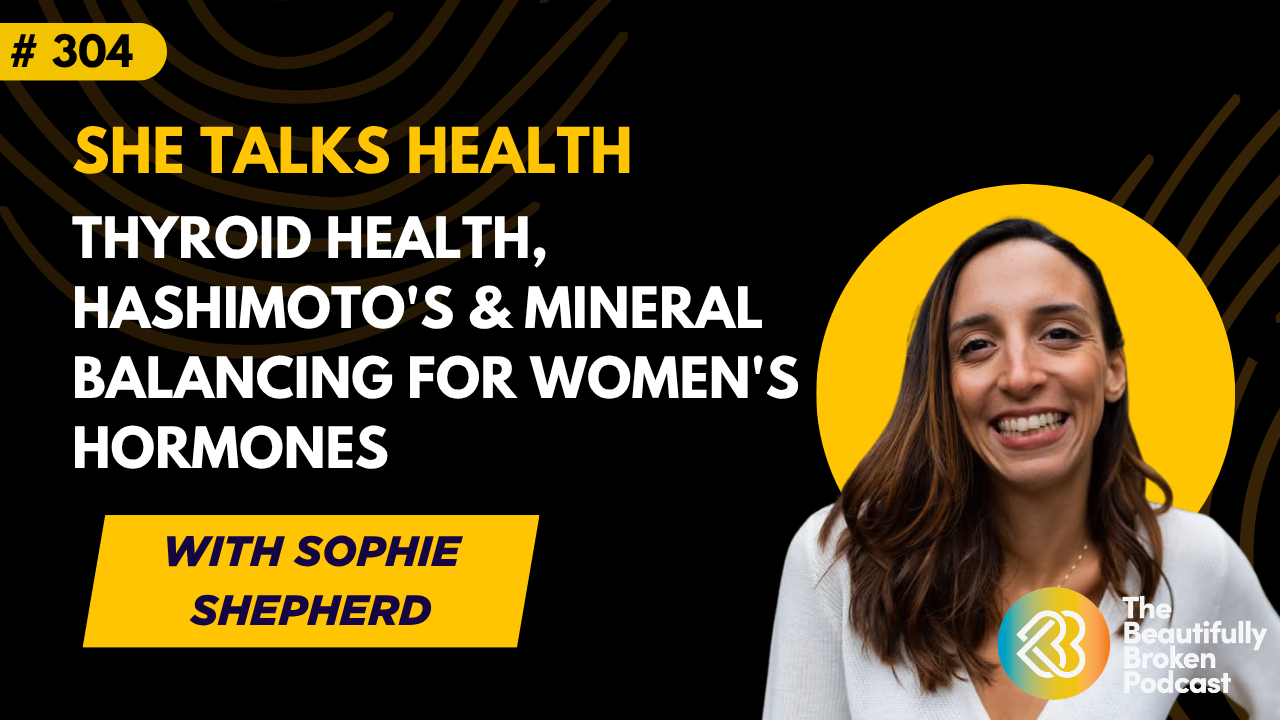
WELCOME TO EPISODE 304
Hashimoto's, thyroid dysfunction, and hormone imbalance — Sophie Shepherd, founder of She Talks Health and host of the She Talks Health Podcast, joins Freddie Kimmel to break down why "balancing your hormones" is usually the wrong starting point. A Functional Diagnostic Nutrition Practitioner who works primarily with women navigating Hashimoto's, thyroid issues, and mystery symptoms like fatigue, bloating, anxiety, and brain fog, Sophie shares her own decade-long health story — from unexplained teenage digestive pain to a hypothyroid diagnosis dismissed as "normal labs" — and the path that led her out of theater and into functional medicine.
The conversation covers hair tissue mineral analysis (HTMA) testing, why mineral balancing (especially copper, zinc, and manganese) can restore fertility and regulate cycles without directly touching hormones, the limits of hormone panels like the Dutch test for irregular cycles, and why chronic stress — emotional, physical, and environmental — is the upstream driver hiding behind most "hormone problems." Sophie and Freddie also get into red light therapy for thyroid inflammation, an honest take on cold plunging for women with Hashimoto's, subconscious rewiring tools like the quantum time technique, and a candid conversation about trust, bio-individuality, and the sponsorship-driven infighting in the health influencer space.


Episode Highlights:
00:00 Introduction to Sophie Shepherd's Journey
04:05 Turning Point: Diagnosis and Realization
07:01 The Ripple Effect of Healing and Referrals
09:05 The Role of Stress and Emotional Trauma
11:06 Tools for Nervous System and Stress Regulation
12:58 Personal Experiences with Anxiety and Illness
14:54 Supporting Hormone Balance with Minerals
16:59 The Power of Bioindividual Approaches
18:48 The Limitations of Labs and the Role of Mindset
20:58 Tools for Physical and Environmental Support
23:11 Mineral Testing and Balancing Strategies
24:49 The Future of Holistic Health and Trust
27:11 Practical Tools: HRV, Cold Exposure, and More
30:01 Navigating the Complexities of Health Trends
33:00 Holistic Approaches to Women's Hormone Health
36:03 The Power of Rewiring Beliefs and Limbic System
39:02 Physical Tools: Sauna, Cold Plunge, and Light Therapy
41:50 The Context of Stress and Modern Life
44:54 Shared Experiences and Nature Bathing
48:03 Closing Remarks and How to Connect with Sophie Shepherd
Connect With Sophie:
Free health discovery call: www.shetalkshealth.com/call
Link to doing a HTMA with me: www.shetalkshealth.com/htma
Instagram: https://www.instagram.com/shetalkshealth/
Upgrade Your Wellness:
LightPathLED Red Light Therapy: https://bit.ly/4gwYiUh
Code: beautifullybroken
Explore the new FDA Cleared Aurawell PEMF:Book A Call
Silver Biotics Wound Healing Gel: https://bit.ly/3JnxyDD
30% off with Code: BEAUTIFULLYBROKEN
MaxGen Labs: https://maxgenlabs.com/BEAUTIFULLYBROKEN
CONNECT WITH FREDDIE
Work with Me: https://www.beautifullybroken.world/biological-blueprint
Website and Store: (http://www.beautifullybroken.world)
Instagram: (https://www.instagram.com/freddie.kimmel
YouTube: https://www.youtube.com/@beautifullybrokenworld
FULL EPISODE INTERVIEW
EPISODE TRANSCRIPT
Freddie Kimmel (00:01.044)
Ladies and gentlemen, welcome to the Beautifully Broken podcast. I'm here with my good friend. Why does this say Sophie Shepard?
Sophie Shepherd (00:08.692)
Sophie Shepherd is what I go by in my business. That's that's just not how I go in my in my business. I have a special d business name as my middle name.
Freddie Kimmel (00:13.324)
Why does it not say Sophie Quest?
Freddie Kimmel (00:23.616)
I love it. Well, I should tell the audience that we're friends and we have known each other for quite a long time. When do you think we actually met?
Sophie Shepherd (00:30.844)
I think it was Cagney. I think I s I saw you in Cagney, I wanna say, or I came to an event that you were speaking with and I met you through my husband, like through theater. So I think it was twenty eighteen or twenty seventeen.
Freddie Kimmel (00:45.101)
I think it was yeah, 2017. Yeah, it's been a minute. So, audience, we're two theater kids that are now on the other side of the coin. We're both doing health and wellness because we're very passionate about it. And Sophie, you you were drawn into understanding the body and and hormones and the dynamics of health because you have a unique story, your pain to power story. Can you walk us through that? Let's say
Sophie Shepherd (00:46.919)
Yeah.
Freddie Kimmel (01:10.529)
Let's say we're gonna get in an elevator. We it can be the Empire State Building, so we have a few floors. But what would you tell me? Well, like what happened?
Sophie Shepherd (01:20.508)
I would say there was a series of unfortunate symptoms that I was dealing with from a really young age. I started at sixteen with debilitating digestive pain. So I started having problems drinking water, cramping up, diarrhea seven, eight times a day for about eight years straight through. Went to the GI doctor, colonoscopy, endoscopies in ho in high school. My friends were worrying about prom and I was worrying about, you know, like how to find a bathroom.
And I was told everything was just normal, this is just like how your life is. Just never have acidic food, never have coffee, and never have chocolate ever again. which I did follow the advice, but it didn't get me anywhere. And so about eight years later, when I was starting my theater career in New York City, I was working on Broadway, off Broadway, I was sicker than ever, started seeing my hair fall out, fatigue, like I would sleep 12 hours and I wouldn't feel better. And I started having a lot of anxiety and depression, so more symptoms were kind of popping up. And I went to my doctor.
She told me that I was just depressed and that I was probably just needed medication for depression. And I told her I didn't think depression made your hair fall out, so could you please run some labs? And what happened was I actually had a rare case of elevation of TSH and low T4 enough that she could diagnose me with hypothyroidism and get me on T4 medication. I remember jumping up and down on my like bed thinking, my gosh, yes.
I have a diagnosis. I didn't make this up. I'm good. And six months later, you know, I was feeling just as bad as I had been before. Only this time she said, you know, your labs are normal. There's nothing more I can do for you. And so that really is what set me on my path to find someone who would listen and explain things to me and take time and of course help me heal and reverse every chronic symptom that I had. And then I realized, yeah, there's millions of me. I'm not the only one. And so I
Completely shipped out of shifted out of theater and started my journey as a functional health coach nine years ago. And now I've been doing it for yeah, almost ten years.
Freddie Kimmel (03:14.665)
Wow.
Well, I have I have referred you to multiple people in my inner circle here in Austin, Texas. we have some g we have some great yeah, we have some great friends now that we share and they have done nothing but rave about your work. They've raved about how their body has responded, how they felt hurt, th reversing things like severe menstrual cycles and bleeding and inability to lose weight and it's it's been really it's
Sophie Shepherd (03:25.507)
Yeah, thank you so much.
Freddie Kimmel (03:47.771)
It's been fulfilling to me knowing that I have people in my inner circle that I can easily say, I love you. I'm not working as a coach because that's a different skill set and a different time constraint. Talk to this woman and you've like knocked it out of the park every single time.
Sophie Shepherd (04:05.039)
thank you so much. Yeah. I I take your referrals very seriously. I I respect you so much and the work you do. So it w it was I was excited and also like, okay, I really, really, really need these people to get better and and support their bodies and it's been like a really beautiful experience and now they're referring more people in the ripple effect. You know, I love the ripple effect. That's like one of my favorite parts of this job is that
help someone and then you get to help their husband or their child or their sister or their friend and then more and more people get to heal and that for me that means that more and more people get to get back to what actually is important in their life, whatever that might be.
Freddie Kimmel (04:40.68)
Beautiful. Beautiful. Then the world needs more Sophie Shepherds. I I have to ask you. I have to ask you, you know, practitioners, we all develop our biases, right? And we we we see bodies and we we we often create a story around what we think is wrong. One of the main reasons I don't call myself a coach, I'm more of like a concierge or
connector or a little bit of a quarterback with a bird's eye view is because I'm not in the weeds doing labs and and looking at markers and there's a very different skill set that that goes along with there with that with that practice like where do you go to keep your tools sharp and to continue learning so you can have that skill set as a coach.
Sophie Shepherd (05:35.374)
what a great question. I I don't think I'll ever stop learning. And it you're right, we do have our biases, so I'd like to try to get a wide reach. one of my mentors, Lisa Patel Killa, who actually just got the p pleasure of speaking on stage with LAS a week ago today. she is the head of her own clinical HTMA and HTMA Summit. So she's a really big resource for me when it comes to things like minerals and heavy metals. She
actually does a lot of her own studies and has has asked me to teach her level two. So I'm in a mentorship group every other week where we come and we actually look at people's cases, which is great because then we can dive into the research on the back end on PubMed and see like how can we find new correlations with this information. So I like to be it for me, I I like to be in collaboration. So that's been really, really great for me. I've also been moderating for
Sheila Canale's blood chemistry course. So that's been a great class for me. It kind of took what we knew about functional blood chemistry and took it to a whole new level. And so I like to buy these courses that are like targeted on a specific area. And for me, I've been lucky enough to also be a moderator and work for some of these people. So then I get to learn from the mentor, which is even better. So those are some of my favorite ways to learn is to take an advanced course from various people so that there's not as much bias.
Freddie Kimmel (07:01.186)
Yeah. You know, I go back to this figure, I probably say it every week, in which we are we have this inverse correlation in the United States in which we're spending more, but we're more sick. And I I hear more and more people are coming in to the DMs. I'm hearing reflections from people listening to an episode and just their the symptoms that people are presenting with with albeit seemingly normal labs is is I'm hearing that conversation more and more.
Sophie Shepherd (07:11.505)
All right.
Freddie Kimmel (07:31.434)
What do you think some of the main drivers are to this epidemic of the the new normal being like a chronic position or a chronic illness?
Sophie Shepherd (07:42.068)
Stress. I mean stress of all kinds, right? As an FDN, we think of stress as not just emotional and mental stress, although that's just as important and oftentimes is the main, if you want to call it root cause or upstream contributor. but also I think of other stressors. I think of like heavy metal exposure or see C mycotoxins and like people living in mold as a pretty big one often. But I think it really comes down to because we're all exposed to these things, right? Like we're all exposed to mold, we're all exposed to metals.
And I really feel like a big part of it is what was leading up right before you got ill. I always ask that question to my clients in my intake paperwork. And every time, I mean, I can maybe count two times where someone hasn't said some sort of major event in their life, a divorce, a move, someone got sick, someone passed, like something that was going on emotionally, mentally as well. So I feel and I mean I think also for my own self. It's like I think about my history now that I've
You can look backwards. I mean, did I have a leaky gut? Absolutely. Did I have SIBO and Candida and Parasites and metals and nine silver fillings in my mouth? 100%. Was I probably living in mold after Hurricane Sandy in New York City? Most definitely. Like there are obviously physical, chemical insults, but what really tipped me over the edge when I got the diagnosis of Hashimoto's was an abusive narcissistic boyfriend that I was living with, right? So
I I really think of it as like almost like an accumulation in the stress bucket, like all those things where my my bucket drops and then that str the emotional stress tipped me over. so I I really do feel like it comes down to those things as well as I mean, I know you're big into genetics, but I I just got into it a little bit like last year and I
It's like, wow, well, this is interesting. Like my glucaronidation pathway, my glutathione conjugation. I am double MTHFR. Like all the ways that toxins get out of the body are a little bit potentially compromised in my system. So I think all those things play, but I think emotion and emotional and mental strain is a big one that people really don't want to talk about, but it usually plays a factor, at least.
Freddie Kimmel (09:49.777)
I love that you gave a one-word answer. It's like w it's beautiful because thou though it's beautiful. It's beautifully simplified in that we are I'm a system of systems, right? It's the the I'm it's very nothing works in a silo. But here Freddie sits in my unique little environment and how I interpret the outside world, be it
Sophie Shepherd (09:51.943)
Ha ha
Freddie Kimmel (10:12.656)
news or noise or trauma or environmental toxicance is going to be different than everybody else. So my stress is mine to own. I find, I actually find great agency in your answer. I find great empowerment in your answer because no longer am I in a world of the PIFAs and microplastics and mycotoxins. I have agency over how I
respond to these triggers. I have agency around the story I create around the triggers, which I'm a huge, huge fan of all limbic system retraining. We were supposed to have Dr. Kat on this week from Primal Trust. I know she had she had like a hiccup. She had a life thing and she had to cancel, but we're we're texting all the time. So I'm really excited to have her on because I go back to this idea that like at this at this juncture in time
Sophie Shepherd (10:50.059)
amazing.
Freddie Kimmel (11:06.333)
the stressors are unique to this generation and we need to deal those. We can't we can't we can't turn a blind eye. I don't believe. And we really need to be cognizant of the storytelling, the power that we give these things because man is man is man is the the nocebo effect. It's very powerful.
Sophie Shepherd (11:25.107)
So powerful. I a little bit more about how I got to that one word answer is that I when I first started I was a f I was a regular like integrative health coach from IAN and it was just coaching up like lifestyle and then I was like, okay, there's that's getting people pretty far. But there's a a few people, I think maybe I need to run labs. That's what I did. So may I'll d go and do FDN. So then I did FDN and then I don't know, it was like a few years into FDN, I'm like
Okay, well that's getting me pretty far, but like what there's this other, but there's still these 20% of people that just like aren't getting better, and like what is and then I started to realize it was stress. And so I did two years with NLP, subconscious reprogramming, hypnosis, like understanding these tools that we can use to reframe our stories to help us process things that have happened and maybe process them in a different way that helps us have more agency in how we tell our story and how we relate to our stress.
And that was a game changer because all of a sudden you you know, yes, the symptoms of like weight loss or brain fog clearing up, things like that. It started to turn into like, I got out of the toxic marriage, I moved across the country to this place I've always wanted to live, I like quit this job that was terrible and decided to start my own business. It started to be more like life wins, not just physical body wins. So it's it's been a really interesting journey for me. especially as someone who associates or I used to associate myself with someone who just
i is anxious. Now I now I know that that's not really my story. I c I'm someone who can experience anxiety, but I am just not an anxious person. So the stress thing is is personal and professional for me.
Freddie Kimmel (12:58.588)
so true. So true. It's beautifully put. I I will tell you there was a period in my in my deep throes of illness where I had sudden I had never had anxiety. Didn't know what it was. It didn't just wasn't part of the wasn't part of the coloring. And w and one day it was like I was like, What is this feeling? I was in rehearsal for Little Mermaid. I'll never forget it. I was like
I it felt like the weight of the room was pushing back on me and I was like, I'm gonna run out of this room screaming in a second. And I couldn't and I was like, what? And it was but it was like it was like the flip of a switch. It was wild, wild. I am so thankful to not be in that. It's funny, a lot of the things that happened to me in my story, it was the it was it was I went to bed one night, I woke up with rheumatoid arthritis.
Sophie Shepherd (13:39.269)
Wow.
Sophie Shepherd (13:51.323)
Really?
Freddie Kimmel (13:51.513)
You know, a lot, yeah, a lot of my things were instantaneous. It was, yeah, really, really interesting layers to that. But I f I find that again, it's just this coloring, it's a storytelling, internal storytelling that we can that we can use as a as a very powerful tool within the healing box. And I'm gonna mention it one more time this week for the audience. I'm gonna tell you guys what. If you want some low-hanging fruit and you want to do something a little more of a
Sophie Shepherd (14:00.436)
Fascinating.
Freddie Kimmel (14:21.27)
Of a let's say a two two dimensional avenue. Download the app. It's called Optimal HRV. It pairs with a band or a chest strap and it's going to walk you through 14 minutes of breathing exercises to find your resonance breath. I find when people do that as a little bit of a practice, even five minutes, you start to get back into your body. And if you're really hyper vigilant, you will feel like you got hit with a tranquilizer gun. Because your your body has not been, it not.
found that slow respiratory rate in quite some time. I don't know if you've ever tried that, Sophie.
Sophie Shepherd (14:54.451)
I haven't tried that app, but I love the sound of it. I mean, I definitely track HRV with my aura ring and things like that, but that sounds fantastic. And we do a lot of different like nervous system and breath work and different tools inside of my programs because it's just a great way to to be able to track. We do something called a CO2 tolerance test, which is when you take three deep breaths on the the third exhale, you breathe through your nose and you kind of time yourself to see how many seconds you can go slowly breathing out and the
The higher the capacity for the breath out, typically the higher the tolerance to stress. And so it's really interesting. Like if you maybe have an alcoholic beverage and then you try to do it the next day, your your tolerance might be down, right? So it's it's kind of cool to see what types of things you can track with just your breath. I I find it fascinating. I'm definitely gonna download the app.
Freddie Kimmel (15:43.091)
Yeah, it's so great. And I will say it's one of the few apps that I notice an improvement in your baseline HRV where you can actually train. There's a lot of claims around, you know, we're we're we're we're swimming in this like the the the vagus nerve simulators that are being marketed to everybody for for vagus nerve simulation. And
A little problematic on the engineering design and the claims, but they don't I don't see them lasting. I don't see those improvements lasting. Whereas like the training effect, just like going to the gym, you go build that bicep, forever you've got those extra mitochondria on board and that dense muscle tissue. So I'm a huge fan of creating the resiliency from within as opposed to always outsourcing. It's not that we don't, right? I'm sitting here with an Anovam breathing organized water. I love all the toys because I do.
And like build the ship so you can go on a long voyage without needing some of them and you'll just be so happy. And that's I don't know. That's my experience. yeah, really, really cool. I'd love I'd love to hear your feedback if you go play with that. It it there's a 14 minute test and it actually has some biofeedback exercise elements and exercises within the app for like five bucks a month.
Sophie Shepherd (16:42.023)
Yeah. I agree with you. Yeah.
Sophie Shepherd (16:51.389)
I will.
Sophie Shepherd (16:59.014)
yeah, that's that's super rad. I'm doing it for sure. I'll let you know how I feel.
Freddie Kimmel (17:01.896)
Yeah. Yeah, yeah, yeah, yeah. My battery my chest drop just broke, but I luckily I got to do the test. I wanna pivot and and again, I wanna go into like female women's health a little bit right now. There is so much buzz around the word hormones, balancing my hormones, both negative and positive. I see a lot of feedback from legacy medicine doctors.
calling complete bullshit on this and they're saying my clients are coming in asking for me to balance their hormones and they don't know what they're talking about. And I understand, I do understand the new the new layer that agentic AI and ChatGPT has given consumers access to immediately searching all studies on BubMed and NIH and coming up with the data for their doctors.
And then I also understand like what it is to be in a body that feels like, okay, something's off. I can't remember words. I'm fuzzy. I cannot lose weight. And so I create a story that's around my hormones because you hear that recirculated so much on social media. So take us into this, take us into the driver's seat of hormones. Like what should we know and how do we approach this? Very, very polarizing topic.
Sophie Shepherd (18:22.159)
Ooh, this is a this is a good one. Okay, so I love this question because I think early early on I would have answered this totally differently. But what I find after working with hundreds of women on their thyroid health, their hormone health, their gut health is that it's all one connected system. It's easy to blame hormones, but tip typically hormones are reactionary. So they're kind of having a reaction to.
The input, right? What are the inputs? Well, maybe depletion in nutrients, maybe stress, maybe a lack of sleep, right? These different low HRV. So like when we s when I hear balance hormones, I just hear balance the body go upstream. The hormones typically will follow. I mean, we're not talking about like when p when women lose h hormonal, you know, function through menopause and perimenopause, but like
I'm just saying in general, like typically they're reactionary. And actually it's interesting because I used to run a lot of hormone testing, and they actually don't do it as often unless someone's having like a cyst or a fibroid or like really happy menses, and we're really trying to understand what's going on with estrogen progesterone, for example. But typically I'm I'm working on things like lifestyle habits, nutrition habits. Mineral balancing can be huge. I've had so many pregnant women.
After we do minerals, like you put the right inputs in and the hormones quote unquote balance themselves. So that's just my personal experience.
Freddie Kimmel (19:46.15)
Sophie, can you just can you just grab your mineral balancing pregnant women? Can you just grab your just hold it a little bit away? Yeah, it's just rubbing on your shirt, just a little bit. pick up right there, because you said as you've had so many people be able to move into this land of fertility once we added the right inputs of minerals.
Sophie Shepherd (19:53.435)
sure. Yeah, sure.
Sophie Shepherd (20:05.915)
Right. So let's just use one example. So a lot of people will come in and they say, My hormones are imbalanced. I don't I don't make progesterone. I'm not ovulating, or they're ovulating, but their progesterone's dipping, or their estrogen is in is too high. so there are specific like things that you can do, right, to lower and manipulate estrogen or to boost progesterone, you can take bioidenticals.
But what I find is that if you give the body the precursors to make the hormones and detox the hormones themselves, which in a lot of cases are is the right minerals, people start getting their their cycle back or regular or less heavy. like just one example from a mineral perspective is like copper toxicity, right? Like there might be too much copper. and so with
Freddie Kimmel (20:56.08)
Who is texting you? Is this Jeffrey?
Sophie Shepherd (20:56.947)
No, I have it on Do Not Disturb and I have it on here. Yeah, I have it on Do Not Disturb and my phone is off. Hopefully that doesn't happen again. so one good example is copper. You know, if if we run a mineral test, maybe some blood work, we see someone maybe has too much copper or it's sitting around too long, that has a relationship with estrogen where it can boost that estrogen up.
But we know that there is minerals that we can use to support and vitamins we can use to support the movement of copper. Zinc, mang manganese, chromium all help either like our antagonists for copper or help move it. Vitamin A boosts ceruloplasm, which is the taxicab that takes copper through the body. So there are like there are these interventions that if you know about them, they can support at more of I would say more upstream level, because it's minerals and vitamins are just like foundational for our health, right? That's well
we're building our bodies off of some nutrients, right? And so I've seen that work over and over again. And I even have two clients right now who didn't even come in for fertility. They were told they're infertile many years ago. and they're in their forties and they're both pregnant and due in two months. And like I I mean, all we did was minerals, mineral balancing.
Freddie Kimmel (21:53.305)
Yeah.
Freddie Kimmel (22:11.631)
Amazing. Amazing. you can hold your mic just down a little bit. Just a way. Perfect. That's good. I'm sorry. That's the last correction I'll give. I want people to hear your beautifully insightful, incredibly impactful information. So it's not information, it's embodied knowledge because you took the information and now you're working with people and seeing where it falls out in the sauce. And like for me, it's like she's in the kitchen baking. You're doing it. So I really appreciate your opinion, Irene. I really do.
Sophie Shepherd (22:17.649)
Okay. Perfect. I
Freddie Kimmel (22:41.506)
The the thing I wanna bring up is that I've had lots of podcasts on minerals and we we get into this world of like mineral balancing. And my question to you is that is it enough to have the presence of like a good full spectrum humic and fulvic mineral, or do we need to take these individual substrates like
Copper or zinc or magnesium to create this balancing act because I've done I've done HTMA tests, although I've never been able I can't shave my hair and send it in. I have to do like armpit or I have to do pubic hair. Or I did think I did beard at one time. I think I did I think I did do beard to come up with a like enough molecular weight. Audience at home, HTMA is hair test mineral analysis. You give a sample of hair, it's
Sophie Shepherd (23:21.691)
I
Sophie Shepherd (23:27.037)
That's hilarious.
Freddie Kimmel (23:38.283)
Basically it's looking at this hair is very recent cellular activity. So because the body is just a collection of the same old cells, your mineral content or levels is in that. It's very easy way to test. And I've done this before and I found in my experience like I got overwhelmed because the the two companies I did it with it, they gave me like twenty-nine bottles. So I got like
I have like twenty nine bottles. They're like, you're gonna take these in the morning and two of these at noon and my compliance was zero on all experiments. So question A, do I need to do that? Is there any full spectrum thing I can take to support with mineral balancing? Or is this just the road we need to do?
Sophie Shepherd (24:25.307)
I love your question. Okay, so the first part of the question, is there anything full spectrum? You mentioned Humic and Fulvik. I love Humic and Fulvik. I love it. And you said I'm in the kitchen, I'm I'm making I'm bacon, right? So I've looked at I I actually am an H T A mentor for a company, in addition to my own owning my company. And so I've looked at hundreds.
Freddie Kimmel (24:40.811)
You're bacon.
Sophie Shepherd (24:49.847)
of HTMAs at this point and seeing what different therapies work, which ones don't, and like what's going on. And so I would say for most people who are coming in to see someone who are already feeling symptomatic, the humic and full bit may not be therapeutic enough. It might be a great baseline and I love it to put it into formulas or to have someone take some on the side. So like I think for someone like maybe yourself, like maybe you're a bit bit more health optimized, that would be probably sufficient.
but where where there becomes more of a need for therapeutics is like when someone is really, really severely imbalanced and they're needing like therapeutic amounts of something like zinc. Now, as far as the compliance thing, what's really cool, I don't know if you know about this company, but this company Vicon, V-Y-K-O-N, they are an HTMA practitioner-led and created company. And the reason that Lisa created the company.
was because of what you just said. She was learning about HTMA. She was giving these like robust protocols and her compliance with her clients was zero percent. So she was gonna take twenty nine supplements. So what she did is no one, right? Like I'm not doing that. and so she created Vicon, which custom compounds therapeutic amounts of minerals based off HTMA results. So there's there's four kind of base patterns that you can have a slow ox, a fast ox, four lows, four highs. She has a base for each of those and then she has a customization. So for example
Freddie Kimmel (25:59.55)
No one.
Sophie Shepherd (26:18.065)
If you have high tissue calcium, you might need additional vitamin A. You can do that in an add-on right in there. You can even add milk thistle, dandelion root, like liver nutrients. You can you can really customize it to the person and what they need. You can do it for kids, you can do it for tweens, you can do it for pregnant women, you can do it for breastfeeding. And they're all customizable by the practitioner. So that has been a game changer for me. And for those that it works for, because obviously there's always like
people who you know won't do it or like can't do it or whatever. But for those that it works for, it's so amazing. And then I what happens is people are like, my gosh, I'm running low with my minerals. Like I need a retest. Like I can't like I just feel so much better. And they get off the minerals and they don't feel as good. and that was actually my experience when I started doing it five years ago. My health just exponentially got better. So I'm a big believer in it now. hopefully that answers all your all your questions.
Freddie Kimmel (27:11.054)
It it does. It's it's good. You know, everybody the thing about the thing about health these days is more than ever there we have more opinions, right? We're actually to this phase where we're having people that are into health and wellness actually that that I would say this, we're having people in the holistic health and wellness space starting to attack each other. Like they're starting to go at, you know, the whatever the
Sophie Shepherd (27:34.461)
Yeah. Yeah.
Freddie Kimmel (27:38.619)
the bio lanes are going against Stacey Sims or going against the Dave Aspreys, and it's like we're at a little infighting period, which is it's not it's not pretty. I think there's validity to it all. Like I understand I understand and empathize with every single opinion that's out there, really and truly. And yeah, I wanna say that like we we
Sophie Shepherd (27:43.495)
Yeah.
It's not it's not pretty.
Freddie Kimmel (28:07.375)
We have to work together. That's that's that's what I I came up with. I we just have to get to There was just this guy on social media who just made this post this week, which is going viral, about like he named every health icon, which would be like an Andrew Huberman and a Mark Hyman and Max Guar and a Peter Atia. Peter Atia's obviously lost a few, but he he so their sponsorships. He named their sponsorships or their affiliations. He's like
Sophie Shepherd (28:31.807)
Yeah.
Freddie Kimmel (28:35.482)
You know, it's all dirty, it's dirty money. And I understand I I do understand that, but we also live in the United States and it's also capitalism and like this is the country that, you know, this is the country that people you are allowed to to develop a business model that works for you. you cannot have full ownership of someone making a decision to like follow your advice and be like and and give reparations for when you've done it wrong. All that being said, like
Do I personally like a lot of the products that that that the health icons are pushing? Most of the times, no. Like I know better. I know better. I know I look at the price point. I look at $90 for athletics green athletic greens. And there is no universe that I can see the value anywhere. In fact, I think there's a study on like the gut health claim on athletic greens, whereas like in a in a in a clinical trial, there was like,
negative or no beneficial value whatsoever to the gut microbiota, but they make that claim on the bacteria. And yeah, but, you know, I mean, listen, that's that's the world we live in. And it's just become it's become a really challenging place to find clarity or trust. And like that's one thing I've been thinking about. I'm like, well, you know, like I'm not gonna be the biggest podcast in the world. Not and
Sophie Shepherd (29:40.061)
Crazy.
Freddie Kimmel (30:01.844)
I can focus on trust. Like I can focus on being a little more intentional about who I bring on when somebody makes a claim. Let's talk about it, right? Let's let's talk about your experience. Let's talk about that belief system. Does that stand up stand up under a little bit of pressure? I I want but I wanna have the conversation more than more than to say, no, I don't want to talk to that person. I'd rather talk about it personally.
Sophie Shepherd (30:25.989)
I love that. I think you're you're onto something with the trust thing. It's it's interesting. I a couple of years ago, I believe you were actually there at this event. I w I'll keep the name of it out, but I I met a lot of those health icons, at this event and they were kind of my you know, they're like they say never meet your heroes and unfortunately that kind of was my experience and I did notice a lot of kind of
I don't know, falsities or like things that didn't really stand up that I I didn't really believe in or follow and realize that at that moment that yeah, they're not those aren't the people that I I'm gonna be looking up to. I'm gonna actually just be paving my own way and figuring out what's true for me and for my people one one person at a time. Because I do think it is so bioindividual and we can't we can't forget that. And I think that's honestly probably why there's so much infighting is because Keto worked for someone, but Carnivore worked for someone else. They both feel that they're right.
Because it worked for them, right? And so there's there's that bio individuality that has to play in, I believe, in order for people to really find what's true for them as an individual and not like us as a whole and making these big statements like everyone needs to do this. I think that that's where we can also get into trouble.
Freddie Kimmel (31:37.504)
Yeah, a hundred percent. A hundred percent. Do you see non responders in the world of rebalancing minerals? Do you see that ever just go sideways and just not work out like you wanted it to?
Sophie Shepherd (31:50.132)
Yeah, it's actually typically more of a reaction to supplements. So some some people just don't tolerate, you know, higher doses therapeutic dosing. So then we have to kind of change change it up. Maybe we go more food-based, which is always part of my plans, but sometimes they're so depleted that we want to like do some therapeutics for a little bit.
I'm trying to think if I've ever had someone do a mineral balancing and like not get any benefit. that's more rare, but it's it's it's more of like a range. So for example, I have a client right now, we had a call yesterday.
one of her main complaints is hair loss. That has not slowed down with her first round. But she was in for lows. She's very, very depleted. So I'm curious to retest and see where she's at. And she had other benefits. So she was sleeping better, her bowel habits were better, right? So it's like, you know, sometimes these things happen in in out of order of the main issue that's bothering someone.
But so those are kind of the things and and sometimes there's other I mean, I don't think that everyone like the only thing that they need is minerals, you know. Right? 'Cause like some I have people who who do have infections in their gut or they do l they are living in mold or they do have a
Freddie Kimmel (32:59.869)
Yeah.
Sophie Shepherd (33:07.239)
big history of trauma or something like that. So there's there's other factors. I think a really big one though that I see again is stress because, you know, it's like it's so well and good to say, I'm gonna take athletic greens or I'm gonna mineral balance. I'm gonna put all these things and I'm a supplement till the cows come home. But you're chronically stressed all the time, guess what? It's like putting like water into a a bucket with holes in it, right? It's not gonna fill. So I do think there's like there's nuance there. I don't think like i it's it's a the
Freddie Kimmel (33:15.251)
Mm.
Sophie Shepherd (33:37.203)
panacea for every single person, but I definitely think it helps most people. we have to think about the person holistically too. What else is going on in their life? What are they eating? Are they even digesting the food that they are consuming or the minerals that they're consuming, right? Like what else is going on for them? Are they chronically stressed and not sleeping? Like those are things that we need to work on too.
Freddie Kimmel (33:46.611)
Mm-hmm.
Freddie Kimmel (33:58.68)
Mm-hmm. A hundred percent. A hundred percent. What are some other tools that you absolutely love? Now I know you said it's almost like for me, I've always thought this way too. It's like, it's like I look at hormones as like the equalizer on the stereo. Like those, they're they're almost like the range of sound is going to be off and in balance when there's other things at play. What are some other ways or other tools that you like to work?
like supporting like terrain. Wait, do you all does it is it true do you only work with women or do you work with men as well?
Sophie Shepherd (34:30.609)
I don't advertise that I work with men, but I have worked with many men, mostly the husbands of my female clients. I have. I it's it's really fun. I actually really love working with men. So yes, you you can work with me. just just email me so that we can set up something a la carte for you. Yes. okay, so your your other question, were what are some other tools for hormones specifically that I like?
Freddie Kimmel (34:34.567)
Okay.
Freddie Kimmel (34:49.468)
I love it.
Freddie Kimmel (34:56.451)
supporting the terrain, not just hormones, but health in general. What are some other things that you really like incorporating?
Sophie Shepherd (35:03.537)
Okay, so I feel like we touched on this, but just to to reiterate, in my program, in my course, and also on my team, I have a somatic and nervous system section. So we have some videos on that, but we also have a coach who does that. So we have a breath work facilitator and a somatic and nervous system expert on my team. So I really, really do if someone's open to it, love to use tools that I learned in that training, then that could depend on the person, but subconscious.
Rewiring beliefs that are keeping people stuck. If someone really comes in and they're like, I do not believe I can heal, I will always be sick. There will always be something wrong with me. I'm hoping that they will have a session with Carly. so we can re-rewire those beliefs. And specifically, there's many tools, but quantum time technique the probably the biggest one that's very similar to like an EMDR kind of thing, where you can go back in time, you can kind of rewire your experience around something that happened and where you believe where you started to believe that that was true for you.
Freddie Kimmel (35:46.31)
Yeah.
Sophie Shepherd (36:03.437)
And maybe find new experiences, new beliefs, new ways of looking at it. That can be very powerful. I use that personally to navigate some of the things I was feeling from my ex that was very traumatic. So that's that whole world. And obviously, like cat is great, and you know, Dr. Kat's great and like anything limbic system retraining, I love. I also I do do like a fair bit with still with stool testing. It's not perfect because obviously we like have some issues there.
But I do if I have someone with a lot of gut issues, I've been using sometimes a combination of like a GI map or gut zoomer, but I also really like the at home tools that we have now. So there's the other for gut, you can do from food marble, you can breathe into the device and you can kind of measure, you can go like a low FODMAP day and then have FODMAPS with your dinner, and you can breathe into this. And the reason I like this is because it's at home, it's the same cost as a SIBO test, and you can do it as
Many times as you want, and you, the consumer, has the ability to like track your own data. So I really like that for people that are just like really frustrated with the bloat and constipation. and actually, one other that I'll just mention that's newer and I I'm still feeling it out, but I've been trying to experiment a little bit with Mira I R A, which is an at-home hormone tracker where you pee into the stick and you put it into the device and it tracks your chart. I think this is really helpful for women who have irregular cycles.
or perimenopause because you know if you try to run a $400 Dutch test on someone who's got an irregular cycle you could end up with bupkis. I'm not measuring hormones all that often but when I do I like to give the power back to the individual because again it's like about autonomy for me.
Freddie Kimmel (37:52.132)
Talk to me about just to maybe explain to the audience what the Dutch test is and maybe offer why we would get a bad result if somebody had an irregular cycle.
Sophie Shepherd (38:04.263)
Sure. So the Dutch test is a urine test that helps us understand what's going on with hormones. They also have added some additional markers so you can look at things like cortisol as well as melatonin. there's some, I believe, neurotransmitters like dopamine on there. So there's there's add additional things like B6 and other other markers that they can measure in the urine. it's a great test if you have a regular cycle and you can catch the data because it will tell you a lot. But
If you have an irregular cycle, like the idea with that test is we're trying to measure, part of what we're trying to do is measure the balance between estrogen and progesterone in the second half of the menstrual cycle. So around say 19, 20, 21 of a traditional 28-day cycle. The problem with that is if you don't have a cycle or if it's all over the place, you don't really know when to take the test. And so your data might be a little bit off or a lot off if you're if you're not regular.
Freddie Kimmel (39:02.52)
Hmm. What about physical? What about the physical body tools as far as something like anywhere from the spectrum of a sauna to a cold plunge? I know you're in Colorado. You probably have some natural opportunities to get out in the cold, red light therapy, anything that you resonate with or love or have seen good results from in your clinical practice?
Sophie Shepherd (39:28.123)
Yes, a great question. So I I think two tools that I'm really loving. one, I really have liked red light therapy for I work with a lot of Hashimoto's people, so actually having it right on the thyroid gland seems to be working. I I don't have that as a controlled trial, but just from like it looks like the the thyroid's actually coming down in inflammation and the results are coming getting better. So I'm really liking that. And I love sauna. I do love sauna, although you are you are definitely
Definitely my my friend that's the expert, but we have all saunas all over the place here. So we've got like the creek and then we have the sauna. So you don't actually have to cold plunge if you don't want to, you could just go in the creek. but I do love a sauna, especially just because so many people they are carrying a lot of toxins and it can be so beneficial to do an infrared sauna. So I love that if people can access it. I do work with people with all types of income and all types of access and resources. So biohacking like that isn't always accessible when when it
Is I always love to recommend it. The cold plunge. I well, I'm gonna just I'm gonna I have some tea on the cold plunge that I feel like is interesting. So I I work with mostly with Hashimoto's and so the cold extremities is a thing, and I am not totally convinced.
Freddie Kimmel (40:40.213)
Yeah.
Sophie Shepherd (40:49.271)
that we have enough research around cold plunging for women and specifically women with Hashimoto's. I wanna hear more, see more. a lot of the people that I work with, it's it's it's they're already either in like a cortisol depletion, like their s their body has been stressed for a really, really long time, or they're at that like heightened stage, alert stage of stress. And I just I I'm not seeing it
beneficial yet for those the where someone's coming in because they seem to be already too stressed. I mean, I know it's a hermetic stress stressor, but like it seems like it's like too much for them at this time. So I'd be curious, honestly, your thoughts about that with like all I know you you're probably doing it more often than I would be, but I I don't know about like that population where they're at when they first come in. Maybe like after they get through it a little bit, then that could be like a helpful stressor. But it seems like when people are in, they're kind of
so stressed already that it kinda tips them into more of a fight or flight response that sticks around.
Freddie Kimmel (41:50.907)
Yeah. I'd say, you know, again, the heteronate heterogeneous presentation of disease. It's like it's so contextual. It's so contextual. I I don't I think if we're looking at humans, I I have a really hard time believing that it's bad for anyone. Full stop. But I think if you are chronically stressed and you're not you're you don't have the raw materials to to regulate core temperature.
Then don't do that. But I don't I don't think it's about saying it's good or bad. Like I don't think I I really I have a hard time when we get stuck on the conversation of is there research to support cold? A majority of your and my existence as far as a human species, ninety nine point nine nine nine percent of the time, we we bathed in in in in the in nature. There wasn't we didn't have the luxury of heated water.
Sophie Shepherd (42:44.467)
Totally.
Freddie Kimmel (42:47.804)
Like that's relatively relatively new and you you took a dip in the crick or creek, wherever you grew up. so I but I think the the again the context of of like catching a trend on social media, observing what others are doing, the idea of muscling through that autonomic nervous system response in which you're you're clasping and shaking. Listen, I've put hundreds of people into the cold.
Sophie Shepherd (42:55.411)
Ha ha
Freddie Kimmel (43:18.037)
that we talk, we align our gaze, we center our breath, we have the conversation that this is what cold feels like. It's not good. It's not bad. It's not horrible. It's not pins and needles. This is cold. And I just think coming back to the moment of like, this is what this is, it's a, it is a, it's a one of the beautiful colors of life for me, cold. But
You know, framing it as a trend or something we white knuckle through. I think that's where it gets bad, dangerous. We start to create stories around, you know, is the science there? Is it not there? It's a cold bath. I feel incredible for like I'll tell I've been having I've been having this thing where after the gym, like three to four hours, I've been getting tension headaches because my you could s literally see see my traps. My traps over engaged. So
Sophie Shepherd (44:12.787)
So golden.
Freddie Kimmel (44:14.681)
Yeah, my traps, my balding muscles. So I'm I'm but I feel it after the workout. And if I don't work out for a couple days, then I'm like, I'm pretty good. So I'm I'm working with the physiology, right? I'm like, okay, what is it? What's the story? What's the fascia? What's the corresponding muscle? What's the rib cage expansion or or lack of, right, in the pelvic floor that's not allowing everything to move and collide like it should. But if I get in the cold plunge and I get down below the occiput and I get and I
And I get my shoulders down in just at like fifty fifty-three degrees, not ice in the water, I man, I feel amazing. Like tension headache gone, no Advil. I mean, and just relief for the whole day, no headache. Like it's incredible. But it's not it's not ice in the water, right? It's just it's like it's just cold water.
Sophie Shepherd (44:53.715)
Mm.
Sophie Shepherd (45:09.725)
Yeah, and I think I mean it's interesting to talk it through with you because I think the context also that is is interesting or different for me is like we we did evolve doing that, but we also didn't ha we had different stressors. W I feel like we had more acute stressors, you know, running through an animal. Whereas right now it's like, okay, we live in these homes with all these chemicals and the blue lights and the chronic stress and the
Freddie Kimmel (45:26.317)
That's right. That's right.
Sophie Shepherd (45:37.694)
poor diet and we're overeating and under under eating good things. And so there's all these additional things that I get curious about. and especially I'm also curious about that like that accumulation over a lifetime, you know, and where someone is at. But I also I love what you said about how you have that conversation. You sit with them, you do the eye gaze because that's the that's the thing. People are doing it because it's cool or it's a trend or it's gonna
Freddie Kimmel (45:41.497)
That's right.
Freddie Kimmel (45:54.669)
That's right.
Sophie Shepherd (46:06.269)
you know, burn your brown fat or like I gotta do it for eleven minutes at this temperature, like this is the way, this is the only way, this is the right way. Because someone some health icon said that and it's like that come on. Like do it if it works for you, you know? so yeah, I feel like I I I guess I take more of a gentle approach with those types of things because
Freddie Kimmel (46:08.099)
Right.
Freddie Kimmel (46:14.947)
Yeah.
Freddie Kimmel (46:19.757)
That's right.
Freddie Kimmel (46:28.405)
a million percent. You should. I mean, I think that's cor I mean, absolutely correct. And again, as your guiding care provider and and you're and as you're holding them, you're like, I'm looking at your labs, I'm hearing what you're saying right now. I'm saying maybe it's not a good time to add another tipping point, one more piece of straw on this which feels very fragile at this time. Let's re examine. Yeah.
Sophie Shepherd (46:52.657)
Yeah. Exactly. Yeah. That was the question though. It's really it's really good to think about and talk through.
Freddie Kimmel (46:59.189)
A hundred I th I it's kind of it's not indifferent from limbic system retraining or going back on this quantum timeline and re examining what we think is happening right now because I just think there's so much power and I've just I've had so many people be like, Hey, I remember you doing that thing for me. Like I felt so good, I felt so empowered. it was a shared experience. There was a lot more going on than the neurotransmitter cascade that we hear quoted in
you know, the Instagram caption. It was like a shared moment. You know, I had gone up to Wisconsin with a with a big group of people and we had cut holes in the ice. And we we cut we we pulled the ice chunks out, which was very challenging. We learned how to use an ice saw and we did nature bathing. And it was incredible. It was so Yeah, yeah, pun intended. It was so cool. It was like
Sophie Shepherd (47:48.573)
That's so cool. I love it.
So cool.
Freddie Kimmel (47:55.231)
It was like zero degrees out and then the thirty-five degree water, which had a foot and a half of ice, felt oddly stabilizing. Yeah. Yeah, yeah, yeah. Yeah, but it f forever bonds with those people. You know, that transcended what the therapy was. It wasn't about that.
Sophie Shepherd (48:03.451)
I bet, yeah. And probably very booming. I love that.
Yeah.
Sophie Shepherd (48:14.359)
yeah. I've had those experiences in Colorado where we, you know, hike a mountain, we're so sweaty and we've just accomplished this massive goal and then we jump in the Alpine River or Alpine Lake and it's so cold, but it's just feels like my gosh, I did it, you know? And it's that stuff that actually makes sense to me in in a way that is different than what we could ever measure.
Freddie Kimmel (48:35.164)
Yeah. So good. So good. Well, I wanna be respectful of your time with your parents because I think you have some beach time to do today. Is that true?
Sophie Shepherd (48:42.483)
I do. I have some major beach time before I f fly back to the mountains.
Freddie Kimmel (48:48.358)
Amazing. Amazing. Well, I really appreciate your time. I think this will be highly valuable for people. Where can people reach you and are you taking clients at this time?
Sophie Shepherd (48:59.603)
Great question. I am taking clients at this time. Everything is She Talks Health. That's T A L K S, not Talks, not T O X. I have a podcast by the same name, She Talks Health Podcast. If you want to get on a call and see if it would be a good fit to work together, you can go to she talkshealth dot com forward slash call. And I hope to hear from you.
Freddie Kimmel (49:22.597)
Yes, I would love that. definitely explore if you're somebody in the world right now and you're just you're looking for clear, grounded, actionable information that is put into a practice for you. Sophie's great. I said I've had nothing but amazing feedback. It's been really amazing to watch you build your practice from I remember when you were IIN and go into FDN and evolve and work with people and different teams and like.
Here you are with this great thriving coaching business and that is, you know, you're you're not the norm. So it's really, really I celebrate you and all the work you've done, the work you continue to do. It's really it's really lovely to see.
Sophie Shepherd (49:58.301)
Thank you.
Sophie Shepherd (50:06.183)
Thank you so much. It's been a a labor of love and I'm really grateful for every single step and the growth that we've had because that means more people get to have their lives back and their health change. So thank you.
Freddie Kimmel (50:17.434)
I love it. We need it. We need everybody showing up at their very best. Ladies and gentlemen, thank you for joining us today. This is your beautifully broken podcast. We're out.
Sophie Shepherd (50:28.638)
Yay.