Triumph over Stage 4 Cancer - A Journey of Hope with Maggie and Brad Jones - Documentary Filmmakers of the CANCER/EVOLUTION
Jun 05, 2023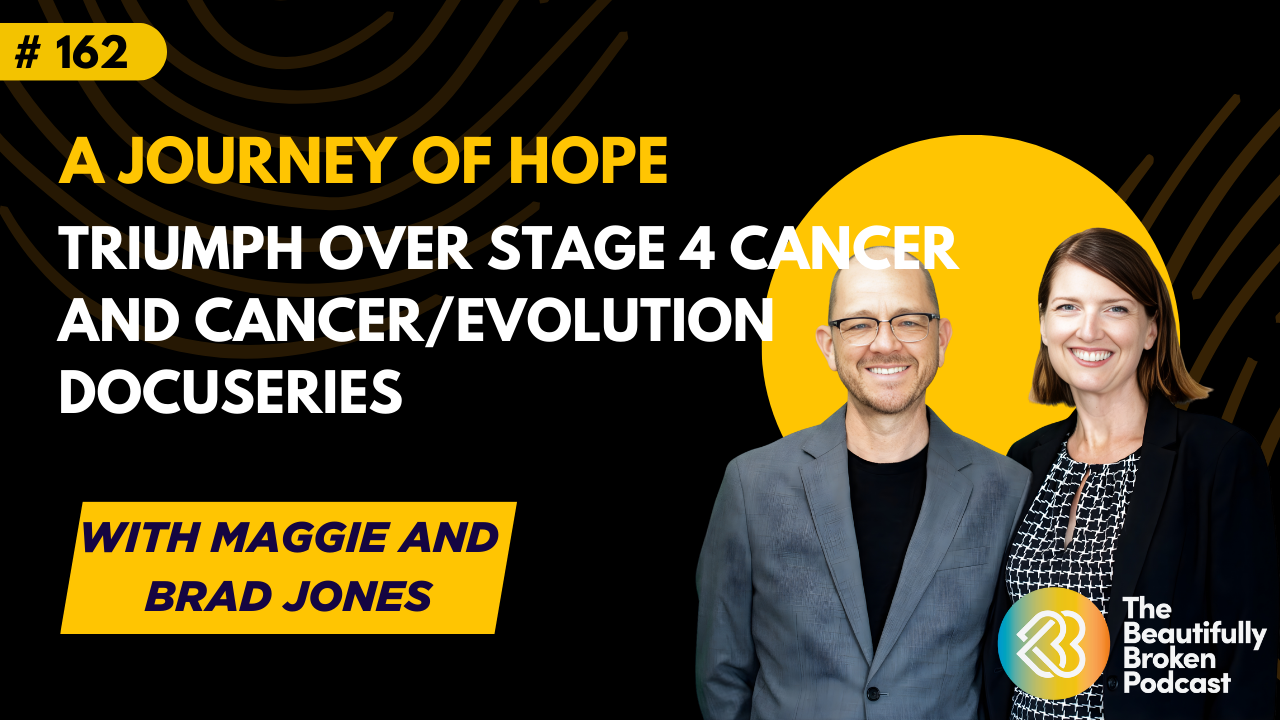
WELCOME TO EPISODE 162
In this powerful episode, we are honored to have Maggie Jones and her husband, Brad, share their extraordinary journey.
Just as Maggie turned 40, her life took an unexpected turn when she was diagnosed with terminal cancer and given a prognosis of less than a year to live. However, against all odds, Maggie defied the dire predictions and emerged victorious, celebrating four years of being cancer-free. Her story is a testament to the unbreakable human spirit and the transformative power of hope.
Throughout her healing process, Maggie formed invaluable connections with leading scientists and practitioners who are revolutionizing the understanding and treatment of cancer through metabolic therapies.
Today, she stands as a prominent voice in the metabolic cancer treatment community, dedicated to spreading awareness and advocating for evidence-based treatments that significantly contributed to her survival and improved quality of life.
Maggie and Brad, acclaimed documentary filmmakers, have channeled their experiences into the creation of the award-winning docuseries, "CANCER/EVOLUTION." This remarkable series showcases the groundbreaking work of scientists and practitioners at the forefront of the metabolic theory of cancer and associated therapies. Their passion for shedding light on these life-changing approaches has earned them well-deserved recognition. Get ready to be uplifted, motivated, and enlightened by their incredible story of resilience, hope, and the pursuit of a cancer revolution.


Episode Highlightss
[00:00] Introducing Maggie and Brad Jones
[05:40] On Dealing With the Cancer Diagnosis and Being in Remission
[12:58] On the Life Changes Maggie Did That Helped Her Recovery
[18:32] Navigating Social Situations While Diagnosed With Cancer
[22:52] The Metabolic Approach to Cancer
[33:56] On the CANCER/EVOLUTION Docuseries
[44:07] Managing Day-to-Day Stress Through Exercises and Different Modalities
[56:25] What It Means to Be Beautifully Broken
[58:42] Outro
UPGRADE YOUR WELLNESS
Silver Biotics Wound Healing Gel: https://bit.ly/3JnxyDD
Code: BEAUTIFULLYBROKEN
LightPathLED https://lightpathled.com/?afmc=BEAUTIFULLYBROKEN
Code: beautifullybroken
STEMREGEN: https://www.stemregen.co/products/stemregen/?afmc=beautifullybroken
Code: beautifullybroken
Flowpresso 3-in-1 technology: (https://calendly.com/freddiekimmel/flowpresso-one-on-one-discovery)
CONNECT WITH FREDDIE
Work with Me: https://www.beautifullybroken.world/biological-blueprint
Website and Store: (http://www.beautifullybroken.world)
Instagram: (https://www.instagram.com/beautifullybroken.world/)
YouTube: https://www.youtube.com/@freddiekimmel
FULL EPISODE INTERVIEW
EPISODE TRANSCRIPT
Freddie Kimmel (00:01.054)
Ladies and gentlemen, welcome to the beautifully broken podcast. We are back with another exciting look into the world of documentary filmmaking and filmmaking about topics. We love to talk about health, wellness, vitality, and especially today we're going to jump into the cancer revolution with Maggie and Brad Jones. Welcome to the show.
Maggie & Brad (00:24.135)
Thank you so much for having us. Yes, thank you so much.
Freddie Kimmel (00:27.654)
It's a treat and I previewed the episode one of the documentary this morning. And as I was saying, I was so moved by the quality of the filmmaking and the music and the storytelling and the integrity of the data. What an exciting thing for people to experience.
Maggie & Brad (00:48.886)
Thank you. Thank you. It's all Brad. His background is in filmmaking. We're lucky it's a joint. This is a joint effort. This is yeah, no one person could take this on. Come on.
Freddie Kimmel (00:50.251)
Yeah.
Freddie Kimmel (00:59.442)
Yeah, and it's personal. It's personal. Maggie, you made this for a reason. Brad, you made this for a reason. The United Front, as well, will frame it. If you couldn't just for the audience, why make a series of impacting film called The Cancer Revolution?
Maggie & Brad (01:22.646)
So it all started in 2018 when Brad and I moved to Hong Kong from Los Angeles. We'd never been to Asia before, definitely never Hong Kong. And exactly one month later, the month of my 40th birthday, I was diagnosed with terminal stage four lung cancer that had spread to my brain, my eye, and everywhere throughout my body.
I was given about six to eight months to live was a median survival rate for that diagnosis at the time. My doctor saw it, you know, I'm healthy. Maybe I'd make it a year. At the time, all I wanted to do was die well. I wanted to make Brad proud of me. My doctor's proud of me. I was like, well, this is it. Let's do it right. And thank God that lasted about five days. And Brad took me away for a weekend, you know, this Friday after my diagnosis.
And I started reading books and I started with simple cancer books like radical mission or something by Chris Carr. And then I discovered fasting and I started reading more about this. And I started reading more about the metabolic theory of cancer and associated metabolic treatments. And I got really into that. And one year later, exactly one year from my diagnosis when I should have been dead I was cancer free and I was diagnosed with no evidence of disease and I've continued living this incredible life. I.
a great quality of life. In fact, the only thing that impacts me is a hangover from my traditional conventional treatment. I did brain radiation. So I have brain radiation to process, which can cause some difficulty speaking for me. So you might hear that on the podcast, but Brad is here next to me. So I was continuing to live. Brad had adopted my way of eating, fasting, all of that. I started communicating with people. I had a blog and back.
trained as a practitioner, trying to help people implement these strategies. And I realized I just can't do it alone, or I can't do it alone. But thank goodness he is a filmmaker. He had 20 years experience doing incredible reality based documentaries, storytelling. And he had the idea that the easiest way to get this to people was something that's easily digestible. They can sit in front of their TV and just learn why this works.
Freddie Kimmel (03:37.95)
Yeah. Maggie, I've got to ask you, what does it feel like to get a terminal cancer diagnosis and to sit here today and say, I have a new lease on life? Can you unpack that a little bit for people listening?
Maggie & Brad (03:54.314)
So, it's so interesting. At the time I was very numb. And the thing that having cancer has taught me is I was numb leading up to it. And I realized that if I only have these few months left to live, I wanted to finally live. I had been living a kind of life where I put off everything until future. Instead of enjoying the moment, I was waiting for the dishes to be done so I could watch TV or.
the work week to be done so I can enjoy the weekend, retirement so I could maybe have some fun. And what a ridiculous way to live. And knowing that I only have these few months, I realized let's do it now. Let's enjoy every minute of these dishes of this work week, whatever it is. And I slowly started to realize just how wrong the way I'd been living was and that I can enjoy every moment regardless of what I'm doing. And it's a ridiculous thing. It's terrible for people who have just been diagnosed.
personally, cancer is the best thing that ever happened to me because I realized I wasn't living life and it's giving me not just a new leaf on life but actual life.
Freddie Kimmel (04:58.686)
Yeah, it's a beautiful way to phrase it. And I'm so proud of you that you've been able to come to this place. I really, I say the same thing. I say cancer is the best thing that's ever happened to me. I know that is triggering for some people. I know there's so much nuance in there and we all have a different experience and story with cancer. So I never want to dismiss the hardship and suffering and pain that goes along with cancer.
Brad, how was this experience for you? What was it like to sit there with the love of your life and your partner to be diagnosed with a terminal illness?
Maggie & Brad (05:39.51)
Oh, it was a terrible. I mean, easily the worst thing that ever happened to me in my life, you know, you. It's just kind of the thing that you just don't ever want to go through. And but but I will say just as like sort of a bit of a golden lining or silver lining, something that we've we've realized since then.
is that we probably overreacted a little bit to her diagnosis, where it was like she had been on this path for a while. And so it was like, when you learn about it, it's black and white, because you didn't know, and now you know. But there was just a lot more gray in there. And that's something that we sort of now realize. It's like, well, when there's a step backwards, that's OK, because a couple of steps forward are coming, right? It's not.
And so that, but that is, was really hard, like when it happened at the time, but, you know, I certainly didn't have that kind of mindset then. And, uh, yeah. And that was one of the, one of the things that we still talk about to this day was just, you know, that idea of like, get it out of me, you know, like that, that was really hard. You understand that urgency when you first find out you have cancer. And I found out I had it everywhere and all I wanted. I was diagnosed because of tumors in my eye. And I was like, I have two, let's cut them out. And then we found them in my brain.
And I was like, oh, I don't use my brain anyway. Let's cut them out. And luckily my cancer was completely inoperable, but I did have options of palliative chemotherapy and radiation. But yeah, I finally been able to let go of that urgency, realizing that I've had cancer for a long time and everybody has a little cancer. Let's just live with it. I don't want to let it get out of control again, but I don't let it control my life. Yeah.
Freddie Kimmel (07:28.914)
Yeah, that's beautiful. Did, Brad, when you were going through this experience, and now, again, here we are in a very different place from, you said it was a full year from diagnosis to being in remission or cancer-free, what's that experience been like for you to live through a miracle?
Maggie & Brad (07:51.486)
Um, it was, well, to be, it was fantastic. First of all, like, I mean, that was great. Um, uh, sorry, we got an airplane going by outside. And, um, but the fun thing actually, I mean, was that we weren't, uh, we weren't expecting to get that scan. Right. We were, you know, Maggie was sort of slowly progressing doing, you know,
Freddie Kimmel (08:02.27)
Yeah, life's hey life's still coming at us while we're doing a podcast.
Maggie & Brad (08:20.006)
marginally better and better, you know, every time we went to the doctor. But she kind of just took a big jump when we got that scan and we kind of, I felt like we were almost stunned when we walked out of the office that day. I'd prepared myself to live with cancer as a chronic disease. And I was very excited by that perspective. And it seems like shortly after I really committed to that perspective, it was gone. And, and I'm fine. I've had, I've never had a confirmed recurrence, but I feel like I have it, you know,
ebbing and flowing. But again, just finding that way of not thinking that my quality of life depends on being completely cancer-free, that's been the important thing to me. And whether I feel like it's maybe ebbing or flowing, it's a message to me to take care of my body and return to what I know is healing.
Freddie Kimmel (09:07.23)
Yeah. Maggie, where does your joy come from? What brings you joy in life?
Maggie & Brad (09:12.522)
This is, it's just being able to experience it. Like we are all going to die. I'm really grateful I didn't die four years ago, but I know it's coming and just being able to cherish everything in the meantime. Brad, you, the people that I meet, our little puppy that we got. It's a constant stream of joy that I can't get away from and I don't want to.
Freddie Kimmel (09:33.478)
Yeah, that's really beautiful. And Brad, I have to ask you the same question, where does your joy come from?
Maggie & Brad (09:40.654)
You know, lately, this documentary has really just been like a driving force. I mean, in both of our lives, but in my life as well. Just when you get emails from people or bump into people, you know, at a conference or something, and they just tell you how much impact you've had on their lives. I mean, I never had anything like that. You know, I mean, I had a fun career. I enjoyed it. You know, it was like I entertained people.
but it pales in comparison to somebody walking up to you and just saying, keep doing what you're doing. Like you're helping people, you're saving lives, right? This is just, so yeah, that really keeps me going like every day.
Freddie Kimmel (10:23.946)
Yeah, incredible. We were on a panel at KetoCon recently in Austin, Texas, Maggie and myself and Brad, you were backstage and I remember you very specifically. I was like, oh, this guy's really holding space for this woman. I was like, what's their dynamic? I didn't know you. And then we got on stage with all these people who had lived through cancer and chronic illness and the one woman had had a heart attack the year before.
And all these incredible stories, it was an amazing panel. It was easily one of the better panels I've ever been on in my life, the moderator included. And we had great questions from the audience. But I felt very aligned with my purpose. And it was one of those hours that you spend in life, you're like, okay, keep doing what you're doing. Stay curious, keep asking these questions because this is important work. I don't know if you felt that way on that panel, Maggie.
Maggie & Brad (11:20.326)
It was incredible. And honestly, Freddie, I learned so much from you, those great questions, but just waiting till the end when your answers came. It really taught me a lot. And one thing that we have noticed throughout this entire process is this community is so supportive and they're all aligned for healing, not for profit or any of those other motivations. It's a community. I'm just so grateful that I found through this experience, including you. Thank you. Yeah.
Freddie Kimmel (11:34.222)
Mm-hmm.
Freddie Kimmel (11:45.382)
Yeah. Oh, thank you. So I also wanted to just, if we can explore, Maggie, what did you do to go from a terminal diagnosis to this cancer-free scan a year later?
Maggie & Brad (11:59.286)
I am so lucky that my cancer was so imminent in killing me. If it hadn't been turned around at all, if it hadn't been just a couple of months, I don't think I would have been able to make the life changes that I had to. But knowing that I only had this time available to enjoy life, I took it seriously. And the number one thing I did.
Freddie Kimmel (12:12.643)
Mm-hmm.
Maggie & Brad (12:20.95)
There's a lot of number one things. I started that first weekend when I read those books, Brad took me away. I realized that I hadn't been treating my body well. And this was a cry out for my body saying, hey.
It's time you have to pay attention. And I decided then that I wasn't going to put anything into my body that wasn't actively healing for it. And so I was quite the alcohol and do it. It's do the, it's in my early days. And so I cut out alcohol completely. I cut out all factory meats, all sugar, of course, process food in general. And the first week was really challenging for me because my passion in life was beer and bread, margaritas and nachos. And I remember my third day walking home from work.
passing this pizza store that I had loved to go in and give myself a treat and saying man I'm taking a blood test when I get home to take my ketones my glucose I can't stop there I can't cheat a blood test and I can't cheat my death so we went on with that fasting has become critical for me at the beginning I remember my first 24 hours were so huge and now Brad and I I mean
Mondays are day we never eat, but we go for two, three days a week. And that's been incredible. Again, I was lucky. I had a lot of fat to lose. So I was able to get rid of that. And then the third I think is stress reduction, which for me was massive. I was taking anti-anxiety drugs. I had a very high stress job because I did take advantage of this palliative chemotherapy.
I've learned I had to go off my anxiety drugs, which what a weird time to go off anxiety medication when you're about to die. So I had a background in my childhood with meditation and yoga. And I tried to get into mindfulness based stress reduction because most of the research is there. And I tried myself and it didn't work. And thank goodness, Brad joined me and we went through the eight week class. And now meditation and yoga are a very big part of our life. We have a sauna now, HBOT.
Maggie & Brad (14:18.078)
We've completely changed our life to make sure that it's healing for us. And we'll never go back. And while I'm talking, I think that's something that a lot of people need to keep in mind that coming remission of cancer or even curing it or finding no evidence of disease, that's not the end. You're not healed. You have to continue this healing for however long you're fortunate enough to be on this planet. Yeah.
Freddie Kimmel (14:25.109)
Yeah.
Freddie Kimmel (14:44.59)
Yeah. How has how have these life changes affected you Brad? Have you have you been on board with everything? Have you guys done everything to an equal endeavor on this journey?
Maggie & Brad (14:57.982)
I would say mostly not I mean, I certainly didn't start eating keto diet as like the day that Maggie did took me a little bit while longer to kind of get on board. Some of that had to do with the fact that we had just moved to a new country. And I was like looking forward to trying all these other, you know, types of cuisine. And so I had to kind of, in my own mind, sort of, you know, put that aside and be like, Hey, that's
trying new foods isn't as important as supporting your wife, right? So, uh, but it just took time to, you know, like kind of to do that. And, um, but eventually, yeah, we were having, and then also, you know, I mean, uh, not to stereotype too much, but guys are kind of lazy and, you know, she was cooking, she was like, Hey, I'll make a salad for you if you want. I was like, all right. So, you know, after a few months, it was, you know, kind of an easy call to, uh, to, to go onto the keto diet. Um, and then I started seeing, you know, positive changes in my, um, you know,
my body as well, which was great. There's one thing I was actually gonna add to Maggie's little story about what she did. And one thing that we always like to emphasize, which is that she also did chemotherapy. She became quickly resistant to one drug and then she's had a second drug that she stayed on that we sometimes question how efficacious it was, but nevertheless it has helped her. And I do, but I do think.
that's important to note that you can do the standard of care with these metabolic approaches to cancer. And so much of the research has shown that, you know, they get a certain amount of efficacy with conventional treatment and with metabolic therapies, but combining them together is magic. Yeah. Yeah.
Freddie Kimmel (16:27.328)
Yeah.
Freddie Kimmel (16:37.958)
Yeah, I think that's a great reminder. I love that that you brought that out. It's it's so important to just remind people that it's, it's not about being at a camp or, you know, we get so attached to our belief systems, but let's let's really focus on best possible outcome for the patient. There, there is Yeah, there is a big piece I just it's bringing up for me. I remember the day that I quit sugar.
Maggie & Brad (16:57.472)
Yeah.
Freddie Kimmel (17:05.706)
you know, and grains and gluten and all those things. It was 2009. People are like, Oh, well, would you ever? I'm like, no, no, I don't buy those things. They aren't in the house. I don't do it. And it's, it's really, once you, once you just commit to that as your new reality, I've found personally, um, if it's not an option, it's easier. If there's a timeline to it, I'm like, Oh, I only have to, you know, I get to.
have to get eight months out or a year out, then it's almost harder. It's more challenging. But I would love to hear if I always noticed that social engagements and parties and holidays and family gatherings was really the part where it was challenging because it brings up things for other people.
that they often get uncomfortable and it can come as like a judgment towards what you're doing. How is that experience for you? Did you find a lot of support in your community or did you find that, you know, some of those things were tough to navigate?
Maggie & Brad (18:07.83)
I think it's really difficult to convince people that you're not judging them just because you're doing something different than they are. But I always use my disease as an excuse. I was diagnosed shortly before the Chinese New Year in Hong Kong and mooncakes were such a thing and people would bring them to me and I just say, oh, I'm so sorry, my cancer treatment, I can't eat this or it'll kill me. And what I try to tell people who ask me about it, if anybody is forcing you to eat food that you don't feel is healing.
Freddie Kimmel (18:13.963)
Mm-hmm.
Freddie Kimmel (18:29.506)
Yeah.
Maggie & Brad (18:37.258)
They're not your friends. They are, if you feel like it's going to kill you, there's no reason you have to eat it. And honestly, Brad and I just don't eat out anymore, period. But we love to entertain at home. We love, it does mean introducing our friends and family to this way of eating, which isn't how they would do it. But I still use it as an excuse. Like I'm brain damaged from my brain radiation necrosis and I'm a delicate flower and like, sorry guys, I just can't eat this food all fast. And I don't mind fasting either. Yeah.
Freddie Kimmel (19:03.924)
Yeah.
Maggie & Brad (19:05.206)
I would say people have been certainly open and supportive of Maggie doing it, and I do it with her, so that kind of makes sense to them. The part that's kind of become interesting is that it's really obvious to see the changes that in both Maggie and myself that we've made just by eating differently. And we're actually really surprised at how very few people have decided to ask about that or follow up on that.
Freddie Kimmel (19:32.395)
Mm.
Maggie & Brad (19:32.862)
except for friends of ours that have cancer, then they're motivated. But it's like, I really wish my mom had looked at what we were doing and was a little bit more motivated to just get a little bit healthier. And that's the most frustrating part is, it's just trying to get other people on board. And we don't actively really do that, but it's just frustrating.
Freddie Kimmel (19:36.256)
Yes.
Maggie & Brad (19:54.734)
or judging people that choose not to, even people with cancer who learn about it and it's not the right option for them, that's okay. It's not your fault. We live in a society that we can't control. I just wanna emphasize again that nobody's at fault and we're not here to judge other people who can't follow these therapies. No.
Freddie Kimmel (20:09.012)
Yeah.
Yeah, I would agree. I think that's a profound reminder. The thing that comes up for me that I've been hearing a lot, it's like, there's such a profound, and we said this in the beginning, you can come to a place where you feel like cancer is a gift, where it's the best thing that's ever happened to you. And I just see it be this profound catalyst of making change that will last. I feel like for me, the changes I'm making are going to go forward and backward generations in my lineage.
and without the cancer, I never would have made these changes. It wouldn't have been, I had a doctor consulting, I was in on a consultation the other day, and this woman was talking about her chronic Lyme disease and her MS and her rheumatoid arthritis, and where she had said, she's like, you know, I wanna do this, and I wanna do the ozone therapy and all the other things, but the lifestyle stuff, I just not sure I'm ready for.
And he was like, I want you to think about it. And he's like, there will be a time when you are sick enough to make these changes. And that's not today, but I want you to know that we got to go all in. And this is just my clinical experience of watching people do what you're doing. He's like, I've seen enough people come through the door to know that you're just not sick enough to make the changes. And I don't want you to be sicker than you are today. And I just thought it was like, Oh my God, what a, it could feel harsh and cutting to someone.
Maggie & Brad (21:34.76)
Yeah.
Freddie Kimmel (21:35.83)
But I was like, what a beautiful way to put it. Only because any speaking from his lived experience. I was like, man, that's a great, what a brave practitioner to put that out there. I know people could say that's triggering or maybe not celebrated in some circles, but I was like, man, what a, what a, that's some cojones there to put that on the table like that.
Maggie & Brad (21:44.414)
No.
Maggie & Brad (21:54.811)
And that would have been me if I wasn't sick enough. I never would have been able to make such drastic changes. And so I deeply respect the people who aren't quite there yet and are still able to make that change, even if it's incremental steps. It's incredible. I took the easy way out.
Freddie Kimmel (22:11.102)
Yeah. Now, the documentary part one that I watched, we jump right into some of the history of the metabolic approach to cancer, which you've referenced a couple times so far in the interview. Can you, and it has its roots in auto-warburg and the functionality of the cell and cellular respiration.
versus an acidic downstream production of energy metabolism. Could you break that down for the audience a little bit? Well, what is the metabolic approach to cancer?
Maggie & Brad (22:45.286)
Yeah, well, I'm gonna take this. By the way, I don't think that last term you used, that sounds way sciencey for our documentary. I think we tried to really make it easy to understand, right? And it's funny, because actually we were just talking about, I was saying how hard it is to kind of get people to understand what we did or get them on board. And that is one of the main reasons that we made the documentary was to sort of,
Freddie Kimmel (22:57.332)
You did, yes.
Maggie & Brad (23:13.054)
make this easy to understand so that, you know, it's so hard when someone comes at you and is like, oh, you should just go on a keto diet. And it, you know, it's like, that's really tough. And so that's what the documentary is trying to do is give you the scientific reasoning behind this metabolic approach to cancer. So what ends up kind of happening, what we're finding, or actually what was found a long time ago with cancer cells is that they love glucose.
And that's just when you eat carbs, when you eat sugar, you get a lot of glucose in your blood. And one of the things that you can do to try and counteract that a lot of times you will say starve cancer, that's kind of a misnomer. But what you can do is lower your blood sugar. And that's what a ketogenic diet does by cutting out the carbs and cutting out the sugar, you're basically restricting the fuel that the cancer has that allows it to grow. And that was
The limiting of the glucose was not found by Otto Warburg, but this idea that cancer cells use glucose instead of a different way of making energy, that was found by this guy Otto Warburg in the 1920s. So that has been scientifically proven for over almost 100 years. We're almost there. It's like 99 years ago. Pet scan works, right? You get injected with the radioactive glucose, it goes into your tumors, and that's why.
70 to 90% of late stage cancers are we go start and they want it all. Yeah. It's exactly why a pet skin works. If your cancer cells weren't taking in more glucose than your regular cells, there'd be no way to differentiate the two. And that's exactly what a pet skin does. It takes up more sugar than your regular cells. So, yeah.
Freddie Kimmel (24:45.012)
Mm-hmm.
Freddie Kimmel (24:59.058)
Yeah, it's fascinating. And there's been other great scientists and authors who I've read over time. Natasha Winters is a book that I will often gift to people. I was like, hey, read this. So why some of the people that you've included in the story, in the documentary, why were these people invited to the conversation?
Maggie & Brad (25:21.31)
Well, I'll jump in to see, because I took it. These started with some of the scientists and researchers, practitioners that really inspired me during my healing, but also some just really well-known scientists since then. And we want to present both sides of the story of the somatic mutation, the genetic theory of cancer, and the metabolic. So we have legendary scientists like Dr. Robert Weinberg.
up against people like Dr. Thomas Seyfried, who I'm sure most of you learned about. And for some of your more advanced listeners, we talk about the metabolic metabolism of glucose in the early days, but it does progress throughout other researchers like Peter Peterson from John Hopkins up to Dr. Seyfried to discover that it's not just a ravenous desire for glucose, but also glutamine. And then at this summit that we're
we're going to have the real premiere alongside this. We have other researchers like Dr. Matthew Binder-Heiden from MIT who are now getting more conventional in studying the effects of nutrition on cancer. So this research is coming and we started with some of the very early people and we're getting up to just the very latest cutting edge researchers. Yeah.
Freddie Kimmel (26:39.314)
Yeah, I love that the idea that the research is evolving and it's coming. I always say, it's really easy to read some of these books or watch some of these, you know, we've all seen the food documentary or Super Size Me or, oh, I'm trying to think, you know, who is the great documentary filmmaker from the 80s and 90s who did all the, say that again?
Maggie & Brad (27:01.654)
Ken Burns? Ken Burns? Oh. But he's great.
Freddie Kimmel (27:05.286)
Not Ken Burns. I love Ken Burns, by the way. My dad loves the Ken Burns documentaries about baseball. That's like one of our bonding points. He's like, I watched the greatest documentary about Ken. My dad doesn't sound like that, but I just have to pick a dad voice. He loves Ken Burns. Oh, goodness. Who am I thinking of? He did the Colin Bynne documentary.
Maggie & Brad (27:11.027)
Yeah.
Maggie & Brad (27:16.694)
Ha ha ha ha ha ha ha ha ha ha ha ha ha ha ha ha ha ha ha ha ha ha ha ha ha ha ha ha ha ha ha ha ha ha ha ha ha ha ha ha ha ha ha ha ha ha ha ha ha ha ha ha ha ha ha ha ha ha ha ha ha ha ha ha ha ha ha ha ha ha ha ha ha ha ha ha ha ha ha ha ha ha ha ha ha ha ha ha ha ha ha ha ha ha ha ha ha ha ha ha ha ha ha ha ha ha ha ha ha ha ha ha ha ha ha ha ha ha ha ha ha ha ha ha ha ha ha ha ha ha ha ha ha ha ha ha ha ha ha ha ha ha ha ha ha ha ha ha ha ha ha ha ha ha ha ha ha ha ha ha ha ha ha ha ha ha ha ha ha ha ha ha ha ha ha ha ha ha ha ha ha ha ha ha ha ha ha ha ha ha ha ha ha ha ha ha ha ha ha ha ha ha ha ha ha ha ha ha ha ha ha ha ha ha ha ha ha ha ha ha ha ha ha
Maggie & Brad (27:27.762)
Yes. Oh, it's the same. You know, exactly. Is bowling for a column, but Matt, Michael Moore, Michael Moore, and I'm the brain damage one.
Freddie Kimmel (27:29.419)
Why am I drawing a blank on this?
Freddie Kimmel (27:33.686)
Michael Moore, I'm glad somebody got it. I was like, wait, what's happening? The, um, but sometimes it can be so polarizing that it almost creates, it almost creates a freeze because you're in so much fear and shock after seeing it. And I've always thought I was like, how do we invite, you know, both sides of the table into a conversation where we can change the institutionalized nature.
Maggie & Brad (27:51.316)
Yeah.
Freddie Kimmel (28:01.643)
of medicine right now, which really, in my experience, that's what needs to happen.
Maggie & Brad (28:07.006)
Yeah, and I mean, I hope that you kind of got that. That's what we're trying to do with this documentary. I don't want anyone to get the idea that even though we talk about the metabolic theory of cancer, we still just say, hey, there's a genetic theory. There's a metabolic theory. You know, like these are both theories. We're not trying to say one is right and one is wrong. It's just that we have very much fixated on the genetic theory for a long time and still hasn't been proven yet.
People have tried really, really hard to prove that as a theory. And the treatments associated just yeah, treatments coming out of it are a little underwhelming. And basically, we're just saying, hey, maybe we should take a look at cancer from a different angle. And one of the reasons for that is that if when you sort of have a metabolic therapy approach to it, like a ketogenic diet,
they're turning out to be pretty successful. And so there's actually some clinical trials of a ketogenic diet for cancer going on right now. So obviously if that is proven, that'll go a long way towards helping the metabolic theory. But yeah, it's just this idea that, hey, science evolves. You know, we need to keep moving forward. And you brought up a great point, Freddie, that nobody, there's no doctor out there who doesn't wanna help people. They're just constrained by this system that-
Freddie Kimmel (29:25.706)
Mmm.
Maggie & Brad (29:27.662)
in and the system is what needs to change. It's not to blame any individual in any way. Yeah, yeah, doctors are kind of stuck.
Freddie Kimmel (29:32.85)
Yeah. It's, they're stuck, they're stuck between a rock and a hard place. And it's, I understand, I really do on a deep level, I understand both sides of it. Because if you went to school, if you went to medical school, and you've been practicing 25 years of medicine, and you get somebody that comes in and says, listen, I was on Google last night, look what I found. It's probably frustrating. The guy's like, what's going on? You know, but it's also we've created, I think,
that avatar of that person that's in that seeker mentality, they are a functionary of the system that's no longer working for them. So everybody, I just find it so helpful just to just take a step back and be able to see why these questions are coming up. You know, people want more from their, their general practitioner, they want more from there. I have, I'm so lucky I did this episode, I will send it to you three or four weeks ago with my nurse practitioner.
Maggie & Brad (30:19.21)
Yeah.
Freddie Kimmel (30:30.146)
who in his office has an ice bath, red light therapy, pulsed electromagnetic field, adaptive resistance exercise. I just went to my doctor's appointment. I go to the doctor every week. I go work out. You know, I go build muscle on my body. And this is the practice. You know, this is what you get. He's actually building a model where he's trying to incentivize people to be well. Knowing the human psyche, he's designed his practice to eliminate the...
Oh, I didn't get there this week. Oh, well, you've got an appointment to see me. That's what you're doing before you come in the office. You know, you're going to get on some of these devices. So it's really, it's exciting to see it start to take hold and the game changers are, they're asking better questions.
Maggie & Brad (31:07.19)
Lovely.
Maggie & Brad (31:17.85)
Even in just the past five years, I'm amazed by the progress that's been made. Like I had to dig into journals, PubMed to discover this information. And now there's conferences about it. And even though there's still a lot of people not willing to talk about it, it's coming. It has to, because too many people are dying of cancer when they're cheap, inexpensive, safe therapies out there that can be used regardless of whether or not you're using.
conventional treatment. It drives me crazy.
Freddie Kimmel (31:48.294)
Yeah. Yeah, I wish my it's usually like a weekly thing my inbox is like, Hey, Freddie, I know you had cancer, I got diagnosed with, you know, triple negative breast cancer this week. And it's just it's so common. You know, and it's it's in my immediate circle. It's very it's very disheartening, you know, so I have a little short list of books, I'll tell people, hey, you know, this is be a great thing just to start reading.
you know, follow these people. These are great sources of unbiased information in my experience. But it is truly a lifestyle thing that I've learned that has to be all encompassing. And you said radical remission, Maggie, at the beginning of the interview is one of my favorite books because it really doesn't point to treatments. It points to a lifestyle shift.
Maggie & Brad (32:15.422)
Yes.
Maggie & Brad (32:39.606)
It does. And actually we're going to have two representatives from radical mission at the summit. That's going along with the world premiere. We also have Dr. Colin Champ who talks about exercise for cancer, just like your nurse practitioner. So this is all coming out and I just.
We talked early on about trying to educate the doctors and there's some wonderful clinics that do that. There is Dr. Nisha Winters, there's Josephine Barbados at the Kent, the Keto Live Institute in Europe. But we realized we're not gonna fail to make a change educating doctors. We have to educate the people because they can enact the change by asking their doctors about it, fighting for it and.
I see that change is coming and it's going to be within our lifetime. And I feel like people are going to look back at doctors saying, ah, camel's the best smoke. The same way that we look right now at doctors saying, yeah, eat whatever you want, have an insurer and some orange juice with your chemo. Horrifying. Yeah.
Freddie Kimmel (33:35.458)
Yeah. Amen. I see it coming too. I think it's important to hold the vision and speak the word and then to also to support platforms like Cancer Revolution. And I always think it's amazing. I think it's amazing that within this journey that you've held through your chronic cancer condition that you're like, oh, let's go make an award-winning...
the docu-series, you know, that's because this is a, this is big. This is a big project. How do you manage the both the creative energy and the stress that can sometimes come along with a project like this?
Maggie & Brad (34:05.342)
This is why I got cancer.
Maggie & Brad (34:20.078)
I'm going to sneak in before you take this. It was very difficult at the beginning. And Brad had to remind me about two years in that if we had any idea of how difficult and long this was going to be, we never would have started it. So thank goodness we were over optimistic two years ago and still went for it. Yeah. No, I mean, it's on, honestly, the hardest part is just the people that get, you know, send messages via whatever platform just.
get it out there, get it out there, get it out there. That's the hardest thing because we are very specifically trying, we have two things have happened, but one is we're very specifically trying to make it a very polished and professional documentary so that there's just so many people that will dismiss you, not because they care about anything else, other than it just doesn't seem like it's high quality. Right? Production quality. Yeah, and that's so weird. And since we had the skill to do that,
Freddie Kimmel (35:14.357)
Yes.
Maggie & Brad (35:18.786)
We are sticking to our guns on that one, just to kind of make something that lasts for a while. And then the other thing that happened was we thought we were going to make sort of like, you know, like a 90 minute or two hour sort of feature documentary. And as we, you know, we did all our interviews and we like laid all this stuff out on the time, you know, a timeline. And I think it was like three hours and we were like, and we had cut everything down to just like, you know.
10 minutes about keto, 10 minutes about auto warbird, 10, you know what I mean? And we basically were just like, we wouldn't be doing this subject matter justice if we made a 90 minute documentary. And we basically, we're like, would we even be helping anyone? That was the, that was, it became the biggest crux, right? It was like, well, yeah, the project would be done, which, you know, that might be a nice load off, I suppose. But it would be like, keep somebody reading you the pub med.
Freddie Kimmel (36:02.317)
Hmm.
Maggie & Brad (36:10.75)
article. Yeah, yeah, you know, I mean, yeah, if you had a summary of, you know, one of these great books that you've read, that was, you know, five pages long, would that have had the same impact as reading the book? And probably not. And that's what we basically were like, Hey, you know, who is our audience really? And that's when we were like, Well, it's cancer patients and care kit, cancer caregivers. And we were like, we're really doing our audience a disservice if we condense this down to just like
Maggie & Brad (36:40.838)
sort of it led to a rethinking and it definitely like strung out the timeline and has led to some frustrations. But it's so good now. He is a natural storyteller and he just cannot. You saw episode one, like it's not just laying out the science. It's explaining the social reasons why we haven't heard about this yet. And it has Nazis. Yeah. So we tried to make it fun. Yeah, it's you know, it's.
Freddie Kimmel (36:53.901)
Yeah.
Freddie Kimmel (37:02.687)
I know. I know. Yeah, I was-
Maggie & Brad (37:09.463)
you can learn something and also be entertained at the same time, we think.
Freddie Kimmel (37:13.514)
Yeah, the geopolitical temperament in 1930s when Otto Warburg was diving into his work, I've studied Otto Warburg for years and years and years, but through a different side, really from the field of pulse electromagnetics and looking at cell voltage and charge and pH of the cell and how that shifts with an electromagnetic wave, stimulating the cell's natural recovery process.
And Otto Warburg did a lot of that work. And then to find out some of his backstory and his relationships, I was like, oh my God. There was a couple of times I wanted to cry because I had never given this guy, he was just, he was always quoted from a book where there were figures and stats and numbers of shift and pH. But I was like, oh my goodness, this is so profound. I don't wanna give anything away other than that everybody, you gotta, you'll really love this because we've all been.
We've all been touched by cancer in our lives. We all will be. And it's something to, I really think it's something to explore. I hope everybody takes the opportunity to jump in with both feet. So where can people watch the cancer revolution?
Maggie & Brad (38:24.662)
So the world premiere for the public is going to be in September and you can get all the details at cancerevolution.events. And so the actual streaming of the episode one, hopefully episode two, but not guaranteed, will be for donations only and that whatever donation that you can make to help fund the next upcoming episodes.
But we're also having the summit that I mentioned alongside it because docuSeries is about explaining the why. Why do these work? What do you do? But it's actually the summit that has practitioners there who can really get into the how do you implement this? What's the latest research? Because it's so evergreen and it's changing. Or sorry, it's not evergreen. It's changing constantly. And if we waited for all the science to be done, we would never get this out.
So we want to just have the evergreen portion in the series and then have these summits so people can learn the latest with that foundation of the why.
Freddie Kimmel (39:22.526)
Yeah, so not till September.
Maggie & Brad (39:25.114)
Unless they wanted to come to a festivals. Yeah, that's a yeah, there's if you look around, we have our events page, it's playing at some film festivals, you know, around you can find it. And then we're also going to be at if you're in Europe, we're going to be at the keto live conference in Switzerland in June. And at that conference where they've been
extremely good to us. And so we're actually gonna play the first episode there and do a Q&A where we just answer everyone's questions as well. Yeah.
Freddie Kimmel (40:01.806)
Amazing. Amazing. It's so exciting. I'm glad you guys are, I'm glad you're doing this together. I feel really good about this that you have your co-pilot all in place for this experience because it's going to be a really great ride.
Maggie & Brad (40:16.386)
I think we definitely are supporting each other. There's definitely days where I'm like a little, it's just so much work, right? And then I just like look over at Maggie and she'll just be like, this is so exciting. I'm so glad we're doing this. And I'm just like, yeah, that's all I needed. That's that little boost, right? And vice versa, but it's just, it's us doing the day-to-day work, but it's the entire community that's come together to support us. So grateful.
Freddie Kimmel (40:23.551)
Yes.
Freddie Kimmel (40:30.882)
Good. Yeah.
Freddie Kimmel (40:38.411)
Yeah.
Yeah, can I ask you, Maggie, who did you use for your team that was open to you bringing in some of these complementary therapies, the metabolic approach? Can you talk about any of that?
Maggie & Brad (40:52.494)
I did not have any conventional support when I was diagnosed in Hong Kong or after I was NED and I moved to London and even after we came here to Seattle. I tell my doctors now, they worked for me. I let them know that, hey, I'm going to eat this way. I'm going to fast despite what they say. With my brain radiation necrosis, I knew that I wanted to pursue hyperbaric oxygen. I've read the studies and my doctors were almost just angrily hostile about it.
And yet six months later, here I am, not the vegetable that they told me I'm going to be. And I actually have it in my chart. That was probably hyperbaric oxygen that was helping. So Brad and I just discovered this thing that I know my body more than anyone else. The doctors are wonderful. I admire them for their training and the ability to prescribe the medications that I want. But ultimately it's me who decides. And I have agency in my health. Yeah.
Freddie Kimmel (41:30.595)
Hmm.
Freddie Kimmel (41:47.31)
Hmm.
Maggie & Brad (41:47.87)
Well, you did bring on a sort of important, I would say, team member at one point. When did you start working with Chuck Meekin? Meekin Metabolics. We'd like to give him a shout out because he is helping cancer patients right now. Meekin Metabolics. He's in the documentary. He still prescribes my off-label drugs and he is probably the only true healer. He started out as a head of regular oncology on the East coast and now he runs his own metabolic oncology department.
Did he come on board for you? What went in your journey? No, I don't remember, but not. It was after it was after the clean scan. Okay. Yeah. I mean, we were kind of in a unique situation where since we were overseas, we actually, you know, I still, we haven't really ever talked about it, but I mean, we like literally sat down after Maggie's diagnosis and we're like, what are we going to do? Like, do we want just like.
Freddie Kimmel (42:25.922)
Yeah.
Maggie & Brad (42:38.602)
We had just landed, you know, like in Hong Kong. It had been a month and we're like, do we just pack it all up and go back? And Maggie was like, no, let's like, keep going. Let's keep, you know, like, yeah. And we went to, I mean, it wasn't always fun, but we went to like eight different Asian countries that year, you know, just trying to make sure that we were living our lives and yeah. Wouldn't change a thing. Yeah.
But yeah, oh, but the I'm sorry, my point was that we didn't really except for just like online and her doing research, we didn't really have access to like, a lot of things that I mean, people in the US are actually pretty lucky if you do some research, there's pretty and it's on cancer V me her website, you can find oncologists you can find
Freddie Kimmel (43:02.1)
Incredible.
Maggie & Brad (43:21.726)
like sort of smaller integrative care centers that can help you do some of this. So for people that are out there, it is out there. Don't despair. You don't think you have to do it on your own. No, work with it. You can find a nutritionist, a dietician, ask about one, even your hospital, which we're not giant fans of, they have a nutritionist on staff that can work with cancer patients. I have just one story from Hong Kong. I moved to a new hospital and I told my oncologist that I was doing keto.
Freddie Kimmel (43:47.598)
Please.
Maggie & Brad (43:51.91)
And he thought for a while, he's like, oh yeah, that's low fat, right? Yeah, it should be fine. So I didn't tell him anything else. He wanted me to talk to a nutritionist who would give me the whole usual spiel. And I was like, listen, I've studied this. I know it. I'm going to do it my way, no matter what I hear. And he let me go ahead and do it that way. And my doctors now they admit my, my primary oncologist tells me that my way of treating myself is against his beliefs.
Freddie Kimmel (43:56.525)
Yeah.
Freddie Kimmel (44:08.448)
Yeah.
Maggie & Brad (44:17.63)
but he also admits that I am the longest lived patients that he has with a diagnosis like mine. So eventually I'm gonna show him through my health and my healing that this might be something that's worth telling others about.
Freddie Kimmel (44:23.595)
Hmm.
Freddie Kimmel (44:30.506)
Wow, that's profound. There is nothing, there is no light brighter than standing in your embodiment. Again, I just, yeah. If we had applause, we would just add that into the podcast at this point. Thank you, thank you so much. I have a question. Along the lines of this project that you're doing and the cancer revolution, and I know there could be, you probably do a 20-part series, you could just keep going.
Maggie & Brad (44:39.062)
Yeah.
Maggie & Brad (44:45.926)
Laughter
Freddie Kimmel (45:00.502)
Because like we said, the beauty of science is it's always evolving and it's usually the outliers that sends it forward 25 years. So with that being said, and the idea that it's a big project, how are you managing the day-to-day stress and your interaction with the outside world? Like, what are your big techniques to down-regulate? I know you mentioned meditation, but what does that look like?
Maggie & Brad (45:29.558)
I meditate every day first thing in the morning. We do yoga at least once a week. I'm actually a yoga teacher now, but just for my personal practice. We have a sauna now. And for me, because of my brain condition, I can't have too much activity, especially interaction with people, which is challenging because I love talking. I love talking to people, but I've had to scalp the ock on that and it could be for the best there. And just always remembering that above all,
my health is the most important thing because you have to put on your own oxygen mask before you can help others. So really cancer taught me how to prioritize myself. Brad, I don't know what you do. Well, one of the interesting things that I've just sort of stumbled across was a little bit of me time in the morning. I was never really a morning person up until a couple of years ago. And I've just started getting up at around 6.30 every day and make a cup of coffee and just sort of sit on the couch.
Freddie Kimmel (46:05.579)
Yeah.
Maggie & Brad (46:26.242)
Sometimes I meditate. Sometimes I just read the newspaper. Sometimes I actually start working, right? But it's just sort of that hour that first hour of the day, I can do whatever I want with I can just, you know, like, sort of carve that out for myself. And yeah, if someone's trying to, it just sort of sets me up, I feel like for the rest of the day, right? I don't go into the day hurried and rushed, you know, like, I just sort of take care of whatever I need to, you know, to get myself up and rolling. And yeah.
I would definitely suggest if anyone I know it's hard to find the time, it's hard to set that alarm like an extra half hour early, but it's something that I'm really surprised at how much it's helped me. And I'm still a stress basket case, but Brad's techniques have really helped me. I never would have made it this far. I think yeah, breathing. We do yoga once a week, but usually go to a yoga class and just sort of help reset, you know, everything.
Freddie Kimmel (47:06.443)
Yeah.
Freddie Kimmel (47:14.348)
Yeah.
Maggie & Brad (47:22.839)
That's usually on Sundays to kind of help like do a little bit of a reset.
Freddie Kimmel (47:28.35)
Yeah, yeah, it's it there's so many tools in the toolbox, I always it's fascinating to me to hear what works for other people and how simple it can be. More importantly, that it's that it's in the formulaic equation, that that there's something that is dedicated me time or self time or reflection, or time to downregulate. Because I think we overestimate what we can do in a day. And but here you guys.
guys are making this documentary platform, which is this is pretty, it's a huge milestone. It's like building the Empire State Building. You're in creation of this wonderful project, which has skies the limit.
Maggie & Brad (48:05.27)
Uh-huh.
Maggie & Brad (48:12.214)
Well, it's funny that you mentioned, you know, like how research keeps evolving and that type of thing. And we're while we do have a very set four episode structure for this one, for a while it was five. And we decided to simplify it. So we've now made it four also to help get it out faster. We just we had a storyline that I really wanted to get in there. And I was like, it's just we're just going to it's going to go on the cutting room floor, unfortunately.
But there's so much out there, like you say, we're basically like, hey, once this four episodes are out, that kind of actually frees us up to like dive into some other stuff. So whether we'll have a full season or what we'll do, we're not sure yet, but we're already sort of looking at and leaning towards continuing this in some way. Season two. Yeah.
Freddie Kimmel (48:47.638)
Yeah.
Freddie Kimmel (48:58.254)
Season two, I love it. I'm so inspired by the things, some of the things that have worked for me, which again, very similar conversation, that they're like, no, you can't heal that. You can't fix that. That's not fixable. We don't have a fix for that. But here I am and some of the things have been completely remediated or repatterned in my body, scar tissue that shouldn't be able to grow back or you don't have lymph nodes, but it's...
the other tissue has taken up the role of those. It's so fun. And I know there's evolving research around pulsed red lights and pulsed electromagnetic field. And now the new science coming out around ice baths, looking at this conversion of white adipose tissue to brown fat, which is more mitochondrially dense. And they're seeing people, I've got two people in my circle now
just doing ice baths have had some remission. I mean, it's, and you're not, these are not so, I mean, I have to in my circle, but you're hearing this more and more and now there are some, there's some white papers coming out. So it's really exciting that we're looking at, and everything we could argue, or we could make a, we could create a theory that everything that I'm talking about has stress reduction involved.
Maggie & Brad (50:02.495)
Yeah.
Maggie & Brad (50:24.138)
But that you bring up such an important point that there is no one way for everyone. And I know that's really frustrating for a lot of people who contact me is what worked for me may not work for you, but you have to find your healing that is gonna work for you. And for your audience, I think a great story is with my brain radiation necrosis in my last scans in December, I talked to my neuro-oncologist and he told us that if he showed my scans,
All 10 would say I'm a vegetable and he has this was one week after I came back from a solo trip to Bali for my yoga teacher training and they have no idea why my brain can look like the mush that it is But I'm still living this wonderful life. And so I can't emphasize enough to people don't let your scans Don't let your doctors tell you how you're supposed to feel you feel the way your body tells you
Freddie Kimmel (51:18.77)
Yeah, yeah, the heart is such a strong compass and it knows, the body knows. We know when we have a full body, yes, or when we have a full body, no, and somebody is telling us how it's going to be. Yeah, I celebrate you for tuning into that. It's really beautiful.
Maggie & Brad (51:31.507)
Yeah.
Maggie & Brad (51:35.746)
I can't do that because I couldn't do it before. I was going to just add a touch to your ice bath idea, which is just this hormesis idea, right? Where it's like, whether it's a sauna, whether it's an ice bath, whether it's hyperbaric oxygen, I mean, or even exercise, there are so many ways that you can sort of put a small amount of stress on your body.
And that just takes care of these cells that are just barely hanging on. And those are the cells that become cancerous over time, right? These cells that really should be sort of sloughed off and, and, and go into the apoptosis, right? Those are the cells that if they hang around, they, they can become cancerous. And so I, it totally makes sense to me that, you know, there's all kinds of things that can help you, right? If you're helping to just get rid of your old cells that your body doesn't need. Yeah. That's the word it's working.
Freddie Kimmel (52:28.81)
Yeah, I always go back to the idea that the body was functioning. It was dealing with cancer perfectly well until it wasn't. So what did that body look like? And how do we bring those mechanisms back online? And I think that's what they're starting to show is some of the different ways that quantifying a red light laser or quantifying oxygenation of the tissue through hyperbarics or even hydrogen gas is another one that's coming up now for...
people who are undergoing radiation therapy, managing and mitigating the collateral damage on peripheral tissue. And some countries use it as, oh, there's a hydrogen bar in Japan. That's normal. Everybody does it there. So yeah, as more information is shared and we're able to get better data on it to better understand so we can create a shared belief system in which this is a thing. That's why I do this show. And I think that's why you guys are doing what you're doing.
Maggie & Brad (53:27.238)
And I can't emphasize enough that science does evolve. And I was recently banned from Reddit for claiming that, that science isn't done, that we're not going to have to have over 600,000 people dying from cancer every year because we can still learn things and be open to that and to a future that's gonna be incredible. Yeah, what we know could fit in a thimble, right? I mean, so when people are like, well, that's not proven.
Freddie Kimmel (53:46.354)
Yeah. Yeah.
Freddie Kimmel (53:52.232)
I know.
Maggie & Brad (53:56.858)
You know, you're just like, oh, OK. So, yeah, I mean, I mean, we're not trying to advocate for things that aren't proven, but we're trying to just definitely say, hey, let's maybe we should look at one way or another. Maybe it's worth looking at. So, yeah, it's kind of interesting.
Freddie Kimmel (53:57.166)
Mmmmmmmmmmmmmmmmmmmmmmmmmmmmmmmmmmmmmmmmmmmmmmmmmmmmmmmmmmmmmmmmmmmmmmmmmmmmmmmmmmmmmmmmmmmmmmmmmmmmmmmmmmmmmmmmmmmmmmmmmmmmmmmmmmmmmmmmmmmmmmmmmmmmmmmmmmmmmmmmmmmmmmmmmmmmmmmmmmmmmmmmmmmmmmmmmmmmmmmmmmmmmmmmmmmmmmmmmmmmmmmmmmmmmmmmmmmmmmmmmmmmmmmmmmmmmmmmmmmmmmmmmmmmmmmmmmmmmmmmmmmmmmmmmmmmmmmmmmmmmmmmmmmmmmmmmmmmmmmmmmmmmmmmmmmmmmmmmmmmmmmmmmmmmmmmmmmmmmmmmmmmmmmmmmmmmmmmmmmmmmmmmmmmmmmmmmmmmmmmmmmmmmmmmmmmmmmmmmmmmmmmmmmmmmmmmmmmmmmmmmmmmmm
Yeah.
Freddie Kimmel (54:13.638)
Yeah, it's a tough time to share data and information and I get it. I really do. It's like, what's the source? What's the validity? I question everything I read. You never know. I think it's only going to become more complicated with some of the AI-generated content. I just saw the... Yeah, I have a background in music theater and television film and I was just looking at that SAG-AFTRA had already negotiations
Maggie & Brad (54:31.412)
Yeah.
Freddie Kimmel (54:43.982)
had in the contract, you could sell your avatar to be in past episodes of like seasons of films or television series that have been filmed 10 years ago. They're like, Oh, well, someone might want to order a season 10 for all in the family. And they're just going to be able to order it and that thing is going to generate it and you'll get a percentage. I was like, this is wild. So yeah, another podcast.
Maggie & Brad (54:55.05)
Yeah.
Maggie & Brad (55:07.509)
easy.
Maggie & Brad (55:11.098)
Yeah. And let's get this stuff out while there still is some idea of credibility that we can take hold of. Yeah. It's going to be interesting. Hopefully there are ways to navigate that. But yeah, I mean, how will we, how will we know that those seem like it's going to be tough? Yeah. Yeah.
Freddie Kimmel (55:27.09)
how will we know? I tell you how we'll know, as I think there will be a pullback and from engage making all your engagement online. And for me, that was, that was when I read that article, I was like, Oh man, what, what a great case for things like Keto con. What a great case for a live summit where everybody goes away to Colorado for a weekend and we see each other and we hug. I'm going to Boise Idaho on Wednesday morning to
a big company called Cellcore. They do humic and fulvic acids to help the body detoxify from glyphosate and different neuterceuticals around Lyme and mole toxicity. But we're gonna be there with like 600 doctors. And it's a totally different experience from being on a Zoom call. You know, you hear, you feel things in a different way, you learn in a different way. And there's a case to be made for society going back to these.
developing our close communal roots, re-evaluating these things. So I hope that's the direction. I always think there's gonna be something good to come from it, even if it sounds a little scary to say I could generate season 10 of All in the Family.
Maggie & Brad (56:37.878)
Yeah. No. And hopefully, it'll come with something to accommodate people who just can't get out right now or can't afford to travel. But the future just gets better and better.
Freddie Kimmel (56:44.554)
Yes. Yes. Yeah, it does. It does. Well, I want to, I want to be mindful of our hour. I celebrate all the work that you're doing. We are going to do a special code for people to get into the summit and we're going to, I think it's Freddie 20. And I, yes, I know that's what it is. I will put that in the front of the show just so people can
get on the list for the summit that's happening in September. And we're just going to continue talking about this project. So I'm so excited. I'm excited to go rewatch episode one with some friends and family because for me, it really is, it's like just make your inner circle thirsty to learn more about some of these things. We don't have to wait till we have a...
Maggie & Brad (57:15.734)
Thank you.
Freddie Kimmel (57:38.89)
late stage cancer diagnosis to make some of these big life changes that we know now from the evolving science really do make a difference in how we live on the planet. So I applaud you for doing the work you're doing. Thank you.
Maggie & Brad (57:51.83)
Freddie, thank you so much for your support and to this entire community for the support. Yeah, thank you so much for your help and helping us share our message too. Yeah.
Freddie Kimmel (57:59.518)
Yeah, you guys are the real deal. I wish everybody was there at KetoCon. You can go next year in Austin, Texas.
Maggie & Brad (58:06.806)
Uh, I think, I think we might be speaking actually. It's probably going to happen. Yeah.
Freddie Kimmel (58:12.798)
Let's put that out there. And just, but just to see you guys are in such integrity and you're so, you embody the things you're talking about. And it's just evident just from meeting you for a half hour, an hour. So again, thank you for being you. Thank you for doing the work you're doing and showing up the way you're showing up. And it was a pleasure to have you on the podcast. I need to ask you, the beautifully broken podcast.
Maggie, I'll let you go first. What does it mean to you to be beautifully broken?
Maggie & Brad (58:44.418)
to have an opportunity to heal it then. It's cancer for me and it's the best thing that ever happened. If I hadn't been broken, I wouldn't have started healing.
Freddie Kimmel (58:54.03)
beautiful. And Brad, what does it mean to you to be beautifully broken?
Maggie & Brad (58:59.63)
Um, I guess just the idea of, you know, like none of us are perfect. And so just, you know, embrace that and just, I don't know, I think living with, living with the idea that I'm not infallible or, you know, that, um, I can make mistakes, um, and everyday learning from them.
Freddie Kimmel (59:21.41)
Yeah, amazing. And then Maggie, I'm gonna give you your own question. You get a magic wand and you're gonna turn on a TV screen in your living room and all of a sudden, everybody on the planet is gonna tune in. You get to talk to the whole planet for 30 seconds. One, two, three, go. What's your message?
Maggie & Brad (59:40.886)
day.
You're in charge. It's up to you. It's you have agency. Don't listen to anyone, but your body and what you know is right. And if you don't know yet, spend some time with yourself and you'll understand how to tap in and your body will guide you. And like, sorry, I hope there's something better on after me.
Freddie Kimmel (01:00:02.702)
It was amazing. And just remind everybody one more time where they can go to support the cancer revolution.
Maggie & Brad (01:00:11.606)
So if you just want information about the film, go to Cancer Revolution, that's with one R in the middle, dot film, and that will also have a link to the events page, CancerRevolution.events, that has all our speakers for the summit, the schedule, and you can make a donation to stream the film or sign up for the summit there. Yeah. And we're also on YouTube, that's probably one of the best places to find out more about us since we do.
Freddie Kimmel (01:00:32.942)
beautiful.
Maggie & Brad (01:00:40.442)
you know, mostly deal in the video. A Cancer Revolution doc is our handle on YouTube.
Freddie Kimmel (01:00:46.99)
cancer revolution doc, I'm gonna go subscribe and follow you right now. Team, thank you for being a guest on the beautifully broken podcast. Have a beautiful day, big love.
Maggie & Brad (01:00:52.134)
Thank you.
Maggie & Brad (01:00:57.907)
Thank you so much for having us, Freddie.