Two Cancers, Cold Water & the Radical Decision to Heal: Dean Hall on Purpose as Medicine (Encore)
May 25, 2026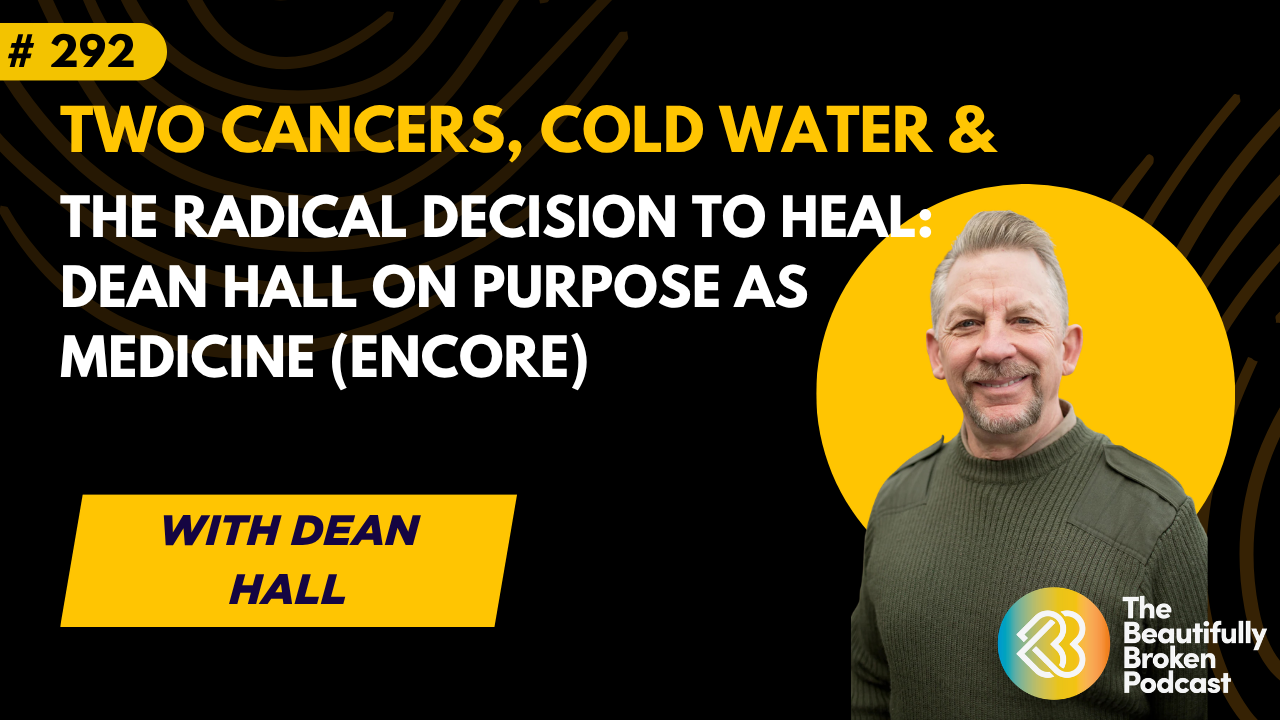
WELCOME TO EPISODE 292
Dean Hall was sick, grieving, and without hope — until he made a decision that changed everything: find something worth living for. In this powerful encore release from the Biological Blueprint, Dean joins Freddie to explore the terrain that no lab test can measure — purpose, spirit, and the courage to take just one more step. Drawing on Viktor Frankl's observations from Auschwitz, Dean reveals why it wasn't the strongest or the smartest who survived the unsurvivable — it was those most passionately tied to a purpose larger than themselves. He walks through his three pillars for navigating a dark night of the soul: releasing the need for perfection, trusting the body's innate ability to heal what it created, and the radical simplicity of asking yourself only one question — what is the next step? Whether you're 180 miles into an open water swim or sitting with a diagnosis that just changed your life, Dean's answer is always the same: you already know.
The second half of this conversation goes into territory rarely explored in health and wellness — transgenerational trauma, family systems therapy, and the epigenetic wounds passed silently from generation to generation. Dean shares how he's only recently begun mapping his own ancestral lineage, from a 14-year-old great grandmother who crossed the ocean alone from Sweden to fishermen and brawlers from Northern England — and how forest bathing and cold water immersion have become his most powerful tools for releasing what isn't his to carry. He also shares a profoundly simple breathwork and prayer practice he has used with thousands of clients over 20 years — a tool he calls centering down — that uses the brain's hardwired need to answer every question it's asked to surface your deepest purpose. One hundred percent of people who stick with it through the frustration, he says, find their answer. This one is worth a second listen.


Episode Highlights
[02:13] – Dean shares the world-record swims that reshaped his life after cancer
[06:36] – How mindfulness and purpose helped him endure extreme physical suffering
[10:20] – The sudden brain cancer diagnosis that took his wife’s life in just 52 days
[14:20] – Losing his identity after grief and feeling completely disconnected from himself
[20:52] – Discovering leukemia during a routine knee surgery workup
[24:30] – Viktor Frankl’s work on meaning becomes a turning point in Dean’s recovery
[31:00] – Why swimming the Willamette River became a mission bigger than himself
[41:22] – Attempting the 187-mile swim while living with active leukemia and lymphoma
[46:47] – How cold water immersion unexpectedly changed his mental and physical health
[51:20] – The shocking blood test that showed his leukemia had disappeared
[58:14] – Forest bathing, natural killer cells, and the role of nature in healing
[01:03:20] – How grief finally began leaving his body in the forest
[01:07:20] – Dean’s philosophy of “BioWild Psychology” and reconnecting with nature
[01:15:22] – Why people facing illness must become active participants in their healing
Links & Resources:
Dean’s Website: https://www.thewildcureway.com/
“The Wild Cure” book: https://www.thewildcureway.com/books
Upgrade Your Health
The Biological Blueprint Course: https://www.beautifullybroken.world/biological-blueprint
Earn 200 in BitCoin + Change your health
BEAM Minerals: http://beamminerals.com/beautifullybroken
Code: BEAUTIFULLYBROKEN
LightPathLED: https://lightpathled.pxf.io/c/3438432/2059835/25794
Code: beautifullybroken
Silver Biotics Wound Healing Gel: https://bit.ly/3JnxyDD
30% off with Code: BEAUTIFULLYBROKEN
StemRegen: https://www.stemregen.co/products/stemregen?_ef_transaction_id=&oid=1&affid=52
Code: beautifullybroken
CONNECT WITH FREDDIE
Work with Me: https://www.beautifullybroken.world/biological-blueprint
Website and Store: (http://www.beautifullybroken.world)
Instagram: (https://www.instagram.com/freddie.kimmel
YouTube: https://www.youtube.com/@beautifullybrokenworld
FULL EPISODE INTERVIEW
EPISODE TRANSCRIPT
Freddie Kimmel (00:01.494)
Ladies and gentlemen, welcome to the beautifully broken podcast. We're joined by our esteemed guest, Dean Hall. Welcome to the show.
Dean Hall (00:08.919)
Hey, thanks, Freddie. I am so excited to be here. It's almost a little embarrassing how much I've been looking forward to this conversation with you.
Freddie Kimmel (00:19.246)
Well, we had, tried, we tried and we got probably 10, 15 minutes into your story and the connection, just, it could have happened, but I was like, Dean, your story is so incredible and you're such a great speaker that I wasn't willing to let the world, at least this portion of my little world be introduced to you in that way. So I just wanted to get internet right.
Dean Hall (00:43.572)
Thank you. Yeah, I was gonna tell everybody it wasn't the connection between us. It was the connection Between me and my own crappy internet, but that's been solved
Freddie Kimmel (00:47.918)
It was not.
Freddie Kimmel (00:54.51)
Yeah, and now here you are in 4k. think I'd love to start out. Dean, you hold a world record?
Dean Hall (00:57.451)
Yeah!
Dean Hall (01:06.037)
I hold two. I am the first person in history to not just do one thing, but two, I am the first person in the world and still to this day, the only person to have swum the entire length of the Willamette River, the longest river in Oregon. It's 187 miles long. And the reason most people haven't done it is it's largely a snow melt river. And so when I did it,
We'd had a lot of snow that year and so it was exceptionally cold. It was 42 to 45 degrees Fahrenheit the first 16 days, which we'll talk about at some point. And then in 2017, I went over and I was finally no evidence of disease in remission and newly married, Freddie. I had warned my wife, but I...
You know, we got married a couple months later. I take her over to Ireland to show her what a badass I am. That's not what happened at all. What happened was just a struggle of endurance. was a great story, but that took me 25 days to swim their longest river, the River Shannon. And it's 180 miles long, but it had no current. had...
Three lakes that are so large, they consider them inland seas. And 23 of the 25 days, we had a 10 to 15 mile an hour or more headwind. And if you know anything about wind and water, if you've got more than a 10 mile an hour headwind, it moves the first two feet of the water in the direction of the wind. And so literally, I clawed out 180 miles like I was on a treadmill.
It was just inch by inch. And so it was really something. It was just this beautiful journey though, because I got my daughter to be my guide boater. And so she got that same time on the river that I did. And it was extremely healing for her grief journey having just lost her mom, you know, six, eight years before. Yeah. Yeah.
Freddie Kimmel (03:00.375)
Wow.
Freddie Kimmel (03:25.994)
Incredible. Dean, how does someone swim 187 miles? There must be some type of unique technique to open water swimming at that distance.
Dean Hall (03:40.853)
Yeah, two things. I technically, I use something called total immersion swimming, which is I had to change my competitive stroke to a total immersion stroke. it largely, I mean, you hardly kick at all. As a matter of fact, you stick your head and chest and shoulders down farther into the water. So it pops your feet up behind your torso.
and puts you in a good draft position. And then, in order to not exhaust yourself, you mostly use your core. I call it water yoga. You're just using your core and then using that core to pull mostly. And so it's this really nice, beautiful rhythm you can get into. And once you learn how the technique is so efficient, you can just go forever it seems. Now they found...
that anything over about 100 meters, if you're kicking, you're just creating drag. It really, it looks good, it looks powerful, but it really, unless you got big gigantic Michael Phelps feet, it really doesn't help. Yeah, yeah, really doesn't help. But mostly when you ask that question, the proper answer is the right mindset and attitude.
Freddie Kimmel (04:54.168)
Flippers.
Dean Hall (05:08.669)
Number one, I would just, you know, it pains me to see how most you hear most endurance swimmers talk and they're dissociating. They're singing a song over and over. I listened to one guy and he said he plays his favorite movies in his mind. That's total bullshit. Of course, I had
Freddie Kimmel (05:32.344)
Hmm.
Dean Hall (05:37.559)
by this time I started meditating one hour a day in October of 2000. And so by this time it was October, or January, June rather of 2014. So for about 14, 13 and a half, 14 years, I've been meditating and practicing mindfulness. And so for me, a lot of being able to do this the way I do it,
is a combination of just really being there and enjoying it and being alive, even when it's hard, even when you're hurting, even when you want to stop, just noticing that struggle. And I should preface that to say, I had almost died three times. As a matter of fact, I could, I wasn't pronounced dead, but there were three times I've woken up in the hospital and they said, whoa.
your wake. Yeah, we didn't think you'd make it. so, and then having my first wife die 15 days for our 30th anniversary, I've been given this precious gift through that kind of tragic event to realize how precious life is. And so when I just want to quit, when it felt like both times when it felt like it wasn't worth it, I would remember
hey, I'm alive. And I chose, this wasn't placed on me, I chose to do this. And I'm out here doing this great adventure. I'm not in a hospital wondering if I'm gonna live through the day. And so it really changes the way you look at things. And then the second thing in that mindset is, especially when you're trying to accomplish something no one in history has ever accomplished before,
I just would honestly continue to tell myself, well, if it was easy, somebody else in the history of humankind would have done it. So, you know, it's hard and that's okay. Yeah.
Freddie Kimmel (07:50.806)
Yeah. Yeah. Are you still actively swimming today? Are you still doing? Yeah.
Dean Hall (07:55.191)
Oh, yeah. Yeah, I didn't get my swim in this morning because I'm editing the final formatting of one of my books that's coming out here in just a short minute. But as soon as we're done, I've got I call it my beloved Clackamas. I've got a tributary that flows into the Willamette that comes out of the mountains. And it is so pristine and clean. As a matter of fact, the water quality is higher than the water quality.
in the drinking water in France, which might say something about the French, I don't know. But it's so clear and so clean that you can see every rock and pebble on the bottom. And you can see my swim buddies, trout and salmon. I know I don't have to share a lane with other humans, just other people with fins. And then we've got eagles roosting in 100 foot.
Douglas Furs. And so it's just part nature connection, part cold water immersion, part swimming. The Europeans call it wild swimming instead of outdoor swimming. And I love that or open water swimming because it feels very wild. So yeah, I rarely miss a day in the Clackamas when I'm home.
Freddie Kimmel (09:05.496)
Mm-hmm.
Freddie Kimmel (09:11.575)
Incredible.
Freddie Kimmel (09:18.998)
Incredible. Well, I want to give people some context, The evolution of your story is epic and there's different layers. And you mentioned the passing of your first wife. Can you take us there at that point in your life? What was happening and how did that unfold?
Dean Hall (09:39.733)
Yeah, it unfolded frighteningly quickly. She was the healthiest person I'd ever known. In 30 years, I can't really ever remember her being sick. She just, and she came, her father's parents came over from Germany in the early 1900s and brought what's called the Russian red wheat, which is largely used in Oklahoma now.
They were hardy stock. Most of them, as a matter of fact, one of her uncles, Uncle Elso, was still doing harvest in an unconditioned cab at 98. And so we just thought she'd live forever. She thought she'd live forever. And one summer, summer of 2010, she got pneumonia, which isn't...
that unusual in rural Kansas. During the harvest, there's so much wheat dust in the air and it's so hot and so humid and people are staying inside and going from hot humidity to very cold air conditioning and that creates, you know, kind of a recipe for disaster. And so we thought she had, she just became fairly listless and not full of energy, which was absolutely
not her. As a matter of fact, for 30 years she'd had two speeds, extremely fast and asleep. One of her cousins said that Mary could solve world peace before she could get her shoes on. That's how much energy that girl had. And so it was very unusual. And it just, to me intuitively, it felt off.
Because I had almost died of pneumonia two years earlier. I knew pneumonia and I'm like, you know, she's not coughing a lot. She's not struggling for breath. This is odd how listless she is. And so after a while I said, you know, let's take another look. The day after I said that, her whole right side felt of her face and she couldn't use her arm, was dragging her right leg.
Dean Hall (12:00.175)
And so we went in, they thought maybe she had Meniere's disease. That didn't feel right. Went in for a brain scan and they found the largest brain tumor the surgeon had ever seen of its kind in 30 years. brain tumors are operable to the extent they're high in the brain and forward. And hers was all the way back down around her brain stem. They told me that
Even with laser guided surgery at that time, there was an 80 % chance they would nick a nerve and she'd be a quadriplegiarist for life or they'd nick a blood vessel and she'd bleed out. But even if things went perfectly, they said it'd probably only give her another six months and that six months would be like living with the flu and a migraine all at the same time.
Freddie Kimmel (12:55.914)
Mm.
Dean Hall (12:56.331)
So we opted out and 52 days later she was gone 15 days for our 30th anniversary.
Freddie Kimmel (13:03.694)
Hmm.
Dean Hall (13:04.565)
Yeah. Yeah, and the ironic thing was I was considered a grief expert in the Midwest. I'd done seminars, I'd written all sorts of magazine and newspaper articles. And when she died, I realized experientially I knew nothing. As a matter of fact, I was so shocked by how difficult it was.
Freddie Kimmel (13:12.344)
Mm-hmm.
Freddie Kimmel (13:18.926)
Hmm.
Dean Hall (13:32.673)
that I called up some of my old clients and apologized. I said, you know, I didn't know. And they were gracious. And they said, Dean, you did fine. And I'm like, I'm not sure I did because it was just so terribly difficult.
Freddie Kimmel (13:44.056)
Yeah.
Freddie Kimmel (13:47.51)
Yeah. And how did Dean do in that time? How did you manage?
Dean Hall (13:54.519)
I lost myself. had always been raised by two mountain climbers. Even my mom was a mountain climber out here in Oregon. And they were the only parents in the 60s that I knew of that actually liked each other. As matter of fact, they were crazy about each other. And they were crazy about adventuring. And so even though I was extremely ADHD as a kid, I was out in the wilderness almost all the time.
And because they were so loving toward each other, the ripple effect is it developed a pretty secure, confident kid. I never really felt like I didn't know who I was. You know, all the other adolescents go through their times of angst. I really didn't. I was having a good time. And then college was fun and then I met Mary and she was great. But insidiously, Freddie,
Freddie Kimmel (14:44.707)
Mm-hmm.
Dean Hall (14:53.703)
I hadn't realized how much of my adult identity had been wrapped up in being Mary's husband. know, about six, eight months before we got married, she came to me and she said, you know, I love you. I'm always going to love you. But you came to Kansas. I didn't come to Oregon. And I'm close to my family. If you want to be married to me, you're going to have to live here. So I came home and Oregon just wasn't as beautiful without Mary. So
told all my friends I was putting myself in exile for love. And that's what I did for 30 years. And the people are nice, but I mostly hated it. I never fit in. And in this little rural town, four miles from the Oklahoma border, deep in the heart of what I call Red Neckary, if you hadn't grown up in this little town of 12,000, or your grandparents hadn't, you were an outsider.
Freddie Kimmel (15:48.342)
Of course.
Dean Hall (15:48.447)
And at first it kind of bothered me. No one called me by my name. They were like, there's Mary's husband or even to my face. Hey, how's Mary's husband? I'm like, my name's Dean. I quickly just forgot about that. you know, being Mary's husband was a good gig. And when it was gone, you know, I'd had 30 years where nobody called me by name. Really. They just called me Mary's husband.
And I didn't realize how that had shaped the man I was. And without that role, I was shattered. I was lost.
Freddie Kimmel (16:16.728)
Mm-hmm.
Dean Hall (16:33.911)
cried all the time, never really cried before Mary died. And I've been in a lot of hard situations, know, but raised in the sixties, know, guys don't cry, which is silly, but I couldn't talk about the weather. I couldn't, I couldn't talk about anything. And I had a pretty good speaking career going, had to cancel everything because I was talking, she was kind of my agent, more just kind of my promoter.
Freddie Kimmel (16:38.328)
Yeah.
Freddie Kimmel (17:03.438)
Mm-hmm.
Dean Hall (17:03.595)
a lady who helped me get these gigs. And we were just talking about some of the gigs I had coming up and I couldn't get through a phone conversation without just breaking down and bawling. I thought, geez, I can't do this on stage. And so I had to cancel everything. Yeah. Really lost.
Freddie Kimmel (17:22.446)
Mm-hmm.
Freddie Kimmel (17:26.264)
Yeah. And you and your wife, you share that you've both struggled with cancer. And that's been a recurrent theme, which so many people, that's going to be a part of the story. And where did that start for you,
Dean Hall (17:35.457)
Yeah. Yeah.
Dean Hall (17:49.047)
In four days before Christmas in 2006, I had played a lot of soccer as a kid and I saw not too long ago a t-shirt that said the older I get the better I was. And that kind of explains my soccer career. I thought it was pretty good. I was first team Allstate two years in a row. I was on the first Nike sponsored team and
an Olympic development team that took us to England and we played with Liverpool and Manchester. And so I thought I was great until I got to play with Liverpool and Manchester and they made me look like Bovo the dancing bear, which was a wonderful experience in humility for the 16 year old Dean. But so I had several scholarships around the U.S. and I on a lark because I love history so much and what a lot of people, unless you're a history nerd like I am.
don't realize how much American history is in Kansas. It's really even the start in many ways of the Civil War. And a lot of people don't know that with John Brown. And so I thought I could go and play soccer and go to Dodge City and go to John Brown's home and all these different places and get paid for it. So I did not knowing I'd meet Marion.
stuck there for the next 30 years. So what I lost track of the question. yeah.
Freddie Kimmel (19:21.622)
No, soccer. I said, when did cancer weave into your story?
Dean Hall (19:26.775)
Right. So all that soccer led to a really bad plant knee, my left knee, because I was right footed. And I'd gotten in a couple really bad accidents playing soccer and just pulled all the tendons and ligaments and had several knee surgeries. And so by the time I was 25, they said, Dean, you really need a total knee.
but this was back in the 80s. They're like the total knees right now only last about 20 years. And so you're gonna have to wait. And so I waited for 21 years till I was 46. And finally I was old enough to get this and they'd gotten better. They were gonna last 50 years. And so at 46, I decided, hey, right during Christmas, a lot of people don't want therapy.
from Christmas to New Year's everybody's busy so I'll go ahead and have this total knee surgery and then get back to work. And so I took a blood test and that's how I found out I had leukemia. And the doctor who is my good friend he's like, didn't you know, I mean most people with your level of leukemia are so tired and I'm like, yeah but I'm working around the clock I thought it was natural. So yeah.
had no idea I was that sick.
Freddie Kimmel (20:53.516)
Yeah. And what brought you to, Dean, where in the story does it unwind in which you're inspired to start doing these long distance swims? Like what was the impetus?
Dean Hall (21:03.733)
Yeah. Well, I got better and then I had a lot of bumps, almost died a couple more times after Mary. And after Mary, I sold my business. This little town was never going to let me be anything but Mary's husband. And even though that's where my thriving practice was, all my adult friends, I just thought, I'll fold everything back up and come back to Oregon.
Restart my life. I'd been homesick for Oregon for 30 years. So I thought why not and so I came back not knowing Now I don't have an income or a business or an identity or my adult friends or a community I am all alone and that isolation just just threw me into a tailspin and For the next two and a half three years. I just got worse and worse and worse
And then in August of 2013, Mary died in 2010. August of 2013, I'm 6'1", and I usually stay pretty lean. I usually run right around between 210 and 215. I was down to 152 pounds. I was skillful. And I've never been what I would call a pretty boy. But Freddie, I was ugly with a capital UG.
Freddie Kimmel (22:21.88)
Wow.
Dean Hall (22:30.647)
As a matter of fact, I was so ugly that I made it a practice for the last year or two never to look in the mirror because it was so disappointing and discouraging. And one day in August of 2013, I accidentally looked up and it shocked me. You could see every rib. could see, I mean, even the bones in my elbow and arm. mean, I
I become so emaciated. You could see my pelvis. It was pelvic bones. It was just, and I blurted out, oh shit, you look like you just walked out of Auschwitz. And one of the things I'd done many times throughout my career as a therapist is help people come back to life using Viktor Frankl's work, Man's Search for Meaning. And he,
actually had been in Auschwitz. And so the first thing I did was apologize. I'm like, hey, Vic, sorry. I realize I look bad. I have no idea what I just said. But it got me to thinking, you know, my daughter at that time now was 20. She lost her mama. Well, she's 21. She lost her mama October of her senior year in high school. And I thought if I don't get my head straight,
she's gonna become a 21 year old orphan. And I cannot, I cannot abide that thought. And me not being a responsible adult, being who I've always been, kind of moving forward, finding a way, charging, me just being a helpless, whiny victim, which that's probably overly gracious for what I had been.
is not only not me, but it's not fair to her. It's entirely selfish. So Viktor Frankl, if your folks aren't familiar with him, he had been an Austrian psychiatrist and he had wanted to study what is that deciding factor between those who succeed and overcome great tragedy or trauma and those who don't.
Dean Hall (24:54.635)
But when he went to set up his thesis, there's no way he could do it unless he put people through great tragedy or trauma, and that's not ethical. And so he started to do something else. And then he found himself in Auschwitz. And after a couple of weeks of just being shocked, he's like, wait a minute, I didn't choose this, but this is perfect setting to do what I wanted to study. And so he'd write little notes on scraps of paper and put them in the...
the cracks in the walls so the guards wouldn't find him. And his original hypothesis was the stronger physically people come in gives them the greater chance to survive. And he found very quickly that wasn't it at all. Even Olympians would come in and in a couple of weeks be gone or a couple of months depending. He found the more passionate you are about a purpose, the greater chance you have.
Freddie Kimmel (25:42.382)
Hmm.
Dean Hall (25:52.469)
to be resilient and overcome. And in Auschwitz, there were two main purposes. One is to see your loved ones again. The other one was to kill as many Nazis as you could. And so I used his book and his work and I had found no matter what the purpose, it really didn't matter. If a person was passionate about it, they would get better. And so...
Freddie Kimmel (26:04.62)
Mm-hmm.
Dean Hall (26:22.515)
I decided that's what I would do is I would become passionate about a purpose, but I couldn't think of anything. And so I don't know if you know, I'm sure you of all people probably do, but the brain by its very nature has to answer every question you ask. cannot ignore a question. You ask a question, it has to answer it. And I had taught people to do that for about 20 years and I'd done it many times myself.
When I'm really stuck and wanting a way out, I'll ask a really what I call juicy question prayerfully several times a day, just really heart with all my heart and soul, just concentrate on it and then let it go. And the longest I'd ever had to wait was about 10 days, about 10 weeks and it's still crickets and I'm getting frustrated.
And one day I'm doing this thing and then I just get frustrated and I open my eyes and it was like I'd woken up. I'd been living in this, I'd been renting for the first time in 30 years, which felt like a real failure. And I hadn't unpacked. All the boxes were still, I was living like a frat boy on a mattress on the floor and a...
I opened my eyes and I thought, well, you while you wait for the universe to answer your theme, maybe you could be a responsible adult and unpack and maybe put your bed together. So I started doing that. I started unpacking boxes and I found a journal. My mom had packed a bunch of my childhood things that she wanted to get rid of. Found a journal that I'd been forced to keep in the sixth grade as an 11 year old boy. And it said, when I get old, I gotta climb Mount Everest, swim the English Channel.
And to this day, when I think about it, still get the shivers. Just this electric shock just went through me and I'd forgotten the boy I had been and how I was eager to become a man. And all I wanted to do is become a National Geographic sponsored adventurer. That's how I wanted to live my life. But I was tired. You got to be responsible. You got to go to college. was brainwashed into this.
Dean Hall (28:44.787)
lockstep movement into adulthood. And so I'd forgotten about who I really was. And I thought, you know, even if I die, I got to do this. And then very quickly I realized, well, I'm broke, so I can't get to Everest probably. And my immune system is so depressed, there's no way I could handle altitude. But I can swim the channel. And so that's what I determined to do.
Freddie Kimmel (29:01.006)
you
Dean Hall (29:15.447)
And as soon as I did it, I spent 12 years as a triathlete and not a bad one, not a great one, but I was always in the top 20 or 30. And, you know, it was a good hobby. And so I'd done thousands and thousands of laps, but I hadn't done any for, well, really since before Mary died, really since before my first diagnosis. And so that first day when I pushed off the wall, I was like, here's Dean.
I remember you. And then I got one length and I didn't think I could make it back across the pool again. But I stayed and I did 11 laps that first day because that's what I promised myself I would do. It took me an hour. Now 11 laps maybe takes me eight or nine minutes tops. But I did it and every day I tried to add another lap and my head started to clear.
I started feeling like myself, started to get a little of my life back. All my numbers started going in the right direction. I started gaining weight and building muscle. It was hard as hell because I had lymphoma. And even though I had lymphoma, I didn't know much about the lymph system. Lymph system are your tiny kind of filters. And when you've got lymphoma, they're clogged and they only work if you're moving.
And so when I would move, especially that dramatically, I would know that within 30 minutes, maybe the rest of the day, I would have pretty severe flu-like symptoms because they would release all the toxins into my bloodstream. And so it wasn't just hard. Everybody's like, man, it must have been hard going and doing those laps. No, the laps, yeah, they were hard, but it wasn't as hard as knowing what was going to happen after you did them.
So it's just that was the hardest point because I didn't know if anybody would ever care I didn't know if I'd even live long enough to get to the river But even then Freddie it was better than just The way my last three years had been sitting doing sorry for myself. I was doing something I was passionate I had a place to put my mind and very quickly one day I after about three months of swimming
Freddie Kimmel (31:30.828)
Mm-hmm.
Dean Hall (31:42.997)
I was swimming more than a mile and the thought occurred to me, who cares if another middle-aged man puts on a speedo and swims to France? It does the world no good and in my case, it's not gonna be a pretty picture. We're not gonna create any posters off of this thing. And so then I went back and started prayerfully asking, okay, I've got this mission. I wanna do this swim.
what is it that I could do that would do the world some good? And because I was never, from the start, very interested in proving to anyone that I'm some kind of big badass because I was a broken down, cancer-ridden 54-year-old who had never been on a swim team in his life. Never won a swim race, so I'm no poster boy. And...
within a couple days that time of praying and asking this old dream of becoming the first person, it was 30 years old by that point, I'd been out here for a bike race and I'd done pretty well. I'd come in 18th out of like six, 800, I don't know. Not a podium, but for Dean Hall, was a win, you know? And my family, because they are who they are, they were real excited about it and so we...
They threw me a big picnic on the banks of the Willamette. And when I grew up, the Willamette was just a sewer. As a matter of fact, the big joke in grade school was if Jesus had walked across the Willamette, it wouldn't have been a miracle because it wasn't really water. was just an oil slick. But in the late 70s and early 80s, a lot of protection
laws, environmental laws got put in place and it was dramatically cleaned up and I'd been gone. And so here I am on the banks of this river that I'd always thought of as a sewer and it was gorgeous. It was big. It was blue. There was a lot of waterfowl. You could see fish. It was alive and things were growing and it just
Dean Hall (34:09.619)
energized me just standing there. And my dad came down and we were kind of talking. I looked at him thinking I was going to impress him because he's a man I always wanted to impress because he's run most of the world's major marathons. He's climbed every mountain on the West Coast many several times like Mount Hood. I think he climbed it the first time when he was nine and he climbed it in another 40 times or so.
This is a man I really respected. And I said, hey, dad, anybody ever swum this whole thing? And I thought he'd pat me on the back and say, that's my boy. He's like, that's the dumbest thing I've ever heard. He's like, where do you come up with this crap? Well, that stuck the hook in. Now I've got to prove him wrong. And so I worked on it for a couple of years. And then finally, Mary's like, how long is this going to take you?
And I said, probably about three weeks. It's 187 miles long and no one's ever done it. And she's like, okay. We're saving money to buy a house.
Who's gonna pay the rent and you're just gonna take three weeks off work? I'm like, I never thought of that. And so I put it on the shelf and it died. And I'm almost glad it had now because I wasn't the man. At that time, I wanted to prove what a tough guy was and I wanted to be in the record books. I didn't want to do the world any good. And I wasn't mentally strong enough.
Freddie Kimmel (35:44.119)
Mm-hmm.
Dean Hall (35:49.943)
I was physically way stronger than I was at 54, of course, but mentally I don't, I probably would have found a way to do it, but it wouldn't have been the same beautiful journey at all. Yeah.
Freddie Kimmel (36:01.834)
Mm-hmm. And so what changed? When did you pick it up?
Dean Hall (36:06.843)
well, that Christmas, it came back to me and I'm like, that makes sense. I was born only four blocks from it. I grew up with it. It came back to life. Maybe I can too. And it's right here. I don't have to travel all the way over to England. and it's, it's more organic and authentic.
Freddie Kimmel (36:21.954)
Mm-hmm. Mm-hmm.
Dean Hall (36:33.823)
I can develop a community right here. then at first my parents thought it was just insane and my mom cried a couple of times. But once they found I actually was gonna do it and I was starting to get some help from a local organization here. They jumped in and they wanted to be a part of it even though they were 79 at the time. And one of the coolest parts of the whole story
And you know, when you go for your dreams, Freddie, and I've seen this many, many times since because because I did this, I get to coach many people who are trying to do their own big impossible dream. And they know I can help them because I was able to do mine not just once, but twice and hopefully many more. And so I give them the mindsets and kind of help them know what the what the it's kind of Joseph Campbell's hero's journey, really, if you want to look it up.
Freddie Kimmel (37:13.944)
Mm-hmm.
Freddie Kimmel (37:30.52)
Mm-hmm.
Dean Hall (37:31.831)
But I help many people do it. What I've found is if you go for your dream, your dream's not going to be like anyone else's. But if you really do it, you'll be tested. But if you don't back down and you just keep moving through what I call the desert of big dreams, then pretty soon life is just going to be handing you these gifts that would never have come.
if you hadn't had the courage to follow your dreams. And one of them was, had, since it's 187 miles, I had six different kayakers guide boaters, because when you're swimming in a river, you can see about 40 to 50 yards ahead of you and about 10, 15 feet, but danger is always about 20, 30 yards. And then also when you get around places that there are boaters,
Freddie Kimmel (38:02.734)
Hmm.
Dean Hall (38:27.255)
You know, they won't be able to see in the water. So you've got to have a kayaker so that they know not to run over you. And so river swimmers always follow, most open water swimmers have to have a kayak in order to have safe safety. And so I had a set of six and a month or so, I think it was six weeks before we're actually going to start four out of the six dropped. And I'm just like,
We've been working on this for months. What are we going to do? Yeah. And they were all apologetic and they all had legitimate reasons. And my dad, I don't know if you've ever heard, there's a huge world famous relay race called Hood to Coast out here in Oregon. And my dad had been very instrumental in getting that off the ground and in the eighties getting it organized with the
Freddie Kimmel (39:00.302)
This is my team.
Dean Hall (39:26.487)
coordinator, Bob Foote. And so he's really good at, and because of all his multi-stage mountain climbs and backpacks, he's really good at breaking things down into stages. So he was helping me plan this swim and breaking it down into daily stages, where we'd get in, where we'd get out, how many miles we'd swim, what the conditions would be, all that kind of stuff. And so he's largely, by this time, involved in it.
And so I called him up and I'm like, jeez, what am I gonna do? What am I gonna do? And I thought, well, I thought he would say, well, you know, we'll figure it out. We'll call some people. But he was kind of quiet. And then the next day he calls me up and he's like, hey, Dean. And he does sound exactly like that. Almost worse now, cause he's 90 this year, but he's like, hey, I know what we're gonna do. And I said, what's that? And he's like, I'll do it. I'm like, oh, okay. Great. I'd love that.
especially for maybe a portion that doesn't have any rapids or switchbacks, know, on easier portion. He's like, what? I'm like, yeah, but what are we going to do with the other three that dropped out? He's like, no, no, I don't think you get it. I'm like, what's that? He was like, I'll do it. I'm like, yeah, that's what you said. He's like, no, I'll do the whole thing. We can call the other two, but we don't need them. I'm like, what? I'm like, dad, you're 79. He's like, no problem.
I'm like, dad, you've never been in a kayak. He's like, I'll learn, I'll learn, I got some time, I'll learn. And so that's what we did. We started getting in the river and doing practice swims and this environmental organization, the Willamette River Keepers that are just, we couldn't have done it without them, put us in connection with two of the best river guides in Oregon that knew the Willamette intimately.
They're on it every day for last 20, 30 years previous. They took Dad under their wing, showed him how to kayak, showed him what to do in different situations. It was just this cool thing. And so one of the beautiful gifts is I got to spend 22 days with my dad. And we'd always been pretty close, and we'd gone on some two, three, four day backpacking journeys.
Dean Hall (41:48.509)
never been together 24-7 for 22 days. And was life-changing. It really was. Yeah.
Freddie Kimmel (41:56.749)
Wow, unbelievable. Now for context, when you're doing this swim, you have two active forms of cancer, correct?
Dean Hall (42:07.733)
Yeah, yeah, I had chronic lymphocytic leukemia, is, according to Western medicine, is never supposed to go away. And then I had non-Hodgkin small cell lymphoma. And the leukemia had gone down a bit. It was mid-range. It was probably about stage two by the time that I swam. And my lymphoma was at about stage three, three and half.
when I smile.
Freddie Kimmel (42:39.938)
And what was the recommendation or the guidance? Did you tell your medical team you were going to be doing the swim?
Dean Hall (42:47.499)
Yeah, yeah. And they thought I was absolutely nuts. I was going down. My father had struggled with chronic lymphocytic leukemia, even though it's not supposed to have a genetic component at all. And what I think now, and there's some science that kind of proves it, we both love hot tubs. And he had gotten a hot tub when he was running and for 10, 15 years got in it every night.
And it made me jealous, so I bought a hot tub, got in it every night, and we used bromine, lots of it, and soaked up that toxin every night. And so I think for us, that's a large part of why we ended up with leukemia. But you never know. But anyway, he was almost to die in 2002 of leukemia.
And his insurance just wasn't helping him, giving him the right doctors. And thankfully, he had quite a bit of money. And so he found one of the world's best worlds. Number three, researcher and oncologist is Dr. Juanario Castro down at University of California, San Diego at their leukemia clinic. And so he'd fly down there very quickly. Castro turned him around. And when I was at my worst, my parents talked me into starting with Castro as well.
And so I did. And when I told Castro what I was going to do, it's like, Dean, this is going to kill you. And I'm like, I'm dying anyway. What do you expect me to do? Just sit and watch Wheel of Fortune on a couch? I'm going to do something. And this is what I'm going to do. And I'd like you to help me. And he said, OK, but let's schedule chemo and radiation for right after this swim.
and please, as you're swimming in the pool especially, take more frequent blood tests. And so he put up those strictures and I followed his guidelines and protocols and that's what we did. But he wanted to do chemo and radiation right away and I'm like, I can't do chemo and do this swim. Let's hold off. He was like, well, you're taking your life in your hands. And I said, well, I mean.
Dean Hall (45:07.731)
Isn't that where it's supposed to be? And he agreed. And so that's what we did. And so I originally was supposed to go down to California in July of 2014.
Freddie Kimmel (45:22.644)
Mm-hmm. And so what happened after the swim?
Dean Hall (45:26.583)
Yeah, I had this great time. I started June 3rd of 2014. And you have to remember, in 2014, people in Europe and some people had started hearing about Wim Hof, but I never had. I didn't hear Wim Hof till 2015. didn't even, I wasn't on Instagram. You know, being an older, crusty guy, I don't think I'd even heard of Instagram at that point.
There was no such thing. Nobody was cold plunging. But January of 2014, I knew that the conditions were going to be very cold. And so I thought, you know, if they're going to be shockingly cold, I better start getting my body because it's in such a mess. I better ease it in and acclimatize it to the cold. So I started taking ice baths.
And I started noticing huge benefits, not only for my body, but especially, and now we know that, you you're flooded with serotonin and dopamine and oxytocin and norepinephrine. I didn't know that. I just knew that this 5,000 pounds on my chest, my broken heart would be gone for an hour or two. And I feel pretty strong and pretty okay. And I was tempted many times to use it.
to ignore my grief, but I tried to be responsible and not do that, of course. so I swam and like I mentioned, it was really cold, 42 to 45 degrees for 16 days. I was swimming 10 to 12 miles a day, which, know, unless you've swam 10 miles,
that doesn't sound like much, but if you.
Freddie Kimmel (47:20.462)
Dean, I had one lap, I'm toast.
Dean Hall (47:23.543)
It's hard!
Freddie Kimmel (47:26.498)
You mean my heart, I don't think anything increases my heart rate like swimming. have Barton Springs. That's right, we have Barton Springs here and I'll swim across, get out, walk around, swim across, walk, and I'm three, four times that. I'm like, I'm good. There's my cardio. I mean, my heart's cranking. Yeah.
Dean Hall (47:30.987)
Really? Yeah, is this full box?
Dean Hall (47:43.891)
Oh yeah, yeah, yeah. I finally, because people are so unfamiliar with what that means, unless you're a swimmer or an athlete, I would tell people, hey, especially Oregonians, because mostly I spoke to them, I'd say, hey, any of you been down to Eugene? It takes about two hours to get there, hour and a half, two hours. Yeah, what was that drive? Oh, long.
Can you imagine riding a bike there? Oh yeah, that'd take a day or two. Can you imagine running? Oh, that'd take about three or four days. Can you imagine walking with a backpack? Oh yeah. Can you imagine crawling there on your hands and knees? And they start to look a little curious. And I said, can you imagine crawling there with a fire hose of cold water in your face? And they're like.
What? And I'm like, that's kind of what it was like to swim the Willamette. It was cold and I had my face sometimes would get so cold, it would swell up and stick to my goggles. I would have a hard time getting my goggles off. Every 45 minutes or so, even with the three mil wet triathlete wetsuit, I was going to thrombosis or what I call deep core throttle where you can feel your
Freddie Kimmel (48:41.838)
Yeah.
Dean Hall (49:05.416)
internal organs banging against your rib cage, which yeah, yeah. And that's kind of a sign that you should probably get up. And so can you imagine swimming for 45 minutes, feeling pretty significant hypothermia, swimming to the riverbank, finding as level of place as you can, doing jumping jacks or running in place for five or 10 minutes until your body warms up again.
Freddie Kimmel (49:08.482)
just to create heat. Wild. Yeah. Should probably listen to.
Dean Hall (49:35.403)
then I'd eat as much as I could. And then the hard part was talking to myself and getting back in. And I would have to do that eight, 10 times a day for 22 days. And so it was a real mental test. It was hard. And many times it was painful. But the beautiful thing is, and I think life can be so beautiful when you look back on it.
is the very hardest challenge. You know, I just tell myself, when my face was all swollen and I was thinking, you know, all day we had about five days where it did nothing but rain. And the first hundred miles, we got no press whatsoever because I think everybody was scared that just this lunatic was on a death wish. And so for days on end, we'd be
swimming and I was trying to raise money for the Leukemia Lymphoma Society and I was getting no press. Nobody wanted to talk to me and I'm doing this thing and thinking it's gonna be a total failure. Why am I doing this? This is so hard. But the hardest of all of it was just that intense bone breaking cold all day long. And yet...
come to find out the first blood test I took leukemia was gone and Castro he came in and he said you know I've been doing this 30 years if I hadn't diagnosed you myself I would have thought you've been misdiagnosed according to Western medicine this is never supposed to happen but I can't ethically say you have chronic lymphocytic leukemia even now because there's
hardly a shred of it left. It really put me into radical remission.
Freddie Kimmel (51:30.797)
Mmm.
Wow. Radical remission. It's a radical story. It's a radical story. It always gives me chills. I haven't asked for the audience, Dean, your book. We can't encapsulate it on a podcast. But if there's a book that you want to pick up and just have a smile on your face the whole time, you'll be with Dean and you'll be with Dean's parents on the river.
Dean Hall (51:35.445)
Yeah. Right.
Freddie Kimmel (52:02.774)
supporting him through this 22 day journey, in which you all everything that you're telling me because I've spent time with you and your family on in the book. I the coloring of your skin, the fatigue, the levels of exhaustion when you pull yourself out of the water, the days that didn't go right when you didn't hit the mileage that you wanted to, and it didn't feel like it was going to happen and then to finally get there. It's just a great story. And it's a great
you know, I wrote you into the biological blueprint because there's a section on magic, purpose, body, spirit. And all I think about when I read the book, I was like, I always see you swimming with a flag or a sail. It's a sail and it's filled with the most profound sense of purpose you could ever have.
Dean Hall (52:43.093)
Hmm.
Freddie Kimmel (52:57.43)
And so if you had to, there a, was there a dream or a statement that filled that sale for you?
Dean Hall (53:05.113)
yeah, yeah. The one that kept me going was one I made that I don't tell most people because I've used it with audiences many times and they're like, huh? But it made perfect sense to me. It was the extraordinary becomes possible when you make it impossible to remain ordinary. So I wanted to do this extraordinary thing. I couldn't continue to be the ordinary Dean.
I had to, as a matter of fact, put up many barriers toward being ordinary and what I had always done. I had to move over that and make it impossible to just stay Dean, especially that whiny, sad sack Dean that I'd been for the three years previous. But mostly what I did this for, I really thought it may kill me.
But I wanted to go out swinging for the fence and I wanted to go out trying to accomplish a dream and so I didn't want it to be about myself. I wanted to inspire other cancer patients. I felt like if they saw this old guy who had active cancer who was doing this thing that seems insane and he keeps doing it
and then maybe even succeeds and accomplishes it, then they will know in their heart that since I'm not special, since I'm not an Olympian, they too have exactly what it takes to refuse to be defined by their diagnosis. The biggest mistake I think we all make is calling ourselves a cancer patient because then it becomes our identity.
And it's not it's not a great identity. It's not a good place to be and so I wanted to teach others That we have the power inside of us even if it's not quote-unquote successful To determine how we go Even to the next day if not the rest of our lives
Freddie Kimmel (55:23.276)
Yeah. And so you got out of the river. And from my recollection of the story, you're supposed to start chemo and radiation because while the lymphocytic leukemia was gone, you still had stage three lymphoma.
Dean Hall (55:37.847)
Right. And Dr. Castro and I thought since the leukemia was gone, my body would have a greater bandwidth to be able to handle lymphoma and the lymphoma would just kind of dry up and go away. But it didn't. As a matter of fact, it got fairly aggressive. had, even before I started to swim, I had what Castro called my hockey puck under my right arm because it was the lymph node the size and shape of a hockey puck.
And then I had these huge, terribly swollen lymph nodes under my jawline that made it nearly impossible to move my neck. And I felt we're really disfiguring it. It was embarrassing to walk around with these big, almost, they almost look like, know, when people have gas masks on and hazmat, that's what it kind of looked like right here. I'm like, geez.
Freddie Kimmel (56:27.693)
Yeah.
Mm-hmm.
Dean Hall (56:35.639)
But those just ballooned and all over my body, they just started popping up everywhere. Under my clavicle, it was like gravel, same with my abdomen and groin. And then they started popping up all around my thighs. And I had over 76 or seven that we identified for sure, just manually. And so again, he's like, man, you gotta do chemo. And I...
I said again, said, well doc, you know, I'll do it, but I believe chemo is the atom bomb. And unless we are at the end and have no other choices, I don't want to drop the bomb. So give me six months. Nature healed me once. I'm going to see if there's something in nature that can heal me again. He was like, my gosh, me.
Freddie Kimmel (57:31.02)
He must have been so mad at you.
Dean Hall (57:33.867)
Well, he was one of the most loving, kind men I'd ever met. As a matter of fact, one of the first times I met with him, usually you go in, you see an oncologist. If you're lucky, you get 15 minutes. He spent an hour and 20 minutes with me the first time. This world-class oncologist. Many times with his hand on my knee. You know, just very caring.
And so thankfully he didn't show me he was angry. I think he probably was. He was a little frustrated and he said, well, if you're going to do this thing and I know you are, here's what you got to do. Here's the number that is your atom time to drop the atom bomb. And I was still, I had a margin away from that. And he said, instead of getting a monthly blood test for a time,
Let's get a weekly blood test. If that stays stable, then every other week. And I'm like, I can do that. So that's what we did. And within two weeks, I found Dr. King Lee from Nippon University in Japan, his research with men on forest bathing. He would take them into the forest. They would be very meditative in their walk, very mindful, using all their senses for an hour or two. And he found...
there's something in the forest emitted by the trees, an aerosol, an essential oil that's imperceptible called phytoncides. And these phytoncides boost your NK or natural killing cancer cells by anywhere from 50 to 200 times for two weeks. And so I thought, okay, I'm not that smart a guy.
But if they do it for an hour or two and it boosts them for two weeks, if I go out for an entire day every week, maybe this thing will become exponential. And so, I'm being raised by wolves, two mountain climbers. Going out into the woods was like not scary. It was like, I get to party kind of thing. Yeah.
Freddie Kimmel (59:47.981)
Yeah.
Dean Hall (59:49.751)
with no substances other than nature. I get to go out into my playground. And so I started going out every Thursday night, staying all night, and then all of Friday. And I started that May of 2015, and I'm happy to tell you that by March of 2016, my lymphoma was gone, again, without chemo or radiation.
Freddie Kimmel (59:56.622)
Mm-hmm.
Dean Hall (01:00:16.323)
And one of the most, I mean, that's a fantastic story, but for me, the greatest thing that happened both in the river and then in the forest was the healing psychologically and emotionally of that traumatic grief. Before I started swimming, I still was having three to six nightmares every night.
reliving Mary dying and everything that happened or some kind of crazy nightmare surrounding that. After I swam, I'd maybe have one or two a week. When I started, the day I started the swim, June 3rd, I still couldn't say Mary's name without crying. The day I got out, we were throwing a celebration for everybody that was part of the team.
And I started talking about Mary and because she was really funny. And so I was relaying funny Mary isms and we were all laughing. And then my brother in law is like, what's gotten into you? I'm like, what do you mean? He's like, you're talking about Mary. And I'm like, yeah, she was my wife for 30 years. It's like, Dean, you haven't been able to talk. You haven't even been able to say her name for four years without crying. And I was like, oh.
hadn't even noticed. And then when I got into the forest, that healing continued. I now think in the next 10 years, we will find especially traumatic grief is best healed in forest environments. Because I cried myself to sleep most nights. But I'd never woke up crying. And it shocked me the first night I'm there in my backpack and hammock.
way out in the middle of the wilderness, way off the path in this sweet, beautiful, resonant area of 100 foot pines and cedars and firs that seemed really friendly. And I got in the rack probably nine, nine thirty, woke up just convulsively sobbing.
Dean Hall (01:02:40.171)
And since I'm a therapist, I knew to break the old baby boomer training of big boys don't cry, just let your body release. And since there was no one around and no one could even hear me, I thought let's let the body do what it needs to do. And so for about an hour, I just vomited up all this trauma and grief and then slept like a baby. And I thought, well, that was interesting. It happened.
Every time I slept in the forest, I'd wake up just bawling until I didn't. Until I didn't need to anymore. And I found with the clients I've gotten to take out among the trees that if they've got held trauma or even just stress, after about an hour or two, I tell them the trees pull it out of you. Do I scientifically know all the ins and outs? No, I think we will.
but experientially, it's something I'm absolutely sure of.
Freddie Kimmel (01:03:42.223)
Yeah, it's profound. know, there's a lot of, it's really interesting. I want to go back. drew this figure eight on my, a little, I like podcasts like this. I have, yeah, I map, I'm mapping things for my brain just so I can go back. And here was, I just had a peptide expert before on you mapping out just, I'm weird. And so I drew this figure eight and
Dean Hall (01:03:55.487)
Nice! Wow!
Dean Hall (01:04:05.719)
I
Freddie Kimmel (01:04:10.668)
I find it interestingly resonant that you grew up in a place where you mentioned this river which was sick, covered with oil and that you took a departure from for 30 years and you went to the middle of the country. And on its own timeline, it let go of its illness. And on your own timeline, you let go of your illness. And there's a tie-in to that river.
And I find it so interesting that that intersection, how it meets with your body being willing to let go or being the impetus or the onset to let go of some of that grief and it let go of some of this toxicity. And then here you are today, both in a unique expression and being very revitalized. Very, very, very resonant. And I see, I just see this really clear figure eight. I love that. Yeah.
Dean Hall (01:05:00.821)
Right. Yeah.
Freddie Kimmel (01:05:08.942)
I love that. you're like, I don't have Evans, but I believe this to be true, that that's been your experience. Now, I have five or six examples of people who have done this in nature and throughout time. And I do remember stories of some of the initial, I think the recounts of the Roman military
acquisition of different countries and warriors would come back from being out years and years and years. And what they found is they were coming back being with their wives and either they would kill themselves or sometimes they would kill their families. And what they found they needed to do is park this warrior mindset out in the woods alone, oftentimes with mushrooms, and let the vibration of war be pulled out of them by the forest.
Dean Hall (01:05:56.823)
you
Freddie Kimmel (01:06:03.638)
And there was this transition time and it's something that makes sense to me in my brain. But it's something that oftentimes we try to out think, right? I can just jump back into life. I'm good. I don't need to whatever this grieving process looks like. It's something that you found and crafted intuitively. And then you had an experience where, well, it worked. You know, so I think your experience
Dean Hall (01:06:09.4)
yeah.
Freddie Kimmel (01:06:33.034)
your deep knowing is valid. I don't think we need the double-blind placebo study.
Dean Hall (01:06:35.953)
yeah, know. Nor do I. mean, I've got so much anecdotal and experiential experience with myself and others that here in the last few months, I've developed my own little brand of psychology I'm calling bio wild psychology. And it's very different than other forms of psychology in that
It starts with a different premise and ends with a different outcome. And then you have to do much different things in between. But for example, the start, the beginning, the way I was raised or trained as a clinical therapist is we start by looking at the person and their experiences, their family and their wounds.
and diagnose those wounds and concentrate on those wounds. In other words, it starts with the person. To me, that doesn't fit nature at all. It's like taking a tree and trying to just dig it up and then look at it. That's not how life works. We are bioelectric energetic beings. That's not hippie hoo-ha anymore.
I always kind of intuitively knew it wasn't, but now we do have research proving that it isn't. And so I believe at the start of BioWild psychology, the way you start is looking at how well charged the human being is. Are they getting out and connecting with nature? Because that, we live on this big battery. And if we don't plug into the planet, we are not
going to be happy or healthy or vibrant because we are at a low charge. You know, people plug in their cell phones every night so that the cell phone will work efficiently. And we experienced what happens when you got crappy internet. You got a poor connection. And yet we want a strong connection with ourselves, with those we love, with our purpose and with
Dean Hall (01:08:56.981)
the world and yet we never take time to plug ourselves in and charge. And so that's how BioWild psychology starts is starting with teaching people in their way how to recharge and how elemental that is. And then how most psychology ends is the person's happy, stable, healthy and strong by themselves.
The end result is a stronger human being. Well, that doesn't fit nature. A tree doesn't become the biggest tree in the forest to be the biggest tree in the forest. That makes no sense. so by a wild psychology, the outcome is to give from your overflow, to be so happy, so healthy, then then you give you bear fruit and you give to others.
It's a more natural evolution and form of therapeutic intervention that I think makes more sense and is much more aligned with who we are in nature.
Freddie Kimmel (01:10:09.506)
Yeah. Amen. Dean, have to have you back on because I do. it's been as many times you ever want to come back. And I want to be respectful of our hour. I would love to just do a couple end questions. And I just want to say that I'm hearing you give this recount of this incredible story and please go read Dean's book. Tell us the title of your first book.
Dean Hall (01:10:11.521)
I
Yeah, I'd love that.
Dean Hall (01:10:20.584)
yeah.
Dean Hall (01:10:38.219)
The Wild Cure from Death to Life on Oregon's Longest River. And I'll just have to plug real quick. I think you're gonna like it. We wrote it specifically so that it's about a two sitting read. It's not a long read. And we rewrote the entire book three different times because the first two times, it just felt unlike me. It felt like I was bragging and talking about myself. And so Bree,
who helped me write it, my daughter, who's an author and a novelist, she got the idea of creating what's called braided interview. And so she interviewed all the team and everybody that was involved, and then she's taken those and threaded those together so it creates the narrative. And so you get to see everybody's adventure and what this thing did for all of us, not just me.
And so to me, it's much more organic and authentic and much less filled with inflated ego. I hope.
Freddie Kimmel (01:11:45.305)
Yeah. Yeah, that was my experience, my experience. And then I also want to comment is that, you know, a lot of times we can hear these stories and by no means, I know you're not telling people to forego doctors and chemotherapy and medical advanced treatments. it, it's easy to listen to your story or to, to jump into a sound bite about what Dean did and say, well, actually what Dean did was he listened to his dad.
Dean Hall (01:11:48.912)
good.
Dean Hall (01:11:58.615)
No.
Freddie Kimmel (01:12:13.014)
and he listened to an expert medical team and you went and you sought somebody that was that understood the nuance of these how to boost a natural killer cell within nature and you had a timeline and you had checkpoints. So I think that's a really important part of the story that we want to throw those away. You know, you did have some good safeguards. You had a team around you. And I just give that for people hearing the story in its full context.
Dean Hall (01:12:38.517)
No, I think it's really, I'm so glad you mentioned it because I get a lot of hate online. I'm killing people and all this kind of stuff. They make me too binary. They make it seem as though I'm against chemo and radiation. And I'm not at all. And I'm not against regular Western medicine. I just wanted to hold off some of those things.
to see what I could do without them until I knew I couldn't and I had the checks and balances like you said. I think both and approach is the wisest. Yeah.
Freddie Kimmel (01:13:17.806)
That's right. That's right. And in the same breath, I'll applaud you for taking radical ownership of your health. It's a great tale, great story. Give us one of your favorite lessons from the river.
Dean Hall (01:13:35.169)
that we are not superior. We are so ego-driven. We are, we think we are the pinnacle of creation. And we, I believe, are only equals here on this planet. Everything is so much more full of life and bio-intelligence than we'd ever guess in our current culture.
And you look at the ancients and the indigenous, they knew that. And we see that style of thinking as primitive, but it's actually, I believe, advanced. And all of science is starting to prove that to us. You know, I developed a real, as crazy as it sounds, a real relationship with what I call Mama River. And she healed me. And I even see myself as one step down.
from her because she's big and beautiful and wise and did this thing and called me to her. And some of the big trees, I feel the same. And so we are just one of the many living species on this earth. We are not the diamond that we think we are. And once you let go of that, life becomes
Freddie Kimmel (01:14:58.925)
Yeah.
Dean Hall (01:15:02.551)
beautiful synthesis and a symphony of life all around you that can only bring a bit of gratitude to you every day.
Freddie Kimmel (01:15:16.024)
beautiful. And then if you would be so kind to people out there that are struggling with a chronic illness or going through cancer, if you could offer them some guidance and advice, what would you say?
Dean Hall (01:15:30.515)
Remember you are the boss of your body and do whatever you have to do to be your own best advocate. If you go in there and expect, and I see this happen time and time again, people go in and they see the doctor as either a parent figure or a godlike status and they put all of their trust and all their hope in the doctor. And then even when they get better,
Most cancer survivors that I know that have done that are scared constantly that they're going to go out of remission because number one, they don't know what the hell the doctor did or they give the doctor or the medication credit and not the process of healing. And so go in there and know that the doctor is your expert consultant, but not your boss.
You are the boss of your body. You've got to own this. And for most of us, there's a reason you're sick. And so you might have to unlearn it. Some people like Mary, I think just get poisoned. know, she grew up in this small town, got washed over with DDT many times as a child. And I think that's probably why she got a brain tumor. Me?
No, I was heart sick, heartbroken, eating like crap, never sleeping, and feeling sorry for myself. And that mental and emotional state led to sickness. So you need to know what you've been doing and what you can do in order to get better. You've got to be in charge of your own process.
Freddie Kimmel (01:17:20.75)
Beautiful. Dean, it's one of the best interviews I've ever done. So I'm inspired. And it's very divine that we had to punt and wait for better signal and better bandwidth because yeah, I had an amazing night's sleep and I got in the cold this morning and I sat and did breath work this morning. And when I was done, I was like...
Dean Hall (01:17:23.954)
wow. Well, thank you.
Dean Hall (01:17:38.135)
good.
Thank you.
Freddie Kimmel (01:17:45.824)
I just felt so open and ready to sit down and hold space for this. So I can't wait to do more.
Dean Hall (01:17:51.479)
Yeah, anytime. Especially you being you. You know, I've told you before, I'm probably one of the biggest Freddie fans out there. So anytime you want me back, brother, I'm here. Thank you. All right. Take care. Bye bye.
Freddie Kimmel (01:18:05.058)
I love it. Thank you for all you do Dean. Big love.