Biological Medicine: Exploring Homeostatic Imbalance, Cancer Factors, and the Mind-Body Connection with Dr. Dickson Thom
Aug 21, 2023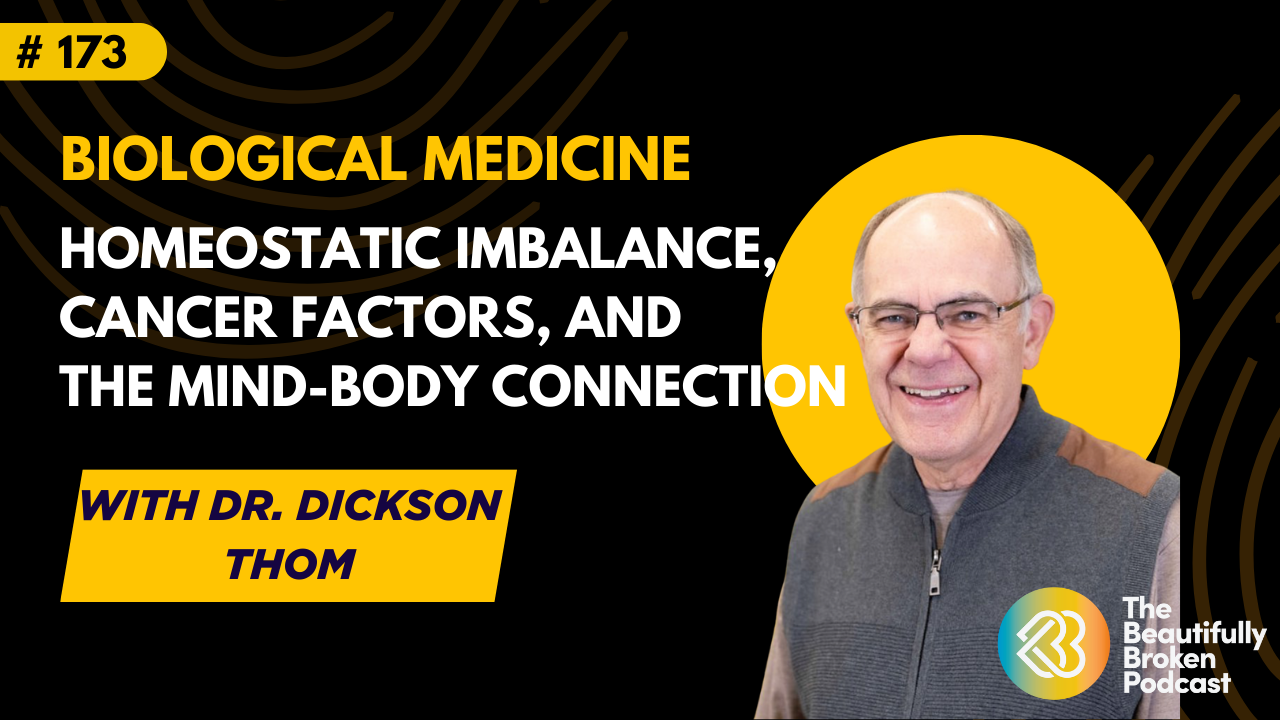
WELCOME TO EPISODE 173
Why do people settle into a homeostatic imbalance, leading to chronic illness? Why do people develop certain cancers while others don't? What are the contributing factors? Where does the line between the physical and emotional body ride?
Answering these questions take a holistic approach to medicine, knowledge not just about the body but also the multiple factors that can affect it both inside and outside us.
With over 45 years of experience in medicine and a focus on naturopathy and biological dentistry, Dr. Dickson Thom is joining us today to answer these questions and give us a more profound clarity into the inner workings of our bodies.


Episode Highlights
[0:00:00] Introducing Dr. Thom and Biological Medicine
[0:08:03] How Dr. Thom Would Treat Strep Throat
[0:14:09] Dr. Thom’s Start in Naturopathy and Biological Medicine and the Development in Dentistry
[0:18:52] Genetics and How It’s Affected By External Factors
[0:28:20] Early Education on Holism
[0:33:25] Dietary Temperament
[0:38:13] How to Reprogram Your Body
[0:48:36] How to Start Someone on Biological Medicine
[1:00:25] Having Someone to Guide You to Better Your Health
[1:07:30] Planning to Get a Whole Picture of Your Health at the Arizona BioMed Center
[1:19:39] Getting Sick is a Process, Which Means Healing Should Be a Lifelong Journey
[1:23:41] Being in the Mindset of Healing
[1:26:36] Dr. Thom’s Message to Everyone
[1:30:00] Outro
UPGRADE YOUR WELLNESS
Silver Biotics Wound Healing Gel: https://bit.ly/3JnxyDD
Code: BEAUTIFULLYBROKEN
LightPathLED https://lightpathled.com/?afmc=BEAUTIFULLYBROKEN
Code: beautifullybroken
STEMREGEN: https://www.stemregen.co/products/stemregen/?afmc=beautifullybroken
Code: beautifullybroken
Flowpresso 3-in-1 technology: (https://calendly.com/freddiekimmel/flowpresso-one-on-one-discovery)
CONNECT WITH FREDDIE
Work with Me: https://www.beautifullybroken.world/biological-blueprint
Website and Store: (http://www.beautifullybroken.world)
Instagram: (https://www.instagram.com/beautifullybroken.world/)
YouTube: https://www.youtube.com/@freddiekimmel
FULL EPISODE INTERVIEW
EPISODE TRANSCRIPT
Freddie Kimmel (00:01.47)
Ladies and gentlemen, welcome to the beautifully broken podcast. I am here with a man that I've been listening to speak for almost 15 hours straight as I go through my intro to biological medicine training course, Dr. Tom, welcome to the show.
Dick (00:16.5)
Thank you very much. It's a pleasure to be here.
Freddie Kimmel (00:19.006)
Yeah. You have such an incredible way speaking about the body and the body systems and wellness. It fascinates me. And I take a lot of courses. I've done a lot of online trainings and I'm, I said this to Liz from Marian. I said it to Jessica and Christine and Michael Baldwin that I'm lit up for the first time in a long time. It's a new lens to view the body. So I'll start out and I'm going to ask you, how would you explain
biological medicine if this was something new to me.
Dick (00:51.744)
Biological medicine is, I would say, the oldest form of medicine that there is. It literally goes back three centuries BC, before the whole idea of understanding that there were so-called things that you would, medication specifically. So what did they use? They used what they had. They used herbal medicines. Chinese medicine has been around for a long time. So biological medicine is simply looking at the body.
the body systems, the body organs, and without necessarily looking at the symptoms that the patient presents with. Because I really believe that the patient's symptoms are not their problem, but it's understanding why they have the symptom. And patients tend to think that the symptom is what's causing them the problem. But it's the physiologic reaction that the body has to...
you know, whatever it is that they're experiencing that is creating what they're not pleasant with. So I use a common one, which is like a strep throat. You know, people go to the doctor, they have a sore throat, they can't swallow. The doctor looks in there and he takes a swab and he says, oh, your throat's all red. And you know, you have these vesicles. Let's do a swab. Oh, you have strep throat. And people think, oh, it's due to the bacteria strep. And I said, actually, no, it's not due to the bacteria strep. It's due to the body's reaction to the strep.
So your problem isn't to get rid of the strep. The issue is that if we didn't have an immune system that would react to create a fever, to create redness or create soreness, we would just keep doing it. And ultimately we would further injure our physiologic processes. So the symptom, when you take the symptom away, you actually are losing the opportunity for the body to truly heal from a biological medicine perspective.
So the focus of our treatment is not to treat your symptom. The focus of our biological medicine is to understand the system or in most cases, systems that are creating the symptom. And so when you address the organ systems, the symptom is no longer necessary. And so it goes away, which is a very different approach than what conventional medicine is because conventional medicine says, well, if you have a headache,
Dick (03:16.148)
take an Advil and I said, well, what happens to the headache? Oh, the headache went away. Oh, so that means you have an Advil deficiency? No, you don't have an Advil deficiency. What you have is you have one of potentially, maybe you just needed your neck adjusted. Maybe you were dehydrated. Maybe you were hypoglycemic, or maybe you didn't sleep well. So there's all these other things. So when we look truly at biological medicine, we're really trying to understand the processes that
that physiologic process and biological processes that happened over time. And I would say the other big difference that I think then, whether you talk about functional medicine or integrative medicine or generative medicine or naturopathic medicine or whatever other name you want to apply to it is, you know, what I tell most patients, the reason that you're here, the reason that you came today, be it headache or PMS or Lyme disease or...
stage four pancreatic cancer, that may be what brought you here. But what I look at is, but how did you get here? Like what happened last year and the year before and what happened in utero? What were the things that were going on that created the imbalance physiologically that then resulted that at some point in your life, you started to have these symptoms? So it's a much more encompassing, it's much more in detail. It's not like, oh, here, I have 10 minutes to talk to you.
I tell people it may take me six hours of investigation just to try and understand what your problem is. So it's a very in-depth, very detailed, but happily very satisfying way to approach people's and looking at people's health. And the most important part is that in addition to that, we teach people. It's really an educational process. It's an educational process that allows people to learn what it is that they need to do for themselves.
Freddie Kimmel (05:07.915)
Mm-hmm.
Dick (05:13.832)
You know, they can come and talk to me once a month or every two or three months, but it's not what that hour is about. It's the, what about all the hours in between? What are you doing for yourself? How are you taking care of yourself that ultimately will make the biggest difference as far as your healing is concerned. And yes, we do support people who have pain or, you know, whatever their, their issue is because we have so many different types of therapies that are available to people.
But if you don't understand the philosophy of what it is that we're trying to do to truly try and understand what is the true cause, and I really mean the true cause, the root cause, the terrain, so to speak, as I like to say, that's where the true healing occurs. And there is, I tell people there's no such thing as an incurable disease, but there are incurable patients.
Freddie Kimmel (05:57.204)
Mm-hmm.
Freddie Kimmel (06:11.486)
Yeah. Yeah, that's been my experience too. It's really fascinating. There is tons to unpack there. And I just want to walk back on one thing, because I know somebody could listen to this podcast, not really having an understanding. And this is, well, this doctor just inferred that if you have strep throat, you don't need to do anything. So give me an example of some way you would support the organs or organ systems of somebody going through the strap, which I can tell you, we used to call
me and my brothers and sisters, we used to call it the pink stuff. We got the strep throat medicine like candy and we were like, mom, are we getting the pink stuff? And I took, I don't know, I was always on medication for strep throat. Always. And you know, ear infections and tubes in my ears and they took my adenoids out. And it was like, that was like my thing growing up. It was fascinating.
Dick (07:04.82)
So definitely I do never want to leave the impression that we don't do something. So strep throat is treated routinely. And so that puts us into a realm of therapies. So the most common and most effective therapy that you could ever use is water in various ways. We have water as steam, we have water as ice, and we have water as liquid. So when somebody has a problem,
When we keep, we'll use strep throat as the example. So what do we wanna do? We somehow want to increase the individual's own immune system to come and deal with the bacteria that's called strep. And so we do what we call a heating compress. So we literally, we want to bring blood into the area, which in any time you bring blood, you bring more nutrition, you bring more oxygen, and you also are able to remove the...
the breakdown products of the bacteria dying because of our own white blood cells that are part of our immune system. So we start with just having them gargle. You can gargle salt water, alternating with gargling probiotics and then spit out the salt water and swallow the, we do those like every other hour or so. And then when they go to bed at night, we wrap, take a wool sock, ring it in ice water.
We use it and put it on their neck, hold it with a safety pin, and then we put a wool scarf over top and they go to sleep with that on. So those are the two simplest things that people can always do at home for that type of thing. But of course, in addition to that, I use homeopathic remedies. We can use vitamin C. We can use just, you know, nutrition, you know, simple nutrition that once again, you could easily have at home to deal with that thing.
Um, the other thing that typically happens is that when you have, you know, that much inflammation going on in your throat, you always will have lymphatic congestion because there's so many lymph nodes in our neck and often they're swollen when somebody has a, so we do lymphatic treatments. The two best lymphatic treatments are a castor ophec. We actually do it over the entire abdomen. Before you go to bed, we do dry skin brushing. Uh, so with those two things enhancing.
Dick (09:27.28)
the immune system and in fact in addition to the heating compress on the neck We can do the same thing on the feet by having people wear what we call warming socks You warm your feet up before you go to bed and you wring out cotton socks or wool socks your cold socks You put them on you put dry wool socks over top you go to bed in the morning They're dry and what you've done is you dramatically improve circulation and your lymphatics So we've got more blood going in more waste products coming out
We've used some homeopathics, we've used some nutrition, and no longer does the knee jerk have to be, or you have to take an antibiotic.
Freddie Kimmel (10:04.83)
Yeah. Fascinating because I, I can't remember. I want to say there was a, there was a time in which there was a time I understand. I almost want to say it was my, either my grandmother or, you know, before my mom's generation, where there was the conversation about the risk of strep advancing and actually infecting valves of the heart. So there was a generation, if you remember, my grandmother had actually had surgery on a heart valve because
her heart had been damaged in some way by the strap. What, and now that doesn't seem to happen as much anymore, but that was a generational thing at that time.
Dick (10:41.012)
So strep, you know, you talk what you're talking about is rheumatic fever. It also, rheumatic fever is a potential consequence of, we'll say, of untreated strep or glomerulonephritis is another one that typically would come. Now it doesn't happen because the chances of getting those from strep, and I think the doctors will say, well, that's because we give everybody antibiotics. I said, well, even if you didn't give people antibiotics, chance of developing one of those consequences is about the same as getting hit by lightning.
So people do get hit by lightning. So rheumatic fever still is a disease. Glamour and arthritis is definitely still a disorder. However, it's not near as where it's common because I would say, you know, right now in the United States, 350 million people, there's probably, you know, a few thousand right now who have a strep throat, who don't even know it. And so strep is there. And if their immune system is dealing with it, they may say, oh, my throat's a little sore, it's a little scratchy, and then tomorrow it's gone.
Freddie Kimmel (11:12.054)
They do, yeah.
Freddie Kimmel (11:30.306)
Yeah.
Dick (11:40.136)
So they don't mount a response necessary that, oh, but what you talked about, you said you sort of lived on the pig stuff that many kids have per se. It's like, and you never give the chance for your own immune system so that the next time it sees it, it doesn't know what to do. It never, you didn't learn the lessons. So you gotta learn it the next, so it says next time you get exposed to strep, and we all do, you just walk around in our environment. I mean, these are, these microbes are.
everywhere and they will always be everywhere. The more your immune system gets exposed to things, the better the better reaction. So we say, oh, that's why people do vaccines. I said, well, that's a whole other point. I said, yeah, but if you had the illness, you have, you have much better vaccinations and are much better immunity than you would from taking a vaccine against specific illness. So, you know, I say that children
ideally should be getting, you know, a baby should be sick three or four times. But don't give them Tylenol. Worst thing you could ever give a kid is Tylenol. And I was, I celebrated when they had a Tylenol shortage during COVID, because now we are associating, you know, Tylenol, unfortunately, it's, it is the most common remedy that sends people to the emergency room for acute liver failure in this country and still does.
Freddie Kimmel (12:40.29)
Mm-hmm.
Freddie Kimmel (13:01.462)
Yeah, yeah, I've seen that stat. Dr. Tom, when did you develop this way of looking at the body and the organ systems and when did biological medicine come into your life and how did that happen? Was it like a lightning bolt moment or is this a process over time?
Dick (13:20.6)
Um, I have to say that now it was my whole life. Um, the reason is my parents are very poor. Uh, they couldn't afford to take me to a doctor. Uh, you mentioned your grandmother. Well, it was my grandmother too. So my grandmother said, when you get a, when you get a cough, you were going to do a mustard plaster on your chest. Uh, if you have a sore belly, we're going to do a castor oil pack. You have a sore throat. We're going to have you gargle salt water. Uh, if you have an ear infection, we'll use.
you know, some garlic oil and mullin in your ear. If you had a fever, we will put you in a tepid bathtub. That's the way I grew up. I was never given an antibiotic. I was never given any type of painkiller ever in my entire life because I, so my exposure was hydrotherapy. That's any type I had an illness, that's what you did. You rested, you ate simple foods.
Freddie Kimmel (14:05.493)
Hmm.
Dick (14:16.412)
You eat broth or soup, the proverbial chicken soup for the grandma did. So I was exposed to this really from the get-go. And then of course, my first career as a dentist, you go on the dentistry and you have all these medications. And I said, I don't take medications. Why am I going to give these to my patients? Yes, I use local anesthetic, but you know, people would have these infections and it's like, wow, I mean, I have to use an antibiotic. I got other things I can use.
even as a dentist, I was sort of an outcast and I wasn't, I didn't use what, what I was even taught in dental school to do. And then I found that I could use hypnosis, uh, and give post hypnotic suggestions to people, you know, after remove their wisdom teeth or whatever I did. And it's like, free. They'd say, I don't need any painkiller. I didn't feel anything. So that was the way I did it. And I was, I in the 1970s, I was telling people to never put an amalgam in your teeth, tooth.
Freddie Kimmel (15:06.774)
Mm.
Dick (15:15.072)
was very unpopular to do back in the 1970s. So it wasn't a lightning ball, that was my whole life.
Freddie Kimmel (15:17.31)
Yeah. What do you think?
What do you think the rate of shared reality or how that belief system has changed that mercury is either good or bad in the mouth? I mean, it's much more in the conversation today. Even your non-biological dentists, they're starting to talk about alternatives. But how have you seen that move forward in your time in the dental industry?
Dick (15:45.512)
Many years ago, so speaking to dental suppliers, they told me eight years ago that less than half the dentists in the United States buy amalgam to put in people's teeth. So they may not say it out loud, but they don't use amalgam in their office. So where do we see amalgam still being used? Unfortunately, in the worst possible cases, and that's in under-serviced communities, in free clinics, because amalgam...
Relatively speaking is inexpensive relative to some of the composite materials or other types of positive possible filling materials that are being used But if you're Dennis if you go to a dentist and he still has amalgam in the office is like, oh my gosh This person has not kept up Everybody knows that mercury is potentially one of the most toxic things you can put into your nervous system And that's where it goes You know it stays in your tooth
Freddie Kimmel (16:17.492)
Mm.
Freddie Kimmel (16:25.122)
Yeah.
Dick (16:44.372)
but it doesn't stay in your tooth because just the eating and grinding and that kind of thing, you're gonna vaporize some of that mercury.
Freddie Kimmel (16:51.494)
Yeah, you know, I was in a I was in a production of in my former career, I did Broadway Music Theater, I was in a production of Alice in Wonderland. And of course, we're doing research on all the parts and the mad hatter. And so we started to read and I was like, Oh, this is based on a real disease of mad of hatters working with the felt and, and a mercury vapors and materials to
Make the felt malleable and that's it was a thing. That is wild to me Wow, yeah
Dick (17:21.66)
Yeah, it was a thing. It was a thing. That's what it did. That's indeed what it is. And now, you know, it definitely is mercury amalgams that are the highest exposure that our community has. Yes, you get some at fish and stuff, but by far it's the feelings in people's teeth that creates the highest level of it. And the unfortunate thing about when you look at just mercury, you know, you can do these studies, oh, it's not so bad. It is bad. It's the trouble when you combine it with any other material.
So if you did like, you know, how much mercury would it take to kill a mouse, you know, and then you put one other product method, let's say arsenic, well, suddenly 100% of them die. So you go from 1% to 100% just by the presence of another heavy metal. So heavy metals are a problem in our society, obviously because of industry. So people are exposed to this stuff all the time.
Freddie Kimmel (18:14.75)
Yeah. It's interesting what you say. It's like we, I guess up till now and more and more I'm exposed to more ideas of wholism and systems and systems thinking. But because I grew up in the system I grew up in and even in the wellness world of biohacking, people almost want to, maybe it's capitalism or marketing, they want to separate out and be like, this is the thing that you need to be afraid of and this is the thing that I'm going to sell you a solution for.
not understanding and people, the common question I get on Instagram is, well, should I get this? Is this good? Should I get this thing? Well, I was like, well, yeah, it's like, you know, the red light, you turn on the red light, charges yourself, it gives you energy. But what your body is going to experience, I mean, I'm irresponsible for me to ever say, it's just a very simple modality. But looking at the system, you know, so this is what really interests me is the education around
Freddie Kimmel (19:16.014)
In one of the slides you presented you mentioned the idea at the end of mapping the human genome There were only like 23,000 genes But we have way more protein expressions like that and in my head I was like wait a second That's like saying I've got manuals for these like 23,000 pieces of IKEA furniture But somehow the energetics of the body comes up with a hundred and fifty thousand pieces like explain that to me How is that possible if we have DNA?
that is going to transcribe to make up cell, a type of cell like an eyeball, how are all these other cells popping up in the body without, we don't have a building plan for them.
Dick (19:55.584)
That was one of the, it's a great question, and that was one of the great consternations when, they started the human genome project in something like 1978 and took till 2003 to figure it out. They started with the assumption that there was one gene for every protein that got coded. And so they assumed we had over 100,000, they would find over 100,000 genes, but we only have unfortunately 23,000 plus genes.
but we still have all these proteins. So suddenly the light bulb went off and said, somehow or other, each gene has the potential of coding for more than one protein. And now you can have the same gene, but it's like having an assembly line that basically makes the same product, but if you want it in blue, it goes down this assembly line. So you put the blue cover on it, but if you want the furniture in green, it goes down this assembly line. It's the same thing, just a different color on the coat.
And so when the whole world of epigenetics was 2005, so it's not very long ago, 18 years ago, it's very new. And to me, in my entire career, to me this was one of the greatest things that I ever felt changed how I thought. Up until that time, I believed that autoimmune disease was not curable because they said it's your body reacting against itself. But once I learned that you can literally change how a gene...
Freddie Kimmel (21:00.194)
very new.
Dick (21:23.484)
and separates and the protein that it makes. And we have the tools to be able to do that now. We don't have to assume that the body always has to keep making the wrong code, we'll say, for the gene because we can change how the gene expresses. And the experiment, one of the experiments that are done that I talk about often was with originally these agouti mice. And agouti mice are...
or in fact, we call them a rat, they're big fat brown fur rats. So now we know we have the genes, we will find the gene, they found the gene that basically, you know, was made these brown fur and made the rat fat, no matter how much food you fed it. But once they had the epigenetics aspect, they gave the mother mouse, before she was pregnant, they gave her a multivitamin. And had a baby pup.
pup grew up but it wasn't fat and it didn't have brown fur. I said, well, how's that possible? And they sacrificed the mouse and they said, oh, it has the gene, but it's turned off. Well, how did it turn off? Oh, we gave it a prenatal vitamin before the pregnancy. And they said, well, that's before. But people come to us, they're not in gestation. So they said, well, let's see what we can do with the dad. So they made the dad.
part of the upbringing of the mouse. And when the mouse grew up, it wasn't fat and it didn't have brown fur. It said, oh, it had the gene, but it was turned off. So you can change the gene expression pre-pregnancy, during pregnancy, or after pregnancy. And so now we know one of the ways we can literally cure people is by giving them, I'll say the right environment.
for it so that the gene doesn't have to express always down a negative way. And so, you know, so he said, well, do you drink enough water for you? Do you get enough sleep? Do you eat food that's right for your body type? How do we make your cells do exactly what we want them to do as opposed to the switch being turned so it goes down the wrong aisle than the aisle we want it to go down?
Freddie Kimmel (23:13.666)
Mm-hmm.
Freddie Kimmel (23:38.322)
Yeah, it is. That ties into me, you know, when we were just I think that the camera was not quite on, we were talking about live events and in person events. And we were saying how much education is done or information exchange through zoom or screen, as opposed to being in the room around a person. A lot of times I could hear the same exact thing. It's not net new, but I'll walk out of the room and I'll be like, my heart is on fire because I feel what that was.
that was being broadcast to me on a physical level, I feel maybe it's a stretch that my genes have changed. And when you say environment, like adding a father figure into an upbringing changes gene expression, I can't help but wonder in this world where many people now have changed to working at home, it's a different way of engaging in community. If that doesn't also have an influence on
some of the rates that we're seeing, whether it's decreased life expectancy or cancer in younger adults or autoimmunity or I could go on, but it certainly could be a factor.
Dick (24:48.756)
Without any doubt, there are so many things that are changing, COVID, the pandemic, changed some of those types of things. We also know that something like over 50% of households become single parents. And you have to know how much of an impact that has on the upbringing, especially if it's when young children are involved, because our brains don't fully mature until our mid-20s.
So those literally from preconception, conception, pregnancy, and those first years, people tend to think about age five. It's like, no, the brain does not fully myelinate until 25 years of age. We'll say men 28 years of age, which means it's continually changing and continually growing. And so we have all those years to have all this influence on
Freddie Kimmel (25:31.47)
Mm-hmm.
Dick (25:42.748)
you know, what ultimately happens. The, you know, when I see many patients who respond in a specific way, I'll say, why do you respond like that? And they'll say, well, that's what I observed. That's what I call their learned perceptions. How they respond in a specific situation is because becoming a learned perception it's in their unconscious. They don't even know why they respond that way because they don't remember they were, they were, you know, three months old, six months old. Like I said, why do you speak English?
or whatever language and they'll say, well, my parents spoke English. I said, well, so if you were in, grew up in China, would you speak English? No, I'd speak Chinese. Why? Because I heard it. So everything you hear and see, you don't know that, you don't even know that you're learning it. You are because it's going into your unconscious to be permanently cemented in there. And so your expressions that you have when you're 45 years old are perceptions that you learned when you were before 25, because that's when all these...
ultimately were cemented into your brain. And the goal is because of trauma and adverse childhood experiences, which is a whole other topic, why people respond with the types of illnesses that we have nowadays, it's now well known that something like more than four adverse childhood experiences have something like a 37 times likelihood of committing to suicide.
Freddie Kimmel (27:10.304)
Yeah.
Dick (27:11.556)
And 80%, just an autoimmune disease, we talked about earlier, you have an over 80% chance, if you've had two adverse childhood experiences, one of them is divorce. The other is if your mother or father had some form of, you know, a depression or anxiety, you put those two in a child growing up, 87 over 80% likelihood, just that of having autoimmune disease, irregardless of illnesses that your parents have.
Freddie Kimmel (27:40.45)
Hmm. Yeah. My head always spins with like, how would we ever address the myriad of variables that could affect downstream of health? And I go back to two things. I go back to some sort of a daily practice to deepen our level of awareness, because I don't think we'll, I don't know, I'm, I'm a, I'm an optimist, but I don't think we're going to control the home environment of families. I don't, I don't see that happening or scaling. Let me say that.
Maybe there'll be some shift for some percentage of the population, but a lot of people are, they're not doing this work, they're surviving. So I go back to that, how do you instill a daily practice? And the other thing I think about, and I'd love your thoughts on this, is getting this, this biological medicine, this idea, this whole ism, this understanding of the organ systems and developmental stages at a much, much earlier age. Like why couldn't this be taught in some sort of
a public school.
Dick (28:43.024)
Oh my, that's where you have to go. You absolutely hit, this is the issue that children are not being taught this type of an education about the body. You know, they usually they'll say, well, we have to teach all this other stuff. I get it. I realize you have to teach all this other stuff. But if you start to understand the body as a whole body system, and we'll say we have sort of 11 key systems with many other organ tissues attached to those systems.
But if children are exposed early on to this type of thing, and if you look at something like Montessori, where it's not about learning that one and one is two, because if I asked a three-year-old who her grandparent taught them one and one is two, I say, well, how do you know it's two? They say, well, my grandmother told me that. I said, well, I'm gonna tell you that one and one is a horse. So why don't you believe me?
type thing. So if anything that you say to somebody, an impressionable, because their brain is impressionable, you have the ability to teach them. And if we truly were teaching people whole body systems and the fact that, you know, you're the, you go to an endocrinologist cause your thyroid is off. I said, but it's not your thyroid. That's just where it's showing up. Have you looked at your other organs? Do you know why your thyroid is off? Because the thyroid matures mostly between age four and six.
And so if I asked you what happened to you before between age four and six, they say, well, I don't remember. I said, well, maybe you can do some work to try and uncover that. And sure enough, you'll find something. And so I would say virtually, you know, something like 40% of people in somewhere in their lifetime ended up with some form of a growth or a goiter under their thyroid gland. I said, well, I can pretty much guarantee you that before and six, something happened that altered slightly your endocrine system.
so that this was something that was gonna happen sooner or later in your life. And it could happen a year later or 44 or 44 years later. So when people start to understand that we mature and evolve through a very organized system, a very organized way that our other organs mature and our brain matures and every system that we have, it comes down to early education. I mean, to me, the first...
Dick (31:05.088)
three or four years of schooling should really be about how the body works. So that you truly understand that one plus one, which, which according to Steiner with his anthroposophical medicine said, don't teach that before eight, seven, because your brain doesn't have the capability of understanding abstract things. Teach them real things about life. So, you know, this, this idea that we put children into school way too soon.
who learn abstract things when their brain is not capable of that is not helping the situation. Teach children how to take care of themselves. Teach children that food is important and that pop tarts for breakfast is not the best thing to take before you go to school. That you actually need whole food. You need whole nutrition to be able to nourish your body, all your different organ systems in order to get the proper number of nutrients. And we know that
of every study that's been done, over 80% of the US population is deficient in at least one mineral, most more than that. So, you know, if they're not, and they say, well, if you eat properly, I mean, I always say, well, if you eat properly, you don't need to take anything. Show me five families that eat properly, and that you won't find them, because everybody tries to do their best. But, you know, if you if an organic broccoli costs $5, and McDonald's hamburger costs one.
They're going for the McDonald's hamburger, not the organic broccoli. And I get it, financially is an issue. However, you can do quite well with doing with legumes and that type of thing. You can make quite a very nourishing whole food meals for less for a dollar if you like. Yes, you have to prepare it, that type of thing. But that's an educational aspect also that nutrition is something that should be educated for children, not only for adults.
Freddie Kimmel (32:58.566)
Yeah, I've, I found, um, those changes in my life personally have been easily driven by the severity of disease and spending a long time in that valley of death and understanding, you know, being really brought back to a baseline. I was like, well, those changes were easy for me. I don't even think about it. You know, and I do. I listen, I even, even me, uh,
living this breathing it every day, I still get overwhelmed and confused about what could be the right thing or the wrong thing. And it really does come back to how I'm getting that education. Sometimes a podcast is great, but you got to do a little digging. Well, who's giving the message? What's their education? What's their motive and motivation and who is incentivizing them on that other side? And one thing that I really liked in the course is maybe you could just speak a little bit about a dietary temperament.
that there will be different, even health foods, that are good for different body types at different times in their lives.
Dick (33:59.136)
So temperament is a thing that, you know, everybody who went through at least a high school education at some point was probably exposed to Shakespeare. And, you know, Shakespeare wrote his plays in what the 1600s. And all the characters in his plays were of a different temperament. So you had the so-called, the person that he called the fool who played so-and-so and the person who was the king who played so-and-so. And they had different...
Freddie Kimmel (34:19.127)
Yes.
Dick (34:27.104)
characteristics, different personalities that were associated with it. So temperament is not something that's new. It was actually talked about Hippocrates in 2400 BC. So it's something that's been known and been around forever. And it's something that you inherit, but it's not inherited on your genes. It's inherited energetically. And there are four key temperaments that, everybody listening to this is one of those temperaments.
And one of those temperaments make the decision about the type of food that you like. So some people like to eat their most protein in the morning. Some people can't eat protein in the morning because they can't digest it. Uh, some people, you know, uh, don't like vegetables. Uh, they don't like certain vegetables and they prefer fruits. Uh, some people prefer to eat quinoa. Some people prefer to eat rice and you say, well, why does they think it's taste? It's actually predetermined. It's predetermined by your temperament.
because the food that you need is determined. And the ideal diet for any and all people, with allergies aside, but that's a whole other thing, allergies are just an indication that your body doesn't recognize it, but that's because you have at least one, two, if not three systems out of balance. So when you balance those, short of an anaphylactic reaction.
It's quite feasible, although now they're even considering that we have a way to treat anaphylaxis by small exposures to, let's say, peanuts or whatever when they're young. So in other words, you're just retraining their immune system, which is what biological medicine is doing. We're retraining your immune system. So the best diet for any one individual as you get closer and closer to your organ systems in balance is to eat according to your temperament. And with that, man, so, you know, generally when I start with a patient...
with any type of problem, I'll just start with what I call a simple diet, an anti-inflammatory diet. Take out the most inflammatory foods that you're eating, whether it's a processed food, whether it's refined sugar, whether it's white flour type products, et cetera. Just start there. Just start somewhere. As people are treated over a period of time, for example, this is not uncommon. Women will say, when you ask a woman what's her favorite food?
Dick (36:46.48)
90% will say, oh, I love chocolate or I love coffee. But three years into treatment, they suddenly say chocolate, oh, I actually don't even like chocolate anymore. And coffee, it's like, it's disgusting to me. You say, well, how's that possible? Did they lose their taste for it? No, because now their temperament is in balance and that's not one of the foods that's best for that temperament. So they just naturally don't gravitate to it. And they gravitate to the foods that are most suited for their biochemistry.
for their physiology and to keep their organ systems, multiple organ systems in balance. And this is the type of thing that I never find other than perhaps biological docs talk about, that yes, there is a specific diet, but it's not like the grapefruit diet or the don't eat diet or the plant food diet. These are for health reasons. If you truly want the best diet, the best diet for everybody,
is their temperament, follow their temperament diet. And you can find a book written on temperaments. You read the book and it'll say, if you're in this temperament, these are the foods. And you'll initially say, oh, I hate all those foods. That's because your temperament is out of balance. When your temperament is in balance, you have every reason to know why. That food really does satisfy me. You eat it, it feels good, it settles well, you digest it well, your whole digestive system works well. I said, yep, I'm eating the right foods for my temperament.
That's what we're looking for. That's one of the goals when we treat patients that they gradually are moving in that direction because you can't just say, oh, well, you're the phlegmatic temperament. Eat only those foods. They'll say, I hate those foods. I'm not eating those. Of course they won't. And they'll never be successful with the treatment plan. So that's why I don't start there, but that's where we go to. That's where our goal is to get them to that point.
Freddie Kimmel (38:37.346)
Yeah.
Yeah, amazing. I wanted to go to, you know, we have this idea around, we have this idea around how much of the human thought process is running on the undercurrent. And I've heard it quoted as much as like 10% is conscious, 90% is unconscious, as you said before, we have these different stages in which we're
The brain is pulling on information. And then we have this 90% of the personality or the, the energetics of the body, the cell to cell signaling is running on a program. So how are some of the ways that you would say are best addressed to, to reprogram repattern how the body is functioning.
Dick (39:26.812)
First of all, is to accept the fact that there may be behaviors or there may be aspects that you're not happy with. And you don't know why, that's the way your program ran. And so we have people going to counseling forever thinking that, oh, something must have happened. And why am I anxious? Why am I depressed? Why do I have anger? Why do I have fears, et cetera, et cetera. So how do I reprogram? So we have rapid eye movement therapy, talk therapy.
which I'm sure are helpful for many people. Specifically, what I do is something that I actually developed myself over the last 25 years, I call it the Brain Protocol. And using the idea of homeopathic remedies, using the idea of the different organ systems, using the idea that we have evolved over the last 310,000 years, that is believed that we've been on this planet as homo sapiens.
we are able to literally reprogram neurons to the point where you no longer have to have the same reaction to someone or some type of an experience. It is well known that many people's experiences are a knee-jerk reaction. And I'll give you the most dramatic one I've ever seen in my 50 years of practice. This is when I was still living in Portland, Oregon.
A patient in Portland is known as the city of roses. So there's roses everywhere. I mean, they have the rose garden. It's well known for that. It's truly a beautiful place to visit in the spring and the summer. So anyway, this patient was anaphylactic to roses. Like, God, of all cities to live in, you have anaphylaxis to roses, and everybody has them in their backyard. And it's like, how do you get around? She says, I carry an EpiPen. Okay, fine.
Well, for whatever reason, I don't remember the reason, but for some reason in my office, one of the days she came in, I had an artificial rose sitting on the desk or beside me. She had an anaphylactic reaction to an artificial rose. There was no pollen, there's no smell, she saw it. So, her anaphylactic reaction was triggered by her brain having that previous, so.
Dick (41:51.964)
her brain automatically reacted as soon as it saw it. And so it wasn't about, oh, I touched it, I smelt it, I was in the presence of... So this is a physiologic response to something that her brain had triggered from the past saying, that's a dangerous thing, get your EpiPin out. So she did, she literally took an EpiPin for an artificial rose. That's so that type of thing. So a lot of the reactions that we have...
Freddie Kimmel (42:17.762)
Yeah.
Dick (42:21.876)
You know, when we experience something, we don't, you know, the, uh, what, um, I forget his name at the moment, but if, if I was to do this, you know, towards your eye, you would immediately blink. You assume that that's a conscious reaction. It's an unconscious reaction. That blink happened unconsciously before your brain could consciously think close your eye so you don't get poked in the eye. There's something like 30 million.
impulses per second that your unconscious picks up. There's about 40 bits that your conscious mind picks up. So the statistics are just phenomenal. That what's the, what the, so just think about a little kid, the three-year-old, the four-year-old, how many bits of information their unconscious is picking up versus the conscious. And we know for 40, four zero.
Freddie Kimmel (42:54.516)
Mmm.
Freddie Kimmel (43:13.182)
What's the conscious doing again? How many?
Dick (43:19.208)
per second. Are we talking millions and millions? You know, the same statistic, a baby has more brain cells than we do as adults. The baby is making a million neurons per second, per second, as it's growing. Now, the conscious stuff is just like, they're crawling around and they bump into the furniture. Ow, that hurt, per se. But in the meantime,
Freddie Kimmel (43:37.933)
Mm.
Dick (43:47.06)
The unconscious picked up, you're on the floor and you're doing this and you're doing that and the sounds in the room and everything else that possibly could be coming in is going into the brain. But you're not picking it up, you're not aware.
Freddie Kimmel (43:58.75)
Yeah. Yeah, they are little sponges. It really makes your mind wonder because I would always think, I was like, well, you know, whatever the home relationship was, the baby, I wasn't, I wasn't, you know, I wasn't processing language or was I, was I picking up the elements and energy of every single conversation and action that happened around me.
Dick (44:20.02)
The reason that you speak with the accent that you do, the language that you speak, all that, that's all picked up by the people who are around you. And so yes, we don't have enough brain connections because the first, literally from the moment of conception until about a year and a half, you know, yeah, you know, the baby or little boy or girl will say mama or dada or that type of thing. But it's not until about 18 months when we get out of what we call the reptilian brain or their survival brain.
because the brain of the conception, and we know that the nervous system's starting to develop at five weeks in utero. The mom doesn't often even know she's pregnant at this point and the heart is not far behind. So we have a nervous system that's maturing, but the only thing that our nervous system is telling us at that age is, oh, that's hot, that's cold, I'm wet, I'm hungry, or I'm tired. That's all it knows. It doesn't know anything else.
There's no emotion associated with it. And so the reason we call it a reptilian brain is because reptiles have been on this planet for 230 million years, long before the dinosaurs were here, per se. And so we have that as part of our own brain. We have matured with that brain, and that's what we call the brain stem, which is about survival. It tells you you're hungry, it tells you you're thirsty, it tells you have to reproduce in order to the species to survive.
You know tells you have to go to the bath so and what is a rep? You know why how reptiles survived for so long is because they have no emotional brain So, you know a reptile, you know, you know lays an egg They're baby alligators in the egg and they go and swim in the water and try and find food They come back and somebody else ate the egg and they go. Oh, well, that's the way it goes Like there's no feeling there because they don't have
limbic brain or an emotional brain that doesn't come until the next stage of Aturation so the baby doesn't have emotion so, you know, they smile We think they smile because they're just they're just imitating. So if you smile at your baby, the baby will smile back It's just imitate doesn't know what the hell smile is if you want to cry the baby will cry, too It's all about imitation. And so we trying to we're trying to give them the best possible
Dick (46:43.796)
influences so they will have what we hope is some really positive reactions to certain types of things. So theoretically, a baby won't cry unless it's hurt or it's in pain, in other words, or unless it's hungry or wet. And if you have a happy baby, it's because you're feeding it properly and you're changing the diaper properly and their baby's getting enough sleep and you have them on a good routine.
Freddie Kimmel (47:00.747)
Yeah.
Dick (47:09.3)
That's all their adrenal gland needs because we know the number one treatment for anybody's adrenal gland is routine. And so I shudder when I, you know, you'll go out somewhere and it's nine o'clock at night, you're in a restaurant and there's a little baby sitting in a high chair. That baby should have been asleep two hours ago. You're not setting this baby circadian rhythm. This baby's going to have a challenge, you know, it's like, oh yeah, well they'll sleep in the car. I said, no, you need, they need routine to truly try and cement.
Freddie Kimmel (47:15.522)
Hmm
Dick (47:39.132)
what their adrenal gland is supposed to be doing, which we know is our gland of survival.
Freddie Kimmel (47:44.37)
Yeah, I've heard many people reference that routine. I've been shifting my routine lately to ensure some morning 30 minutes before 9am gazing at the rising sun and then at the end of the day to really try to get that light signaling. And it's helped my sleep is totally improved. It's been about a month. And I've done it intermittently, but really committing to saying, Okay, this is something that I want to
I'm so on the ball when I sleep good. And when you don't sleep, I swear it. Now it's like I went out drinking all night. I remember, I'd be like, this feels like a night out of college, one bad night of sleep, it wrecks me. It's really interesting. Yeah.
Dick (48:27.352)
I watch everybody. And so what do people do? They go to Starbucks and drink a cup of coffee to wake them up. Said, it's too bad because that means you didn't get a good night's sleep. You know, in seven and a half to eight and a half hours is now the 10,000 studies have been done saying if that's not happening consistently, patients will say, but I don't need four hours. I said, well, you may think you don't, but your brain needs a hell of a lot more than that. How do you think you cement information? And you know, I was a professor for...
Freddie Kimmel (48:33.391)
Yeah.
Dick (48:56.956)
27 years. And, you know, students would come in, and this was very mean, but I did it just to see what would happen. So, you know, you study a specific topic, you do an exam on that topic, and they cram, you know, exam week, and then they're two weeks into the new term. And I gave them the same exam that I gave them, you know, for their final. And they said, we don't know any of this stuff, because they didn't remember it, because they're up, you know, studying until two in the morning. I said, you don't cement anything.
The only way you cement information into your brain is to sleep over seven hours. So before big tests and stuff, the best thing you can do is get a good night's sleep, which is true. You wanna have a good productive day, get a good night's sleep. That'll really help your day be productive.
Freddie Kimmel (49:42.674)
Yeah, it's the ultimate medicine. I have a pretty consistent sleep protocol too. Tom, you said, Dr. Tom, you said in the beginning we were talking about you've seen people, it doesn't matter what they come in with, whether it's allergies, food sensitivities, you said Lyme disease and then you said stage four pancreatic cancer. I mean, how do you feel when somebody walks in with a really heavy diagnosis? Are you...
Dick (49:45.204)
All right.
Freddie Kimmel (50:10.122)
I'm sure there's an empathetic change within your body, but how are you going to treat and look at that person? Obviously, these two people are on, let's say, allergies to pancreatic cancer. They're on a different timeline. So meeting the person where they're at, but how would you start someone off in the lens of biological medicine? Where do you begin in some of the same baseline things? Or
Dick (50:33.756)
I always, the baseline for every patient is the same. And that means we do diagnostic testing. Diagnostic testing beyond just taking an MRI or a CT or a routine blood test or a physical exam. That's, I mean, everybody does that. But I'm talking energetic testing, energetic testing to truly try and find what are your organ systems doing? And in the case of pancreatic cancer, you say, yes, that's your diagnosis. And the first thing I'll say to them,
Please remember that cancer is a word. It is not a sentence. So when we talk about a word, it's very different than thinking because people come in and think, oh my god, I've been told the C word. That means, you know, I've been sentenced and I have six months to live or I have a year to live. I said, no, it's just a word. It's not a sentence to what it is. So we do diagnostic testing. So we do simply things like body composition analysis. We do contact regulation, thermogram.
We do heart rate variability, we do ZYTO scans, you know, we do a variety of energetic testing. And what am I looking for? I'm looking to see how each of their organ systems responds when they perceive that their body is under stress, because that's the reaction that ultimately will determine, for the most part, what their symptoms will be when their body feels stress. And when I can determine that, I can also, it also allows me to determine which organ system.
I need to focus on initially. And I think of health sort of like being an onion with multiple layers. We're trying to get to the core. The true cure is when we get to the core. But in order to get to the core, I have to peel off all the outer layers per se. And when we do testing and whether it's allergies or PMS or Lyme disease or pancreatic cancer, we still have to start in the same place. So it's unlike conventional medicine that says,
here's pancreatic cancer, here's breast cancer, this is the protocol. I could see five different patients with pancreatic cancer and it would be five different approaches because I'm individualizing it to that person's individuality. I'm individualizing to their specific biochemistry. I'm individualizing to their specific temperament. I'm also individualizing to something else that we haven't mentioned, which is called myasin, which is part of how your body responds.
Dick (53:01.452)
something that I consider, I mean the easiest way I can explain that is your body, everything that you put into your body or onto your body, for lack of a better word, your liver looks at it and says that's me or no that's not me. So it's either self or non-self and what you do with the non-self is a predetermined response that you don't decide how that happens. So when I understand
Dick (53:30.932)
treating pancreatic cancer, I can pretty much tell you whether they're gonna have a terrible time with doing chemo or whether chemo, I mean, they'll actually do not bad, too bad, because some people do pretty damn good with it. It's like, how's that possible? Like, and some people will not be a problem. And then the oncologist thinks nothing's working. I said, no, that's exactly what's supposed to happen in this patient. So we do the diagnostics and then the simplest way of looking at
Freddie Kimmel (53:43.999)
Mm-hmm.
Dick (53:58.84)
Every patient with every treatment, as I said, and everything that I teach to all the physicians, I've taught thousands of them, I said every single time the patient walks out of your office, there needs to be five things that they have to do for themselves every day. Your treatment plan has to ensure that they're doing this. The first thing that they need to do every day is how are you increasing their oxygen? How do you increase the oxygen in their body?
And of course, the best way to do that is teach them breathing. And whether they do meditation or yoga or Tai Chi or Chigong, or you do the box method of breathing or whatever, some, whatever you teach them to do. I said, every cell needs electrons because electrons are how the mitochondria work. Uh, we know that light energy, light therapy is a huge way to get electrons in. And we know that normal cells, you know, from the work of Otto Warmburg.
have a, we'll say a charge of like, we'll say 70 to 80 millivolt, negative 70 to 80 millivolts. An aging cell, you know, and an old guy like me, it's probably about negative 50. But then when we look at cancer cells, cancer cells have a charge of about plus 15 millivolts. And I said, well, of the four cancer therapies you're doing, surgery, radiation, you know, chemotherapy or biologics, which of those is increasing your electrons?
Well, none of them. Well, then you wanna know why cancer comes back? Because you've never changed the electrical charge in the person's body. You wanna make new cells, but you don't have enough charges. Like trying to look at your laptop computer as the battery is dying and saying, oh, where's my picture going? Where's my picture going? Plug the thing in. You need to plug in electrons. Easiest way to get electrons is to walk barefoot on grass or walk in the sand or lie on the grass. Touch the ground. Yet.
your electrons in. Every patient needs to have some form of lymphatic treatments. Lymphatic system, you know, people think it's a circulatory system that eliminates their waste products. No, it's your lymphatic system. There's about three times more fluid in your lymph system than there is in your circulatory system. So we have about up to 12 liters of times of fluid in your lymphatic system. And that's when you just touch your skin and scrape it, that clear liquid comes out. That's lymph.
Freddie Kimmel (56:25.696)
Yes.
Dick (56:26.096)
And so your lymphatic system is throughout your body. And one of the most amazing things about that 10 years ago, they, they so-called discovered that there was a lymphatic system in the brain, which still boggles my mind to think about, well, what did you think? It stopped at the neck and then we didn't have any lymph in our head. How do you think all this, how the brain cells that are so active, how do they get rid of their waste products? Anyway, so we, we add oxygen, we add electrons.
We move the lymph for what's going on. What are you doing for this person's nervous system? So whether they meditate, relax, get on a sound bed, they do what we can do at home therapies to do it. But we need to put them into a parasympathetic state. The ideal component of the nervous system is such that 40% of the day we spend parasympathetic, 60% of the day we spend in the sympathetic nervous system.
Sympathetic is your flight, right? Rest and relax and heal is your parasympathetic. So theoretically the seven to eight hours of sleep at night and during our meal times is because as when we should be parasympathetic. So how do we get into that state regularly needs to be part of the treatment. And the fifth one that I've added because I see it so often is minerals. It's easy to get vitamins, minerals are a little tougher.
So it's almost routine that I have every patient take either trace minerals or foetal minerals or mineral supplement of some type, in addition to eating as many different colors of fruits and vegetables as possible in our diet, that's where we're getting it. And because the research is such, and if somebody has a condition, even without testing them, I can pretty much guarantee that something's not gonna be there. I just said, Lynn, let's just do a trace. So all treatments.
Prancreatic cancer or allergies are doing those five things plus whatever other energetic therapies, that whether they like to do acupuncture or homeopathic remedies or PMF machines or MagnaPulse machines or whatever else we can do to support all those systems. That's what happens when they come to the clinic. We enhance their oxygen, we enhance their electrons, we improve their lymphatic system, we enhance.
Dick (58:49.38)
and balance their nervous system, and we make sure that they have adequate levels of nutrition. I would say that's what's significantly different in a biological medicine practice also than in conventional medicine where it's like, oh, this is your symptom, try this medication to see if it covers your symptom. But none of those five things are ever addressed or talked about. And the only way you heal is by getting those five things every day into your life. And you talked about the changes that you've made. And so...
Freddie Kimmel (58:54.506)
Hmm.
Dick (59:18.516)
People don't think about breathing. And if you look historically at breast, if this was 1900, the average person in 1900 only used to breathe six to seven times a minute. Now in 2023, it's 16 to 20 times a minute. And the more that you breathe, the poorer your carbon dioxide threshold in your brain is. And that's what's causing you to breathe. People think they breathe because they need oxygen.
Freddie Kimmel (59:41.943)
Hmm.
Dick (59:47.304)
I said, no, you don't need oxygen. You need to get rid of the CO2. And the CO2, it's like anybody who's taken a CPR class because of COVID, they realize that they don't have to do mouth to mouth breathing anymore because you have enough oxygen in your body for about eight minutes. You keep the heart pumping down, the blood around, your brain will have enough oxygen for eight minutes. It's like, well then why am I breathing every three seconds per se?
not because you need the oxygen, it's because you need to get rid of the CO2. So the more that you can, you know, slow your breath down, the brighter your brain can adapt and the better your healing will be of any type of situation. And you know, other than, you know, people like yourself and people who talk about this alternative medicine stuff, it's like, yeah, you go to yoga studio and, you know, yoga, one of the biggest things with yoga more than the poses was learn how to breathe from.
learn how to do belly breathing, learn how to move your diaphragm. Every time you take a deep breath and move your diaphragm, you basically are massaging your liver. Your liver does like 500 different things every instant of your body. It's like, that's why it's not, life is not compatible without your liver because it does so many different things. And why not massage your liver every time you take a breath? Like the liver says, oh, thank you, thank you, thank you, thank you. You're helping me do my job.
Freddie Kimmel (01:00:45.462)
Hmm.
Dick (01:01:14.432)
And these are the types of things that people said, well, where is my liver? I said, well, it's right on the right side under your rib cage, just feel deep in there. You're gonna touch your liver under there. And say, the only thing people know about their liver is, well, I shouldn't drink too much alcohol. I said, well, there's a hell of a lot of other things that are not good for your liver, besides alcohol in general. And you can do so many things that help us.
Freddie Kimmel (01:01:14.508)
Yeah.
Freddie Kimmel (01:01:35.178)
Yeah. When I had just recently had a friend that I was visiting in December who, you know, he's going to the gym, he's, he's out, he's surfing super active in the world, but he, he ran a restaurant and he drank a lot of the bar and his liver was, you know, a sort of the touch, you know, he could feel that the pain in it. Um, so I was like, Hey, this might be a really good signal from the body to adjust. Um,
Dick (01:02:00.649)
All right.
Freddie Kimmel (01:02:01.446)
I think he's had, yeah, I think he's had almost eight or nine months with, with totally, you know, just changing because he was like, yeah, I can really, he was able to tap into his body and in that one moment, Dr. Tom, how, how important now, you know, it's, it's very simple oxygen, electrons, grounding, minerals, lymphatic support. It's not overly complicated. Um, and at the same time, it is a process of reeducation. So
How important do you feel the guide is? I like to say the medical sherpa, whether it's re-educating or putting together a program that someone needs to follow.
Dick (01:02:42.504)
Well, since my practice mostly is very serious illness, many of the patients who come to see me, it's obviously essential. I don't believe anybody could put together a program necessary. I mean, I don't think you can read a book or watch the internet and say, well, I have stage four pancreatic cancer. Do this, do that, do this. Oh, this person, and then you'll see the story. Well, I took this one pill and I got cured of pancreatic cancer. I said...
Freddie Kimmel (01:02:51.012)
Mm-hmm.
Dick (01:03:11.556)
I think that's amazing that you're able to do that. That's not my experience personally as a physician of doing that. So the, you know, the, the younger you are, the more that you can get, just get some general guidance. But when you get to men over 50, women over 40, when your organ systems have had 40 or 50 years of, I'll say struggling to stay in homeostasis generally in order to get that back, because if it was just lifestyle.
then we wouldn't need to be talking about this. However, I find, what I have found clinically, as I said, while they're doing, they're eating really well. They exercise regularly. They drink enough water for their body weight. They go to bed on time. They meditate. They relax. They're in parasympathetic state, but they still have X, whatever X is. They still have long COVID, let's say, but they're doing all the right things. How come they aren't doing all the right things?
Freddie Kimmel (01:04:06.958)
Mm-hmm.
Dick (01:04:10.736)
I said, well, because there's other components of their temperament, of their terrain, their miasm, constitution, and temperament that are still out of balance. Those are the things I would say that will need some, I'll call it professional support from somebody who has an understanding of those types of tools. But in the meantime, you need to keep doing your diet and sleep and water and sunshine and movement on a regular basis because that's how you'll maintain them. I call it my basic treatment guideline.
I also call them natural laws. In fact, every person on this planet has the same basic requirements for survival. Everybody needs to drink water. Everybody needs to eat food. Everybody needs to sleep. Everybody needs to move their body. And when you look at centurions around the world, you'll find that's really how they survive. Often they don't have doctors. You know, they basically, they didn't own a car. They don't have the internet. They don't have a cell phone.
They walk everywhere, they ride a bicycle. So they move their body and they eat whole food, often that they grow in their neighborhood, this local, et cetera. So they're just following natural laws. And natural laws are what will maintain one's level of wellness. And so the closer you get there, the less guidance you need in general. But my experience is for the first three years or so, people need a lot of guidance because they're learning. The other thing that people need to unlearn
This is what you said when you started, when we started with. I said, so the next time you get a strep throat, let's say, you know, it'd be probably not at this point in your life, but, but let's say you were 20 years old and had a strep throat and you knew this, would you immediately go for the pink liquid or would you say, Oh no, I'm going to do salt water rinses. I'm going to rest. I'm going to do a heating compress. I'm going to do warming socks and lo and behold, Oh my God, my strep throat went away, said, Oh, I guess I don't need to do that pink stuff for the.
But that's an educational process that, you know, people have to experience that to learn, yeah, this stuff really does work when you do it and understand what it is that we're trying to do. The most important thing that I don't try to do is stop a person's symptoms. Somebody has a fever, the first thing they want to do, and often pediatricians are telling, you know, the mom, oh, don't let him have a fever, he'll have a febrile seizure.
Dick (01:06:36.112)
I said, febrile seizures are actually okay because what the research has shown, you'll actually have a higher level of intelligence if you have a febrile seizure. And one in three kids will have another one. Fever seizures by themselves are scary as heck, especially if you're a young parent and this is the first child. However, what is the sign? It's a great sign that you're, you know, what's the best way to kill bacteria? It's heat. Why do we cook food to kill bacteria?
Freddie Kimmel (01:07:02.541)
Yeah.
Dick (01:07:05.576)
So if you want to cook a strep organism in your throat, get a fever of 104. You don't need any antibiotics. That's better than any antibiotic. Now, a lot of adults don't generate those high fevers. However, when a kid has a fever, and whether it's 101 or two or three, I say to the parent, as soon as you're uncomfortable, that you think it's too high, then just put them in the bathtub. Put them at 97 degrees, you'll cool them down, and in two hours, they'll go up again. I say, wonderful.
Freddie Kimmel (01:07:16.043)
Yeah.
Dick (01:07:35.52)
their body's responding just like it will. And in 24 hours, you'll be all better because you basically did what an antibiotic takes a few days to do. You allow the body to heal itself when you know the tools and that's the education part that always has to be there.
Freddie Kimmel (01:07:45.752)
Yeah.
Freddie Kimmel (01:07:55.67)
Yeah. I appreciate you framing the complete picture and how you would function as a guide or an educational model. Because a lot of times I will get these questions. People come, again, because of my lived experience or whatever the radio show, I get these messages, Freddie, I've been diagnosed with this or that. I'm going to go to Brazil to do the hypothermia beds and they're going to raise my temperature up. Or I'm going to go do the stem cell transplant.
I pause because when I hear it, I was like, okay, what else? It sounds like a one-off. What you're doing is you're thinking, I have had no success with the allopathic model, so I'm going to try alternative. We're just substituting the biologics or the biohacking as the allopathic model and really not still addressing terrain. There was a family who went down to Puerto Vallarta to go to a clinic.
And they had done the beds where they raised the body temperature up. And the girl ended up getting, uh, she was four times as bad because it actually like had driven the infection in her brain. She, she, you know, she lost the ability to communicate. It was such a sad story. Um, but I don't hear it. It's really hit or miss, you know, the people that go, I'm going to Venezuela for STEM cells. I don't hear people say, Oh, it was amazing. Sometimes it's good, but a lot of times I don't hear great results. And that's.
know, 20, 30, $40,000, sometimes a pop. And so there is that, I think, going slow to go fast, slowing down, understanding your resources. But a lot of times people don't understand that this, like you're at the Biomed Center in Arizona or the Biomed New England is an option in the United States to get this whole picture. What would, let's say somebody comes in, we get an avatar, they have something scary diagnosis, they want to do this right.
How long should they plan to come see you in person to get that really nice full workup?
Dick (01:10:01.308)
Ideally, I'd say for most of those types of things, it's a minimum of one week. We do typically the diagnostics on the first day, usually the second day, and when we do some treatments, depending on what their chief complaint is, on the second day, we then review that in detail, and then each day that they're there, we are giving them, as I said, we're giving them oxygen. We're one of the specific therapies. We're doing electrons, we're doing lymphatics, we're doing nervous system, et cetera.
Often if it's an advanced stage of cancer, it's not unusual that they'll be there for three weeks because we'll also be doing IV therapies. We may be doing ozone therapies, high dose vitamin C therapies, Meyers cocktail therapies. We may be doing eBoo, which is basically a cleansing of their blood system for what's going on. So there's so many tools that are available.
and there's not one tool is the right tool for every patient. So as you said, very often, people will come in and for example, we have four different ways of doing lymphatic therapies at our clinic. And we may try three of them and the patient will say, oh, I didn't like that one, didn't help me at all. And then we'll say, well, which one did? Oh, this one did. Okay, well then that's the one we all gonna focus on. Or we'll have them do post-electromagnetic field electrons.
We have a MagnaPulse. They said, well, what about this one? Well, try that one then. Which one did you use? Did you feel better with an Electron Plus or did you feel better with that one? Oh, the Electron Plus was better. Okay, then that's the one we'll use because it isn't one size fits all. That's why this is called bio-individualization. We have to individualize the treatment with the goal in mind of improving those five areas that I mentioned, but we have different tools of doing that. When we do EWOD.
the exercise with oxygen therapy is one way of doing it. We also do Valken, we also do Nano V. We do Ebu as another way of getting oxygen. We do Ozone. So it's like, but which one is the best for you? That's based on our testing, that's based on the response. We have an incredible team of nurses that work with us. We get great feedback from them. They are, I'm constantly asking, find out from the, talk to the patient, talk to the patient. How did that feel? Is that comfortable?
Dick (01:12:25.52)
Et cetera, et cetera. So one week is kind of the minimum, I would say. Three weeks is not unusual. And it's not like one week and you're done. There's constant follow-ups by telemedicine, depending on where they live in the country or out of the country. But we can now do a follow-up in two weeks. We can do a follow-up in a month. Sometimes it's not uncommon that our patients may come twice a year, depending...
where they're coming from. Local people are obviously coming more often. Being in Arizona, people from California are one hour flight from LA, for example. They tend to come more often. So that also becomes individualized to their specific health situation. But what we also like to do is I like to try and find, like when they leave, you say, because you responded so well to lymphatic.
Freddie Kimmel (01:13:05.164)
Mm-hmm.
Dick (01:13:24.4)
massage. I'd like you to call around in your name. There's got to be somebody who probably does lymph treatments in your area. Let's see if you can find somebody or they responded really well to ozone. Okay. Well, let's see if we can find somebody in your area relatively speaking who can do IV ozone to keep the plan going. So, you know, we lay out a plan that an at-home plan, but not only that, but what are what's what do you have available? You don't have
It's pretty obvious that they won't have what we have in Providence or what we have in Phoenix, you know, at this point, but you don't have to because we're the two key centers, I'd say, in this country that have all have, I'd say we, theoretically you could call us a one-stop shop. And there's not any other, there's not other clinics. Other clinics have, you know, they do this or do that. Well, great, that's what we want. And in fact, my educational, the reason that I'm teaching doctors,
Freddie Kimmel (01:14:11.373)
Yeah.
Dick (01:14:21.956)
all over the country about this medicine, so they can go back to Chicago or Seattle or New York City for that matter and say, well, I'll have these two pieces of equipment. Wonderful. So when we have patients from that area, we know where to send them. And you can do that. And if you want to come back for a tune up in Providence or in Arizona, you come back and see us and we'll do it both. So we work with your doctors. We're not trying to, we don't keep you as a patient.
You have a local medical team. Keep working with your local medical team. So we work with them. We're not here to think that it's our patient or you're not a patient. No, it's like, I'm more than happy. It's like many of my patients have three or four physicians. Great, I don't, I mean that, I'm just gonna tell you what I do and this is what I want to do and this is how I want you to do it. So, and however we can help you facilitate that, that will be to your benefit. That obviously is what our goal is ultimately.
in helping any patient with any type of a problem. And, you know, I'll be honest, do we get a hundred percent success? Absolutely not. There's no possible way. Unfortunately, sometimes beginning the journey is a little bit too far advanced, but one of the, you know, I do have to say that, you know, what I'd like to see and I kind of know in the case of a cancer patient, for example, I'll just be honest.
We improve the quality of life so much. I've got so many letters from cancer patients Not them from their family One of the early ones 25 years ago. I remember treating he was a veterinarian He had esophageal cancer and he had two or three recurrences and he was told that by his oncologist We're at the end of our road. We have really nothing else that we can offer you You know, it's very likely is get your affairs and art etc. So
He came to see me years ago and he said, well, I'm told I have like three months or whatever, six months to live and there's nothing else you can do. What can you do? I said, well, you know, I don't treat cancer because I'm not an oncologist. All I can do is try and look at your organ systems, try and understand which of your organ systems are not functioning optimally and try and help you improve that. And so there was just what he did. And he passed away 23 months later, which said, oh, well, he died. He said,
Dick (01:16:50.556)
Well, when I got a letter from his wife, she said, I can't tell you how much we appreciate. He saw two more granddaughters born. He saw a niece who got married. He was able to do his greatest love of his life, which was go to Alaska to go salmon fishing. He went twice. None of that was to be expected, he said. And he had such a high quality of life. He basically returned to life for 22 months. And then in the last month.
we knew it was close because he lost all his energy, he lost his appetite, and he literally passed away very peacefully. She said it was the most, it was very, the journey that he went on for those 23 months was so outstanding because of what he had. And I think that's the type of thing that I've seen so often with patients and said it's not that they live forever, I don't want to give that impression.
And I'm open, I'm also open that people are willing to do a variety of different treatments. And I said, as long as you're doing those five things, whatever else you're doing, because if you're not doing those, I don't care if you can go to Venezuela and get stem cells and do all that. But if you're not doing this other stuff, and for example, the unfortunate story you just mentioned, I'd immediately say, well, that's because they didn't clear her among trees. And if you don't clear your among trees efficiently, as soon as you start stirring the physio up,
Freddie Kimmel (01:18:03.715)
Hmm.
Dick (01:18:15.396)
you're going to get worse because you can't get it out. So, you know, in dentistry, it was always a challenge working with dentists who immediately wanted to start removing amalgam fillings. And I said, no, don't do that first. This person's severe constipation. You want to know how do you get that mercury out is through your bowel movements. This person's constipated. All you're going to do is recirculate the mercury. You're going to give them terrible headaches. You're going to get skin rashes.
And then they say, well, they have a Herbstammer reaction. Well, that's not a Herbst reaction. That's a poor among tree function reaction. Get those among trees working first efficiently, then go to the dentist and get your mercury and algorithms replaced safely the way that they should be replaced. People say, well, it takes too long. I said, well, it took you 50 years to get here. So it's like, I'm sorry that it's gonna take you a few years to get out of here, but it's not like I don't have an answer that...
Freddie Kimmel (01:18:56.856)
Yeah.
Dick (01:19:09.888)
that works that quickly because the body doesn't heal itself. You know, cells don't turn over like overnight. Yes, the eye turns over in every couple of days in our gut in three to five days, but those are the cells that are turning over. But every cell in your body, you know, 10 to the 13, which is a lot of cells are changing on a constant basis and different rates. And unfortunately, our nervous system are the cells that heal the slowest. That's why, you know, when somebody has a broken neck,
Christopher Reeves, for example, he was never able to walk again. And then you have all the complications that come with immobility and then the inability to digest and all that. And he said, well, you know, he passed away. It's like, yes, because these other organ systems don't work and they work giving him oxygen. I don't know if they were, I shouldn't say that. But whether he was using any oxygen electrons, was he moving his lymphatics? What were they doing for his nervous system? And I always come back, you know, I always say to a person, what are you doing for them?
Freddie Kimmel (01:19:45.791)
Yes.
Freddie Kimmel (01:19:56.555)
Yeah.
Dick (01:20:06.208)
Are you doing anything to support that? And most people don't even know what I'm talking about. They say, well, I breathe already. I said, yeah, but you're breathing 18 times a minute. That's not helping you. You need to breathe six times a minute. That'll help you. And then so it's this education of retraining that really helps people to understand. And they go, ah, I'm starting to see it. And I say, you have to hear it seven times before you really understand. It's like, okay, now this makes sense.
Freddie Kimmel (01:20:19.445)
Mm.
Dick (01:20:34.756)
I starting to see what you're talking about and how this can be so helpful for any individual patient. And so, I'm happy to say that with cancer patients, it's that it's always the family. They always so supportive of how their quality of life, they're not confined to being in a bed, they can't get out of bed, they need to be helped to the bathroom, they can't eat because they have nausea and all that kind of stuff. It's like...
You know, and it's, and I'm not, and I, so they're doing chemo, wonderful. You can keep doing your chemo. If you're doing radiation, that's wonderful. You can keep doing that. I don't change what it is you're doing. What I'm doing is helping your body work better. And often the oncologist thinks that it's not working because their hair doesn't fall out or they're not, they don't have nausea or they don't have diarrhea. I said, that's because your body's working properly. It's dealing with the chemo or the radiation or whatever treatment you're doing.
Freddie Kimmel (01:21:24.162)
Yeah.
Freddie Kimmel (01:21:30.298)
Yeah, it's fascinating. It's fascinating listening to you say all the things because it's like that's what I do in the morning. I get up, take the walk outside. I stand in front of a red light panel. I'm on a vibration plate. I do some movement. I slow my breath down. I also think another really fascinating thing about learning how to breathe is it really, not only could it extend your life, but it actually slows down time. If you've ever been in that experience where you just feel like the day is going and you just do one, it's just like,
Dick (01:21:32.596)
Yes.
Dick (01:21:52.416)
I'm going to go to bed.
Freddie Kimmel (01:22:03.694)
And you're just like, when I take a deep breath, I'll say, oh my God, how long has it been since I've done that? You know, and it really does, it really does slow down time. It's always the simple stuff. Dr. Tom, I am, I love this interview. I'm so excited for people to hear it and learn more about what you're doing and how you're educating people. Of course, there is the course on the Marion Institute in which people can get certified.
in biological medicine and I am in the intro course right now. There will be a link to that in this podcast, but they have the opportunity to do the course and the prerequisites and then do a live training with you, correct? In Arizona.
Dick (01:22:47.008)
That is correct. That's the end of October. We're doing a live training. That is correct.
Freddie Kimmel (01:22:52.034)
That's awesome. I have my calendar booked out to be there, so I'm excited for that one. And I celebrate the work that you're doing in the world. I could listen to you speak forever, but we'll respect the rest of your day. And we'll shut this one down for now, but I know there's gonna be so much more. I'm excited to keep learning. And I have had friends, close personal friends, I've witnessed them go do the...
Dick (01:22:58.568)
Thank you.
Dick (01:23:07.104)
I'm gonna go.
Freddie Kimmel (01:23:22.074)
an immersive at Biomed and I've had some people had some, yeah, barely get in out of bed to go to the grocery store. And one of my friends was doing like flips in a pool and a couple of months out and he had a really great, really great response from just really changing the course of his life. And I think one of the most important things I heard you say on this interview is, you know, it is a whole body. It's a systems how everything is integrating and we didn't get sick overnight. You know, this, this didn't get sick overnight.
Dick (01:23:33.614)
Awesome.
Dick (01:23:48.625)
Correct.
Freddie Kimmel (01:23:50.838)
This is a process and expecting one modality or one dietary shift to be the reason that everything unfolds in two weeks is not necessarily realistic.
Dick (01:24:03.872)
And I think that's important that you emphasize that because a lot of people think, you know, well, you know, I read this and I should never eat animal protein again. So I'll go to totally plant-based and they said, or I'll do keto or I'll do paleo. And those are great diets in specific situations, but there's a lot of people who should not be doing those diets because once again,
biological individuality and so on, we can customize it to the individual. So those people often, I mean, I always appreciate the fact that they're making an attempt to improve their health, which is important and which is what I want everybody to do. And we have the advantage of being able to a little more customize it to the best bang for the buck, so to speak, that the thing that will help you the most is this.
and these few things, but don't expect the diet is gonna suddenly be the solution to all these particular health problems. Knowing that these problems, you know, the Chinese used to say, for every year that you've had a problem, it'll take a month for it to improve. And I used that theory for my first years of practice. And then I started finding, hell, that wasn't working because people still weren't where they needed to be. But then I said, oh, but when you had symptoms.
But you've had symptoms since before you were conceived. You just didn't realize it. Because we now know because of terrain education, is that stuff starts before your parents even thought about conceiving you. Because it comes from them. And that's ultimately, people say, well how did my eight month old have leukemia or a Wilms tumor or whatever. They haven't been around long enough to be exposed to this stuff. I said.
know what your grandparents were around long enough, or the patients who I've seen who have relatives who are in Auschwitz, or some type of extremely traumatic situation like that. And that has been handed down. Studies out of Japan have shown that you could have a mother who was particularly traumatized, and their grandchild has the same epigenetic change that switched off their gene, and yet...
Dick (01:26:22.612)
they're depressed, but they have no reasons to be depressed. So we know it goes back a long way. So healing is a lifelong journey. I tell them it's not a 12 step program, it's lifelong.
Freddie Kimmel (01:26:26.008)
Mm.
Freddie Kimmel (01:26:34.066)
Yeah. Yeah, but there is there is with that said, there's great power, there's great appreciation for life. And I think I've always one thing I adopted through my through my course is that I don't base my joy, if possible on my day to day fluctuations in health. You know, there's things there's always things I think we can grab because I deeply empathize with the person who, let alone get out of bed. I'm like, I would hold my shoelaces and not
know what the next thing to do was. Like my brain was that slow. It was scary. You know, I would just hold them in a couple of minutes. I was like, I think something's wrong with my brain. So in those times, you have to find things that you can lean into, you know, beautiful music, reading a book, even lying in bed and watching your favorite television show, whatever your body would allow and just appreciating life. So it is a balancing act, you know,
Dick (01:27:06.856)
hope. Well, let's get.
Freddie Kimmel (01:27:32.334)
type of a positive affirming mindset that here's where I'm at in allowing an acceptance and tomorrow does not need to be at this level of severity.
Dick (01:27:44.66)
And I think it's important also to realize that this isn't all or nothing. I tell people, do the 80-20 rule. If you're 80% of the time, you can do the things that we're talking about. 20% of the time, it's like, you wanna have this or do that or whatever, go ahead, but please come back to the 80% rule. And so, because we're not expected, and what I believe is the closer the...
Freddie Kimmel (01:27:52.237)
Mm-hmm.
Freddie Kimmel (01:28:05.259)
Yeah.
Dick (01:28:12.412)
person is, you know, I think of health as sort of between two norms, a high and a low. And as long as you stay between there, you're going to, your body is more than happiest, really happy and staying homeostasis. It's when you go, oh, too high or too low, that it keeps fluctuating. That's when your body will have a great difficulty trying to return you to homeostasis. That's really what our goal is. How do we get all your cells, all your organs, all your organ systems back in balance? And so
Freddie Kimmel (01:28:40.459)
Yeah.
Dick (01:28:41.444)
I like to think medicine doesn't have to be so complicated. Mind you, it's not easy, but it doesn't have to be so complicated when you go back to the most simple aspects of physiology and biochemistry. Because your biochemistry in mine is 99.9% the same. Every person on this planet, your pancreatic enzymes work the same as mine. Your neurons, your neurotransmitters work the same as mine.
Freddie Kimmel (01:28:53.718)
Mm-hmm.
Freddie Kimmel (01:29:02.004)
Yeah.
Freddie Kimmel (01:29:06.338)
Mm-hmm.
Dick (01:29:10.76)
how light stimulates your eye in my body is the same as your body. So it's all the same. And just the final thing, people always say, said, well, you're always interested in genes, but you know that 50% of your genes are the same as a banana.
Dick (01:29:30.124)
It's like it's not all about genes, it's about what you do with them and how you deal with them.
Freddie Kimmel (01:29:33.662)
Yeah. Yeah, it's wild. It's wild. Dr. Tom, I'll ask you one last question. As we go out, you get a magic wand, and you can you can wave it and all of a sudden everybody on the planet is going to tune into a TV screen. And you get to give a message to planet Earth, what are you going to say?
Dick (01:29:55.616)
The message to planet Earth would have to be that the best way that we can heal the planet is to follow natural laws. And natural laws have been here since time began and they'll be here long after we are not here in general. Natural laws are the types of things that have allowed the planet to survive and will continue to survive despite all the stuff we're trying to do to it with climate change and all that stuff nowadays. But as far as humans are concerned...
The more that we can follow and understand how our body works from the basic needs of what we have to do, we stop literally polluting it with so many foreign things that go into our system. The more that you put foreign objects into your body, non-self again, the more that our organ systems have to work to get rid of them.
because, you know, and people do many things to themselves. And it's always amazes me that our body is as tolerant as it is to the many things that we do that are not particularly healthy, but somehow people survive doing it. Although that being said, we know if we look at longevity studies, and by theory, we should be able, our body cells can continue to reproduce.
believed until about age 140. Now we don't see too many 140 year olds, we see a few hundred year olds. As you said earlier, the life expectancy in the US has decreased the last five years. We are now 47th in the world as far as life expectancy is concerned. Number 46, by the way, is Cuba, who have a higher life expectancy than the US does, which is a pretty shocking.
statistics. Really? People live longer in Cuba than they do in the United States, despite what we count as the best healthcare systems. So it's the negative things more than the positive things I would say that needs to go up on the television screen. Do the right things for yourself and, and covet neighborhoods, be in community, socialize, talk to your neighbors. Don't become a hermit. Don't, you know,
Freddie Kimmel (01:32:02.878)
Yeah.
Dick (01:32:15.988)
It's unfortunate we have to lock our doors. You know, even people don't even know their next door neighbor anymore because they're afraid to talk to them. I mean, we are a socialized being. How do you, how can you improve your depression? Is raise your oxytocin level. That's the anti-stress hormone. How do you raise that? You hug somebody, hug your partner regularly. You know, say nice things to them. Speak positively.
to people, that type of thing. Like the unrest in the world is very unfortunate, and it's very unfortunate we can't all live on this one planet and appreciate the gifts that we all have to bring, that we each bring individually to the planet as we do. But we truly do need to get along with each other as a human species. That will ensure our survival.
Freddie Kimmel (01:33:13.898)
Yeah, agreed. Dr. Tom, thank you for being a guest on the Beautifully Broken podcast. Love it.
Dick (01:33:21.552)
It's been a pleasure. It's anytime. And I look forward to, you know, when you get to Arizona, I look forward to having more of these conversations.
Freddie Kimmel (01:33:31.702)
Me too, me too, I'm excited. Have a beautiful day.
Dick (01:33:34.684)
You too. Good talking to you.
Freddie Kimmel (01:33:36.607)
Yes.