Deuterium Depleted Water, Mitochondiral Health and changing the way we age with Victor Sagalovsky
Apr 18, 2022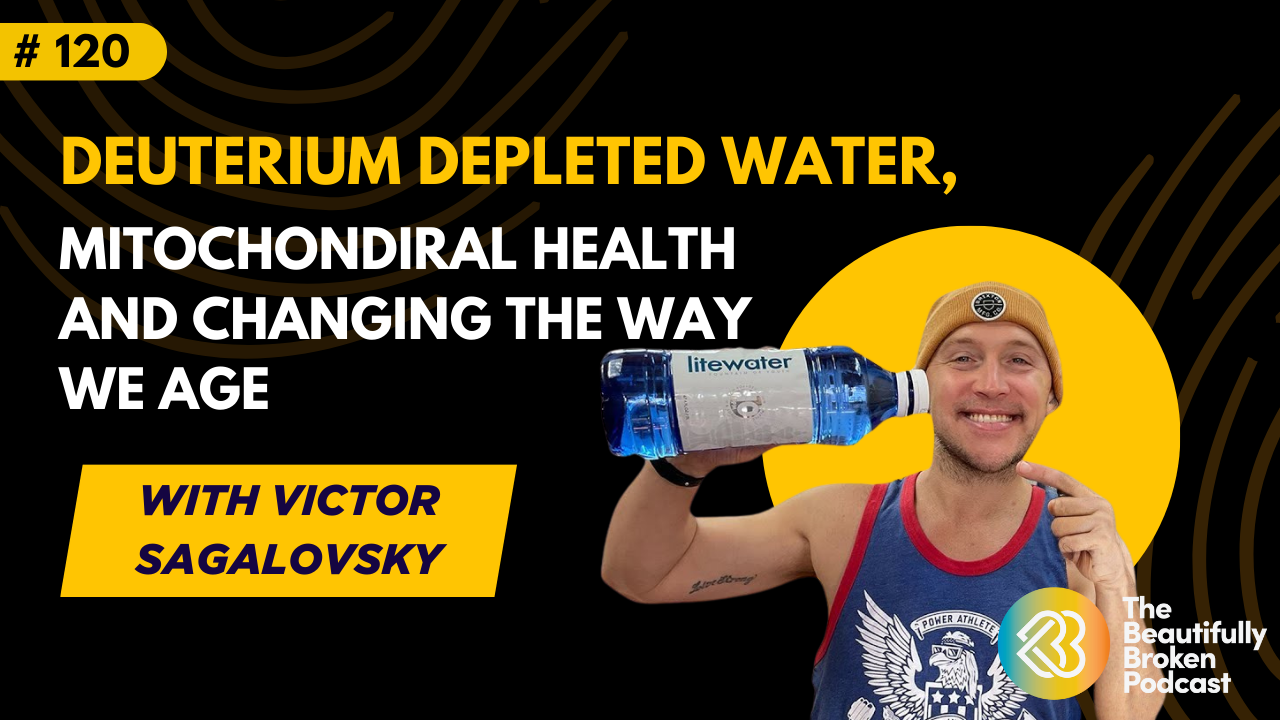
WELCOME TO EPISODE 120
Are you ready for a bold hypothesis? By managing deuterium and other damaging isotopes we may be able RADICALLY to extend our lifespans. So what is deuterium-depleted water and why should I understand its role in aging? If you are interested in unraveling the secrets of becoming superhuman, keep listening. In this episode, Freddie has Victor Sagalovsky join him on the show to discuss deuterium-depleted water. Victor is the co-founder of Litewater Scientific, the first and only super deuterium-depleted light water. He has dedicated himself to the research, development, and production of this rare longevity hack. Victor shares the benefits of depleting deuterium in the body for people with chronic illness, improving mitochondrial health, and the science indicating a possible extension in longevity for cancer patients. He also expands on the molecular structure of deuterium, and how the depletion process is carried out. There’s a lot to unpack in this episode, so stay tuned, and think about using the rewind button to get all the details logged into your brain cells!


Episode Highlights
[01:47] Elevator pitch on deuterium-depleted water
[05:17] What is deuterium-depleted water?
[12:33] Benefits of deuterium-depleted water to the body
[29:25] Deuterium-depleted water for cancer patients
[34:47] How to get started with deuterium-depleted water
[44:40] Victor’s understanding of being beautifully broken
UPGRADE YOUR WELLNESS
Marion Institute BioMed Course: biologicalmedicine.org
Code: beautifullybroken
Silver Biotics Wound Healing Gel: https://bit.ly/3JnxyDD
Code: BEAUTIFULLYBROKEN
LightPathLED https://lightpathled.com/?afmc=BEAUTIFULLYBROKEN
Code: beautifullybroken
STEMREGEN: https://www.stemregen.co/products/stemregen/?afmc=beautifullybroken
Code: beautifullybroken
Flowpresso 3-in-1 technology: (https://calendly.com/freddiekimmel/flowpresso-one-on-one-discovery)
Medical grade Ozone Therapy: https://lddy.no/1djnh
Code: BEAUTIFULLYBROKEN
AquaCure Machine + Molecular Hydrogen
Website:https://eagle-research.com?ref=24931
Code: beautifullybroken
DIY Home Cold Plunge Experience: [https://www.penguinchillers.com/?rstr=6757]
CONNECT WITH FREDDIE
Work with Me: https://www.beautifullybroken.world/biological-blueprint
Website and Store: (http://www.beautifullybroken.world)
Instagram: (https://www.instagram.com/freddie.kimmel
YouTube: https://www.youtube.com/@beautifullybrokenworld
FULL EPISODE INTERVIEW
EPISODE TRANSCRIPT
Freddie Kimmel and Victor Sagalovsky (00:00.128)
Ladies and gentlemen, good morning. This is an episode I've wanted to drop for a long time. We are going to talk about deuterium depleted water. And if this sounds like a new topic or something that is out of your sphere of influence, it very well may be because deuterium depletion is relatively new and it's in my field of awareness because there's shown benefit for depleting the deuterium in your body.
with chronic illness, longevity in cancer patients, and mitochondrial health or how we age. So as we sit down with Victor Sokolovsky from Lightwater Scientific, just grab a pen and paper and take some notes, because I promise you, this is probably a podcast you'll listen to numerous times, and it's really interesting and fascinating, and the science is just emerging and bubbling. So nothing gets me more excited.
than sitting down with somebody passionate about the art of aging, art, the study of the genital logical curve. That's a word I practiced many times to be able to say on this intro. I love you guys. Thanks for spending time with me and I can't wait to get started. Here we go. Welcome to the beautifully broken podcast. I'm your host, Freddie Kimmel. And on the show, we explore the survivor's journey, practitioners making a difference.
and the therapeutic treatments and transformational technology that allow the body to heal itself. Witness the inspiration we gain by navigating the human experience with grace, humility, and a healthy dose of mistakes. Because part of being human is being beautifully broken.
Freddie Kimmel and Victor Sagalovsky (01:47.44)
Ladies and gentlemen, welcome to the beautifully broken podcast. We are here at the biohacking Congress in Las Vegas. Incredible. And I actually get to sit down with my friend Victor and we are going to talk about all things water wellness, maybe some molecular hydrogen, deuterium depleted water. And if all of those words sound new to you, we're going to do a deep dive. We're going to do a deep dive. Yeah. As deep as we can. As deep as we can in an hour. Victor, if you
met somebody in an elevator and they said, well, what do do? What do you, what do you spend your time doing on planet earth? What would you say? Well, it depends how long the elevator ride. Right. I've actually thought about this one because I looked up like, okay, if I had to do an elevator pitch, you have to consider how long is the elevator ride. So I look, okay, what is the longest elevator ride in the world? It's actually three minutes long. It's in line. So if I have three minutes at the mall, let's go with it. So what do I do? I started out like, uh,
early on in life interested in aging. As a kid, I just look at old people go, what is this process that nobody informed us about and yet we all participate in aging? So I was kind of like an armchair gerontologist since I was a kid, trying to figure out, why does my grandma have, why does her face look weathered, but her skin that's not exposed to sun still looks like a baby? I'm just trying to understand what is the mechanism that's responsible for our aging? think it's a great question that.
we should try to solve while we're here. And that's kind of guided me to ask the questions because it comes down to asking the right questions. So jump cut, let's say 40 years later and I'm into deuterium depleted water. We have a company that makes deuterium depleted water called Lightwater. And I believe that's the actual like that's cherry on top. That's the cream on top or the little ornament you put on the top of your...
top of your Christmas tree. is, as we understand it now, or at least as far as I understand, and I like to explain to everybody that that is one of the most important biohacks that we have in terms of an intervention that we can do by doing something where it's a different concept, where instead of putting something in your body, you're actually taking something out. Yeah. So I've been on this path for, well, I first found out about it in 2004. So I've been on this path for, you know, most of my adult life and
Freddie Kimmel and Victor Sagalovsky (04:10.406)
Before that, I was very into foods, culinary, understanding the biochemistry of food. so I've always been involved in this kind of holistic space, probably because maybe I was a little more sick than other kids when I was growing up around my peer group. So my questions were different. Why are they healthy? And they're doing nothing for that. And here I am unhealthy, trying desperately to become healthy and for a long time, just falling flat.
So that made me kind of start the research of, understanding myself, humans, biochemistry, aging. So yeah. Beautiful. So if we go back, we walk it back to the deuterium depleted water, which you said was the cherry on top. I believe so. I mean, listen, I'm excited about it. It's foundational intervention. So I, as I always tell people, go hike up to the source of the spring. It's not enough to wade in the water in the river. Go up there, go where the trails don't lead and find the source.
or where something is coming from. And if you find the source, you may be able to plug it up. You may be able to come up with some ideas that you didn't have before about the origin of things. So it came up in my digging around what can I do to support my body after going through metastatic cancer? And I kept seeing deuterium depletion come up. Actually contacted a agency in LA where we did a bunch of testing. We looked at my levels and I went through a protocol of drinking this water and
The idea being that my body would have better mitochondrial health and be able to deal with the self correction mechanisms that exist inside. Now, this deuterium depleted for people who have never heard this word, again, what would you say to a person who's just coming into the conversation? What is deuterium depleted water? Well, I'll say is that not all water is equal. We look at a glass of water and this is a good example because this water and food, you know, they ultimately provide energy for the body.
But if you look at water, think our water, as we learned in school is H2O, but it's not. There's so many different isotopes and variations of it. And one of those isotopes is deuterium. Now deuterium is a heavier form of hydrogen. Okay. So it has a neutron whereas regular hydrogen protein does not. So this makes it twice the mass. And when you have something that's twice the mass, in this case, leads to a lot of problems downstream for DNA, for mitochondria, for enzymes, everything downstream. So.
Freddie Kimmel and Victor Sagalovsky (06:38.013)
You look at this water and it's H2O and then six drops inside of that, let's say you have a liter of water. So six drops of that, it's very small amount will be what's known as HDO. So instead of that two hydrogen, one oxygen bond, it's one hydrogen, one deuterium. So that kind of makes it lopsided because a little bit like this part's a little heavier than this one, right? So that's deuterium. Deuterium is just a heavier form of hydrogen that we have to deal with. It's natural. It's been there since the beginning of the universe.
Yeah. And levels have been rising and what they discovered in the fifties was that the terium levels vary around the world slightly based on geography and hydrological cycle. So what they found was that people that were drinking water that had less deuterium, slightly even 16, 20 % less than the global average, they found that these people had increased longevity and increased health span. In fact, it was found that this research was done in the Soviet union originally.
And what made them ask the question in first place was why are these people over here, which is in Siberia, the Yakutians, the Altaians, and some people in the Caucus Mountains, but they particularly focused on a Siberian group. So why are these people that live in a very harsh, unwelcoming environment? They're pretty much like Eskimos. You know, they have, they don't get much sun. They don't have, they don't have any vegetables. You know, it's the farthest from Mediterranean diet. You can imagine a lot of raw meat. And at that time a lot of
Soot from carbon in their homes, you know, because they're stoves. So these people don't live a healthy lifestyle. Although the environment is fairly clean. But yet they had seven times more centenarians, people over 100, than anywhere else in the Soviet republic. 7X. 7X. 7X per one million. So per one million, I think one study was 324 centenarians per one million people population. And everywhere else, it was a lot lower.
Right. know, like 20, 25, six, you know, per million. uh, it's a big number. So people saw this and so what, why, right. And then they spent probably about five years trying to figure it out. Cause they're like, you know, what, you know, what is it? Is it their diet? It's their genetics, their environment, it's the air. And they honed in on water on the water they were drinking. And it was interesting since this was done in the fifties, it was only, it was less than 20 years before they had even discovered that hydrogen has another isotope.
Freddie Kimmel and Victor Sagalovsky (09:01.567)
But well, hydrogen is all hydrogen. And the reason hydrogen is so important for everything, for our bodies, for the universe, 75 % of the universe is hydrogen, by the way. And so the reason it's so important is because it's so simple. It's the only element that doesn't have a neutron. It's just a proton and electron. So it's just like fire. So my question is, you said around the world, levels of deuterium in nature exist at varying degrees of levels.
Give me a way to express that. My understanding is it's measured in PPM, parts per million. So what would someone in the, let's say the mountains of Colorado versus LA versus Antarctica, what are those levels? What's the range? Because you could strategically place yourself to live in an area where it's less deuterium and you'll find that you're actually, you feel healthier, more energetic. So the average, the ocean is 155.76.
And then 155.76. Yes. Okay. Yeah. It's pretty exact. Yeah. Wow. But, um, and then the average for drinking water for on the planet is 150. Okay. Okay. So that's LA. You mentioned LA and then Colorado, you have, uh, in certain parts of Colorado, you have all the way down to the high one 30. So one 38, one 39, which is, it doesn't seem like a big Delta of difference, but it is because this is over time.
This is on a linear scale of your life. So you just compare when you drink a year's worth of water, and we'll talk about food as well, but when you drink a year's worth of water at 150 ppm and you drink a year's worth of water at 139, and you look at the energy benefit, right? You actually have a net energy benefit. Yeah. Versus in the two, and you'll see that there's a clear and a big difference over time in just a slight drop in the terium level.
In fact, I noticed that when I go to Boulder Colorado, the people are all active. They're healthy. They're just, you know, it's where the Olympians train. You know, I think it's because of the elevation. That's part of it. But really it's because the water is slightly lower in deuterium. So where you find, so the, I'm kind of trying to mind read your next question and why in some places it's lower than others, right? Let's do why it's because of the hydrological cycle. So the oceans take up most of the water in our planet.
Freddie Kimmel and Victor Sagalovsky (11:24.233)
So they have a lot of influence. Okay. So if your hydrological cycle is away from the ocean, like in a localized area, for example, the Eastern slope of the, of the Rockies and the Sierras too, you'll notice that that hydrological cycle is more localized. Unless a weather pattern flies in, you know, shifts in from the ocean, really that cycle is, like this. So there's no influence from other places. And then other places, so that's one, the hydrological cycle away from the ocean. So in a localized area, have.
you have lower deuterium because it's more concentrated, more localized without influence, but also latitude makes a difference too, somewhat. And that's because the way the hydrological cycle works when water evaporates and then condenses down and this is just amplified at higher latitudes because it's colder. So when the water evaporates, turns ice faster. So it goes to this dynamic separation a lot faster and the cycle happens more, it's more concentrated. So in fact, what we did or my colleagues did over a 20 year period when they created this
process and this factory facility to make, remove the deuterium from water. It's just study the hydrological cycle and then copy it and try to amplify it or in this case, succeed at amplifying it. Beautiful. So if I get my hands on some deuterium depleted water, low deuterium water, what is the process in my body? How is that helping my body to be more apt to age slowly? You already have access to deuterium depleted water actually. It's the water inside your
cells in your mitochondria, specifically in the mitochondria and that'll confine spaces where the energy is made. Yes. That is determined if we did. Now everybody at home needs to know that your cells create a special type of water. So walk us through that process as well. It's called metabolic water. Got it. Okay. So all the water that we, that we make, that we synthesize is, is homemade. It's not none of the water that we drink makes it into the mitochondria. Okay. Interesting. So how much water do we make a day internally?
It's like 1500 gallons. Well, really a recycle. Yeah. 1500 gallons, 20 % of the water of our daily water needs are recycled. And then maybe, and this is kind of what I've been playing with as a, you know, as a biohacker myself is saying, it's with fasting and stuff and saying, Hey, can you increase that? Can you increase the amount of water that your body can recycle and depend less on external water? this metabolic water is just synthesized in the process of making energy.
Freddie Kimmel and Victor Sagalovsky (13:51.532)
Just like you would in the lab, two hydrogens and an oxygen and kaboom, you got water. But this water is highly structured metabolic because the mitochondria doesn't want any contaminants, especially deuterium, which is the, which is the number one contaminant for the mitochondria. So you have deuterium depleted water inside of you. In you've got quite a bit because we have trillions of So I'm making the deuterium depleted water internally. You are. And when I'm drinking my tap water from Austin, Texas.
I'm increasing deuterium, correct? You are. Because my internal pure source would be depleted. Well, these nanoconfined spaces in the mitochondria, they do everything they can to keep the outside world out, right? Except for the except for what they need is fuel, which is food broken down, eventually down to the protons and electrons. So yeah, you have a lot of mitochondrial water. And when you drink normal water or bulk water that hydrates you that goes there's so many there's so many reactions and processes. Yes. In the body, right?
So this water, there's a mechanism known as hydrogen exchange. And the hydrogen exchange, what happens is let's say you drink deuterium depleted water. And there's a mechanism where those hydrogens become exchanged. The heavier hydrogens, which are your deuterium, become exchanged for the protium, which is the lighter hydrogen. And so you excrete, expel the heavier water. So this is done over time. It's not like you can get rid of or lower your deuterium levels in the body overnight, but it's a gradual process.
Other ways you can do it. Drinking deuterium rewaters the best way. It's a total hack because it didn't exist before, right? Except in maybe 15 to 20 % lower than nature, but we've, can now even go lower because of science, but food, fats, fats are naturally more depleted than carbohydrates. Nature's strategy is to put the deuterium into the carbs and try to keep the fats depleted. And fats are our best fuel source, produced the most amount.
ATP compared to glucose. So yeah, you can increase your diet to be more fat. You can increase the space, the time in between meals because every meal you have introduces not only more food, but more material. So you can, you can practice intermittent fasting. You can practice dry fasting, which is going without water or food for as long as, as long as you can. What's the longest you've tried fasted for? About seven days. About seven days. It was a little less than seven days.
Freddie Kimmel and Victor Sagalovsky (16:17.786)
I was going for seven and then my mom said, you better quit this, man. I was great. I was like day six and a half. My mom was like, dude, you haven't eaten or drank in six and a half days. And from what I know growing up, you'd be dead by day three. So this getting me worried and you better stop. Okay. All right. But I realized that, yeah, I know people that have gone 10 days. I know two people have gone 10 days. I've read about a person that
done 14 days that under clinical supervision, which is the maximum you can do under clinical supervision is about 14 days that they've observed. So it just shows you that you need a lot less than you think. And the reason dry fasting or the fact that you don't have water, drinking water doesn't kill you is because you're making the water while you're dry fasting. Now, certainly at some point it's going to, it's going to go away, but when you burn fat, you produce metabolic water. So if you burn a kilo of fat,
you produce about an equivalent amount, almost a liter of deuterium depleted water, which is metabolic water. And that metabolic water is about 60 to 70 % lower in deuterium than regular bulk water. Yeah. I guess my question is, and again, so people could grasp the value of this as far as healthspan expanding our longevity, what is happening to a beneficial standpoint in that cell when we're drinking?
Deuterium depleted water or we're getting our levels down internally. How does that help me from an end user? It's so much because it affects everything from DNA to enzymes proteins peptides, but more importantly the mitochondria So the way it's the way to mitochondria works. Mm-hmm And the way to mitochondria mitochondria is we know is the powerhouse of the cell produces the adenosine triphosphate or ATP That is the energy currency of our biology. Sure and ATP is made
different processes in the body, but the process that makes the most ATP is in the mitochondria known as the electron transport chain. And this is a chain that feeds protons, electrons toward a motor. This motor actually, it's a little nanomotor. It's beautiful. I've seen pictures of this rendered by MIT and it's pretty wild. It actually looks like a little turbine spinning around. It's a motor generator. Yeah, actually. Yes. It looks exactly like a motor that we would design. Yeah. But,
Freddie Kimmel and Victor Sagalovsky (18:43.225)
It's actually is a good argument, a great argument for intelligent design because there's no way that the way these two, the F zero and the F one parts of this motor, the way they are arranged, there's no way that nature would have created this. It's like saying, here, let's put this piece of chunk of metal, you know, out in the lawn and watch it for the next billion years and see how long it takes to, for it to evolve into an internal combustion engine. Yeah. Somebody has to manipulate it. Now outside forces to come in. Otherwise, it's just going to be a chunk of metal forever. So this motor is in.
is amazing because it shows that it's like it's intelligent design to put this thing together. Cause there's no way through evolution that these two parts would have come together as motor generator. And this thing simply takes protons spins. as protons spins, this generates ability to make ATP and adenosine diphosphate comes in and puts that other phosphate on there. And now you have ATP and this happens. We have 35 trillion cells in our body. And then we have each cell has a
one to 2000 mitochondria when you know, if you're, if you're healthy, if you're healthy, if you're healthy. then each mitochondria has something like 350,000 in these nano motors and these nano motors are spinning. Uh, they spin up to 9,000 RPM at perfect translation of energy, right? A hundred percent efficiency, which we can't do in a motor yet ourselves. So it's quite profound. Beautiful. It's beautiful. It's really beautiful. So every, every seven seconds, instead of these motor getting a proton, which is what it's looking for, cause it's got a little.
round peg for a round proton. And then this thing comes in every seven seconds. That's, that's twice the size. It's crap. It's carrying a neutron along, right? And it tries to fit in that spot. That's reserved for proton. when it tries to do this, this motor stutters creates wear and tear. Shearing almost. Yeah. I mean, a lot of things happen, but it's like, it's this motor that spins. think it's, 500 protons per second. So every five seconds you get a deuterium.
So cause it to stutter and the stuttering and that while the stuttering is happening, no ATP is produced, but also creates wear and tear. Because in nature, in this process, this neutron, that's also part of nature. So the nanomotor, I want to track this back for me, myself, and everybody listening. It is used to seeing a neutron every once in a while. Every once in a while. Every once in a while. It's trying to keep it all up. But it can't.
Freddie Kimmel and Victor Sagalovsky (21:05.39)
It's our environment. evolved in it. We're just here. It's just here. We're here. We got to coexist. Yeah. So there's a mechanisms exist.
Ladies and gentlemen, I had to stop the podcast. I need to tell you about a company that I am loving right now, Upgraded Formulas. They are located right here in Austin and they provide an HTMA test for at home use. What's HTMA? It's Hair, Tissue, Mineral Analysis. So from the comfort of my bathroom, I can send away some hair and I can get a picture or snapshot of my mineral balance in my body.
Minerals are the building blocks of life. It is going to tell me how metabolically active I am, how easily I build muscle or burn fat, how I mount an immune response, and how the health of my bones may look in the next 20 to 30 years. This is a service I believe in so much I've had my mom do it not once, but twice. And she has got information to improve her vitality, her strength, her energy based on this test.
don't guess principle. Also, you have to check out their magnesium, which is always something that I use when I travel and it totally moves my deep sleep scores. Check out upgraded formulas and use the code FREDDY10. That's FREDDY10, all caps, F-R-E-D-D-I-E10. And you'll get a discount in the cart and you can look at your mineral makeup and make better choices about your wellness going forward. Love ya. You know what the Krebs cycle is, right? Yes. Okay.
or the San Giorgio cycle, as some other call it, a citric acid cycle. So this is a, when I first started learning or studying this in the late 90s, I'm thinking, man, everything I've learned from yoga doesn't line up with this Krebs cycle thing, because yoga teaches us, or just common sense teaches us, or just observation teaches us that nature likes the path of least resistance. Everything likes to be simple, right? If you can, right? We've all experienced that in the morning. What is my path of least resistance to the black?
Freddie Kimmel and Victor Sagalovsky (23:10.111)
coffee. So if you could teleport, you would do that instead of taking the plane, right? You want to get there. want the patholese resistance and the Krebs cycle look like it doesn't seem like the patholese. This thing is terribly complicated. Why is it so complicated? And then I found out years later, because this was the work of Dr. Boros, who coined the term due to nomics, which is the study of how the terium is managed by the body. He explained that the reason it's so complicated because the series of gates
to exchange deuterium for regular hydrogen. It's trying to keep deuterium out. So the reason is for its complexities is because it's like what, 20 to 22 little steps. They're trying to exchange out the deuterium. And for people at home, again, the Krebs cycle is a process that also makes energy, but it would look or appear less efficient. Yeah. Because there are so many processes. Well, it just produces less ATP, but it all feeds into the electron transport chain. Yes. So yeah, this is it.
The takeaway here is you have something very complex in nature and you look at it and go, why? Why is it so complex? And nobody could give a adequate explanation, at least for me, until this deuterium problem was introduced and go, aha, of course it's so complicated. It's just a series of gates keeping, trying to keep this stuff out. So it evolved out of necessity because otherwise it wouldn't be so complex, right? Yeah. It wouldn't evolve to have that complexity to try to keep this deuterium out. In fact, there's a lot of, a lot of metabolic reactions that try to exchange deuterium for hydrogen.
just starting to find out about because there's so many so many metabolic processes in the body. But yeah, so that's so this is something so new, you know, I that was known about the deuterium damages. So deuterium is heavy, right? So you can simplify very easily and it's still be valid. The things that are heavy slow you down. And when you're lighter, you've got more speed, you're lighter, know. So that's what deuterium does. It slows down everything from top to bottom, bottom to top, the very smallest, the very largest. So and it also it
makes anything that it's attached to where it's that thing is looking for a hydrogen. It causes it may cause us to be lopsided because this thing's heavier. So you got a hydrogen here and you want to have a hydrogen here. But so you got to do terium here. So it's heavier. So you have this kinetic isotope effect. Kinetic isotope effect talks about how a molecule disassociates. So if you have a hydrogen carbon bond versus a deuterium carbon bond, that deuterium carbon bond, this associates nine times slower, nine times slower. Yeah.
Freddie Kimmel and Victor Sagalovsky (25:35.903)
It's like, you know, if you woke up tomorrow and you were twice the weight, right? You'd be like, my God, you know, like all of a sudden you gain double your mass. Yeah. Be like, this is a little, this is so hard to get used to. Right. Yeah. You know, you're to drag yourself around. It's going to be hard. There's going to be a lot of resistance. going to be, it's a burden friction. So it's a friction. Everything wants to go at the right speed. And you got the slow poke over here blocking the lane. know, it's wild to think that the structure of water on our planet as we know it.
is a large contributor and we're not saying toxic water, we're just saying water in general, the way it exists and the amount of is causing our aging. Yeah. And when you look at it, the amount of deuterium is 0.0125%. While the hydrogen that exists, that's basically almost like nothing. Yeah. And that's why that's why it was overlooked for so long. So you're going to tell me that something that is a hydrogen that is only one point zero one two five percent of the whole
constituency of hydrogen is something that's going to cause you to age and break down your cells. But in fact, that's true because when you look at it, or at least the way Dr. Ohlgun who discovered in 2007, the actual process of how it damages mitochondria and the electron transport chain and nanomotor. That's why I said this was new in 2007. Right. 60 years, they knew that addition of deuterium slows you down. Decreasing of deuterium, depletion of deuterium speeds you up, you know, metabolically. 60 years later, 2007 says here's why.
or one of the reasons why, big reason why, is nanomotor. So the way, and Dr. Oguna asked him, what made you even consider this problem? And he said, was because I looked at this question, 0.0125. Okay, it's not very much. Three drops of HDO in a glass of H2O, it's not very much. And he looked at it, okay, but because we are made up of water, know, we're molecularly almost 98 % water. He looked, okay, well, how much of this stuff is in our blood? And then he saw, oh,
This is interesting. It's five to six, seven times more than the basic constituents that we need to live. Glucose, magnesium, potassium, calcium, all the minerals and simple sugars. It's like five to seven times more deuterium in our blood. So it's ubiquitous. we have all the mitochondria is trying to manage it. They're trying to manage it. Everything in their body is trying to manage this deuterium from getting into the electron transport chain.
Freddie Kimmel and Victor Sagalovsky (28:02.463)
and then ultimately breaking down our motors. Because what happens is if you have a motor and okay, so if you have a deuterium hit it, causes it to stutter, a little wear and tear, enzymes come in, try to repair it, you think, okay, no big deal. Of course, yes, this is continuous, this is cumulative. This is like kiss, kiss, kiss, and then elbow to the face, kiss, kiss, kiss, elbow to the face. It's like, it's nonstop. So where does it cause the breakdown of the mitochondria? Because you could see that it'll slow down energy production.
As those motors get hit, know, it'll slows down the energy production. But as you have this wear and tear and the shaking, the stutter, the shaking, what does it do over time? It weakens the membrane that's attached to that motor. That motor is locked in a membrane. The reason those protons are able to come in this way and go out this way is because there's more here than here. So there's a gradient, know, everything here wants to go here because there's less of it here. So it's like, it's getting sucked in. And if that membrane starts to leak,
And those protons, those protons are only supposed to go in into this inner mitochondrial space in the matrix through the motor. But if it goes in through the membrane, it starts to leak and then those protons equalize. And then no motor spins, no energy is created. You get jammed up with protons coming in and everything. You get inflammation, know, then apoptosis. back to when I originally said this came up in a search when I was looking up
ways to support the body host cancer or post cancer treatment. Why is a deuterium level that is depleted associated possibly with somebody having a better path through cancer? I've seen this research come up and I know it's something they're starting to explore and look at. I think I told you this at one point, one of my favorite books is the metabolic approach to cancer. Yes. And they just look at supporting the mitochondria so the body can have a better fighting chance. is many, many scientists.
and researchers doctors believe is cancer is a metabolic disease. Yeah. So, but this work is actually not that new on this front. There's a doctor in Hungary, Dr. Kabor Shambhai. And he wrote a book 20 years ago where it was a book on how to defeat cancer using deuterium depletion as an adjuvant treatment. Didn't stop the treatments for, they were doing whatever chemo, radiation, you know, so he wrote this book based on at that time, I believe it was a
Freddie Kimmel and Victor Sagalovsky (30:29.476)
about 300 case studies. And since then, he's now got a new book this year. He's got over 3,200 case studies now. And what he found was that the survivability, this is published in the paper, the survivability was about 8x for people that had some neoplastic condition. So it's a metabolic, as he claims, it's a metabolic issue, right? The cancer, I mean, it's a complex topic. Of course. But the more energy you have, bodies are self-healing organisms, so the more energy you have, more mitochondrial energy, more ATP.
Yeah. The better your chances are of fighting this cancer. But it's a, it's a complex topic. I'd love to get into it there's so much I could share on this one topic alone. But, think it's good for people to, again, it's like, I look at these topics as a, um, you know, we're flipping a stone and maybe there's something sparkly under there that you want to explore more and do more research about. And I think I don't hear deuterium depletion water or
light water. It's rare that anybody knows what I'm talking about. They're like, what do you say? Well, they will. They're like, I got a Berkey. Walk me back to the bird. Listen, for a long time, for long time, I don't think people even realize cells had any bioelectric potential or any voltage. Sure. You know, I sat with a double PhD one time at a microscopy course, and we were talking about something and I just made an offhand comment like, well, maybe it's because of the, you know, voltage, the cell is off. He goes, what? Voltage. He goes, what are you talking about? I go, volts to sell. goes, cells have voltage.
We got two PhDs in medicine. That was a new concept for him. You know, I mean, I was a drama major. So, yeah, I mean, among other things, but the point is that there's so much that we have yet to learn. Yeah. And it takes time for these things to come into textbooks. So, and yeah, just to back up a little on the cancer side, it's really all about bioelectricity. It's about, like you said, the voltage of the cell. Yeah. Right. So if the voltage of the cell is weak.
then it can't replicate properly. The way I explain neoplastic condition very simply is there's a stem cell. That stem cell is going to differentiate into the final cell that it's going to be. Okay, right. It needs energy to differentiate just like we need energy to do anything in our life. And if it doesn't have the right voltage or the right energy as it's making that transition, like it's very much like when the cell transitions into its final form, it's very much like Superman's going into a telephone booth, spinning around and
Freddie Kimmel and Victor Sagalovsky (32:54.938)
transforming into superman. So Clark Kent walks in, Superman walks out. So stem cell walks in, differentiated cell comes out. Okay. But what if it didn't have enough energy to make that spin fully? Right. So now it's stuck. Now it has the quality of a stem cell, which is different than a normal cell. Right. And so it's stuck in between. So it's this cancer cell that has this ability to hyper replicate like the stem cell does. It has that same kind of primal ability to grow faster than other cells.
But it's not, it's mutated, it's a mutated stem cell. So the body doesn't attack it right away or ever, because, this is just my cell. So the latest therapies of cancer treatment is to tag that cancer cell, tag it as something that the immune system goes after. Because the immune system goes out, this is my own cell, it doesn't recognize. Somebody could say, hey, that's bad. Eventually something happens and the cancer is managed.
but it only managed if the body has the energy. Yeah. Which is like diminishing returns because as the cancer diminishes your energy, you need more to fight it. So that's why, you yeah. I mean, again, if we look at the numbers, you know, one equation or way to look at that energy potential that I've been, I've been talking about lately is the idea that we have, you know, the human genome project maps 23,000, 25,000 genes. And then we have like 140,000 protein expressions. Right.
So the idea that we've got more types of cells and we do blueprints for, which you said, it's like Superman goes into the booth. He comes out of, you know, one of eight characters. Who is it? Right. And if the energy is not there, you know, I think that's a great way to look at it. And it also, a, it points to, we don't understand everything about the body yet. And what is healing and what is healing potential? What we do, what we do understand is if we have enough energy, all things are possible. All things are possible. Yeah. So supporting the body in that way.
You know, we're looking at this, we're opening the door around water, deuterium. How would somebody go about using this in their life or what would be a typical way for somebody to get started? Do you just start drinking depleted water? Is there a parts per million level that a person should begin at? It's probably individualized, but I've tested before. I've done multiple tests. I've done ones that were just saliva. I've done ones that were.
Freddie Kimmel and Victor Sagalovsky (35:20.614)
saliva and breath. Breath, breath, breath, breath, breath, breath, breath, breath,
Freddie Kimmel and Victor Sagalovsky (35:49.96)
You get a pretty good sense of what the body is at or the extracellular tissue. When you do the breath vapor, that's more indicative of your metabolic water. Got it. So you look at the difference between the two and you see if the metabolic water, if the breath vapor, what's the delta between your saliva test and your metabolic water or your breath test. And if you have a wide delta, that means your body is doing a good job. It's filtering. It's filtering the endotarium out.
But if they're the same, body's not doing a good job, no job at all, it's just run amok. And that's where in a clinical sense you would use those two tests. Typically people just use saliva because when they're on a protocol, because your goal is to just test what your base level is in your entire body as an average. So when you go down by about, drink 150 ppm and then you go down to 120, it's like 16 to 20 % lower.
150 ppm down to like one the one time is in your body. Yes, your body you'll notice it. Yeah, you'll notice it because you're taking off a burden. It's been there. And how long would that take for somebody? Let's just take my body weight, you know, 170 pounds 30 to 90 days. Okay, sometimes you can notice differences earlier, but you will drop about a half a ppm to one ppm per day. Okay, when you drink to turn into water in the beginning, the dilution of your
But you're in bleed water is not as important as later because in the beginning, if you drink, if you drink water, that's 120 PPM, you're going to drop, right? Your body's going to go down to equal or get close, try to get close to with the water you're drinking. Of course, food is also something that you take into account in this case too. So in our modern world, our diets are very carbohydrate dependent. And also there's a lot of concentrated food, right? A lot of, a lot of things that have been just compacted.
nutrient dense, but in that nutrient density or that concentration, you also expose your body to more deuterium. And in those complex carbs, you expose your body to more deuterium and in the eating of multiple meals per day. Because I remember from, you know, my early twenties when I was studying yoga and he said, okay, a yogi eats once a day, a healthy normal person eats twice a day. A stupid person eats three times a day and a crazy person eats four times a day. This is the ancient texts. Okay. So, so
Freddie Kimmel and Victor Sagalovsky (38:12.712)
So, okay, you don't need this much, you know, you know, so, so it's just the internal management process. Yeah. Of even a mainstream medical studies show that calorie restriction increases lifespan. Yeah. With animals. Yeah. Even there's, there's some good data to support a 48 hour fast previous to going into a chemotherapy regime. Right. The body creates sort of neuroprotective environment.
in which there's less collateral damage within the body. Right. Well, you can't make any growth hormone when you're when you're digesting food. So if you just stop that, then you can increase the growth hormone in your body, which is affects everything. Yeah. So, yeah, we have a mechanism that we're just starting to understand how our bodies work. And like I said, me, I just wanted to go to the I'm only interested in going to the source of something upstream and find out what is causing all this other stuff, because band-aids are great. But at the end of the day, they're just band-aids. Yeah. So
You know, what do we do to increase our lifespan? Like for real and not only a lifespan, but all health span. Cause I don't think I want to be a hundred, just, you Oh, Rickety, you know, I, want to have a long health span. you see that with a number of people. I mean, you see it. A number of people is very small number, but you see it. You see people in their nineties and even in their hundreds that aren't having any mental or not much mental decline with the exception of, you know, certain markers of physical aging. They're pretty much.
functional or you could say that they're more than functional. You could say that they're still capable. If you, have a couple of questions for you just because I want to also be aware of our, we're biohacking Congress. have our hour. I'm like kind of watching our time here. Of course I could say who would want to do this in their life and you could easily say everybody. But if there was a group or a subset of the population right now that you see that's really struggling, is there somebody that you would love to see integrate?
deuterium depletion protocols into their journey, whatever they're struggling with. I don't know. I haven't really like looked at it in that way. I haven't looked at it from a bias view like that. Okay. Who, you know, cause I've always sell people who should drink this. say, well, our customers are those who can afford to drink it and those who can't afford not to. Yeah. Cause some people should be on it because it's their life. But I think what I'm most interested in is athletes. I can see athletes get into this because I think it's going to change human performance.
Freddie Kimmel and Victor Sagalovsky (40:39.966)
going forward. of my favorite studies in this is in 1999 in Moscow, horse racing. So there was a four year old horse set a new world record, not a new, sorry, not a new world record, a new record, Russian record. Okay. And they gave it two hours before, gave it 10 liters of the term, put a water. So it had like instant, it had the instant mitochondrial activation and it caused a horse to break the back, break the national record.
So that's cool. So I think that it's the extreme of human potential that I'm interested in this case. Certainly anybody that anybody that says, anybody that gets up in the morning, tired, change that, change that fast. And you can change that in 30 days or less. But I'm most interested in like what the human potential is here. Where can we really flip the script on our ability to break a three minute mile? The best of us, what can they do? And for the rest of us,
It's just great because for me, you just feel like you felt your entire life. Like, well, I was sick up until my mid twenties, but after that, I pretty much figured that out. And I've been feeling pretty good since then. And I still feel the same. So the name of the game is mitochondria. And when you're young, that's a cell might have 2000 mitochondria floating in there. It's a little energy factory. And when you're old, maybe there's a couple hundred. Yeah. So, you know,
body is willing, but it can't. But the mitochondria is weak. just doesn't have the factories, right? If you don't have the factories, you don't produce the goods. If you don't have the goods, you can't enjoy them. So that's for anybody. Yeah, for anybody. But if you're specifically dealing with any metabolic issues, this might be something you should look into because that slight little Delta may be all you need. If you look at the general population, you'll see that most people are, I don't want to say most people, but in what I've seen,
You see a good number of people have deuterium levels that are even higher than occur naturally on the planet. So if the highest is 155 and you're walking around with 157, that's not good at all. know, so you just want to ease the burden on the body and the cells. You know, we're working nonstop. You know how much ATP we produce per day? No idea. Twice our body weight, twice our body weight. Yeah. I guess recycle. So we're constantly working. We just want to less resistance, more capacitance.
Freddie Kimmel and Victor Sagalovsky (43:07.776)
higher voltage, you know, but without the resistance. So we just want to easier path forward an easier way path of least resistance. that's why I looked at where can I find path of least resistance? Okay. Lower the deuterium that'll, that'll increase your path of least resistance. It's certainly in my top five biohacks that I think people should at least explore, learn about, lean into some research. Where would you point someone to go to read about deuterium depletion or to learn more? They could go to our website.
Lightwater, scientific.com, L-I-T-E-W-A-T-E-R, and scientific, or Drink Lightwater, same thing, goes to the same place. Yeah, drinklightwater.com. And then there's other websites. We have a testing facility, testing lab that we started called deuteriumtest.com. There's deuteriumdepletion.org that I put up that has tried to put all the studies that I could find, you know, grant on that. There's a deuterium depletion summit. We did our first summit last year. We had the world's leading scientists.
Doctors, thinkers, influencers in the space of Deutonomics, which is the, new biochemistry of the study of how body manages deuterium. So you can go to these deuterium summit.com. So there's, there's a number of websites, but I would start to drink lightwater.com and read the history. wrote this history because I thought it was important for people to know the provenance of where this comes from and how incredible it is and how new it is and how amazing the potential of this is.
and give proper credit to the people that help create this. So I'd start there, drinklightwater.com. Beautiful. Well, I really appreciate you being a guest. Final question, beautifully broken podcast. You know, we talk about putting the broken pieces of our, when we stumble and we fall and really the energy behind the action, what does it mean to you to be beautifully broken? Well, to be beautifully broken, you're perfect as you are. That comes to mind.
And actually, it reminds me of a Salvador Dalí quote. Don't fear perfection because you'll never reach it. Yeah. So broken is perfect. Right. And it also is what moves you forward. Right. If you don't fail at something, then you wouldn't go forward to find a solution or an answer. And that's where the aha comes. So it's our natural state. Embrace it.
Freddie Kimmel and Victor Sagalovsky (45:32.505)
That's what makes it beautiful. Right. I know. love it. Ladies and gentlemen, thank you for joining us at the biohacking Congress. You're to be able to check out people like Victor, companies like Lightwater in upcoming events. They're going to be in Boston. They're going to be in Miami. And I think nothing substitutes being in the room where it happens with people shaking hands, talking to people, experiencing the tech, drinking the light water, being in the hyperbaric chamber. So
I implore you to jump on a plane and come to one of these events that are closest to you. really, it really is special to be here in person. It's good for the heart. It's good for the heart. mean, that's, that's a huge component of healing is community for me and being able to do these conversations live is so much better than Zoom. I'm done with Zoom and we invite you into the door. So please join us until next time. Freddie Kimmel, your host. Thank you so much. Namaste.
Thank you.
Hi friends, I hope you're loving this show. Let's take a quick break to hear a word from our sponsors. If there's one word that makes me feel really intelligent, it's photobiomodulation. Better known as red light therapy. Photobiomodulation has been clinically shown to increase energy, circulation, increase testosterone production and workout recovery, hair growth, even the improvement in the depths of fine lines and wrinkles. You actually don't have a lot of reasons not to incorporate red light therapy in your home.
not all panels are created equal, which is why the panel I recommend to my family and my friends is LightPath LED for the following reasons. This company continues to evolve their technology, including up to five wavelengths in each bulb. They include a three-year warranty. This is one of the most robust in the industry. And they also have pre-programmed frequencies to add the benefit of pulsed light to the body. And most importantly, after purchase support, so you know how to best use your device,
Freddie Kimmel and Victor Sagalovsky (47:33.24)
for your specific needs. Now what does the evolving science say around pulsed light? Pulsed light yields benefit to the mitochondrial health, leading to increased production of cellular energy, thus improved outcomes. So say it with me, let's mine the mitochondria. So check out their beautiful new website at Lightpath LED and use code BEAUTIFULLYBROKEN, all lowercase, for a discount and checkout.
Freddie Kimmel and Victor Sagalovsky (48:01.049)
My friends, you made it to the end of the podcast. Can you believe this is season four? Wait, don't turn it off yet. Before you go, I have something very important I need to say. There are two ways in which we can build this relationship that we've been working on. The first one is to join me on my membership program at buymeacoffee.com forward slash freddysetgo. You get early access to all the podcasts, bonus episodes, discounted coaching, and free webinars.
with thought leaders in the wellness and technology industry. The second way to support this guy right here is to go to freddysetgo.com and download the Beautifully Broken Buyer's Guide. This is my ebook. It's a collection of transformational technology, supplements, and courses that have worked for me, my clients, and my family. These are things that I have found incredibly helpful in my personal healing journey, like the Ionic Foot Bath or Amp Coil or the Red Light.
Most offer significant discounts by clicking the link or using the discount code. Now please know they don't cost you anything extra and at the same time they do support the podcast through affiliations. Friends, thank you for tuning in. If you enjoyed today's show, head over to Apple Podcasts and leave a review. Five stars if you loved it and well,
I guess if you're compelled to listen to this entire thing and leave a one-star review, I'm gonna take that too. If you want to connect with me directly, I spend most of my time on the social media platform known as Instagram at freddysetgo. Or you can find me at buymeacoffee.com forward slash freddysetgo or freddysetgo.com. And lastly, from my vast team of legal internet lawyers, which I pay a lot of money to, the information on this podcast is for educational purposes only.
By listening, you agree not to use the information found here as medical advice to treat any medical condition in yourself or others. Always consult your own physician for any medical issues that you may be having. That's all for today. Our closing? The world is changing. We need you at your very best. So take the steps today to always be upgrading. Remember, while life is pain, putting the fractured pieces back together can be a beautiful process. I love ya. I'm your host, Freddie Kimmel.