You Can't Light a Fire Without Fuel: Minerals, Mitochondria & The Mineral Reset with Caroline Alan
Apr 27, 2026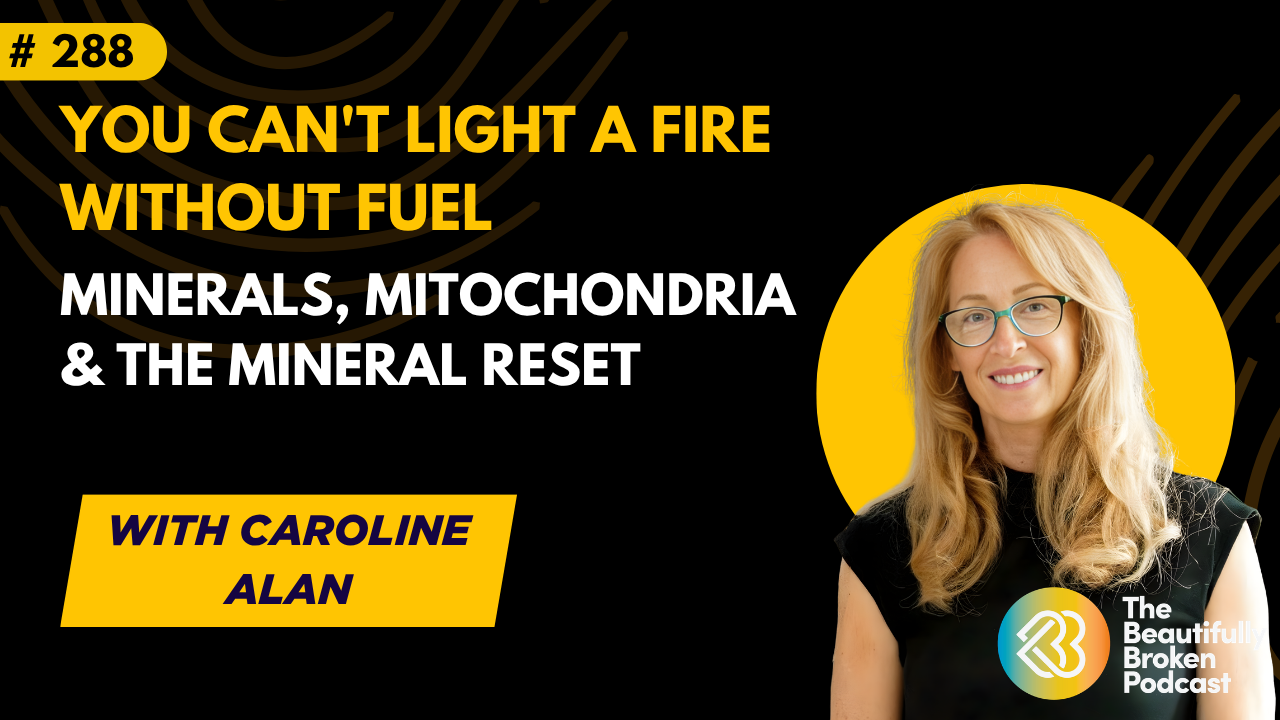
WELCOME TO EPISODE 288
Caroline Alan spent years in serious ill health — flattened adrenals, gut inflammation, chronic insomnia, recurring sinus infections, and a compromised immune system — before a single discovery changed everything: plant-based humic and fulvic mineral complexes. Without changing anything else, every symptom resolved over eight months. That curiosity sent her deep into the science of minerals, eventually leading to the founding of Be Minerals and now her debut book The Mineral Reset, published by Hay House. In this return episode, Caroline and Freddie unpack why minerals are the most overlooked foundation in all of health — not just electrolytes, but the full spectrum of 18 to 22 essential minerals your body needs in balanced ratios to run every biosynthesis process: hormone production, adrenal function, gut enzyme activity, cognition, detoxification, and energy generation at the mitochondrial level. Her campfire analogy is one of the clearest explanations of cellular energy you'll ever hear — and it will make you rethink every supplement in your cabinet.
The second half of this conversation goes deep on the practical: why serum blood testing for minerals tells you almost nothing, why the OligoScan (spectrophotometry) is Caroline's preferred intercellular mineral test, why you can take magnesium every day and still test deficient, and how parasites, heavy metals, and candida all compete for your mineral receptor sites. Caroline and Freddie also explore the paradigm shift at the core of her book — stop treating your body like a car and start relating to it like a forest ecosystem — and why mineral balance is more important than mineral quantity. Plus: the surprising truth about hydration, why empty filtered water may pass straight through your cells without being absorbed, and how humic and fulvic minerals change the way water crosses your cell membrane. Caroline's new book The Mineral Reset is available now at mineralresetbook.com — use code BEAUTIFULLYBROKEN for a discount on Be Minerals products.


Episode Highlights
[00:00] – Caroline shares her experience with chronic illness and full recovery through mineral supplementation
[06:29] – Why mineral depletion is rarely considered despite widespread symptoms
[09:15] – The “campfire” analogy for how minerals fuel energy production in the body
[11:12] – How severe mineral imbalance can impact critical functions like heart health
[12:19] – The difference between macrominerals and trace minerals and why both matter
[14:24] – Why macronutrients depend on micronutrients for actual biological function
[24:04] – How digestion and absorption determine whether minerals are usable by the body
[28:18] – Reframing the body as an ecosystem instead of a machine
[30:37] – Why foundational inputs can shift multiple systems at once
[33:01] – Limitations of common mineral testing methods and what they actually measure
[34:50] – Introduction to intracellular testing and the role of Oligoscan
[41:31] – Why mineral balance matters as much as total quantity
[43:53] – The role of minerals in true hydration and water absorption
[45:03] – Why demineralized water fails to support cellular function
[47:32] – How most supplements fail due to poor absorption and lack of balance
[50:09] – The importance of building a relationship with your body instead of forcing outcomes
Links & Resources
Beam Minerals: http://beamminerals.com/beautifullybroken
— Code: BEAUTIFULLYBROKEN
The Mineral Reset: mineralresetbook.com
— Code: BEAUTIFULLYBROKEN
CONNECT WITH FREDDIE
Work with Me: https://www.beautifullybroken.world/biological-blueprint
Website and Store: (http://www.beautifullybroken.world)
Instagram: (https://www.instagram.com/freddie.kimmel
YouTube: https://www.youtube.com/@beautifullybrokenworld
FULL EPISODE INTERVIEW
EPISODE TRANSCRIPT
Freddie Kimmel (00:01.757)
Ladies and gentlemen, welcome to the beautifully broken podcast. I am back with Caroline Allen. Welcome back to the show.
Caroline Alan (00:09.686)
It's always great to be here with you, Freddie.
Freddie Kimmel (00:12.393)
Yeah, and literally last time, you were with me. You were right next to me in my little podcast studio in Austin, Texas. It's great to see you. How you doing?
Caroline Alan (00:25.804)
I'm doing really well. Thank you so much. I did love being there in Texas when we were together, but this is also good. I'm in Colorado right now, so we're not far.
Freddie Kimmel (00:34.641)
Mmm. I love Colorado. It's so stunning. I- I- It's in my charts to live there one day.
Caroline Alan (00:43.342)
You should come to the Grand Valley, a very special place.
Freddie Kimmel (00:47.357)
Mmm. All right. I'm gonna pin that. I'm gonna make a little note. Caroline, you have been so busy. What have you been up to?
Caroline Alan (00:49.55)
Thank
Caroline Alan (00:54.99)
Wow, what have I been up to? Well, we've been growing our business, Be Minerals, and I did write a book called The Mineral Reset that's coming out in a couple, well, I don't know when this is airing, but it's coming out on April 28th of 2026. That's very soon. So we're very excited and
Freddie Kimmel (01:16.414)
That's like now.
Caroline Alan (01:21.976)
We're doing a lot of things associated with that. really see it, you know, it's gonna be, it's really part of a mission. So it's not just like launch a book, get done. This is about bringing this message to as many people as possible that minerals are the foundation of health. And it's been a long time coming. It's being published by Hay House, which I'm very proud of. And it's, I think it's gonna have a really positive impact on many people's lives.
Freddie Kimmel (01:51.772)
Incredible. How long did it take you to write this book?
Caroline Alan (01:53.166)
Well, the brainchild of it has been four years. The actual writing of it started two years ago. And the proposal was accepted by Hay House a little over a year ago, about, a year and a half ago. Well, yeah, somewhere in there.
Freddie Kimmel (02:16.362)
Before we get too far into the process, are you going to do an audible? Are you going to read your book?
Caroline Alan (02:24.936)
I did. is absolutely an audible version, and I did read that. That was grueling. Hopefully people don't get tired of hearing my voice.
Freddie Kimmel (02:32.073)
Ha ha ha ha!
I know, it is a process. I have a friend that does that for a living. That's all he does is record books. Wild.
Caroline Alan (02:41.878)
I tell you, your mouth gets so sore. You literally start talking to that root after a bit. Yeah.
Freddie Kimmel (02:48.264)
Yeah. Yeah, it's so interesting. will tell you, I'll share with the audience, know, as a singer, I know when I'll go do a vocal warm-up and, you know, I'll try to sing a song for a little while or work on a new piece. If I start to get a lot of tension in my jaw, I know, A, there's something that is out of alignment as far as my understanding of how to approach the mechanics of the song.
And I always go back to one of my very first voice teachers and I was like, oh, know, this is hard to sing, I lose my voice, my voice gets tired. He's like, have you ever heard a baby lose their voice? Screlting, screaming, you don't, you lose, you learn to lose your voice.
Caroline Alan (03:34.126)
That's very interesting.
Freddie Kimmel (03:36.906)
You learn that. That is your inefficiency. Obviously, tissue changes and properties change over time, but he's like, you know, it is the manufactured process of forward head position and tight packs and laryngeal restriction, all these things that go into us being able to express ourselves. And I just thought that, I was like, that's so fascinating to me.
Caroline Alan (04:01.876)
It is absolutely fascinating. You know, I remember when I took voice lessons years ago, also, I had an amazing voice teacher and she showed me that at that time there was no way for me to make sound without effort. And she showed me how to make a sound without any effort. Just breathe in, breathe out and you can make a sound. And it was the first time that I'd ever experienced that, I think, since I was a child.
It was a mind-blowing experience. Yeah.
Freddie Kimmel (04:33.307)
Yeah, amazing. Well, back to this book, The Mineral Fix. Why did you feel you needed to write a book?
Caroline Alan (04:42.03)
You know, there's, because of my own experience, first of all, you know, my own experience with minerals was that I was in really ill health about 10 years ago and I had flat-lined adrenals, bad inflammation in my gut, bad periodontal disease. I didn't sleep through the night. I woke up every night three or four times. had also had had a mold exposure event. So I had recurring sinus infections. My immune system was shot. And, you know,
All of these problems just compounded so that I had to completely quit my career. I had to take a break. was really not in a good way. And I was introduced to plant-based humic and fulvic mineral complexes. And I changed absolutely nothing but taking a one ounce glass of liquid every day that tastes like water. And over the space of eight or nine months, all of the symptoms completely resolved. Like completely resolved.
Freddie Kimmel (05:38.855)
Hmm.
Caroline Alan (05:41.012)
And I was so curious. Nobody had ever mentioned that I might be mineral depleted or even that minerals were something you should use. And I mean, nobody ever mentioned the word.
So I started doing a huge amount of research and I am very curious. I call myself an under the hood thinker. like to, you know, I worked on my first VW because I wanted to know how it worked, you know. So I just went down the rabbit hole and I started reading scientific studies. I didn't understand the words. I started learning what the words meant. And ultimately, as I went through that process, I had so many aha moments.
And I mean, that was really the inception of being minerals because I went to the man who had recommended the minerals and I said, we need to start a company. We need to bring these minerals to the world because if I'm struggling, if they help me think of how many people, I mean, I was just thinking of many of women in perimenopause, you know, because that was me that could be helped. And then, but then as I really started learning, I realized that it's a very
complex subject and I wanted to take all those scientific studies that I had read and understood now and take them and put them into very simple straightforward language that anyone could understand whether you know it was an eighth grader you know in grade school or whether it was
a 70 year old person who might be feeling, you having some cognitive issues. You know, no matter where you are in your journey, I wanted you to be able to access the information and apply it to your life really simply.
Freddie Kimmel (07:32.207)
Yeah. How would you what do you see the role of minerals being in in the body's like process of making energy?
Caroline Alan (07:42.69)
They are, you the way I like to describe it is this. So if you're gonna build a campfire, you're gonna need some wood. You're gonna need some heavy fuel that you're gonna burn.
That's minerals. They are the heavy fuel that your body burns. You also have tinder in a campfire that kind of lights on fire easily. That's the amino acids. Many of them are readily available in your body. Some come from the outside. Minerals all come from the outside. Now the match, the thing that starts the fire, turns that fuel into energy is the mitochondria. The mitochondria inside your cells are the
have the ability to take the fuel that shows up in their space and turn it into energy in your body. the interesting thing is if you have enough of that fuel, your body generates about 1200 watts of electricity every day, has the ability to generate about 1200 watts of electricity. Now, that's like enough to run your toaster and your blender, you know, so it's a lot. And
Freddie Kimmel (08:42.255)
Hmm.
Caroline Alan (08:53.182)
So if you don't have enough of that heavy fuel, those minerals, which are like the wood in your campfire, then lots of your campfires aren't burning. They don't have any fuel. It's like when you go camping, you're looking for wood and like it's all gone because everybody already burned it. You literally can't light the fire. So inside your body,
Freddie Kimmel (09:11.238)
Mm-hmm.
Caroline Alan (09:18.518)
your cells don't have enough energy and they end up having to pick and choose what they can do and what they can't. And your body will, in its infinite wisdom, will select the critical functions over less critical. And the more depleted you get, it gets closer and closer to those critical functions. A heart attack is actually mineral deficiency.
Freddie Kimmel (09:41.742)
Yeah.
Freddie Kimmel (09:46.863)
Yeah, I think we mentioned, I can't remember if we mentioned this in the last episode, but that when people do these contests on radio shows where they see how they can drink as much water as possible in a day, and people will have their heart stop because they decrease the salinity of the body and they create an electrical shortage. There's no charge. They short their fuse out. I was like, wow.
Caroline Alan (10:00.078)
Mmm.
Caroline Alan (10:08.77)
You literally.
Caroline Alan (10:14.774)
Weight lifters who are people who are doing bodybuilding, they have this thing right before they go in where they starve their body of water so that they will get to all of their definition and their muscles will get. And then they and then they flood themselves with water and they often end up in the hospital. Yeah.
Freddie Kimmel (10:29.465)
Yes, bodybuilders, yes.
Freddie Kimmel (10:37.018)
Yeah. Well, a lot of those guys really do die of heart attacks. It's pretty wild. When you say mineral, right? I mean, I know there's magnesium, there's potassium, there's electrolytes, there's... What do you mean when we need to get our minerals? Like, what do we need? Because that's a big blanket statement. I'm looking at the periodic table, right? There's a lot of options.
Caroline Alan (11:00.61)
You know, it's, yeah, it's so great. And one of the things I did in the book, which I love is if one of the first things I did is said, can you name five minerals? You know, because I've asked lots of people, really, really smart people, and they start, they're like, okay, magnesium, potassium, zinc, and that's about as far as they get.
because people don't even know what a mineral is. Like, what is a mineral? So the first thing I want people to get when you ask that question is, if you look around your broom or if you're on a walk or you're driving, all of the structure around you, all of it, all the structure in the universe is minerals.
And in your body, all of the structure is minerals. Now, when we're talking about energy generation or biosynthesis process in your body, there are specific minerals that your body utilizes. And there's about 18 to 22, depending on who you speak to, because people have different opinions. But let's stick with the 18 number. So you're gonna have the minerals that have, we call them macro minerals. They're the minerals that your body uses a lot of.
often call them electrolytes. They're the magnesium, the potassium, the sodium, the calcium. And they're really just minerals with a strong electrical charge. They just have a stronger electrical charge than other minerals. But then there are whole bunch of other minerals, some of which you've people have heard of like zinc, selenium, chromium. These are ones that people use for when are told to take for different things. But there's many minerals that you absolutely have to have.
that most people have either not heard of or they don't think of as something that their body needs like copper. I mean you've heard of copper but did you know you absolutely need copper? It's extremely important to biosynthesis in your body and energy generation. Things like molybdenum, boron, sulfur, on and on. I I could just I can keep naming all of them but
Freddie Kimmel (13:14.636)
My list, by the way, that I quick jotted down, was boron, selenium, zinc, potassium, magnesium, sodium. So I had more than five. I was like, can I do that?
Caroline Alan (13:20.174)
Okay, of course you did.
Right, of course you did. And you're very smart, right? So you were able to name those off. And often, you know, when I'm naming off the list, I struggle to remember all of them. But the main point is that there are these macro minerals that we utilize a lot of, and then there are the micronutrients. And so one of the things I'm trying to help people understand is we tend to, like in health and wellness now, we talk a lot about the macros, proteins, fats, carbs, and you should watch your
you have to watch your macros. But the fact is those macros do not do much in your body at all without the micros, the micronutrients, the minerals.
Freddie Kimmel (14:03.502)
Hmm.
Caroline Alan (14:04.076)
So you have to like for all protein generation, all neoglucogenesis, all, know, create ketosis, for autophagy, all of those processes in your body that are happening, especially if you're using different ways of eating, require micronutrients. And they don't require just one or two, they require all of them, and they require them in balanced ratios.
So we've been taught to think of our body like a car, like we're going to just fill up the magnesium tank today and the potassium tank, and we're going to go off the supplemental facts where somebody said you need 500 milligrams of magnesium every day or potassium or whatever it is. know, those are completely not relevant to you or I. You and I have different lifestyles, ages, ways of eating, genetics, epigenetics. So our body is a natural eco
system. Works a lot like a forest, and not like a car.
Freddie Kimmel (15:09.868)
Yeah. You said, again, you said the body, you said, well, you said the universe is made up of minerals, but then, and so we have this idea that like, then there's also the concept that there are certain minerals used for energy creation. What do mean when I say, you say my body is all made up of minerals? Like, I mean, we could take a bone, right? A bone is, I could understand all the complexes that are in bone as a mineral.
Well, what about like my fascia and like the... Yeah.
Caroline Alan (15:41.772)
Yeah, well, yeah, actually, I'm going to tell you that if we took all of the water and gases out of your body, and interestingly enough, your body is a lot of gases, a huge percentage is just gas. So if we took all the water and gas out of your body, be a small pile of minerals. That's why I'm saying all the structure.
Freddie Kimmel (15:52.695)
Mm-hmm.
Freddie Kimmel (16:01.186)
Hmm.
Caroline Alan (16:04.632)
the actual structure, you break it down all the way, like decompose it back to its base material, it's all minerals. Everything in the universe.
Freddie Kimmel (16:13.357)
whole minerals.
Caroline Alan (16:17.002)
everything in the universe, not just so this is now we can get into quantum stuff, you know, and this is where I've been studying nano bubbles and, you know, Browning movement, you know, Brownian Brownian movement, which is a whole it's just absolutely phenomenal because I'm trying to learn how humic and fulvic actually do what they do because they have some amazing properties. And so I've been working with some people going deeper into why
Freddie Kimmel (16:23.286)
Yeah.
Caroline Alan (16:47.057)
how that might actually happen from a quantum perspective.
Freddie Kimmel (16:51.348)
Yeah. Wow. Yeah. I was just, I was talking to my partner yesterday about the book. Have you ever read the holographic universe?
Caroline Alan (17:01.28)
love that
Freddie Kimmel (17:02.73)
What a wild concept of reality. It's so interesting. So all my... So I'm not gonna, at the end of the day, I'm dead and gone and I'm decomposed, I'm not gonna be a pile of protein, is what you're saying.
Caroline Alan (17:17.838)
No, you won't. You will be a pilot, like ultimately. So think about a forest, okay? So when a plant grows in the soil, the way it creates all of its structure is by absorbing nutrients and minerals through the soil.
and then it uses the minerals for energy generation and also as building blocks for the structure of the plant. And some of those end up being proteins and carbohydrates and different enzymes and different liquids and all sorts of different things. But if you actually decompose that plant back, it's just minerals.
Freddie Kimmel (18:01.353)
Yeah, I've never connected it in that way. And I know that to be true. But my brain right now is like, wow, that's right. Yeah, I'm a protein expression, as you've been being a little bit. Yeah, which is you could think about this, the idea of how fast particles are vibrating and moving, like from the very dense to the very active. And that's life.
Caroline Alan (18:03.276)
So he did.
Caroline Alan (18:10.218)
Right, it's so interesting, yeah.
Caroline Alan (18:25.966)
Yes.
Yes, that's right.
Freddie Kimmel (18:30.562)
Right? We're vibrating very fast, we're moving very fast. It's wild. That's wild. So... Oh, go ahead. No, you go.
Caroline Alan (18:36.47)
So, go on. No, I was just gonna say, so if you think about like the material that we use for beam minerals, it's called humate, and it's a black crystalline, excuse me, I didn't do my voice exercises before I started. Yeah. So.
Freddie Kimmel (18:55.851)
I love it, well let me get to do one of those if you want. I've got a great one.
Caroline Alan (19:03.246)
This humane material is a black crystalline substance and where does it come from? It comes from ancient decomposed rainforests like 65 million years ago, meteor hit the Yucatan.
killed 75 % of all life. All these rainforests around the world died and decomposed and they delivered their mineral content over eons back into the earth in a strata of soil, well like 10 to 12 feet below the earth. So, but the interesting thing is when you when people ask us well what minerals are in you know what what kind of magnesium is in your product as an example and we'll say
Freddie Kimmel (19:31.455)
Hmm.
Caroline Alan (19:45.536)
magnesium, like MG. Think about the periodic table. You see, because when things decompose all the way back to their base material, they become the elements from the periodic table. You see, it's really interesting when you think about the world this way.
Freddie Kimmel (20:05.458)
Yeah. Yeah, I mean, it's for me, it's, it's, you know, for health, navigating health, know, navigating better health, you very simplistically, if it's like, I want to improve someone's position, how do I assist them in that? And we it's many times I find it is a great unlearning of
You know, we can think go walk in a Rite Aid when you're a kid and you got your Flintstone vitamins and there's all these different substrates and artificial chemicals and things and it's, you know, it's what we've been taught that is hard to take off the dry erase board is fact. But a lot of times it doesn't hold up, you know, as far as like how, you know, if you ask somebody today, it's like, well, what's the best type of magnesium? You're going to get a hundred different answers.
Caroline Alan (20:45.674)
It really is.
Caroline Alan (20:55.946)
Exactly.
Freddie Kimmel (20:56.276)
you know magnesium 3 and 8, magnesium oxide, magnesium citrate, all the, know, which one's the best for what thing. And a lot of times where it's so hard to do, Caroline, this is kind of before we hit record, it's the thing where I feel a lot of empathy for the consumer and how lost everyone feels and overwhelmed because everybody's got an opinion on it. But if you can pull away the marketing and we can look at the science,
Caroline Alan (21:02.947)
next
Freddie Kimmel (21:24.424)
you know, and boiling it back down to, what are the substrates that create life?
Caroline Alan (21:30.114)
Well, and this is why I want to write the book, because...
There's so many people out there touting this and touting that you should do this, you should do that. And people are taking 20, 40, 60, 80 pills a day and doing all sorts of things, right? But mostly people are walking around like you would never buy a car if you didn't know how to put gas in the tank or maybe how to change, at least check the oil. Maybe you don't know how to change oil, but you know how to check it or you know that you should check it. But many of us are walking around
Freddie Kimmel (21:54.483)
Mm-hmm.
Caroline Alan (22:04.736)
Just asking somebody is just going sick to what should I do? me what I should do and I'm like Let me just tell you a little bit about how your body works
like when you eat something it goes into your mouth and it goes down into your stomach and it gets broken down with hydrochloric acid and then it goes into your digestive tract where enzymatic processes work on it and break it down further and it has to get broken down all the way to its chemical ionic components before it can be absorbed through your gut lining via these what I call
They're receptor sites. And these receptor sites are actually, they're for specific things. They're not just like general, like anything that lands there, I'll just catch it. No, there's like magnesium receptors and chromium receptors and zinc receptors and you name it, there's receptors. And those now catch a magnesium molecule and carry it into your bloodstream. Now it's in your blood. Well, that's good, but guess what? It doesn't actually do its job there.
has to get inside the cells because that's where the campfires are.
Freddie Kimmel (23:18.067)
Mm-hmm.
Caroline Alan (23:18.348)
That's where the energy is being generated by your mitochondria. So you have to get them into the cell as well. So just knowing that is like me looking under the hood of my car and realizing that the points, my little spark plugs need to be like scrubbed off every once in a while if that charge is going to happen and, you know, ignite the gasoline. So people are like doing a lot of filling up a gas, filling a couple of
Freddie Kimmel (23:42.633)
Yeah.
Caroline Alan (23:48.332)
and putting it in their cup holder in their car and then wondering why their car's not running.
Freddie Kimmel (23:54.909)
Yeah. Yeah. And, you know, I'll just say that the public right now, I'm speaking for the public, I just hear that people, and it's the most common reflection is that they're overwhelmed and people don't know who to trust. And that people are just, you know, we're never spent so much time on a phone and the phone is really, you know, it's a
Caroline Alan (24:05.294)
You
Caroline Alan (24:13.634)
Yeah.
Freddie Kimmel (24:21.756)
it's a marketing tool at the end of the day. It's like pretty wild how it's evolved over time, specifically the social media space. it's like finding discernment in that space. Like I understand that the reality is the problem people are facing is there we're more sick than we've ever been. We spend the most on healthcare of any country in the whole world and we're the sickest in the United States. So
And you know, I just had Dr. Scott Sharron and we were talking about it. He's like, it's like 94 % of people have mitochondrial dysfunction. So people need help. You know, people don't feel great. I ask that all the time now. I'm like, who in the audience feels great? I mean, amazing. You feel strong. You're like walking down the airport and you're like, I feel, I feel great. I'm jacked. You know, all the things. It's rare that people feel great.
And so the problem is like very, it's real, it's topical, it's like on the front burner. And so when we're trying to solve that and we're working, like what would you tell people, how do you get people in through the education phase, through the space where here's what I want you to try for like the next what, is it six weeks, is it three months? Because as you and I both know,
Everybody's gonna come to the table with a different nervous system tone different dietary platform Mildly different genetic blueprint ish, you know, we can argue about that But where where do people what what's your advice for people? Where do they start?
Caroline Alan (26:01.038)
Well, this is what I say and this is what I learned, is start at the foundation. Because let's say you go and you're gonna go do, I'm a woman, I do hormone replacement, you're gonna do hormone replacement. But guess what? To utilize those hormones that you're putting in your body, you need minerals.
every biosynthesis process in the body, all your adrenal function, all of your thyroid production and function, all of your reproductive function, all of your cognition, all of the enzymatic processes in your gut, they're all, they all require minerals. So what I say is, there's two things. One is stop thinking of your body as something that you're going to impact.
and start thinking of it as an ecosystem that you have a relationship with. And if you have a relationship with your ecosystem, you don't just start throwing stuff in there to impact it because ecosystems don't work well like that. They like small, incremental, balanced, gentle changes over time.
so they can adapt, incorporate, integrate, utilize.
So when you're trying to have short term impacts, which we've been taught, have a headache, take an Advil, right? Instead of why am I having a headache? Instead of asking the question, why am I having a headache, which is an ecosystem question, or why am I overweight? That's an ecosystem question. Or why can't I lose weight? Or why am I thirsty all the time? Or, et cetera. These are ecosystem questions. So that's what I'm
Caroline Alan (27:55.826)
trying to do in the books is get people to shift their whole thinking. It's literally a sea change event. Rather than thinking about your body as a car, something you're going to take the mechanic when it's broken or something you're going to try and impact really quickly, begin to look at it as it actually is, which is an incredibly wise and miraculous natural cellular ecosystem.
Freddie Kimmel (28:02.022)
Mm-hmm.
Freddie Kimmel (28:24.838)
Yeah, it's really interesting. As you're saying this, I'm just realizing, you know, we, we will often take one way of thinking and apply it to every situation. And the the miracle of of modern society is that like, you can get in a horrible car accident, break a bunch of car parts, and go get them fixed. And it's incredible. And
Caroline Alan (28:51.947)
It is.
Freddie Kimmel (28:53.798)
But that level of thinking, doesn't, it's like, doesn't, when we think about the, when the body's settled on a new norm that is like chronic fatigue and low energy and chronic pain, that's a different system.
Caroline Alan (29:10.188)
Yes, totally.
Freddie Kimmel (29:12.165)
And it didn't get there yesterday. It took a lot of time to develop that relationship with your energy, with the outside world, with your home hormonal system. And that's tough. It really needs yeah, we're not taught that.
Caroline Alan (29:28.351)
And that's no, no we're not. And this is why I say, you know,
It's so hard. One of I think, overwhelming things about thinking about it like this is where do I start? If it's an ecosystem, like if it's like, if I can take an Advil or I can take a pharmaceutical or I can go get somebody to fit mend my broken bone, you know, like these are, these are acute kinds of things and I can, you know, I can get my mind around it. But an ecosystem that truly I'm actually not in control of,
Freddie Kimmel (29:43.121)
Yeah.
Caroline Alan (30:03.69)
very overwhelming. what I really am, what I'm trying to get people to think about is it actually could be very simple because your body is so innately wise and has it in miraculous in creating
Freddie Kimmel (30:03.75)
You're not. Yeah. Yeah.
Freddie Kimmel (30:14.076)
Hmm?
Caroline Alan (30:24.302)
I can't use this word homeostasis anymore because I just learned about how nanobubbles work and Brownian motion. So, but so actually I learned the body's not trying to create homeostasis. It's actually creating fluctuation, natural fluctuation, like the seasons, like, you know,
pulsing like so so that's a very interesting but at the same time it's always trying to create balance let's say between those fluctuations and with those fluctuations so it will do that it actually has the ability to do that and that's what happened in my body you see my bot my ecosystem was so
Freddie Kimmel (30:55.067)
Hmm.
Yeah.
Caroline Alan (31:08.274)
out of whack, so completely out of whack from so many external hits, internal hits, emotional hits, energetic hits, know, you name it, that it could, and then it didn't have that foundational fuel for the campfires. You see, so literally it's like, come on baby, my fire. You know, it could be as simple.
Freddie Kimmel (31:30.8)
Yeah.
Caroline Alan (31:33.758)
as just providing full spectrum foundational minerals. I'm not saying you wouldn't end up doing anything else for your health. I'm saying just start there. And then you'll raise a lot of boats off the sand.
Freddie Kimmel (31:45.828)
Yeah.
Caroline Alan (31:51.182)
as this tide comes in of all these minerals into your system, now your body goes, I have enough energy to clear that inflammation in your gut. cleared that periodontal disease. can this that inflammation in your sinuses. We can get rid of that. No problem. I've got plenty of energy here. And also the cells are going to start sending signals to your nervous system saying we got everything we need here. Everything's good.
We're all cool here. Everything's good. And what does that do your nervous system? It lowers cortisol levels. It gives you more bandwidth to respond to life. It makes you be able to sleep at night. So all my life I was an insomniac, terrible insomniac. had anxiety about sleeping. Now I sleep through the night every night. Yeah. Well, last night I did wake up, but that was for a different reason.
Freddie Kimmel (32:40.227)
Mm, that's amazing. That's amazing. I had a horrendous night's sleep last night. Horrendous. I did a high dose vitamin C with glutathione and every time I do that, after I get off a plane, and like, it's the glutathione, it activates my liver and I'm like, I like feel like I had a Kundalini awakening. I'm like, I'm up baby, I feel good. I was like, but I ain't sleeping.
I just laid there. I was like, okay. But I feel, you know, I also think that like, I'm okay. I'm not stumbling over my words with you. I had a meeting before. I'm like, good, it'll be fine. It'll be fine. I'm like really embracing it. I wanted to talk to you about measuring minerals and testing and quantification. What are your thoughts? Do you talk about that in the book at all?
Caroline Alan (33:15.48)
Right.
Caroline Alan (33:26.572)
Yes.
Caroline Alan (33:33.614)
I do. I actually have a whole section on testing, all the different testing methods, why you would use them, why you might not, when they're useful. But my big question to people is, if you're going to go get your minerals tested, go get your minerals tested. And there's lots of different ways we can talk about what they are. But what are you going to do when you find out it says that you're low in magnesium, or you're high in potassium, or you're high in zinc? What are you going to do?
That's my question to people because if I look at a forest, if I look at a forest, if there's high magnesium somewhere in the forest, what does the forest do? It doesn't add a whole bunch of other stuff.
It just waits till that can be cleared. It actually uses Humic and Fulvic as the tools to remove the excess and create balance in that particular local area.
Freddie Kimmel (34:34.041)
Let me ask you this, what are some of your tests that you like for just looking at mineral balance?
Caroline Alan (34:38.252)
Yeah. Yeah. Well, the main thing I want people understand when you're doing testing of minerals, serum, which is blood.
is not useful because all that really tells you is what you have eaten in the last and got that's actually gotten broken down absorbed into your bloodstream. And remember because the campfires, the mitochondria are inside your cells, the minerals you need to know how much have been actually brought into the cells. So you need an intercellular test. Now there are two ways to do that. One you can you can test use of what's called an excretion model, which
would mean using hair. You could take your hair not from your head if you dye your hair, but you could use.
Freddie Kimmel (35:23.929)
an HTMA test, we've talked about that a lot on the show, hair test mineral analysis.
Caroline Alan (35:26.926)
your tissue mineral analysis. Yeah. And it's good. The challenge with that is if you're not an excreter, particularly of heavy metals, many people, their body just literally holds onto them. It won't excrete them. So it won't actually tell them what their lifetime cellular load of heavy metals is. So the best test that I recommend is something called Oligoscan. It uses spectrophotometry. You have to be physically where the practitioner is.
but it's non-invasive and you get the results immediately and it will it just shines a light into four places on your palm and it looks at
intercellularly what you have. There are other intercellular types of tests that will give you mineral readings as well. I don't have much experience with those so I don't recommend them. the oligosaccharide will give you readings on all your beneficial minerals, your heavy metals, vitamin levels as well, as well as some free radical load in your body, so oxidative stress levels, and also
It tells you something about sulfur conjugation, which is about how your body is detoxing. So it's a really good test. But the trick is you come back, you know, we have people who come and they have a test and they take magnesium almost every day and their magnesium levels are low on the test.
So what does that tell you? This is the problem, is that there's not enough knowledge about how minerals work. So I could give you some examples of why you might have low magnesium even if you take it every day. One could be that the receptor sites are being taken up by heavy metals. So you may have some heavy metal toxicity. The other is that...
Caroline Alan (37:22.11)
you could have my parasites and the parasites might be actually metabolizing that magnesium before it actually gets absorbed into your bloodstream. So those are just two first examples. There are others candida can also affect that.
Freddie Kimmel (37:38.722)
Yeah.
Caroline Alan (37:39.978)
So this is, it's a big, we're just starting. This is like, we're like in the, people were first starting to study the microbiome. This is where we're at with minerals now. This is really the vanguard of health.
Freddie Kimmel (37:54.165)
Yeah. We've had Jeff on from a legal scan and Jeff was at our event last, our South Austin wellness project, doing scans here at the house. Everybody, everybody loved it. Such a great test. Yeah. Yeah. He's low. It's the great it's I love that he's local and such a really cool technology. and again, you know, I would just, I've always
Caroline Alan (37:57.934)
Yeah.
Caroline Alan (38:04.76)
excellent, excellent. I'm so glad to hear that.
Freddie Kimmel (38:18.779)
looked at that idea that I'm looking at like a blood serum level or this and then I'm going to take this one micronutrient that's never felt that natural to me and the science really doesn't hold up. And again, if you think about this body as this very intuitive, self-balancing, wanting to achieve some sort of order, then it's like, you know, eat foods that are rich in these
these foundational like structural elements to create, you know, the next version of me in six months or whatever. It's like, you know, clean water, clean food, good sleep, sunshine, time outdoors, sense of purpose, right? It's like, you know, and I always, I always will, I've always thought this when you have an abnormal result come back,
Caroline Alan (39:04.757)
Exactly.
Freddie Kimmel (39:16.822)
from a lab or something. It's like, what are we what, like, what would you change? What would you leave out? Do you leave out the good sleep? Do you leave out clean food? Do you leave? It doesn't change a lot. This is where I always come back to like, well, what would I really do differently as opposed to aligning my body in a pattern that is like, in the rhythm of nature, which is very restorative, we can look at all these different principles doing this, unless we're in an emergent medical situation, and we need to go to
the ER, then yes, that's not your gunshot protocol. We're going to go to the ER. I want to ask you another question about, so we, there are different ways to test. Are you currently, or have you ever in the past, have you guys done testing around Beam and looked at some of these, like an oligo scan or an HTMA? Have you seen impact over time? What's been your experience there?
Caroline Alan (40:14.039)
Yeah.
So we haven't done scientific like double-blind kind of studies. We just aren't big enough as a company to afford doing that. We've looked at doing it. There's some challenges. First of all, a ligiscan is not a medical device in the US. It's a medical device in Europe, but not considered a medical device here. So that means we can't actually use that as a testing tool for mineral levels. So the other thing about a test for something
Freddie Kimmel (40:30.678)
That's right.
Caroline Alan (40:44.496)
we've got anecdotal evidence which I'll talk to you about, but if you're going to do a study you have to do a six month study, maybe a year study, because what happens with minerals and particularly with humic and fulvic minerals like or mineral complexes which is what are in the beam products, they work slowly over time as I said. They're not you know like you take a stick pack of a salt-based electrolyte and you're going to be able to show a certain
level of salts in the blood, know, magnesium, calcium, potassium salts in the blood in a short period of time. It doesn't tell you how much actually got into the cell and it also doesn't tell you if they're in balance with the other minerals like phosphorus, you know, other things that are really important, sodium, etc. So
this is one of the things you have to is mineral balance is as important as quantity. Mineral balance is as important as quantity. So you're almost better to have a low level of balanced minerals than a high peak of one or a couple different minerals. but we have so anecdotally what we have seen is this we will go to a show we use a ligis scan people do their tests they come and they're like taking salt based
Freddie Kimmel (41:43.487)
Mm-hmm.
Caroline Alan (42:07.062)
electrolytes as an example, but their magnesium is low. They're like, why is my magnesium low? I take that every day. We say, well, maybe you should go check out parasites and maybe you should just stop taking that every single day because it's putting salt into a freshwater system every day. And that's not really that great. Maybe you should just try taking B minerals and stop that other stuff, the single mega-dosed minerals. So they do that and they come back the next year at the show and their mineral levels are like spot on.
And they're like, wow, that's cool. So, and that's happened time and time and time again. So the interesting thing is that when you bring minerals into an ecosystem in a balanced way, they support balance of the entire ecosystem. And this is again, ecosystem thinking. Ecosystem thinking says, why would I take a large wheelbarrow of magnesium, throw it on the floor of a forest?
Freddie Kimmel (42:37.567)
Mm-hmm.
Freddie Kimmel (42:41.055)
Yeah.
Caroline Alan (43:06.944)
the plants thrive there. So your gut microflora, which works very much like a forest, doesn't thrive when you put concentrated, powerful substances like minerals into your gut on a daily basis.
Freddie Kimmel (43:07.313)
Mm-hmm.
Freddie Kimmel (43:27.102)
Yeah.
Caroline Alan (43:27.902)
it really creates more work for your system because your system has to eliminate all this excess. So you're better off to bring, use trace minerals, use plant-based humic and fulvic, maybe, or shilajit. Shilajit is a humic substance or peat, which comes from the Himalayas. You know, there are lots of different ways to use these. And really what these do is they reconnect you to what all of nature is using. I call it the sustainable
loop that nature relies on. The way nature works is plants grow in soil, they grow until they're done, they die, they decompose, and as they decompose, guess what's created humic and fulvic. And humic and fulvic represent these molecules that are Earth's way of storing energy for future cellular life.
Freddie Kimmel (44:19.123)
Yeah. I mean, it makes a lot of common sense to me that, you know, we can look at two things. We can look at the degradation of like the general population's health over time or anything from fertility rates to level of environmental toxicity. And it's all the water. If you think about all the water, my God, I went to A4M this weekend. It's like all the water we could even get a hold of. It's like in these big plastic tubs, it's just double filtered. There's no life in it.
Caroline Alan (44:48.782)
Exactly.
Freddie Kimmel (44:49.556)
know, there's no life in that water. And that's something that we need to drink every single day. I think the stat is, I always quote, 75 % of Americans are chronically dehydrated. That could easily be more than that. What are your thoughts on water and drinking water? How much water do you think we really need as human beings today?
Caroline Alan (45:16.066)
Well, I don't know if I would say I would never say an amount and I'll tell you why.
Freddie Kimmel (45:20.84)
Mm-hmm.
Caroline Alan (45:22.186)
So again, it's all about the water you drink. It's not about how much. And it's also whether you have something like fulvic and humic in your system. Because as an example, athletes who come to us completely dehydrated, they're taking all these salt packs, they're just terribly dehydrated, depleted, their guts are messed up. They stop using the salt-based electrolytes, which are supposed to be hydration tools, and they start drinking humic and fulvic. Now they drink way less water.
Freddie Kimmel (45:26.793)
Yeah.
Caroline Alan (45:52.032)
They urinate less, so less water is just going straight through their bodies actually absorbing and assimilating the water that they take in.
Freddie Kimmel (46:02.452)
Mm-hmm.
Caroline Alan (46:06.301)
I think my next book is going to about hydration. Because if you take empty water, is the other thing is that nowhere in nature is there empty water, water that's devoid of minerals, nowhere in nature. Actually cellular life has no way to absorb and utilize water that is empty. It just goes straight through the system. It just goes straight through.
Freddie Kimmel (46:30.598)
Yeah, that's, I think that's the most powerful thing for me to niche. If you guys pull one thing from this podcast is that your body is so smart. And if you're chugging water all day, that's has no life-giving properties, both from it's, it's the movement of water and also like the minerals present. we're like, it's, it's really hard to be well. It's really hard to be well.
It's just, it's not, it's, pretty low hanging fruit. Like what we're talking about here. It's like, take the element that existed in nature. If you think about the modern scope of like, how long have we stood upright? We were not drinking filtered water filled with chemicals. Just that, just that. And it doesn't mean, it doesn't mean, just think about this. Don't take my word for it. But it doesn't mean that
Caroline Alan (47:16.555)
Exactly.
Freddie Kimmel (47:26.544)
doing this one thing is going to turn around like your chronic illness. However, there's a strong case to keep it in your health portfolio as non-negotiable and essential, however you want to say it. It makes a lot of sense that we don't necessarily need validated in a double-blind study. It's like how it's really how nature functions and
That's, that's, that, those are my thoughts on it anyway today. That's how I think about it.
Caroline Alan (47:57.474)
Yeah, and this is about...
us teaching people to fish. So if you understand you have a conceptual framework that makes sense, is logical, you can get your mind around a campfire, you can get your mind around a forest. So if my body is really more like a forest, it's not a car, how would I treat it? How would I, you see, that's what I want people to do is just start to create a different way of looking at it because it's like, walk
around and look from a different angle. And then what happens is they go to the health food store and they're in the supplement aisle and they start looking at stuff and going, wow.
How would my ecosystem really respond to this? This bottle of whatever it is, pills. Is it gonna break it down? Is it gonna absorb it? Is it gonna actually ever get into my cells? How much of it? Is it really gonna make a difference? This is why we all have that cupboard that I call the supplement graveyard. The cupboard filled with all the pills that we just said, I didn't really. Or maybe the bad tasting drinks.
And we're like, we'll do it. It didn't really make any difference.
Freddie Kimmel (49:12.422)
Yeah, that's right.
Freddie Kimmel (49:16.388)
That's right. Yeah, mean even walk into a health food store. It's like most of the stuff, it's like packaged, synthetic, energy devoid, lifeless, you know, all the things. You guys really do have a, it is literally a product of the earth, which haven't seen excessive tampering with from my understanding of your product.
Caroline Alan (49:19.5)
Yo.
Caroline Alan (49:37.934)
Very little.
very very little and and purposely because the more that you tamper with them you know lab formulated minerals they have very very low electrolytic quality which means they don't actually create the kind of conductive force in your body that you really need so they they mostly go straight through they don't they don't actually do much first of all you know most of them are made with from rock shells and bones your body can't really digest them
Freddie Kimmel (49:42.724)
Yeah.
Freddie Kimmel (49:59.366)
Mm-hmm.
Freddie Kimmel (50:05.083)
Yeah.
Caroline Alan (50:10.768)
So just that alone is a problem. So what I just say, why don't we just use what nature did? Because nature solved the problem. Every single cell on earth needs minerals in balance ratios. So nature went, okay, let's create some. Create a pre-fibulated molecule.
Freddie Kimmel (50:29.188)
Yeah. Yeah.
Yeah, the, you know, the only other thing I'll add is just for, you know, you guys are hearing this and it's like, you know, we talked a little bit about before we hit record, it's like, I understand, like, there's so many options and things, so many levers you can pull to improve your position. also take into account, like, what is the energy behind the action that like this, the, what I want to say.
like the hyper rigidity and the compulsive like chasing of health. It's not that energetic, that nervous system. For me, it's like the body is saying, I'm not ready to take on healing at this time. And if there's any way you can frame like your, your act of drinking water and fluids as an act of peace and ease.
And I always see, I see people, people chug and like they're slamming water. I'm like, my belly hurts watching. Why are you, how much water can you really hold in your belly right now? You know, like an intuitive, like I don't drink water around food. I'm like, I want my stomach acids to do my stomach acid thing. Like I don't want four glasses of water and I want to just eat food. I want that acidic nature in my belly to be prime for breaking down.
all those nutrients and so there's an energy behind the action to all of this as well which I would intuit is at least half the medicine.
Caroline Alan (52:06.414)
Peace.
Freddie Kimmel (52:06.426)
You know, I don't know what your thoughts are there.
Caroline Alan (52:08.31)
Yeah, again, it's about having a relationship. And if you actually have a relationship, you'll start going, wow, this water, all this water that I put in my belly doesn't really feel good. Or those salt-based electrolyte packs that I'm throwing in my gut are kind of like making my stomach cramp and giving me a lot of urination. Or whatever it is that you're doing, you're actually going to start being more aware of the impacts that you're having on your ecosystem. Yeah.
Freddie Kimmel (52:36.368)
Yeah, other thing just because my work with lymphatics is, you know, I get a lot of people sending me their in-body, their intracellular, extracellular fluid ratios. And if you think about this idea that two-thirds of the body's water should be in the cell, one-third is in the tissue, that is wildly often, most people, even fit people. I'm always amazed. I'm like, wow, you're...it's just not in the right spot.
Caroline Alan (52:47.757)
Wow.
Freddie Kimmel (53:05.921)
And so there is this lack of balance internally that's happening. And I think that's why a lot of people are experiencing this just high level of exhaustion and metabolic fatigue, metabolic dysfunction. And so what does it look like to create that internal milieu of balance? That is also like, it's movement, it's breath, it's the framing of your experience.
will play into the... it'll be complementary to doing something like Beam as part of your daily routine. And again, it's like a building block.
Caroline Alan (53:37.891)
Yeah.
Well, and also that's actually really interesting. You talk about the balance of water intracellular and extracellularly is because that's also what humic and fulvic do is they increase transport of nutrients and water across the cell membrane. So that also makes sense why people feel so much better and why they feel hydrated.
Freddie Kimmel (54:03.567)
Mm-hmm.
Caroline Alan (54:05.806)
because the balance of extracellular water levels is shifting. That's really great. I hadn't really thought of that, so that's fantastic.
Freddie Kimmel (54:16.078)
Yeah, great, great fun toy to play with if you have an in-body scan and go, you can get a really good idea of some of the higher models do phase angle. So they're going to tell you like the health of the cell. They're going to tell you how hydrated you may be and what different areas of the body may be more unbalanced than others. It can be a limb so we can look to different postural adjustments and fascia restrictions. It's really wild.
I'm going to do a whole episode on this, but yesterday someone posted a video on LinkedIn. And it's an MRI of the brain. And the person is mouth, breathing in the video. And you're watching the, without the tongue engagement, you're watching the breath drive the pump into the middle of the brain of the cerebral spinal fluid. So you're watching, and this guy was like, see, nasal breathing is all you need to compliment
Caroline Alan (54:58.008)
Mm-hmm.
Freddie Kimmel (55:16.847)
the drainage of cellular waste from the brain into the cerebral spinal fluid. And it was very compelling, right? It's a great story. And my friend said, did you see this? I'm like, he's half right. He's half right. The pumping is absolutely spot on. However, what exists in the brain is the lymphatic meninges. There's lymphatic vessels in the meninges of the brain. And then it is the cervical nodes in the neck and the occiput, which are the drain.
And so if those are blocked, but we still have this pumping, you will have head pressure, brain fog, headaches, nose, nose breathing didn't fix your problem. It is always like there are many things that come into play. So I say that story just to say that, when you hear this podcast, like take it as your opportunity to, to do a little dive, like go get the mineral fix, like go learn about minerals. really think there's a, the mineral reset.
Caroline Alan (56:13.454)
Mineral reset. Yeah, that's right. Mineral Fix is a tome. It's like this thick, and it tells you everything about every mineral. Probably 10 people would really read it. It's a reference book. It's a good reference book. But mineral reset will give you more of a contextual framework for minerals in your body.
Freddie Kimmel (56:16.077)
not the mineral effects.
Freddie Kimmel (56:23.553)
Uh-huh.
Freddie Kimmel (56:28.747)
A reference book, The mineral reset.
Freddie Kimmel (56:37.099)
And this will be out, the book will be out when we release this. Where can people get the book?
Caroline Alan (56:40.054)
Yeah, just go to mineral reset book.com and yeah, just mineral reset book.com and when you get the book, you'll you'll get also an introduction or an
Freddie Kimmel (56:45.545)
not the it's mineral reset book.com
Caroline Alan (56:56.618)
access to a book in our series I'm going to be putting on, taking people through a reset program. also get some really great kind of bonus content along with that. So it's not just a book, it's a book in a special box with special stuff for you.
Freddie Kimmel (57:11.981)
Cool. That sounds amazing. That's mineralresetbook.com. Great. We'll put that in the show notes. We will provide a special link for you guys to get a discount on Beam products. The code will be beautifully broken. I'll put this at the top of the podcast as well. And then other thing I just want to mention is my puppy, Mr. Higgs, loves his pet formulation. We give him...
Caroline Alan (57:17.834)
Okay.
Freddie Kimmel (57:40.814)
beam in his water every day. Yeah, slurps it right up. He's 16, yeah. I sang to him this morning on Instagram. He gets medicine in his chicken. I have a It's a post. Yeah, I have a chicken feeding song. And every morning I'm like, yeah, it's like our little ritual, you know?
Caroline Alan (57:42.508)
That is so great. That is so great. He's going to live a very long time.
Caroline Alan (57:56.803)
Is that a story or is that a post? Okay, I'm gonna go look at that.
Caroline Alan (58:07.368)
I love that.
Freddie Kimmel (58:08.429)
But we hook him up and he's doing really good. He's 16. He's an old puppy, but he's like, you know, he's waiting for, I can hear him. He's like done a couple of passes downstairs. like, it's time for the walk.
Caroline Alan (58:18.99)
I'm still waiting for the Freddie Kimmel beam jingle.
Freddie Kimmel (58:23.467)
The beam jingle. All right, I'll get on that. I'll get on that. I'm deaf. I'm in a phase right now. I'm really feeling the need to bring more music back into my life. Yeah. Well, I really appreciate you being a guest and I'm excited to put this podcast out. know your schedule is full now, doing promotion for the book and getting the message out there. Are you going to do any tour, live book tours, any stops across?
Caroline Alan (58:52.366)
You know, we're actually might be doing an event in Austin in June. We're just now planning that. So in early June. just.
Freddie Kimmel (58:59.091)
Okay. Okay.
Caroline Alan (59:03.086)
you know, literally just decided that a couple days ago. But we're we're also doing a virtual book tour, which will be a virtual event that we're doing, which kind of allows people it's not going to just be like me reading from the book, it's going to be an interview style thing focused on the book, bringing out all the all the points, it's going to be, I think, really interesting hosted by a guy named Alec Alec.
Alex Mandozian with Hay House and I think it'll be a really great event. So we'll let you know about that. You can put that in the show notes as well.
Freddie Kimmel (59:37.418)
I love that. You don't have dates yet for June.
Caroline Alan (59:41.47)
very beginning of June, like the week of the week of the third. Yeah. We could do. Okay. Yeah, I absolutely will.
Freddie Kimmel (59:48.063)
Okay great. I will be here. Keep me posted. Keep me posted. Thank you for being a guest on the Beautifully Broken Podcast. Caroline, Helen, always a treat and go get your mineral reset and I can't wait for you guys to give us little feedback on this one.
Caroline Alan (01:00:09.77)
Awesome. Freddie, thanks so much for having me.
Freddie Kimmel (01:00:12.221)
Yes, big love.