Illuminating Excellence: The Best Red-Light Therapy Panel for Health Enthusiasts with Scott Kennedy
Apr 10, 2023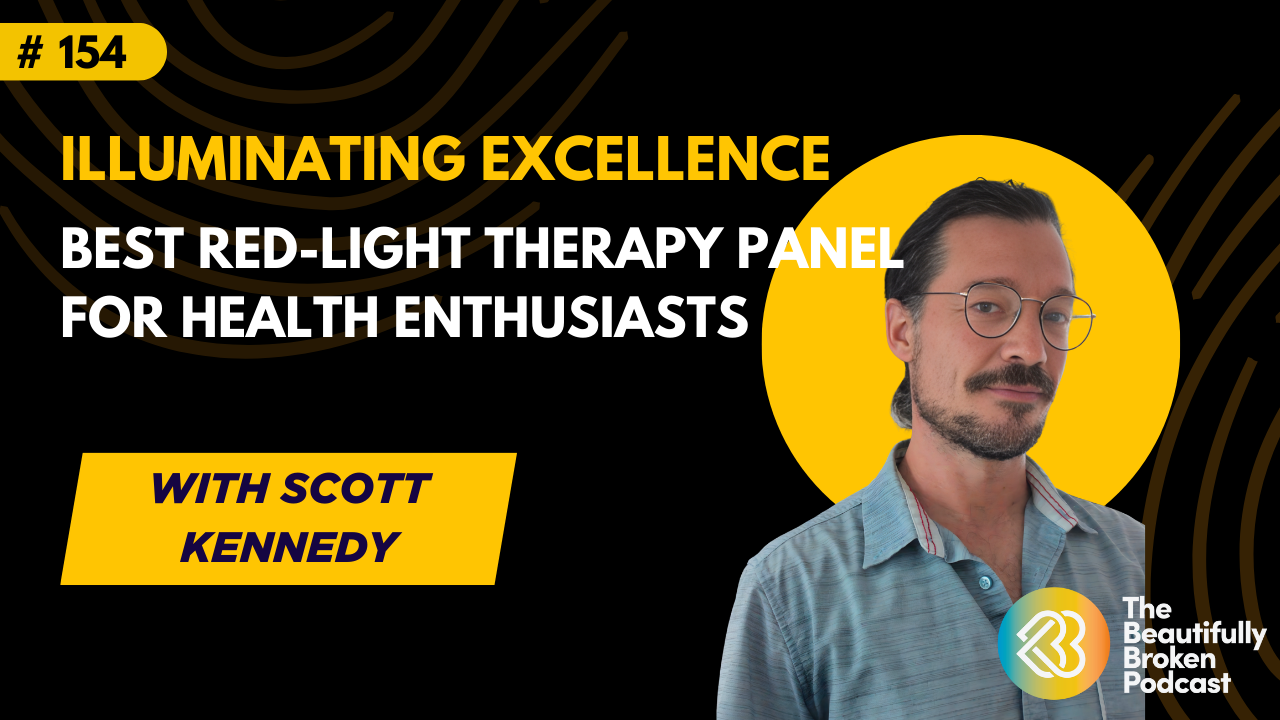
WELCOME TO EPISODE 154
In this episode, we dive into the benefits of red-light therapy, including reducing pain, inflammation, and stress, enhancing athletic performance, improving mobility, and effectively treating anxiety and depression. Scott shares insights on Lightpath LED's newest Diesel Series, which is hailed as the best red-light therapy panel for health enthusiasts.
Learn how Lightpath LED is at the forefront of utilizing light energy to develop cutting-edge products that deliver results. Don't miss this illuminating discussion on The Beautifully Broken Podcast, where excellence meets red-light therapy for optimal health and wellness. Tune in now to uncover the power of light for your well-being!


Episode Highlights
[0:00:00] Scott Kennedy and Why You Need Red Light Therapy
[0:09:07] The Science Behind Red Light Therapy and Studies to Prove It
[0:15:05] Red Light and How It Benefits the Mitochondria
[0:17:36] On Red Light at Different Wavelengths and Pulses, and Noticeable Immediate Effects
[0:28:17] Lightpath LED’s New Diesel Series
[0:34:01] Discerning Between Different Red Light Therapy Products
[0:40:04] On Why The Diesel Series Has a Longer Warranty Period
[0:44:25] On Getting New Technologies into Treatment Centers or Hospitals
[0:55:25] Closing
UPGRADE YOUR WELLNESS
LightPathLED https://lightpathled.com/?afmc=BEAUTIFULLYBROKEN
Discount Code – beautifullybroken
Flowpresso 3-in-1 technology: https://www.beautifullybroken.world/flowpresso
Medical grade Ozone Therapy:
Discount Code: BEAUTIFULLYBROKEN
GOT MOLD?: https://www.gotmold.com/beautifullybroken/
Code: beautifullybroken10
AquaCure Machine + Molecular Hydrogen
Website:https://eagle-research.com?ref=24931
Code: beautifullybroken
AMD Ionic Footbath: https://calendly.com/ioncleanse/detox
Silver Biotics Immune Support and toothpaste
Code: BEAUTIFULLYBROKEN
DIY Home Cold Exposure: https://www.penguinchillers.com/product/beautifullybroken/
Cellcore – https://www.beautifullybroken.world/affiliate-products My favorite Binders
My Favorite Sauna: Therasage https://bit.ly/39mTxwY
Code: BEAUTIFULLYBROKEN
CONNECT WITH FREDDIE
Work with Me: https://www.beautifullybroken.world/biological-blueprint
Website and Store: (http://www.beautifullybroken.world)
Instagram: (https://www.instagram.com/beautifullybroken.world/)
YouTube: https://www.youtube.com/@freddiekimmel
FULL EPISODE INTERVIEW
EPISODE TRANSCRIPT
Freddie Kimmel (00:00.384)
Ladies and gentlemen, welcome to the Beautifully Broken Podcast and our first, we got to give them a trophy, our first three Pete. Today we're joined by Scott Kennedy live. It's going to be insane. We sit down with Scott, who is the founder of Light Path LED. He is a veteran of the U.S. Armed Forces. He is an expert in dental lasers. And as I said, he creates the best red light therapy panel on the market hands down.
It's not a competition. It's actually laughable at this point because what Scott continues to do is he looks at the field and he says, I am going to make it better. And he just keeps doing it. So I celebrate this new product called the diesel series. We're going to talk about it. So I'm not going to talk about it now, but he has generously given this audience a code, a really big discount on all the products on light path. Led using beautifully broken in the checkout.
Stick around, this is fun. This one is also gonna be on YouTube and we got a beautiful camera crew so you can see me, you can see Scott. Check us out, let's jump on in.
Welcome to the Beautifully Broken podcast. I'm your host, Freddie Kimmel, and on the show we explore the survivor's journey, practitioners making a difference, and the therapeutic treatments and transformational technology that allow the body to heal itself. Witness the inspiration we gain by navigating the human experience with grace, humility, and a healthy dose of mistakes, because part of being human is being beautifully broken.
Freddie Kimmel (01:47.544)
Ladies and gentlemen, welcome to the podcast. We're gonna get going, but before we do, I have to mention a product that I've been talking about for over six months. This is Silver Bionics. Silver Sol Technology, which is a technological play on silver, but they've coated it with a silver oxide that can steal thousands of electrons. This particle that Silver Bionics has invented is AG404, which makes a supplement hungry for electrons.
If you've listened to this podcast in the past, you know when something can take electrons away from the bad guys or the pathogens, your immune system is going to operate better. So I use their immune support daily. I have not had a cold since I started doing this. It's been over six and a half months. The other product they make that I absolutely am in love with is their toothpaste.
your mouth and gums feel fresh and pink. It's very, very effective. And this has been validated by one of my favorite biological dentists, Dr. Gene Sambataro. The other thing that I have to tell you is they have a burn cream. Now, I wouldn't tell you that I needed a burn cream. However, I was just in Maui and the fair skinned individual that I am, I was blessed to have this and would literally watch a sunburn melt away after an hour because the cooling effect
of this burn cream was amazing. check it out. They are offering this podcast 30 % off on any of their products using the beautifullybroken. So check that out today. And last but not least, I got to give some big love to AMD ion cleanse, which is an ionic foot bath, which yes, I know, Freddie, you got a little woo on me, but it's not. You put your feet in water, you put in the ion plates,
and both negative and positively charged ions are added to the body. What does the body do with these ions? It binds and forms covalent bonds with metals, toxins, biotoxins, mold. And through studies, over three to four months, we can watch levels of environmental toxicity like glyphosate. Glyphosate is a weed killer that you don't want in your tissues. It affects everything in a bad way. And again,
Freddie Kimmel (04:08.396)
You're noticing a theme here. Energy, electrons, light, the stealing of electrons. Team, I align with these companies and these sponsors because they work, they're effective, they're affordable, and they do the good deeds. So check them out when you shed love on them and their shopping carts, you shed love on this podcast. That's it for now. Let's jump in. Ladies and gentlemen, welcome to the beautifully broken
podcast. I'm so excited to have our first three Pete guest on the show. We are here with the founder of Light Path LED, Scott Kennedy. Scott, how you doing? I'm really good. I'm so excited. It humble beginnings, right? Do remember when we first interviewed in a barn in Connecticut? I do.
I'm good. How about yourself, Freddie?
Scott Kennedy (04:55.15)
Yeah, I think that was my first interview ever. Yeah, I'm sure it went horribly
Note, I actually remember this, Scott got off and we turned off the mic and you were like, that was really amazing. You felt really good.
Yeah. Yeah. Well, it's when you can have a conversation. Yeah. And, you know, as opposed to question one, question two, question three, it just goes a lot easier. Yeah.
I think there's this idea within interviews or podcasting that you have to be prepared or come with some level of expert information or Scott, I want you to quote the study from 1972 in which the irradiated the tail of a rat and they saw a benefit in its lymph nodes. And that's not what I want. Scott, 1973, nasal cannulas, red light therapy.
Good. Good.
Scott Kennedy (05:42.85)
I can't remember that one.
So if we were walking down the street and I said, Scott, you work with red light therapy. Like, what does that mean? Because there'll be people that didn't hear episode number one that we did together. I'll put these in the show notes and the second one we did. What is red light therapy and what does it do for the body?
In a nutshell, we're using specific wavelengths of light that we know through, you know, 30, 40 years of science has a benefit to our cellular health. mean, that's a very simple way of putting it, but it makes a lot of sense because people get a little too involved in red light does this red light does this all these different things. And it becomes this, you know, this magic pill, which does not exist. Red light really does one thing.
It helps the cells, specifically the mitochondria, the powerhouse, produce more ATP energy. From there, there's a cascade of effects that occur just by our cells being able to have more energy. So that's really it. The best way to describe it, it's like a nutrient. It's a nutrient that our bodies, all of our bodies need. And we can do this in a device that you can just have at home and you can be doing
anywhere from five, seven times a week, 10, 20 minutes a day. And it just has so many benefits to what your body needs.
Freddie Kimmel (07:11.678)
There was an interesting social post I saw in which somebody was trying to bring up the question. They're like, well, am I born with a red light deficiency? Like, why do I need to use these panels? What is this? Because you see there's not an eruption, but there's a generous amount of companies out there working with this science and creating products. And one good question, you're like, well, why do I need this? You know, it's like, how do you answer that question?
That's a great question. Mitochondrial dysfunction is something that they've been doing a lot more exploration into. We generally talk about, you know, just about every disease disorder dysfunction. The underlying cause is inflammation. Go a step deeper. Mitochondrial dysfunction, meaning the mitochondria is, they're weaker, they're less in numbers. They're producing less ATP. So
Anything from diabetes, cardiovascular issues, eye issues, cognitive function type issues, aches and pains, autoimmune. Again, when we get deeper, inflammation, mitochondrial dysfunction. All right, what's causing that? It could be genetic. A lot of times it's our environment. I mean, we don't live in a world like our ancestors. We're not living in a world where our food is organic.
We're not living in a world where there's not all these toxicities. We're constantly bombarded with stress. So our bodies are lacking in so many things. That's where light can really be of benefit. So we're trying to bridge that gap. We're trying to, through new devices, be able to give people that nutrient, that light energy, which can help.
balance some of the issues that we deal with on a daily basis.
Freddie Kimmel (09:07.734)
Yeah. You mentioned 30 to 40 years of science in red light therapy. What are some of your now I do this to it, you can pretty much go on Google, you can confirm your bias pretty much on any topic you want in the world. And I've done some really good research into red light therapy. And what I've seen is, there's quite a lot of information out there that's been through the highest standard of a trial. So it's double blinded. There's a group with a device
There's a group with a sham device that don't know they're being treated with red light therapy. What are some of the favorite studies that you like to look at or maybe some of the new ones since we've last spoke that enforce this cornerstone of belief that this is something people should have in their homes?
Yeah, so probably over 30 years, well over 7,000 studies have been done. I think the last I heard, like 84 % of the results have been positive. And we can even look at the 16 % and go, well, we know why it didn't show positive. It showed maybe neutral. And that's because the power being used was too low or it was too high or whatever else. You know, you can really point out, but 84 % is
huge. mean, that's a great number to have. Some recent ones, really a lot of it comes down to cognitive. They're finding out so much more about the brain and how inflammation in the brain can occur anywhere from people with depression all the way up to people with Alzheimer's, dementia. So again, we go back to underlying issue, inflammation below that deeper mitochondrial dysfunction.
That's what's going on with a lot of people with some type of cognitive impairment. So a lot of the studies have been focusing on that because there hasn't been a great alternative. There hasn't been a pill for dementia, for Alzheimer's, for whatever, where they haven't worked very good. So they've been able to study more about light, particularly pulsing light as well, and seeing really good benefits. So a study comparing antidepressant
Scott Kennedy (11:17.804)
with light. Four months, they saw equivalent results. The group doing just the red light, group doing just the antidepressant. But with a lot of medications, you see it trail off. So at the eight month mark, the light was showing greater positive change for the person with depression over the antidepressant. That was a big one. Eye sight. That's another big one.
So a lot of people particularly getting up in age, macular degeneration. There's no great thing out there to solve that. So they've been doing more with light, whether it's macular degeneration or just eyesight issues in general. Again, where are most eyesight issues coming from? Inflammation, step deeper, mitochondrial dysfunction. So great results on improving the last study I saw was, I think it was a 17 to 20 % improvement
In contrast, near and far sighted. That's a huge improvement. Another great study was on fertility. So females who could not get pregnant. So they did a study on that. 17%, which you say that seems like a low number for someone who cannot get pregnant, cannot deliver. That's huge. You know, for something that is extremely affordable, it's non-invasive.
So there's a lot of studies and they're coming out and they're getting more studies. There are bigger studies coming out. So I think every year that goes by, it's just going to keep on going up with the studies. And then they're going to start delving into more fine tuning things like what are the exact wavelengths that work really good? What's the exact power that we need? The duration? What's the right pulse frequency that we want for certain types of issues?
So I think it's just gonna keep on improving.
Freddie Kimmel (13:18.094)
Yeah, you said that the idea that a woman trying to get pregnant through this study that you quoted had a 17 % greater outcome in having a child.
17 % of them were able to get pregnant and deliver.
and deliver. what I take from that is like, so I literally give myself goosebumps right now because I say, let's stack the 17 % with elite nutrition, meditation, with an elite form of mineralization, remineralization of the tissues. You know, we can start to like push the needle forward using these holistic lifestyle, a redirection of our lifestyle habits, which
This is something we have control of. It's something we can choose to do tomorrow. I just get really amped up about it. It's not that I think we can get lost in, I want the 100%. In the body, from my experience, it doesn't work that way. Right? We can almost look at if I adjust the sail of the ship just by a couple degrees, I can dramatically affect the course of my destination. If Michael Phelps adjusts his hand, his rotation of his stroke by just degrees,
It's another gold medal. this is a 17 is that's a lot of degrees change. I get really stoked about that. You mentioned a couple terms that maybe people listening to this for the first time didn't understand frequency, the pulse rate. Let's talk about that a little bit. The idea of what are from your understanding the really let's do the nanometers of wavelength of red light first.
Freddie Kimmel (15:03.598)
So there's different wavelengths. There's a spectrum to which red light is red, correct? Am I saying that right? Correct. Like if I looked at the rainbow and I said there's a nanometer, there's a spectrum that the rainbow exists on and then there's a sliver that's red light. Right. And red light has a specific value to the body, the mitochondria. Can you explain that a little bit and why that's important?
Yeah. So if we go back kind of like a mitochondria, people go, it's the powerhouse of the cell. Yeah. Go back to high school again. Roy G. Biff. We remember the visible light of sunlight. know, Roy, R, red, orange, yellow, on up. So what they found, now we call this red light therapy. It's a complete misnomer. Red is just one of the wavelengths that we use. can use near infrared. We can use
blue, can use green, can use yellow. They all have different aspects to them. The main thing is penetration is different. So we know through the science, red and near-infrared are the two wavelengths that penetrate deepest in the body that have a mitochondrial effect. So red, when we talk about red, that's in that 600 to 700 nanometer. Then we have beyond that, we have near-infrared.
It's not visible to the human eye, but I see certain types of animals can see near infrared. If we put on goggles where we have an old cell phone, we can see near infrared. So red penetrates less in the body than near infrared. Red is most absorbed by hemoglobin. So once it hits the blood, the capillary bed underneath the skin, that's about where it stops, but it can create systemic effects throughout the body. Near infrared.
is less absorbed in hemoglobin, so it's going to be able to pass through. So where red is great for skin issues, it's great for underlying, it's great for superficial lymphatic systems, great for the eyes as well, superficial type things. The near infrared is going to penetrate deeper. So now we're getting into muscle, joints, bone, brain, organ, on and on deeper type tissues. The combination actually has a synergistic effect.
Scott Kennedy (17:22.541)
So when they did the study just using red, just using near infrared, combining the two, the combination did better. That's why you're gonna see most devices that are gonna carry both wavelengths.
Yeah.
Freddie Kimmel (17:36.43)
Yeah, so when I first started out doing red light therapy I think the first device that I had was a little nasal cannula and it went into my nose and I'm 90 % sure that it was one spectrum Yeah of red that meant the intention was to go up and it was it to hit this blood supply up here above the eye and Give energy to the system and I found great value from that. So with that you've obviously looked at the
nanometers, the wavelengths, which you see to be most beneficial, what are those that you've included in your panel systems?
Yeah. So our new panels have three wavelengths. Interestingly, my previous one had five. So I've actually taken a step down. So again, it was supported by science. So, you know, sometimes people want to get caught up in the like razors. So it's got two blades. It's got three blades. It's got four. It's got five. It gets a little bit ridiculous. When research came out and it was pretty clear that in the near infrared range, eight, 10 nanometer
had the best effect on the brain and had the deepest penetration into the body, I said, let's get rid of the other two near infrared wavelengths, which was 850 and 930. Let's just stick with 810. So every bulb has 810 in it. Now in the red, the red so far all act pretty similar, but there's slight differences in penetration. So I have two in the red, one 630, one 670.
So we have one that's a little bit less penetrating and one that's a little bit more penetrating. So those are the three wavelengths. And as science changes, which I'm sure it will, I may very well look at changing the wavelength. So much of what I do is going to be based on the science.
Freddie Kimmel (19:29.334)
Yeah. The other thing that we mentioned was the pulse rate. So we're talking about we have a nanometer, a wavelength of red or visible red that's coming from the panel system for light path LED. And then we have the different pulse rates. And can you explain that why somebody would use a different pulse rate in a panel and what's some of the supportive literature you've seen to rationale, including that in your system?
So the pulsing has been around in photobiomodulation, the technical term for red light therapy, you know, for well over 20 years. And the science is now catching up, which is typically what happens. pulsing, just to make life easy, pulsing can be interchanged with frequency, can be interchanged with Hertz, so it gets a little bit confusing. It's a simple turning on and off of the light, but it's that very specific
durations, very specific hertz or pulses per second. So if I had a light bulb and I had to switch and I just went on and off, that's technically pulsing. And that's what we're doing. But again, we're making it very, very specific. So we can be pulsing the light at one time a second, up to 10,000 times a second. What they found with the studies, which have been, that's where the field is really growing because they found that pulsing has an added
benefit to just what we would call non-pulsing or continuous wave light where it's just on like your light bulb is just on. Pulsing what they found creates a benefit particularly for cognitive. So we think about the brain. The brain has wavelengths, alpha, beta, delta, gamma, theta. So if we can match a pulse that's going to be either transferred into the brain and changed into
an electrical impulse, in essence, giving a message to the brain or it's giving a message to the cells in the body that it likes and it's going to increase the healing process. There still needs to be a lot of studying done to determine what is the greater benefit. So whether it's 5%, 10%, 25%, 50%, we don't quite know, but they do know in a great amount of studies that both for cognitive
Scott Kennedy (21:51.818)
as well as whether it's eyesight, whether it's bone healing, whether it's wound healing, that the pulsing has shown greater benefits.
Yeah, yeah, I've noticed even from using like, there's a torch that you have on your site that if I do the static red light on my thyroid or some acupressure points on my meridian system, verse the pulses, I can feel almost like a slight tingling. It's like I can feel the circulatory benefit. Now I'm very, very sensitive to energy. And I've also tested this on other people. And the second you go to the pulse rate,
There is something different than happens. good friend, Sarah Turner, who is a research scientist, one of the world premiere specialists in photobiomodulation, she said to me, think it was a week ago, she was like, if I create a device, it will have pulsing. Like she's that on board with it. We mentioned some of the science and literature coming out around 40 Hertz. One of my favorite neuroscientists, Andrew Huberman.
was talking about the value of pulsing a light at 40 Hertz to help the brain help different mechanisms to break up beta amyloid plaque cognitive function. I've been really excited to just watch this unfold. And just like you said, stay cautiously optimistic as we learn more. But I have had some people come over and use the panel and notice they're like, wow, I'm really
I just thought of two names that I haven't been able to in 20 years and I didn't have to think about it. It just rolled off the tip of my tongue and it was right after I was on the panel. The other thing I had is I had someone on pulsing 10 Hertz and they said, Freddie, I looked down at my phone and I was reading my email and I didn't have my glasses on. Like they noticed a pretty quick benefit within three or four days that their eyes were just, whether it was less stress in the ocular cavity from being pulsed with the light.
Freddie Kimmel (23:52.568)
but they've noticed some benefit in their vision, so.
Well, I'll tell you what is the immediate response. Again, science. When light gets absorbed by the mitochondria, speeds up the production of ATP, it also releases nitric oxide. Nitric oxide is a huge, huge component for our body. Nitric oxide creates vasodilation. So we're getting the capillaries, the arteries, the veins, they're opening wider.
That means more blood supply is going through our system. That means more oxygen is going through our system. So if you had any part of your body that is not getting the correct amount of oxygen needed and we can all of sudden flush that area with oxygen, you're going to have some pretty immediate results. There's a reason why a lot of professional athletes are using light and they'll do it, you know, within a couple hours of either their training.
or their actual event because that nitric oxide boost creating that vasodilation, bringing oxygen to the body, not only helps them in studies perform better. And we talked about like the 17%. Like that doesn't sound like huge. With a professional athlete, we're talking about 2%. But that 2 % is that inch advantage. We're talking about their recovery time being less, meaning they can exert themselves harder.
they can work out more frequently because they have less pain, the less inflammation in their body. So that's the immediate response. And so that's why you can see with certain people, someone that is in pain, maybe someone that's older, they have back issues or they have foot issues and they love to walk, but they can't walk very far anymore. By simply a one, two, three sessions, they're feeling better. It doesn't mean it's gonna.
Scott Kennedy (25:50.446)
It means it can help them manage. So much of us, whether we're dealing with neuropathy issues, autoimmune issues, aches and pains, cognitive, what we really want in life is just to be able to wake up in the morning and not have that be the first thing that pops into our head. We just want to be able to manage our day. If we can do that by having something as simple as light without any of the side effects that are caused by so many of the other medications, whatever out there,
I mean, that's life altering for people.
Yeah, I think it is too. It's certainly a lifestyle practice that I find accessible. I find there's enough science to support even a skeptic to experiment with it and try. And with that, I just want to talk about, we mentioned before, there's so many products on the market. You know, and I choose to very transparently, when people ask me, I was like, guys, no brainer, go to lightpathled.com.
Use code beautifully broken and go get a panel. Like from my experience and just in this wellness space of arena, there's great products out there. But why I tend to trend towards Lightpath is the fact that you are always evolving your product. And now here we sit and if you're watching this on video, we're sitting in front of two panels that are visually more stunning representations of any red light therapy device on the market to date.
at one of the most affordable price points and delivering some of the best attributes that I've seen. Period. mean, it's... We'll do it in not a used car salesman way. I want to show the differences. And at some point, we'll do a side by side. We'll show you a standard industry panel and we'll show you what Lightpath looks like. And it's a wow factor. have the older version of your product in which I have four full body panels stacked on a beautiful TV mount.
Freddie Kimmel (27:45.856)
It's a huge fan favorite. I have a vibe plate in front of it. Everybody loves to come over and do that. As we said, stand on the vibration, nitric oxide release, stand in front of red light, more nitric oxide release. You get off, your brain feels incredible. Now the new panel, which is called the diesel line is much more robust. It's wider. You can really get away. If we were to stack these on top of each other, it's like big enough for an NBA basketball player to have a full body treatment.
And then you've done some other things too. So let's talk about the diesel series and what you've done to change the product that you were producing before.
Yeah. And it was funny because I remember not too long last time I was down in the area, we were trying to kind of come up with a name for the new model and we're like, do we want to call it the 2.0 or the, know, and a lot of that was kind of cliche. And if I remember correctly, we probably had a couple beers and somehow diesel came up and I was like, that's it. Because that was the name that really encapsulates what we've done with this device. So, you know, I'm not an engineer.
So all I can do is I can go out and I can say, hey, engineer people, this is what I want. This is what I need in mind. And they can either say, yes, we can do that or no, that's just not possible. So my previous model, I still think was one of the high-end ones out there, but there was things that I needed changed on it that I was asking for that couldn't at that time, couldn't be done. Or I was getting too much. My engineers hate me because every month I'm saying,
Yeah.
Scott Kennedy (29:23.778)
Let's change this. Let's fix this. Let's add this because whether it's science or just being able to easily use something. So one of the things I really wanted was to have double chip, which just means if you look at most panels, one looks red, one looks off, one looks red, one looks off.
Yeah, we've all seen videos of people standing in front of the red light panels and that's one of the questions I got when people would buy they said, Freddie, my panel is broken. Only half the lights are lighting up. So it was a and if you were to turn them out, you could kind of see them on but it was just like it was that invisible spectrum that we're talking about.
So I couldn't get the engineers to, they tried it and it didn't quite work. It couldn't survive. It couldn't handle the punishment of daily use. And then I found engineers that could do it. So like in every single bulb now, we either have two or three chips, meaning we've got red and near infrared in each one, which means that if I'm up close to it, I'm not getting red here, near infrared here, red here. I'm getting...
all the wavelengths at once. So I'm getting better overall coverage on the body. One of the other things was I just wanted something to be really, really durable. I wanted something that could not just last through the shipping process, which as we all know, I these can take a beating. I wanted it to be strong, you know, for in your home. So if something did happen, you felt confident. So we changed the whole outside. So just a casing, if you just
Yeah.
Freddie Kimmel (30:45.368)
Yeah.
Scott Kennedy (30:55.788)
you know, knock on it. It's thick, it's strong, it's durable. Then we go to the inside. The fans have all been upgraded. The power supplies, just simply the wiring has been upgraded. And so how does that affect the end user? So the fans are a lot quieter. There's some panels out there that kind of rattle. They're kind of loud. This is quiet as can be. So we've got the decibel down, which is what I wanted.
Because we were able to build it with higher quality, got EMF down. We've gotten stronger diodes that are going to last longer. We've gotten stronger bulbs that are going to last longer. We got a display that's easier, know, user friendly as well. So we've added a lot of things that just give me confidence, you know, that I know what you're ordering is going to be undoubtedly the highest quality on the market.
Yeah, great. You said the casing. What is the casing made out of?
So this is made out of iron.
made out of iron. And you mentioned you've gotten the EMFs down. That's a big hot button right now. It's hard to understand what's what is an electromagnetic field, which is created off all anytime we run electricity through a wire, there's going to be a field created. And there's some science of support that EMFs can be bad, the appropriate dose or wavelength or exposure time. So let's just talk about that for a little bit. What are we looking at?
Freddie Kimmel (32:27.8)
Where do we get a safe dose by standing in front of these panel systems? Because they have fans, they have a lot of power going through the back. most of the panel systems do create an electromagnetic field.
Yeah. Sometimes I think EMFs are a little bit overstated because if we think about our household, we're using a hairdryer. That's a lot of EMFs. We've got our phone to our ear all the time or sitting in our pocket right beside our testicles or whatever. We've got our AC units, we've got our microwaves, we've got our TVs, we've got our vacuums. Huge EMFs with those. But if we're talking about a health device, a device that's supposed to improve your health,
That's something that's important that we've got to really take note of. Panels are meant to be at a distance. We have a high enough power that it doesn't have to be right on your skin. We want it to be a distance. We want the lights to be able to flare out to cover a larger area. So we need to make sure that when you're at the appropriate distance, you're not getting EMF. About six inches, we're at zero. At three inches, we're zero. Closer than that, it's very, very slight.
Wow. And that's where most of the panels have been able to go. Some of the more quality ones, as opposed to some of the... If you ever see a device with just two prongs, stay away from that one. Yeah. If you see a device that just has kind of a plexiglass cover, you know, stay away. If it's just a plastic, stay away from those.
Yeah, I have a question for you. So you run a, you have a group on Facebook, Red Light Therapy for Beginners. Am I saying that right? Yes. How many people are in that group? 12,000 people in there. And so you very non-product driven answer new users questions. I often, I will scan that group, which I'm a member of and I, and I always get the ping, right? Somebody posts, found this on Amazon or I found this in China or I found this
Scott Kennedy (34:10.648)
We're at about 12,000.
Freddie Kimmel (34:30.84)
They're like, what about this one? A very common question. So how do you usually answer that for people?
Yeah, you know, here's the thing is you can find with anything. You can find really cheap stuff and you can find really great stuff. So you just have to discern appropriately. And it's tough because it's new to a lot of people. So it's not like we know the difference between. I'll just throw this as example. We know the difference between a Ford and a Lamborghini.
pretty obvious. But when you're going on a site and you're seeing, hey, I can get this panel for $89. And you say, oh, well, this one is over a thousand. You may instinctively go, well, well, let's go to the $89 one. Now we're dealing with Flickr, we're dealing with EMF, we're dealing with low quality bulls, we're dealing with low power. And hey, maybe for someone that they're on a really tight budget, get started with something like that. That's fine.
Put your toe in. Get something that you can get now and get some kind of benefit, and then you can work your way up. But yeah, that's unfortunate because there's a lot of things on the market that either are poor quality or it's being over-marketed, meaning they're putting in these bells and whistles that they know will convince someone that this is the way to go because it's got this dimmer switch or it's got all these different modes.
And again, once we would get right down to it, it's the science, it's the science, it's the safety, it's durability. But one thing that a lot of people forget is the customer support. And that's where they get lost because they'll buy a product. It may actually be more expensive than this or maybe less expensive and they get it in. And like we've all got stuff that we spent money on that collect dust because we don't know how to use it appropriately. So they get a device in.
Freddie Kimmel (36:24.216)
Yeah.
Scott Kennedy (36:31.158)
And then I see them on the Facebook group and they're asking questions like, Hey, I'm trying to call up the support. They can't tell me about how do I use it because I've got this kind of an issue. And so again, that's where people have to be discerning. mean, we can talk about certain things like how much is this per bulb or per square inch? How much is this going to cost? Like a house you're looking at what's the cost per square foot. Okay. That gives us general idea, but where is the location?
You know, how much land is there? How easy is it to get to the bus or the train? You know, does it have a garage? All these other variables. So we can talk about how, hey, you could get something less expensive, but it may only be nine inches wide. So by the time you get it in there, you go, well, this is too small. I've got to get another one. Now you spent more. Or if you get a device in and you don't know how to use it, you just wasted that money or you're using it and you're not getting good results.
because you don't have someone to say, hey, don't just put it out on the foot because you've got neuropathy issues. It may be coming because you're not getting oxygen. So we need to hit the lymph node in the back of the knee. We need to hit the lymph node in the groin area. Maybe it's a nerve issue. Let's start hitting the lower back area. You know, so I would say out of all the great changes that I've made, I think the thing I'm most proud of is that you can literally buy the unit.
and call me. You can literally schedule 20 minutes and we can have a phone call and you can say, here's all the issues that I've got. And I can say, here's what I want you to do. You know, here's where I want you to place it. Here's how long. Here's the pulse that I want you to work with. And that's what people need with something that they're not familiar with. They need someone to help hold their hand and walk them through, not just till they get your credit card.
Yeah.
Scott Kennedy (38:28.696)
So it's the support that I think is really, if there was one thing when buying a device that's most important, I would say it's support.
I would do I just the one that's going to bring you value is the one that you're going to use. And I find that the intimidation factor of, I've got this thing, and I'm unclear, will cause paralysis in them doing anything. And I've said this before, I did a podcast 10 episodes ago about this idea of oftentimes, we're looking at a problem, and we'll just go out and we'll buy something, not fully understanding the implications of
What should I be expecting? Should I be looking at an immediate shift in my energy in a week? 90 days? Six months? Depends on what's going on, right? Like you said, there's so many variables we bring in human beings always. It's like your background emotionally and from an environmental toxicity level is so different than mine is going to be. Dramatically different. So there's no way we're going to have the same outcome. It's impossible. That's where I think it's exciting as far as like, I love to problem solve for people.
And because I know I'll just use the 17 % from the fertility study. I know this is giving you extra how that plays out in the big picture. You know, we'll see. But maybe we got to make four or five micro adjustments to your lifestyle and then we'll get the return on investment. I want to just pivot to the idea of I have a lot of confidence when companies come forward with a really good warranty.
And that's something that you've changed on this, correct? You've upped the warranty on the panel because of the internal components. Can you speak to that a little bit?
Scott Kennedy (40:09.346)
Yeah, so simple. It's a five year warranty, which is the highest in the market. So I went up from the previous model from three up to five. And that's simply because the way that it's built, we can have confidence that it's going to way outlast the five year. But that's one of the biggest things is warranty and knowing that if there is a problem with it, that you've got someone you can pick up the phone and say, hey, here's an issue and then we can solve it for you.
So it's a peace of mind thing really. But again, with anything new to people, you know, we can get stuck with paralysis by analysis. You know, so I try to make it as easy for people to look at our device and go, it checks off this, this, this, this, this, this. That's where we can go.
That's beautiful. The other thing I just want to, I want to speak to or mention and not to get on a soapbox, but for me, I've always said red light is like the gateway biohacking device. You don't have to overthink it. You get panel in home, you get panel in bedroom, you take off your clothes and you stand in front of it naked every day, you know, 10 minutes, just 10 minutes a day. You will have a shift in your mood.
That's the one thing I noticed. Like I really do miss the days when I don't start my morning with it. And it's funny now in Austin, Texas, it's chilly. You know, I have a little side room where I have my lights set up, so I haven't been doing it as much. You know, I'm like, it's like 40 degrees. You know, so it's there is that little rethinking. Where does your red light live in your home where you're going to easily achieve a session? And so
The one thing that my partner has, Kristen, that I don't, she has hers on a rolling stand. So if she's podcasting, she can roll it in, she can do her lower body while she's on a meeting, she can roll it over against the wall, she has a meditation cushion so she can go in and get it in. So I just think that it's the place that you select to do your therapy is also very important. The last thing you want this to be is a clothes rack.
Scott Kennedy (42:24.396)
Right. It reminds me of when I was learning guitar and my son was about two, right at that age where he started going after my guitar. So I put it in the closet. 12 years later, it's still in the closet. So yeah, you've got to find the place where, you know, it's out of sight, out of mind. So this is what I've got at home. I don't need to have a huge setup. I like to be able to sit down on a pillow, turn on my breath work.
I'm a big fan of combining things. You know, where I'm going to be in front of the light, I'm to do some breath work. I'm going to do some meditation. I'm going to do some binaural beats. I'm going have my coffee. You know, for someone that has a smaller tabletop unit, you know, have it on your bed stand. If it helps you sleep at night, have it there. If you like to use the first thing in the morning like I do, have it on your table. You know, have it right there where it's going to remind you, okay, time to get my light in. And the key is it's not like something you do.
for a month or for two months or for three months until you get over your problem. Like I said, this is a nutrient. It's no different than going out and getting your vitamin D with your sunlight. It's no different than going out and exercising. It's no different than eating healthy. It's not a diet fad. It's not a, let's do this for a month. Let's lose 10 pounds and then we're good. Cause we all know what happens after that month is over.
This is important to make as a life change. So every day you're waking up in the morning and this is your go-to. This is what's giving you the energy in the morning. This is what's taking away that grogginess. This is what's taking away that brain fall for the day. This is what's taking away some of those aches and pains that come along with certain autoimmune type issues. So this should be your daily go-to and it should be something that you're
Yeah.
Scott Kennedy (44:20.086)
ready to bring into your life as a permanent change.
Yeah, more and more. just want to comment on one more thing. I have so many people reaching out because they see the stuff I post on Instagram. often have we had a Friday night frequency night last night had about 15 people over and people are on the red panels and the vibe plate. They're in the sauna. They're doing amp coil. We're doing Brown's gas. And then we're just this is a backdrop to the social setting. So I often have
emerging business owners or entrepreneurs saying, hey, I want to bring this into my center. And the first thing I always say, it's from my experience, whatever gets the full body. And so we'll definitely do a video of this, but the diesel XL and next to you is the shorty, correct? Has an H bracket and we can stack these and that is big enough to treat Shaquille O'Neal.
It's It's about seven feet tall. So it's going to get pretty darn close.
Yeah.
Freddie Kimmel (45:25.014)
Yeah. And it's like we said, this is wide enough so we can get away with two panels, not the four typically seen in a biohacking center. It's on a rolling stand so you can move it around. But again, it's like where we set it up. And I think the only thing I think about is like, I like when people have a treatment area, it's either a red light room, because it's gonna fill the whole space with red light. People don't think about that. They're like,
I have it on the wall and everybody else is blinding when they walk in because this thing is really bright. And so it's a red, white room or it's a pole curtain. And the other thing I'll just throw out there as an idea, you had these beautiful teepees that you bought on Amazon when we did an event in Austin, Texas. We did the how do you health festival and you had put, I think you had a, had the shorty in the teepee in front of a meditation cushion. And I thought that was just such a cool way.
It gave this great vibe. You know, like your eye, I'm going into a Burning Man tent now and I'm going to do a little red light. It was so neat. So I'd love to just hear your thoughts. If you were going to open and you had a red light therapy clinic in New Jersey for a long time and you had the beds, you know, had the beds, which are very, very expensive 50 to a hundred and 150 thousand dollars, which I just want to throw out there. We did test heart rate variability, predominant brain wave states.
The panels tested stronger than the $100,000 bed because we did pulsing.
because we did pulsing. Right, so we did the pulsing with the panel as opposed to the bed, which was continuous wave, and we were only using a small. We were just using the tabletop pulsing, and that had better readings on the heart rate variability than the full bed did.
Freddie Kimmel (47:05.998)
That's right.
Freddie Kimmel (47:13.376)
Yeah, I am frugal. I'm frugal in the failed attempts that I've had at buying stuff that didn't yield the result that I wanted. That is my bias. So when people tell me they're opening a center and they're going to go invest in a bed from Germany, that's $150,000. I'm always like, bro, we can do like three grand, 3,500 bucks and we can set you up with like better results, more power, prettier, better.
end user, a satisfied, happy customer. Do you want to explore that? And it's honestly people, they're like, but I really like the bad or they're like, no, no, no, but it's the bad. Not to name a product or not name a product, but I'm just saying from my experience and testing and understanding of the radiance coming off these bulbs, there's more value here and a dramatically lower price point. just
It's like whatever you think your business model is. I ask people to always think about that.
Yeah, I mean, I got the bed. I mean, I thoroughly enjoyed the bed, but it cost me a ton, you know, and in hindsight, I would never do that again. Yeah. You know, so there's multiple ways we've got a wall stand coming so we can actually hook up bars up to the wall and hang one, two, or we can hang four of these or we can put two of these, two of these. So we need a nice wide.
you know, 30 inches, if we ever needed it that wide, I don't know why we would, but you could do that. We've got a horizontal stand coming out where we're going to be able to put this and this together. So you can lie on a massage table or a chiropractic table, have the light right over top you so you can relax. Me personally, I love the idea of stacking these and doing a vibration plate. That's a really good combo. And again, me personally,
Freddie Kimmel (49:02.09)
Yeah.
Scott Kennedy (49:11.542)
In the morning, I just like to be able to, and I made the shorty particularly because if you're sitting down in front of it, it's like the right height. So it's a little bit less expensive than this. So you get what's going to be good for you. What you think you're going to be using. There's a lot of people out there. They simply can't stand in place for 10 minutes, whether that's neuropathy issues, joint pain, whatever else sitting down they could do. But then there's also people that just, can't get down on the ground.
So maybe they get this and they get a lower seat or they put this up on the wall or on a door and they have it at the right level for them. Or they get to stand where they can be horizontal and they can lay underneath it. Do 10 minutes, flip over, do another 10 minutes on their other side. So the key is to make not just the size, but accessibility with this. again, it's the same thing. If I get this, but I can't utilize it because of whatever health issues I'm going through, it's a waste of money.
Yeah.
So the key is not just for your home, but again, also at the wellness center where someone can easily come in, use it. takes up less space. It takes up dramatically less money and the end result is even better than that would be the way to go.
Yeah, I think so too. I just want to call this out to anybody that hears this podcast who has a medical center or a hospital. I always think it's such a shame that we aren't reaching our first responders, our dramatically overtaxed nurses and doctors. I don't understand why we can't partner with a hospital somewhere. I know, I do know why, because we've tried to do it with other wellness technologies is the bureaucracy is insane.
Freddie Kimmel (50:57.72)
but to have a break room where you just had a couple of red light booze for nurses and doctors in the middle of their shift to go take a 10, take a 10, take your clothes off, go literally recharge your mitochondria and refresh your energy while you're doing surgery, while you're feeling frustrated because that patient has hit the buzzer for 15 times because they're in pain. It's such a low investment. This is a great way to start to trickle
wellness in to the disease management system that we have. And I want to lead this charge, but I'm leading a lot of charges.
It's a tough one to lead. Now, I've got a couple of dentists who do just that. They've got a panel on a door in their office. So they're the assistants, hygienists, the front desk people can use it during their break. Now we always say, well, why isn't this in every doctor's office, hospital? We kind of have a good idea of why that is. Sure. But we're starting to see changes. You said when there's not a pill, then they can start putting money into
Yeah.
research for light. And that's where we're seeing such big changes with studies on cognitive. But a great example, oral mucusitis with kids that are going through cancer treatments. One of the most probably painful things out there is when you can't even swallow water. You can't even swallow spit. You can't swallow food because of the pain, basically blisters throughout your mouth, down your throat. They've been using light.
Scott Kennedy (52:32.482)
very consistently with amazing results for those kids. They're starting to use it more in burn centers because they're seeing amazing results. They're starting to use it more for those clinics that take care of diabetic ulcers. You're seeing it more in ophthalmology. Funny enough, you see it a lot in vet clinics. They're using it on their pets because they're getting great results. Great results with
dogs with kidney failure. You have kidney failure, six months, the dog's basically gone. Light is extending that for a year, two years on. So we're starting to see these little pockets, these little pockets, dental is getting involved, chiropractic is getting involved. So we're starting to see these little pockets. All right, eventually it's going to start to take off and the medical community is going to have to really take a hard look and go, wow,
We really have something can be really beneficial. Now we just have to find a way to bring it in and to utilize it and to be able to explain it to the patients. think that's the toughest thing for people is it takes time. You can't just simply go, here it is, pop this down one in the morning, one in the evening. You know, there's a little bit of a discussion, so we've got to educate them and then start educating kind of the bureaucracy part of it. But we're getting there.
Yeah.
Scott Kennedy (53:59.639)
It's just, yeah.
process? I will say for the users at home and people listening and wanting to explore this, the side effects of red light therapy are not a bleeding colon, heart failure, chronic migraines. Yeah, it's exciting. I'm excited for the education that I think this is why I get stoked about the podcast is having these conversations, the ability that we can reach people in India, Turkey,
No.
Freddie Kimmel (54:29.592)
Dubai, Japan, China, Iceland, and you get messages like, Freddie, I heard you talk with Scott. You know, and they've sat down with us for an hour. And I think this is where it trickles down, but I do have that hard call out to anybody involved in a, whether it's the management or the onboarding of new technologies into a hospital, I think this would be a fun one to explore. So if you're, if you're that person, let's do it. I want to be mindful of our time.
We have other podcasts to get you on in Austin, Texas while you're here. This has been such a treat for me. And I like how each one is like we've evolved a little bit in our ability to capture the content. And it's fun to see this grow over time and Light Path grow over time. And I'm proud of you, man.
My communication skills have slowly improved. Slowly. By the tenth podcast, I'll have it down.
Great. Well, my name's Freddie. This is the Beautifully Broken Podcast. This is Scott Kennedy from Lightpath LED. We hope you had fun learning and listening and please use this information, whether it's to upgrade yourself or a community member or a family member who you know could use the help. Big love.
Freddie Kimmel (55:49.762)
Ladies and gentlemen, you and I are moving on a four year relationship. That's gotta be some kind of a record. Thank you for tuning in. If you enjoyed the show, head over to Apple or Spotify and please give us a review. I know how busy you are. I know you got a list of things to do that's a mile long, but it makes more people across the world hear this mission. And one more ask. Before you go, there's a way that you and I can continue learning.
There's a way that you and I can continue to deepen the relationship that started in this episode. You could visit beautifullybroken.world and you can check out our brand new website and store listed are all the wellness tools, the supplements, the articles backed by scientific protocols to move forward in a wellness, the products that I am using and I personally love. Most of them offer a significant discount by clicking the link or using the code.
And the beautiful part? They don't cost you anything extra and at the same time they do support the show. Now, we have another new feature alert. I don't want to overwhelm you, but if you want to see the beautiful faces of our guests, if you want to watch me unbox and review products, head over to our brand new YouTube channel, Beautifully Broken World. This last message is from my vast team of internet lawyers.
The information on this podcast is for educational purposes only. By listening, you agree not to use the information found here as medical advice to treat any medical condition in yourself or others. Always consult your own physician for any medical issues that you might be having. Our closing, the world is shifting. We need you at your very best. So take the steps today to always be upgrading. Remember, while life is pain,
Putting the fractured pieces back together is a beautiful process. I love ya. I'm your host, Freddie Kimmel.