The Microbiome Blueprint: Unveiling the Secrets of Our Ecosystem Within for Optimal Health with Kiran Krishnan
May 29, 2023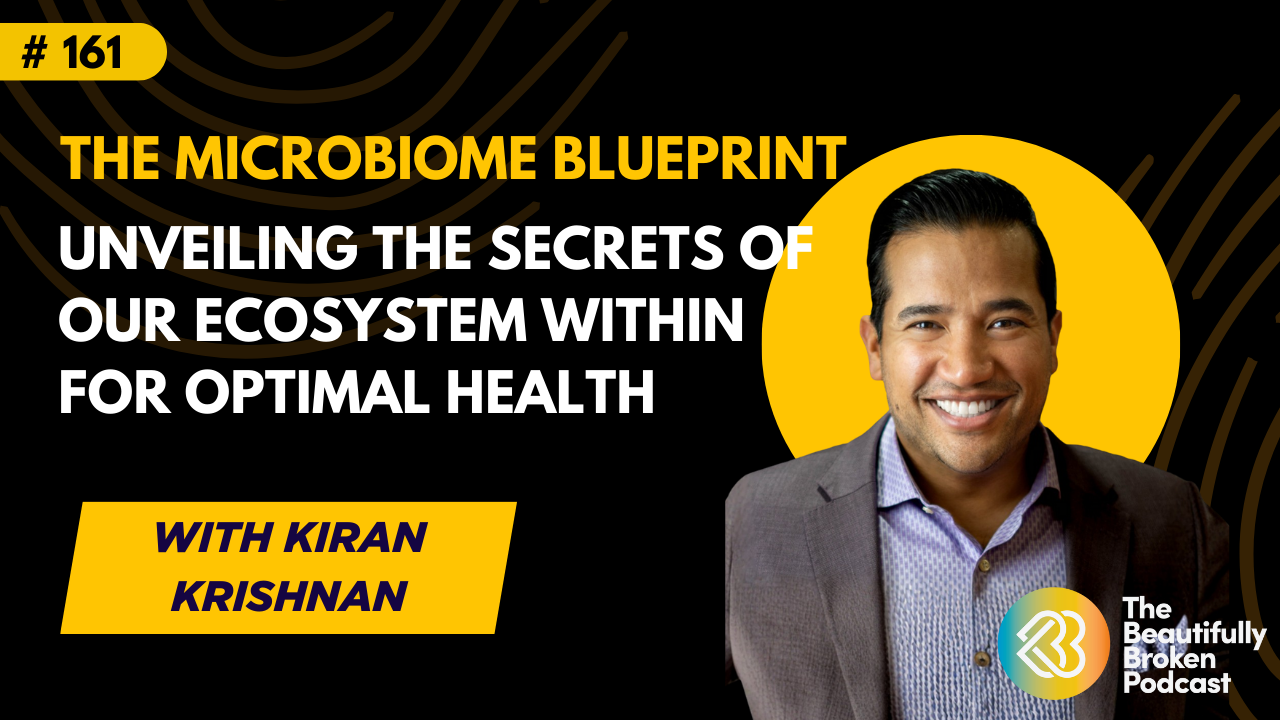
WELCOME TO EPISODE 161
Kiran Krishnan is a world-renowned microbiologist with a deep understanding of our microbiome ecosystem. He joins us today to share the importance of maintaining a diverse microbiome, the relationship between the gut and the brain, and how what comes out of our bodies can give us insight into what happens inside. Tune in!


Episode Highlights
[0:00:00] Introducing Kiran Krishnan and How He Maintains Microbiome Balance
[0:11:20] What to Look for in a Probiotic
[0:13:48] The Resilience of the Digestive Tract
[0:17:01] MegaGenesis and the Current Microbiome Diversity Research
[0:26:37] The Problem With Restrictive Diets and the Importance of Microbial Diversity Over Our Diet
[0:31:08] What Poop Can Tell Us About Our Health and What Our Microbiome Does
[0:40:03] Correlation Between Lyme and Low Microbiome Diversity
[0:46:11] What to do to Build and Encourage Microbiome Diversity in Your Body
[0:55:33] Shared Bathrooms and Microbial Communities
[1:00:13] What Kiran Would Tell the Whole World If He Got Their Attentions
[1:01:17] Outro
UPGRADE YOUR WELLNESS
Probiotics and Gut-Lining Restoration Kit: https://microbiomelabs.com
Code: beautifullybroken
Enroll at Biological Medicine: biologicalmedicine.org
Code: beautifullybroken
Lourdes Hydrofix Premium Edition https://holyhydrogen.com/?sca\_ref=3008232.jSqidhzJ01
Code: beautifullybroken
LightPathLED https://lightpathled.com/?afmc=BEAUTIFULLYBROKEN
Code: beautifullybroken
Flowpresso 3-in-1 technology: https://www.beautifullybroken.world/flowpresso
Medical grade Ozone Therapy: https://lddy.no/1djnh
Code: BEAUTIFULLYBROKEN
GOT MOLD?: https://www.gotmold.com/beautifullybroken/
Code: beautifullybroken10
AquaCure Machine + Molecular Hydrogen
Website:https://eagle-research.com?ref=24931
Code: beautifullybroken
AMD Ionic Footbath: https://calendly.com/ioncleanse/detox
Silver Biotics Immune Support and toothpaste: https://bit.ly/3JnxyDD
Code: BEAUTIFULLYBROKEN
DIY Home Cold Exposure: https://www.penguinchillers.com/product/beautifullybroken/
Cellcore – https://www.beautifullybroken.world/affiliate-products My favorite Binders
My Favorite Sauna: Therasage https://bit.ly/39mTxwY
Code: BEAUTIFULLYBROKEN
CONNECT WITH FREDDIE
Work with Me: https://www.beautifullybroken.world/biological-blueprint
Website and Store: (http://www.beautifullybroken.world)
Instagram: (https://www.instagram.com/beautifullybroken.world/)
YouTube: https://www.youtube.com/@freddiekimmel
FULL EPISODE INTERVIEW
EPISODE TRANSCRIPT
Freddie Kimmel (00:02.401)
Ladies and gentlemen, welcome to the beautifully broken podcast. Kiran, you are the second person to achieve a three-peat on the show. Welcome again, again.
Kiran (00:14.042)
Yes. Well, thank you so much. It's such a pleasure to be here. You know, I remember our first two conversations, they were so awesome. They're so fun. And hopefully we gave a lot of people value from the conversation as well. So it's a it's an honor to be back. Thank you.
Freddie Kimmel (00:29.761)
Thank you. And I was thinking about this this morning, you know, the way we're, the way we're engaging with each other and building community in a digital space. It's changed even since we did our first show four years ago, how people learn and interact. And I almost find myself intimidated with the new levels of information that I'm almost put into a place of paralysis. Even I would
consider myself somewhat of a health expert. And, and now I feel like sometimes I know nothing. When I go back and look at the opinions and the new evolving data, and it's just, where does someone start? Do you ever find yourself overwhelmed?
Kiran (01:10.902)
You know, you can, yes, absolutely. And I do as well, you know, because, and I have a, I'd like to think a pretty strong understanding of how most of the things work within the body itself. But nonetheless, the approach can be extremely confusing, right? What you do first, what do you focus on? You know, what is step one in your health journey? And then what does step five look like? You know, how do you know when you get there? All of these things just kind of, you know.
mix up in people's heads, especially because they're getting piecemeal information from lots of different places, right? And lots of people have different focuses and priorities, the people that speak about this stuff have different focuses and priorities as to what is the most important thing you should do. And everything can't be the most important thing, right? To make any of this practical at all, we have to boil it down to certain things. We have to start somewhere and we have to be happy that we're starting somewhere.
Freddie Kimmel (01:45.947)
Yes.
Freddie Kimmel (01:54.002)
Mm-hmm.
Kiran (02:08.63)
Because I think a lot of what I experience with people when I engage with them and I talk to them is not only a degree of frustration with being confused and not knowing where to start and what to do, but also feeling a little bit defeated that this is too much, it's too complicated. Achieving good health and good quality of life is too complicated. And it shouldn't be that way, right? It should be digestible. It should be something that most people can do.
Freddie Kimmel (02:25.2)
Yes.
Kiran (02:37.938)
especially if they have access to things, like the right foods and supplements and devices and so on. So I'm glad we have this kind of conversation because maybe we can make it practical.
Freddie Kimmel (02:50.265)
I would love to do that. And I'm just going to reference that people can go back and listen to our first two episodes, and they can really get an understanding of what you do, your education, your credentials, which are incredible. We were mentioning that you basically have the George Clooney status of airline miles because you can go anywhere and just get bumped to first class because you mentioned you did 300,000 to 400,000 miles a year speaking, learning.
collaboration, you name it. It's really incredible what you're doing. So I would just implore people to go back and look at that. And then the idea that you can do that. Like you are healthy enough to maintain a robust immune system to be exposed to all the microbes. So I would love just, if you could give us a couple of minutes on what you do to keep your.
Kiran (03:44.716)
Yeah.
Freddie Kimmel (03:46.093)
microbiome balanced so you have this high level of functionality in your immune system.
Kiran (03:51.37)
Yeah, absolutely. That's a great place to start. So my health goal has always been about being resilient. I don't want to be healthy by having to make 100% perfect choices because I know that's not feasible. I know there's gonna be 20%, 25% bad choices that I make, and many of them deliberately because they're fun. I don't wanna go out with friends and...
Freddie Kimmel (04:16.122)
Yes.
Kiran (04:19.586)
give the waiter a third degree about everything that's being cooked and touched in the kitchen and what may or may not have gluten in it or not have to have a cocktail with my friends, right? Or, you know, sometimes staying up late and sometimes missing workouts, right? All of these things should be able to happen and your body should be able to be resilient. That's a fundamental characteristic of being human to me is being resilient, right? That's why we're at the top of the evolutionary ladder. That's why we're at the top of the food chain because
we can exist under lots of different conditions of stress if our system can adapt to it, right? And as it turns out, when you start looking at the signs, a lot of that adaptation and resilience comes from the microbes that you house in your system, right? We as a species are wholly inadequate to do almost anything, right? We have 22,000 genes in our chromosomes, right? That's nothing. An earthworm has about 22,000 genes.
So we are in our own genetic capabilities as sophisticated as an earthworm is. But what makes us so interesting and what makes us so complex and gives us all of this amazing capability is the fact that we have over 2.5 million microbial genes in our system. That is the largest data bank of capability that we house. And if we house those and we allow those to flourish and exist,
in our system, that's where we tap into capabilities, resilience, adaptation, and all that. It's the microbes that provide these things for us, right? So for me, when it comes to resilience and foundational health, it's all about maintaining diversity of the gut microbiome. That is one of those key things that everyone can wrap their head around and grasp and work towards that is not that complicated.
And if you have a healthy, diverse microbiome, and we can explain what a healthy microbiome means, but if you have a diverse microbiome to begin with, you will live longer, right? That's what this research shows. In fact, they can predict the biological age of individuals very closely, very accurately by looking at the diversity of the microbiome, right? And that's a key aspect of how centenarians...
Kiran (06:38.098)
in all these different geographical regions, how they live to 100 plus with very healthy outcomes, all of them have very diverse microbiomes. Now, they go about it differently, right? There are some commonalities, but their foods are different, right? What they drink is different. Their environments are different. If you look at Okinawa, Japan, it's a very different diet, environment, and all that than the Costa Ricans that are centenarians or even people in in North America that are centenarians.
They're very different environments, but all of them drive diversity in their gut microbiome. So for me, there's a small handful of things that I really hone in on every single day that helps me maintain diversity. That's a key aspect.
Freddie Kimmel (07:23.177)
Great. And is there a, is there as far as like a probiotic supplementation, is there a stack that you carry with you and a frequency to which you introduce that into the gut?
Kiran (07:34.046)
Yeah, you know, with probiotics, it doesn't have to be too complicated, right? I know it gets very complicated for people because there's so many offerings, there's so many messages out there. There's so many must-haves, and this is the most important, that's the most important. For me, when you look at a probiotic, I really want two things out of it. I want a probiotic that enhances diversity, right? So, and that has two components to it.
is a probiotic that can combat some of the dysfunctional bacteria. Because we know when you have an elevated path of biome... Oh, probably because of that.
Freddie Kimmel (08:09.785)
Yeah. It's all right. We got a background track.
Kiran (08:13.194)
Oh, good. When you have an elevated pathobion, which means that you have an elevated number of organisms that are opportunistically pathogenic, that is to skew your body's ability to adapt to situations. I'll give you a strong example of that in a second. So I want a probiotic that facilitates diversity by competing against pathogenic and problematic organisms. And then I want one that also supports...
Freddie Kimmel (08:23.634)
Mm-hmm.
Kiran (08:41.762)
the growth of really important keystone species, right? So if you will, a gut orchestrator, that's a really important foundational probiotic. Now, as it turns out, humans have been consuming this kind of probiotic for millennia since the dawn of time, inadvertently through the environment, eating, getting exposed to dirt, eating things out of picking and foraging foods, eating, drinking waters out of rivers and streams. There are lots of ubiquitous organisms in the environment.
that can actually facilitate some of that activity, right? So activity number one, I want it to maintain diversity. Activity number two, depending on what's going on in my life, I want a probiotic that can modulate inflammation. Because a lot of chronic low-grade inflammation starts in the gut, right? And that's either through leaky gut or other mechanisms that start in the gut. But at the end of the day, inflammation, for the most part, will start in the gut. You can have localized inflammation in certain parts of the body.
You can get contact dermatitis on a part of your skin and have inflammation there. You can have localized inflammation from other sources, but the most dangerous kind of inflammation is a chronic low-grade inflammation that people suffer from, which becomes the foundation of disease. So if you have a probiotic that can address that and can address diversity, that becomes foundational. Everything else is about diet, lifestyle, prebiotics, enzymes, all these other things that you can utilize to facilitate those...
basic functions.
Freddie Kimmel (10:10.317)
Yeah, beautiful. My friend, Anahita, just got a hold of a product from Microbiome Labs in which she was referencing it has a keystone strain included or heritage strain. Can you remind me what the term was?
Kiran (10:20.162)
Mm-hmm.
Kiran (10:24.618)
Yeah, keystone species. Yep, that's right.
Freddie Kimmel (10:26.569)
Keystone. And she said, she was like, the directions on the package were to take one a day to start out for a while. And she was like, I'm great. I'm functional medicine health coach. I can take two. She said, Freddie, I had this crazy cramping for like a couple days. And then two weeks down the road, she was like, all I've wanted to do is take pictures of my poop, because they're like mind blowing, perfect S curve into the toilet. And she's been really impressed with
Kiran (10:48.205)
Yeah.
Freddie Kimmel (10:55.949)
with the results and she is self-proclaimed. She was like, I go well normally. I wouldn't have said that was a problem until I noticed just the change in frequency and the shape of her bowel movements.
Kiran (11:08.842)
Yeah, and that makes all the difference, right? We ignore that quite a bit. We don't look often enough into the toilet as a indicator that something is going wrong in the digestive tract. Now, your digestive tract is incredibly resilient to begin with, even if you start off with an unhealthy microbiome. Just think about shows that exist, like what is it called, My 800-pound Life or 500-pound Life, right? You think about humans.
that have stretched their system to the point that they are six, seven, 800 pounds and they're still alive, right? It speaks to the resilience of the system to begin with. Now, imagine you don't create those stresses, you don't stretch the system that far, but yet instead you continue to support some of the key fundamentals of the system, it'll work for you beautifully for a very long time, right?
Freddie Kimmel (12:04.304)
Yeah.
Kiran (12:05.07)
Those kind of examples to me are really critical because it tells you how resilient the system can be, even under that kind of stressful condition. So, but you have to take these little clues, right? You have to look in the toilet. You have to look at when you eat something, does that create some sort of disturbance in your gut all the time? And then you go, well, I just can't eat that thing, right? Well, that may not be the answer, right? Or I just, you know, I...
I get five or six sinus infections a year. I've always had that. Or I just have allergies. I can't touch these seven things. These things that we kind of just blow off, they're all signs and signals that the system is not functioning the way it should. And there are some basic things you should do in order to start adjusting that.
Freddie Kimmel (12:35.309)
Mm-hmm.
Freddie Kimmel (12:52.397)
Yeah. I go back to the idea that there was usually a time in someone's story when they could do those things, which was always like when I would go into a gastroenterologist or an immunologist, they would tell me, well, these things are all problematic. I was like, but two months ago, they weren't. It was totally fine. And all of a sudden, what happened? They're like, well, that's not today. So we're just going to take these things out. They'll forever be out.
Kiran (12:58.443)
Yeah, exactly.
Freddie Kimmel (13:19.357)
They're going to be trigger foods. They're going to make you sick and old and tired, and they're going to make your joints hurt. And so that was something that there was just a low level of awareness or there was no desire to explore what happened in the terrain to make that shift. Kieran, the brand was, or the label on the package, it was Megagenesis. Megagenesis, which she said it had industrial spores from the
Kiran (13:23.278)
Thanks for watching!
Kiran (13:43.431)
I love that product.
Freddie Kimmel (13:49.697)
spores in the non-industrialized world that supports a primal gut mechanism. So what would be unique in that strain?
Kiran (13:58.294)
Yeah, so to clarify, that one's actually not a spore. It's a lactobacilli, actually. So we're a microbiome company in general, right? So which means that we have a few components to our charter that's really, really important. Number one is of course, making discoveries around the function of the microbiome, right? So to understand the system better.
and to elevate the overall science. So this is why we do a lot of the studies that we do, is we're trying to understand how modulating certain things impacts process, disease process, health process, and so on. The other thing is, of course, then developing tools that you can use to modulate the microbiome and for health benefit. And the last thing is about preserving the microbiome. That's a component of what we are starting to do.
that to me is arguably one of the most important things that we should be focusing on, right? So the kind of things that keep me up at night, I tend to sleep pretty well in general, but if I am up at night, the kind of things that keep me up at night is the mass extinction that's going on in the gut microbiome. Right? It is an absolutely scary thought. I started this conversation by saying that our resilience and our capabilities for the large part comes
from the amazing treasure chests of genetic and protein capabilities that our microbiome houses for us. Imagine we start losing large components of that biome, we start losing capability and functionality. We will become ill adapted to exist in the world that we're in right now, but that's happening right now. So if you look at hunter gatherer tribes that exist today in Tanzania, the Hadza tribe or...
Papua New Guinea tribes and so on, if you look at their alpha diversity, which means the number of viable species in their microbiome, they tend to have alpha diversities at 300, 400, 500 active species. We've done over 10,000 microbiome tests in North America. The average species, the average alpha diversity we see is about 125. Since we left that lifestyle,
Kiran (16:12.566)
we've lost probably two thirds of our microbiome. And if you think about it and you start thinking about what does that mean from a capability of physiological standpoint, it means you're gonna have more people born with developmental disorders. You're gonna have more people born with allergies. You're gonna have more people that are highly susceptible to anxiety, depression, Alzheimer's, Parkinson's, metabolic syndrome, all of the things we suffer from.
Freddie Kimmel (16:16.444)
Wow.
Kiran (16:41.438)
as chronic illnesses, including the now 120 plus autoimmune conditions that we've created. And I say we created because about 50 years ago, there was maybe 20 known autoimmune conditions. Now we have over 100. We've created new diseases for us to deal with. All of these things, if you look at the research and you look at the pathologies, they can all be traced back to a dysfunctional microbiome. So as we lose these microbes and we don't pass on...
healthy sets of microbes to our kids, our kids and their generations subsequent to that are gonna be born with more and more dysfunctions. The analogy I give so people can wrap their head around it, because it's a little nuance, it's hard to think about this, right? It's almost like, what if I were to tell you that our actions today, our choices today would lead to our kids being born without a spleen, right? And then their kids being born without a spleen and maybe just one kidney.
Freddie Kimmel (17:34.502)
Yeah.
Kiran (17:39.274)
Right? Think about the disadvantage they have from day one. But we're already seeing that, right? Every generation, we have higher numbers of autism. We have higher numbers of developmental disorders, higher numbers of allergies and asthma. All of these things are microbiome related. So this is my long way of answering your question about the megagenesis, right? So the megagenesis, the way this came about is we work a lot with some of the top researchers in the world, right?
Freddie Kimmel (18:00.997)
Yeah.
Kiran (18:08.526)
partnerships with researchers and research institutes are critically important because it takes companies like us to take what they're doing in that academic world and pull it forward into the real world and actually make it accessible to people through education products and so on. So there's a wonderful microbiologist. His name is Jens Walter. He works he's a researcher and a professor at University College Cork and the APC. APC's
in Cork, Ireland, which is one of the largest microbiome research institutes in the world. He's been doing a lot of work with the Papua New Guinea tribes. These are the hunter gatherer tribes that still live more a hunter gatherer life than a modern life. He's been sequencing their microbiome for years and trying to understand what does their diversity look like, and his particular focus has been what are strains that are highly prevalent in that population that are completely absent from us?
from the modern population, right? With good, when you look at the phylogenetic tree, what you can tell, because you can do this through a genetic analysis, that we likely had that strain, but through years of industrialized living and all that, we've lost it, right? So it becomes one key example of a victim of extinction. And so what he's done is he's found that strain, it's a form of ruderi.
that is basically absent 100% in the Western world. And he's cultured it and characterized it. And we started working with him on developing this strain, on figuring out what it does, and then trying to reintroduce it into the U.S. population. Because it seems to be incredibly important for functionality among our hunter gatherer ancestors, but we don't have it at all. And then when you add it in, you start to see some massive changes in your gut microbiome.
So that will become, that's the first example of lots of different strains that we're going to discover, characterize, study and develop that we've lost over the course of industrialization that we wanna bring back into our gut population, right? That's the most important thing we can do is house and harbor and safeguard this amazing population of microbes that we have to pass down to the next generation.
Freddie Kimmel (20:28.293)
Before we go forward, you had mentioned 22,000 genes in a human being. What was the number that you quoted from our microbial community? How many genes are we looking at?
Kiran (20:38.494)
over two and a half million. So 150 times more microbial DNA in our system than human DNA.
Freddie Kimmel (20:41.832)
Yeah.
Freddie Kimmel (20:47.873)
Yeah, I just want everybody to feel into that at home. And every time we talk, I sort of get frustrated. I was like, why am I worrying about all these other things for my health? Why am I not solely focused on the gut? And we understand that we've got to go where our heart leads us to go. And it always swings back around, is just one of the most paramount things we can do to be managing this intelligent immune system. This...
Kiran (21:12.716)
Thank you.
Freddie Kimmel (21:14.225)
And you've said before on the podcast from mouth to anus is really outside world. It's our way of interacting energetically with the, all the information that comes through. And, and I have a very limited 22,000 genes. And then we have this millions and millions of downstream chemical reaction, which are giving the cells information. So I think the energy, the energy behind what you're talking about is profound. I want to just do a very quick sidebar. I don't want to get into diet.
There's, I was just at KetoCon and we were talking about the ketogenic diet and application for specific cancers. And many people are like looking at this carnivore diet and, you know, diet wars. Really, it's like, I just saw research that kind of paired veganism right with a carnivore diet, as far as like longevity. It was like, how could this be? And is there research in your lived experience to support?
that microbial diversity may play a greater role than what we're eating?
Kiran (22:19.274)
Yeah, so that's one of the problems with restrictive diets is that it does, they all do harm the microbiome diversity. Right, so there's studies on people who go on keto high fat diets, there may be some initial benefits. And to me, actually, a lot of the benefits come from eliminating sugar from your diet, right? Because you're basically taking out, you're replacing carbohydrates, you're replacing refined carbohydrates, sugar and all that with fat, which is great.
There's lots of good, healthy fat and it's very important for you. But I think a lot of the benefits you see in the first few months of going keto, first month or two, does come from eliminating sugar. But it's not sustainable because the studies also show that within eight weeks of doing full, very high fat, keto-like diet, the diversity of the microbiome starts to drop quite significantly, especially bifidobacteria, fecalin bacteria, acromansia, all of these really important...
species that are considered to be keystone species. All of these organisms are inversely related to chronic disease, right? Meaning the higher levels of those you have, the lower risk you have of chronic disease. So we become obsessed with this idea that, oh my God, you know, he went keto, she went keto, they lost weight, right? And so, and they look better and they feel better, great. But there's many ways of doing that, right? I remember in college at one point, I went on something called a cabbage soup diet, right?
I lost weight, but it doesn't mean that the cabbage soup diet is good for you. So, people get very militant about their diet position. And I get it. It becomes a camp. It's my team versus your team thing. But the most well-studied diets in the world, we're talking about diets that have not only double-blind placebo control, randomized type of studies, the ones you can do with diet, but they have longitudinal studies, which is the really important one.
They have prospective longitudinal studies where you follow people over decades and compare them to people of other diets are things like the Mediterranean diet. The Mediterranean diet is a diverse diet. You've got really good fats, you've got really lean proteins, you've got lots of fiber and carbohydrates, lots of polyphenols, olive oil and red wine and all of these good things. Those are the components of...
Kiran (24:41.37)
a healthy diet because in part, they also feed diversity in the gut microbiome. So I always tell people, you know, if you're determined to go keto or carnivore or vegan or whatever it is that your mind is set on for a period of time, don't do it for much more than two or three months, you know, and because they'll be diminishing return down the road, right? We have to just go back to how we were built. We were built to be omnivores. We were built to eat lots of things.
and our ancestors did not have the luxury of going, I'm just gonna be keto for the next few months, right? Our system is designed to eat lots of things, be able to digest lots of things, be able to assimilate lots of diverse nutrients.
Freddie Kimmel (25:22.601)
Yeah, I'm always jealous of those people who can just walk into a restaurant and have like no digestive effect. They're just like can eat anything and they just have these incredible, my brother, he can just he can like crush a pizza and hot dogs and beers and then like be fine. I was like, I would be in the hospital. And it's it just goes to show, I remember, I remember actually, you know what, it's funny, I asked, I called my mom and I asked my mom for poop. I was like, Mom,
Kiran (25:48.268)
Yeah.
Freddie Kimmel (25:49.581)
I'm reading into fecal transplants. It's been like seven years. I can't go to the bathroom. I'm like always cramping. Thank God I didn't have to do it because that would have been, it would have been weird, but I was open to it. I was open to it. I asked my mom for poop. She's like, how am I gonna get you that poop? I was like, I'm imagining it's in a freezer in a Tupperware container. You're gonna ship it to me. I don't know, but I'm ready to make a milkshake out of it and do a fecal transplant. Well, I know, I know, crazy, crazy.
Kiran (25:57.527)
Yeah.
Kiran (26:15.97)
Oh man.
Freddie Kimmel (26:19.217)
But when you're, I was desperate, I didn't care. I said this a lot. A lot of the decisions that I made about my health, which greater informed what I saw the ends of the spectrum to be, even the failed experiments have been very valuable. They've guided me back to like a very consistent truth, which always comes back to diversity and not living in a camp of absolutes, like staying open, staying curious. I wanna talk about, I wanna talk about,
Kiran (26:42.338)
Yeah. Yeah.
Freddie Kimmel (26:47.729)
Before we jump to these extremes, taking a look at what's going on inside, I have the just came in the mail. I have a new FX biome from microbiome labs, which I'm going to be able to take a look and really I can tell you in three months, I've had three months of just like such steady progress. It's been a lot of
Kiran (26:59.177)
Yeah, awesome.
Freddie Kimmel (27:13.701)
shifting around using some of the prebiotics, which I could never tolerate before. Now I can. That's made a big difference for me. Doing a little bit of fasting and then working on scar tissue for me in the belly, which is affected transit time. And that's the big one. Like, you know, great example. Everybody's going to have a different past. Some people have scar tissue, which affects the flow, that movement, that parasympathetic wave down the intestines. So we got to plan for those people too.
Kiran (27:27.936)
Yes.
Freddie Kimmel (27:42.641)
But if I'm going to open up this box and actually Karen, I'll let you laugh. I like put into chat GPT. I was like re write the lyrics for Dick in a box from Saturday night live and do it to a stool diagnostic poop in a box. And it gave me this great lyric girl. It's my shit in a box girl. Microbes in there, a whole new world. Got to send it to the lab. They're unfurl all the data about my microbe swirl.
Kiran (28:01.161)
Thank you.
Kiran (28:08.67)
That is amazing. Wow. All right. You got to record that while you're doing the test. That's
Freddie Kimmel (28:12.857)
I gotta go get the track and I gotta find the way the beat, but I'm imagining like, one, I put my poop in the box, two, I put a stamp on my box, three, I put the box in the mail, something like that.
Kiran (28:20.975)
Right.
Kiran (28:27.214)
Totally, I love that, I love that because poop can be fun, right? And sampling poop can't be fun, especially with the outcomes that you get at the end of it. And it's chat GPDs, phenomenal, nuts.
Freddie Kimmel (28:37.325)
Yeah, it's wild. It's a powerful tool. So when I send this box away, when I send my poop away, which I would just say, if anybody, if you're cringing, if it feels weird, I promise you, there's really good information here to just learn about your body. You know, I was very depressed my first test that I got back because there was no, there was like one percentile, no diversity. I had been on three years of doxycycline for Lyme.
Kiran (28:53.676)
Mm-hmm.
Freddie Kimmel (29:07.157)
oral and it had just, it was, you know, it's kind of gone. So I built it back. It's taken time. But what is this? I know there's a, I feel like there's a, it's a new test. I feel like there's a quicker turnaround. You got some new data in this new diagnostic for home users.
Kiran (29:23.078)
Yeah, you know, one of the important things about genetic analysis is that the technology improves by leaps and bounds every about three or four years, right? Like if you look at what we were able to do from a sequencing perspective four years ago, that was like a flip phone compared to what we can do now being an iPhone, right? So that's the difference in technology. And most people shouldn't understand that or know that, but
One of the things we've done now with this new version is we're able to go deeper in the sequencing. So normally, and this just gives people a reference to keep in mind, we've normally over the last few years gone to 3 million base pairs, right? That's the resolution in which that we were able to sequence. So think about it as like 3 million megapixels as a resolution that we can do. Now, we can go to 6 million megapixels or 6 million base pairs. So the resolution is double.
and which means that our picture is much more clear as to what their community looks like. Right? So one of the most important things about stool sequencing and sequencing the microbiome is that you have to be able to map what the microbiome looks like from a population standpoint. Right? It's not necessarily who's there, but it's who's there in what proportion and who else is there. Right? It's a neighborhood type of mentality. Right?
And if you're looking at variables within the microbiome, the context really matters. One of the, you know, like you might see other stool tests that really focus in on pathogens. And this can be very disruptive to people's health because they have these weird, unusual ways of measuring pathogens. And when what you end up getting is a test that screams pathogens all over the place, right?
Freddie Kimmel (30:50.302)
Hmm.
Kiran (31:08.926)
And then inevitably what's gonna happen is doctors are gonna jump in and start using antibiotics, antimicrobials all the time. That's actually gonna destroy the rest of the microbiome and actually make it easier for pathogens to grow. And we've seen so many of these people come to us after six months, eight months, 12 months of antimicrobial therapy going, my gut is now destroyed. It was bad back then, but now with all of this, because there was these pathogens on the test, my gut is now destroyed.
And that's because it's missing context, right? So one analogy I give people is like, if you're a city planner and you're planning out, you know, a neighborhood or a city, and somebody randomly came up to you and said, hey, are five police officers enough for your city? One of your first questions would be like, what's the population, right? That context makes a difference. If it's a million people, five police officers are absolutely not enough, right? If the city has a hundred people, by far that's good enough, right? So...
that context of what else is there in what proportion is really important. So we've worked really hard over the last five years to build that muscle of being able to map the microbiome effectively. So that's the first part. It's high resolution, highly accurate in terms of determining what species and subspecies are there, mapping out the entire context so you know in relation to all the different microbes what the levels are. And then the last thing is focusing in on
functionality, right? It doesn't matter if we tell you this vector is there, that vector is there, that vector is there, it doesn't mean anything. The question is, what do they do, right? What is their tendency in your microbiome, right? Do you have a lot of bacteria that produce hydrogen sulfide that reduce hydrogen, or sorry, that reduce sulfate groups into hydrogen sulfide? Do you have a lot of bacteria that convert protein to ammonia? Do you have more bacteria that make branch chain amino acids, right? All of these things.
affect your outcomes in terms of what you eat and so on. So we hone in on functionality and functional groups of microbes so that you have actionable items, right? So that when you get the test back, you look at it, it tells you some of your high level data as to where you stand in a healthy population in terms of your diversity, your resistance, your pathogen load, all of that stuff. But then it digs in into the functional characteristics of your microbiome.
Kiran (33:31.05)
what does your microbiome tend to do, right? And that gives you an idea of what choices you should make when it comes to food and supplements and all of that stuff.
Freddie Kimmel (33:43.978)
What does someone frame that journey look like? If I got a test back and I was looking at something, maybe there's some unfavorable levels or there's an overgrowth, what does the timeline normally look like with an intervention? Let's say they're going to try to redistribute the beneficial microbes around the gut.
Kiran (34:05.758)
Yeah, you know, the beauty of the microbiome is you can modulate it pretty quickly, right? So a lot of our modulation studies that we've published are three to four weeks under controlled conditions, however, right? So I would say given that, you know, in reality, we're not under controlled conditions. There's other variables that impact the outcome. I'd say three months is probably a very, you know, doable timeframe to actually make measurable changes.
You can increase your diversity in three months. You can increase production of short chain fatty acids, which is another critical feature of a healthy microbiome. You can reduce opportunistic pathogen load, right? Without having to kill them, without having to go after them with antimicrobials, which will kill everything, right? You can improve your sacroiliac fermentation versus proteolytic fermentation. So proteolytic fermentation means that your body is basically taking proteins and some carbohydrates and converting them
into certain toxic compounds like P. cressol, for example, versus sacrolytic fermentation is the ability to form things like butyrate, propionate, acetate. So when you see in the test that you're shifted towards proteolytic, there's certain things you should reduce in your diet and certain things you should increase to favor the sacrolytic bacteria, right? So it's an ecosystem, and that's the beauty of it, is that our health is largely dependent on an ecological system, which is
great because the ecological system can be changed, right? If our health was solely dependent on our genes, we'd be fucked, right? Because if you have genes for certain conditions, you're screwed, you can't change your genes, right? But we now know that the vast majority of chronic illnesses can be brought back to some dysfunction in the microbiome, which is providing an underlying risk. So if you modulate that part of the microbiome, you should be able to reduce the risk.
Freddie Kimmel (35:58.073)
Yeah, it's fascinating. I just got a screener and by the time this comes out, the documentary will be out on Amazon Prime. It's called The Quiet Epidemic and they're looking at the prevalence of Lyme disease and the elusive nature of the spirochete. Have you looked at different subsets of data around people with a chronic Lyme disease that are there?
Kiran (36:16.494)
Mm-hmm.
Freddie Kimmel (36:26.609)
just the inability to get better and move forward or have a reduction in symptoms. Have you seen a correlation with the diversity of the microbiome in the gut?
Kiran (36:37.242)
Yeah, in fact, there is some data that looks at that. And in part, but one of the hard things to know is, is the diversity of the gut, the reduced diversity of the gut in people that suffer from long-term Lyme, is that a consequence of the treatment for the Lyme or do they already have reduced diversity in the gut, right? So that's the part that needs to be teased out. And I think future studies will look at people's microbiomes prior to starting.
the treatment for Lyme. Now, here's an area where it is very clear that the diversity of the microbiome and certain aspects of the microbiome are very, very impactful in people's outcomes. And that's with COVID, for example, long haulers, especially, right? In the U.S., it's estimated there's somewhere around 30 to 40 million Americans that are suffering from COVID long haul syndrome. We work really closely with Professor Liam Mahoney, who is one of the top immunologists in the world, right?
and he's at the APC at University College Cork. He's probably published 350, 400 papers. Very, very highly published author. One of the top minds in the world of immunology. We work a lot with him. I was just meeting with him about three weeks ago in March in Cork, and he was sharing with me data on his new studies around long hauler syndrome and people that had hospitalization and death from COVID and what their microbiomes looked like.
before having those poor outcomes, right? And he's mapped it out on hundreds and hundreds of people. And the data is so eerily clear that if you have a certain type of microbiome, they can predict that you will likely come up with long-hauler syndrome after you deal with the condition. Or they can predict your risk of death or hospitalization from the symptom. They can look at your microbiome the first day that you may test positive and you're asymptomatic, right?
They can look at your microbiome and go, in three days you'll be fine, or they can look at your microbiome and go, likely in three or four days you'll be in the hospital. Right? And it doesn't, you can't tell that from the person itself. It doesn't matter what their comorbidities are and so on. They can look at the microbiome and fingerprint it. And what he's shown very clearly is that people who have low alpha diversity, right? Below a certain number and a high level of pathobionts,
Freddie Kimmel (38:43.506)
Wow.
Kiran (39:00.898)
These are microbes that induce a lot of inflammatory response. These individuals are very at high risk for long-hauler syndrome, hospitalization, and death. And someone who could be 25 years older than an individual with that pathobion, if they have a diverse microbiome, they will fare much better when it comes to this condition, right? So, but this is true for almost every kind of stressor on the body.
Freddie Kimmel (39:21.638)
Yeah.
Kiran (39:28.962)
This is part of what I was talking about with resilience earlier, right? It doesn't matter what the stressor, it doesn't matter if it's the new pandemic that's starting or it's poor food quality, it's poor air quality, it's toxins in your water, it's stress, it doesn't matter what the input is. If the input causes stress and inflammation on your body, if your microbiome is dysfunctional, your risk of having that input create significant problems is way higher, right? And we're not talking about
Double, triple, we're talking about 10 fold higher. Right, so if you look at the data on COVID, for example, if you took two people who were 50 years old, right, and everything else was same about them, except one was pre-diabetic or diabetic, which means that they have a certain type of microbiome. Now the reason they're diabetic is because of a certain fingerprint on the microbiome, right? This has been clear. Diabetes, type two diabetes especially, is not just a disease of
poor lifestyle choices, right? It's the poor lifestyle choices that actually diminish aspects of the microbiome and that lays the foundation for why you develop diabetes, right? It's not just hyperinsulinemia, hyperinsulinemia over and over again, and then your pancreas just goes, bleh, I can't work anymore, right? It's, there's actually an aspect of the microbiome that drives it. And this has been published by the American Diabetic Association. You know, these institutes are usually decades behind on frontier research, but they've figured this out, right? So,
You take that individual who has diabetes and then same age individual, everything else same about them, same body weight and all that, but no diabetes. The individual with diabetes is 10 times more likely to die from the condition than the same age person with no diabetes, right? And that is a factor of the microbiome. And that shows you right there, how resilience through a healthy microbiome makes all the difference, right? Because...
Freddie Kimmel (41:23.898)
Yeah.
Kiran (41:24.618)
We cannot stop negative inputs. We're gonna have it in our lives, right? We can't live perfect lives. We can't live in a perfect location. You know, you were just talking about before we came on, before we started recording, the filtration of the air and you just look at what's in the air, right? That is a negative input. There are people that breathe that and they're done, right? Their system shuts down. They go into full autoimmune response. They may go into, you know, cytokine storms and things like that, right? And then there are people that could sit there and breathe there.
and breathe that and be just fine. So that's the manipulation that I, to me that's the most important.
Freddie Kimmel (42:00.881)
I think it's very empowering to frame it that way because it's easy to look at the world as a field of landmines. When you start to experience life that way, whether it's diet or air quality or trauma, and it really all comes down to our way of, you've said there's a way to build strength, resiliency, and through this diversity, but it's really in the interrelation. And isn't that, it's sort of the magic in life.
Kiran (42:09.292)
Mm-hmm.
Freddie Kimmel (42:30.661)
You could be the most spiritually wise sage by yourself with your journal in meditation. But the second you have to interrelate or work with another human being and you just keep finding, why is this hard for me? But you know, we have to do that in practice. So I'd love to pivot and just talk about some things we can incorporate into practice to help build the diversity in the microbiome that are lifestyle choices that maybe you see as your top two or three things.
Kiran (42:59.434)
Yeah, so for me, and I think one of the most important things I do and have done over the last six, seven years is fasting, intermittent fasting. Intermittent fasting, I do a 14 to 16 hour a day fast, six, seven days a week. It's so easy now. It was a little bit hard in the very beginning where I might have had to start with 12 hours, and then after a week, push it to 13, then push it to 14. Now I don't even think about it. In fact, I have to remind myself.
around like 2 p.m. to go, oh, well, I haven't eaten yet. I gotta go eat, right? But a lot of high functioning things I do in the morning, interviews and research work and all that stuff, I do that all fasted. In fact, I used to race. I'm a competitive cyclist, and so I race on a team and I was the only guy on the team that did all my racing, all my training completely fasted, right? So I'd get out there at seven o'clock in the morning,
I'm now 10 hours into a fast and we're riding competitively for the next five, six hours. Everyone else is popping gels and bars and all that stuff, non-stop. I'm just drinking water with some electrolytes, and I'm perfectly fine. And so to me, that is one of the most important things because there are components of your microbiome that only flourish during a period of fasting.
So if you think of your microbiome as multiple layers, it's not designed as layers, but it's just to visualize, it's easier for people to understand. So the primary layer are microbes that are what we call primary digesters or fermenters, right? So they take the big macromolecules that come into your gut through diet, which will take six, seven hours to get over there to your colon. They take those big components, the big fiber components, the remaining proteins, the fats.
and they start metabolizing and breaking those down. Now the byproducts of those go to the secondary fermenters who then start breaking down those byproducts. They produce side products as a result of that and then they send that down to the tertiary metabolizers. And then those metabolizers start working on those other byproducts. So you've got this like staged fermentation that occurs in the gut. The thing is, if you think about it, by the time that the third layer,
Kiran (45:19.062)
gets to start eating and fermenting and growing and proliferating, it's a good 10, 12 hours after you last ate, right? So then if you're eating again, what happens is it stops that third layer from doing what they do because it reactivates the first layer. They're just hanging out dormant, they're happy, they've already done their fermentation, but boom, here comes more food. They have to get active again and start proliferating and fermenting and so on, right? So...
So in order for you to actually have increased diversity, a period of not eating allows all of the microbes in your system to eat, right? If you eat too frequently, you stop the process of fermentation and digestion somewhere midway, right? So fasting becomes really critically important that way. It actually helps the microbiome. The other thing that helps diversity in the microbiome, and that's counterintuitive. A lot of people think, whoa.
Don't eat and it helps the diversity? Yes, there needs to be a period during the day where you don't eat. Second thing is about increasing diversity of your diet, adding in new foods on a somewhat regular basis. Some of the tips I give people is just go to like an ethnic grocery store. You live in a wonderful place, Austin, that has all these amazing ethnic grocery stores, Middle Eastern stores, Asian markets, and so on. Grab one thing from that market, one root, one tube, or one...
vegetable, one form of protein, whatever it is that you don't normally eat, add it into your diet that week, right? And try to maintain it and then next week add something else. By the end of the year, you've got 40, 50 new foods that you've added to your diet. And every one of these foods have different bonds, different structures that feed different organisms. The more diverse your diet is, the more diverse your gut microbiome will be. So that's two simple things you can do. The third one is about getting outside, right?
doors, it has a huge impact on the diversity of your microbiome. And I don't mean just walking down the street. That helps to some small degree, but it's really about being in natural environments, going in hikes, going to the beach, places like that. And I recommend to people when you go on hikes to do two things, which really will enhance what happens to your microbiome when you're hiking. Number one, the hiking, the exercise part of it is great, just breathing the air, but touch things.
Kiran (47:43.486)
Like when I go with my kids on hikes, I make sure they're picking up rocks and they're grabbing sticks and I'm having them feel this leaf, right? See the texture of this, look at this bark, feel how that feels compared to this bark. And I want them to feel, be curious about those things, but mostly what I want them to do is touch nature, right? And then at some point in the hike, I'm gonna toss them an apple or a sandwich or something. So they grab something and they eat. I don't have them clean or sterilize their hand before that, right? That is the most fundamental thing we do as a species.
to that supports our microbiome is eating in nature, right? That's what we've done ever since the dawn of man. That's what all those hunter gathered tribes do every single day, they eat in nature. When you eat in nature, you actually absorb and expose yourself to a lot more microbes from the environment, right? More so than just walking through. So that's a third thing that you can do. The fourth thing, which is one of the coolest and favorite things is getting a dog.
Hopefully you're dog people or you haven't thought about a dog, but dogs enhance the diversity of your home, microbial diversity of your home, especially if you take the dogs on walks in natural environments. They're going to pick up all these microbes and they're going to bring it into the household and households with dogs have kids with fewer incidence rates of asthma, allergies, viral infections and so on. So those are four simple things you can do. And the fifth one, I would say from a lifestyle perspective is managing stress.
because stress is one of the most profound disruptors to the gut microbiome, right? And the reason for that is every time you have a bout of stress, what happens is there are opportunistic microbes in your system that read the stress hormones that as the signal for them to proliferate their virulence factors, right? So what they do is they sit there and they're called opportunistic because they're waiting for the right opportunity where the host.
immune system is suppressed or compromised in some way, then they go, hey guys, this is our turn to proliferate. And they're designed by nature over course of evolution to look for things like epinephrine, norepinephrine, cortisol, and so on. So when these things elevate in your system, those organisms go, this isn't when we turn on our genes and they fire up. So if you have multiple bouts of stress throughout the day, it's like taking a little antibiotic each time, right? You're going to create severe dysbiosis. In fact,
Kiran (50:06.45)
In 2015, there was a publication in the Frontiers of Immunology, which was a meta-analysis paper, which means that it looked at dozens of research papers on the topic. They concluded from this that stress-induced dysbiosis, which is a dismantling of the gut microbiome, an imbalance of the microbiome, which leads to leakiness in the gut, and then the translocation of toxins in that leaky gut.
was the number one cause of mortality and morbidity worldwide, right? Is the number one cause of death and disability worldwide. Stress that leads to dysbiosis, that dysbiosis causing leaky gut, leaky gut allowing toxins to leak through in particular things like LPS, right? Just think about that mechanism and how that simple mechanism is a number one killer worldwide because it sets everyone up for chronic low grade inflammation.
which is the foundation of most disease conditions. So think about if you can manage the stress, if you can manage the diversity, if you can enhance the diversity, if you can enhance a keystone species, if you can balance your diet and increase the diversity, you're doing an amazing job already. Everything else you add on top of that is just icing on the cake, right? You wanna do cold plunges, you wanna do saunas, you wanna do all these things. Those are all fantastic, great for your cells, but you're taking care of the foundational part of it.
those things will actually have enhanced effects on your system.
Freddie Kimmel (51:32.781)
Yeah, I love that. And it's certainly confirming the managing stress, how stress moves into the tissue, how it affects everything that goes on in our lives. I often say I sometimes have a better result from my gut microbiome, the quality of my bowel movements when I do a fast, but I take time away from my daily schedule. So it's not fasting over
what could be considered already a stressor, where I feel like I'm obligated to serve all these people, but I'm also trying to give my body a break. So, you know, lots of times throughout history, a fast was a spiritual experience where people stepped away from the, you know, I say the nine to five, the nine to five is sort of a new thing, which is like, yeah, it's nine to five for seven days a week and really give the body a break. I just find that so profound. The other thing I wanna just mention, and if you could comment just,
briefly on, I know you have to be mindful of your time, that we see greater improvement in immune response, fewer cases of asthma, viral infections when there is an animal in the home. That just blows my mind because you would think it's counterintuitive that the dog's walking around picking up feces, walking all over the place. But I've heard you talk about how unsterile the modern day toilet is.
Kiran (52:54.026)
Mm-hmm. Yeah.
Freddie Kimmel (52:55.997)
The idea that it can you speak to that a little bit that we kind of all share a microbial community if we're sharing the same bathroom anyways?
Kiran (53:04.01)
Yeah, yeah, and even if you have two separate bathrooms in the same household, you still are, because when you think about it, and this really was highlighted by a study that came out from, I think it was done by Johns Hopkins University, where they followed individuals that were taking a course in antibiotics, right? So before the individual started the course in antibiotics, they did a bunch of stool tests to map their microbiome, then they followed the microbiome through the course of antibiotics, and then up to six months after.
Of course, with no surprise, you find that during the course of antibiotics and then up to six months after, you see all of this dysbiosis happening in the microbiome as a result of the antibiotic course. But what was fascinating about it is they also followed the microbiomes of household companions of those individuals who weren't taking the antibiotics. And they found that those individuals also saw similar perturbations in their guts, right? So we live in this microbiome cloud in our communities, in our household absolutely.
Freddie Kimmel (53:58.032)
Mmm.
Kiran (54:02.738)
in office settings probably as well, right? But the reason is because we're shedding microbes like crazy all day long, right? Through our skin, through respiration, through farting, right, farting is a bunch of microbes come out of your system. You're constantly shedding your microbes in the environment. The toilet, for example, is a beautiful place to aerosolize and shed microbes. So if you imagine you've got one bathroom in the house, you've got a roommate or someone that lives there.
It doesn't have to be a platonic partner. They defecate in that toilet. That's gonna solubilize a lot of bacteria on the surface of the water. The moment they flush and that thing swirls, you're gonna get an aerosol of microbes into the air. That's gonna get sucked into the air vent system and blown out into other rooms. One room where your toothbrush may be sitting there, right? Or a fruit sitting on the counter or something you set out on the counter, some food. That...
Poop bacteria is going to settle in on that food or those things that are going to go into your mouth. So we are sharing microbes, whether we like it or not. So it becomes really important that the biome of the household is healthy because a negative biome in the household can absolutely influence the rest of the people, right? So it becomes part of your job. If you're the health person in the household and you're trying to improve your outcomes, you've got two, three other people in the house that don't care.
making poor decisions all the time and shedding bad microbes into the environment, it becomes important for you to wrangle that environment and make sure everyone is paying attention to diversity in a healthy microbiome.
Freddie Kimmel (55:38.477)
Yeah, it is a family affair. We're going to leave it at that. Kiran, I'm going to let you go. I so appreciate your insight. It's so valuable. I'm fired up. I'm going to take this stool test and I'm going to do some work. I'll talk with your team and then maybe we can do a follow-up in like four months.
Kiran (55:41.035)
Mm-hmm.
Kiran (55:56.366)
That'd be awesome. I would love to see what your still test looks like now. That's so awesome that you're doing that.
Freddie Kimmel (56:01.377)
Yeah, I will candidly and with a little bit of trepidation, I will offer that to the audience and we'll definitely do a zoom and we can do some screen sharing so we can walk through some of the results. It's just great information. The things I would love people just to really feel into is we're so outnumbered by the microbes in the system.
Kiran (56:15.146)
That'll be awesome.
Freddie Kimmel (56:24.637)
They carry so much more information than we want to give credit for. We think it's about the body, how we interrelate to the world, both energetically and through the food that we take in as paramount. And it's a family affair. When you have a household and many times I hear this from people, they are the caretaker of another person and it's all about that person with a chronic illness and they're not doing anything. It really is time to lean into like not only the dietary and the stress management techniques.
But when we're going to work on the microbiome, do that as a unit in the family, I think we'll have better outcomes. I certainly see that across different spectrums, not just what Kieran is talking about, but across other modalities of healing. Everybody should be doing these things and really we can make it fun that way. So I want to close this down. Kieran, the beautifully broken podcast, you're a three time guest. You get, you just get.
You get 15-20 seconds to say something to the people of planet Earth. You get to impart everybody with just one piece of wisdom. What would you say to everybody today?
Kiran (57:27.318)
I would say that know that there is a tremendous amount of hope.
for the things that you're suffering from, right? I understand if you've had a condition, if you have a condition, if you're working through it, it can seem hopeless because a lot of times you're gonna go to medical outlets and resources that are gonna say, there's nothing we can do about that. Maybe we can manage this symptom or that symptom. There's no cure for that, right? People hear that all the time with the things they're suffering from and that can create a sense of hopelessness and the definition of depression is loss of hope.
So I want people to know that you can fix almost any issue that's going on in your body that's a chronic issue. If you look at the ecosystem, if you look at the microbiome, it can absolutely help. So there's lots of hope. Keep listening to programs like this. Keep empowering yourself with knowledge. You absolutely have control over your outcomes.
Freddie Kimmel (58:22.477)
Ladies and gentlemen, Kiran Krishna, thank you for being here and thank you for being a guest on the beautifully broken podcast. Big love, everybody.