The Quiet Epidemic: Lyme Disease Confidential
May 15, 2023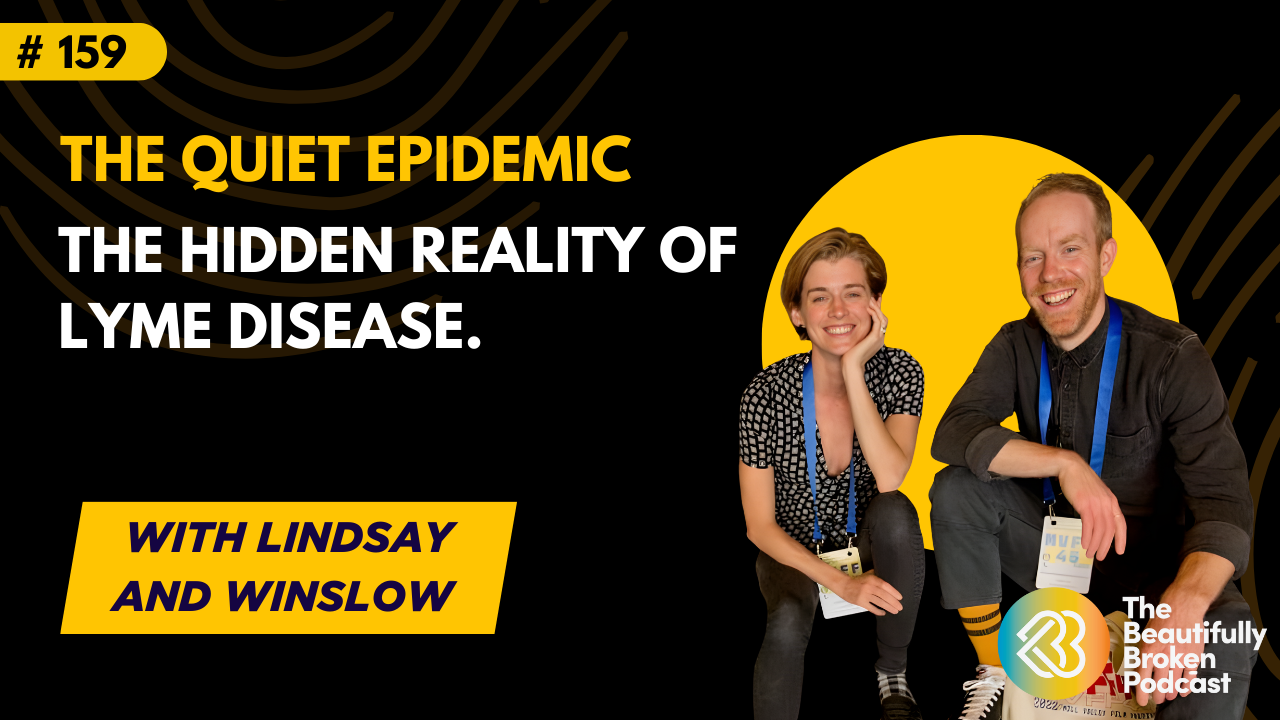
WELCOME TO EPISODE 159
Joining us to share their knowledge are Lindsay Keys and Winslow Crane-Murdock, filmmakers who created a documentary called The Quiet Epidemic, hoping to shed some light on the silent existence of Lyme disease, an illness they both have.
Bringing more awareness to illnesses like Lyme is what the Beautifully Broken podcast is all about, and I look forward to you tuning in to the insights we discuss in this episode.


Episode Highlights
[0:00:00] Introducing Lindsay Keys and Winslow Crane-Murdock
[0:09:43] On “The Quiet Epidemic” Documentary
[0:16:46] Lindsay and Winslow on Living With Lyme
[0:23:40] On Focusing on the Human Experience in the Documentary
[0:28:55] On Lyme Treatments
[0:36:59] Biological Medicine Feature
[0:38:53] On Vaccine Development
[0:42:31] On the Broken Diagnostic Systems for Lyme
[0:53:48] Guidance Through Living with a Chronic Illness
[1:00:54] The Future of Lyme Diagnosis
[1:04:50] On What It Means to Be Beautifully Broken
[1:06:59] A Special Announcement About The Quiet Epidemic Documentary
[1:08:52] Connect With and Support Lindsay and Winslow and Their Documentary
[1:14:06] Outro
GUEST LINKS
The Quiet Epidemic Website: https://www.thequietepidemic.com/
UPGRADE YOUR WELLNESS
Biological Medicine: biologicalmedicine.org
Code: beautifullybroken
Lourdes Hydrofix Premium Edition https://holyhydrogen.com/?sca\_ref=3008232.jSqidhzJ01
Code: beautifullybroken
LightPathLED https://lightpathled.com/?afmc=BEAUTIFULLYBROKEN
Code: beautifullybroken
Flowpresso 3-in-1 technology: https://www.beautifullybroken.world/flowpresso
Medical grade Ozone Therapy: https://lddy.no/1djnh
Code: BEAUTIFULLYBROKEN
GOT MOLD?: https://www.gotmold.com/beautifullybroken/
Code: beautifullybroken10
AquaCure Machine + Molecular Hydrogen
Website:https://eagle-research.com?ref=24931
Code: beautifullybroken
AMD Ionic Footbath: https://calendly.com/ioncleanse/detox
Silver Biotics Immune Support and toothpaste: https://bit.ly/3JnxyDD
Code: BEAUTIFULLYBROKEN
DIY Home Cold Exposure: https://www.penguinchillers.com/product/beautifullybroken/
Cellcore – https://www.beautifullybroken.world/affiliate-products My favorite Binders
My Favorite Sauna: Therasage https://bit.ly/39mTxwY
Code: BEAUTIFULLYBROKEN
CONNECT WITH FREDDIE
Work with Me: https://www.beautifullybroken.world/biological-blueprint
Website and Store: (http://www.beautifullybroken.world)
Instagram: (https://www.instagram.com/beautifullybroken.world/)
FULL EPISODE INTERVIEW
EPISODE TRANSCRIPT
Freddie Kimmel (00:06.142)
Ladies and gentlemen, welcome to the beautifully broken podcast. I have an amazing announcement today. First of all, it's the first time we have ever had three people interviewed in 154 episodes. This is crazy. I love it. And when I mean by that, I've had dual guests, but I've got the three
Winslow (00:27.592)
Thank you.
Freddie Kimmel (00:36.002)
Now for the buildup, we have Lindsay Keys and we have Winslow Crane Murdock, who are, they are the, you're the parents of the documentary, The Quiet Epidemic. Welcome to the show.
Lindsay (00:44.34)
I'm sorry.
Winslow (00:44.573)
Yeah.
Thanks for watching!
Lindsay (00:49.62)
Thanks so much, Freddie. You're right. No one's framed it like that, but that's how it feels. We have a child that's almost eight years old.
Winslow (00:50.37)
That is true.
Freddie Kimmel (00:58.442)
Oh my goodness, eight years old. That is incredible. Man, I have to tell you, I watched the documentary and more or less my life has changed because it reinvigorated a fire in me, how much work there is to do. I feel amazing today after going through Lyme and mold and all those fun co-infections. And sometimes we can really get lost in our healing.
our own little story. And it was a great reminder that there are people out there struggling, that this is a very complex paradigm, Lyme disease, the CDC, how people go through this in different ways because of their access to funding or wellness or information or competent medical teams. It just, it blew my mind. And I was so inspired that I didn't want to wait. I didn't want to wait to get you on the podcast because it's so fresh.
inside me. So first of all, I just want to give my like stamp of like eight star out of four approval. I was just really, and I've watched all the documentaries, I've watched all the lime documentaries, and for me, this one was, it was a, it was a battle cry. It was like, let's fucking go. Let's go. We have to change the way we're thinking about this. So thank you guys for your work.
Winslow (02:06.45)
Thank you.
Lindsay (02:08.862)
I'm gonna go.
Winslow (02:24.59)
Thank you for saying that.
Lindsay (02:24.86)
Thank you. It means a lot.
Freddie Kimmel (02:27.862)
Yeah, so let's start. I want to jump into the film, but let's start. Why someone would choose to make a documentary, a documentary film about Lyme disease and Lyme's co-infections?
Lindsay (02:42.061)
Yeah, people ask us that a lot. And, you know, of course, maybe unsurprisingly, it's personal. So in 2015, my health completely unraveled after many years of mysterious illnesses with no explanation, surgeries, you know, a lot of antibiotics for strange infections.
rarely if ever came up. I had a bullseye rash when I was a kid and I was promptly treated for that, but nobody ever mentioned it, even though I lived in upstate New York and went to college in Connecticut. So I think, you know, after years of tick bites all around the U.S. in 2015, my body just couldn't take it anymore. So thanks to my mom, who Freddie, you've actually gotten to know over
Freddie Kimmel (03:38.364)
Yeah.
Lindsay (03:40.14)
saved my life because she was the one who said, you know, I think that your illness now is related to the Lyme infections that you had in the past and that you're not actually cured. And that blew my mind because I had watched her go through her own battle and she was still in the thick of it at the time and I was actually very skeptical of what she was going through because I couldn't understand why she was seeing a doctor that didn't accept insurance. I didn't understand why she was swallowing all these pills and her whole life
changed and the mom that I had known had basically vanished. And I was like, that can't be what I'm going through. That's what you're going through. And sure enough, she was right. So she strongly encouraged me for two years. I finally gave in because I had no choice. I was losing my ability to read. I couldn't find my way home from work. While living in New York City, which is very scary, severe neurological, muscular, skeletal
And it goes on and on. I had no choice but to go into the Wild West and exit the health care system that I'd always known. So with mom's encouragement, I made an appointment with a specialist, a Lyme disease specialist. And at my first appointment, the nurse realized that I was a hot mess. I mean, it was bad. And she said, how are you going to get through this? Do you have a passion?
Lindsay (05:10.42)
people who had a purpose tended to have better outcomes. So I told her that, you know, and I had been making movies and taking photographs for years at that point. And I said, I'm gonna make a documentary. I felt like the only thing to do in that moment. And she said, wow, we have another patient here who is your age and he's a filmmaker with Lyme. Do you want me to connect you? So I wrote a note and I remember like, I couldn't, I could hardly even hold the pen
hurt so much and I wrote I scribbled a little note and never knew if I would hear from this person but he's he's with us on this podcast today.
Freddie Kimmel (05:50.962)
That's amazing. It sounds like a good time to pass it over to Winslow.
Lindsay (05:55.941)
Yeah.
Winslow (05:56.454)
I have the note. I have the note. The note is right here. It's been sitting on my desk ever since. Made its way across the country with me. It says, hi, let's make a documentary about Lyme disease. I've been looking for a collaborator, but it's a tough sell. It's personal and complicated. Working with someone who gets it is essential. Reach out. Let's chat. So yeah, I, you know, I think it was a, it was, um, it had never happened to me
It's the first time that a doctor had handed me a note. I think for both Lindsay and I, you know, I think we don't ever feel like there was this moment where we were like, okay, should we do this? Yeah, let's, you know, it just happened. Like she wrote me a note, I called her and seven years later we were like, holy shit, what just happened? Here we are, you know? So I think, yeah, it's been a wild ride. For us, you know, I had a similar experience of getting really sick.
Lindsay (06:38.02)
Hehehehe
Freddie Kimmel (06:39.044)
Yeah.
Winslow (06:49.75)
having to move home to upstate New York because I was so sick and ending up getting passed through the Western medical system for six and a half, seven months and going from a diagnosis of a potential brain tumor to depression and finally ending up in a clinic where I didn't actually even know that they diagnosed Lyme disease, but I just knew they spent more time with patients and then them giving me that diagnosis. My initial reaction was I didn't think that Lyme disease could be this bad because I thought that I knew about what Lyme disease was.
And then the tests came back positive and I decided to walk that journey. It's such a disorienting thing as patients. I mean, we all know those first appointments and sort of walking into the Twilight Zone that is Lyme disease is just so strange. And I think we both felt that because we were filmmakers and had worked in that field before that this was something that we could do. It would be a way to understand our own experience. It would be a way to spend time, yeah,
disease and about the people that are in it. And it would be a way to create a tool that would allow other people to not have to be as confused as we were. And I think that was the real goal is how do we, you know, as a patient, especially when you're so sick, it gets so hard to continually describe to people why the disease is so controversial, why the doctors don't accept insurance. To talk through these really complicated subjects while you yourself are getting treatment is really, really hard. And so the idea was, can we create something that people can just show?
Freddie Kimmel (07:55.043)
Thank you.
Freddie Kimmel (07:58.602)
Thank you.
Winslow (08:19.81)
their loved ones, they can show doctors, they can show family and friends, and to make it in a way that doesn't feel like you're being yelled at and preached at, but in a way that is accessible for other people to enter into that story and to believe it. And so who we chose as characters and the way in which they presented themselves were deeply important to the message that we were trying to convey.
Freddie Kimmel (08:40.722)
Yeah, it's really beautiful. Now remind me, let's say this, there's some lead players in your story. So we have some medical staff at around Duke University. We have our couple of our protagonists. Can we walk through the list of who's in the film?
Winslow (08:47.492)
Mm-hmm.
Winslow (08:57.95)
Yeah, go for it.
Lindsay (08:59.24)
Yeah, so we actually met the main subject and her father, who's also a main subject, Julia and Enrico Bruzzese at the same clinic where Winslow and I met. So it was a very serendipitous encounter. We all collided at this clinic in upstate New York. Winslow and I had both just booped home and the Bruzzese's live in Brooklyn, but they had been offered free treatment at this clinic because Julia was actually blessed by Pope Francis on live television.
And she said on camera that she had a clinical diagnosis of Lyme disease, as you would have seen in the film, Freddie. A doctor reached out. It was the doctor that Winslow and I were seeing. And he offered them treatment. So we all collided there. And they were in the thick of it. And the whole family was just in such disarray and emotional pain and confusion trying to figure out what Julia was going through and how to get her better.
So choosing them was really, choosing to follow them was just an obvious to us because they really model what it means to show up when someone in your family is suffering. And as we know, a lot of people who go through line tend to be isolated and in some cases not believed by their families. And so they're really beautiful role models as a family.
Winslow (10:21.15)
Thanks for watching!
Winslow (10:26.75)
Thanks for watching!
Lindsay (10:29.52)
going through this. She's, despite being so young, she was only 12 when she lost her ability to walk from Lyme. She has handled herself with such grace and is always thinking about others and even when she is going through so much herself. So they are our main subjects. And then Dr. Neil Spector is another main subject at Duke University.
Lindsay (10:59.46)
He had a heart transplant due to Lyme disease, untreated, undiagnosed for I think around 15 years or something. And yeah, he decided to change the focus of his research from cancer to Lyme disease, which goes to show you just how complicated this is. A lot of people would not put cancer and Lyme disease in the same category. And Freddie, I'm sure that you have your own thoughts about that as someone who has battled both.
Freddie Kimmel (11:06.844)
Yeah.
Freddie Kimmel (11:27.642)
Yeah. Yeah, I think it's really hard for me to imagine the level of living in such severe pain for four years, five years, and then getting a cancer diagnosis to imagine that my immune system wasn't severely compromised, knowing there's there's millions of cancer cells circulating through the body that they're managed every day until there's a systemic dysregulation. So I've I've always, you know, nobody wanted to have that conversation then when I was in my oncology.
Winslow (11:52.75)
Thanks for watching!
Freddie Kimmel (11:57.602)
floor. But I always thought it. I was like, how can this not be connected? You know, walking around in just such pain. So he was, I had always known about Neil Spector. And I just, man, what a, what a light. I mean, I was like, I want to hug this guy. I just, he seems, what a character. He reminded me of kind of like a, like a Mr. Rogers.
Lindsay (12:02.321)
Yep.
Winslow (12:13.671)
Yes.
Lindsay (12:17.34)
Absolutely.
Winslow (12:18.05)
you
Lindsay (12:20.1)
Thanks for watching!
Winslow (12:26.05)
Ha ha ha ha ha ha ha ha ha ha ha ha ha ha ha ha ha ha ha ha ha ha ha ha ha ha ha ha ha ha ha ha ha ha ha ha ha ha ha ha ha ha ha ha ha ha ha ha ha ha ha ha ha ha ha ha ha ha ha ha ha ha ha ha ha ha ha ha ha ha ha ha ha ha ha ha ha ha ha ha ha ha ha ha ha ha ha ha ha ha ha ha ha ha ha ha ha ha ha ha ha ha ha ha ha ha ha ha ha ha ha ha ha ha ha ha ha ha ha ha ha ha ha ha ha ha ha ha ha ha ha ha ha ha ha ha ha ha ha ha ha ha ha ha ha ha ha ha ha ha ha ha ha ha ha ha ha ha ha ha ha ha ha ha ha ha ha ha ha ha ha ha ha ha ha ha ha ha ha ha ha ha ha ha ha ha ha ha ha ha ha ha ha ha ha ha ha ha ha ha ha ha ha ha ha ha ha ha ha ha ha ha ha ha ha ha ha ha ha ha ha ha ha
Freddie Kimmel (12:28.583)
Oh goodness, who else? But also very, he had a light sensibility about him where there's, oh, he's like, this guy's kind of funny. So I just, yeah, I really, I really warm to him. And then who's the doctor at Columbia? Dr.
Lindsay (12:30.1)
Thanks for watching!
Yeah. Yes.
Winslow (12:42.65)
That's Dr. Brian Fallon.
Freddie Kimmel (12:44.602)
Dr. Brian Fallon, who I had heard many times of his work previously. So it was nice to get a little intro to some of these different characters in the film and follow everybody around.
Winslow (12:54.192)
Well.
Yeah, we follow a lot of scientists or not follow, but we hear from a lot of scientists as well and a lot of doctors. And then also some investigative journalists, Marybeth Pfeiffer plays a huge role in the film. And Pamela Weintraub is there as well. And they really sort of guide the investigative part of the film. We sort of saw it as these two layers. There's the present day story that's playing out. And then when they would hit these roadblocks in the present day, we had to go back in time to explain the decisions that made it so hard to be a patient right now. And so there was these two levels
sort of moving in and out of, which was, yeah, just the experience of our characters and then, you know, the investigation of all of the many decisions that have led us to where we are at this moment.
Freddie Kimmel (13:40.202)
It's unbelievable. And the first place that my brain wants to go is, and remind me the clinic that we've mentioned a couple times that you guys, you met your leads, you met Julian Enrico, that's in Upstate New York.
Lindsay (13:55.98)
Yeah, it's called the Stram Center. And we were there just for a time. And then we all, Winslow moved across the country. Well, we got out of our parents' houses really. So we moved on to other treatment centers and doctors, but we were there for a brief time. And yeah, I mean, that's where, if not for that clinic, we never would have met and we never would have met Julia.
Winslow (14:11.078)
Eh.
Lindsay (14:26.461)
and they're still supportive of our journey, which is cool. They're excited to see this come to fruition after all these years.
Freddie Kimmel (14:32.262)
And who is a lead physician there that was kind of guiding everybody?
Lindsay (14:36.38)
His name is Dr. Ron Stram and his nurse practitioner was Jennifer Goldstock and she was actually the one whose care we were under even more so. She had a real interest in Lyme and tick-borne illness and Dr. Stram was more focused on cancer. So, Jen Goldstock was the one who actually handed the note to Winslow from me. Yeah.
Winslow (15:00.15)
Mm-hmm.
Lindsay (15:06.1)
journey for both of us, which as you know is very winding and yeah, it just keeps going.
Freddie Kimmel (15:11.462)
just keeps going. Yeah, it just keeps going. It's very, you know, it's, it's, it can be so frustrating at times because you're like, I'm fine. I'm like completely, you know, I'm so robust energetically. And then you have, it's funny, I find the better and better and better I get. And I identify as healed. I identify as healed. And when, when you have a day, one day out of even like,
Winslow (15:12.85)
..
Winslow (15:35.035)
Hehehe
Lindsay (15:35.832)
Hehehehehehe
Freddie Kimmel (15:41.402)
100, where you're down, it's it, for me, it hurts extra worse. It's terrifying, because you're like, I can't, I can't afford to go backwards. What do you mean? You know, it's just the psyche and the way the brain works is so interesting. You know, I'm, I'm continually drawn to the work around trauma and trauma release and the body keeps the score. And how do you not consider the psychological abuse that a person has?
Lindsay (15:46.42)
It's terrifying.
Winslow (15:46.55)
Thanks for watching.
Lindsay (15:53.242)
Yep.
Winslow (16:11.25)
Thanks for watching!
Freddie Kimmel (16:11.402)
person with Lyme goes through just in the medical care, not their symptoms alone, like the medical gaslighting, which is just, that has to be worked on at some point.
Lindsay (16:16.18)
Yeah, exactly.
Winslow (16:23.192)
Yeah.
Lindsay (16:23.789)
like
Freddie Kimmel (16:26.144)
Yeah. Yeah. I have a question as we, you know, we go through, how are you guys both doing today? That's always the magic. Everybody wants to know how you're doing today.
Winslow (16:31.876)
Ha!
Lindsay (16:35.329)
It's true. Winslow, how are you feeling today?
Winslow (16:37.17)
Today specifically. Uh.
Freddie Kimmel (16:39.502)
Well, you know, let's look at it as like a bell curve, you know, or, or like, let's look at it over maybe since the time you met.
Lindsay (16:46.022)
Yeah, yeah.
Winslow (16:46.05)
Yeah, it's the time we met. I think I can say we are doing a lot better since the time that we met. I don't wanna speak for Lindsay, but yeah. Yeah, I feel grateful to not be in that place anymore. When Lindsay and I first met, I was probably six months, five months into treatment at that point. And the treatment helped sort of stop the downward decline, but I still was in a pretty scary spot
Lindsay (16:51.441)
Yeah. Yeah, yeah.
Lindsay (16:56.8)
Thanks for watching!
Freddie Kimmel (17:14.522)
Mm-hmm
Winslow (17:16.91)
And we decided to take this on at a moment when we were both still very, very sick. And it is really interesting looking back at just photos of us out in the field and just being like, wow, we don't look good. We really are struggling. And it was also a really huge thing to take on. I mean, we were flying across the country overseas. We were in India for a month with the Brosezi family. We were doing really intense production. And it was both like, I think to what you were talking about it.
Lindsay (17:27.34)
No, it does not look good.
Winslow (17:46.15)
the soul, but it also was really, really physically difficult. And it was hard to tell where it was netting out in terms of our physical health. But now I feel, honestly, I felt the best during COVID, which is interesting because we weren't traveling. We were just in one place for a long period of time. And to just be rooted in a place and to get to know a place. And I think that is a really
Freddie Kimmel (17:54.565)
Yeah.
Freddie Kimmel (18:08.754)
Mmm.
Winslow (18:16.03)
came out in the past year we have been on the road consistently promoting it, which has been super exciting and super grateful for that experience and also really exhausting and draining. And so I feel pretty good and I feel a lot better than I did when we were making the film, but I do and am understanding the way in which all of these flights and all of this promotion takes a toll on the body.
Lindsay (18:19.038)
I guess.
Lindsay (18:36.726)
Yeah.
Freddie Kimmel (18:36.762)
Yeah. Yeah. What about you, Lindsay?
Lindsay (18:39.24)
Yeah, I mean, I thought that I was going to die by age 30. And I was 26 when I got my chronic Lyme diagnosis. So, you know, and I'm 34 now. So I can't even compare. I can't even compare where I am today with where I was then because I didn't know how I was even going to survive one more day in that state. And now I'm mostly symptom free. But yeah, but still dealing with it.
what you brought up before the body keeps the score. I think, you know, I'm really excited about the research that's coming out around psychedelic medicine. And I really feel like there's a place for that in processing the experience of being sick, the experience of being sick and making a movie about the sickness. And just, you know, being a human, I think there's, you know, every person
to their emotional and mental health, whether or not they're chronically ill. And I also wonder if that might actually play a role in the development of chronic illness in the first place. So you can have a room full of people and everyone is bitten by a tick and everyone responds differently to that tick bite. And as we know, trauma has an effect on the immune system. And I have experienced in the past,
stressful moments or specific events that have led to flares and even full-blown relapses. So I think that being aware of that is really important and something that I'm, when I think about the road forward as far as treatment goes or feeling better, I'm not really interested in antibiotics right now. I think the energy healing, we were talking about the ampoyl before.
Um, also, you know, psychedelic medicine, um, you know, infrared sauna is really amazing, that sort of thing. And, you know, the, the, uh, brain retraining programs really intrigued me as well. Just trying to get my brain out of this chronic fight or flight mode. I, when you're in the fight of your life for years, your brain can get caught in this state of just feeling stressed.
Freddie Kimmel (20:46.884)
Mm-hmm
Lindsay (21:09.14)
of course that's not healthy either. So I think it's a silver lining of being, of having your health completely fall apart is that you learn a lot about how to take care of yourself and then, you know, hopefully implement those moving forward.
Freddie Kimmel (21:19.585)
Yeah.
Freddie Kimmel (21:22.822)
Yeah, it really is a whole body, whole spirit, whole emotional intelligence endeavor that I've found. I would like you, I would notice that a severe stress response or when I overburden myself, it's just that you'll have a flare. The immune system gets really, really angry. So that's, you know, that's been my experience and things like DNSR or I do a system called ReOrigin, which is, you know, it's literally pause.
Winslow (21:48.071)
Hmm.
Freddie Kimmel (21:52.982)
my brain is caught in a loop and it's throwing me for a loop. And I just walked through this, I did it last night. And I'll just talk myself through three rounds of this maladaptive response. And you do, you can take the volume of a symptom down to like six, it was at a 10 in three or four minutes. So the power of that, you know, knowing like Annie Hopper's work and the power of the mind in the
Lindsay (21:54.44)
Yes.
Winslow (21:55.991)
Ha ha.
Freddie Kimmel (22:22.702)
loops of this, like, what am I losing by this? How much life am I losing? What opportunities? And it's just, it really is a spiral that we have to, you know, mitigate. And so there's, like you said, psychedelic medicine, ketamine assisted therapy. You know, my doctor is doing this now, he's having great, great success. And it's all, it's all based on a journaling exercise in which you have to journal for two days and write out your whole life story. So when you do the therapy that you can go through and you can focus on.
Winslow (22:26.55)
Mm-hmm.
Freddie Kimmel (22:52.822)
on touch points. It's not just go do the medicine, right? It's the integration. It's the after work that I think is really powerful. There's, in my experience, you know, it's not going to be a quick fix. It's like, how do we use these tools? How do we use these tools? When I saw Neal Spector in the film, I remember reading articles about, I was trying to look this up right now really quick.
Winslow (22:54.153)
Mm-hmm.
Winslow (23:05.75)
Thank you.
Lindsay (23:07.7)
Exactly.
Freddie Kimmel (23:24.046)
Suni, Allegheny, or Adirondack.
Winslow (23:26.37)
around that.
Lindsay (23:27.7)
Was it Holly? Was it Holly Ahern?
Winslow (23:29.25)
Halle A'Hern? Yeah. Ha ha.
Freddie Kimmel (23:30.582)
Holly. Yeah. Yeah. I had had her on and she had, we had done an interview and she had talked to me about, you know, how she had cultured her daughter's Borellia and she, through frequency medicine, specifically a unique type of a rife device, had stopped the Borellia from replicating. And so with that and a little low dose antibiotic that she had had, she said, and I just checked up on her a little while ago, she said, her daughter's doing great.
Winslow (24:00.592)
Mm-hmm.
Freddie Kimmel (24:01.743)
So it was really interesting. Did you, did you, I noticed you really didn't get into too many treatments in the documentary. We really focused on the human experience of story and which I thought was great. I thought that that's like, oh my God, that's another film.
Lindsay (24:01.745)
Yeah.
Winslow (24:18.671)
Mm-hmm. Yeah. Very much so.
Freddie Kimmel (24:22.267)
So why were you drawn to make that choice?
Winslow (24:24.97)
Yeah, I think we were drawn to make that choice because I think when you look at the whole of what we know about Lyme disease, there's just so many better questions and better research that needs to be done. I think that all of us are doing the best that we can with the knowledge that we have. But because there has been this war between these two sides, all of the science has been about
Winslow (24:54.95)
and ask better questions. And so that's what Dr. Spector was doing. He was like, I want to pull in people who have never even thought about Lyme disease, but who know how to do science well, and to know how to approach that well, right? And just bring them together and see what we can unlock. And in three years, he made these huge, huge strides because he brought these people in who were willing to take an open mind and just say, okay, let's look at this. And, you know, that what they found was, was fascinating. And Neil, you know, Neil would say, like he would say,
Freddie Kimmel (25:05.822)
Yes.
Yeah.
Winslow (25:24.89)
be on antibiotics for this long. I don't want it, you know, but these are the best tools that we have at the time. And so I think for us, as we started to think about it, one, we wanted to make a film that broke outside of the Lyme community. And so I think that the treatment question is very much a Lyme community question, which is how do I get better? Which we absolutely understand, but everyone has a different experience. And I think everyone has a different experience because we don't have a good understanding right now of what's going on, right? So if we don't even have a test that tells us when our treatments are working,
or we can't even find the bacteria in the body. These are all questions that have to be answered, I think, before we can have a real conversation scientifically about here's a broad treatment that's going to work for everybody, right? We do know that antibiotics are a mainstay. I think that Lindsay would say this as well. And I would say that antibiotics were an important part of our treatment, but it was not the only part of our treatment. It was not just dump antibiotics on, and then great, we're better. For me, the antibiotics felt like they stopped a downward slide,
Freddie Kimmel (26:07.386)
Yeah.
Freddie Kimmel (26:17.612)
Hmm.
Winslow (26:24.85)
then there was all this other stuff that had to happen in terms of rebuilding and trying to get back to a place where I felt functional and good. And so I think that the treatment conversation is a really important one. But in terms of a film that's trying to raise awareness about an issue and how far we have to go, it felt like sort of a rabbit hole that we could have easily fallen down. That's never going to please anybody, because everyone knows that they have their own thing that worked. And for example, I did antibiotics,
Freddie Kimmel (26:32.523)
Yeah.
Freddie Kimmel (26:51.465)
Yeah.
Winslow (26:54.93)
are the ones who turned me onto the rife machine. And I started going over to their house and getting blasted with the rife machine and then trying to go over to Lindsay's house and do work and like just absolutely destroyed. At the point when I was doing, you know, IV antibiotics and not Herxing, and then I would do the rife machine and Herx, right? And so I think that there are all of these things that are just so complicated. And also I think,
Lindsay (27:03.144)
I witnessed it. Destroyed. Faceplant on my mom's couch.
Freddie Kimmel (27:07.106)
Yeah.
Freddie Kimmel (27:14.585)
Yeah.
Freddie Kimmel (27:21.542)
So complicated.
Winslow (27:24.85)
along with the fact that people are willing to try anything. And I think that's, you know, what we would always say is that, you know, people are, the people in power are criticizing patients for trying anything as they create the environment with which people feel like they have to go try everything that they can because they're not getting any answers, right? And so the burden is really on these medical professionals who are like, wow, you're crazy to actually come up with something that would allow you to not have to go out
Freddie Kimmel (27:54.423)
Hmm.
Winslow (27:56.692)
So, yeah, I think that, but we wanted to create something that felt bulletproof and approachable. And I think also like the treatment conversation so easily and so quickly has stigma attached to it that it just felt like something to just like, let's leave that for another conversation.
Freddie Kimmel (28:12.462)
Yeah. Yeah, that's brilliant. I would agree with you. It's so polarizing. And I think the point that you made about more research needing to be done before we can really have that conversation on broader scale is just very intuitive, very intelligent. I would agree with you that it's just so... Here's what I always say is that from, you know, one of the things just being in this field of, you know, I had no Lindsay and Lindsay's mom back from
Winslow (28:26.513)
Mm-hmm.
Freddie Kimmel (28:42.422)
functional health coaching, looking at how do we build these next level coaches to be able to facilitate the needs which the doctor will never supply. Or working with people like Amp Coil or Laipath LED, all these different technology solutions. What you start to see after thousands and thousands of phone calls is that the variables that a human brings in are endless. And we will never, you're never going to solve the very, you know,
Lindsay (29:06.566)
Yeah.
Winslow (29:06.652)
Mm-hmm. Yeah.
Freddie Kimmel (29:12.402)
emotional intelligence, the genetic background, the heavy metal toxicity, glyphosate, what your dietary platform or belief system is, it's endless. So I think it will be a nuanced, personalized targeted approach, which I do think will also be able to build a system for. Oh, if you have A and B, then you're not going to do C. I do think that exists somewhere in the near future. Which is stuff I get really excited about.
Winslow (29:17.45)
Yeah.
Freddie Kimmel (29:42.482)
And what was your, so how long, I gotta ask, how long did you continue with the being blasted with a rife machine?
Winslow (29:50.71)
for a while. Yeah, for a long time. I would go over to Holly's house and I really didn't believe it. But I had been told this whole time that I was supposed to herx, you know, and I would herx a little bit on antibiotics, but I just generally felt awful. But the rife, it was wild. I was immediately herxing, you know, and I would sit and then so I ended
Lindsay (29:50.8)
Thanks for watching!
Lindsay (30:00.6)
Thanks for watching!
Freddie Kimmel (30:05.723)
Yeah.
Winslow (30:19.89)
sick with Lyme disease and she would walk away and I'd be like, are you okay? And she'd be like, I feel like nothing happened to me. And I would just be like, I feel like I just got punched in the face. You know, and we're sitting there having these two completely different experiences, depending on who we are. Right. And so, but you know, I think that it's, it is, I think, worth saying though, that it is also the wild west, you know, and I think that that's a really hard part of this. And that's one of the other reasons why we didn't get into treatment is because
Freddie Kimmel (30:29.465)
Yeah.
Freddie Kimmel (30:43.733)
Hmm.
Winslow (30:49.83)
ways to get taken advantage of in this world as well, right? And everything costs so much money. I mean, that's a huge part of the Lyme disease experience is that everything is costing money. And so you have to have the wherewithal to not get played. You have to have the money to be able to try things. And you have to have the support to sort of find your way through this morass of some people who are doing at the very cutting edge of medicine,
Freddie Kimmel (30:54.044)
Yeah.
Freddie Kimmel (30:57.944)
Yeah.
Winslow (31:19.75)
crazy, but it is working for people. Or you also have people that are getting taken advantage of. And I think it is an important thing that people don't talk about enough is because we get criticized so much for it. I think everyone tries to sort of hide from that. But it is the truth that this situation has created this Wild West where it's so hard to find your way through and find what works. And then also when it works for everyone individually and not as the whole, then it also, you know, I know people who have gotten the same right
Freddie Kimmel (31:49.982)
Nothing, yeah, I have that experience as well.
Winslow (31:50.091)
and they put a lot of money into it. And so, you know, it's a really, it's a difficult, challenging issue.
Freddie Kimmel (31:56.622)
It is the, you know, the thing you said before, it's like the powers that be or the establishment being frustrated that we would be moved to go try rectal ozone or learn how to inject yourself with ozone, which, which I did in New York City. I was like, oh, let me practice on an orange for a while and learn how to stick this needle in my arm. Seriously. But I will tell you, but I will tell you that at that point, and I'm sure you both can relate, I didn't care.
Lindsay (32:10.5)
Thanks for watching!
Winslow (32:11.407)
Yeah.
Winslow (32:15.837)
Hahaha
Lindsay (32:17.408)
Yeah. Yeah! Totally!
Winslow (32:19.606)
Yeah.
Winslow (32:24.75)
Mm-hmm.
Lindsay (32:24.764)
Yeah.
Freddie Kimmel (32:26.502)
I just wasn't interested. It's not that I wanted to commit suicide, but I wasn't interested in living that way anymore. And every day was on a level of suffering that I can only tell people and they could try to imagine. You know, I'm like, imagine like not getting off the couch for a couple of weeks and like being exiled or your heart's racing going to the bathroom because you're, it's just ridiculous. I always said, I wish I could snap my fingers in an appointment and we could just trade energetics for like 20 minutes.
Lindsay (32:31.585)
Yeah.
Winslow (32:38.816)
Yeah.
Winslow (32:46.65)
Thanks for watching!
Lindsay (32:47.311)
Bye.
Yeah.
Freddie Kimmel (32:56.582)
and I could just watch the person on the floor. I'm like, bro, that's every day all day for me. And then maybe people would be inspired to be a little more outside of the box, a little more compassionate and empathetic. That's what, the other thing that drove me crazy was like, there was no empathy. People would look at you like you were just like, whack them.
Winslow (33:01.593)
Yeah.
Lindsay (33:02.376)
Yeah.
Lindsay (33:07.34)
Yes, absolutely.
Winslow (33:07.835)
Yeah.
appreciate it.
Winslow (33:15.601)
How could you try this?
Lindsay (33:15.72)
Yeah, yeah. I think that you want to be sick. And I think it's again, because if there's the diagnostic tests are all saying this person is fine, then the doctors don't have time to figure it out. So it's easier for them to just say, Oh, you're imagining this, you're making it up. And to your point to Freddie, what you were saying before, you know, practicing on yourself and going out, I did bee venom therapy for a year and a half. Okay. So I'm just going to put that
Winslow (33:19.412)
Right.
Freddie Kimmel (33:32.466)
Yeah.
Freddie Kimmel (33:41.962)
And you did the actual bees.
Lindsay (33:45.6)
Thanks.
Freddie Kimmel (33:47.183)
Can you tell the audience, because people are going to be like, whoa, we just lost somebody. Yeah, yeah, tell me, be venom therapy, because I did it as well.
Lindsay (33:52.0)
It's, this is important. This is important, right?
Lindsay (33:57.38)
Yeah. Oh, you. Oh, hey. Okay. We're really going there.
Freddie Kimmel (33:59.102)
Come on. I have slide decks. I have slide, I do a talk, you know, I do a talk on like the body's systems and like going through all the things, but I have slides of like everything I tried and I eventually cut, I cut slides because it sounds ridiculous. I would like, I'm like, reading through all the things, but tell us what B-venom therapy is.
Lindsay (34:08.945)
Yeah.
Right.
Lindsay (34:16.56)
Yeah. Yes. Right. I know. I know. Yeah. So B-venom therapy, the protocol that I followed was through the heel hive, which you have to pay for, but it was helpful guidance for me to feel like I wasn't completely doing it on my own. And basically you slowly work your way up to, in the number of stings, Monday, Wednesday, and Friday. So the maximum number
Freddie Kimmel (34:33.793)
Mm-hmm
Lindsay (34:46.0)
along either side of my spine. And I would sting myself, which was pretty wild. I would like pull up my photo booth on my computer or use the selfie camera on my phone and be holding these live bees that I was living with in my apartment. Like I would, I actually developed a really cool relationship with them. You know, I developed like a real love and appreciation for them, which, you know, and I know it's very sad because you're sacrificing them when you're using them.
Freddie Kimmel (34:57.902)
Wow.
Winslow (35:16.15)
Thanks for watching. Bye.
Lindsay (35:16.38)
but you're also supporting apiaries where you're buying the bees from, and they're producing way more bees than any person would ever use for even a couple of years of bee venom therapy. So it was a wild process, but there are studies on bee venom therapy and HIV, bee venom therapy and breast cancer. And again, this is very preliminary research, but the practice has been used for thousands of years.
Freddie Kimmel (35:28.126)
Mm-hmm
Lindsay (35:46.42)
is a really interesting healing modality that involves not just the venom of the bee, but the pollen and the royal jelly and all aspects of the bee, from bee medicine. And it's just so sad that we've lost so much of this ancient wisdom that is just so fascinating because basically it can't be, you know, because it's a liability to perform it in a doctor's office, you know? And so to that, to your point before, like we should, you know, for me personally,
Freddie Kimmel (35:56.022)
Yes.
Lindsay (36:16.0)
that risk. I didn't know what it was doing to my body. My kidney started to hurt and so I stopped. But I definitely noticed that it helped with various symptoms and energy levels. But yeah, it's a mystery. It's still a mystery to me and I'm glad that I did it. And if there was an FDA approved safe and effective treatment that I could use, then I would have done that. But there isn't. So I stung myself with live bees for a year and
Winslow (36:42.95)
Thanks for watching!
Lindsay (36:46.1)
I'm sorry.
Freddie Kimmel (36:46.822)
Yeah, that's pretty baller. Winslow, do you have anything else? Do you have any like tales from the crypt, crazy live things you did you wanna share? Ha ha ha.
Winslow (36:49.621)
Yeah
Winslow (36:56.91)
I'm trying to think. God, I did a lot of rife. I mean, coffee enemas, right? Those seem so basic now, right? I'm like, everyone does a coffee enema, but first time you do one, yeah. Well, first time you do one, I mean, it is worth remembering that the first time was surprising. I'm trying to think what else. Yeah.
Lindsay (36:58.522)
Ahhhh... Hahaha...
Lindsay (37:06.52)
I knew you were gonna say that.
I know. Yeah, hose up your ass, whatever.
Freddie Kimmel (37:11.582)
everybody does a cut yeah
Freddie Kimmel (37:19.507)
Yeah.
Freddie Kimmel (37:23.642)
We talk about coffee enemas all the time on this show, so it's really not. It's, yeah.
Lindsay (37:26.22)
I love coffee enemas. I love coffee enemas. Yeah.
Winslow (37:26.51)
Yeah, yeah, yeah.
Freddie Kimmel (37:31.922)
My whole body would shake the first one I did. Like I was so sensitive to the caffeine. Like I'd get like full body tremors and I started with like a tablespoon of coffee. Actually, I think I started with like chamomile tea or something like that. They were like, try tea.
Winslow (37:32.63)
Yeah. Yeah.
Mm-hmm. Same. Yeah. Yeah.
Lindsay (37:41.663)
Yeah.
Winslow (37:45.517)
Ha ha!
Bedtime? Yeah, it's my bedtime anime. Yeah.
Lindsay (37:50.086)
Oh my god. That's the idea. Yeah.
Freddie Kimmel (37:50.602)
Bed type T. Calm down that colon. Yeah.
Lindsay (37:56.581)
That is amazing. But it's so true. I mean, I can imagine people who haven't been down this path listening to us right now and being like, wow, but we weren't always like this. It's born out of necessity. I would have thought that this was crazy too, if I had been, you know, healthy and functional and hadn't been abandoned by Western medicine, right? But it's worth trying. When you're that desperate, you'll try anything, for better or for worse.
Freddie Kimmel (38:08.186)
No.
Winslow (38:08.25)
Mm-hmm.
Winslow (38:23.914)
Yeah.
Freddie Kimmel (38:25.262)
Yeah, let's talk about that for a second, abandoned by Western medicine. I always preface that with, my life is completely saved by oncology and medical doctors. And then it's really when the after effects, when they just, you know, peripheral scar tissue kept growing and I had to do surgery after surgery and immune system crashed from the Lyme that I really got lost. But you go into the documentary around the ELSA test and the Western blot and the, God, how do I explain this?
Winslow (38:34.455)
Uh huh.
Winslow (38:44.372)
Hmm.
Freddie Kimmel (38:55.222)
I want to frame it. The lack of integrity in which different protein bands from the spirochete were removed in order to, I guess, be able to like trademark or copyright a future medication or vaccine. Is that, am I getting that right?
Winslow (39:16.11)
Uh, yeah. Yeah. I mean, essentially they, they, so they were creating a vaccine with these two antibodies that were also on the test. And so they were moved from, from the test. So there wouldn't be cross reactivity. So basically they wanted to, so if, say you got vaccinated for Lyme disease, but had never been bit by a tick, they wanted to be able to test you with the Lyme disease test and you would test negative. So it's not like those two antibodies wouldn't show up and they would have to ask you, Hey, did you get vaccinated?
Freddie Kimmel (39:34.623)
Mm-hmm.
Winslow (39:45.91)
even have to ask, they'd be like, nope, you don't have Lyme disease because you didn't test positive, right? And so, but what that meant is that they used these two antibodies that were very, very specific for Lyme disease. And so they took those off the test. The Lyme vaccine then was taken off the market. And so most people have never gotten the Lyme disease vaccine. And so now we're using a test that is worse and we also don't have a Lyme vaccine that's on the market. And so for someone like myself, you know, the standard
CDC tests, you need five out of 10 bands in order to be considered positive. That's five out of 10 antibodies in order to be considered positive. And I tested positive for four antibodies and they told me my test was negative. And then I went to Igenix that includes those two antibodies that were used in the vaccine that I never would have gotten from a Lyme vaccine because I haven't received it. And I was positive for those two very specific Lyme disease antibodies, which gives me six bands, which makes me positive.
for Lyme disease, right? And so there's this way in which this test that's already an antibody test that is already not great because it depends on a person's immune response is now made worse by the fact that we don't have that information on it. That actually, if you're positive for one of those two antibodies that were removed, pretty much the only way you got those antibodies is by being exposed to Lyme disease because they're just specific for Lyme. And so we argue that that's a huge, huge issue.
Freddie Kimmel (40:47.765)
Yeah.
Winslow (41:15.85)
And when we talk about a test that already isn't good, I mean, if we added those two things back in, it would at least be better. You'd be catching more people. I mean, myself for sure, I was positive on those. Lindsay, I think you were as well, right? Julia was in the film. Julia would have been six bands instead of four. So the fallout from that decision, yeah. Yeah. Yeah.
Lindsay (41:26.3)
Yep, yep, yeah. Julia as well, yeah. Yeah, yeah.
Freddie Kimmel (41:32.902)
Yeah. Six instead of four. That was me too. Yeah, I was, I was negative. And then eventually, you know, forked up the money at the time, which was a fortune for me. It was 1200 bucks at the time. A fortune. I was like, oh, it's like everything I have to just to get a test, not even to get treatment. But I did it and it was like
Lindsay (41:34.82)
You too. Yeah, there you go.
Lindsay (41:42.26)
Yep. Oh yeah. Yes, exactly.
Winslow (41:43.07)
Yeah, go ahead. Yeah, I know.
Lindsay (41:48.34)
Yep. Yep. Yep.
Winslow (41:50.95)
Yeah, just to get a test with two things that are added back in. It's essentially the same test. Yeah.
Lindsay (41:53.701)
Yeah. Yeah.
Freddie Kimmel (41:54.082)
Yeah. And it wasn't it, wasn't it for, I'm not sure if they still mark it the same way, but they were like, okay, you're positive in California and New York, you're negative on the iGenX test. So I think I just got there with five bands, but you know, the two that they were moved were, were both in there. So that was the first time it became aware of what's, what's happening here. What is, what is the system that we have for identification of this disease paradigm? It seems severely broken.
Winslow (42:01.13)
Yeah. Yeah.
Winslow (42:10.172)
Yeah.
Lindsay (42:20.4)
It's very broken and it makes you wonder how many folks are out there walking around with Lyme and tick-borne illness right now and they have no clue because we were all those people and we know many people who were those people and there are plenty of folks who watch the quiet epidemic and start to connect the dots in their own life or in the life of their child and it's like, oh wait, you know, this one couple that came to our screening at the
Lindsay (42:51.34)
We had lunch with the mother afterwards and she was just sort of, you know, she was very overwhelmed in her own thoughts and was like, what's going on? And she said, you know, my daughter was bitten by a tick on Shelter Island when she was 10 and her test was negative. But then after watching the film, she realized that that didn't mean anything. And so we're witnessing that people are watching the film realizing that that negative test
necessarily mean that they're not infected and then they're calling into question whether they're fibromyalgia diagnosis or lupus or MS or various chronic fatigue syndrome, myalgic encephalomyelitis diagnoses might actually be due to an infection that needs to be treated because if it doesn't get treated, it could get worse. So that is huge. That is one of the biggest messages of our film
Freddie Kimmel (43:44.706)
Yeah.
Lindsay (43:50.46)
in testing, you cannot rule out Lyme disease, and it's a clinical diagnosis. And in some cases, it might even worth being treated empirically, you know, with a doctor who's willing to try to see if a treatment might help. Because otherwise, a lot of people are just living their lives with these incurable, quote unquote, incurable, you know, almost death sentences in some cases, you know, people
Freddie Kimmel (44:18.043)
Mm-hmm
Lindsay (44:20.4)
sclerosis, and yet some of the doctors that we interviewed for our film, they have successfully treated multiple sclerosis patients for Lyme and Tick-Borne illness and the lesions on their brains go away. So this is huge, and we don't even know how big this is. I think we would all be completely stunned if we had an accurate diagnostic that could give us the real numbers.
Lindsay (44:50.787)
estimate.
What is that actually based on? We have no idea.
Freddie Kimmel (44:56.842)
Yeah, yeah, I would agree. I, yeah, that point of the movie made me and same with the team from Amp Coil. We just were like, oh my God, I was like enraged at that point when you're, when you're being, uh, walked through the process of why those bands were moved from the test. It just made me so angry. Um, the needless suffering that is, you know, I always wonder, I always wonder, is it gross incompetence? Is there some type of a, you know, I think a lot of things we could
Winslow (44:58.95)
Thanks for watching!
Thanks for watching!
Winslow (45:13.55)
Thank you.
Freddie Kimmel (45:26.802)
probably argue that are incentivized by the capitalistic system of business. You need more customers. The machine does need to be fed. What are your guys' thoughts on that? Is it just, what is that? We just went through this very polarizing, I hate to go to the pandemic, but we could also go there too. We could probably just leave it out. Or we could pee. I'm really, it just makes me so angry. I was like, I remember in the middle
Winslow (45:32.114)
Yeah.
Winslow (45:46.712)
Yeah.
Lindsay (45:51.734)
Yeah
Freddie Kimmel (45:56.842)
middle of the, in the middle of the pandemic, I was like, up to do this job. And people are like, oh, you've got to get vaccinated to be able to go here. And I was like, do you know what I have been through with? No, you don't. With my immune system, I'm like, you're crazy. Not not, and I'm not saying my belief system is either way, I know it's a very triggering topic for people. But there was no way I'm going to do anything to change like all the ground that I've gained over
Lindsay (46:09.188)
Yeah.
Freddie Kimmel (46:26.842)
this healthy distrust from Lyme disease that I'm like, wait, I pretty much been lied to and like, you know, just disingenuously a gas lit through the last 20 years. I'm like very not trusting.
Lindsay (46:40.88)
Yeah, it's understandable. It's totally understandable. Winslow, how would you answer that question?
Winslow (46:41.565)
Yeah.
Winslow (46:44.971)
Yeah.
Freddie Kimmel (46:49.002)
Like, did I ask a question in there? Or did I just like?
Winslow (46:51.672)
No, I think you asked the question. I mean, I think one of the things that we say, cause this comes up a lot, you know, is that none of this stuff was actually illegal, which I think is the point, right? Like people were like, this is a conspiracy and Pam Weintraub says this. She's like, it's not a conspiracy. They're out in the open saying it. This is what they did. And they, and whether they
Lindsay (46:51.68)
No, you did, you did.
Winslow (47:18.37)
believe in the science or not, none of this, you know, this is a lot of this is just how the medical system works, right? We have an insurance system that has codes for what is treatable, that is trying to cut costs. We have a medical system that allows for 12 to 15 minutes with a patient that makes it incredibly difficult to bring complexity into that conversation. We have a and we have a for-profit healthcare system where the incentives are always going
in the world in a for-profit healthcare system, literally the incentives are skewed. The idea is that sick people make money, right? And so there is always that inherent disconnect within that. I think that these doctors made a decision and I think that if, I can see them in the 90s being like, wow, so many people are getting sick with Lyme disease, we need a vaccine. Like, let's just
Winslow (48:18.35)
like that will help, right? But they made these decisions that simplify the definition of the disease in order to be able to do that research, to test that vaccine, and then also to create a test for it. And then the vaccine failed because I think we didn't have a full understanding of what the bacteria could do. And then we were left in a situation with no vaccine and a worst test and no one willing to own up to the fact that we were in this situation. And then no one willing to go back on it, you know? And so it's been 40 years
with ego and greed and a for-profit healthcare system that is just like where patients and patient's wellbeing is sort of the last sort of tear down of importance. And so I think that's just a huge part of it as well. But I think too, when you talk about like, this was an interesting time to release this film post-COVID and to really be going after various public health institutions. I am someone who believes that we really need robust health institutions.
Freddie Kimmel (49:02.127)
Hmm
Winslow (49:18.35)
that we really need the NIC. I think we really need the NIH. I would rather have the government and government funding be the one directing the science than private corporations who are trying to make money from it. I think that's just better for us. But I think one of the ways in which you actually rebuild trust in any relationship, but also rebuild trust in institutions is by actually having honest conversations about where they failed. And so what I've seen a lot with COVID, I think, is that people within the public health sphere
Freddie Kimmel (49:18.804)
Me too.
Winslow (49:48.41)
taken this, they've sort of been baffled at the fact that people don't trust them. Like, how could this be? We are trying to do good here. And I think a lot of them are. But unless you're having a real conversation about the places where things have failed, I think that you're going to have a lot of people coming into that with just continued mistrust, you know? And I think with Lyme, it's a really interesting conversation to have. I mean, Ross Duhout wrote a really interesting column during COVID in the New York Times about his
It creates this distrust of these institutions. And the question is, how far do you take that? And so his whole thing was like, when do you become a conspiracy theorist versus when do you have a healthy mistrust in institutions? And how do you know how to navigate that line? And I think it's really, really difficult, because we've all, of course, lost trust, because we've seen the way in which these institutions aren't working in the ways that benefit us. And then it becomes very hard to trust things in the future. And so I think that's a real question. And I don't know the answer to that,
Freddie Kimmel (50:23.764)
Yeah.
Winslow (50:48.35)
How do you hold trust in some things while also knowing that they've failed in others? And I think one of the ways that would help that is if these public institutions would actually have real honest conversations with people about, hey, here's our history. Here's what we've done well. Here's what we've not done well. Here's how we're trying to do better in the future.
Freddie Kimmel (51:06.602)
Yeah, I agree. Lindsay, do you want to add anything to that?
Lindsay (51:09.96)
No, I mean, everything that Winslow said, I agree with. I think it's, you know, transparency would be ideal. I think it's a hard situation. I don't know if our health agencies just think that the general public can't handle the truth or that they don't need to know the truth, but that is a very strange existence to have these sort of overlords. It's like, who are these?
these people that decide what they shouldn't, shouldn't share or can and can't share, whether it's the data from our diagnostic tests. I mean, this crucial potentially life-saving, life-changing data, these bands on the test, oh, we're just gonna withhold that. And that's just one small, not small, but one very particular example, but it just seems like there's so much withholding and I don't know if it's to prevent
or what it is, but...
This hierarchy really bothers me because these are supposed to be our public health, unbiased, pure, funded by taxpayer dollars institutions. And it's just so clear that we're not there anymore. I don't think it's any secret that we're not there anymore. The private and the public sectors have become so enmeshed with one another that even our politicians are being funded by corporations at this point.
seems like there's been just like on most levels of society a corporate takeover that makes it really hard. You know, overturning Citizens United, removing big money from politics, that could change a lot for us. I would love to see something like that happen in health care as well. And Neil used to say the same thing. Neil was a very pie in the sky, big
Lindsay (53:15.14)
may have said, oh, he's not being realistic or whatever. But it's like, you have to aim high. You have to start speaking about the possibilities if we're ever going to start exploring them, whether it takes 10 years or a thousand years to get there. If we lived in a nonprofit healthcare system, I think that life on earth would be dramatically different. And even if it's naive, that's my wish. Not that it would ever come true, but that's my wish.
Freddie Kimmel (53:36.102)
Hmm.
Freddie Kimmel (53:42.402)
Yeah, beautiful. Beautiful. I hold the same wish as you. And I just want to echo that even, you know, even with my firm distrust, like, I understand like all the amazing things that we can do from a diagnostic and a medical standpoint and a life-saving standpoint today and like the selfless, tireless hours that our nurses and doctors have given towards care, especially throughout the pandemic, you know, most of my really good friends in Austin, I've got like
Winslow (54:06.15)
Thanks for watching!
Thank you.
Winslow (54:12.876)
Yeah.
Freddie Kimmel (54:13.442)
And, but just to see them and experience what they're feeling after being through the pandemic. And they talk about somebody who has just been in the middle of the crunch and overused and overworked and abused. It's just, I see, but I just see this dramatic need for change. So I always want to, I always want to celebrate everything we have. And like, like you both, I'm aware of how
Winslow (54:24.191)
Mm-hmm.
Freddie Kimmel (54:42.342)
and coaching. And I always, I love, I'm really on the word Sherpa right now. Who is your Sherpa that is bringing you through this experience? Because I don't think that any of the things, any of the, the biohacking tools or the ozone or the saunas and the binders, it without a great guide, it's equally as problematic as anything else we're doing. You need a guide that has, that doesn't have the bias. And I'm, I'm, you know, I know people who work in that capacity, that most of them are weight-loss,
Lindsay (54:46.463)
Thank you.
Winslow (55:03.138)
Yeah.
Freddie Kimmel (55:12.342)
listed. Actually, that's a great sign when we have a dog on the podcast. It's like, good, good luck. The dog, no, no, no, it's no sorry, is there like, you're on point.
Winslow (55:16.234)
Ha ha ha.
Lindsay (55:17.5)
I'm so sorry. Thunder is rolling through as well. So it's becoming very dramatic in the air right now. I think we're onto something.
Freddie Kimmel (55:28.282)
We're onto something. Yeah, listen, our furry friends know when we're on point, but you know, the need for better guides for better coaches that are not easily swayed by the bias or the incentives, and it really is challenge. I'm aware of how challenging that paradigm is to create.
Winslow (55:47.95)
Yeah, no, I totally agree.
Lindsay (55:48.34)
Freddie, you're reminding me of something right now. And it actually calls into focus even the name of your podcast, Beautifully Broken. I think what you said is just so poignant. And we should be able to both revere and express gratitude for a system and also call it into question. It's not one or the other. And I think there's this very dramatic binary right now.
Winslow (56:15.95)
Mm-hmm.
Lindsay (56:18.54)
this or you're against it. And that's the case across all like all of society right now, all, you know, hot button issues, either for it or against it. And, you know, to be honest, we've actually received some criticism around the film from people in the Lyme community for it not being hopeful enough. And we were kind of stunned to hear that because other people watch the same film and they come away saying, that is so hopeful. I feel so inspired. I feel reinvigorated.
Freddie Kimmel (56:37.102)
Hmm.
Lindsay (56:49.78)
I have so much more hope now. And so I've been reflecting on that. I'm like, why is it that, you know, I think we should be able to call out the hard stuff and point to the hard stuff. And that in and of itself is hopeful because by naming it, you can begin solving it. Pretending that it's not happening and that it's not existing is not, I mean, at least from the way that I live my life, I mean, that just that level of denial.
Winslow (57:04.15)
Thanks for watching!
Lindsay (57:18.3)
I understand the importance of being optimistic, of course, but it's not bad to say that things are hard or broken or that they need to be repaired. And that's something that we felt very passionate about in the quiet epidemic is holding both the light and the dark because they're two sides of the same coin. You have this corruption in the healthcare system, and then you have these incredible people like Neil Spector and the Bruce Azis and everyone in our film.
and our supporters of the film who are responding to that crisis. And simply by responding to it, I think that that suggests that there is hope. No one is lying down and saying, oh, we should just give up. This is this is over. Everybody is feeling, you know, called in their own way. The work that you're doing, you know, Freddie, the work that we've done, everyone. And I don't mean by watching the film. I mean, just by going through a really hard experience, everyone is confronted with this decision.
going to how am I going to confront this in my own life? And am I going to help usher other people through the same battle? So it's beautifully broken, the entire situation. Some people ask, if you could give this back, would you? If you could give back the diagnosis and the fight and get back all the money that you've spent and trying to get better and everything else, would you? And it's hard. It's so bizarre to say. But it's really hard to say.
Winslow (58:29.975)
I'm sorry.
Lindsay (58:48.4)
So it's having a purpose and having your eyes open is a really beautiful thing.
Winslow (58:53.15)
Thanks for watching!
Freddie Kimmel (58:53.482)
Yeah. Yeah, there's the, and you can't buy that. I think that's what people don't understand. You can't buy, you can't buy this passion and fire. And I always say these things were forged in the Valley of Death. Like my belief systems and my energy and how I'm able to show up today is because of, I would never give it back. I wouldn't give back the cancer. I wouldn't give back the surgeries. I wouldn't give back the Lyme arthritis, which was just, you know, my Achilles heel. It was just
Lindsay (58:56.703)
No.
Winslow (58:57.05)
Thanks for watching!
Winslow (59:13.25)
Mm-hmm.
Freddie Kimmel (59:24.642)
I meant that as a reference, not literally my heel, but like full body. You know, it was just tear. I'm like, God, I'm, you know, this is not, this is everything that I want to do with my life is hindered by this one thing. My friend wrote me yesterday and I was telling you guys before the podcast that the movie had inspired me to bust out my amp coil and run a frequency journey for spirochetes. Because I just, I just had to sit. I was like, because I haven't needed to do that in so long.
Winslow (59:26.89)
Yeah.
Freddie Kimmel (59:53.742)
And I just looking at Neil and the idea of where these stealth pathogens hide out. And so I busted out this coil and I, of course, made my knees swell up like a balloon. And it's been like four days and they're better now. And I was having a really tough couple of days. I busted out the binders and I really haven't had to do this and I mean literally 16, 18 months, spent a long time. And so I forgot.
with that response that icky yucky feeling just came so much depression, so much fear. And I think that happened for a reason, you know, in alignment with your documentary. I texted my friend, Caitlin, I said, you know, this is really scary. I'm not, I wonder if I did something bad that I hurt myself. And she said, she texted me back, I know it's, I think it's, it's why I don't go hard on killing or antibiotics because I'm scared on what's underneath and how hard it is and how
Winslow (01:00:27.614)
Uh-huh.
Freddie Kimmel (01:00:53.502)
I would almost rather live in simmering discomfort than acute disability. And I just pause. I looked at literally gave me goosebumps to read again. And I was like, that is, that is very much, uh, I think a lot of people could, could align and resonate with that statement after going through lime.
Winslow (01:00:58.75)
Thanks for watching!
Winslow (01:01:10.95)
Yeah, absolutely.
Lindsay (01:01:11.6)
Absolutely. Yeah. Yeah. You're like, well, at least it's not as bad as it was. So, and we, and then you have, everyone has a different threshold for what that is.
Winslow (01:01:16.55)
Ha ha.
Freddie Kimmel (01:01:16.722)
Mm-hmm.
Winslow (01:01:20.55)
Yeah.
Freddie Kimmel (01:01:20.582)
Yeah, it is very scary if you forget, you know, because anyways, I do, I was like, you're like, oh, this is, you know, this is an eight out of 10 day and nine out of 10 day. I was like, what were the twos? What were the ones? Were the negative fives? Because there were hundreds and hundreds of those. And I just, yeah, I'd forgotten my memory. So the film has just really inspired me. I want to do more. I want to be more of an advocate because I can be. And I want to do more
Winslow (01:01:40.17)
Yeah, totally.
Freddie Kimmel (01:01:50.542)
advocacy is needed and clarity and Winslow, you put so beautifully, we need to understand it more. This data, this data collection needs to be done by somebody out there and it probably will be philanthropic, I don't know. But some of the hopeful things I pulled from the documentary were really like Neil's work and being able to image spirochetes in the body and showing, oh, there's a knee, there's a lot of heat coming off the knee, it's not just inflammation, that could be
Winslow (01:02:04.871)
Yeah.
Winslow (01:02:13.95)
Thanks for watching!
Winslow (01:02:19.85)
Right. Yeah.
Freddie Kimmel (01:02:20.502)
Have you guys got to experience any of that? Have you got to do a scan or anything?
Winslow (01:02:25.351)
They're not there yet. Yeah, they're not there yet, but they're in the process right now of raising funds for clinical trials. And so I think they're hoping to be there soon. But yeah, we were there with Neil as he scanned that mice tissue and saw that his big dream could work. I think that was, he kept prefacing it. We were like, we want to come film this. And he was like, it's just not going to be that cool. He's like, the likelihood of this working is so slim.
Freddie Kimmel (01:02:26.702)
They're not there yet.
Freddie Kimmel (01:02:49.407)
Yeah.
Winslow (01:02:53.75)
And we got in there and he was like, oh, there it is. That's what it is. And so that was a really incredible moment. That was in mice that wasn't a live scan of mice. And so that was very much a first step. But it was just this incredible thing where he was like, because literally it was like what, two years before that, where he was like, I have this idea. I want to be able to look at it in the body. And we were like, cool. He's like, I think I can light it up.
Freddie Kimmel (01:02:53.764)
Hmm.
Freddie Kimmel (01:02:57.502)
Thank you.
Yeah.
Freddie Kimmel (01:03:07.486)
Yeah.
Lindsay (01:03:14.96)
Yeah. Yeah.
Freddie Kimmel (01:03:19.763)
Mmm. Huh?
Winslow (01:03:23.45)
I was like, I don't know anything about this, Neil, but great, like go for it. And then all of a sudden it was like, hey, look, it's lit up. I did it. It was really, really amazing. And his team's incredible and passionate. And again, I think that really what it is. We had this, I'm even hesitant to say it, but we had this great quote that we didn't include in the film. And it's a quote from a famous scientist, Max Planck, which is science advances one funeral at a time.
Lindsay (01:03:25.763)
Hehehehe
Freddie Kimmel (01:03:28.464)
Yeah.
Lindsay (01:03:31.342)
He's so cool.
Freddie Kimmel (01:03:31.765)
Yeah.
Winslow (01:03:53.85)
Which is just the idea that we have to we have to move forward. We have to be progressive in our ideas and I think that we've just been in this logjam for so long and so I'm really excited because I think that there is Movement happening now that is gonna allow people to step into this in a new way and to just ask better questions And and once we actually have that like if we got a consortium of people who said I were just scientists Let's like just throw out this whole controversy
Freddie Kimmel (01:03:53.864)
Hmm.
Freddie Kimmel (01:04:00.444)
Hmm.
Winslow (01:04:23.45)
what is happening right now? Let's figure it out. And I'd be really curious to see what happens because I do think it is gonna be a mix. I mean, I don't think that these IDSA guys are all wrong. They have a definition of Lyme disease that is this and Lyme disease is definitely that. You know what I mean? Like that is for sure Lyme disease, but it's also this, right? And so I think that that's the thing is the broadening of that definition, the widening of that tent. And they've been very much, Alan Steerer spends his time looking into
Freddie Kimmel (01:04:32.707)
Yeah.
Winslow (01:04:53.97)
And I guarantee you that that's something that's going on as well, right? Is that it is affecting our immune system, you know? And so, I think because there's been this war, like, no one's having that conversation together. No one's willing to admit that, yes, it's a little bit of this. Yes, it's a little bit of that. Yes, it's just so complicated. And then the question becomes, if it is that complicated, what do you do in a doctor's setting? You know, what do you do in 12 to 15 minutes? And what you were talking about, nurses and doctors, like, this is a hard, hard job. And in the system that we have right now, and this is what Neil would always say, is,
Freddie Kimmel (01:04:56.885)
Oh yeah.
Yeah.
Winslow (01:05:23.45)
medicine in 12 to 15 minutes. How do you sit with someone and listen and really understand their story and understand all the factors that they're bringing in when you have that short period of time? And Neil, we have this great scene with Neil where he would just talk about, you're going to go to the doctor. They're going to scan your gene code, and they're going to be like, oh, here's your pill. And you're going to be like, well, I have headaches. And they're going to be like, well, you don't have the gene for headaches, so you don't get a headache pill. And that's what he was really scared of. And so he was this amazing blend of, how can we do really good science that
Freddie Kimmel (01:05:47.565)
Yeah.
Winslow (01:05:53.45)
this new technology that we have, but also remember that like the core of this is listening to patients and just that the art of medicine of just sitting down and being like, how are you doing? Let's talk about it.
Freddie Kimmel (01:05:59.844)
Yeah.
Freddie Kimmel (01:06:04.602)
Yeah, I would totally agree. I want to be mindful of our hour. I want to let you guys go about your day. But I do have some follow-up questions. And Lindsay, you already answered. You already said what it means to you to be beautifully broken, unprompted, and it was beautiful. And Winslow, what is I would ask you the same thing? What does it mean to you to be beautifully broken?
Lindsay (01:06:19.987)
Cool.
Winslow (01:06:28.533)
Um, wow.
Hmm.
Winslow (01:06:37.59)
I think, yeah, I think that it means just that. That it is okay to have wandered through this and to emerge on the other side and that. You know, I think that I get wary of calling this a gift, but there's so many lessons and I wouldn't trade those lessons. And I feel so grateful for the things that it brought me. And I think that, you know,
beautifully broken. I see that as like beautifully broken from what I was before but re-emerged into something new, you know, I think it is One of the big things that I had to learn was that I'm not just doing this alone, you know, I think that especially being like a young man at that time getting that diagnosis with no history of therapy or history of talking about my problems of
just like hyper male culture for the first 22 years of my life. You know, I think that it was incredibly disorienting. And to learn that I had to ask for help and that I had to lean on people and that our communities are what save us, I think that's a lesson I would never give back, you know? And then to learn how to sit there and to say that, yes, I feel this way, I feel broken, I can talk about it. And, you know, I think Lindsay was getting at this earlier and you were as well
the psychological aspects of that, you know, what you find is as soon as you say it, you feel less broken, right? As soon as you as soon as you admit to how you're feeling and to where you're at and to the fear, all of a sudden it has less hold on you. And so I feel incredibly grateful for the journey that it's been and for the place that I've ended up and for the healing that I now get to do and for the awareness that it's brought, you know, and I and I agree that I wouldn't trade that.
Freddie Kimmel (01:08:13.244)
Yeah.
Freddie Kimmel (01:08:37.002)
That's an amazing response. Thank you for letting me ask you both that question. I am aware that you guys have a special announcement about your documentary.
Lindsay (01:08:48.62)
Yeah, a special announcement that is brand new news. So the Quiet Epidemic, after seven and a half years of making it, launching it into the world through film festivals and the theatrical run that we just had, it will now be available to stream on Amazon, iTunes, and Apple TV. So it will be available to rent and purchase on May 16th
everyone's home. We're also encouraging people to share the link with anyone that they think needs to know this information. So doctors, you know, other medical providers, nurses, their local press, their legislators, their family and friends who might be at risk or maybe not very understanding of the experience that someone has gone through with Lyme. So, you know, this story is relevant
Lindsay (01:09:49.68)
you know, we really hope that the film makes a difference. So May 16th, yeah. And people can sign up for our newsletter on our website, thequietepidemic.com. We keep people posted that way. And then we're also on Instagram, Facebook, and Twitter, the Quiet Epidemic.
Freddie Kimmel (01:09:53.165)
Yeah.
Freddie Kimmel (01:10:05.902)
which is how I found you.
Lindsay (01:10:07.26)
Yeah, that's right. But you found my mom first. Yeah, it's so funny. Winslow knows my mom very well, Trudy. But yeah, I mean, even watching her go through this has been very inspiring and she's helped guide so many folks through the wilderness. So yeah, having a guide is everything. Don't be afraid to lean on people around you.
Winslow (01:10:09.15)
question.
Freddie Kimmel (01:10:09.462)
I was like, I want to watch this Tic movie. And then I was like, oh, I know your mom.
Winslow (01:10:13.478)
Uh.
Yeah. Yeah.
Freddie Kimmel (01:10:32.422)
Yeah, she's a special soul. You're definitely cut from your mom's DNA.
Lindsay (01:10:36.062)
Yeah, that is true. That is true.
Winslow (01:10:36.491)
Yeah
Freddie Kimmel (01:10:40.022)
I have one more just ask. I know your film, The Quiet Epidemic, is set up as a not-for-profit, not-for-profit status. And you're at this place right now where the goal is to get people's eyes on this film, its impact through the experience. So how can, what do you need? What can the audience do to serve you? And what's the action step for people who are inspired to do something beyond just watch the film?
Thank you.
Winslow (01:11:12.29)
for it, Lindsay. Yeah, yeah, yeah, for sure.
Lindsay (01:11:12.8)
Should I answer this? Okay. So yeah, so we've always said that the quiet epidemic is not just a movie, it's a movement. We don't want people to just watch this home alone and then live in fear of ticks and going out into the world. If anything, we need to be coming together around this. So although the creation of the film is done, we now have an impact team, a team of impact strategists and producers who are creating a strategy,
Lindsay (01:11:43.32)
leading up to the film's launch on May 16th, but also through the long term. We really wanna create a movement where people can feel in community, not feel alone, feel like they have a voice and that they have power in this situation. So we are currently, our current fundraising goal is to raise $100,000 in tax deductible donations. Anyone that wants to get involved
can reach out to us through our website, again, thequietepidemic.com. And that money will make a direct impact because it means that the film can help, or it can help the film not get lost in the endless shuffle of all of the documentaries that are coming out in the world right now. And with the success of the past year at the festivals, and the film is actually screening at medical schools now, even we know that this can reach the masses,
it so that folks know that it exists. And then if we can launch it effectively right now, then eventually it'll be able to fly throughout the world on its own, and we won't need to hold its hand anymore. So that's the goal.
Freddie Kimmel (01:12:55.902)
That's beautiful. And so there's a donate button on the site, thequietepidemic.com. People follow that link and it looks like any amount, right?
Lindsay (01:13:07.56)
Yeah, any amount. Most people who make larger donations do wire transfers. So they can just email us and we can share wire transfer info. But donations of any amount would be super helpful at this time. All of the reach of the film at this point has been entirely organic, meaning we have put no money into advertising. And that says a lot, because it's already getting out there in a big way, even without any advertising. So even smaller donations that we can throw behind ads
Lindsay (01:13:37.5)
people who need to see it.
Freddie Kimmel (01:13:40.086)
Yeah.
Winslow (01:13:40.872)
And also just spreading the message. I mean, following and sharing and tagging and all of these things are so huge because it really is about building a movement of people behind it. And so the more eyes, the better.
Freddie Kimmel (01:13:51.722)
Yeah. Well, I'm certainly going to be an advocate for the film. We'll be doing a lot of conversations about it. I'm sure we'll do a follow-up. And well, I can't wait for people to hear this podcast because it really, it's really nice to have conversations with, you know, people who have been through the experience, but look at what you guys have done and what you've created. And it, it wasn't, it wasn't like an overnight thing. You guys spent years on this project. So I applaud you. Yeah.
Winslow (01:14:16.292)
Yeah.
Lindsay (01:14:17.8)
Yeah. If, if we could do this, then that's, that's like, that's evidence that anyone can, you know, you just have to aim big, like, like Neil did, you know, we had our pie in the sky idea, it even as sick as we were, we were able to pull it off. So, so don't play small, even if you have a lot of, you know, hard stuff going on in your life, or you're not feeling well, like, just do what you can with where you are. And you and be open to being surprised about how far you can take it. Because we
never, this was not guaranteed for us and it was not easy and yet here we are. So I hope that that's a message of hope as well for folks to find that passion, find that purpose and have the unrealistic dreams. We're here for it. That's what we're here for.
Freddie Kimmel (01:15:07.765)
Yeah.
We're here for it. I agree. Well, it's been such a pleasure having you on the podcast. I will put all these links in the show notes for everybody and we'll talk soon. I'm excited. I'll say this is like a spoiler, like the Ampoil team, our CEO and some of our founders watched the film and they were so inspired that they are going to reach out to the Julia and Enrico.
to donate a device for four months for them to work and see if we can't move the needle in the right direction. But we're also gonna support you guys, both Lindsay and Winslow, if you guys want, for three to four months, just because we know, we understand what it is to be a person who's moved through the Lyme disease experience, and you guys are gonna need your energy to support this project. So I'm excited for that. Maybe we can do a touch in, if it aligns in a few months.
Winslow (01:15:44.574)
Amazing.
Lindsay (01:15:51.725)
I'm sorry.
Lindsay (01:16:02.8)
That's right. Thank you. Oh, yeah. And Julia, too. I'm sure that Julia is a beautiful speaker and has so much of her own wisdom and experience to share. So I would encourage you to, Freddie, if you ever want to have a chat with her. She is just incredible. So.
Winslow (01:16:02.814)
Yeah.
Winslow (01:16:07.45)
That would be incredible.
Freddie Kimmel (01:16:20.502)
Yeah, I could tell from the film. I was cheering up pretty good when she was doing her prom pictures at the end of the film there. Ugh. It's a special moment. It's a special moment. So we can do hard things, team. I celebrate the work you're doing and thank you for being a guest on the podcast.
Lindsay (01:16:27.901)
Oh yeah, totally.
Winslow (01:16:28.35)
Yeah, that's a special moment.
Winslow (01:16:36.75)
Thanks.
Lindsay (01:16:36.821)
Right.
Thank you so much, Freddie.
Winslow (01:16:40.65)
Thank you so much for having us. Yeah, I really appreciate it.
Freddie Kimmel (01:16:42.082)
Yes. Big love.
Lindsay (01:16:45.263)
to you.